
   |
Paparazzi hurt journalism quality
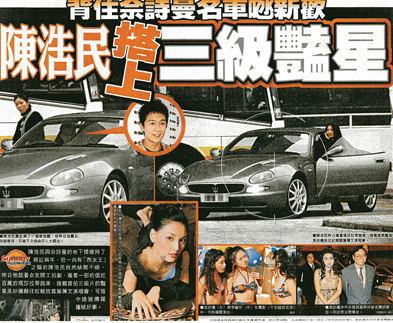
Apple Daily mistook a man in a car for actor Chan Ho Man and said he behaved intimately with a Category III actress. (Courtesy of Next Media Corporation )
By Fung Ying
Flip through some of the Chinese press and chances are you will see dramas and romances of celebrities splashed on their pages for all to read.
This paparazzi style of news reporting is affecting the quality of journalism.
“The rise of paparazzi probably leads to a decline in quality reports,” said Bono Lau, who has over 20 years of experience as an entertainment reporter and editor.
He has worked in many newsrooms, including Apple Daily and Oriental Daily, and now owns a production company.
“Next Magazine was the first magazine to have paparazzi, in 1994,” Mr. Lau said.
Paparazzi is a derogatory term for photographers who stalk celebrities to obtain photographs.
Mr. Lau commented, “Paparazzi cannot be classified as reporters. They record a celebrity’s life rather than report news.”
They come in all shapes and sizes. Mr. Lau said a news organization once hired some middle-aged taxi drivers as paparazzi to fool the celebrities.
He said, “They go to Happy Valley or Lan Kwai Fong at night and gather footage of celebrities there using a digital video camera. That’s all they have to do.
“Some paparazzi can earn an initial monthly salary of $10,000, while entertainment reporters who have worked for 2 or 3 years cannot command the same pay.”
Today, the basic salary of an entertainment reporter who has completed secondary school is about $5,000. University graduates get an extra $1,000 to $2,000.
Mr. Lau said, “The salary is low and the working hours are long.
“Because of the low salary, fewer intelligent people want to be entertainment reporters. This has become a vicious cycle.”
As a result, paparazzi reporting is becoming a mainstay of entertainment reporting in Hong Kong.
Back in Mr. Lau’s days, entertainment reporting was of a different caliber. The reporters were well treated and often traveled overseas on assignments.
He recalled, “We were usually given some red-pocket money after interviews.
“Entertainment reporters were well paid, and we seldom had to pay for meals.”
These days, the lower pay of entertainment reporters, combined with an increased dependence on technology, has affected the quality of entertainment reporters.
Mr. Lau said that some are not even able to write.
“Some reporters don’t have very good Chinese skills and some don’t even know how to write good articles,” he remarked.
He feels that the quality of news has declined.
“Back in those days, reporters wrote news stories and editors checked the stories at least once. Thus, there were fewer mistakes.
“Now, reporters can report news by phone, email or fax. Sometimes, they don’t even need to write any stories, and information often gets distorted.
“Some magazines even make up stories that are not true, thus threatening the credibility of the media.”
In March this year, Apple Daily ran a half-page picture of a man in a car with a Category III actress.
The newspaper claimed that the man in the picture was actor Chan Ho Man and that he had behaved intimately with the actress.
The next day, Mr. Chan faxed a statement to Apple Daily saying it was impossible that the man in the picture was he, because he was in Taiwan at that time.
He also faxed documents proving he was not in the country and demanded an apology.
A week after the incident, Apple Daily printed a short apology.
Besides inaccurate news, Mr. Lau feels that a lack of good reporters leads to conflicts between artists and entertainment reporters, said Mr. Lau.
“The reporters usually ask very sensitive questions which irritate actors.
“If they were better educated, they would be able to phrase their questions better,” Mr. Lau says.
There are few constraints to being an entertainment reporter in Hong Kong, said Mr. Lau.
“In Hong Kong, if you ask daring questions, you can write any story you like about show business.”
But, he emphasized that any reporter should know what is news and what is not. The same goes for entertainment reporting.