Periscope
Elite corps' power drops
"When I joined the AO, I wanted to make a difference, see what I could do to help with the development of Hong Kong, do research and see what ideas I could put through. In a sense, that's what an AO does in the government. However, overall it's not what I have expected," Mr Wong said.
As a junior administrative officer, he had to do a lot of paperwork to "help formulate, promote, justify and sell" what the principal officials suggested, he said.
He said he often spent days to prepare a stack of documents for just one-off use. "The Legco (Legislative Council) raises many questions every week...The secretary of the bureau will have to answer them, and you will be asked to prepare answers for that," he said.
"The situation has changed. Everything has been politicised," said Mr Wong, who now works as the community development director at a think tank headed by Regina Ip Lau Suk-yee, the former secretary for security who resigned in 2003 over public opposition to the government's proposed national security law.
No longer in top charge
Before the introduction of politically
appointed ministers five years ago, it was
the administrative elite who dominated the
initiation of policies and could be promoted
to the top jobs under the old civil service
ladder.
The highest positions of administrative
officers are now limited to that of
permanent secretaries, who are under the
ruling tier of politically accountable
ministers.
Yet, analysts say administrative officers remain playing a significant role in policy making. They say the ministers still need the support of the administrative corps.
John Burns, chair professor of politics and administration at the University of Hong Kong, said: "Most of the principal officials came as an undisciplined group who lacked public support and government working experience. They need the administrative officers to educate them on key issues, evaluate political feasibility and help them to promote policies."
"I am not saying that administrative officers are much more powerful than before but they have to share this power now," the professor said.
The ministerial system has, to some extent, diminished the administrative officers' policy-making power and career prospects, he said.
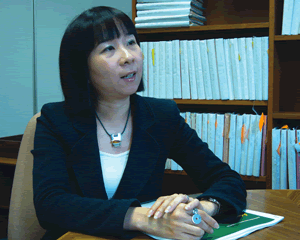
"Administrative officers are facing a
constant problem of manpower
shortage." Winnie Ng Ching-ching,
principal assistant secretary
for the civil service

"In organisation structure, we
have one more box to report to.
That's the difference."
Raymond Young Lap-mun,
director of Celebrations Preparatory Office

John Burns says the administrative officers remain
playing a significant role in policy making.