According to the spokeswoman of the Public Relations Department in
Po Leung Kuk, who declined to reveal her name, two kinds of sponsorship are available for
interested parties to choose.
One is to donate money for the general children's welfare business.
The other is to have one child assigned to each sponsor through the donation. In the latter
kind of sponsorship, the sponsors can apply to visit the children.
Miss Ace Hung, a year one biochemistry student in the Hong Kong
University of Science and Technology, is one of those sponsors.
Ace is now sponsoring a 3-year-old boy in Hong Kong through Po Leung
Kuk.
Said Ace: "Just donating money to provide them with food and
accommodation is only part of the sponsorship, which by itself is obviously inadequate for
the children's balanced development."
In view of this, Ace voluntarily visits the child weekly or biweekly,
in addition to donating $900 each year.
While Ace chooses to sponsor those children in Hong Kong, some people
would like to help those living thousand miles away.
"The living standard of Hong Kong is of a reasonable level. But in
some countries, food and housing are in immediate demand," said Miss Joyce Chan, a year
one medicine student in the Chinese University of Hong Kong.
However, Joyce can feel that a barrier exists between the sponsored
children and her.
"Communication is restricted due to the inefficient mailing
systems in those backward countries. Correspondence can only be made every three months,"
said Joyce.
Another obstacle is the language barrier.
Said she: "That was a time my meaning was twisted by the translator
in the organization, making the child and me very frustrated."
No matter how discouraging the communication might be, Joyce thinks
that it is meaningful to spare $200 a month for the needy children.
However, not every case leaves the sponsor with pleasure. On the
contrary, some children would behave in ways that trouble the sponsors.
Said Joyce: "One of my sponsored children in Ethiopia continued
writing me letters after the sponsorship was discontinued by the organization."
According to World Vision, sponsorship would be terminated if the
child can be self-reliant.
The case turned out to be somewhat like blackmail because that child,
being classified as self-sufficient, kept asking Joyce for financial support directly.
Said Joyce: "He claimed that he could not find a job. But there
was no evidence to prove this. I can't help thinking that every letter sent previously was part
of his plot."
Joyce did not reply to the child and no letter was sent afterward.
She was simply upset and felt cheated.
Mr. George Lui, a 48-year-old businessman who owns a factory in Mainland
China, started sponsoring children in a remote area of the Hu Nan province two years ago.
Mr. Lui felt that it was his obligation to donate money to grant them
chances to study.
However, Mr. Lui tries to prevent himself from becoming involved in
the matter deeply.
Explained he:"I have to shoulder certain social responsibilities
and family burdens. This makes me unable to devote time and attention to the sponsorship.
"What I can contribute is money, roughly $4000 a year. As long as
it doesn't alter my own lifestyle, I'm willing to provide help."
Mr. Lui admitted that his effort is very limited."I just want to
play my part. And I hope the literate children can in turn help others some day when they've
grown up."
May 1999
Reach out the Helping Hands
By Tom Ho
Some local and worldwide charity groups have done much to help children
living in poverty. Po Leung Kuk is one of the organizations in Hong Kong which organizes
sponsorship schemes to help homeless children.  She is now supporting her third child in the Third World via World
Vision Hong Kong.
She is now supporting her third child in the Third World via World
Vision Hong Kong. 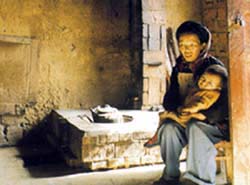 Not everyone can afford to contribute in non-monetary means. To some
sponsors, money is all that they could contribute.
Not everyone can afford to contribute in non-monetary means. To some
sponsors, money is all that they could contribute.
More about Child Sponsorship
World Vision Child Sponsorship