February 1999 Dilemma between studying and organizing activitiesClashing RolesBy Wong Po Kwan
All-round education is the policy of many educational organizations.
University students are encouraged to develop their skills in communication and leadership
in addition to pursuing technical knowledge.
Yet, the students may feel bothered as there are conflicts between
studying and organizing activities. Such distress is especially common among the
executives of large organizations like the student unions.
In November 1998, three union executives of
the Hong Kong Baptist University
were advised by the Student Affairs Office to quit their jobs in the
union because of their unsatisfactory academic results.
According to the Manual for student activities of Baptist
University, any student who wishes to be elected executive members of student organizations
should have a cumulative overall Grade Point Average of 2.00 or above.
All student unions jointly responded to this matter, criticizing
the Student Affairs Office of the Hong Kong Baptist University for interfering in the
internal policy of the Union.
Consequently, the president and the external vice-president
remained in their seats. This was regarded as a success of the firmness of the union.
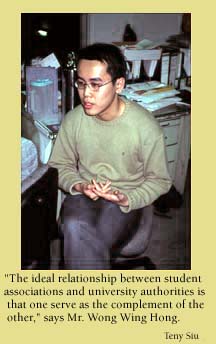
Mr. Wong Wing Hong, the external vice-president of the Student
Union of the Hong Kong Baptist University, admitted that his academic result was not
very satisfactory.
"Yet it is due to personal reasons. I do not have great interest
in my major subjects so I could not grasp their main ideas.
"I will spend more time focusing on my studies," he said.
It is a common belief that the workloads of the union executives
are so heavy that they have difficulty handling their studies. It is not uncommon
for union executives to extend their studies for a year to concentrate on organizing
activities.
It is agreed by Mr. Danny Tsui, the external vice-president
of the Student Union of
University of Hong Kong: "The workload is really great.
I have to deal with all external matters of the union like meeting with other
university unions, the Hong Kong Federation of Students, and announcing the
standpoints on behalf of students on major issues such as the Baptist University incident."
However, he thought that there was no direct correlation between
study and school activities.
"Running a student union or organizing activities can stimulate
students to rethink their social roles. It is part of university education." he said.
Ms Bonnie Tsang, the internal vice-president of Student Union of
Hong Kong Baptist University thought that it was a matter of time management.
"I may sacrifice some time for leisure or accompanying my family
if I were not a student union executive. Total studying time would be more or less the
same," said she.
"The ideal relationship between student associations and
university authorities is that one serve as the complement of the other," says
Mr. Wong Wing Hong.
Said he: "Students have the right to choose what they want to
pursue. They can participate in organizations, doing part time jobs or having love
affairs. They should not be restrained by regulations or guidelines."
Mr. Ng thought that dedication is the most important criterion
for organizing activities.
"The committee members should have a picture of what an ideal
university or an ideal society is. They should keep track of social issues and have critical
minds," he emphasized.
Mr. Ng agreed that the union served as a pressure group on the
campus and had the freedom to criticize the policy of university authorities. However,
he emphasized that the relationship between the Office of Student Affairs and the Student
Union was parallel.
"Also, all members may cast their votes in the General Meeting
and General Polling before resolutions in major issues such as union election," said he.
Mr. Tsui from the University of Hong Kong believed that a
student union should be independent of university authorities in order to gain
flexibility and complete sovereignty.
Said he: "The independence of a student union has been discussed
for many years. We are not fighting only for the independence of the Student Union,
but for all student organizations and interest clubs. We hope we can change the whole
atmosphere of the campus."
Ms Tsang and Mr. Wong, executives of the Student Union of the
Baptist University, had reservations about the idea of independence of student unions.
"Many technical problems will emerge because it involves the
change of the whole organizational structure. Besides many unexpected things will
happen," Ms Tsang said.
Mr. Wong indicated that the most crucial and fundamental
thing they were fighting for was the improvement in attitude of the Office of Student
Affairs toward student organizations.
"The ideal relationship between student associations and
university authorities is that one serves as the complement of another, each with
discrete responsibility," said he.
Mr. Ng from the Hong Kong University concluded: "The most
appropriate relationship is that we can monitor and criticize the authorities and
vice versa, with a cooperative and respectful attitude."
By Teny Siu
Joining student activities is commonly regard as a good training
for university students. However, not many students are enthusiastic about participating in
student movements.
"Compared with the 1970s, student movements in the 1990s are at
their lowest point," said Fung Kin Fai, the former central representative and the present
executive director of the Hong Kong Federation of Students.
Over a thousand students attended the Annual meeting of
the Federation in the old days. Only 50 to 60 attended in recent years, however," he said.
Mr. Fung attributed this to the changing economic and political
environment in Hong Kong.
"The school fee doubled and doubled in these twenty years.
Students are busy doing part-time jobs," he said.
"They don’t even have time left for joining activities in the
school, not to mention joining the social movement."
Mr. Danny Tsui, external vice-president of the Student Union of
the University of Hong Kong thought that the downturn was related to the changing
social atmosphere.
Said he: "Before the early 80s, the economy was still
underdeveloped and the society was volatile. There was a confidence crisis as Hong Kong
was going to reunite with China. Students then had higher social awareness and were
more concerned about the future of Hong Kong.
"Campaigns on protecting Chinese sovereignty over the Diaoyu
Island and the Thachter Letter Incident in 1983 were good examples.
"The situation has changed now as students are rather
affluent and individualistic. They lack concern about China, the Chinese and political
matters."
To Mr. Tsui, student movements have a special function.
"Through the student movement, we want to send a message to the
media and affect different classes of the society. We want to encourage the students to
be concerned about the policies of the universities and participate in student
activities," said Mr. Tsui.
Both Mr. Fung and Mr. Tsui admitted that it was hard to boost
student movements at this moment. Yet, they thought they could do something.
Said Mr. Fung: "Before the clock ticks, preliminary work such
as holding discussion forums, meetings and lobbying students have to be done.
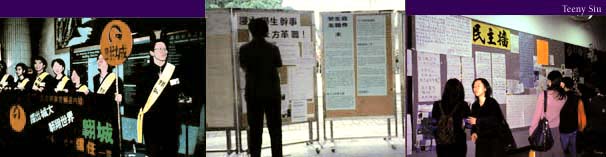
"And student unions should post newspaper cuttings, along with
articles on current affairs written by the student representatives, on the graffiti. That
will help students know more about current issues."
In 1983, one year before the signing of the Joint Declaration, the Current Affairs Committee
of HKU issued a letter to Margaret Thatcher, the British Prime Minister at that time, asking
for the democratic reunion of Hong Kong with China.
The letter was banned by the Students Affair Office, and over 1000 students participated in
an assembly concerning the matter.
No further student activities in the Hong Kong University can compare with the scale of
that incident.
|