









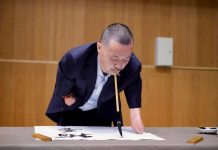












Armless Chinese calligrapher Zhang Wenyou shares his journey with his brushes.
By Fami Nguyen
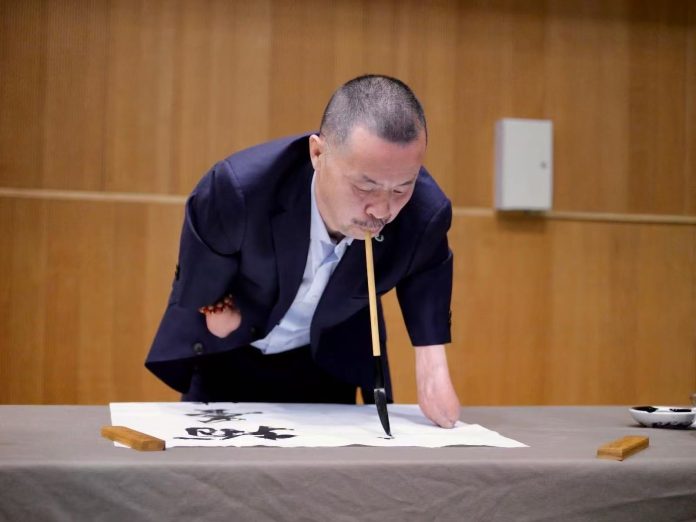
Using his mouth to hold the brush, armless Chinese calligrapher Zhang Wenyou devotes himself to copying scriptures and promoting Buddhism in Cheng Tian Chan Temple in Quanzhou, Fujian. He sees calligraphy not only as an art but also as a method of spiritual cultivation.
He believes that “Calligraphy is the heart’s expression, so all the strokes are from the heart.”
“When you write, the mind gradually focuses, worldly burdens fade away, and you naturally enter a state of joy.”
Zhang regards transcribing Buddhist sutras not as a task but as a spiritual practice.
Daily calligraphy practice at Cheng Tian Temple, Quanzhou. (Photo courtesy of Zhang Wenyou)
“If my mind is disturbed by other thoughts while writing, I will miss characters. The sutra will be incomplete if a single character is missing. Future readers could misunderstand the meaning. That is why, after finishing each volume, I proofread every character. If even one is missing, the entire volume has to be rewritten,” Zhang says.
His works have been exhibited in several national exhibitions, including in the First National Youth Calligraphy and Seal Cutting Exhibition, the First National Album Calligraphy Exhibition, and the Sixth Newcomers and New Works Exhibition of the Chinese Calligraphy Circle.
Building on his exhibition experience in mainland China, the calligrapher held his first solo exhibition in Hong Kong last year, titled 2025 Heart – Zhang Wenyou Calligraphy Exhibition, at S.H. Ho College, The Chinese University of Hong Kong.
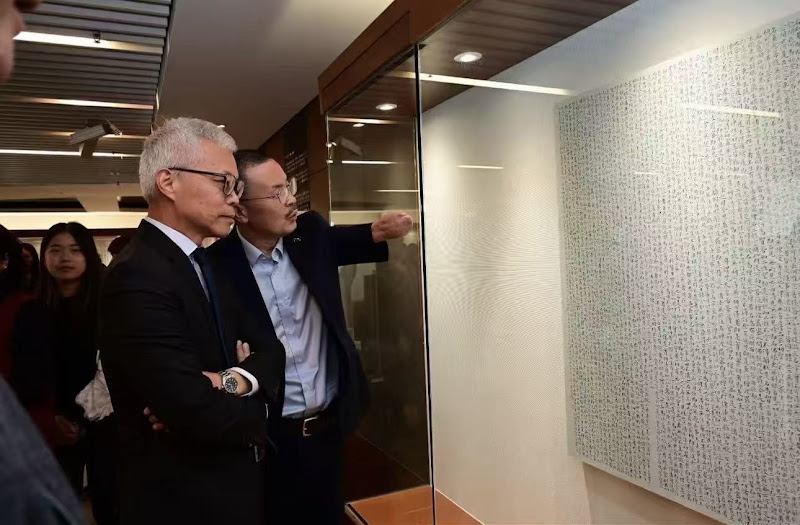
Zhang Wenyou held his first Hong Kong solo exhibition, “Heart”, which opened on 18 February 2025 at S.H. Ho College, The Chinese University of Hong Kong.(Photo courtesy of S.H.H.O College, CUHK)
The 56-years-old artist began his journey with calligraphy at a young age, which brings hopes to the unexpected accident.
At the age of four, Zhang lost his arms due to an electrical surge when he climbed onto an unguarded electrical substation.
In a 1970s farming village, losing both hands meant losing the ability to labour.
“My parents went through a long period of pain and struggle. They could not see any future for me,” he recalls.
The idea of learning calligraphy came when Zhang realized calligraphy could be both an art and a means of livelihood.
This realization came as he watched villagers ask calligraphers to write Spring Festival couplets, which are auspicious phrases written in black or golden ink on red paper to express the new year. Zhang realized calligraphy could be both an art and a means of livelihood.
Zhang practiced calligraphy on his own without any formal instruction until he was 12, when he met Geng Chunlin, then chairman of the local Calligraphers Association.
Geng taught him to pursue the Wei and Jin dynasties’ style, particularly the works of Wang Xizhi and his son Wang Xianzhi, laying a solid foundation in classical calligraphy.
It took Zhang two years to master controlling the brush with his mouth.
“The teeth anchor a brush, but they must not clamp down too tightly. Or else my body stiffens up and affects the fluidity of each stroke I write,”
“Saliva is another obstacle. At first, it tends to flow uncontrollably. But my mouth’s sensitivity has gradually decreased. Once that issue is resolved, writing becomes feasible,”
“There were times I wanted to give up. But if I did give up, I would be giving up on life itself rather than just a skill. It was not just about giving up a skill,” he recalls.
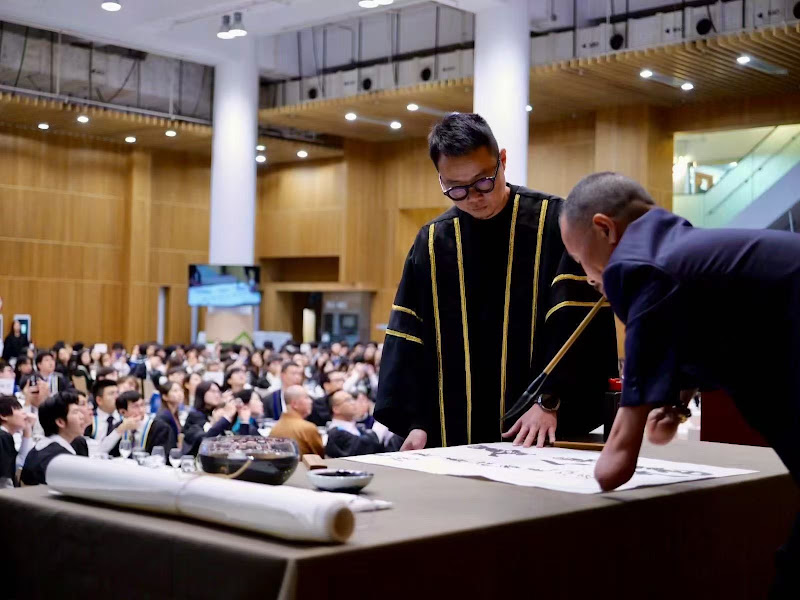
Zhang writes a piece for S.H. Ho College at the High Table Dinner.(Photo courtesy of S.H.H.O College, CUHK)
Losing his parents when Zhang was 17 became the driving force for him to leave his hometown and travel across China in search of opportunities.
“The biggest challenge was survival. Very few people bought my work. Eating wind and sleeping in the dew was commonplace. But I still held firm to my beliefs and ideals,” Zhang said.
After years of dedication to calligraphy , his works have been exhibited both nationally and globally.
In 1997, the 27-year-old Zhang accepted an invitation from the abbot of Zhenru Temple to transcribe the 500-meter-long Lotus Sutra, one of the most influential and revered Buddhist scriptures, in small print, using gold ink.
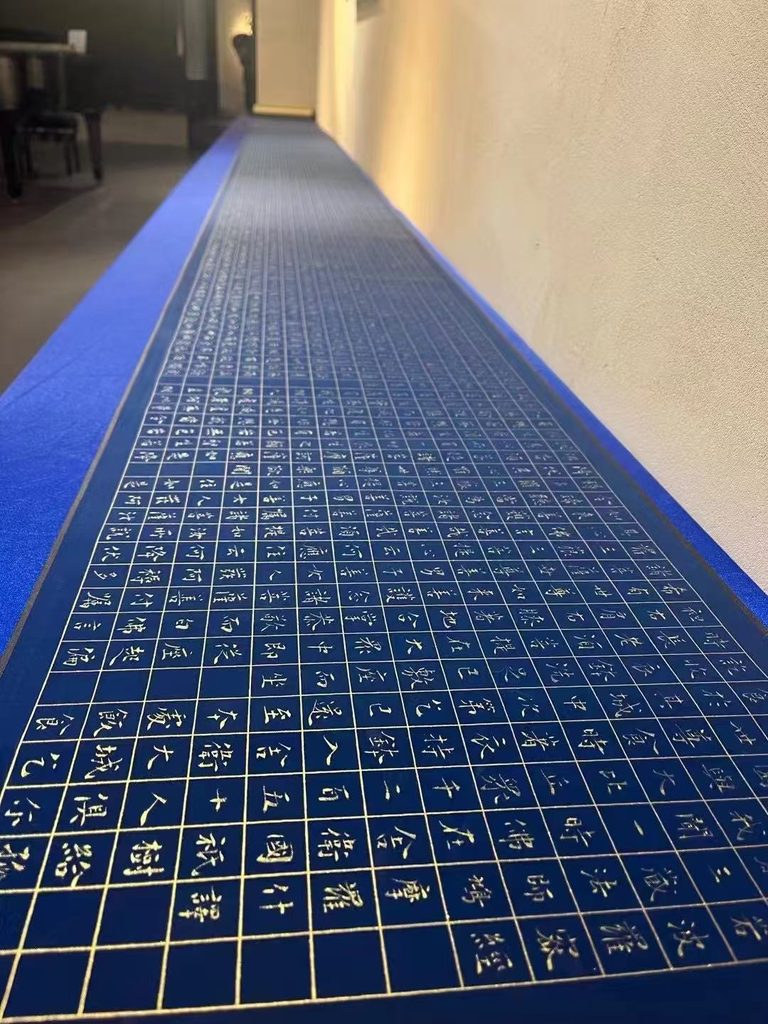
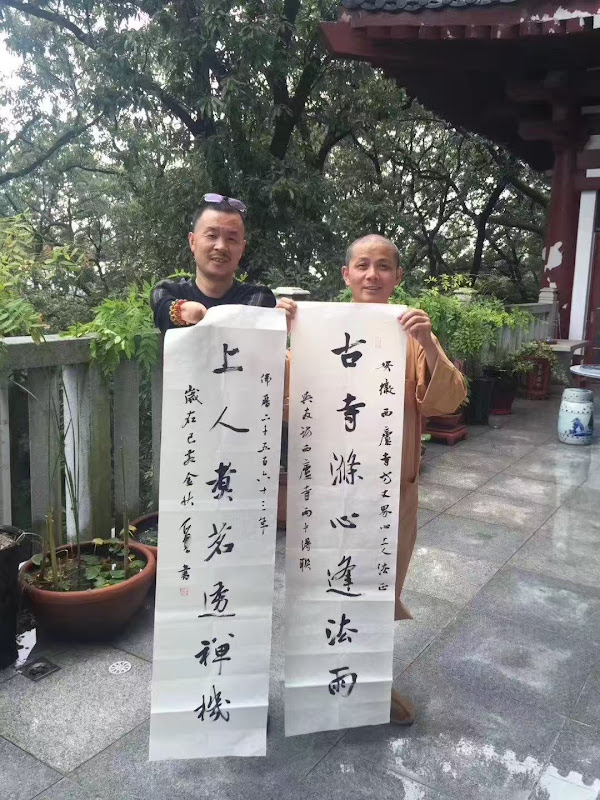
Zhang’s sutra calligraphy. (Photo courtesy of Zhang Wenyou)
“If I write too quickly with the gold powder, it won’t adhere well. If I write too slowly, the strokes will lose their fluidity and become rough. I have to find the perfect balance,” the calligrapher shares.
In 2000, while residing at Zhenru Temple, Zhang was invited by Professor Zhang Zhenshan from the College of Architecture and Urban Planning at Tongji University, to inscribe “Peach Blossom Spring” on a stone in the traditional Chinese garden called “Qian Yuan” on the campus of Ruhr University in Germany.
“Through those exchanges, I came to understand that art knows no borders, and the capacity of the human heart has no limit, ”
“Only by embracing diverse cultures can I truly elevate my art, ” Zhang says.
For aspiring calligraphers, Zhang advises starting by imitating classic works of ancient masters to lay a solid foundation before developing one’s own style.
“The pinnacle of calligraphy is not imitating the ancients, nor is it creating one’s own unique style, but rather possessing both and not being both. Just like proverbs and idioms, initially it is the experience of one person, then the experience of generations of ancestors, and finally the experience of generations of descendants,”
“When there is no longer a distinction between oneself and the ancients, only then can calligraphy truly flourish,” Zhang adds.
Edited by Suzana Li
Sub-edited by Kathy Yee