
















Home Blog Page 2

Seeing Myanmar Beyond the Scams

Chinese travellers are returning to Myanmar despite the country’s online reputation as a “paradise for scam syndicates”.

By Zhengyang Zhou

When Jin Zexuan, an automotive marketer from Shanghai, tells his colleagues he is travelling to Myanmar, they respond, “You’re gonna be taken to a scam centre as soon as you land, and I will not believe a word you message me.”

On December 21, 2025, Jin flew to Yangon for a 10-day visit. It was one of several unconventional destinations he had travelled to, including Bangladesh, Cambodia and Iran.

On Chinese social media, however, Myanmar is often associated almost entirely with scam syndicates. The country is widely seen as a “paradise for scam syndicates”. According to estimates from the International Criminal Police Organization, hundreds of thousands of people have fallen victim to human trafficking and ended up in scam centres.

One high-profile case surfaced in January 2025, when Chinese actor Wang Xing was captured by a scam syndicate in Myawaddy, Myanmar, after being lured to Bangkok for a fake acting job. 

But Jin is still determined to go after reading RedNote posts saying cities in central and Southern Myanmar cities, such as Yangon, Bagan, and Mandalay are relatively safe for travellers. These cities are controlled by Myanmar’s junta government, a military force that overthrew the country’s democratically elected government. Northern Myanmar, by contrast, is associated with scam hubs and collusion with ethnic insurgents.

While travellers are unlikely to be taken to scam centres when visiting the southern major cities, daily life has been shaped by the turmoil that follows the civil war beginning in 2021. Yangon has been under curfew until last December, when the military government set out to “improve economic, social and religious matters” before elections. Foreign visitors cannot buy local SIM cards before arrival, and the gap between the official exchange rate and the black-market rate can be as high as twofold. 

But this is not too much of a problem for Jin after looking through travel advice on RedNote. After landing, Jin takes a cab straight from the airport to Grandma’s House (WAI PO JIA), a restaurant opened by a middle-aged Chinese man in Yangon’s Chinatown, to exchange money at a black-market rate and buy SIM cards.

His first impression of Yangon is that it is more modern than he had imagined. “The road from the airport to the city was quite fancy, but the driver told me it was built to impress foreign officials,” Jin says. “But all other roads in Yangon are quite rundown. Colonial buildings are falling apart. The walls were peeling.”

“You can see the raw vitality there, which cannot be found in touristy cities like Bangkok,” he adds. 

On the last day of his trip, he met a group of underground music artists in Yangon through social media. They ended up hanging out and talking until late at night. According to Jin, the group found a way to channel their creativity and artistic expression under curfew, using karaoke venues as live music spaces.

“You can engage in genuine conversations with people and see that they are fighting for self-expression under oppression. Whereas many tourist cities feel like a big marketing scheme trying to sell you the exact same thing,” Jin says.

Jin is not alone. Searching “Myanmar Travel” on RedNote, one can find many posts sharing travel experiences and tips. Many of them debunk the irrational fear toward Myanmar, stating cities like Yangon, Bagan, and Mandalay are safe and praising Myanmar’s rich tourism resources and its kind local people.

Screen cap from RedNote of people sharing travel experiences in Myanmar.

Tian Zenghui, a 33-year-old restaurant owner from Beijing, shares Jin’s adventurous spirit.  She has visited North Korea, Cambodia and Laos and prefers distinctive cultural landscapes to shopping and city lights. Last November, she visited Yangon and Bagan for 11 days.  

Tian is interested in Buddhism and traditional architecture. Bagan, a UNESCO World Heritage Site, has long been on her travel list.

“I found it fascinating that those ancient temples didn’t just turn into pure tourist attractions like Angkor Wat in Cambodia. People still go there to worship after more than 1,000 years,” Tian says.

She says Myanmar has retained much of its cultural distinctiveness. In the streets, she sees many people wearing longyi and htamein, the traditional Burmese wraparound garments worn by men and women.

“People in Myanmar are very peaceful. Every morning, I saw the receptionist at my hotel reading Buddhist mantras,” she says.

People praying in front of a Buddha in Bagan. (Photo courtesy of Tian Zenghui)

Transportation between cities, however, is one of Tian’s frustrations. “The bus that travels between Yangon and Bagan takes ten hours, which is very uncomfortable, but on the other hand, flights are infrequent and expensive,” Tian says.

News about people being lured into scam compounds does not alarm her as much as it does many people online. She says she has been following news about Myanmar and has spoken with locals to understand its political situation.  

“I knew some Burmese students back in college, and they told me Northern Myanmar had been in active conflict for years. It is quite different from junta-controlled areas,” Tian says.

Kevin Yong, a Malaysian-Chinese owner of a hostel in Yangon that opened in 2019, has lived in Myanmar for around 10 years. He says the scam operations feel quite far away from his daily life.

“I learned about it on the news like everyone else. It’s pretty far away from our daily life and northern Myanmar almost feels like another country. Since the junta took power, northern Myanmar has become much harder to access, and you can’t really travel there now,” Yong says.

Yong says his hostel enjoyed strong business shortly after opening and attracts guests from around the world. At times, it was completely full. Then Covid-19 broke out in 2020, and all international commercial flights landing in Myanmar were suspended.

After the pandemic, tourism began to recover globally, but Yong says this did not happen in Myanmar because of political and economic instability that followed the 2021 military coup.

“We were still holding on when Covid-19 hit because business was really good in the months before. But then in 2021 the junta took over, and everything kept going downhill,” he says. 

The civil war, which broke out shortly after the military seized power, had killed over 6,000 civilians by early 2025, according to the Assistance Association for Political Prisoners. It has left Myanmar in deep political and economic turmoil to this day.

Basic utilities such as electricity and water also have become unreliable. “Sometimes the water would be cut off without notice. We are in the hospitality business…we can’t just tell our guests they can’t shower,” Yong says. 

During the country’s democratic transition in the 2010s, tourism grew rapidly and reached 4.7 million tourists in 2015, according to the World Bank. The number then dropped to 0.9 million in 2020 following the pandemic.

Yong says his hostel now receives fewer than a third of the guests it did in 2019. He also has begun to notice signs of burnout in himself and has decided to step back, leaving day-to-day operations to his business partner.

“It’s a survival game now. We are just waiting to see if things will get better.”

Specializing in Myanmar studies, Professor Zhong Xiaoxin at Yunnan University sees the “Myanmar phobia” on Chinese social media as a result of “information asymmetry”.

“People weren’t paying attention to Myanmar for a very long time, and when news about scam centres came up, it became over-dramatised,” Zhong says, “because what people say on social media goes for virality instead of reality.”

Having done extensive field work in Myanmar for a total of 30 months, Zhong keeps in touch with many locals, including one who previously worked at a scam centre in Myawaddy.

The professor says the scam centres in northern Myanmar emerged around 2015. At that time, the syndicates do not have to worry about labour shortages due to considerable revenue. After borders close in 2020, they begin to struggle to find enough people, “so they wouldn’t let people go so easily”.

“Some claims are clearly exaggerated. For example, organ trafficking is highly unlikely in those scam centres because it requires advanced technology,” Zhong says.

For Zhong, Myanmar’s image on the internet is a perfect example of an echo chamber. People who think Myanmar is extremely dangerous and people who actually travel to Myanmar are exposed to very different information, and “the chambers don’t communicate”. 

“It makes views polarised”, Zhong says, “even if someone actually saw videos shot on the streets of Yangon saying it’s safe, they would probably be gonna say ‘Are you trying to trick me into going there?’”

For travellers who have already decided to visit Myanmar, “setting aside the stereotypes about Myanmar and getting a real taste of what Myanmar is like,” Zhong suggests.

Edited by Isa He

Sub-edited by Jennifer Liu

The cost of efficiency: Vietnam’s administrative reform

Local population and business declined after Vietnam’s provincial merger in 2025.

By May Chan

Civil servant Tuyen Hung had built a stable life in Vinh Phuc, a province 63 km away from Hanoi in northern Vietnam. She is now being deployed to a new city which is 40 km away from her home, as the central government is redrawing the national map by merging provinces. 

Tuyen has lived in Vinh Phuc with her husband and two children for years. Her husband was a teacher while the children all went to nearby schools. 

“I never expected to start all over again in a new city. Now, my husband needs a new job while the children have to switch schools,” the mother says. 

In June 2025, Vietnam launched a historic administrative reform that reduced its 63 provinces to 34. The move aims to cut government positions from 420,000 to 290,000 to fight corruption among local authorities. The new measure is expected to save VND 190,500 billion (US $7.3 billion) for the national economy, according to the Vietnamese government. 

Following the reform, the former Vinh Phuc province was merged into the new Phu Tho province. The administrative capital has now shifted from Vinh Yen, a city located in the heart of Vinh Phuc, to a citywhich is 40km away —Viet Tri. More than 2,200 civil servants and their families are being relocated to the new capital, including Tuyen’s family.  

When Tuyen returns home to collect her belongings, she finds the town has changed. “The main streets, where many shops and markets are located, used to be jammed with commuters and shoppers every day. Now they are almost empty,” the 39-year-old woman says.

Vinh Yen before and after reform in 2025, the main streets are almost empty.

Tuyen points out that many residents are thinking about their future, especially the young who are looking for entertainment and job opportunities. 

“A smaller population means a decline in business, such as restaurants or entertainment. Public resources for education, social service and facilities might be cut down,” she says. 

“Even the weekly musical show in our city square, which had been going on for six years, was cancelled. Young people don’t want to stay in a declining town,” Tuyen adds. 

According to government statistics, with a population of 1,221,803, Vinh Phuc’s net migration rate fell to -1.7 per cent in 2024. 

As people move away, local businesses are feeling the pain.

Nguyen Ha Anh, who has run a barber shop in Vinh Yen for 12 years, says her profits have dropped by 50% since the merger began in June 2025.

Her shop is situated near several government offices, and about 70% of her clients are public servants. Regular customers visited her shop every one or two weeks and they knew each other quite well. Some even used to visit daily for a hair wash.

“But around August 2025, they started dropping by to say goodbye. It is sad to see them go, and I also feel worried about how to run my business in the future,” the shop owner says. 

Ha Anh’s barber shop on Sunday. There was only one customer at the time.

To cut costs, Nguyen had to let go of her only assistant.

“Other shops also have suffered losses. I’m lucky that my shop has a convenient location. The situation is even worse for those in quieter areas,” she says.  

Nguyen observes throughout Vinh Phuc, “For Rent” signs have become a common sight.

In a less populated neighbourhood, grocery store owner Jane* closed her two-decade-old business four months after the merger was announced.

“After the reform was rolled out, many have left my neighbourhood. By October 2025, I only had five to 10 customers a day,” Jane recalls. 

Now she is looking for a new job. “My brother in Viet Tri can secure me a job there, but I’m not ready to leave. I was born here,” she says. 

“Finding a job in Vinh Phuc will be hard, though, with businesses closing and little demand for workers of my age,” the 43-year-old woman adds.

Throughout Vinh Yen, “For Rent” signs have become a common sight.

Nguyen*, a Vietnamese political journalist, says turning the area into an industrial development might be the long-term solution to revive the affected community.

She notes that major investors such as Honda, Toyota, and Piaggio are already operating here, with more than 480 foreign-invested projects.

The new Phu Tho leaders aim to leverage this, Nguyen observes. In June 2025, they proposed a development plan positioning the former Vinh Phuc region as an industrial hub. This strategy is expected to attract more industrial investors to the area, with China’s Songshan Lake Group already proposing a VND 62 trillion (US $2.4 billion) high-tech industrial park. 

“If more industrial sites are developed, they will provide jobs to retain local residents and may even attract newcomers seeking opportunity,” Nguyen says. 

Professor Song Ruifeng of the General Education China Programme from The Chinese University of Hong Kong points out that the reform highlights the complex reality of a nation-scale policy. 

“All such decisions are trade-offs. Vietnam’s actions must have been based on a sophisticated calculus, and there will certainly be benefits. The remaining issue is whether the losses of those affected will be sufficiently compensated,” Song says, adding that it is not only about financial compensation, but also about whether new opportunities will be available.

“Crises may be opportunities for innovation if they bring reflections and transformations. For the country, local communities should also be seen as a priority for real growth,” Song adds. 

*Name changed at the request of interviewee

Edited by Jennifer Liu

Sub-edited by Christine Ge

A Neighbour’s View: Panamanian Perspective on US Invasion of Venezuela

In light of US invasion of Venezuela, Panamanian students offer insight in a South American context.

By Eileen Chen, Nova Linh Tran & Irina Zhang

Since the U.S. launched an invasion in Venezuela in January, South Americans have been observing the development in Venezuela carefully. People in Panama, one of Venezuela’s neighbouring countries, which restored consular services in Venezuela last June, have been closely monitoring the situation. 

Daniel Harari, a Panamanian student, closely follows the political shifts in neighboring Venezuela.  “I believe that in Venezuela’s case, there was no other way,” Harari shares. 

He notes that despite mass protests years ago, the people were unable to unseat the government due to “rigged elections”. Consequently, the involvement of external forces—specifically from the United States—is viewed by many in his circle not as an unwelcome intrusion, but as a vital catalyst for liberation. 

“I don’t necessarily watch traditional news channels but listen to the direct lived experiences of my friends.” Harari says he often bypasses mainstream news channels in favor of speaking with people “closer to the action,” as he remains skeptical of the surface-level narratives presented by many media outlets. 

These personal connections have shaped a perspective on regional stability that leans toward optimism despite historical complexities. “I’m involved and very aware of everything that’s happening,” Harari shares, noting that his primary information comes from sources he has known his whole life and trusts as reliable. 

“I believe what’s happening is a very good thing. I felt happy for my Venezuelan friends, because they were very happy as the old regime is being brought down,” he says, adding that he does not fear further escalation. 

Harari views the removal of the previous dictatorship as a gateway to regional prosperity rather than a violation of sovereignty. Many of his friends who fled the violence and corruption of the old regime are now preparing to return. “They’re happy they can return to a country with no violence, no corruption, and business opportunities,” he adds, noting that there is “no suppression at all” felt from the current transition. 

This optimism is rooted in the practical benefits of a stable Venezuela for the rest of Central America. Panama’s proximity—just a short flight from Colombia and the South American markets—makes Venezuela a prime location for future investment. 

“Hopefully, when Venezuela recovers, it will impact my daily life in a good way. I wish to do business there, as there is a large population, which means a lot of money and opportunities to enter a new market that I couldn’t before because of all the corruption in Venezuela. But now that the corruption is gone, there’s a huge upside of opportunities opening up,” Harari says, eyeing future entrepreneurial ventures. 

Alberto Cohen, a Panamanian exchange student at the Chinese University of Hong Kong, shares a similar sentiment of happiness and relief for the invasion, “It was about time… it was a long time coming,” describing the capture of Nicolás Maduro after years of dictatorship.

“Venezuelans have been fighting for years for this. It was something they could not imagine happening.”

He describes the U.S. intervention in Venezuela as widely supported among people he knows, arguing that prolonged political repression left few alternatives. 

While acknowledging concerns over legality and geopolitical interests, he maintains that many in the region prioritise outcomes over process, especially given what he sees as the failure of international organisations to act.

“It was not the most legal way…but it was the only way,” he says, adding that there was “zero chance” of change without external force.

At the same time, he frames his views through Panama’s own experience of U.S. intervention in 1989. He notes that the invasion left lasting trauma, but argues that it ultimately contributed to the country’s long-term stability and development.

The U.S. intervention of Panama aimed to dethrone Panama’s then ruler, who was wanted by U.S. authorities for drug trafficking. Over 500 Panamanians were killed during the invasion, including 202 civilians.

“In Panama, it was different as there were civilian casualties, and people still talk about that,” he says. “But over time, the country stabilised and rebuilt itself, and I believe the same will happen with Venezuela.”

This comparison shapes his broader perspective on foreign intervention, which he sees as controversial but, in certain contexts, necessary. 

Cohen suggests that experiences in Latin America inform a more pragmatic view, even as debates over sovereignty and external influence remain unresolved.

Edited by Pauline Yau

Sub-Edited by Winnie Li

Ho Chi Minh City is Sinking

Residents in Ho Chi Minh City are suffering from power loss and flooding because of over extraction of groundwater.

By Cindy Doan

Cracks have started appearing on the walls and the floors inside Duong Duy Khanh’s house in Ho Chi Minh City over the past two years as the city is sinking.

“At first, we didn’t realise what was happening, we just felt that the house seemed to be uneven,” says Duong, the 19-year-old student  who lives with his family on the western edge of the city.

His family became aware of the problem after furniture began shifting out of place and doors could no longer close properly.

“We keep having to adjust the tables and cupboards to keep them balanced, we also have to move cabinets away from affected areas,” he says.

The damage to Duong’s home is caused by ongoing land subsidence affecting parts of Ho Chi Minh City, where sections of the ground have gradually sunk.

“Visible cracks have appeared along all the walls and floors. We have done minor repairs almost every month, sometimes even every two to three weeks during the rainy season. So far, we have spent nearly VND 6 million (US $230) on it,” Duong says, “my parents have to spend about 30 minutes every morning checking for new damage.”

Land subsidence refers to the gradual sinking of the ground, often caused by excessive groundwater extraction. Water is pumped out faster than it can be replenished, causing building foundations to weaken and flood risk to increase.

Large areas of Ho Chi Minh City are built on low-lying, water-rich sediment from the Mekong Delta, making the ground particularly vulnerable to compression over time.

“Loud noises, like doors slamming or nearby construction, make us nervous.,” Duong says, “sometimes we even have to rearrange where we sit because parts of the house don’t feel stable.”

Concern that the damage may worsen and threaten his family’s safety also affects Duong’s study. “During exam periods, I keep thinking if the house will remain structurally safe,”he says, “it’s difficult to plan for the future when you don’t even know if your home is safe.”

Despite the challenges, leaving Ho Chi Minh City is not an easy decision. “My family has lived here for generations. Our careers and relationships…everything is here,” he says.

In January 2026, the Ho Chi Minh City Department of Natural Resources and Environment issued a public warning that large parts of the city could become uninhabitable in the coming decades, especially for low-income families.

With over 9.8 million residents in 2025 according to Metro Area Population, nearly 72 km² out of the city’s 2,095 km² have already shown signs of sinking, according to the Ho Chi Minh City Department of Construction. In many districts, the ground drops by two to five cm each year, partly because of its weakened drainage system.

The Climate Central in Vietnam warns that large parts of Ho Chi Minh City could fall below flood levels by mid-century.

Another resident in the city, Nguyen Thi Mai Anh says her house is flooded several times a year, especially during the rainy season in September and November. 

“It was not like this before,” says the 39-year-old shop owner, “now the water comes in almost every rainy season.”

Nguyen’s shop experiences power outages during heavy rainfall in Ho Chi Minh City.
(Photo courtesy of Nguyen Thi Mai Anh)


Nguyen has raised the floor of her living room and installed a small barrier at the entrance to combat flooding. During heavy rain, she moves electrical appliances and furniture onto higher shelves and stays up late to monitor the water level. Electricity is often cut for safety reasons during floods, especially in older residential areas like hers.

“Power outages sometimes last for hours, leaving us without lights and internet. The repeated flooding has increased our maintenance costs and disrupted my business. My children have to do their homework in the dark, and it’s very hot,” Nguyen says.

“Without electricity, the refrigerator stops working and fresh food spoils quickly in the heat. Cooking also becomes difficult because we can’t use electric stoves or rice cookers, and floodwater often reaches the gas burners on the floor,” she says.

When flooding hits,electronic payment systems stop working. Nguyen says she has almost no customers, even if there were, they could not pay because of that. “If this keeps happening, I don’t know how long we can stay,” she says.

As the city sinks by several centimetres a year and sea levels are projected to rise by 50cm by 2070, flood risk will increase in the coming decades, according to the Ho Chi Minh City Department of Construction.

Vietnamese authorities have introduced a range of policies to address the problem, including restrictions on groundwater extraction, expanded use of surface water supplies, and building tidal gates, embankments and upgrading drainage.

Overloaded drainage systems leave streets submerged after intense rainfall.

Though measures are in place, environmental specialist Le Thi Thu Nguyen at the World Bank’s Vietnam office says implementation varies widely across districts, particularly between central areas and rapidly urbanising outskirts.

“Policies are here. But the progress of execution on the ground can be very different.  There is still a gap between policy intentions and what residents experience,” Le says.

“Technical solutions are available. What we need is stronger coordination between departments and long-term commitment. Subsidence is not a problem that can be solved in one or two years. It requires sustained investment and clear accountability,” she adds.

Ho Chi Minh urban planners say the city may learn from Tokyo, where subsidence has been slowed after groundwater extraction was tightly controlled and surface water systems were expanded in 2020, according to the Institute for Global Environmental Strategies (IGES).

“If action is delayed, the social cost will be much higher, especially for low-income communities who are already the most vulnerable,” she says.

Edited by Winnie Li

Sub-edited by Isa He

Silent or Silenced?

Latin Americans across the globe express their worries after US military intervention in Venezuela

By Sonia Chang and Jóse Cervantes

With many family members and friends living in Venezuela, Carmen Fuentes* is worried. “My friends have quit their WhatsApp groups to avoid getting caught or being sent to jail,” she says. 

For decades, the Venezuelan government has kept a close eye on what is said and allowed to be broadcasted in the country. Nothing has changed after the U.S. military intervention in January. 

“People are silent in Venezuela now. Police are checking people’s phones on the street, even students’ phones. People cannot use WhatsApp to talk about the government freely, ” Fuentes says. 

Even after moving to Hong Kong in 1991 and running her piñata business, she is still afraid of getting into trouble.

While former Venezuelan President Nicolás Maduro Moros is facing drug charges in a New York City court, Delcy Rodríguez is now serving as the acting president.

“It is a mess in Venezuela now. The biggest problem in the country is the system,” says Fuentes.

“The future of Venezuela remains uncertain,” she says. 

“Everything is possible to be done by the U.S. No one can predict that the U.S. would capture the president of a country,” she says. 

Calling Hong Kong her home, Fuentes says she has no plan of returning to Venezuela because Hong Kong gives her the sense of safety and an abundant life which her hometown could not offer. 

Like Fuentes, Bolivian university student Sofi Rojas* is also concerned about her friends in Venezuela. 

“Street controls and phone checks have been more frequent. People who say bad things about Nicolas Maduro are put behind bars. It is extreme and scary,” Rojas mentions.

“Taking the dictator out of the country does not solve any existing problems in Venezuela. Venezuelans are not freed from the corrupt system left behind,” the 19-year-old student who opposes the military invasion says. 

“The interest of the U.S. is clear. Donald Trump has long planned to control the oil in Venezuela. The military invasion was just a means used by the U.S. to an end. It was never about the life of Venezuelans,” Rojas says. 

“The military invasion in Venezuela is just the beginning…any Latin American country could be next,” she adds.

Not only Rojas, but many Latin Americans are upset by the U.S. involvement in Venezuela. 

“I am 100 per cent against the military invasion. The U.S. government is invading the sovereignty of Venezuela,” says Xaime*, a Mexican business manager based in Shenzhen. 

Lambasting the U.S. military operation inside Venezuela against alleged drug boats in the Caribbean Sea and the arrest of its president, Xaime criticises Trump for threatening Mexico and Greenland with similar actions. 

“I am concerned about what the United States can do without any limitations from international organisations or international law,” he says.

Having arrived in China more than a decade ago, the businessman says he tried to build bridges between Mexico and other countries even before setting foot in Asia. 

“I always say no when someone proposes to talk about politics with friends or other outlets, I draw the line to focus on my job and the quality of it,” Xaime says.

Like many other Latin Americans in China, Xaime has received many questions from curious or intrigued people since the U.S. attacked Venezuela in early January. He thinks the U.S. intervention is absurd.

“What has been going on in Venezuela is a choice made by them many years ago by electing former president Hugo Chávez,” he says, adding that while Maduro is deposed to the American justice system, the institutional skeleton of the dictatorship still remains in Venezuela. 

“We live in a two-faced world, where some countries can act in the wrong way and still be supported. One thing I am 100 per cent in disagreement with is the violation of a country’s sovereignty,” he says. 

Despite his strong opinions against the U.S. military intervention in Venezuela, he thinks it is possible for the Mexican government and the U.S. government to collaborate as an alternative to fighting drug cartels across Mexico. 

“If the United States is really concerned about helping Mexico against drug trafficking… Go for it! The Mexican government has not been able to do so in decades,” Xaime says.

*Names changed at interviewees’ request

Edited By Swara Kamble

Sub-edited by Pauline Yau

A Hidden Life

Underaged Compensated Dating – a form of prostitution involving young women who provide dating and sexual services in exchange for money or presents, remains a prevalent issue in Hong Kong

By Jovie Wong

Coming from a broken family and being cash-strapped, Ruomi Cheung has worked in “compensated dating” offering companionship, and even sexual favours to older men in return for money and luxury gifts since she was 16.

Now 18, Cheung reveals she has to do whatever it takes to escape from her family. Her parents are divorced, and her stepfather is abusive. The family owes more than HK$200,000 (US$25,525) in debt. 

“I must leave this sick place,” she says, adding that she was bullied in school for  three years starting at age 13. Then she was transferred to the Vocational Training Council (VTC) and has continued her studies to this day.

Living alone, Cheung says she has to make a living through compensated dating, since working as a maid cafe hostess and a bar hostess cannot make ends meet. 

“I have to pay rent. It’s hard to live in a metropolitan city as an 18-year-old girl,” she says.

Compensated daters meet clients in bars and clubs at Lan Kwai Fong

Sharing her life as a part-time girlfriend on Threads has attracted many followers. She sells photos, videos, and even her underwear, and dates men who contact her via Instagram and Threads for “Rewards”, usually money, sometimes luxuries.

 “I post pretty pictures of myself, and they’ll come. It’s so effortless,” she says.

“I just have to post photos and wait for messages. Men pay me HK$150 (US$19) for 15 minutes of FaceTime, wearing shorts and a tight vest,” she adds,  noting that it is not a small amount for a poor student who survives on only HK$250 (US$32) a week in living expenses from parents.

“Then people in the chat room offer HK$300 (US$38) for pulling down a bit of my vest, then HK$800 (US$102) for touching my breast when dating, then… more and more,” she says.

Cheung earns about HK$300 (US$38) from selling underwear and HK$500 (US$64) from posting photos and videos. 

“At first, I didn’t realize I would go this far,” says Cheung, adding that she later offers sexual services (limited to manual and oral sex) in return for HK$1,300 (US$166) or more. 

She also has a so‑called “sugar daddy”, who covers all her expenses and gives her an extra HK$15,000 (US$1,914)  a month for her companionship and sexual services.

“I cannot resist such temptations, so I say yes to them,” Cheung adds.

Wong, another teenage compensated dater who mainly meets and serves clients in bars and clubs, thinks she was born for the job because of her love for drinking and high tolerance of alcohol.

Compensated daters are paid to attend social events and drink

 “I knew I was made for this job,” the 17-year-old girl says.

Clients pay Wong to attend social events and fend off drinks for them. “I don’t need to do anything in those few hours, just drink. Then HK$2,000 (US$255) comes,” she says.

With a cigarette in her hand, a faint trail of smoke lingering in the air between words, Wong reveals she also comes from a divorced family. 

“I have to live with my mom, but I cannot get along with her. Home is just a place to sleep,” she says. Her mother gives her no extra money. The relationship between them is more like that of roommates. So she has to earn on her own.

Unsatisfied with earning HK$2,000 (US$255) for hours of drinking followed by headaches or nausea, she began offering sexual services to earn the same amount in 30 minutes.

But she wants even more. She later becomes an agent, recruiting new girls into compensated dating. “Every time I introduce girls to jobs, I get extra commission. Now, I don’t even have to work, and money keeps rolling in,” she says, adding that she has made around HK$20,000 (US$2,553) in the past 20 days living on commission.

Tong Choi Chun, a social worker and founder of Ching Yin Centre, which mainly helps teenagers with special educational needs, says the economic factors are not the only reason why girls engage in compensated dating.

Terrence Tong, Social Worker Officer and founder of Ching Yin Center

“Emotional needs, like not feeling loved and cared for, or being ignored or neglected by family, are also a strong factor,” Tong says.

Apart from money and luxury goods, Tong says special experiences that teenage girls can rarely encounter–such as a client-service provider relationship that mimics father-daughter bonding is also a reason behind it. 

“Over time, many girls grow emotionally attached and struggle to quit the industry,” he says.

Tong says clients emotionally manipulate these girls, making them willing to meet any demand, even those close to sexual assault or violence, as long as the price is right. Many cases Tong has handled involve severe distress and depression.

In 2015, the Department of Social Work and Social Administration at the University of Hong Kong conducted a telephone survey on participation in compensated dating in Hong Kong and found that only three percent of interviewees had ever engaged in compensated dating, but many social workers, including Tong, note that there are many unknown cases and not many girls seek help. 

To help these girls, Tong recommends combining financial education with personal growth programmes to help them understand their monetary value and develop a healthy self-perception.

Edited by Swara Kamble

Sub-edited by Jennifer Liu

Cooking Pho Refugees

Farah Đặng, once a child in Hong Kong’s Kai Tak refugee camp, now runs a restaurant built on resilience and giving back.

By Calliope Nguyen

Born in a refugee camp and raised amid an immigrant influx, Farah Dang now runs a restaurant chain in Hong Kong and cooks for refugees in need every weekend at the Christian Action Centre for Refugees.

“When I cook for the refugees, I see myself in them. It takes me back to the camp, to my roots, to the journey my family and I have been through,” she says.

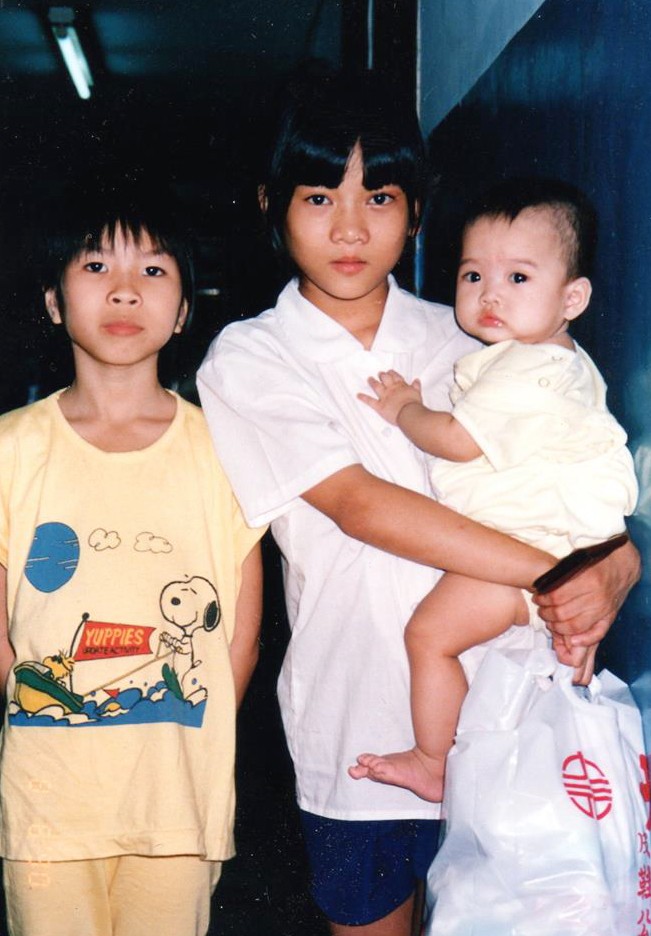
Dang was born in 1981 during the peak of the Vietnamese exodus to Hong Kong. After fleeing from a war-torn Vietnam, her family was settled at Kai Tak North Refugee camp.There, Dang spent 11 years growing up beside her mother’s hawker stall.

“My mother would be up at 2 or 3 a.m. to make pork congee. I would help her cook the soup, wash dishes, and bring goods to the market. That was our life,” Dang recalls her earliest memories. It was the daily three-hour routine of stirring pots of cháo sườn (pork rib congee) and steaming xôi vò (mung bean sticky rice), before attending classes at the nearby New Horizons school. 

“I just remember having the most amazing childhood regardless of the conditions inside the camp,” she notes. Eight children shared two bunk beds. The tight space makes great space for small talks.

Dang (left) in Kai Tak camp. Photo courtesy of Farah Dang.

Even the ever-present rats and cockroaches became unlikely friends. “We used to feed them bits of food under my bed,” she laughs, confessing that the sight would terrify her now. It is this deep sense of community and belonging that sweetened the life at Kai Tak camp.

The camp, she insists, was not just about hardship. 

“My most vivid memory was playing. There were a lot of children inside the camp. I was never lonely,” she says. Her days were filled with the simple joys of badminton and rope-skipping; she and her friends even fashioned their own jump ropes from elastic bands. 

This playful environment had an extra boost from a unique source—her family’s three arcade machines. A gift from her father’s friend, the machines brought in coins from neighbourhood kids, giving Dang and her brother pocket money and endless entertainment.

“All the kids from the camp used to come play because we had it all—Tetris, Munchies, Snake, you name it. That’s probably why I’m always so entrepreneurial, always finding a solution to something,” she says, crediting this early experience with shaping her mindset. 

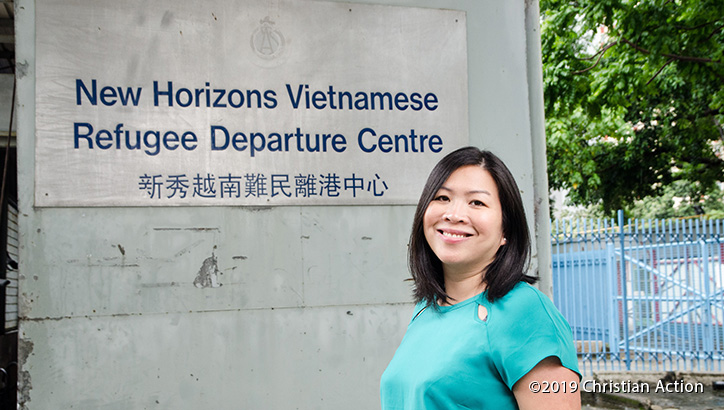
Dang at the former New Horizons Vietnamese Refugee Departure Centre, once operated by Christian Action to aid Vietnamese refugees. Photo courtesy of Christian Action

At 11, Dang’s family resettled in the United Kingdom. For the first time, she stood out.  “Before that, we were all the same. In the UK, though, I was the only Asian. People told me to go back to my own country,” she remembers. 

While she learned to turn the fear and fluster into a thick skin, this defensiveness did not translate into pride about her identity. “Still, I’d be afraid to even say that I’m a refugee, because I didn’t want any disadvantage or discrimination against myself. But now, I could happily say I’m a second generation Vietnamese refugee. These are my experiences, this has made me who I am.” she says. 

After 11 years in the United Kingdom as a chartered accountant, however, Dang realised her true calling was the kitchen. “I miss how I was able to connect with people through a simple bowl of phở. Feeding people is exactly what my parents and my grandparents would have done! It is their way of showing love, of saying “How are you?”, and now it’s my way too,” she says.

Finally, when Dang’s husband relocated to Hong Kong for work, she accompanied him. In 2018, alongside a fellow Vietnamese woman, she launched Soho Banh Mi. What started in a small Mid-levels alley has since grown into three locations across Hong Kong, but it remains a tribute to her past and a space for giving back.

For Dang, her restaurants can be the stepping stones for the community. “Anyone who wants or is willing to learn is welcome here. It’s a love I want to share for whomever I happen to meet across my path. I just hope the very best for them,” she shares.

Dang making a bowl of bún chả, one of the restaurant’s best-sellers.

Her commitment extends far beyond the restaurants. Having been nurtured by the caring teachers in the camp, Dang understands how one act of care can change a life. She now volunteers with Christian Action for Refugees, the very charity that managed the Kai Tak camp. On weekends, she prepares lunches and delivers food under the footbridges to refugees seeking shelter. 

“Each time I hand out a meal, I feel a mix of gratitude and strength. I’m reminded of how far I’ve come, and I’m inspired and proud knowing that I can now be the one who offers hope,” she reflects.

“I’m sure it’s not much, but I want to do as much as I can. Whatever you can do, you should do it—out of conviction, not because of any fame or money attached to it. You should just do it because it’s truly the right thing to do,” she adds.

Looking ahead, she hopes to expand both her restaurant chain and her cycle of care. “That’s why I keep on opening my shop. It’s not just for me; it’s also to inspire other people to give back,” she envisions, ensuring the resilience born in Kai Tak would continue to nourish generations to come.

Edited by Mike Chu

Sub-edited by Pauline Yau

A Vietnamese vlogger: “I love Hong Kong!”

Loyal Hong Kong fan, Vietnamese travel vlogger Nguyễn Lan Minh shares her love story with the city.

By Fami Nguyen

Hong Kong travel vlogger Nguyễn Lan Minh met nearly 100 TVB actors in 2025, including  Moses Chan Ho, Linda Chung Ka-yan, Raymond Lam Fung, Helena Law Lan, Nancy Sit Ka-yin, Felix Wong Yat-wah and many more. For the 32-year-old office worker from Vietnam, it is a memorable footnote in her 25-year love story with Hong Kong.

“There are many cities which are more beautiful and modern than Hong Kong.  But for me, nowhere gives me this special feeling. Only Hong Kong!” She says. 

The Hong Kong loyal fan has come to Hong Kong 18 times in the past nine years, including seven trips alone in 2025. Her company supports her by allowing her to work during her stay in the city. 

Her journeys are made possible by a three-year multiple-entry tourist visa that she received in 2025, which allows stays of up to 14 days for each visit. She makes the most of this visa, spending all her permitted days in the city and returning every two months.

Each 14-day trip to Hong Kong costs her between VND 30 million to 35 million (approximately US$1,200 to $1,400). She pays for all her trips without accepting advertising or sponsorship from any brands.

The media administrator for an IT company in Vietnam dedicates all her time outside of work to “Long Nhong Hong Kong”, a Facebook page that has over 29,000 followers.

Nguyễn Lan Minh, and two co-founders of “Long Nhong Hong Kong”, Phát, and Thi, in the 2018 trip to Hong Kong

In 2018, she came to Hong Kong with two childhood friends who share the dream nurtured by TVB.  They had so many photos, videos, and memories that they decided to create the Facebook page in 2019 to make a record of the trip. 

Nguyễn collaborates with an artist to sell Hong Kong-themed stickers and key chains to sustain the Facebook page. “Others might use their channel to earn money. I make money to feed this channel,” she says. 

On the page, Nguyễn shares daily images and street scenes in Hong Kong. For example her breakfasts at Hong Kong cafes or known as Cha Chaan Teng, elderly couples holding hands on the street, trams, the bustling flow of people in Hong Kong, and even the colourful manhole covers in Central, along with her experiences meeting celebrities and stories with local people. 

The post of highest interaction, with 8,000 likes is the farewell post for the late actor Benz Hui Shiu-hung in October 2025. Besides that, her everyday life and street videos are the most popular posts on her page, with approximately 300,000 views and 2,500 likes.

“Many followers have messaged the page saying that they see a Hong Kong they love on screen, now much closer and more familiar through my films. I film as I go, but I don’t post immediately. I focus on enjoying Hong Kong while I’m there. I edit and share the videos after I return to Vietnam,” she says.  

After visiting more than 20 famous tourist spots and islands like Peng Chau, Lantau, and Lamma, Nguyen shares,:  “I am done with the stage of visiting touristy spots in Hong Kong.  I now just enjoy sitting by Victoria Harbour, riding the “ding ding” tram and seeing the city, or feeling the first raindrops of a storm. I just need to be in Hong Kong, just seeing Hong Kong is enough.” 

Nguyễn Lan Minh prayed at Wong Tai Sin Temple in 2023

She often visits temples and her favourite one is the Wong Tai Sin Temple in Kowloon. “I believe that if you keep loving, dreaming, and praying, your dreams can come true, and I always pray that I will have more opportunities to return to Hong Kong,” she says.

The travel vlogger’s love story with the city began when she started watching the “Journey to the West” (1996 and 1998) from TVB with her grandmother when she was six years old. “That time, watching TVB dramas with my granny was the happiest period in my memory,” she says. 

She lost her grandmother when she was nine and her old home to a landslide the following year. The world of TVB dramas then became a treasure trove, keeping her cherished childhood memories alive.

 “Before I even knew where Hong Kong was on a map, I knew what it looked like and what its people were like. I had a dream that I must get to Hong Kong before turning 25. I wanted to go to the city that has a big role in my childhood memories,” she says. 

She saved up for years, but when she contacted a travel agency for a visa in 2015, her application was not approved. “They said that as a young and single woman who had never travelled abroad, applying for a visa to travel alone was not easy,” she says. 

On February 9, 2017, Nguyễn finally set foot in Hong Kong with her elder brother. “Why does Hong Kong look exactly like the old neighbourhood I have lost?” She wondered when she found the architecture and the atmosphere of her vanished childhood home in the old quarters in Hong Kong.

She was overwhelmed by a feeling of déjà vu that went beyond the movies when she walked on the street for the first time in Hong Kong. 

Nguyễn Lan Minh and her elder brother came to TVB headquarters for the first time travel to Hong Kong in February 2017

She visited the TVB headquarters on her first trip to Hong Kong. “The first time I saw the TVB building with its mascot on the rooftop from afar, I stood there and cried. I never imagined that the land I saw on the small screen when I was a child would now appear before my eyes. Even my brother thought I was crazy for crying just from seeing the TVB building,” she recalls with laughter. 

In 2019, she began learning Cantonese, taking classes twice a week for six years.  “I feel incredibly happy to be able to speak Cantonese, even if it’s just a simple phrase like ‘Jo-sun’ or Good Morning in Cantonese,” she shares. 

This effort has helped her connect with local Hong Kong residents. Nguyễn met a Hong Kong family at the Doraemon exhibition at K11 MUSEA in August 2024. They kept in touch and became close friends. In 2025, Nguyễn celebrated the Mid-Autumn Festival and Christmas with the family.

“I believe that if I treat Hong Kong gently, Hong Kong will reciprocate with the sweetest treatment,” the travel vlogger asserts.

Looking ahead, Nguyễn’s heart-compass remains firmly pointing at Hong Kong, but she has no plan to move to the city.  “What I have now is already beyond my imagination,” she says. 

“I feel the term ‘travel vlogger’ is too strong for me. I don’t see exploring Hong Kong as a job. I record these videos purely out of my genuine love for Hong Kong. I consider myself a Hong Kong lover,” she says.

She encourages others with similar dreams not to compare their journeys to others but to bravely pursue them. “I believe if you have Hong Kong in your heart, you will get to Hong Kong. Everyone has a different path,” she says.

For Nguyễn Lan Minh, the future is a continuation of a love story, one where Hong Kong only needs to be Hong Kong, and she is simply happy to be there.

Edited by Christine Ge

Sub-edited by Winnie Li

Beat Scalpers by Going Abroad

Hong Kong fans prefer watching concerts overseas than buying scalped tickets in the city.

By Rita Yau

Instead of paying a scalper HK$7,000 (US $897.72) for a concert ticket, Nic Chau spent HK$11,000 (US $1410.6) to watch YOASOBI concerts in Singapore and Jakarta in a seven-day trip. 

Chau planned to watch the concert in Hong Kong. He tried to purchase concert tickets the moment sales opened at noon on September 4, 2024 via the KKTIX platform. 

But he failed. Tickets were sold out in three hours.

“When I checked on Carousell and Facebook, tickets selling at HK$1,480 (US $189.8) were resold for about HK$6,000 – 7,000 (US $769.47-897.72),” he recalls. 

Ticket scalping is the practice of reselling event tickets. Scalpers usually buy tickets in bulk and resell them, leaving fans unable to purchase directly through official channels. Scalped tickets are usually sold at prices significantly above their original value, with markups averaging 49% but sometimes exceeding 1,000%, depending primarily on the event’s popularity, timing, and seat location.

“Ticket scalping should not be encouraged. The money doesn’t go to performers but those illegal scalpers,” Chau says. 

“The price of a scalped ticket equals the cost of airfare and two concert tickets in Singapore and Jakarta. So why not go to overseas concerts instead? I also got the chance to visit other countries,” Chau adds. 

He joined the online queue immediately when tickets for the concert in Singapore were still available on September 27, 2024 at 2:00 p.m. via the Ticketmaster SG platform. 

“The sale was quite competitive. I waited for 30 minutes online before I managed to get the tickets,” he says. 

Chau successfully purchased one VIP Standing ticket of the Singapore YOASOBI concert at face value HK$1,561.01 (US $200.19). 

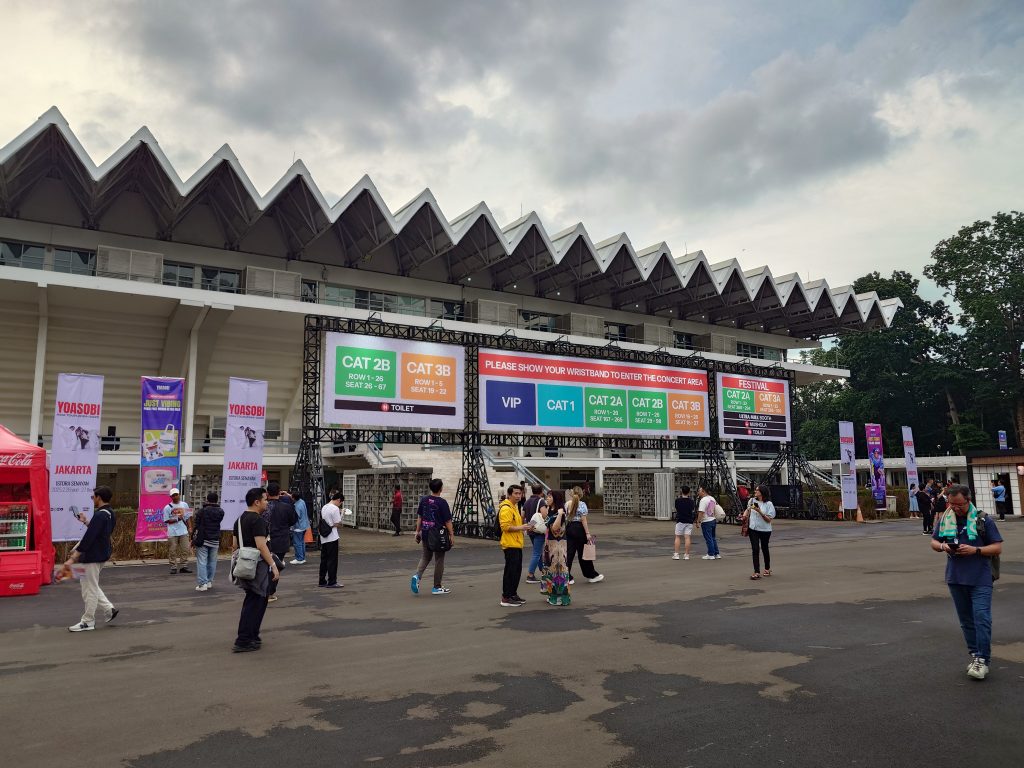
The venue of the YOASOBI concert in Jakarta. (Photo courtesy of Nic Chau)

For the Jakarta concert, the situation differed. Sales there began on October 12, 2024 at 11:00 a.m. through the official website yoasobiinjakarta.com. 

“I didn’t buy tickets for the Jakarta concert immediately after the sale started. The cheapest ticket sold out on the first day, but tickets of other kinds were available for over a week,” he recalls. 

From February 22 to 27, 2025, he spent four days in Singapore and three days in Jakarta, spending about HK$11,000 (US $1410.6) in total for attending two concerts in Singapore on February 23, 2025 and another in Jakarta on February 26, 2025. 

Fans attending YOASOBI concert in Singapore. (Photo courtesy of Nic Chau)

The following table is the breakdown of his expenditure:

K-pop fan Lai Wing-sze also gave up getting tickets for the 2NE1 concert in Hong Kong and flew to Kuala Lumpur for the show instead. The cost of her entire trip was HK$4,000 (US $512.98) cheaper than a single scalped ticket.

Lai first attempted to buy tickets for the 2NE1’s Hong Kong concert of Asia Tour <Welcome Back> on October 23, 2024 at 3:00 p.m. through the Cityline platform as soon as sales started.

“I checked the ticket page to queue as soon as ticket sales started. All tickets were sold out in an hour. I still failed to reach the website page for buying tickets,” Lai recalls. 

She then searched for tickets through scalper chat groups on Telegram. 

“The official price of a ticket was HK$2,299 (US $294.84), but scalpers were selling up to about HK$10,000 (US $1,282.45). It is just ridiculously expensive,” she says.

Lai then found out it was a much better deal to watch the concert outside Hong Kong. 

“It is much more worthwhile to buy overseas concert tickets at the original price and turn it into a trip. No matter where I go, it still beats paying HK$10,000 just to watch a single show in Hong Kong,” she says. 

The ticket sale of the Kuala Lumpur concert began on December 17, 2024 at 11 a.m. via the GoLive Asia platform. 

“When the concert tickets in Kuala Lumpur went on sale, my friend managed to buy two and she asked if I wanted to go. I said yes right away,” Lai recalls. 

They successfully purchased two VIP Soundcheck tickets at face value HK$2,531.01 (US $324.59).

Lai travelled to Kuala Lumpur from January 31, 2025 to February 3, 2025 and attended the 2NE1 concert on her second day. The entire trip cost her around HK$6,000 (US $769.47) in total, HK$4,000 (US $512.98) less than the price of a scalped ticket for the same concert in Hong Kong.

The following table is the breakdown of her expenditure:

In Hong Kong, ticket scalping is illegal. Section 6 of The Public Entertainment Ordinance (Cap. 172) states that no person shall sell or offer tickets with a price higher than the fixed amount set by the event organizer held at licensed venues. Any person who violates will be fined HK$2,000 (US $256.49). 

Fans unable to purchase tickets for Hong Kong concerts

But this rule does not cover venues run by the Leisure and Culture Services Department such as the Hong Kong Stadium and the Queen Elizabeth Stadium. 

Since the opening of the Kai Tak Sports Park last year, online concert ticket scams have increased significantly, surging 60% to 2,805 cases. The police urge the public to avoid purchasing or obtaining tickets through channels not authorized by the event organizers to prevent falling victims to scams and incurring losses. 

In an operation near Kai Tak Sports Park on April 8, 2025, police arrested six people for allegedly selling two Coldplay concert tickets at a price above face value. Tickets originally priced at HK$399 (US $51.06) were being sold for HK$1,499 (US$191.82), a markup of 2.7 times.

Edited by Christine Ge

Sub-edited by Alexa Lau

Great Wall of Curriculum

Foreign teachers in China struggling with tighter control in classrooms.

By Victoria Zhang

English teacher Isabella Green* from the United Kingdom, who has taught in China for 14 years, finds tighter control over curriculum and classroom teaching in international schools for Chinese nationals.

“After I started teaching at an international school for Chinese citizens for the semester of 2020-2021, I realised we weren’t supposed to host Western celebrations such as Christmas and Halloween. It’s because the people from the Education Bureau say celebrating these events in school is forcing Chinese citizens to celebrate events that are not of their own culture,” Green, who has worked at an international school for Chinese nationals since 2020, says. 

“Nobody really cared about what the schools did or did not do before 2021. This is because the rules were mainly enforced by the people the Education Bureau sent to monitor the school. After 2021, they started monitoring us more and more, so we have to follow the rules,” she says.

Mainlanders come to Hong Kong to celebrate Christmas as they are not allowed to publicly celebrate western holidays

Green started teaching in China in 2012 at an international school for foreign passport holders which is not regulated by rules that apply to international schools for Chinese nationals like where she works now. 

“In the school for foreign nationals, we can celebrate Western holidays and teachers have shorter workdays in general as the students don’t have evening study,” she says.  

There are two types of international schools in China. Expat schools, which are for students with foreign citizenship, are not required to follow the Education Bureau’s rules and regulations, while private bilingual schools or international schools with Chinese and foreign nationals are under the Education Bureau’s restrictions.

In 2003, international schools for Chinese nationals were required to have both a Chinese principal and a foreign principal, with department regulators visiting for inspection.

Green recalls the practice was not strongly enforced before 2021. Spot checks without prior notice and inspections of these schools have become more frequent in recent years. 

“Starting from 2021, students in compulsory education (Grade 1-9), are required to learn the Chinese curriculum for the Zhongkao, (Junior High School Scholastic Aptitude Examination) and Gaokao, (Nationwide Unified Examination for Admissions to General Universities). But the exams are in English. To cope with that, we teach those materials mixed with a bit of A-Level materials,” the teacher shares.

In May 2021, the revised Regulations on the Implementation of the Law of the People’s Republic of China on the Promotion of Privately-Run Schools announced that foreign curriculum (such as A-Level and International Baccalaureate) should not be used for compulsory education in international schools for Chinese nationals.

Official statement: Foreign curriculum is not to be used for compulsory education.

Green points out foreign curriculum is only used as supplementary learning. The number of English classes is capped at four per week for Grades 7 to 9 students, three for Grades 4 to 6, two allowed for Grades 1 to 3.

“I think it’s because the Education Bureau wants to give more time for the compulsory grade students to learn the Chinese curriculum. They teach subjects like Chinese history and politics,” Green shares.

According to a statement issued by the General Office of the State Council in 2022, the change is made to lighten students’ and parents’ academic and financial burdens, students spend the most time studying English during after-school tutoring.

Official reason for limiting English lessons: to relieve students’ and parents’ burden of after-school tutoring

“As the students don’t have great English foundations, the allowed number of English classes is not enough. We would change the name of English lessons to ‘reading’ or ‘literature’ to help them get ready for exams. It is vital for the students if they were to take a foreign graduation exam,” she says.

In 2025, there were 1,124 international schools in China, with the annual tuition fee ranging from RMB ¥120,000-¥200,000 (US $17,219-$28,699). 

Michael Porter* also shares that international schools for Chinese nationals are under tighter control and inspection than before. 

The former chemistry teacher and principal who worked at an international school for Chinese nationals from 2020 to 2025, says the Education Bureau quite liked the school song when the school was set up in 2020.

“But when they found out it was a religious hymn, they decided it wouldn’t be appropriate so we stopped the idea. In these situations I thought it would be better to respect the country’s values than to push back,” Porter recalls.

“There is a saying that the further away from the capital the school is, the less important the policies were and more local interpretation. For example, rules might be looser in Shenzhen and Guangzhou compared to areas closer to the capital,” he says.

The former principal also shares that rule changes are based on the will of the Chinese principal and their relationship with the Education Bureau. 

“If he (a school principal) has great relations, his school can do things others can’t do and trouble would be solved with a drink at the bar. Students might have different experiences based on how under the microscope the school is,” he shares.

Porter states that his school’s main goal is to make profit, and satisfying parent and students’ requests is his main priority as a principal. But with contradicting voices and changing rules, his job is very difficult.

“To cope with the regulation on foreign curriculum, we kind of tread a grey area where we try to combine the foreign and Chinese curriculums. We split students into classes based on English proficiency. Those with lower English proficiency are taught mainly in Chinese, those with higher English proficiency are hopefully taught all in English,” he says. 

“We need to find middle ground for everything. We try our best to incorporate international experience while following the rules,” he adds.

Qin Rongfang, a parent with both sons, aged 18 and 19, enrolled in international schools, shares that she hopes her sons can have a wider social network so they can look at things from different perspectives of the world by attending international schools. 

But her goal is not achieved.

“My son enrolled in his first international school in 2020 and went there for a year. The principal was from the United Kingdom, then he was replaced by a Chinese principal who added many rules such as mandatory evening study until 9 p.m. and no devices. It felt like the school changed into a Chinese public school,” Qin says. 

Qin recalls many foreign teachers left, and the remaining of the lessons were taught by local teachers. Parents were not happy and changed schools for their children, leading to the school’s closure in 2022.

“The education was not very international. It’s literally studying a foreign curriculum (A-Level) in the traditional Chinese school system,” the mother of two says.

“My sons gave up the ZhongKao exam in 2021 as the schools said it was not necessary for their students. After seeing that international education in China wasn’t like what we expected, it was too late to go back to public schools,” Qin says.

Qin Rongfang’s 18-year-old son using Chinese to help study English materials

Qin shares that her youngest son’s lacking English skills makes it hard to study for his upcoming A-Level exam. He needs to use Chinese books to help him understand the English A-Level materials.

“That has caused a lot of frustration, and fellow parents have shared that our children’s education journey should not be this complicated. After all, we paid 140k a year for the tuition fees,” she says.

*Names changed at the request of interviewees

Edited by Alexa Lau

Sub-edited by Flavia Zhou