















Home Blog Page 33

A Neighbourhood Complying with the Trend of Times

Tangled up in redevelopment and a railway launch, To Kwa Wan residents find ways to cope with the changes in the old neighbourhood.

By Kajal Aidasani

Mok Suk-fan, who has been working in To Kwa Wan for 15 years, feels numb about redevelopment plans in the area and the newly launched MTR Tuen Ma Line.

“Shops being acquired, people moving out… all these have been going on for over 10 years. I am so used to all these new establishments such as Grand Waterfront and Sky Tower,” says Mok, who is a clerk and health worker at Kau Pui Lung Elderly Home.

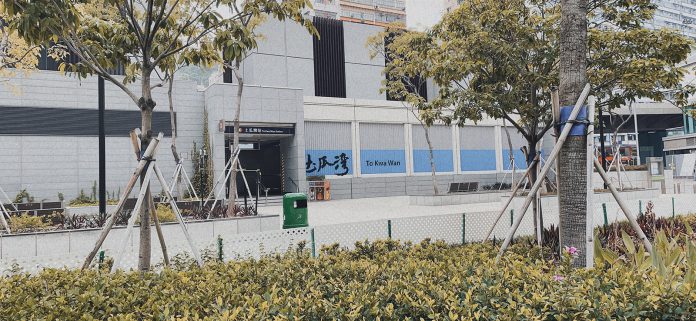
The elderly home is only a three-minute walk from the MTR station opened since June 27. The railway has brought convenience to Mok and families of the elderly home residents by reducing their commuting time and that encourages them to visit the elderly more frequently.

The district in eastern Kowloon houses over 20 elderly homes. Mok says even with the rising rent, none of them plan to relocate. But shops in the neighbourhood are not that lucky.

An area stretching from Chatham Road north to Ma Tau Wai Road was known as the “Furniture Street”, where many shops vended imported furniture of various styles.

Mok says the noise and road blockage caused by the station’s construction, which lasted for nine years, greatly affected the business of the furniture shops.

“Furniture Street” is now packed with shops selling bread, noodles, paper offerings, and many more.

A hardware store and a candy shop which Mok used to visit are closed. The site where they were located is now zoned for urban renewal.

Kalo Supermarket, a grocery shop run by Winnie Wong, is one of those affected by the redevelopment plans. Her shop moved from Hung Fook Street to Yuk Shing Street, in June.

“To be honest, small shops like us are all struggling. We are just waiting for government’s compensation,” Wong says.

Her shop has withstood the test of time in one of Hong Kong’s oldest districts for nearly two decades. It was even featured in a local illustrator, Wai-wai’s postcard set entitled “Vintage Shop with Love” with 19 sketches of shops in 2016.

Wong’s shop was loved by the community – kids used to go for soda drinks after school, and their parents bought daily necessities such as soy sauce. Workers used to gather there for beer, and some spent quality time petting Wong’s cat at the shop.

Customers used to spend quality time petting the cat at Kalo Supermarket.

Wong says her business has not benefited from the newly launched MTR line as her regular customers were relocated to public housing estates in other districts. “I am suffering from 60 per cent business loss, meaning almost no salary,” she says.

The shop owner says her old customers still visit her at the shop. “They come back two to three times a week to take a final glimpse before more buildings get demolished,” she says.

Although she feels attached to the blue-collar neighbourhood, she believes it is time to use an uplift.

“The walls are cracked and leakage is a problem. It is similar to old people like me. When your internal system is malfunctioning, there is no way to repair. You have to change the entire thing,” she says.

The 55-year-old grocery shop owner has spent 30 years in To Kwa Wan. She hopes she can stay in the district for the rest of her life.

“My youth is here,” she sighs. “I will live here anyway, but I am not sure about my shop. The neighbourhood is changing, and all I can do is to go with the flow,” she says.

The neighbourhood is changing, and all I can do is to go with the flow.

Also being subjected to move are ethnic minority residents in the culturally diverse community. According to the 2016 Population By-Census, 10.1 per cent of Kowloon City District’s population, To Kwa Wan included, were ethnic minorities. One of them is Pakistan-born Wasal Khan, owner of Mashaallah Provision Store, who feels uncertain about the future.

Wasal Khan at his snack shop.

He has lived in To Kwa Wan for nine years, and his shop which sells South Asian snacks opened two years ago.

Khan’s home and his shop are both in the redevelopment area. He has signed the relocation agreement but has not been informed about the official vacate date yet.

His monthly rental expense stays at HK$8600 during the years of urban renewal project. But his business has dropped 70 per cent since the redevelopment projects emptied five streets by the end of August.

“Buildings are cleared up. They are all empty places now. Before there was no MTR, and now there is,” 43-year-old Khan says.

Khan thinks he does not benefit from the new MTR line as his old customers are no longer here. They order delivery by telephone once in a while, and do not do shopping as often as before.

According to the Urban Renewal Authority’s website, a “people first, district-based, public participatory” approach should be adopted to carry out urban renewal, with their sustainability aim to support social inclusiveness and social mobility of the underprivileged.

Notice posted by the Urban Renewal Authority in the redevelopment zone.

But many of Khan’s friends had to move out of To Kwa Wan and bear higher living costs.

Khan prefers staying in the area and moving both his shop and home to the nearby wet market. “I have many friends here. I have business here, and I have my home here, so it (To Kwa Wan) is special (to me),” he says.

Chloe Au Yee-wing, a social worker in the To Kwa Wan urban renewal social service team, thinks the place is unique for its intangible connections between people.

The renewal projects involving Wing Kwong Street, Kai Ming Street, Hung Fook Street, Yuk Shing Street and Ngan Hon Street came to an end by August, with the last two shops moved out on August 16 and the last resident moved out on August 31.

Au says though many elderly people have resettled in buildings with lifts, they prefer their old homes where they grew up with fond memories.

She recalls seeing the charm of the neighbourhood when she first started working in the area two years ago.

“Walking from one end of the street to another, everyone greeted one another. They gathered around a burst water main and joked about it. They put down shopping bags at shops and retrieved them later at night… Small communities with close ties like these are becoming rare in Hong Kong,” she says.

“Strong community networks may be alien to the young generation. Urban renewal and redevelopment are not just about demolishing, compensating and relocating. The ties between people matter too,” Au adds.

Urban renewal and redevelopment are not just about demolishing, compensating and relocating. The ties between people matter too.

Edited by Kelly Yu
Sub-edited by Reus Lok
My Wife is Having an Affair with Mirror

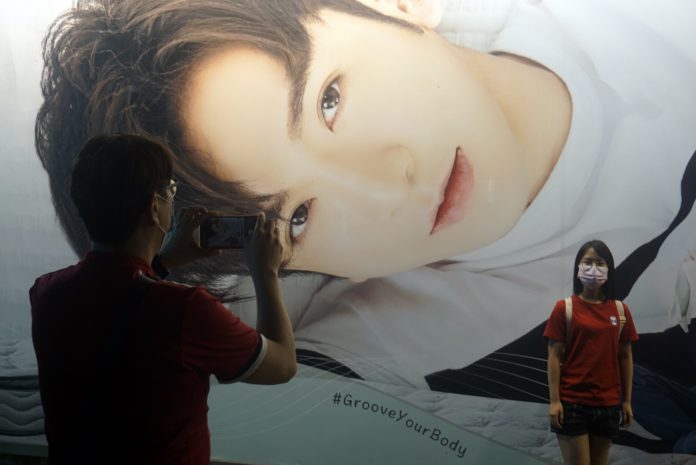
Local pop boy band Mirror has stolen married women’s hearts and “ruined” thousands of marriages.

By Angel Woo

Mirror, a local Cantopop boy band formed after ViuTV’s talent contest King Maker has become so popular in the city that it has been accused of “ruining” thousands of marriages by stealing many married women’s hearts.

One of the “victims” who asked to be identified by his nickname RC, is a 32-year-old man who married his wife two years ago. His wife is madly in love with Keung To, one of the most famous members in Mirror who is 10 years younger than him.

“One night at dinner time, my wife started talking about Keung To as she always does. This time I finally could not stand it and set up a Facebook group named ‘My Wife Married Mirror and Left My Marriage in Ruins Concern Group’ as I wanted to share my ‘plight’ with my friends, who are also the ‘victims’,” RC says.

But he has never expected that so many married men share his feelings. “I set up the group on the night of July 3. At first, there were only a few group members. The number soared to 10,000 the next day. It only took a week for the group to have over 280,000 members,” he says.

Groups members name themselves “ex-husbands” as their wives have been too obsessed with Mirror members and have emotionally abandoned their husbands.

The Joy in Depressing Times

The Facebook group, now with over 300,000 members, has become extremely popular among married men with similar experience. “Ex-husbands” share stories on how their wives are madly in love with Mirror.

“My girlfriend hopped on a bus with Keung To’s advertisements, and she is screaming now, what should I do?” a member said in a post dated September 19.

“My wife bought all products endorsed by Keung To – from Pandora to ice cream mooncakes,” another ex-husband shared in post dated on August 5.

“My wife was not very crazy (about Keung To) at the beginning. She just kept talking about Keung To every day. After I set up the Facebook group, she has been putting up more and more Keung To posters at home,” RC says. “Our wedding photo in the living room is now replaced by a Keung To poster,” he sighs.

RC says he actually did not feel upset at the beginning. “As long as she doesn’t spend all her time watching Keung To’s music video and reading Facebook or Instagram posts about him, it is still acceptable,” he says. “But she keeps testing my limit,” he smiles wryly.

RC admits that it is stressful to manage the group, as the number of followers grows. Mental support from group members has become his motivation.

“People message me to say thank you because they have a lot of fun reading posts in the group. Then I realize a small step I take can bring joy to many, so I journey on,” he says.

“I hope this group can spread positivity to Hongkongers as we have experienced depressing times in recent years. When people talk about this group, I hope they can think of something happy,” RC says.

I hope this group can spread positivity to Hongkongers as we have experienced depressing times in recent years.

“I don’t mean to ask people to escape from reality, but I hope they can be a bit more relaxed,” he adds.

A “Ruined” or Happier Marriage?

One of the “ex-husbands” who found comfort in the Facebook group is Alex Yuen. He described the group as “the source of joy”. His wife Vikaroonie Wong is a fan of Ian Chan Cheuk-yin, one of the main vocals in the boy band.

“After reading stories shared by the ‘ex-husbands’, I know my situation is not that miserable. She only puts up Ian’s posters at home,” he laughs.

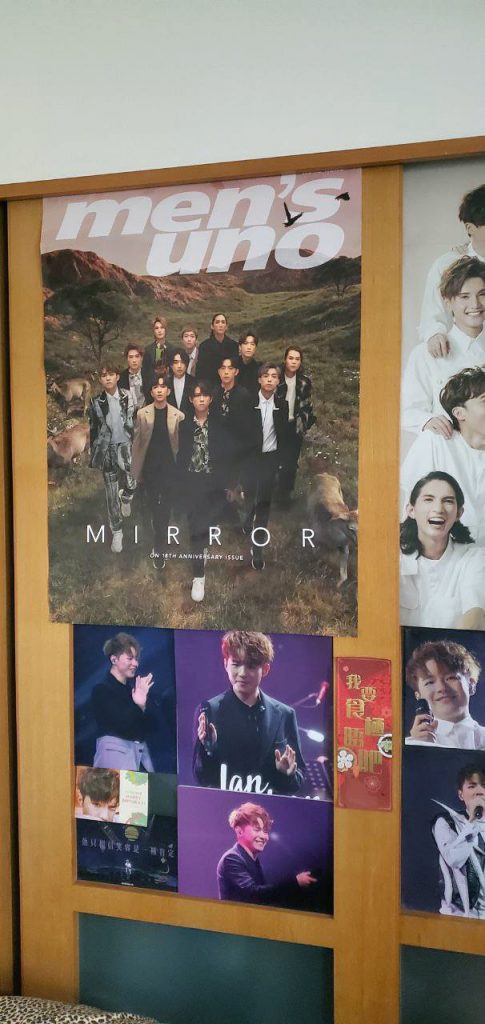
Vikaroonie Wong’s room is blanketed with Mirror posters. (Photo courtesy of Vikaroonie Wong)

The couple has been married for six years with two kids aged four and two. Their marriage has been “ruined” after Wong watched “We are the Littles”, a ViuTV drama about young volleyball players featuring Ian Chan Cheuk-yin, a 28-year-old member in the boy band.

“I wondered who this charming guy was when I was watching the drama! Then I found out he is Ian, then I became a die-hard fan,” Yuen’s wife says. “He is so handsome when he plays volleyball,” she says.

“To be frank, I didn’t have any hard feelings. If being a fan of Ian can make my wife happy, then let’s do it,” Yuen explains.

Yuen joined a Mirror event to get a capsule toy of Ian in April as he wanted to give a surprise to his wife.

“My wife always tells me that Mirror has a great variety of fans – from young girls to daddies – so I thought it would not be awkward to go there. But when I arrived, all the fans were young girls, and I was the only uncle standing there! That embarrassing moment was beyond words,” he recalls.

“It is just a joke to say Mirror ruined our marriage. Actually, we have chatted more because of Mirror,” he says.

If being a fan of Ian can make my wife happy, then let’s do it.

From Dislike to Appreciation

Tony Lam, a 26-year-old “ex-husband” pleased his wife by making handmade gifts related to Anson Lo Hon-ting – his wife’s favourite member of the boy band.

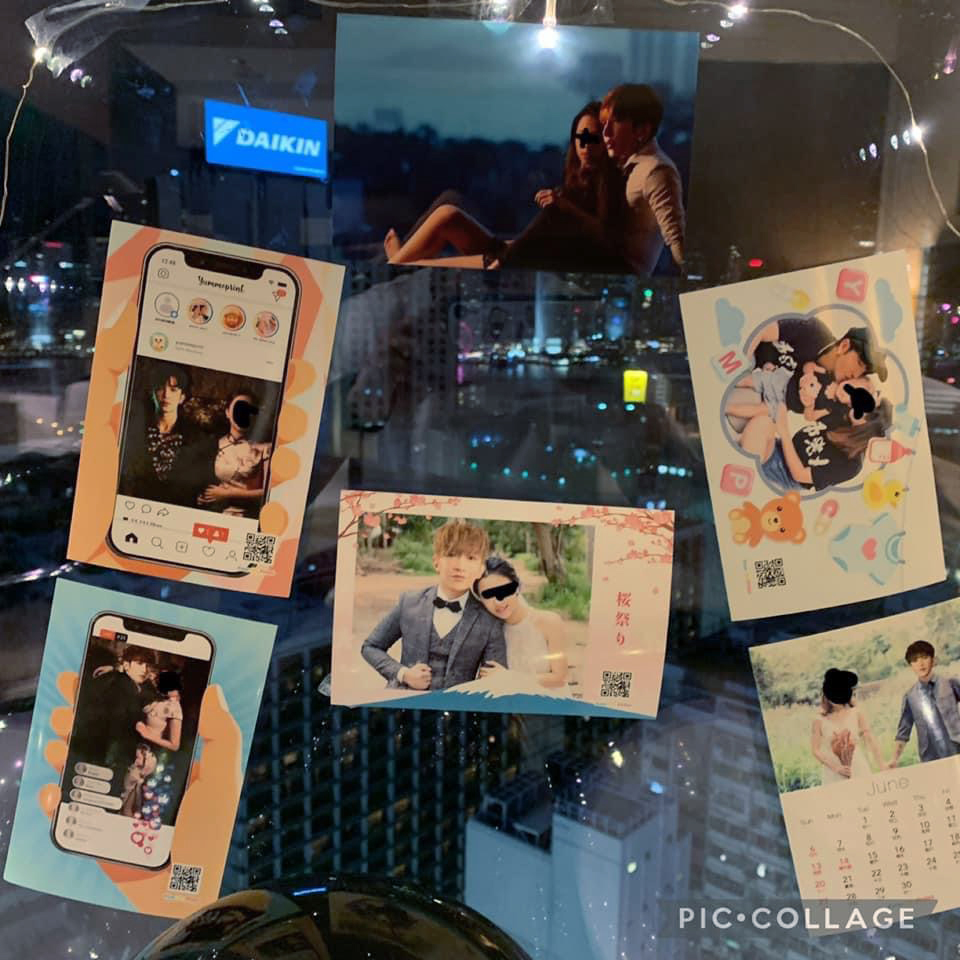
Tony Lam created pictures of Anson Lo and his wife by using photoshop to celebrate his wife’s birthday. (Photo courtesy of Tony Lam)
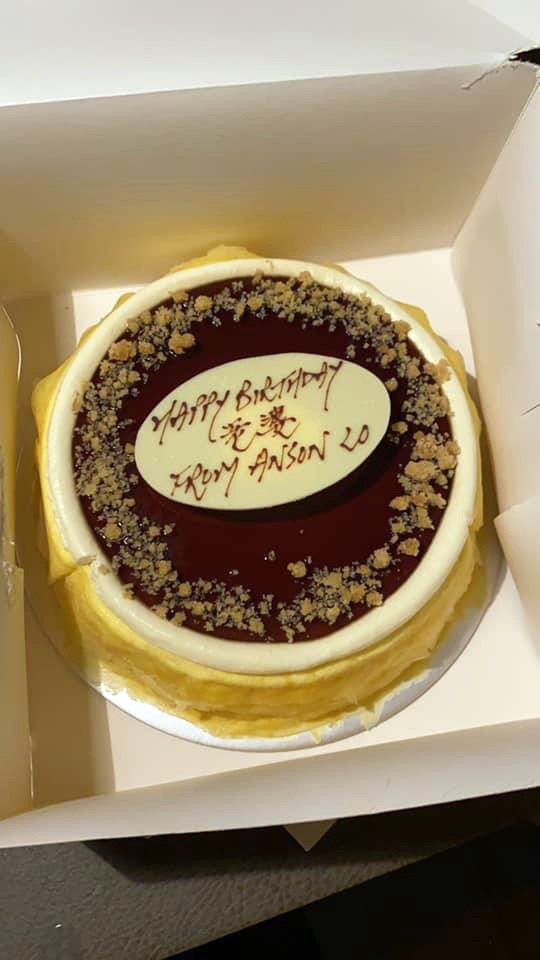
Tony Lam ordered a cake featuring a message “Happy Birthday from Anson Lo” for his wife.
(Photo courtesy of Tony Lam)

“On her birthday, I ordered a cake with ‘Happy birthday from Anson Lo’ written on it and retouched our photos, replacing my face with Anson Lo’s,” he says.

“She was extremely happy. I guess she might not be that happy if I had given her a luxurious bag instead,” he says.

Lam says he did feel annoyed when his wife first became Anson Lo’s fan and they even argued. But his impression towards Mirror changed after watching the Ultimate Song Chart Awards Presentation (叱咤樂壇流行榜頒獎典禮) held by Commercial Radio Hong Kong on January 1, 2021.

“I thought Mirror was MK pop at the beginning,” he says. MK pop, also known as Mong Kok pop, is used to describe local music groups in Hong Kong with strange dance styles that mock Korean pop music groups. 

“But I was touched after watching the awards presentation. More and more Hongkongers treasure our local culture in recent years, so when Mirror said they wanted to sing more Cantonese songs for Hongkongers, I started to appreciate them,” he says.

More and more Hongkongers treasure our local culture in recent years, so when Mirror said they wanted to sing more Cantonese songs for Hongkongers, I started to appreciate them.

Understanding Your Partner

Sally Choi, team leader in counselling at the Caritas Family Crisis Line and Education Centre, who has five years of experience in marriage counselling says, “It seems it is just a joke to say people’s marriages are ‘ruined’.”

“When your spouse falls in love with an idol, one might feel jealous, but it may improve the marriage as they can have more topics to discuss with each other,” she says.

But there are some couples who have conflicts. Choi believes the reason causing these conflicts is because they think their partner has changed.

“For example, their partners may spend their time going to their idols’ events instead of doing house work,” she says.

“Try not to complain and understand why they have these changes. Everyone should communicate with their partners,” Choi suggests.

It seems it is just a joke to say people’s marriages are ‘ruined’.

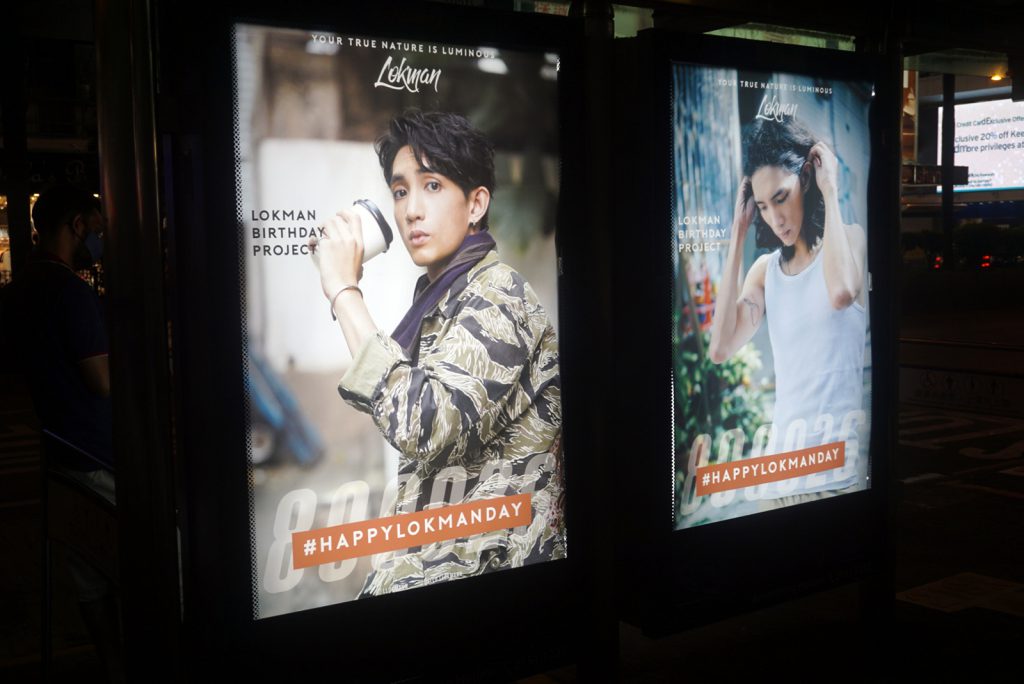
Fans place advertisements at bus stops to celebrate a member of Mirror Lokman Yeung’s birthday.

Edited by Charlie Yip & Mandy Yim
Sub-edited by Isaiah Hui

The Rebellious Game Content Creator

Ade Zun has surprisingly attracted a bunch of faithful fans despite refusing to create contents appealing to the public.

By Alina Chen

Live streaming on Bilibili so that his fans could watch him playing video as usual on January 19, 2017, Ade Zun, found words in different colours suddenly appear out of nowhere and swoop across the screen. These messages are called danmu, which literally means “bullet screen”, and they are popular on Bilibili, one of the many Chinese video-streaming websites with 50 million subscribers.

Instead of receiving bullet messages commenting on his contents as usual, Zun received birthday wishes from hundreds of his fans this time. “They said they were notified by the Weibo’s birthday reminder,” the game content creator says.

“I was surprised as I had never mentioned my date of birth before … I was touched,” the forty-year-old man recalls the wonderful moment like it happened yesterday, adding that he rarely celebrates festivals in real life after stepping into his 30s.

Journey to Content Creation

Zun had never played video games until he received a game console from his dad in 1991. Since then, he often watched videos recorded by other players to learn more about game strategies.

“I thought I could do the same,” Zun reveals how he was inspired to broadcast himself playing video games online so that others can get tips, ideas and solutions on gaming.

However, unlike other content creators, Zun simply recorded his games and uploaded the videos without editing as he merely wanted to share his game experience.

He started to play The Sims 4 in 2014, a life simulation game published by Electronic Arts, immediately after it was released for Microsoft Window users.

Ade Zun has made a video series for The Sims 4. (Photo courtesy of The Sims 4)

In the life simulation game where players can create unique characters, their homes, and families, Zun has created a family called Zhao, which has lasted for more than ten generations. He records the lives of the family and uploads them to a video series called Life Goes On.

Up till now, Zun has more than 53,000 followers with an average of 2,000 views for each of his 1,700 videos.
He is not that “popular” since other similar Bilibili game content creators usually each has more than 100,000 followers and an average of 10,000 views for each video.

Focusing on the Niche Market

Zun attributes his relatively low popularity to the type of games he plays and the style of his videos.
“Honestly, I do care about the numbers (of his channel) … but content is more important,” Zun says

“Honestly, I do care about the numbers … but content is more important.”

Unlike other game content creators playing exciting games and making visually satisfying videos for the sake of attracting the mass audience, Zun prefers playing relaxing simulation games that could last for several hours. He would also narrate his games in a peaceful way and chat with his fans about life casually.

Zun says he works as a fulltime game streamer and uploader but refuses to disclose how much he earns.
Other than the series of The Sims, he did try to follow the public taste.

Ade Zun has set up a game channel. (Photo courtesy of Ade Zun)

He once tried to record a popular game called Animal Crossing, a popular game released by Nintendo, and edited the videos before uploading to his channel. Although viewers did increase after he changed his style to cater to the public, they left when he gave up playing Animal Crossing.

Apparently, those viewers are not the kind of fans that Zun wants.

This made Zun reflect on his target audience. He says, “My real fans watch my videos for two reasons: game and style. They like my videos as I am playing their favorite games in a unique way. Once I change, they leave.”

“Then, I follow my heart and be myself,” Zun says he would not mimic other trending videos since then.

“Those (viral) short game videos are having negative effects on our society. They are ‘easy to consume’ but shoddy,” Zun complains.

Zun thinks The Sims is a game that allows players to “experience a real life”. “Life is not always an exciting party. It is full of ordinary things,” he says he especially likes to interpret fine details of the life simulation game with his fans.

“As I mentioned in my videos, we have mixed salad for a thousand times, but life will go on,” he says he is determined to continue to make his “monotonous” game content.

Moments with Faithful Fans

“I remember one of my fans said watching my game videos was more interesting than playing the game directly,” Zun reminisces.

“I remember one of my fans said watching my game videos was more interesting than playing the game directly.”


Zun says his friendly fans always motivate him to keep uploading videos. “Although many people will leave unfriendly comments, most comments on my videos are encouraging … I think I am so lucky (that most comments I have received are positive),” he adds.

“Sometimes I will even invite my fans to play with me, they can share their own ‘Sims’ and ‘live’ with character that I have created in the game. It turns out that the game (experience) belongs not only to me (but also to all fans),” he says as he describes his interactions with fans.

“Other than the game itself, my fans like to share their real-life moments with me, say entering a dream school or passing an exam,” he adds, saying that his fans are indeed his close friends.

“I can feel the joy of connection through these moments,” Zun concludes.

Edited by Isaiah Hui
Sub-edited by Coco Zhang

Tsiu Keng Agricultural Park Development

Reporter: Charmaine Choi, Victoria Fong Kit Wa, Lesley Lam Wai Yi
Editor: Sarah Ryou, Savoki Zhang

The Hong Kong government is set to acquire land from local farmers to build an Agricultural Park to revive the agricultural industry. But farmers find the project unnecessary and harmful to traditional farming culture.

Tiny but Tricky Pets

Reporter: Kajal Aidasani
Editor: Sarah Ryou

More people are keeping hedgehogs as pets. But many lack preparation and knowledge to take care of their little thorny friends. 

Food Delivery Workers in China

A food delivery man in China.

Reporter: Jack Deng & Allina Chen
Editor: Charleen Chen

Food delivery industry in China has been growing fast in recent years. The working conditions of food delivery workers get the public’s attention. Workers are facing unfair treatment by their companies or food delivery platforms.

Saving Shanghainese

Reporters: Ryan Li, Ella Lang, Sophia Wu
Editor: Laurissa Liu

Shanghainese has been on the decline among younger generations. But some local people are still trying to save the dialect in creative ways.

Touring in Hong Kong

Reporters: Gloria Chan Yi Lam, Leung Pak Hei, Bonnie Yam
Editor: Patricia Ricafort

Due to the pandemic, many governments have introduced travel restrictions, limiting overseas tourism. People are now opting for local tours as travel alternatives. But more local tour guides are needed to lead in-depth tours introducing the history and culture of Hong Kong.

Love Across Barriers

Reporters: Glacier He, Gabriella Lynn
Editors: Alice Wang, Shell Zhang 

Couples engaged in long distance relationships are experiencing a rough patch during the pandemic. Though lovers have been forced apart due to travel restrictions, they stay strong. 

Made in Hong Kong

Reporters: Felicia Lam, Winkie Ng
Editors: Agnes Lam, Bonita Wong

In recent years, more people have bought locally produced products over imported goods. Shops and platform owners share with us their endeavours to protect local industries and culture.