
















Home Blog Page 4

Storm-Chasing Tragedies Spark Crackdown as Typhoon Ragasa Batters Hong Kong

Authorities are cracking down on storm-chasing after Typhoon Ragasa left a family hospitalized and others arrested for endangering children during extreme weather.

By Swara Sanket Kamble

Police have stepped up law enforcement to curb storm-watching after three members of a family of four were swept by waves into the rough sea and were hospitalized in intensive care on September 23rd when Super Typhoon Ragasa hit Hong Kong.

The mother, 38, and her five-year-old son were storm-watching when they were swept into the sea by powerful waves. The father, 40, failed in his rescue attempt and also drowned.

A passing boatman rescued them. 

The family, including their nine-year-old daughter, went to Ka Yip Street in Chai Wan to watch the waves of the tropical cyclone Ragasa, while the No. 8 Signal was hoisted.

The Hong Kong Police Force received a report from a passerby at around 3:25 p.m. The Fire Services Department dispatched three fire trucks, three fire boats, and three ambulances to the scene. 

Firefighters performed CPR on the son after bringing him to the shore first. The parents were then moved onto a rescue boat to receive first aid. 

The three were then taken to Eastern Hospital to receive medical aid while the mother and son were unconscious.

As of September 25th, the mother and son were in a stable condition, while the father was treated and discharged.

A total of four were arrested for child neglect, and another was arrested for trespassing on a closed-off beach when Typhoon Ragasa hit Hong Kong. 

Police also arrested two South Asian women for allegedly endangering an eight-year-old boy by bringing him storm chasing during the super typhoon while the highest signal, No. 10, was in effect, on the evening of September 25th 

The two women took selfies with the boy at the Ap Lei Chau waterfront when a large wave swept all three of them off their feet. No serious injuries were sustained.

In another incident, police arrested a 46-year-old man and a 33-year-old foreign domestic helper on suspicion of child neglect, after the pair brought two children – aged four and six – to watch the waves during Super Typhoon Ragasa on September 24th. 

Chris Tang, Secretary for Security, speaks at RTHK (Photo Courtesy: RTHK)

Speaking on a RTHK programme on September 25, Secretary for Security Chris Tang Ping-keung stated that the police would investigate whether taking children to watch waves during a typhoon constituted neglect. 

Tang also described the incident in which the mother and son fell into the sea as “unfortunate”.

“There are no laws criminalising chasing the wind and waves yet, but if you go to a place – for example, a beach that the government has declared as closed, there will be penalties for entering,” he said.

Responding to questions by lawmakers during a Legislative Council meeting on October 8, Tang stated that under the Offences against the Person Ordinance, law enforcement could prosecute persons who brought children to wave-watching spots, as it invoked the offence of “neglect by those in charge of a child or young person”. 

“This offence carries a maximum penalty of 10 years’ imprisonment, which has a high deterrent effect,” he said. 

He described the act of storm-chasing during typhoons as “selfish and reckless”. 

“Such highly irresponsible behaviours not only endanger the safety of themselves and their children, but also place rescue personnel in extremely dangerous situations when accidents occur,” Tang said. 

Regarding manpower deployed to rescue wave-watches during typhoons. The secretary for security stated that the government deployed 1,311 personnel for 81 incidents between January 1, 2023, and August 31, 2025, involving drowning accidents and mountain rescues during extreme weather conditions.

Tang explained that it is not simple to introduce legislation regarding storm-chasing, as there are various considerations. The government will have to review existing legislation related to this issue. 

However, the security chief said the government will not fine anyone for rescue operation costs. 

This is to prevent the unnecessary loss of life from people choosing not to call for help to avoid being fined, Tang said. “It is the officers’ duty to save lives,” he added. 

He urged members of the public to exercise self-discipline, consider the well-being of their families and rescue personnel, and avoid putting themselves in dangerous situations.   

According to the Hong Kong Hospital Authority, 59 males and 42 females have been injured during Typhoon Ragasa and received medical treatment at the Accident and Emergency department of public hospitals. 

Super Typhoon Ragasa.
(Photo Courtesy: SSEC/CIMSS/University of Wisconsin–Madison)

Hong Kong narrowly avoided the worst of the super-storm, as Ragasa skirted around the city at a distance of over 100 km away. 

Ragasa marked the second time in Hong Kong history that two No. 10 Typhoon signals were issued in the same year – the first was in 1964, according to the Hong Kong Observatory. 

It also broke records as the most distant typhoon to trigger the No.10 Signal. It was approximately 130 km away from the city when the highest signal was issued. 

As of November 13, 2025, a total of 13 typhoons have hit Hong Kong so far, with three alone in September, according to the Hong Kong Observatory.

The Observatory issued the No. 1 signal on Monday, November 11, because of Severe Tropical Storm Fung-wong. The No. 1 alert was lowered the same week on Tuesday evening as the storm departed.

Scientific Officer at the Hong Kong Observatory, Raphael Lui Yuk-sing, says the proportion of intense tropical cyclones in the Western North Pacific region is expected to increase. 

“Due to climate change, the sea levels will rise, and we can expect a higher threat of coastal storm surges. We must stay alert and be fully prepared to face the threat of tropical cyclones or extreme weather in the future,” Lui says. 

Regarding the recent storm-chasing incidents, the officer says even though a lower signal is hoisted during a typhoon, the public should be on alert and pay attention to the information provided by the Hong Kong Observatory. 

“They should always stay away from the shoreline and avoid engaging in water-sport activities,” Lui stresses.

Edited by Erica Hwang

Surrogacy: A Bright Future or a Regretful Decision

Desperate old couples in China are hiring surrogate mothers to give birth to babies.

By Ivonne Deng

Chen Guifang feels embarrassed to be regarded as the grandmother of her six-year-old twins whenever picking them up from kindergarten. 

“It is annoying to be recognised as their grandmother by other parents… I try to think of it in a funny way. After all, I chose to give birth to these two boys to satisfy my husband. I’m happy with my life now,” the 55-year-old woman living in Fujian, China says with a smile.

Like many Chinese, Chen and her husband are bound by traditional values that having a son is important in family inheritance. Due to their old age, they decided to have children through surrogates. Introduced to a surrogacy agency by her friends, the family used the husband’s sperm and a donor’s egg to have their sons through a surrogacy agent in Guangdong, China.

According to a paper issued in the Science Journal Nature, there were more than 400 surrogacy agencies in China that facilitated the births of over 10,000 surrogate children each year between 2014 and 2019.

“I am worried about the ethical and legal risks, but my husband and I desperately wanted a boy at that time. I couldn’t get pregnant, and I could not stand it if my newborn child was a girl even if I could give birth,” Chen says.


Chen’s husband, holding his sons (Photo courtesy of Chen)

The surrogacy agency Chen found offers a full range of services at a cost of RMB ¥600,000 (US $84274), from body examinations to taking the baby home. An extra RMB ¥100,000 (US $14046) is needed for the household registration of the baby, the permit that allows access to schools, homes, civil service jobs, public health care and almost every aspect of daily life in China.

Similar to other surrogacy agencies in China, the one Chen visited is an underground one, which is hidden inside a “health research centre” in Guangdong. It has its own secret lab, a group of surrogate mothers, and doctors from top hospitals for the treatments.


The health center where the consultation room is located

Peng Weitian, the consultant of the Shenzhen branch of this agency, points out that most of the customers are old couples who are eager to pick the sex of their babies. They have to wait for about two years to have their own surrogate children. 

“Most of them are couples over 40 years old. Time is not a big issue as they have been waiting so long because of the one-child policy. They can be really picky in customising a perfect boy, instead of rushing to start the process,” Peng says.

He adds that compared to other agencies in China, his agency charges a higher price because their clients are ensured that the eggs and sperm come from the exact person they choose, and they will try to make sure the babies are healthy with the sex the clients desire. 

“It is an advantage of our agency. In the mainland, the information about embryonic genes is not available. My customers always want to make sure the baby has the genes they want, not worrying if it is being replaced by other genes,” he says, adding that the agency will send the embryo to Hong Kong for examination.

He admits that it is not possible to ensure a 100 per cent success. Once health problems are found, the customer can restart the process without extra charge. Working in a grey legal market in China, Peng notes that the separate responsibilities make the agency hard to be caught. “The only thing that cannot be found is our lab,” Peng says.

Six years after bringing back her twin sons home from the agency, Chen’s family has mixed feelings about having them via surrogacy. “I took a big risk to customise two lives. My husband thinks it’s worth it. For me, sometimes I’m happy, sometimes I have to brainwash myself,” the mother says.

Chen has two daughters that she gave birth to on her own and feels proud of. The elder one is 36 years old and is working in the US now, whilst the younger one, a 19-year-old, is a bright student studying in Hong Kong. 

“The twins are much more naughty and silly than my daughters, so we spend much more money on them than my daughters… raising them is harder than I thought,” She admits.


Chen’s twin sons, celebrating birthday (Photo courtesy of Chen)

Chen adds that the family has to buy a new home in a district with reputable primary schools to secure a spot for the sons, which puts the family under financial strain as her husband is the only main source of income.

Her daughters refuse to give any support to their brothers. “My second daughter has quarrelled with me many times. She is angry that I exploited other women for sons,” Chen says. 

“But I have no choice now. I have to raise them because of all the risks I have taken, and the responsibility as a mother,” she says.

Edited by Alexia Leung 

Sub-edited by Myo Min Htin


Sewn to Tradition In Every Stitch

Miru Wong Ka-lam shares her journey of running a 67 years old embroidered shoe shop.

By Belle Yip

Embroidered shoes maker Miru Wong Ka-lam works from 8pm every day to prepare different compartments of embroidered shoes.  

“I spend five to six hours cutting soles into different sizes and sewing patterns for the vamp of the shoes,” says Wong, who inherited a handmade shoe shop from her grandfather. 

Sewing different patterns for each pair of shoes can be time-consuming. “It can take me more than 10 hours to sew the patterns for each pair of shoes,” the third-generation owner of a shoe shop, ‘Sindart’, says.   

The shop was established in Hong Kong by Wong’s grandfather in 1958. It is now located on the first floor of Bowring Centre in Jordan. 

Sindart in Bowring Centre

The price of her handmade embroidered shoes falls in a range. The most affordable option costs HKD$99 while tailored order can be up to HKD $2800 or above.

“Once, it took me half a year to hand in a pair of tailor-made embroidered shoes to a customer who was about to get married. She wanted to wear embroidered shoes which were the same as her mother’s wedding shoes on her big day,” the shoemaker recalls.  

Embroidered shoes were once fashionable footwear in the 1950s-60s. Now ladies only wear them during special occasions such as Chinese traditional weddings and Lunar New Year.

Hand-made embroidered shoes for Chinese traditional marriage ceremony

Wong shares that the most time-consuming part was designing a dragon and phoenix motif. “The bride gave me a photo of her mother’s shoes. But it was not clear, and it took me some time to work out the details of the design. I had to keep making changes to suit the customer’s needs,” she says.

Apart from the design, her handmade shoes can also be tailored based on each customer’s unique foot size, features, and issues such as asymmetrical feet and feet with larger bones. Some customers also ask Wong to create a new design based on images of their pets. 

Her creations feature a variety of colours, of which each colour has five to six different colour tones, requiring a lot of time for sourcing materials of the right colours. 

Wong’s love for embroidered shoes began when she was a six-year-old primary school pupil. Her grandparents taught her beading and sewing after seeing her drawing on shoes. Her first masterpiece was a sewing flower. 

When she was a media communication major student, she used embroidered shoes as a main theme in school projects. “In filming, catalogue and editorial design projects, embroidered shoes were featured as the main character,” she shares.

Being showered with compliments from classmates and teachers at university, she became more devoted to embroidered shoes production and started to design new patterns, such as pandas.

She also conducted more in-depth research on embroidered shoes for her final year project. “I learnt more about embroidered shoes, the related culture and history, such as the development of the craft in different dynasties. During the Qing dynasty, consorts wore those shoes with flowerpot-heels to show their prestigious status,” she says.

Wong makes use of what she learnt at university to produce promotional materials to rebrand and reform the store with 67 years of history.

In 2016, she wrote a book to promote embroidered shoes. The book also covered history, the making of shoes and her personal experience from childhood to inheriting the family business.  

As a new blood to the industry, Wong continues to release new designs to retain customers. New patterns on her embroidered shoes now feature adorable animals such as rabbits, Shiba dogs, and cats to boost her business.

Embroidered shoes with unconventional designs, such as panda and Shiba Inu

“I use new types of cloth such as denim and velvet, depending on the seasons and compatibility into daily outfits,” Wong says.

The styles of shoes are also amended. “I have made more slip-resistant soles for slippers, so they are more suitable for wearing outdoors. I design high-heel and more slim-fit editions to make embroidered shoes more fashionable,” she says.

Wong finds that there are supporters for both traditional and innovative designs, and sometimes older customers opt for those with unconventional patterns such as rabbits and Shiba dogs.

“Most existing customers purchase our shoes about once a year, especially for festivals or special occasions such as Lunar New Year. Some tourists visiting Hong Kong also buy my shoes, and most are from Japan,” she says. 

Despite Wong’s effort to sustain the business, 2025 is tough for her. “My shop survived SARS and COVID. But in 2025, the total change of consumption pattern is a big hit. People are more willing to spend money on traveling instead,” Wong says.

The business was good even during the pandemic. The embroidered slippers were popular, and many purchased them online,” she adds. 

“Also, it has become harder to buy materials for making shoes in Sham Shui Po, where many cloth and needle work stores have closed down due to decline in demand,” Wong says. 

At the height of the business when her grandparents were running the store, each version with the same size and design had 10 pairs produced. The stores mainly sold ready stock instead of made-to-order items. 

“There were 20-30 full-time workers back then when my grandparents were in charge. They had to seek help from neighbours and friends sometimes before Lunar New Year to meet the sudden increase in demand,” Wong recalls.

“A few years ago, I made five to six pairs of the same size and design. But now, only one to two pairs for each are produced,” she says. 

To sustain the business, she scales it down and continues to create more new designs to grow customers.  

Wong also tries to hold more workshops to promote embroidered shoes. “Participants can make their own shoes from scratch and learn about the meaning of each pattern,” she says. So far, about 2000 people have joined her workshops since 2012, most of them are in their 60s and 80s.

Wong gives talks at schools to promote the traditional skill to students. 

“Youngsters do appreciate traditional culture. I put my passion into this craft. I will persist, until the time when I accomplish,” she says.

Edited by Alexia Leung

Sub-edited by Suan Yeon

A Life Shaped by the Blast

Atomic bomb survivor and Nobel Peace Prize laureate organisation co-chairperson Terumi Tanaka warns of the growing nuclear threat and calls for peace.

By Della Qing in Tokyo

Atomic bomb survivor Terumi Tanaka, who received the Nobel Peace Prize in 2024 on behalf of Nihon Hidankyo, shares his story of struggles with university students, as wars in the Middle East and Europe continue in 2025 – a year that marks the 80th anniversary of the end of World War II.

“I was at home in Nagasaki when the explosion happened. My home was 3.23 kilometers away from the hypocenter. I was 13,” the co-chairperson of the anti-nuclear weapons group says in a sharing session with students of the Chinese University of Hong Kong in Tokyo.

The date was August 9, 1945. Tanaka heard the roar of a Boeing B-29 Superfortress bomber carrying out its mission flying over Nagasaki.

“I never expected it to drop such a terrifying weapon…Suddenly the whole world turned completely white. I could not see or hear anything. I ran to the first floor. Then an intense shock wave passed through our entire house,” the 93 – year – old survivor recalls.

“I lost consciousness when I got to the first floor. When I woke up, I found that my home was flattened. The wind was very hot. Two large pieces of glass pressed against me. It was a miracle that I was somehow spared from injuries,” he continues.

Terumi Tanaka getting ready to leave his office in Tokyo to attend a sharing talk.

Tanaka, a former associate professor at Tohoku University’s School of Engineering, explains that the energy from the explosion can cause damage through intense heat from the flash of light, radiation, and scorching winds.

“Three days later, I went to find families of my two aunts who lived near the hypocenter. I hiked up a small hill with my mother…There I saw the destruction of Nagasaki. All houses were burnt and corpses scattered around. Many people were badly injured. They were still alive, but nobody could help them. I had no emotions…not even sympathy. I just kept walking to find my aunts,” Tanaka recalls.

“I found the burnt-out body of one aunt at the ruins of her house which was 400 meters away from the hypocenter, and the body of her grandson, who was a student from Tokyo University. Her grandson travelled back home to Nagasaki in hope of having food to eat. Food was scarce during war time. He was killed by the atomic bomb before heading back to Tokyo. My grandfather also died because of severe burns all over his body,” he shares.

“Another aunt’s house collapsed and the whole place became a pile of wood. It took us a long time to figure out where the house was. My aunt was severely burned, and died just before we arrived. We then cremated her remains with our own hands. When we picked up some unburned bones, I felt sad and was in fear. Then I began to wail. My mother didn’t say a word. She was desperately suppressing her emotions,” Tanaka sighs.

Tanaka says everyone lived in terror and anxiety, as they did not know if they had internal injuries which could take their lives any time.

“My uncle, after staying a few days at a relative’s home, suddenly had a fever and died ten days later because of the visceral injury caused by radiation,” he adds.

“The deaths I witnessed after the explosion were horrible. I think even during war time, nuclear weapons should not be used and must be banned forever,” the survivor says.

About 140,000 people died in Hiroshima and 70,000 people died in Nagasaki from August to December 1945, according to the International Campaign to Abolish Nuclear Weapons.

Despite all the hardship, Tanaka was determined to resume his study. “I had to work for five years to save up money for my university studies. I managed to be admitted to a university and my major was physics,” he says.

He began reading more about social science when he was back in school. “The terrible condition that we suffered made me think, me and my family did not do anything wrong, why we were so unfortunate. I then realised that I must do something to push for changes,” he says.

The devastating experience paved the way for Tanaka to embark on his lifetime career of pushing for peace, while he worked as an academic at the university.

“I was quite healthy at that time. I also had a job with a stable income. So I have the capacity to help other atomic bomb survivors,” Tanaka says.

The Japan Confederation of A- and H-Bomb Sufferers Organizations, also known as Nihon Hidankyo, was founded in 1956. Tanaka offered help to the organization in Miyagi Prefecture. Later, he was invited to become a member of the organization.

Founded in 1956, staff of Nihon Hidankyo work in the Tokyo office advocating for a ban on nuclear weapons.

“My duty was to understand the situation of the survivors in different places and help them. I also led atomic bomb survivors to testify at the United Nations, and held an atomic bomb exhibition at the UN every five years,” he shares.

“I believe all these efforts led to the Treaty on the Prohibition of Nuclear Weapons in 2017, and we were at last awarded the Nobel Peace Prize in 2024,” he adds.

Nobel Peace Prize winner 2024 certificate hanging in the office of Nihon Hidankyo

Tanaka stresses maintaining peace requires dialogue and cooperation between different countries: “I hope everyone will talk more about peace rather than war – how to maintain peace and create peace, rather than discussing possible wars or what to do when war happens.” 

Edited by Suan Yeon & Daniel Paek

Sub-edited by Erica Hwang

“Let us construct a peaceful world free from nuclear weapons and war!”

Atomic bomb survivor and Nobel Peace Prize recipient Terumi Tanaka warns of the growing nuclear threat and calls for peace.

By Christine Ge in Tokyo

As conflicts in the Middle East and Ukraine continue, 93-year-old atomic bomb survivor Terumi Tanaka warns the threat of a nuclear war is an urgent matter that world leaders must address in dialogue. 

“Even in the 21st century, leaders of many countries continue with outdated approaches, such as waging war or believing that as long as their own nation is prosperous, other countries do not matter,” Tanaka says when meeting students from the Chinese University of Hong Kong in a classroom at the University of Tokyo campus.

The co-chairperson of Nobel Peace Prize winner Nihon Hidankyo (Japan Confederation of A- and H-Bomb Sufferers Organizations), an organisation set up by atomic bomb survivors from Hiroshima and Nagasaki, expresses deep concern about declining international cooperation. 

“If tensions between nations escalate to the point of war, it will inevitably lead to nuclear conflict. We must eliminate any possibility that could lead to a war,” he says.

Handwritten message by Terumi Tanaka, “Let us construct a peaceful world free from nuclear weapons and war!” in Japanese.

“There are people who want war to happen, but they won’t go to the battlefield themselves. War only makes them richer,” he says, criticizing industries and politicians who benefit from military actions. 

“These people create a climate of fear by claiming ‘we are under attack’ or ‘we are being threatened,’ making citizens believe that military expansion and weapons purchases are  necessities…as long as these leaders can convince their citizens a war is necessary, they can continue to  use public money to purchase weapons,” he adds. 

Citing data from the Stockholm International Peace Research Institute (SIPRI), Tanaka points out that there are about 4,000 nuclear weapons that can be launched at any time world wide.

Canotaph during a Remembrance Day ceremony, commemorating those who passed away in the World Wars.

He points out Russian President Vladimir Putin, and his government officially adopted a new nuclear doctrine last November, lowering the threshold for a nuclear strike in response to a broader range of conventional attacks. Tanaka warns: “If Putin is not in the right mood, he might use it (nuclear weapons).” 

He stresses maintaining peace requires dialogue and cooperation between different countries:  “I hope everyone will talk more about peace rather than war – how to maintain peace and create peace, rather than discussing possible wars or what to do when war happens.” 

The peace activist has put his appeal into action all his life. He started helping atomic bomb survivors in Miyagi Prefecture in 1956, shortly after Nihon Hidankyo was founded. His duty was to travel to various regions to visit atomic bomb victims across the country and find out what difficulties and problems they had when rebuilding their lives. His work won praise and was invited to join the organisation. 

“I also lead atomic bomb survivors to the United Nations to share their testimonies and organise  exhibitions on the atomic bomb at the United Nations every five years,” Tanaka says.

These efforts contributed to the anti-nuclear weapons group’s most significant victory – the 2017 adoption of the Treaty on the Prohibition of Nuclear Weapons (TPNW).

But in 2017, Nihon Hidankyo did not receive the award. The International Campaign to Abolish Nuclear Weapons (ICAN), which jointly promoted TPNW with Nihon Hidankyo, won the award.

 “We thought we would win that year. We’d been practicing for some time to get ready for the award presentation. But we did not get it. We thought maybe it’s because Norway is a member of The North Atlantic Treaty Organization (NATO), and they could not honor a group that helped  victims who were bombed by  the USA,” he says.

Poster on the global state of nuclear materials and weapons

The group was awarded the Nobel Peace Prize seven years later in 2024.Tanaka says: “More and more victims have  passed away, and our membership  continues to shrink. For those who have left us, I think the award came too late.”

The organisation has a very strict membership policy. 

“Under the policy, it means only victims who have suffered from radiation exposure or injuries, and victims who lost family members or became displaced due to the atomic bombing can be our members,”  

Tanaka says the organisation is considering admitting survivors’ descendants as members. 

“We are worried that surviving members and new members who did not have the experience might have different views and that will be a problem. If membership becomes more diverse and opinions are in conflict, it becomes harder to form unity,” the retired professor shares.

Nobel Peace Prize, awarded to Nihon Hidankyo

The Nobel Peace Prize monetary award has greatly improved the organisation’s financial condition with about JP¥150 million (US$100 million), the future of the group remains uncertain. “We are still discussing how to make good use of the resources and who should take over the work of the organisation,” he says. 

Despite facing challenges of running the organisation, Tanaka has high hopes in the younger generation for promoting peace,  “A new group that shares our core values might be formed in the future and  continue our work,” he adds.

Tanaka’s office

Edited by Suan Yeon

Sub-edited by Erica Hwang

The Award Goes To … PEACE – Editor’s Note

World peace is no longer a promise — it’s a fading illusion. As the wars in Ukraine and Gaza rage on, and genocides unfold in places like Sudan, we’re reminded that conflict is not an exception, but a constant. History, as we’re often told, repeats itself. But that’s not an excuse — it’s a warning.

In this issue — our November 2025 edition — we reflect on that warning in a month marked by Remembrance Day, a time meant to honour those lost to two world wars and to strengthen commitment to peace. Yet, in today’s world, remembrance feels less like reflection and more like persistence.

Our Periscope feature centers on 93-year-old Terumi Tanaka, a Nagasaki atomic bomb survivor and co-chair of Nihon Hidankyo, the Japan Confederation of A- and H-Bomb Sufferers Organizations. In 2024, he received the Nobel Peace Prize on behalf of the group — a powerful moment in the lead-up to the 80th anniversary of the end of World War II. Tanaka doesn’t just recount the horror of nuclear war — he warns us about the growing global appetite for militarization and the evolving threat of nuclear weapons. His message is clear: peace is not passive; it must be fought for.

In People, Varsity reporters introduce you to Miru Wong Ka-lam, who keeps tradition alive by running a 67-year-old embroidered shoe shop in modern Hong Kong — a quiet resistance against cultural erasure. We also feature a bar where people can enjoy “Hitting Villain Cocktail,” an experimental mixture of stress relief with Cantonese folk rituals, proving that even in chaotic times, tradition can thrive.

Other stories explore the uneasy relationship between students and GenAI. More are using it to ace assignments, but many fear they’re trading intellectual growth for convenience — and losing the ability to think for themselves. Our reporters also dig into the subtle politics of dating apps, where digital loneliness is reshaping intimacy and youth culture, and where personal choices are increasingly influenced by algorithms and isolation.

Varsity reporters also report on how storm-chasing for social media clout turned dangerous during Typhoon Ragasa, with arrests and hospitalizations raising questions about public safety and digital recklessness.

From tech to tradition, our stories this month reflect one core question: what does peace look like in a fractured world? At a time when the world feels like it’s unravelling, we believe journalism must do more than document — it must ask the hardest questions, challenge apathy, and imagine better futures.

Because peace isn’t just the absence of war.
It’s the presence of justice, empathy, and truth.

Thank you for reading.
Erica Hwang & Suan Yeon
Co-Chief Editors

Splashing water, spreading blessings: Thai New Year in Kowloon City

Reporters: Christine Ge, Della Qing, Flavia Zhou, Isa He, Ivonne Deng, Jennifer Liu

Thai Community in Hong Kong celebrate traditional Thai New Year “Song Kran Festival” through splashing water in Kowloon City in April, 2025.

A Lifetime of Pushing the Bar

Reporter: Belle Yip, Justin Tai, Swara Sanket Kamble, Whitney Kwok

Tsu Kwong-hong , 76, shares his persistent journey of fitness and bodybuilding.

Hong Kong’s First South Asian Plus-size Model

Sakshi Vasudev

Sakshi Vasudev speaks on breaking away from conventions as a model in the city through healthy physical and mental outlooks.

By Swara Sanket Kamble

While many models are encouraged to go on restrictive diets to achieve the fashion industry’s “ideal” thin body, Sakshi Vasudev, the first South Asian plus-size model in Hong Kong takes control of her health through a balanced diet and exercise routine.

“There is so much more in life than the way you look. You don’t have to change your ways in order to fit a certain standard of beauty. You can be the way you are and still be beautiful,” Vasudev says.

“It depends on myself if I want to have a good diet. I told myself if I want to pursue this [modelling] seriously, I need to keep myself in check. I have started going to the gym, taking care of my skin, and stopped eating junk food. I mean, from time to time I eat junk food, but it’s not like I’m stuffing my face,” the 23-year-old model says.

Vasudev usually has her mother’s home cooked meals such as curry, vegetables, and rice. Her favorite food is stir fry Chinese vegetables, like choy sum, with rice. 

She points out the fashion industry plays an important role in creating beauty standards for models which are difficult to attain.

“Obviously this sets an unrealistic expectation that girls wanting to become a model need to starve themselves, eat salads, or even extreme to the point of throwing up after meals so it doesn’t affect their bodies,” Vasudev says.

“The type of [modelling] agencies that put models through diet restrictions and ask their models to puke after every meal are looked down upon,” she adds.

Vasudev highlights that the body structure of different nationalities is an important factor affecting body shape. “In East Asia, women are more slim and have a small bone structure. Whereas if you go to the West or South Asia, you’d know the body structure is quite big. And sometimes it has nothing to do with diet,” she says. 

Weighing 73 kg and 171 cm tall, Vasudev works out three to four times a week, mostly focusing on training with weights and targeting different muscle groups.

“Now the media has played a pivotal role in showing what models should look like, but you can also see some representation of different body types. And I hope it continues where we see different body types in the fashion industry,” she says. 

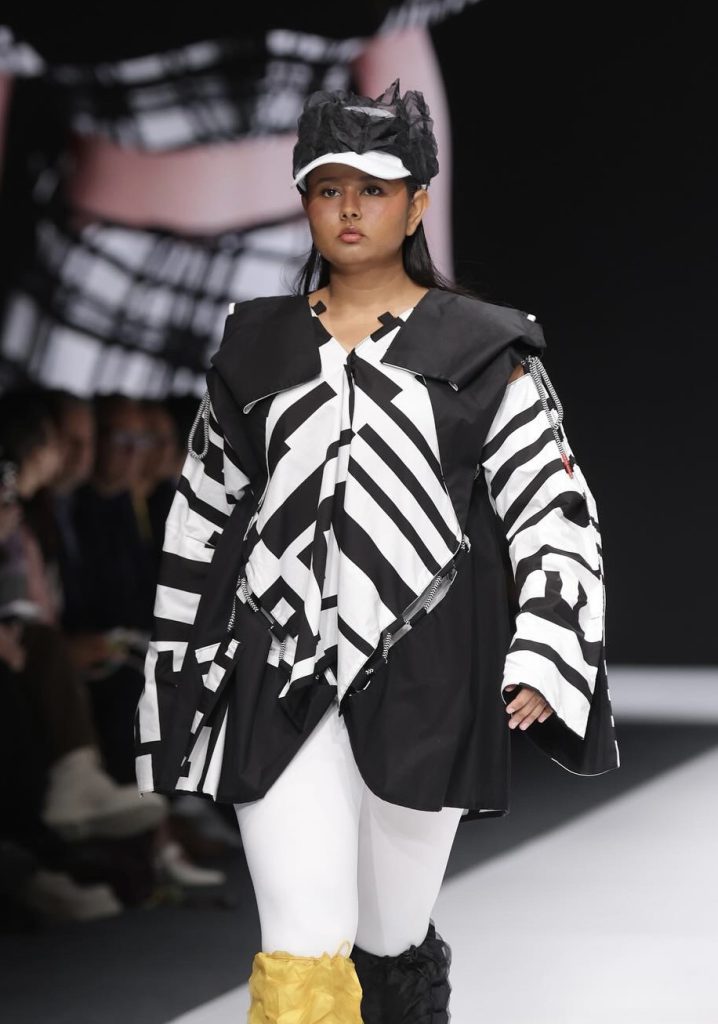
Vasudev as a runway model for the Redress Design Awards in September 2024 (Photo courtesy of Sakshi Vasudev)

Vasudev joined ‘Self Management Hong Kong’ last year, a modelling agency, which hires diverse models and represents them globally. She is the first plus-size model who joined the agency. 

She was previously signed to ChubbyChubby – Asia’s first plus-size modelling agency – from 2022 to 2023. 

“I reached out to ChubbyChubby after seeing their TVB interview. Being Indian and curvy puts me on a unique edge so they were eager to sign me on. Their whole message was to be the first plus-size modelling agency in Asia and they want to change the norm in the industry,” she says.

Vasudev has modelled for many different brands such as makeup company Charlotte Tilbury, a luxury designer clothing brand Emma Wallace, and has walked the runway for Hong Kong based fashion brands Redress, The Hive, and Harmony HK.

“Traditional models are booked easily for editorial shoots for high end brands like Elle. Plus-size models are usually booked for active wear, lingerie, and upbeat, lifestyle types of photo shoots. These are usually for brands who want to showcase diversity,” Vasudev says.

Colored plus-size models usually get jobs once every two to three months. 

“Hong Kong is not quite there yet in terms of diversity and inclusivity,” the model says.

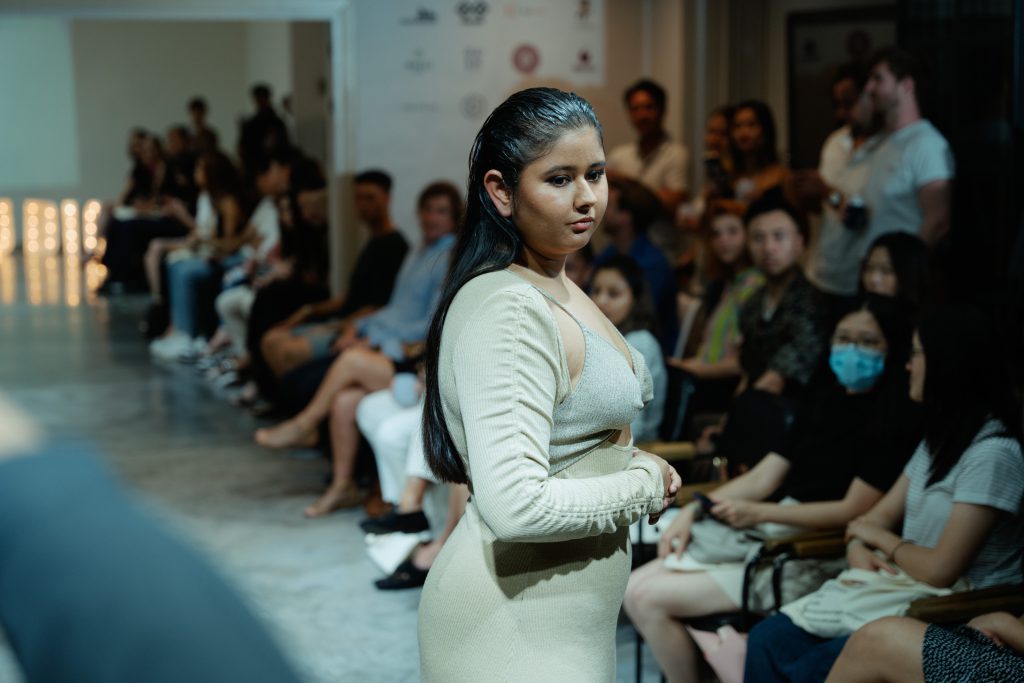
Vasudev (left) for Rising Lotus (Photo courtesy of Sakshi Vasudev)

In 2020, Jill Kortleve was the first plus-size model to walk for the French fashion house in over a decade.

“I believe the West is more open to plus-size models. Hong Kong is much slower. Since the pool of models here is quite small, brands prefer booking traditional models,” Vasudev says.

Precious Lee is one of her favorite plus-size models.

“I watched an interview posted on YouTube in which Lee talked about how she started walking for Versace. She told her agent that she wanted to model for Versace and they laughed at her. A few years later, she walked for Versace and became Donatella’s favorite,” Vasudev recalls. 

This serves as inspiration for Vasudev.

Vasudev shares that high-end brands such as Chanel do not care about diversity, but more about brand image.

“There aren’t a lot of plus-size models modelling for luxury brands. I want to break that stereotype and model for Chanel one day,” she says.

Vasudev started modeling in 2019. She was 18. She especially loves walking runway shows.

“There is a certain type of energy I get on the runway. The moment you put me on a runway, I get a lot of confidence. I love it because you can showcase your personality and listen to music,” she says. 

Vasudev auditioned for and was selected for a winter show by Harmony HK – which is the first diverse model agency in Hong Kong and Asia, representing models from all backgrounds, races, ages, shapes, and the LGBT community.

“Once I stepped on the runway, people cheered for me and it gave me such a confidence boost, because for my entire life I was always considered as not the prettiest one. I was seen as too fat, or I was always behind the shadows… I just wanted to try it out. I wanted to prove to people that people like me can be on the runway,” the proud model recalls. 

Vasudev as a runway model for the Hive (Photo courtesy of Sakshi Vasudev)

Being in the public eye means that Vasudev is no stranger to criticism. 

“I once posted a reel of me walking and in the video you could see my stomach jiggling. I got a lot of negative comments from people, mostly guys, telling me to ‘go to the gym’. It really showcases how quick people are to judge,” the model says.

“Although the comments did affect me a bit, I’m here to walk and you’re [netizens] here behind your fake accounts while I’m getting rich,” she adds.

Vasudev recalls her high school days when she was affected by the names her peers called her.

“I started hiding myself in cardigans, even when it was very hot outside. I never wore dresses or skirts, I was always in jeans and t-shirts,” she says.

“Subconsciously, there’s always a part of me that says ‘you’re fat’. I grew up chubby, I didn’t suddenly gain this weight. There were times that I lost weight and then gained it back. Now it doesn’t matter if I am fat. I want to be the strongest version of myself physically and mentally,” she adds. 

Vasudev is on a mission to prove people wrong and spread the message that everyone is beautiful in their own way. “If you know yourself and your health is okay, there’s no pain, and the doctor says you’re good, then everything is fine,” she says.

Vasudev reminds aspiring models to be persistent and urges them to keep trying.

“You’re going to get rejected and that’s ok. Don’t take it personally. Keep developing yourself and your skill sets. In a world of constant nitpicking, people constantly try to throw you down. Take that as motivation to get better,” she adds.

Edited by Lunaretta Linaura

Sub-edited by Cindy Lee

More than Pets – Editor’s Note

Our May 202r issue – More than Pets is now published.

Pets have become family members and friends of their owners bringing them joy and companionship. Pet related businesses have grown in recent years ranging from afterlife service, pet salon to pet insurance. 

Varsity talks to business operators which provide funeral service for pets to learn the latest updates of the industry.  Reporters find out tailor-made packages of funeral services are available for pet owners with different religious beliefs. Cremation service, funeral ceremony, souvenirs in memories of pet owners’ beloved flurry friends are all covered in these service packages. 

While some animals are loved and cared for, the unfortunate ones struggle to survive. A former café operator Siu Lam-lam, the owner of Duncan’s Cafe in Mong Kok took care of up to 30 stray cats at one point. 

She put cats in her café and her home to take care of them. She also helps them find new owners and feed stray cats.  Cat lovers flocked to her café weeks before its closure in late March. 

This issue is a reminder that pet owners determine the fate of an animal’s lives. They are more than pets and should be treated with love and care.

Other stories featured in the May issue include stories in both China and Hong Kong. 

Varsity reporters look into an abandoned mine turned Cafe that has become popular, protestors involved in the White Paper Movement and their current state, smokers in Shenzhen ignoring anti-smoking rules and micro drama regulations in the Mainland.

As for stories in Hong Kong, we have stories about students doing self-study in Disneyland, secondary school students doing bodybuilding, the Community Care Service Voucher Scheme and the story of Hong Kong’s first plus-sized model.

Our May issue gives us more insights on both the Chinese and Hong Kong Community. Let’s take a look at the world around us. 

Enjoy your read!

Cindy Lee

Chief Editor