
















Home Blog Page 5

Tighter control over micro drama industry in China

By Isa He

Rigid micro drama regulations may curb creative freedom.

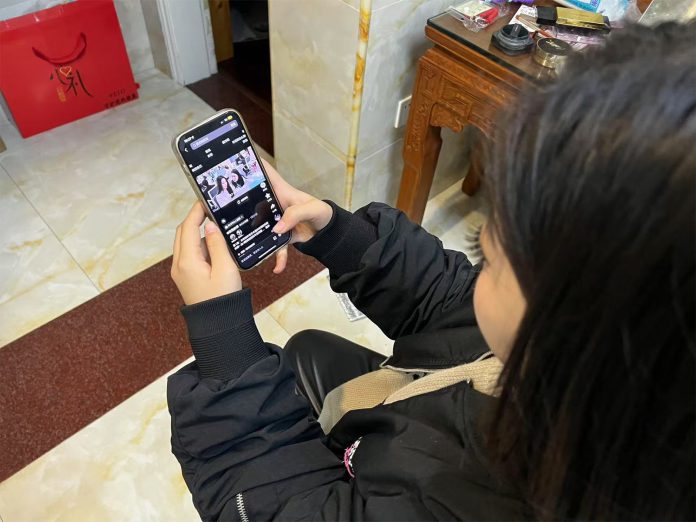
As a crazy fan of micro dramas, Cai Hanjun, a 20-year-old university student, watches micro dramas on Douyin for about one to two hours every day.

Hooked to her phone screen, Cai loves micro dramas – vertically shot, minute-long episodes featuring frequent plot twists. She enjoys genres like romance, suspense, and comedy, with a particular preference for stories about reincarnation and revenge. 

“There’s one micro drama I really like, which is about a woman coming back to life and taking revenge on her husband who hurt her in her first life. It felt really satisfying and I was addicted to watching it,” the student living in Wuhan says. 

As of June 2024, the number of Chinese micro drama viewers reached 576 million, accounting for 52.7 per cent of the total internet users in the country, according to the China Netcasting Services Association (CNSA). 

In 2024, revenue from the micro drama market reached RMB ¥50.40 billion (US $6.93 billion), surpassing the box office of Chinese movies for the first time, according to DataEye, a digital research firm based in Shenzhen. 

The firm also estimates that the micro drama market will surpass RMB ¥100 billion (US $14 billion) by 2027.

Whilst the popularity of these ultra-short, binge-friendly micro dramas has been booming in recent years, they have also brought scrutiny from the government.

Since 2024, the National Radio and Television Administration (NRTA) has tightened regulations on micro dramas by introducing new rules on content review, theme direction, and platform responsibility.

On February 5, it released a notice that a classified and three-tiered review system based on production themes and budgets has been established.

Key micro dramas, with a budget of RMB ¥1 million (US $136,729) or more, or involving sensitive topics such as politics, military affairs, diplomacy, or national security, must undergo national-level review. 

Regular micro dramas, with a budget ranging from RMB ¥300,000 (US $41,018) to RMB ¥1 million (US $136,729), are reviewed by provincial-level radio and television authorities. 

Smaller productions with a budget under RMB ¥300,000 (US $41,018) are supervised by streaming platforms, which are responsible for internal content review, copyright compliance, and routine reporting to regulators.

Noting that the new regulations aim at fostering industry growth and ensuring stricter governance, the NRTA requires all micro dramas to hold an online drama distribution permit and display a government-issued license number. It also introduces a “white list” system banning unlicensed content from being promoted or monetised.

It adds that the new measures hope to prevent the industry from over-commercialisation and encourage content that aligns with public values and social responsibility.

Due to the regulations, Cai noticed that the type of “satisfying” dramas she likes has become harder to find. “I used to see a lot of dramatic plots. Now, it’s harder to come across them. It’s a bit disappointing,” she says.

“The shows I watch do have distorted values. And yes, some dramas could negatively affect people’s thinking. So maybe regulation is necessary,” she says.

But Cai does not like the government’s tighter control over micro dramas, as these policies dampen creative freedom. “It makes people feel restricted… I hope they won’t interfere too much so there is more creative freedom,” she adds.

When asked about her view on the three-tiered review system for micro dramas, she says, “As long as I’m not restricted, I want to be in the group that can watch everything.”

The industry regards the new regulations as a watershed that micro drama is shifting from rapid, unregulated growth to a stage of stricter policy guidance and compliance. 

Li Tao, the founder and CEO of Fengxing Culture, a micro drama firm in Xian, western China, sees the new regulations as a turning point, signaling both official recognition and rising expectations for the industry. 

Li Tao Participated in the Second Micro-Drama Summit Forum, hosted by micro-drama media outlet Xinwanr, on December 14, 2024, in Hangzhou .

Li points out that at the start, the industry grew wildly, resulting in many micro dramas with content being vulgar, violent, and other unhealthy values.

“It is only after the supervision of relevant departments and the introduction of relevant policies that the industry is gradually moving towards a more and more standardized direction and healthier development,” he adds.

Li notes that many micro drama production companies that fail to produce high-quality work have been eliminated by competition and market forces in the past two to three years.

He says his firm will strictly follow the policy requirements to create more content with correct values, correct guidance, and diverse topics, encouraged by the government.

Assistant professor Lin Jian of the School of Journalism and Communication at the Chinese University of Hong Kong reveals that the regulations are very much related to the political system in China.

“In China, cultural governance has been a significant part of national supervision. Because the Chinese government is a one-party system, it requires its society to be consistent with its ideology. It conducts a content review to ensure that the values are consistent with the mainstream ideology,” he says. 

“Since the market of micro dramas has grown rapidly in the past two years, many Chinese are exposed to them. And as a cultural product, it involves values and ideology, so government censorship will come in,” he adds.

Lin stresses that the industry has a wealth of experience in dealing with government regulations while maintaining freedom of creation, and supervision of micro dramas is much more complicated than that of films.

“Even though those regulation policies are now introduced, the production of content on the internet is freer compared to the production in traditional media. Wheth
er an internet company or a government department, they don’t have enough time, manpower, or capital to conduct a detailed review of every piece of micro drama content, unlike a movie review,” he adds. 

Stating that the three-tiered micro drama review system can enhance the efficiency of the reviewing process, Lin hopes that the review system can be better defined and polished. 

“It is necessary to regulate cultural content, especially the production of the so-called mass culture and popular culture. But the question is how you establish a transparent review system, the human factor of the current review system is still relatively large, and its boundary is not very clear,” he says.

Edited by Yika Ng

Sub-edited by Lunaretta Linaura

Paradise Lost for Stray Cats

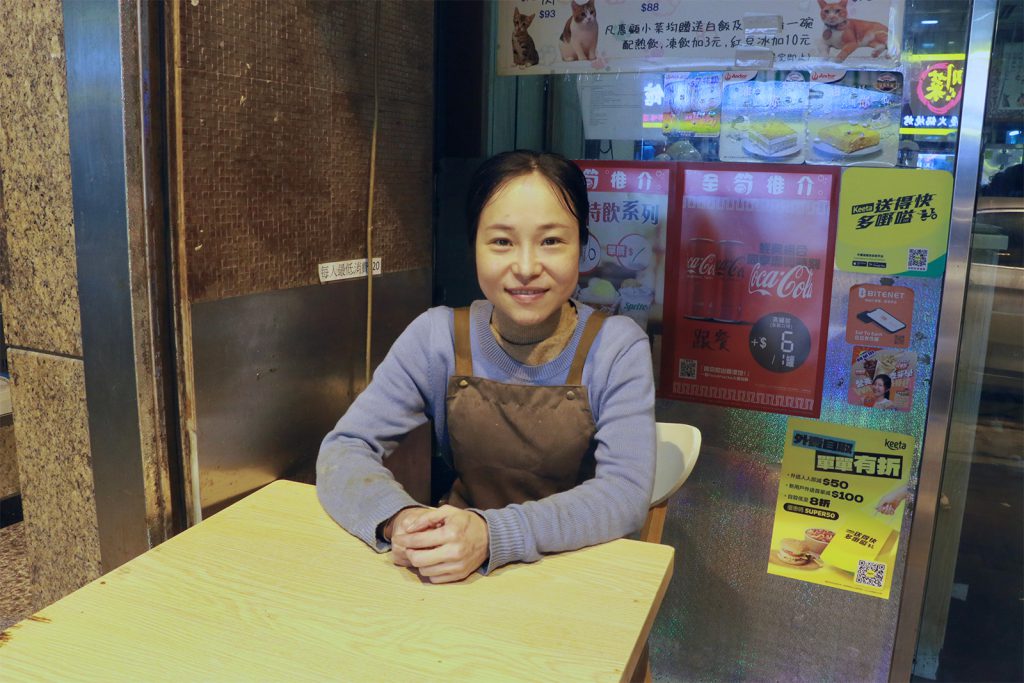
Siu Lam-lam, the owner of Dundas Cafe, reflects on her journey of making her restaurant a foster house for stray cats. 

By Whitney Kwok

Former restaurant owner Siu Lam-lam is now devoting all her time to care for her beloved furry friends, as she closed down her restaurant in Kowloon. In the past nine years, the restaurant used to be a happy hang-out spot for her customers and a safe haven for stray cats. 

“My restaurant is more than just a dining place. It is a place of warmth, a place for gathering and gossiping, a place for people to share their happiness over cats, and most important of all, a place for needy cats,” Siu says with a smile.

After the closing of the restaurant, Siu takes a break from her 12-hour work schedule and spends time with her 30 cats at home. 

Dundas Cafe is located in Portland Street in Yau Ma Tei.

Siu continues to help needy cats by keeping in contact with other stray cat feeders she knows. 

“I told them to help me feed stray cats in the area where I used to feed them, and to feel free to find me if they need any supplies,” she says. 

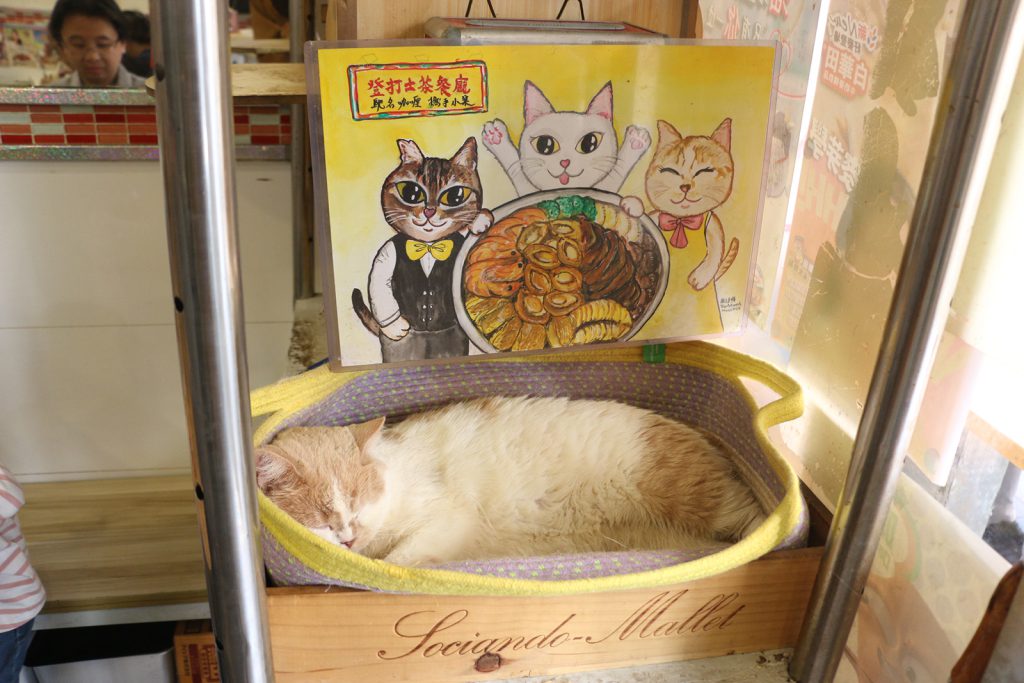
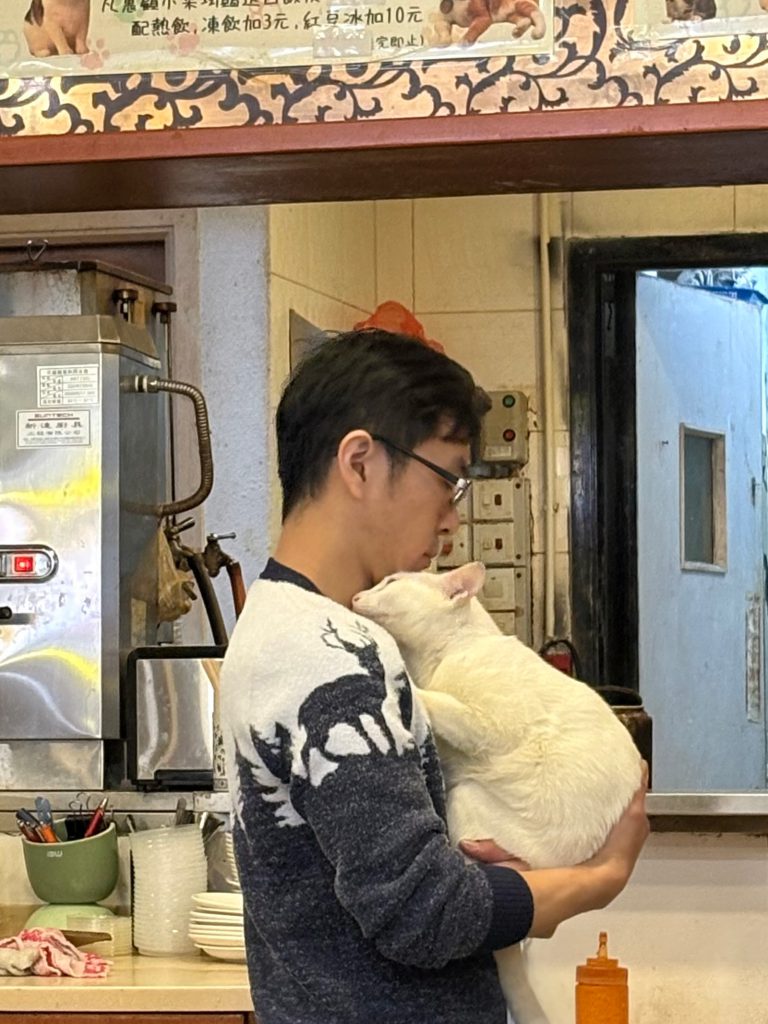
Three “cat managers” Eggplant, Cotton Candy and Milk Milk, have also retired from Dundas Cafe, a Hong Kong-style cafe in Mong Kok.

“The cat store managers will continue to stay with me, and receive training for the next job,” Siu says with a laugh, adding that she took care of 18 cats in total at the restaurant when at its peak. 

Since 2016, Siu has helped at least 286 cats find a home, clearing most of the stray cats in the area around her restaurant. An average of about HK $7,000 (US $902.26) was spent every month on veterinary medical treatment, cat food and other expenses. 

Siu Lam-lam, the owner of the restaurant.

On March 7 2025, the restaurant owner announced on Facebook that she was going to close down the restaurant at the end of March due to economic downturns after nine years of operation.  

At the time, there were still about 30 foster cats seeking adoption, and 19 of them were soon adopted, three weeks before its closure. 

Siu conducted home visits before handing over her beloved cats to their new owners to make sure the cats would be well-taken care of, even during the preparation to wind down her restaurant.

“Having a secure safety net on all windows is a must, the regular mosquito net or a magnetic one is not enough, as cats can easily scratch them off,” she adds.

She also checks if potential adopters have prepared cat necessities, including cat food, litter and medicine, before handing her cats to them. 

“Every adoption is like arranging a marriage for my daughters. I don’t arrange adaptation just for the sake of giving away the cat, instead I want to find a safe, loving and warm home for every one of them,” she says. 

A donation box was placed in front of the cashier. Many customers showed their support by donating money to the restaurant. 

Siu requires pet owners to send her photos of the cats to make sure they are settled well. 

“Seeing how cats changed from being skinny and sick, to becoming princes and princesses in their homes makes me realise that all my efforts and time spent are worthy. It brings me joy that money cannot buy,” the cat lover shares.

Siu keeps the rest of the cats herself because of their old age, adding that the remaining cats are 12 to 18 years old, equivalent to over 60 years old in human age. 

“Old cats cannot adapt to new environments easily and might feel stressed about moving to new places,” she says, adding that cats can suffer from issues like inflammation.

Having recently moved into a new and bigger flat to accommodate her 30 cats in mid-March, Siu recalls her cat story that began in 2017.

When Siu dumped rubbish in a back alley after work, she saw skinny and sick stray cats digging for food in the trash. 

“A pack of cat food did not cost much, so I started feeding them regularly after work ever since,” Siu recalls.

“More and more cats started to go to the spot where I first fed them. After a while, some cats allowed me to pet them, so I decided to take them in to stay in my restaurant and take them to vets for medical treatment, ” she adds. 

The café was then known as the “affordable cat cafe” in the neighbourhood. While most cat cafes serve western dishes for over HK $100 (US $12.85) and charge an extra entrance fee of around HK $50 per hour (US $6.43), the Cha Chaan Teng provides a large range of Hong Kong-style food including dish rice for around HK $50 (US $6.43) and side dishes range from HK $70 to $100 (US $9 to $12.85). 

“We lost some regular customers because they were concerned about hygiene. But many cat lovers started coming to my restaurant,” Siu recalls. 

Cotton Candy was one of the cat shop managers.

While Society for the Prevention of Cruelty to Animals, Society for Abandoned Animals and other charity groups are active in handling stray cats, the number of abandoned animals continues to increase as owners surrender their pets due to various reasons such as pregnancy or newborn baby, immigration and housing issues according to the Agriculture, Fisheries and Conservation Department.

There are also reports about the abuse of stray animals. Under the Prevention of Cruelty to Animals Ordinance, the maximum fine is HK$200,000 and carries a maximum imprisonment of three years if found guilty of cruelty.

“Some people might pour alcohol or put rat poison into food bowls for cats, so I usually stay for an extra hour after work. I return home at around 1 to 2 a.m.,” she recalls. 

Her friends and customers also took the stray cats they found to the restaurant.  

“My customers took cats from all 18 districts to me, as they trust me. Some are even from Mui Wo and Cheung Chau,” the former restaurant owner says. 

Siu is concerned about whether it is ethical to keep store cats, as she has rescued at least 20 abandoned store cats in the past. 

“I don’t understand why some store owners just abandon their store cats when they close down. They are loyal employees who work for free,” she says.

“Still, some store owners treat their cats as their children and keep them at home after closing their business,” she adds. 

The restaurant announced on Facebook that it would be closing down on March 31 after nine years of operation on March 7, 2025. (Screenshot via Facebook)

Siu reflects on her nine-year journey with mixed feelings.

“Many friends greet me as I go to work every day. I will definitely miss this neighbourhood after the closure of my restaurant,” she says.

“I hope that me and the cat shop managers can get back to a restaurant soon, so that we can sell food while rescuing cats and meeting new friends,” she adds. 

“But now let me take a rest, relax and play with cats at home first before considering future plans,” she says.

Edited by Daniel Koong

Sub-edited by James Cheang

Gym Class after School

Dedicated secondary school students share their inspiring story of bodybuilding.

By Justin Tai

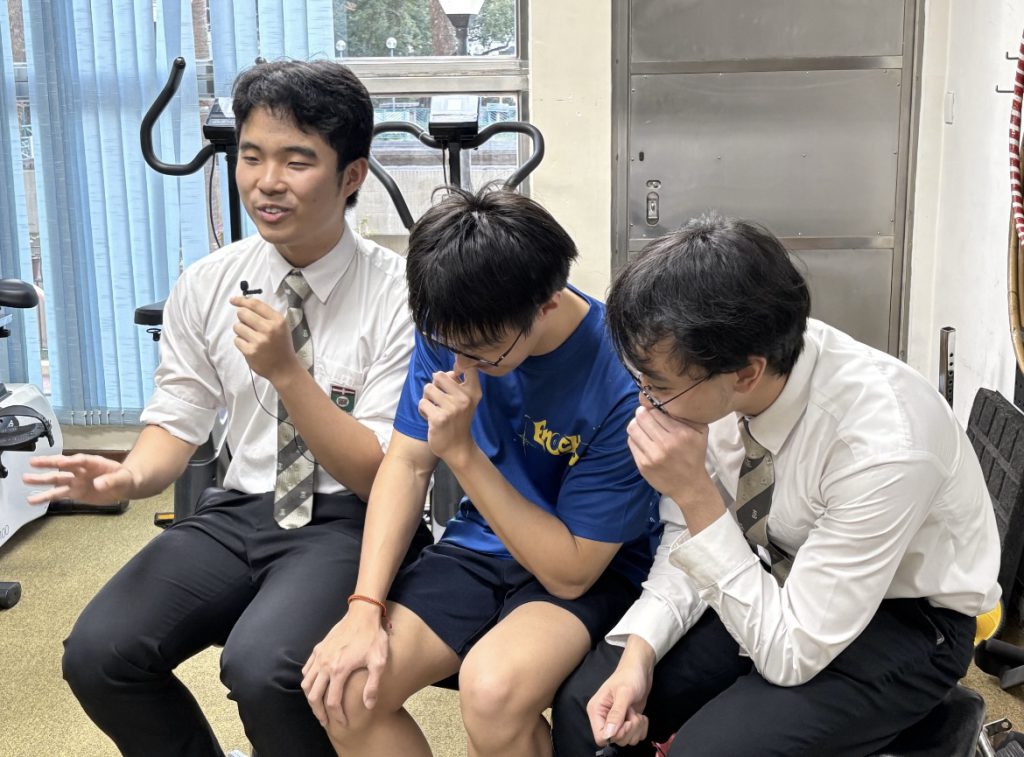
A rejection from a crush may lead to a broken heart. But to Huang Wang Yu, it can be a source of power in the gym. The teenager started bodybuilding to mend his broken heart when he was 15.

“Being rejected turns out to be a good thing that makes me embark on my fitness journey,” the Form Six secondary school student recalls with a smile. 

Huang Wang Yu (left) during the interview.

As the leader of the Bodybuilding and Fitness Society of Salem-Immanuel Lutheran College, Huang, now 18, has a six-day workout routine, in which he starts off with training his chest, followed by back on the second day and legs on the third. 

“Each exercise is repeated for four sets until I reach my limits, a cardio-session is also added in each workout, which lasts around one-and-a-half to two hours,” he shares.

The cycle repeats twice a week with just one rest day in between.

  • Huang is doing bicep curls.

Apart from Huang’s daily workout routine, he does not let his guard down on his diet as the goal is to keep fit and lower his body fat.

“My diet is bland and boring, I’ve been consuming as little rice and oil as I can, and my diet is mainly composed of meat and vegetables,” he shares.

  • Huang’s daily meal during the pre-competition period. (Photo courtesy of Huang)

In July 2024, his school held an inter-school bodybuilding competition. The 18-year-old won second place.

“The feeling was so crazy, because I have never thought the show would stir up this much attention from the bodybuilding community and the media,” Huang shares.

Behind the stage was not all sunshine and rainbows.

“Four months before the competition were the most tiresome and difficult periods,” Huang recalls.

With strict diet discipline, he only ate boiled chicken breast and blanched broccoli, and the amount of carbohydrates could be counted on the fingers of one hand.

“I kept eating the same thing three times a day for three months straight, let alone the six-day weightlifting and cardio routine. It was a living death,” the bodybuilder sighs.

Besides Huang’s daily routine, he also had to keep up with his studies and prepare for exams.

“It was pretty hard for me. But I decided to focus more on the competition and put away my studies for a while,” Huang recalls.

To recover muscle and release stress, Huang cut the workout routine down to three days a week just before the competition, ensuring he was in peak condition.

Having fulfilled one of his bodybuilding ambitions through the competition, Huang sees it as the beginning of his bodybuilding journey.

“I will participate in bodybuilding competitions when I am in university and win as many awards as I can. I want to be a fitness coach or a personal trainer,” he says.

While Huang started bodybuilding for a romantic reason, his gym buddy Law Tsz Shing, who just wanted to kill time by doing workout, has evolved from a shy boy to a confident young man.

“I had so much spare time that I didn’t know what to do, so I thought working out would be great, I might as well improve myself,” the 18-year-old student, who started bodybuilding when he was in Form Four, says.

“I’ve been sticking to a five-day workout routine. A week starts off with chest, followed by arms, back, shoulders, and legs, I usually do four sets of twelve reps for each exercise,” he shares.

  • Law Tsz Shing (left) is doing cable-flys.


Like most beginners, Law did not have any clue of what to do at the gym. 

“When I first stepped in the gym, I felt uneasy because I didn’t know anything about fitness and weightlifting,” Law recalls. 

The shy teenager in the first three months of lifting was guided by Huang, who encouraged him to join the bodybuilding competition.

“I was so nervous about this, especially during the two weeks before the competition. It gave me so much pressure knowing that I would be half-naked and posing in front of a big crowd,” the secondary student, who came fourth in the contest, says.

Law has evolved from once a timid and skinny boy to a man standing up on the stage showcasing his muscles.

“I wasn’t as sporty as I am today. I was more academic-oriented and I played sports just to kill time, but now going to the gym has become a hobby,” Law shares.

“I never thought of becoming a professional bodybuilder anytime soon; lifting weights is simply an interest for me now,” the 18-year-old adds.

The transformation of these young men would not have been possible without Wong Chun Man, one of the masterminds behind the school’s bodybuilding society and competition.

Also, as a gym-goer himself, Wong believes the results of working out are much harder to achieve than solving a math problem.

“I believe students who are in the bodybuilding society are very persistent and aren’t afraid of hardships. Even if you keep working out tirelessly, you may not see changes instantly. Because it takes so much perseverance and time. But for studying, as long as you revise, you can quickly see improvements,” Wong shares.

“Students can learn this important life lesson of being determined, that you must put in great effort in order to have great results,” he adds.

He points out that encouraging students to work out also helps solve their sleeping problem.

Wong, the vice-principal, also believes it is challenging for the young generations to find a particular hobby or interest due to the era of smartphones.

“Using one to two hours of your day working out at the gym is far better than two hours of mindless scrolling on smartphones,” Wong shares.

“Seeing the way students enjoy a specific hobby other than playing smartphones and getting results from it is already a great success to me,” he adds.

As the bodybuilding competition has gained traction from the public, the vice-principal decides to organize the competition again this year on 9th July.

“We have invited all secondary schools in Tai Po District to take part in the event this time, including the alumni. We hope to promote this event on a bigger scale,” he shares.

Edited by James Cheang

Subedited by Daniel Koong

Cotton Doll(dau)ghters

Mainland girls keep cotton dolls as their children.

By Jennifer Liu

To provide a home sweet home for her 16 cotton dolls, Jessica Huang’s family spent about RMB¥200,000 (about US$28887) to buy a 35 square meter flat in Hebei province.

“I want to have a home that’s just for me and my ‘children’,” Huang says, explaining that she treats her dolls like her daughters and sons.

“My parents think I am being childish for keeping and taking care of my dolls. They think I should focus on studying, and collecting dolls is a waste of time and money. They often complain that my dolls take up a lot of space and their reaction makes me feel very stressed,” the 20-year-old university student says. 

Huang suffered from depression and anxiety due to pressure from her studies and interpersonal relationships when she was a high school student. 

“But thanks to my dolls and new friends I made online to share our experience of taking care of cotton dolls, I am no longer depressed,” she says. 

Her parents bought her the flat in 2023 after learning that her daughter’s mental health had improved after she started collecting cotton dolls. 

“Taking care of my cotton dolls helps me relax. I don’t have to worry about saying the wrong thing that might upset others. I really enjoy chatting with my dolls,” the Year Three student says.

Huang chats with Cotton Doll about the boy she likes, academic and interpersonal difficulties, disputes with parents, and thoughts on the future: “I need more listeners than responders.”

Huang spends at least five hours a day with her dolls and online friends who share the same hobby. They have conversations online about various topics like doll clothes, finding photographers for their dolls, newly launched dolls and so on.

“It requires lots of effort to take good care of my dolls. I have to dress them up like the way my mother did to me when I was a child, ” she says.

Huang takes two to five of her dolls with her wherever she goes, such as the school library and cafeteria. 

“Hanging out with cotton dolls is like being with my friends or children, it gives me a feeling of company. My cotton dolls bring me peace of mind and warmth, even in unfamiliar places like restaurants or libraries where there are many strangers,” she says.

Huang says she does not want to have children in the future.

“Children are noisy and immature. It is very costly to raise a child. If I keep a pet, it will one day pass away and I will be very sad. But cotton dolls will always stay with me,” she says.

  • Huang goes to concert with her doll and takes photos with it. (photo courtesy of Huang)

The fertility rate among young people in China is continuously decreasing. According to the National Bureau of Statistics, China’s birth rate has been declining from 2014’s 13.8 per cent to a historic low of 6.4 per cent in 2023.

Another cotton doll collector, Emily Lau, 24, has already spent over RMB¥100000 (US$13800) on her 58 cotton dolls. 

Lau says she has been “raising” cotton dolls since 2018 because she finds them cute and affordable.

“When I had to renovate my home in 2024, I specially reserved space against a wall to install cabinets for my dolls,” she says.

Lau shares, doll owners are nicknamed “mama” in the cotton doll community, as these cotton dolls are not just decorations and are very important to their owners and their mental wellbeing.

“Mama” usually dresses them up, designs their hairstyles and buys them accessories,” she says.

The 24-year-old worker says each set of clothes for cotton dolls costs her several hundred yuan, even more expensive than her own clothes. She also buys shoulder bags and baby prams for her dolls.

“When I take pictures of the dolls, many people look at me with confusion. I don’t feel embarrassed because I believe I am no different from a mother who takes pictures of her children,” she says.

Just like real children, cotton dolls need to take regular showers. As cotton fillers cannot be washed directly, so “mama” usually spends a long time gently brushing off dust from cotton dolls with a soft-bristled brush or a slightly damped soft cloth.

Lau shares the production of cotton dolls is very complex and usually takes half a year to make one.

“The long waiting time makes ‘mama’ look forward to seeing her baby doll and cherish them even more, just like a mother looks forward to meeting her newborn baby,” she says.

  • Mama usually uses bags to take the dolls out. (photo courtesy of Lau)

Married for four years, Zhang Li, 33, also enjoys having cotton dolls as her companions.

Zhang lost her job in 2020 during the pandemic. Feeling lonely and anxious, she started raising cotton dolls and made many friends with similar hobbies on online platforms. 

She shares that taking photos of her cotton dolls and posting them online is an important moment for nurturing dolls and exchanging tips about taking care of cotton dolls.

Zhang often pictures her dolls in coffee shops, scenic spots, and concerts.

“I really want someone to pay attention to my dolls collection and talk to me about this. I enjoy this feeling. When I see a cotton doll post getting a lot of ‘likes’, I start thinking about how to shoot better,” she says.

Zhang has built a small room on her desk for the dolls, with tables, chairs, computers, recorders, and carpets arranged like a human family.

“I prefer playing with cotton dolls that help me gain many likes and shares on social media platforms. I tend to find them more adorable and buy them more clothes than other dolls,” she says.

Zhang says her husband respects her hobbies very much. “ He always praises the way I dress up my dolls and even helps me imagine the shooting scenes for them. He likes to collect anime figurines. We don’t have any children at the moment, and these ‘useless toys’ in the eyes of others have become our spiritual children.”

“Compared with my husband, my dolls are better companions,” she adds,“Sometimes my husband makes me angry, but the dolls can accompany and listen to me when I am angry. When I am alone at home, it’s the dolls accompanying me. The doll spends much more time with me every day than my husband does.” 

On Xiaohongshu, a Chinese social media platform, there are over 59.25 million discussions and 5.37 billion views under the “Cotton Doll” tag as of April 2025. According to Research on the Development Trends and Future Investment Analysis of China’s Cotton Doll Industry (2025-2032) by INSIGHT AND INFO, the market size had reached 11.2 billion yuan in 2023, and it is expected to exceed 15 billion yuan by 2025.

Professor Dai Ying of Journalism and Communication of Shandong University of Finance and Economics points out the popularity of cotton dolls shows girls long for warmth, companionship, and a sense of belonging.

“Dressing up cotton dolls according to their own ideas is actually creating an idealized version of themselves. Creating a “beautiful living space” for dolls is actually projecting one’s own plans and imagination for future life onto them,” Dai says.

Professor Dai also notices that “mamas” take online feedback of ‘like’ and ‘share’ seriously. 

“When data becomes a standard for measuring love, it reflects the mentality of East Asian parents who have high expectations of their children,” she says.

  • The steps needed to bath a doll. (photo courtesy of Zhang)

Edited by Cindy Lee

Sub-edited by Zora Yan

Smokers Ignore Anti-smoking Rules

Smokers turn a blind eye to no smoking sign in Shenzhen.

by Ivonne Deng

A tiny no-smoking sign that can hardly be seen is hung on a wall inside a bar in Shenzhen. A few ashtrays are placed on its bar counter.

“I know that smoking is banned in public areas including bars, but I never stop customers from smoking. Otherwise, my business will suffer,” its bartender, Zhang Jinglong, says as he passes an ashtray to one of the customers who is smoking while drinking.

“Customers can still smoke in bars and restaurants whenever they want,” Zhang, who has been working in the bar for three years, adds.

Since 2014, it has been illegal to smoke in bars and restaurants in Shenzhen. Offenders are subject to a penalty of RMB¥50 (US $6.8) if they stop smoking when being warned. A higher fine of RMB ¥200 (US $27.22) will be imposed on an offender if he or she refuses to stop smoking, and if he or she confronts officers, he or she will face a fine of RMB ¥500 (US $68.04). 

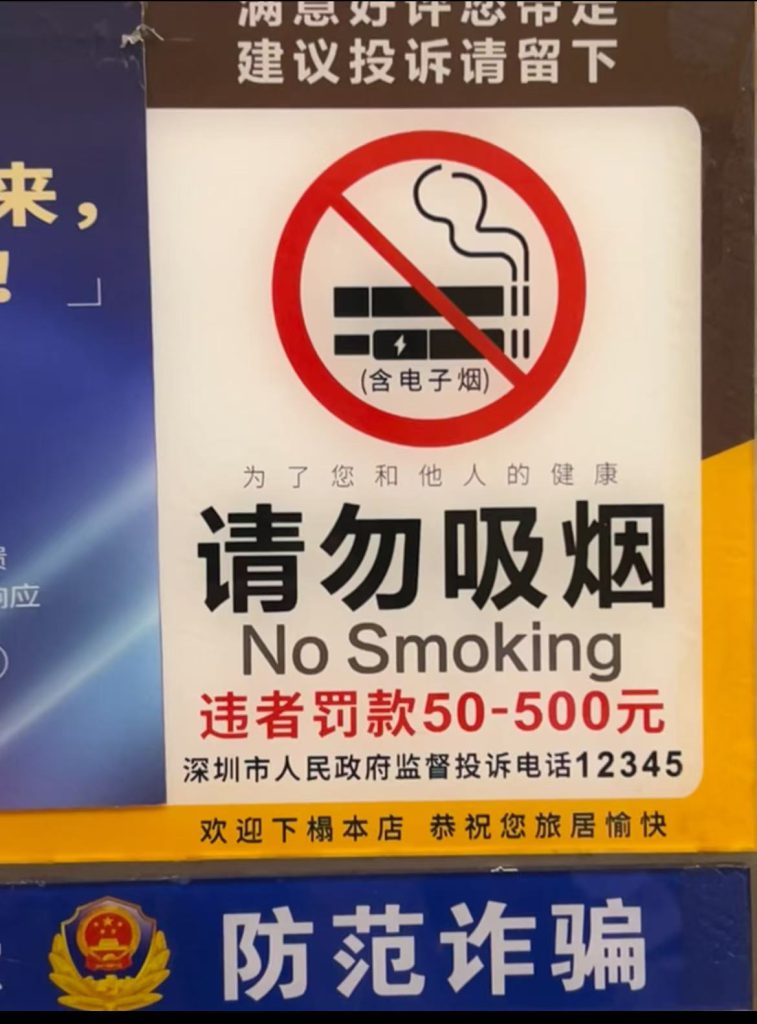
Though hidden on a wall in the bar, the no-smoking sign clearly states the fine and complaint hotline.

The no smoking sign designed by the government is posted in a hotel.

But no one in the bar in Futian, southern Shenzhen, pays any attention to the sign, including the bartender. 

“I’m also a smoker. I have been smoking one pack of cigarettes a day for eight years. The anti-smoking policy hasn’t changed my habits at all. All the smokers I know have never been fined,” Zhang says.

While allowing customers to smoke, he doesn’t worry that non-smokers will ruin the business.

“Non-smokers come to bars as well. They stay if they can bear it,” he continues.

While Zhang sees no one taking the smoking ban in Shenzhen seriously, the Public Hygiene and Health Commission of Shenzhen Municipality states that the city has the strictest smoking control policy among all cities in China.

The Shenzhen government released a special economic zone control smoking ordinance in 2014, and revised it in 2019 to include a ban on e-cigarettes.

The government claims that no-smoking signs are posted in nearly 90 per cent of indoor premises such as restaurants, government offices, and shopping malls. 

The volunteer is posting the sign in a restaurant.

University student Ni Ziyi, who often goes to restaurants and bars in Shenzhen, says that she cannot stand second-hand smoke. 

“Once I find customers smoking in any indoor premise, I just leave,” she says, adding that she does not dare to confront smokers in a bar or restaurant.

 “To avoid conflicts, I won’t stop them, and I have never seen any restaurant or bar operator do so. Smokers in China are mostly middle-aged men. They are difficult to talk to and easy to get angry. I think that is the main reason why nobody stops them,” she says.

The Year Two economics major student is disappointed when talking about the anti-smoking policy. 

“I have never seen any authority or volunteers telling smokers to stop. I don’t think anyone is enforcing the law in Shenzhen. And I don’t believe there will be. Smokers will always smoke,” she says.

But Yu Mingyun, leader of a smoking control team in Longhua District, Shenzhen, a government-organized volunteer team, says he finds there is a drop in the number of smokers. 

Student volunteers in Longhua district, Shenzhen
(Photo courtesy of Yu Mingyun)

Yu’s 20-member team patrols bars and restaurants in Longhua District once a week.

“We walk around the community, check if smoking signs are posted in every indoor premise such as restaurants and stores, talk to business operators, and stop smokers from smoking,” he says.

Stepping into a shop, Yu starts talking to the owner after checking the signs. “We are smoking control volunteers. We ask smokers to go outside or stop. Smoking is bad for health and dangerous as it may cause fire,” he says, though most business operators stay silent.

The team gives smokers pamphlets about the no-smoking policy, but rarely urges them to stop smoking if they do not want to.

The team also has to handle customers’ complaints. People can take photos of smokers in indoor premises like restaurants and upload them to a WeChat mini programme launched by the Shenzhen Tobacco Control Office in 2024. Volunteers then go to do checks in two days.

But as volunteers, they have no right to fine offenders. “Most smokers are willing to cooperate. But the only thing we can do is to give advice,” Yu says. 

“I have taken part in volunteer work for five years. We do not see people smoking in office buildings and restaurants, and all my family members and friends don’t smoke or have quit smoking,” Yu shares.

Two college students joined his team as volunteers in March, and Yu believes more young people will join him to fight smoking. 

“I know it is difficult to stop these smokers, but at least we should make an effort, and I am committed to doing this,” he says.

Edited by Bliss Zhu

Sub-edited by Cathleena Zhu

Farewell Furry Friends

Hong Kong pet owners hold tailor-made funeral service for their beloved pets.

By Whitney Kwok

In Ruby Lai’s* bedroom, a jar containing the ashes of Siu Dim is placed on a bookshelf along with a picture of her pet dog. She also made a necklace and a paw print for her sister in memory of their beloved furry friend. 

Lai euthanised her 15-year-old dog after it suffered from acute heart failure in December 2024. She called a pet hospice care service company to collect the remains from a clinic to the company’s centre.

The toy poodle’s body was refrigerated and cleaned in the centre. A 40-minute mourning ceremony was held before cremation a few days later.  

“About 10 friends and relatives attended the ceremony. During the ceremony, a video of Siu Dim’s life was played. We talked about our memories with our furry friend, then we bid farewell to our beloved Siu Dim,” the pet owner recalls. 

  • Ruby’s toy poodle Siu Dim passed away when it was 15 years old. (photo courtesy of Ruby Lai)
  • Ruby places the container with Siu Dim’s ashes in her house. (photo courtesy of Ruby Lai)

The service costs HK $1,800 (US $231.37) for the death care services, and an additional HK $1,200 (US $154.25) for the souvenirs. 

“Pets are not just toys for fun. They are our lifetime companions that have become members of our family. When a family member passes away, the remains are not just dumped into a refuse collection point,” she says.

Under the current law, there are no strict regulations on the treatment of animal bodies. Pet owners are advised to pack dead animal bodies properly in plastic bags and deliver the remains to the Public Refuse Collection Points in all 18 districts in Hong Kong, which will then be sent to landfills. 

H.K. Pet’s Hospice Care Service is one of the service providers in Hong Kong. 

“Pet owners can’t bear to just pack their beloved pets’ remains in plastic bags and throw them away. Our service can offer a venue for them to bid their pets a proper farewell,” business development manager Chillie Woerm says.

The company also offers other services such as pet memorial souvenirs, including necklaces, 3D paw prints, crystal blocks and photo frames, made with the pet’s bones, ashes or hair, which cost from HK $638 (US $81.89) to HK $2,980 (US $382.66). 

Pet memorial cabinets can also be rented by owners to store the ashes of their pets with the pets’ food bowls and toys. The annual cost ranges from HK $1,500 (US $192.52) to HK $3,200 (US $410.71), depending on the location of the cabinet. 

  • Options of pet souvenirs include necklace, 3D paw print, crystal block and photo frame , which cost from HK $638 (US $81.89) to HK $2,980 (US $382.66) (Screenshot via website of H.K. Pet’s Hospice Care Service)
  • H.K. Pet’s Hospice Care Service offers four pet memorial cabinet sites, the annual cost range from HK $1,500 (US $192.52) to HK $3,200 (US $410.71) (Screenshot via Instagram)

“Most of the cases we handle involve cats and dogs. In the last two years, we also have more clients with small-sized pets like hamsters and chinchillas,” Woerm says.

The company has also received requests for hosting funeral services for goldfish and turtles whose owners used to just flush down the toilet. 

It costs from HK $1,280 (US $164.31) to HK $8,280 (US $1062.76), depending on the size of a pet for individual cremation services. Every pet is cremated in an independent tray of its own. 

“After receiving calls from pet owners, we will collect the pet’s remains from them. Then the bodies will be refrigerated in the cold storage and cleaned in a room equipped with an Ozonized Water Disinfection System by a funeral director,” Woerm says. 

“The farewell ceremony can be tailor-made. We provide three types of rooms: Chinese styled one for pet owners who are Buddhist and Taoist, western styled one for owners who are Christian and Catholic, and a room with no religious features. Customers can conduct religious rituals of their choice,” she adds. 

The manager shares that pet owners will then attend the cremation ceremony. 

“The owner can press the button to kick-off the cremation themselves. The duration depends on the size of the pet, for example, a cat or small-sized dog takes around one to two hours. The whole process is similar to the funeral service for a human being,” she says. 

Pet owners can collect bone ashes in urns after cremation.  

  • Chinese styled room (Photo courtesy of H.K. Pet’s Hospice Care Service)
  • Western styled room (Photo courtesy of H.K. Pet’s Hospice Care Service)
  • Neutral room (Photo courtesy of H.K. Pet’s Hospice Care Service)

Philip Wong Yat-lung, deputy director of a research institute of Economics and Policy in Hong Kong observes growing emotional attachment to pets in Hong Kong has contributed to the growth of the pet service industry. 

“Pets do not let humans down and they are human’s best friends. Such value has groomed the demand for services like pet cremation, grooming, and healthcare. Urbanisation and the limited living space also contribute to the popularity of smaller pets, further fueling the market,” he says. 

In Hong Kong, 241 900 households were keeping dogs or cats in Hong Kong, with an average household size of 2.9 members, representing 9.4 per cent of all households according to the most recent Thematic Household Survey on keeping of dogs and cats conducted by the Census and Statistics Department in 2018. 

Wong points out that the annual revenue of pet-related industries in Hong Kong has continued to rise even during the pandemic and the economic downturns that followed.

The average monthly spending on cat care has continued to increase from HK $1,253 (US $161.68) in 2022 to HK $1,889 (US $243.08) in 2024, according to a survey by Exhibition Group, which organises the Hong Kong Cat Expo annually. The spending on other pets such as dogs also shows a similar trend.

“The resilience of the pet industry during challenging economic times stems from the strong emotional bond between pet owners and their pets. Pet care is increasingly viewed as essential, and owners are willing to spend on high-quality services, even during financial downturns,” he says. 

*Name changed at interviewee’s request.

Edited by Cindy Lee

Sub-edited by James Cheang

Doing Self-study in a Theme Park

Students do self-study at Disneyland.

By Flavia Zhou

Disneyland, not a library, is the best place for Chan Bai to do self-study, especially when she has to revise for examinations. 

“If I go to the library or stay at home, I study the whole day. Sometimes I am tempted to scroll with my smartphone. It is good to change the venue for my study. I can take a stroll in the theme park when I want to take a break,” the Hong Kong university student says.

After learning from a classmate that many students do self-study there, Chan bought an annual pass in October 2024, which cost her HK $1178 (US $151.74). She visited the theme park three times that month to do her study. 

“I went to the theme park alone a day before the final exam for the first time in November last year. I finished doing some revisions at that time. I only had to go through all the materials again. I wanted to revise in a more relaxing environment. The area around Grizzly Gulch is my favourite spot,” the 22-year-old student recalls.

Chan Bai’s friend shares she does her self-study at World in Frozen in Disneyland.
(Photo courtesy of Chan Bai)

“It took me an hour to go to the theme park. I studied from 2 a.m. to 6 p.m. after lunch. Then I joined the Christmas events at 6 p.m. So it was a day of schoolwork and fun. I didn’t feel stressed even though it was exam week. I will go there again to study with my friends,” she adds.

The marketing student prefers reading class notes and PowerPoint files when doing self-study at the theme park.

“I usually sit in a spot where there are few tourists around. I can listen to Disney music playing at the park. My favourite song is Grizzly Gulch Daytime Music Loop. The whole experience is very pleasant,” she says. 

Another student Lee Jiu shares Chan’s feelings about studying at the theme park. 

“I usually go there when I have to do PowerPoint slides and project reports. It’s a very relaxing experience. But when I really have to stay very focused doing reading, then I do my study in a library,” says the 22-year-old student, who has been to the theme park for her schoolwork two times so far.

Lucky Nugget Saloon in Grizzly Gulch and Big Grizzly Mountain Runaway Mine Cars are her favourite spots for inspiration when doing proposals. 

“I like brainstorming for new ideas for coursework. I always do roller coaster rides to scream and relax, and then inspiration bursts,” the marketing student says. 

Lee enjoys studying at Disneyland so much that she wants to work in Shanghai so that she can bring her work. 

Lee Jiu enjoyed Disney Firework in November 2024 after finishing her course work at the theme park.
(Photo courtesy of Lee Jiu)

Ming Yue, a university student majoring in statistics science, also enjoys going to the theme park to study. Her favourite spot is RC Racer in Toy Story Land. She goes to Disneyland to study once or twice a month.

“I go to Disneyland to write essays or statistical analysis reports. I like staying at a resting area near Big Grizzly Mountain Runaway Mine Cars and the dining area or lounge area in World of Frozen. I go there after lunch and study, from 2 p.m. to 8 p.m.,” the university student says. 

“I can finish my studies and then have fun in Disneyland. This is better than studying in a library,” Ming says.

“Seeing visitors playing at Disney doesn’t bother me. Visitors there motivated me to complete my studies faster. I usually do thrill rides after finishing my studies before returning home,” the 21-year-old adds.

Edited by Zora Yan

Sub-edited by Bliss Zhu

The Sound of Silence

Protesters who joined the White Paper Movement two years ago stay silent now.

By Della Qing

University student Skylar Ho avoids news about politics and social issues in China, despite having joined the White Paper Movement protests during the COVID pandemic.

“Nowadays, I read less news related to social issues. I do not look for news to read. I only read the news when I come across stories on Instagram. Then I still read the entire report carefully,” Ho says.

“I’m about to graduate. This semester I have no class. I feel like I’m living the life of a “lonely senior”. Every day I cook for myself. I am working on my dissertation. I read books, and watch movies and TV series. I also do exercise for an hour every night,” Ho adds.

In November 2022, thousands took to the streets across China to protest against the government’s zero-COVID measures. Students from different universities in Hong Kong gathered at the Chinese University of Hong Kong campus to protest. Holding white papers, students shouted slogans like “Long Live Freedom” and called for press freedom. Ho was one of them.

In the protest in CUHK, people arranged the candles into the shape of “1124”. (Photo Courtesy of Finley Sun)

“I followed news about the pandemic and protests closely at that time. I read and reposted angry messages criticizing the lockdown policy in China on Instagram. I think at that time we were in a powder keg about to explode,” she recalls.

“When the protest started in different cities, I spotted many messages about young people holding white papers in the protest. We had the same feeling and our hearts were connected no matter where we were,” she adds.

Ho shares she stays silent most of the time now. 

“I’m now less passionate, brave, and idealistic than in 2022. The thought of ‘nothing can be changed’ haunts me, especially when the cost of speaking out is getting higher and higher. Considering the potential risks, I prefer to stay silent. But I’m still thinking about social issues, and I chat about these with my friends,” Ho says. 

“In China, the media is the mouthpiece of the government. I think the government is trying to edit people’s memory by preaching the fairy tale of prosperity and solidarity. They do not admit that they made tons of mistakes during the pandemic era, causing many deaths,” she sighs. 

Another postgraduate student Chloe Song, who also joined the Whiter Paper Movement protest shares Ho’s depressing feelings.

“I still remember the experience of being trapped in a lockdown in Shanghai. I felt so depressed that I couldn’t sleep all night. I cried when I was lying in my bed. It’s like I was sentenced to prison. I knew maybe someday I would be released, but I couldn’t help but dwell on the tragic fact that I was in prison,” she recalls.

Song still reads news to learn what is happening in the world.

“I think it’s understandable that Chinese media outlets remain silent on issues related to the pandemic now because they are subject to strict censorship. I think this shows there is no systematic change despite many speaking out during the White Paper Movement,” the business major student adds.

“I have been hiking with my friends in Hong Kong recently. So far, I have completed hiking MacLehose Trail. I feel that when I am walking on the trails, I seem to be closer to Hong Kong. Also, I can experience the joy of sports while doing so,” Song says.

“I talk about social issues with my friends. I think the most fortunate thing about coming to Hong Kong is that I have met some friends whom I can talk freely with,” she adds.

The 24-year-old student points out that the protest highlights the fact that the people have no say in public governance. 

“I don’t think that the zero COVID policy was lifted because of the protests. The movement failed to make changes on a national level. The social and political structure remains the same,” she sighs.

“I think leaving China is the best option, as there is no sign of change. Someone who was arrested during the White Paper Movement said to me: ‘Slaves cannot become citizens with civic awareness unless this generation of slaves fades’ after being released. This friend of mine has applied for political asylum in another country,” Song says.

Despite feeling hopeless about the future, the business major student also shares that she at least had the chance to speak up about social issues and has made friends with many like-minded people during the protest. 

“It was an unforgettable experience for me. If the movement happens again, I will still take part in it but will think twice about safety,” she says.

Another student, Finley Sun, is about to graduate and is worried about job hunting. 

A Protest Poster put up by Sun. (Photo Courtesy of Finley Sun)

“I still have a lot of things to do for my final year project and course assignments. I’m completely overwhelmed. I have no time to look for a job,” Sun says.

“I now focus on my own life. I mainly think about what to eat, when to meet my friends, when to turn in my homework, and how to plan my practice before the next running race. I still discuss social issues with friends sometimes, and I read and repost news on Instagram, but not as frequently as I did during the pandemic,” she adds.

Sun joined the protest at a Hong Kong university campus in 2022. She also held a piece of white paper in Prince Edward Station on 1st December 2022 with her friend, and they were intercepted by Hong Kong police.

The protest slogans were written on the wall. (Photo courtesy of Finley Sun)

“The police warned us saying we were involved in unlawful assembly. But later on, I checked the related ordinance, and I found out the law actually states the number of participants should be three or more. Obviously, we did not break the law. The police were just bluffing,” she says.

In January 2023, Chinese police officers visited her home in Mainland China looking for her. 

“But they didn’t pursue the case when they could not find me. I guess they saw my immigration record and thought I was home. After one or two weeks, my mom received a call from the police and asked her to have a chat with the officers,” Sun recalls.

“The police officers didn’t tell my mom about the details. I think they only knew my name and what I did, but they didn’t have any proof. So I just denied everything. They also did not further investigate,” she says.

“The police just took some notes and kept the arrests for 24 hours in detention. It was more like a warning. I will do it again if I am put in a similar situation. I can afford this cost, ” she says.

Sun flew to Kaohsiung and watched An Unfinished Film on December 30, 2024 alone. She cried at the end. This movie reminded her of the traumas she went through during the pandemic.

The film, directed by Lou Ye, a Chinese screenwriter and director, is a record of lockdowns that began in Wuhan in early 2020.

The film, which won the 61st Golden Horse Best Narrative Feature alongside Best Director, has not been released in China, and information about it is banned behind the Great Fire Wall in China.

“What impressed me most is that this movie is a collection of videos about the pandemic, which were posted by ordinary people and went viral online. They were deleted by authorities. At the end of the movie, there is a line saying ‘Thanks to all the people who filmed these untraced and deleted videos’,” Sun says.

Edited by Cathleena Zhu and Emma Wei

Sub-edited by Celina Lu

Transform abandoned rural land into tourist paradise

Turning an abandoned mine into a viral ¥68 million café, young people in China turn a remote village into a touristy spot.

By Christine Ge

After turning an abandoned Anji mine pit in Zhejiang Province into a cafe with a splendid natural view, the owner Cheng Shuoqin is now setting his eyes on an even bolder project by transforming a nearby forgotten landfill into a rural cultural park with inspiration from ancient oracle bone script.

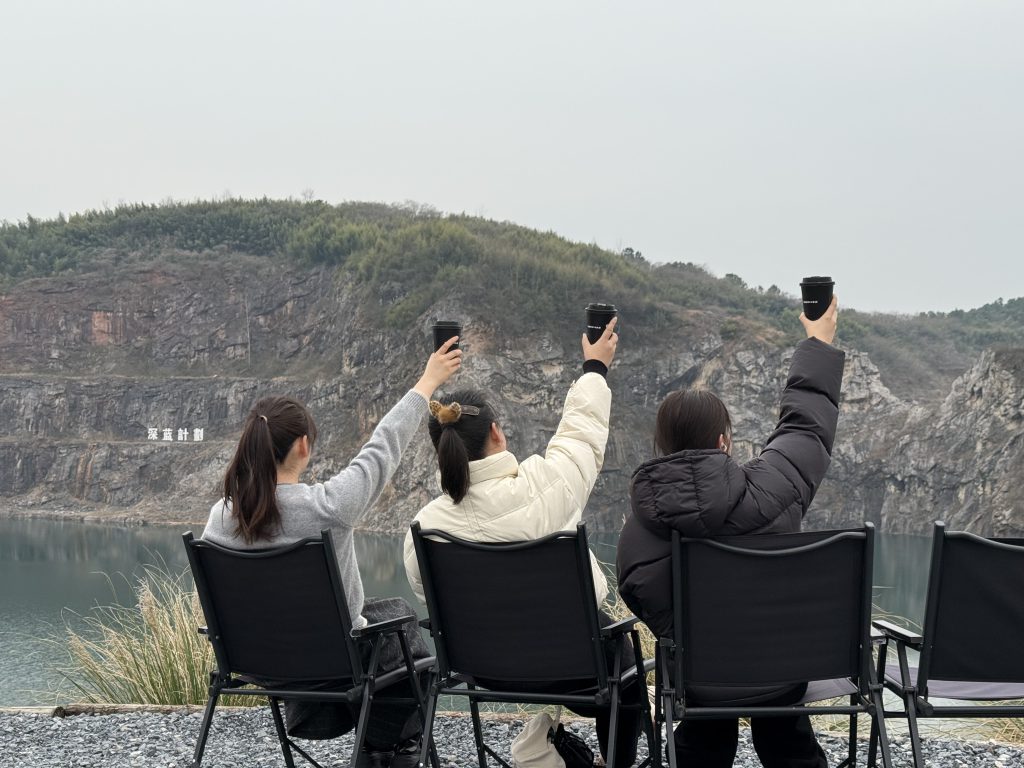
In three years, the café has earned RMB ¥68 million (US $9.38 million) and serves as a “photo studio” for thousands of visitors during weekends. All want to take a picture with a cup of coffee and magnificent scenery as the backdrop. 

During public holidays, visitors even need to queue for two hours to get into the café to enjoy the best view and take the most stunning photos.

The photo spot in Deep Blue Cafe where people queue up

“We are trying to create a space that can connect people, nature, and emotions,” Chen says, explaining why the café is established on a once-abandoned quarry pit. 

“People do not take a two-hour-long drive to a rural area simply for a cup of coffee. We turned our café into a large outdoor photo studio, a place for young people to take beautiful photos that are liked and shared by their friends so that they feel more emotionally bonded,” he says.

By paying RMB ¥68 (US $9.4), a customer can get a cup of coffee and a ticket to the fantastic view of the serene location. 

View from Deep Blue Cafe

Yet Cheng’s ultimate goal extends beyond profit, he aims to redefine rural China as a stage for youth innovation while reviving a forgotten landscape.

 “There are countless neglected resources in the countryside. Through creativity, they can become attractions that draw millions of tourists to visit not just once, but a hundred times,” the 31-year-old owner says.

While the café is now popular in China, Cheng is developing a bigger project, a series of cultural and tourism landmarks in the name of Deep Blue to promote his hometown, Anji County.

One of the first moves is to transform an abandoned landfill, just a 30-minute drive away from Deep Blue Cafe, into a cultural park. 

The Bookstore in Deep Blue Park (Photo courtesy of Deep Blue)
The Building inspired by oracle character of “Anji” in Deep Blue Park
(Photo courtesy of Deep Blue)

“In the park, we have incorporated more cultural content such as a library, an art gallery, and a building inspired by the oracle characters of the word ‘Anji’. We hope that through design and creativity, more people can see the beauty of this county,” he says.

Cheng’s café and the future park are inspired by a trend that people long to “escape the big cities” after the pandemic in 2022, with more people flocking to rural areas for outdoor experiences. 

Before being a café owner, Cheng was a teacher in a Hangzhou elementary school for two years. He quit in 2021 as he realized he had no passion for teaching and could not stand the repetitive day-to-day life. 

Back in his hometown, Cheng started the café business with a few friends. All of them were university graduates, and some were from Zhejiang University and Fudan University, who grew tired of city life.  

 “Young people like me were craving escapes that blend nature with social connection,” he says.

Tourists in Deep Blue Cafe

With a tight budget, they wanted to get the café unveiled within a short time once they obtained the government’s approval. In just 18 days, they managed to welcome their first customer on the May Day holiday in 2022. 

The officials and residents in Hongmiao Village, where the café is located, offered lots of help.  They have established a profit-sharing model which they offer the café the land in exchange for job opportunities and tourism revenue.

The villagers and the village authorities take up 49 per cent of the café’s share, whilst the café owns 51 per cent. 

Since its opening, the café has quickly become viral on social media and has become a benchmark for rural revitalization programs. 

Deep Blue Cafe

“We have received a lot of support, such as help from the local government and publicity from official media such as CCTV, which has made the café more well-known to the public. We try to give back to local residents, such as providing jobs and profit opportunities in return,” he says.

“An old lady selling shaobing, a flaky round flatbread, outside of our café earns up to RMB ¥20,000 (US $2721) daily during peak seasons. Nearby villagers have opened restaurants too. They’re happier when we’re busy,” Cheng notes.

As one of the rural entrepreneurship pioneers, Cheng is cautious about romanticizing having business in the countryside.

 “The countryside is an arena, but don’t blindly plunge into entrepreneurship,” he warns.

He encourages graduates to explore diverse roles. “You can innovate agriculture, promote cultural heritage, or use tech to solve rural issues. We need thinkers, not just coffee sellers,” he says.

Pointing out that people should explore opportunities not only in big cities but also in rural areas, Cheng says, “If we stop viewing the countryside as a ‘Plan B’ and start treating it as a canvas, young people can write entirely new stories here.”

Edited by Angel Yu

Sub-edited by Yika Ng

Aging with Dignity

The Community Care Service Voucher Scheme offers seniors a new lease on life, blending care, connection, and independence.

By Belle Yip

Going to day care service three days a week, Sean Pui-kwun hopes to grow old in his own home with his family.  

“I don’t think I urgently need to live in an elderly home,” Sean says.

Once a taxi driver, Sean is now an 89-year-old retiree. He likes wandering around the community, but the strength of his legs is deteriorating gradually. Now, a 15-minute walk is his maximum.

An accident last year made Sean understand he should keep a close eye on his health. “I fell onto the ground when leaving my building. My elbows kept on bleeding that day. My wife and my daughters were frightened,” Sean recalls.

For about half a year after the accident, he needed the company of his daughters or his wife whenever he went out for a walk or lunch. “I thought I was a burden to my family,” Sean says, adding that having day care services has revived his life as his health has slowly improved.

The accident triggered his daughters to think of finding a day care centre for their father. The daughters helped Sean apply for the Community Care Service Voucher Scheme for the Elderly (CCSV) after being advised by a social worker.

Cover of Government promotional booklet for the scheme.

Under the CCSV scheme, elderly can obtain services such as speech therapy, personal care or rehabilitation exercises provided by government-recognised organisations. The government subsidised day care and home care services based on household income. 

Sean pays  HKD$204 for each visit to the day care centre.  His family wishes the government could subsidise more.

Every Monday, Tuesday, Thursday, and Friday, Sean spends half of the day at Woopie Club (To Kwa Wan), a daycare centre in the community.

“I can still spend some time on the streets and have dinner with my wife after the centre visit,” Sean says. 

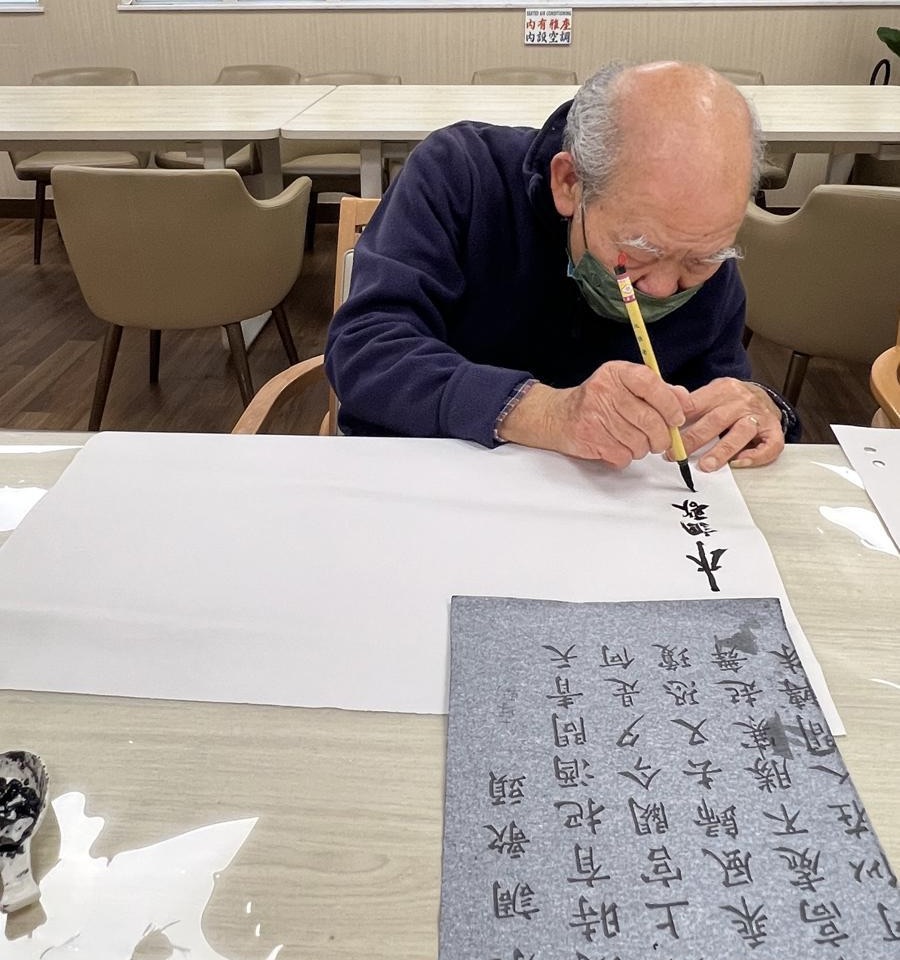
Sean loves hanging out in the centre to stay active. “I like doing calligraphy. The centre provides me with brush and ink so I can do some practice,” he says, adding that he also likes tossing bean bags and playing cards with other elderly. 

Sean is writing calligraphy.
Photo courtesy of Woopie Club (To Kwa Wan).

“It’s great for socialising and making new friends. And I feel there is something I can do and long for,” Sean says.

While Sean feels happy about his time in the day care centre, other family members share his joy and that makes the family become more harmonious.

“It’s all about having more me-time,”  Sean’s wife, Li Ching, says with a smile. 

Noting that day care services reduce unnecessary arguments, Li, in her late 70s, adds, “Life feels a bit lighter that way.” 

Yan Che-kai Brian, vice case manager of Woopie Club (To Kwa Wan), says the day care centre is just like a clubhouse for the elderly.

“They can hang out with each other to enjoy their retirement life. With similar ages, they can easily make friends with each other,” Yan says. 

The centre provides lunch and muscle-training exercises. The exercise is complementary to those provided by hospitals, which help speed up rehabilitation.

He adds that activities for the elderly are tailor-designed. Seniors with similar conditions and backgrounds have similar training. The importance is to train their cognitive ability. 

“Elderly women who used to be factory workers engage in related nostalgic therapy like gardening therapy and shoelace tying,” Yan says. 

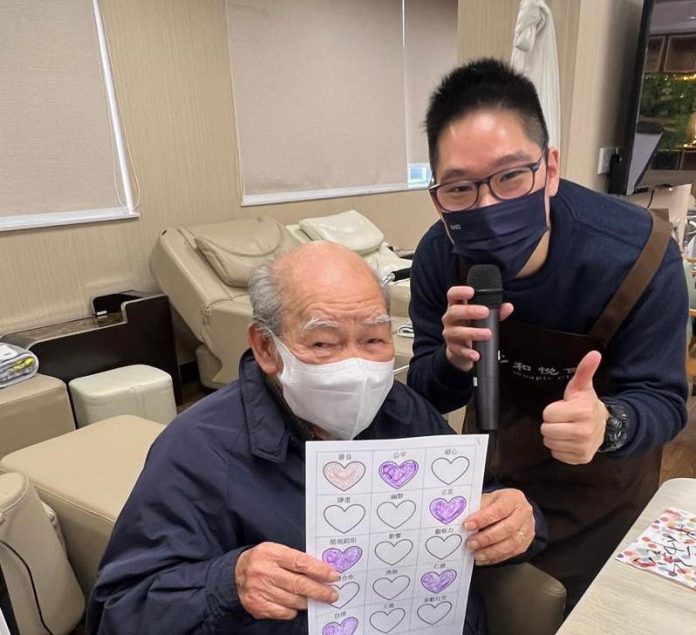
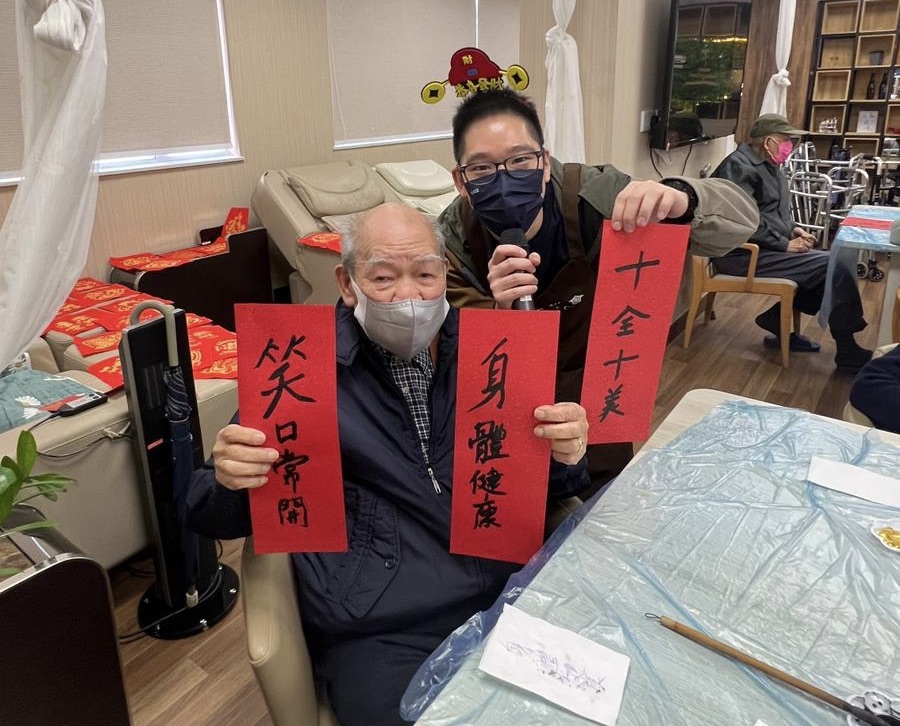
Sean (left) wrote his own Fai Chun to celebrate the Chinese New Year. On the right is Yan.
Photo courtesy of Woopie Club (To Kwa Wan).

Although many elderly people in the centre love its services, the number of centres providing the day-care service dropped after the regularisation of the scheme in 2023, according to Yan.

Yan explains that most elderly and their family members still hold the traditional belief that they prefer services like meal delivery and companionship services, and they are less interested in rehabilitative activities and cognitive training at day centres. 

Dr. Fong Meng Soi Florence, senior lecturer of Asia-Pacific Institute of Ageing Studies (APIAS), shares Yan’s observation. She points out that many elderly and their caretakers found the CCSV scheme too complicated. 

“They don’t know how to choose authorised service providers in the long list,” Fong says.  

Fong thinks it is important to educate caretakers. “Caretakers are the ones who make the decision,” she says. She points out the caretakers seldom study each provider when making a choice and not many social workers provide one-stop service for each case. 

As of January 2025, there are 297 Recognised Service Providers under the CCSV scheme as stated by the Social Welfare Department.  

Fong says some of the authorised providers may fail to provide services some elderly need and small-scale centres are unable to make money from admitting elderly under the scheme.

“With only five to six cases, the small-scale ones cannot bear the cost. They then turn to focus on other services that are profitable,” she says.

A survey conducted by the Social Welfare Department (SWD) reveals 16,402 elderly received CCSV until November 2024. Among them, only 68 per cent were using the service whilst the rest were not receiving any service at all. 

Usage conditions of Community Care Service Voucher Scheme for the Elderly (CCSV).

As announced in the latest Budget, the government will raise the number of CCSV recipients by 1,000 to 12,000 in total, involving an annual expenditure of about HK$900 million.

Fong welcomes the new move. 

 “The scheme is public service for the elderly in Hong Kong that allows them to age at home. Nothing can compare with the happiness of mingling with other elderly,” Yan says.

Edited by Celina Lu

Sub-edited by Angel Yu