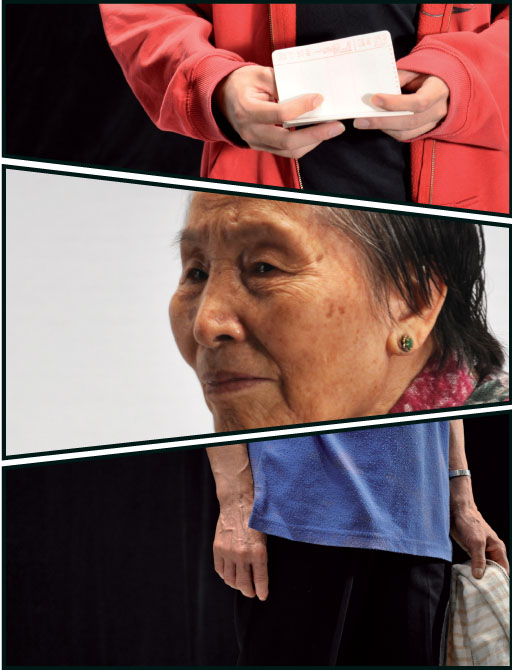












Hong Kong is a city with a rich history and multiple identities. In this issue of Varsity we take a look at some of these identities and how they have evolved and are evolving over time.



Hong Kong is a city with a rich history and multiple identities. In this issue of Varsity we take a look at some of these identities and how they have evolved and are evolving over time.
Hong Kong Mosaic
At some point in life, most people will ask the question, “Who am I?” Ethnicity may play a part, the place they grew up in, the language(s) they speak. Given Hong Kong’s colonial history, relationship with the mainland and mixed population, it is intriguing to see how its inhabitants define themselves.
In this issue, we explore how the identities of different sectors of our community have evolved with the changes in society. Often, an individual experiences tensions between different layers of their multiple identities.
There are concerns that while students are being cultivated to be more “Chinese”, the government is pumping money into promoting a one-sided view of what that means in mainstream national education programmes.
Today, new arrivals from the Mainland may be coming to settle in Hong Kong for purposes different from their predecessors. They no longer come for the better welfare or living conditions. They no longer seek to integrate into Hong Kong society as China’s rapid development overshadows the appeal of being a Hongkonger.
On the other hand, those who do want to integrate are having a hard time. Members of ethnic minorities may be born and raised in Hong Kong, but they are not completely accepted as locals. Still, some have been able to find their place here. Briton Andrew Brown is Hong Kong’s first expatriate village head, having been elected by both expatriates and locals in three consecutive elections.
Other, traditional identities of Hong Kong are disappearing. Hong Kong’s fishing industry and communities once flourished, but today its remaining fishermen struggle to make a living.
These are the people that make up the communities of Hong Kong. Whatever their identities are, they each have a story to tell. Take your time to read through these stories – perhaps it may help you to discover your own.
Managing Editor
Melanie Leung
The Best of Times, the Worst of Times
In 2010, Hong Kong rebounded strongly from the financial tsunami – the Hang Seng Index stayed above 20,000 points, GDP grew by more than 6.5 per cent and a land developer paid $68,000 for a square foot of land on the Peak.
At the same time, we also have 1.26 million poor people, one in every three of the city’s elderly lives in poverty and we lead the developed economies of the world in terms of income disparity.
Given such contradictions, we cannot help but question: what is wrong with this city?
In this issue’s Periscope, we bring you stories of people at the grassroots as they struggle to make
a living and face enormous challenges every day. We hear from inexperienced youths trying to break into the job market, from the middle-aged working poor, and from the elderly who have nothing to show for their years of toil. We see a problem of intergenerational poverty, which means long-term poverty across all age groups in a family, is developing. Intergenerational poverty is undermining social mobility and fuelling tensions and resentment within the community.
To stop things getting worse, the whole city has to act now. The government should improve the education system and offer more opportunities to youngsters. Corporations should stop exploiting workers and, instead, should show them respect by paying a fair wage for their labour. All of us should take responsibility for looking after our senior citizens as they worked hard to create the city we are living in.
During this happiest moment of the year, we should not neglect the impoverished. We all can help.
Instead of buying Christmas presents for your loved ones, why not donate the money you would have spent to charity? You can send the receipt, along with goodwill and blessings, to the people you treasure.
Let’s share love, warmth and solicitude this winter.
Herman Wong
Managing Editor

Reporters: Katherine Chan and Melanie Leung
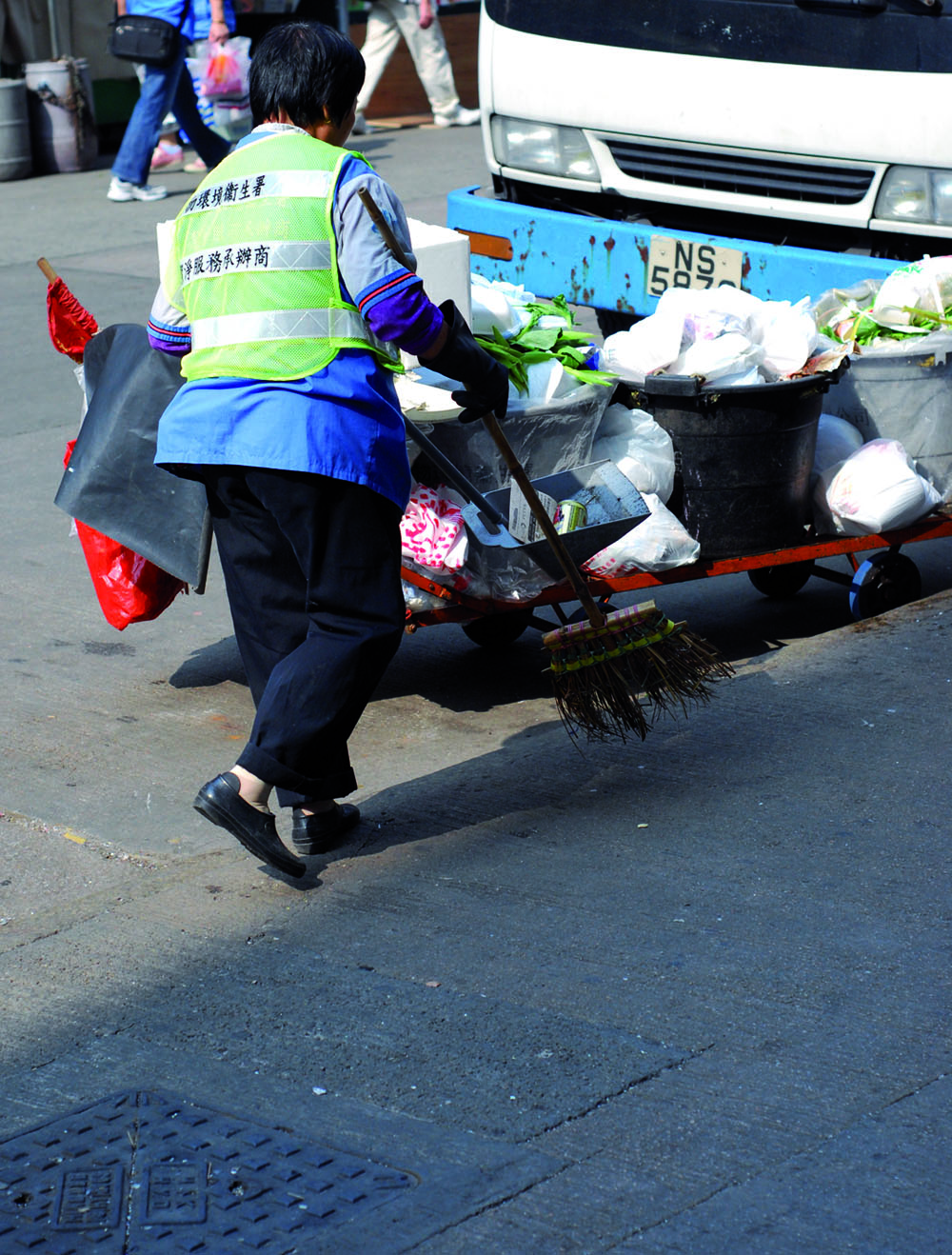
With a cap pulled over his head and a pair of black-rimmed glasses, 22-year-old Jay looks like a typical Hong Kong youngster. His eyes are glazed over with fatigue – not because of endless hours spent playing computer games but from long hours of work, day in, day out.
Jay’s father died when he was young and he came to Hong Kong with his mother and younger sister seven years ago in the hope of a better life. But things did not turn out so well. His mother got cancer two years after their arrival and Jay dropped out of school after form five.
The family survived on Comprehensive Social Security Assistance (CSSA) and Jay’s part-time job at a laundry. But several months ago, when his sister turned 18, the government cut off their payments. His sister also no longer qualifies for assistance on the vocational course she is taking.
All this means Jay is now the family’s sole breadwinner. “Suddenly, it was all down to me. It is a heavy burden on my shoulders,” he says. He now works 13 hours a day, six days a week at the laundry store for $7,000 a month. “I am a coolie,” he says.
Not only does he have to endure long hours, but also insecurity. Jay’s work schedule is not fixed, he is never certain if he is still needed the next day. His weary, blood-shot eyes begin to well up as he quietly describes the pressure of responsibility. “Every day I wake up and all I know is I must work. If I don’t, then we will have no money. Often I feel too tired to go on, and I cry in my room.”
More than half of Jay’s earnings – $4,000 a month – is spent on rent. In order to help make ends meet, he relies on food handouts from the Tung Wah Group of Hospitals which are funded by the Social Welfare Department. The service provides rice, noodles and vegetables on a temporary basis. “I eat instant noodles for my dinner almost every night,” he says.
While many young people are full of hopes and ambitions at his age, Jay cannot foresee any future. He can only focus on making as much money as possible. Recently, he burnt his right hand on a stove when he was cooking at night but he dared not take a day off work or trouble his sick mother. Instead, he put on a glove and continued working.
To Jay, life offers no alternatives. “It won’t help if I think about the situation negatively. I would only be unhappy at work, and I would make mistakes,” he says. “Why should I even think about it? Making mistakes would cost me my job.” He laughs bitterly at the notion of pursuing further studies. “It’s just a waste of time. The new month is coming up, and I have to pay the rent.”
What keeps Jay going is his family.
Once I realise that I am not working for myself only, but also for my mother and sister, I get over it,” he says. Now he hopes things will improve if they can get a public housing flat. He counts down to the day his sister finishes studying and can share the financial burden.
Reporters: Andrew Choi Tsz-hong and Piano Ho
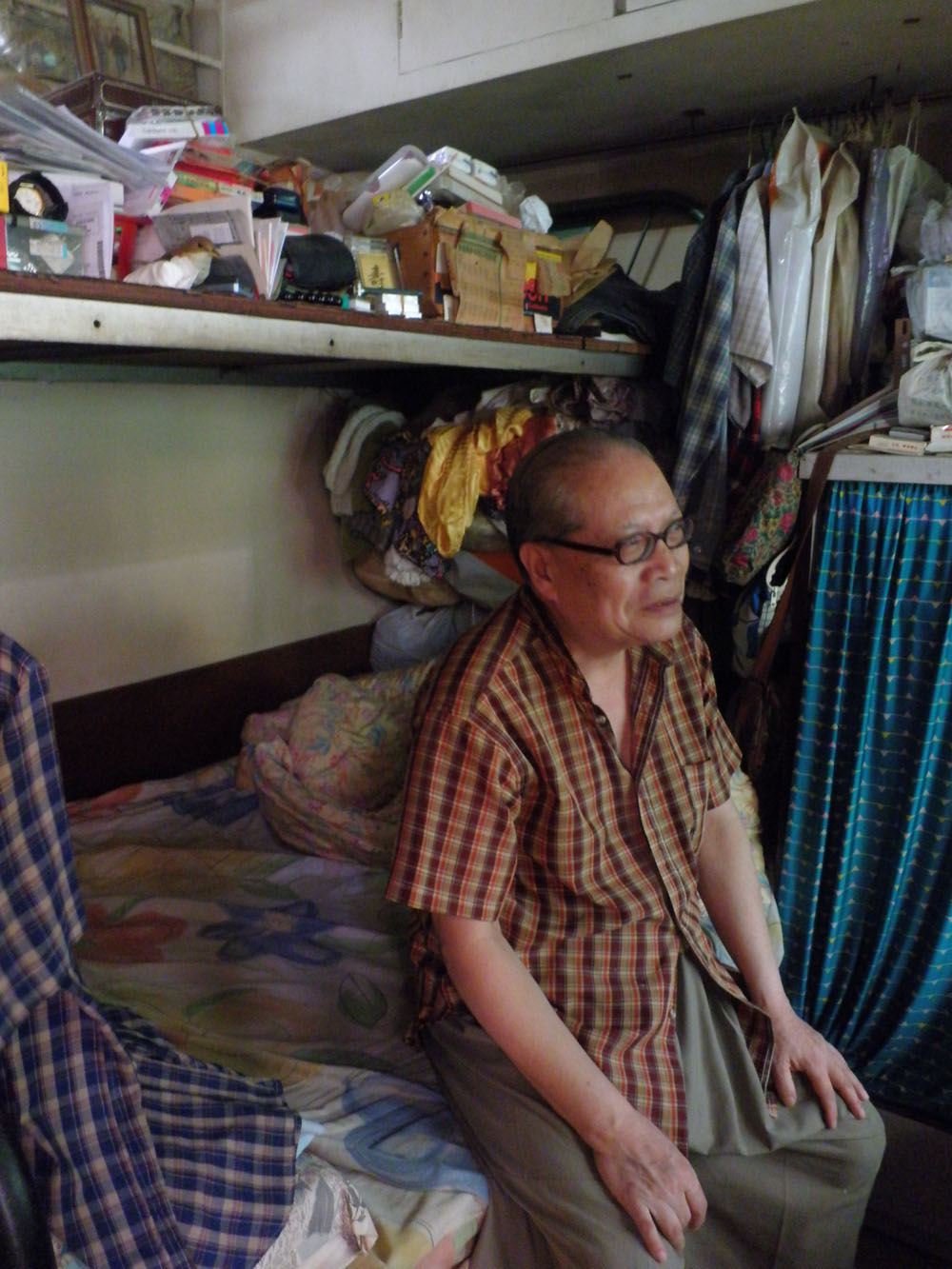
On a typical work day, 50-year old Tsoi Wai-man wakes up at around 5 a.m., gets ready and walks to the office to start his shift as a security guard at 6.45 a.m.
The shift is supposed to end at 7 p.m. but he often ends up staying longer, without overtime pay. Then, he goes home for a quick dinner and shower before it is time for bed and a night’s rest before another long day of work starts again.
“I don’t even have time to watch television. I never have my own time. I feel like I have sold myself to my boss!” he says.
His reward for selling himself to the boss is a monthly salary of $7,495 for a 12 hours a day, 26 days a month job. However, his income is unstable because he only gets to work whenever his company calls him to take up a temporary vacancy. “You work to death when you get calls. But you may get crazy waiting for the company to call you to work after a few days.”
Tsoi’s story is a common one for Hong Kong’s working poor. They tend to be people in their 40s, working 10 or more hours a day and for wages as low as $25 an hour.
A report released by the charity Oxfam earlier this year showed that between 2005 and the second quarter of this year, the number of working poor households had increased by 12 per cent to 192,500. This means one in every 10 families where at least one member is working has a monthly income that is less than half the median income of families of a similar size.
Like many of the working poor, Tsoi has a basic education level. He dropped out from school after form two and has been working for 35 years. He has been working as a security guard since 2005. It is a tough job – Tsoi summarized it using three descriptions – long working hours, low salary and harsh working conditions.
He once worked for nearly 15 hours but was only paid $307. Also, he once worked just 18 days in two months. He is barely able to maintain his daily life with the meagre and unstable income. “Sometimes, I have only one meal a day,” he says.
Security companies may require Tsoi to work anywhere in Hong Kong and he has to spend time and money on travelling to different places of work.
Tsoi is disillusioned with the security industry and has tried searching for different jobs, such as logistics clerk and outdoor office assistant. His attempts have all failed as employers prefer to hire younger, better educated workers who are willing to accept a low salary.
He also believes he has been punished for exercising his rights. Tsoi appeared in the news media when he demonstrated for better workers’ welfare. Afterwards, his then employer told him to leave, just a week before his probation period ended. “I am sure they fired me because of my actions outside the Legislative Council,” Tsoi grumbled.
But Tsoi’s worst employer was the one he had around two and a half years ago. At the time,his father, a long-term patient, was taken into intensive care. He asked for leave from work but his boss rejected his request. Tsoi had no choice but to quit his job and rush to the hospital. He was there when his father passed away.Still, Tsoi did not have enough money to buy a coffin and hold a funeral for his father. So he asked his friends and the Social Welfare Department for help.
He describes that period as the hardest and darkest time he has ever experienced. His message to employers is: “Labour is your asset, not your burden.”
Reporters: Edith Liu and Rebecca Wong
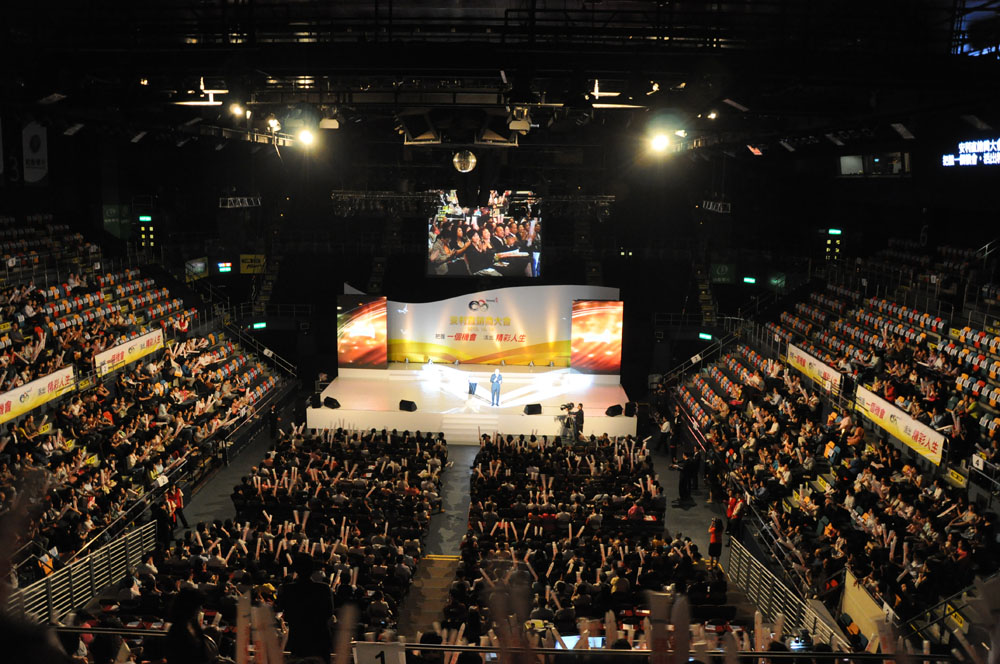
The best money saving advice may not come from financial planners, but from the 290,000 elderly people who are now living in poverty in Hong Kong.
They sit idly in the park, leaving their home appliances switched off to avoid steep electricity bills. They visit the markets at sunset when the food is the cheapest and unsold meat is occasionally given away for free. They do not cook very often because a simple dish can be stretched to feed them for at least three days.
The elderly save in every possible way. They save because they have to.
The elderly poor population has increased by 14.2 per cent over the last decade, according to the Hong Kong Council of Social Service (HKCSS). Between 2009 and the first half of this year, the elderly poverty rate rose from 31 per cent to 34 per cent, the biggest increase among all the age groups. It means one out of three Hong Kong residents aged 65 or above is now living in poverty.
The HKCSS draws the poverty line at half the median monthly household income using the Organization for Economic Cooperation and Development definition. In the first half of 2010, a single-member family with a monthly income below $3,275 would be regarded as poor, while for a three-member family, the poverty line is drawn at $10,000.
Traditionally, the elderly got by on money given by younger family members and their own savings. The government provides a supplementary benefit in the form of Old Age Allowance, also known as “fruit money”.
However, the elderly can no longer rely on the financial support of the younger generation. With the change in emphasis from the extended family to nuclear families, and the proliferation of the working poor population, it is no longer a given that sons and daughters are able or willing to support their ageing parents.
Ms Yeung, 82, lives with her son, his wife and their child in Diamond Hill. It is a working poor household and she does not expect her son to take care of her financially. “He has only given me around $3,000 in the past few decades,”says Yeung.
According to Mariana Chan Waiyong, the chief officer of the Policy Research and Advocacy of the HKCSS, the dependency ratio for working poor households like Yeung’s is higher than that for better off families.
Studies show that on average, each worker in a working poor household has to support two family members in addition to himself or herself. That is more than double the dependency ratio for the population as a whole. “We can hardly rely on the working poor to support the elderly,” Chan concludes.
By Hazel Chung Chin Ching and Vinky Wong Hiu-ying
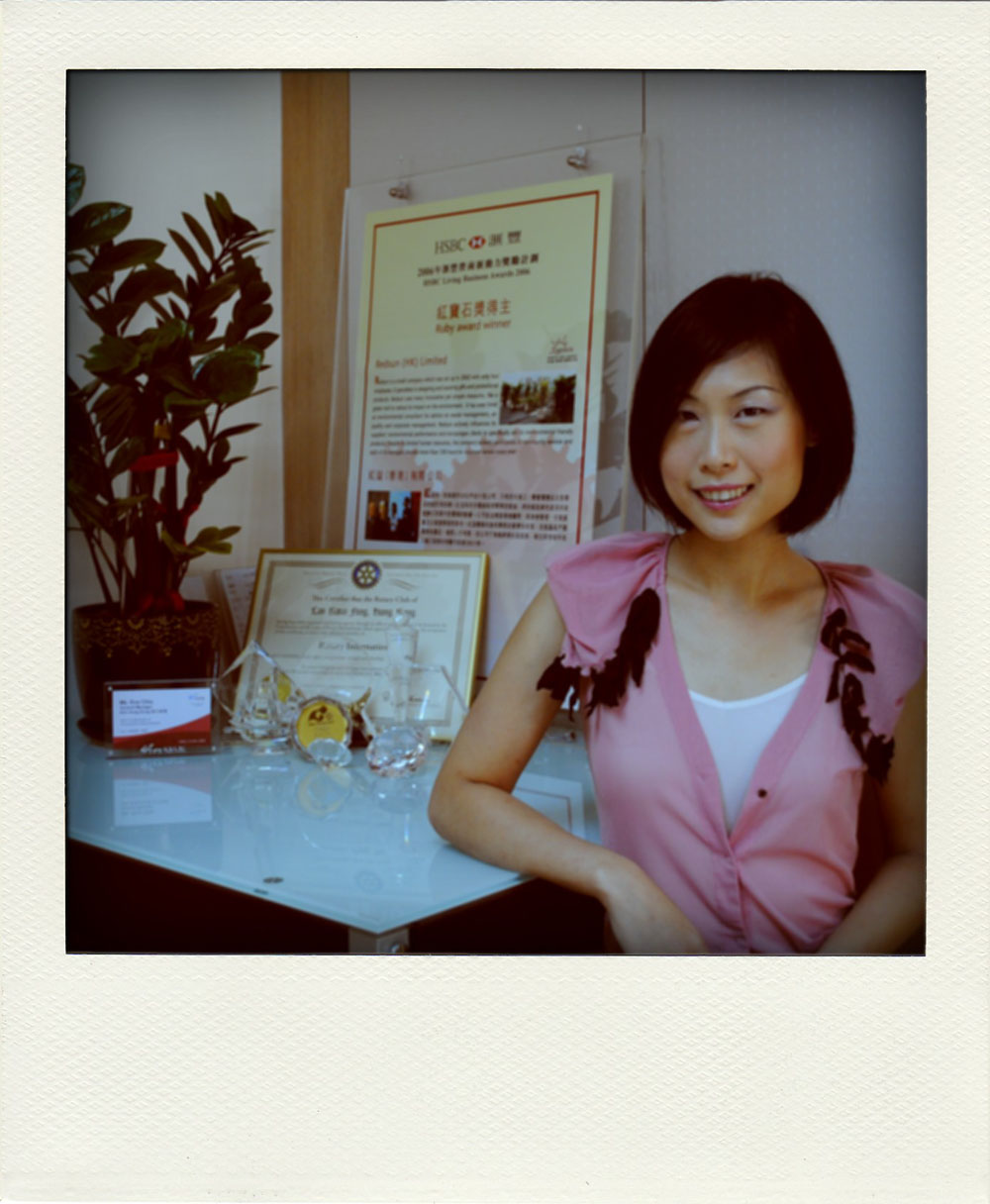
It has hosted cheering crowds for countless pop concerts and sporting events, but on this night, the audience is there to see different kinds of stars. One woman is frantically pressing the record button on her recording pen as 2,000 pairs of inflatable clapping sticks whipped up the atmosphere further. As the night draws to a climax, a voice booms out: “If you follow a fly, you will find a place to pee; if you follow a bee, you will find a tree; and if you follow Amway, you will find the successful key.”
The arena erupts in applause as the direct selling company’s Hong Kong Crown Ambassador, Anita Fu marches off the stage. This accolade is the highest achievement for Amway’s sales agents – who are known as distributors. The event is the Amway Distributor Rally and standing on the stage is the latest batch of what the company calls Gold Producers. This is the third highest level for Amway distributors and Gold Producers get to pocket 12 per cent of the value of their sales.
Some of these Gold Producers are still in their 20s; many started their Amway careers while still at university. Among them is Chan Sze-man. Chan, who is 24, studied journalism and communication at university but took a different career path after graduation. She now has a full-time job in sales and marketing, and uses her remaining time working as a part-time direct selling distributor of Nutrilite products under Amway.
Direct selling refers to the marketing or selling of products directly to consumers in their homes and workplaces. The people doing the selling are called distributors and they introduce their products through one-to-one and one-to-group demonstrations. These distributors see their operations as an independent business, although they also work as teams.
The world of direct selling has its own vocabulary and jargon. Distributors call the people they introduce to the business as their “down-lines” and those who introduced them as their“up-lines”. When down-lines make sales of a certain level, their up-lines will be awarded a percentage of their sales amount. This is known as “passive income”. The higher the sales, the higher the percentage the up-line gets.
Chan was first introduced to direct selling by her university roommate and has now been in the business for three years, In her best month, she achieved sales of $130,000 and was given a $15,000 as bonus. She says this business is an excellent part-time job.
“No other part-time job can bring you extra income of more than $10,000,” says Chan. “It is more than the salary of my full-time job.” Chan says the products she sells are inexpensive, everyday goods, so the turnover is very stable.
Chan goes further, and says being a distributor helps her to achieve her dreams. “I can build my own career instead of working for my boss’ dream,” she says. “I want to save time to take care of my family, so why not work harder for a few years so I can enjoy life later?” Last September, she paid for her family to take a trip to Beijing, an impressive feat for a just graduated employee.
At the same distributor rally, a 21-year-old university student sits in the auditorium, looking forward to being one of the people on the stage next time. Tsang Wai-ling is a third-year student of nursing at The Chinese University of Hong Kong (CUHK). After experiencing the intensive internship training for nurses, she decided the job is far too demanding.
“Nurses make a good salary and the income is stable, but you have to work under great pressure,” she says, and that is why she will first consider direct selling as a full-time job after graduation.
“The working hours are very flexible. You are not pressured to achieve a quota.” Tsang lists the advantages of taking part in direct selling, “There is a lot of training provided, including communication skills, leadership training, as well as knowledge about the products, to help you introduce products to friends.”
Reporters: Nia Tam and Beverly Yau
While thousands of graduates fill in countless job application forms and ponder their futures every year, other young people are not thinking about finding their dream job but about setting up their own business.
Becoming an entrepreneur may be the realisation of a childhood dream or simply the result of a random opportunity. Here, Varsity talks to three young entrepreneurs, who share the struggles and joys of being their own boss.
I have dreamt about being an entrepreneur since I was a form three student,” says Eva Chiu Man-wah, the founder and managing director of Etin Hong Kong Limited, a company that designs and manufactures promotional umbrellas.
Now in her early thirties, Chiu was inspired by the female characters in the financial novels of local writer Leung Fung-yee. “All the heroines in Leung’s stories are young, good-looking, talented and most importantly, have their own business,” she adds.
Given her clear sense of purpose, Chiu began preparing herself early. She realised she would need to know how to read a company financial report, so she chose accounting as an elective subject in form four.
After leaving school, Chiu got a job as an accounting clerk for an international company while studying for an accounting degree from The Open University of Hong Kong. At the company, she climbed up the ladder to Accounting Manager, and then worked in various positions in merchandising, retailing, marketing and management.
“I worked as an employee to learn the skills that every position needs. Earning money was just the second most important thing,” she says of her 10 year’s as an employee.
Chiu says those years as an employee were a great help to her when it came to starting and running her own business. She says her management style, which emphasises team work, care for colleagues and effective communication, is modelled on her experience in that international company.
Chiu’s first attempt at striking out on her own was a gift shop. It was while running the shop that she discovered there was a “concealed but profitable market” in promotional umbrellas, printed with the logos of companies and organisations or promoting their products.
So she drew up a proposal for a company to produce promotional umbrellas and submitted it to a competition called Youth Business Hong Kong organised by the Hong Kong Federation of Youth Groups.
Her idea of a physically attractive and practical promotion product won her a loan of $90,000 and advice from professionals. It gave her just the support she needed to start what is now Etin Hong Kong Limited.
Although her family saw her as an independent and capable young woman, Chiu faced strong opposition when she revealed her business plan. Her worried mother told her that she would have a stable income and a future without too many difficulties as an employee.
There were times her mother must have felt vindicated. Chiu recalls the days when she had to constantly commute between Hong Kong and the mainland and work for almost the whole day without any rest. Her weight dropped drastically as a result. Chiu says she had to sacrifice time with her friends and family, but she would not have done it any other way. “Any regrets? No, I don’t have any. I chose my own path and it is worthwhile,” she says.
Neither did she give up when confronted with her biggest challenge and disappointment to date. Not long after the global economic meltdown in2008, Chiu’s good friend and business partner suddenly left Etin and started a rival company, poaching some of the best customers. “Etin is like my baby. I have a responsibility and a sense of mission to protect it,” says Chiu.
Telling herself not to disappoint those who had supported her for so long, she managed to achieve a 50 per cent growth of business in the past year. “My business became even more prosperous after the break up,” she says.
The company is now 15 years old and has been awarded the HSBC Living Business Excellence Award – an award recognising corporate responsibility – for three consecutive years.
Chiu has reached one of her targets, to be able to buy her own office, but she says she will keep advancing herself and her business through life learning. “The hard work is worth it,” she says.
Reporter: Crystal Chui Tsz-ying
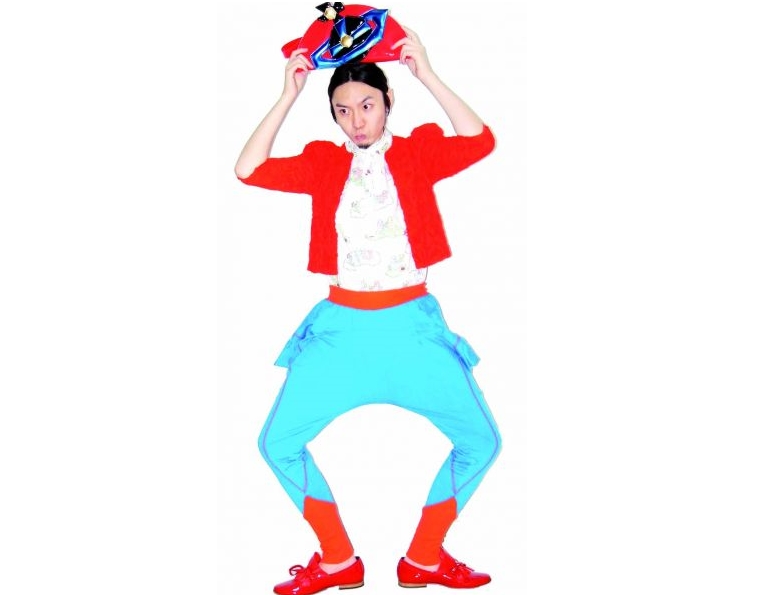
It is a weekday evening at a Hong Kong coffee shop. Men in suits and young office ladies turn their heads towards the entrance as a young man strides in. The young man’s outfit is not what we usually see men wear: a short camouflage-patterned jumpsuit with a pair of flats. He has shoulder-length wavy hair, a neat goatee and chiselled features. He is also completely unperturbed by the other customers who are blatantly staring at him.
The Guy Who Dresses Up
Joey Ma Chung-hon says he is used to attracting attention whenever he goes out. “Let it be. It doesn’t matter to me,” Ma says while chewing a mouthful of apple crumble.
His craze for fashion began seven years ago, when he was a 20-year-old student in Los Angeles. Ma says the people there wear all sorts of clothes, their various styles along with punk and EMO styles inspired him to love fashion.
Ma’s closet is anything but conventional. There are heels, skirts, dresses, an extensive collection of colourful socks and all sorts of eccentric garments and accessories. “There are some things, which if you don’t do them when you’re still young, you will regret it. You just can’t ask me to wear clothes like this when I am 30 or 40,” he says.
Right now, he has around 300 items of clothing and 100 pairs of shoes in his wardrobe. He usually buys clothes online and spends an hour surfing fashion websites each day. Ma spends an average of $10,000 and a maximum of $50,000 on clothes each month. His parents sometimes complain about the expenditure.
Since March this year, Ma has uploaded photos of his outfits on his blog titled “Individuality”. He posts up photos of himself in different outfits and from different angles. Each picture is accompanied by information about each item of clothing. The site now has posts on more than 160 outfits. In mid-September, he started posting photos on LOOKBOOK.nu, a fashion website where people from all over the world share their own street-fashion photographs.
This blogging experience took Ma’s interest in fashion to a higher level. After developing the habit of taking photos of his outfits, he now pays even more attention to what he wears.
But not everyone appreciates his efforts.
He meets friends of friends who are surprised to see his crazy outfits, and people post his photos on online forums. The posts criticise his tastes in fashion. But Ma says none of this is going to make him change his style. “Somebody even said, ‘I would beat him up if I saw him on the street.’ What they are doing is too extreme. I was sad for a while but afterwards I was completely fine,” Ma giggles as he explains. He may look proud and unapproachable in his photos, but in real life, Ma is a softly-spoken and shy person.
Ma thinks whether someone is hurt by put-downs depends on whether that person can accept himself and the outfit he is wearing. If the answer is “yes”, then he should not care about what others think of him. He adds, “Many people in Hong Kong do not have the guts to be themselves. Perhaps some men want to be well-groomed as well, but they are too shy to do so.”
Still, Ma knows there is a time and a place for him to express his individuality. He works for his family’s fruit product trading business and adopts a more sober look for his work attire. He dresses in suits for work to project an impression of reliability for his clients. He thinks this is the reason why most Hong Kong working guys stick to wearing suits and most of them rarely spend much time on grooming. Now he is a member of the working population, Ma keeps the stylish clothing and ”crazy” outfits for holidays and gatherings.