The Enriched IT Programme that will be extended to all schools
Reporters: Agnes Lam, Bonita Wong, Kayi Tsang
Editors: Edith Chung, Sam Kwong
Applications of STEM (Science, Technology,
Engineering, Mathematics) is in everyday lives. Establishment of Cyberport and
the Hong Kong Science and Technology Park has yet to turn the city into a regional
tech hub. The government has stepped up effort to promote STEM education to
breed young talents.
The Financial Secretary announced the Enriched IT
Programme in the 2014-15 Budget. The eight-year pilot programme is comprised of
Enriched IT Class Programme and Enriched IT Activities Programme. Eight
secondary schools – Cheung Sha Wan Catholic Secondary School, Christian
Alliance SW Chan Memorial College, Pak Kau College, Pui Ching Middle School, Shun
Tak Fraternal Association Yung Yau College, St. Paul’s Convent School, The
Y.W.C.A. Hioe Tjo Yoeng College and
Tin Ka Ping Secondary School, were selected to run
Enriched IT Class from 2015/16 to 2022/23 school year. It provides around HK$1 million
yearly to each participating school.
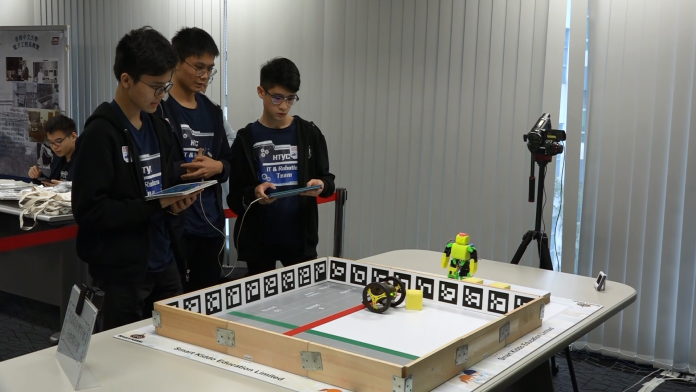
Jordan Fung, a Form Five student of EITP, CEO of
Pedosa Group, believes STEM education is vital for the future generation. “STEM
education is about equipping every student with the skills to succeed in our
society in the 21st century. It’s about how we can use our creativity to turn
our ideas turn our concepts into reality by taking actions to do so,” he says.
Godwin Wong is a Form Two student who designed and
invented BackUp, a device to measure and alert users when they have posture
problems. His design won the Hong Kong ICT Best Student Innovation Merit Award in
2019.
Students and teacher of The Y.W.C.A. Hioe Tjo Yoeng
College agree that the EITP helps strengthen STEM education.
Pui Ching Middle School allocates funds to employ
alumni to serve as tutors to help students prepare for competitions. Jonathan
So, the teacher-in-charge of the EITP programme and alumnus of the school, says
he encourages and inspires students by sharing his experiences of joining
international competitions with them.
In light of the positive feedbacks of EITP, the
government proposed to set aside HK$500 million to implement the IT Innovation
Lab in Secondary Schools initiative in all publicly-funded secondary schools in
the coming three school years.
Leung Man-kit, panel chairman in computer of PCMS, hopes
the government can acknowledge and focus on training student’s computational
thinking instead of teaching topics that are trendy but will soon be obsolete.
Anthony So Man-cho, professor at the Department of Systems Engineering
and Engineering Management at the Chinese University of Hong Kong, says STEM
education should be implemented in a more systematic way. “Basically the STEM education now the
secondary level shooting into different directions and most of them are related
to technology…I guess it calls for a more systematic approach to train up our
future STEM talents. Systematic STEM education is essential for our city’s
future development,” he says.
Performance groups in Hong Kong struggle to find performance venues
Reporters: Laurissa Liu, Kelly Chen, Alice Wang, Katherine Wang
Editors: Fangdong Bai, Valerie Wan
The West Kowloon Cultural District is the largest
arts and cultural project in Hong Kong to date. Comprising 40 hectares, the
district houses 17 core arts and cultural venues and space for arts education.
But the increase in public performance venues still fails to meet the market
demand.
Alan and Becky dance group says they had to file application for the use of Tsuen Wan Town Hall three years before the performance date.
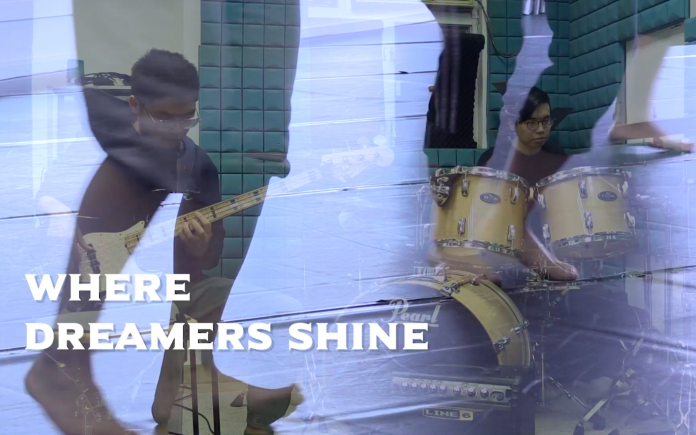
Prune Deer, a math-rock band also has difficulties finding performance venues. Like most other independent bands, they have to practice and perform inside industrial buildings.
The number of failure cases of applying for government performance venues has risen in the past few years. In the year 2015-16, 14,789 were recorded, 19,459 for 2016-2017 and 23,398 for 2017-2018, according to the Leisure and Cultural Services Department.
Established
in 1993, Passover Dance is a non-profit dance organisation. They also have
problems booking performance venues. Pewan Chow, the Artistic Director points
out public performance venues are in great demand, as the rent is much cheaper.
Hong Kong food truck operators are struggling to survive
Reporters: Charleen Chen, Lasley Lui, Regina Chen, Wayne Chang
Editors: Tommy Yuen, Daphne Li
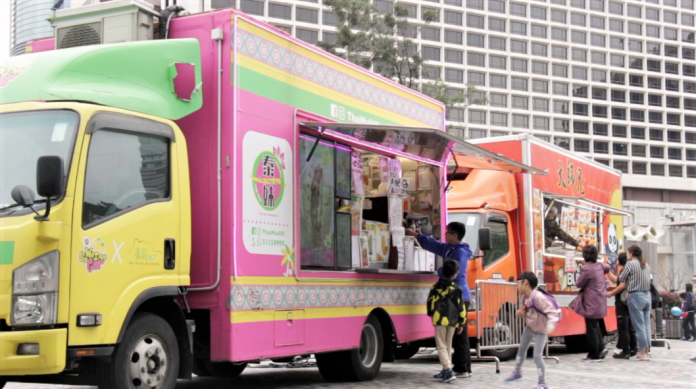
The Food Truck Pilot Scheme, an initiative
launched by the Tourism Commission in 2017, has recently been extended to 2021.
Currently, a total of 15 food trucks are operating at eight tourist spots,
including Disneyland, Tsim Sha Tsui Art Square, Golden Bauhinia Square, Ocean
Park, Science Park and Asia World-Expo. Four new venues such as Science Park
and AsiaWorld-Expo were added to the list after the scheme was refined last
year.
Despite the policy refinement, operators
have difficulty running food truck business in the city, and are gloomy about
the future.
Mr Liu, owner of Ma Ma’s Dumplings, is
frustrated about his business. “We can barely survive. We don’t operate our
food trucks in other spots. We get the
chance to do business at Disneyland every four months, and we do our best to
make money there.”
According to the Commerce
and Economic Development Bureau, food trucks at Disneyland generated the
highest revenue accounting for 60 per cent of the total gross revenue of all
food trucks or HK$19.4 million up to mid-October 2018. The amount was 20 times
more than that at Wong Tai Sin Temple.
Lam Sui-wa, chairman of the Hong Kong Food Truck Federation, finds food trucks in Hong Kong facing more restrictions than those in Germany. He urges the government to provide more supporting measures to boost food truck business.
Lawmaker Tommy Cheung Yu-yan criticises the government for not doing anything for food trucks. He thinks food trucks should target local residents as their main source of customers, but not tourists.
Life and death education helps to overcome the fear of the unavoidable yet seldom publicly discussed matter. At the same time, it encourages the appreciation of life.
Reporters:Ariel Lai, Sarah Ryou, Shell Zhang, Tiffany Chong
Editors: Sarah Poon, Erica Li
Asians are more conservative to
discuss death publicly. It is a taboo to plan for the ultimate departure.
Therefore, most of the time people are not well-prepared when the passing bell
rings.
Everyone has his or her own
interpretation of life and death. Some think death is a reminder of the limit
of life. It helps to realise your responsibilities and commitment can no longer
be fulfilled.
For Tong, a 70-year-old street
sweeper, life is pessimistic. “I envy those people who die because Hades is
just like a Xanadu to me, while I am still suffering in this world,” Tong says.
He wishes to die soon as a relief for himself.
Although suicide and aging
population have been worrying matters in our society, there is still not enough
life education available. Many organisations hope to formulate a proper
understanding of life and death so that people can navigate them with the right
mindset instead of purely grieving the end of life.
Life Journey Centre under the Jockey
Club offers an interactive 60-minute experience for participants to go through
a life cycle. There is an impactful scenario in which participants lie inside a
coffin to reflect the decisions they made during the activity.
The programme is developed from a
‘time tunnel’ journey concept. It has four zones: ‘Are You Ready for the
Journey’, ‘Many Choices in Life’, ‘One-way Tunnel’ and ‘Rest in Peace’.
Chris Ho, assistant manager of Life
Journey Centre, notes different generations have their own reflection on this
‘life journey’. For students, they feel regretful about how they treat their
parents badly, whereas adults are awakened from sacrificing their dream for the
job.
“I think life is about a mutual
understanding and tolerance at different life stages,” he says. He hopes the
centre can serve the purpose of life education and participants can view the
elderly from another angle.
Three university students also share
the same mission of promoting life education by setting up a bookstore at Chai
Wan.
Louis Chuk, owner of Stay Within
Bookspace, believes bookstore is a good medium to deliver the message about
life. It sells books that answer people’s query about the meaning of life.
There is also a shelf of books with topics like war, poverty, mental health,
environment and animal, which Chuk thinks they are very related to the theme.
“We find that the life cycle from
birth, aging, to sickness and death is not definite,” Chuk says. He explains
some people died at a young age because of accidents so they do not even have a
chance to go through the aging and sickness stages.
Chuk describes the life journey as a
Jenga. Choices become fewer as people enter the next life stage. It is
difficult for them to make a decision. Eventually, the Jenga falls as expected.
Every month, the bookstore organises
a human library session or a Death Cafe. While sipping coffee, participants can
exchange their views about life and death casually. In April, a Death Cafe
invites both local and international students to share the rituals and cultures
related to death in their own countries.
Independent bookstores survive with their own styles
Reporters: Emilie Lui, Lambert Siu, Hayley Wong, Cynthia Sit
Editor: Iris Yeung
The book retail industry in Hong Kong is dominated by one single publishing giant. Three major Chinese-language chain bookstores, namely the Commercial Press, Chung Hwa Bookstore, and Joint Publishing HK, are all under Sino United Publishing, which takes up around 80 per cent of market share according to local media reports.
Meanwhile, Hong Kong is observing a change
in reading behaviour. The Hong Kong Publishing Professional Society has done a
survey of 2,063 local readers last year. Results found 31.2 per cent did not
read any print books in the past year. About 63.9 per cent read with devices
such as tablets and computers. The change in reading habit poses threats to the
survival of bookstores.
In the wake of the situation, independent
bookstores manage to survive in the competitive market. Instead of running as a
traditional bookstore, owners highlight special elements in their stores to
attract customers.
Beibei Book House is a bookstore inside a
farmland in Kam Tin. Retired social workers Ringo Tsoi Man-yuen and Teresa Lee
Sau-lai opened the bookstore three years ago to promote slow-paced living.
Apart from enjoying unique reading experience at a farm, readers are encouraged
to bring along unwanted books in exchange for a meal made with fresh produce
from the farm.
Another bookstore Varsity reporters visited is The Book Cure, a second-hand bookstore inside a wet market. Phyllis Chan Lap-ching set up the bookstore because she thinks the young should read more. Other than selling old books, she also organises book-sharing activities in hope of strengthening community bonding and promoting reading culture in their neighbourhood.
Nowadays, bookstores are more than just for buying books. Chow Ka-ying, who wrote two books about independent bookstores, says many operators are revitalising their business models. She says quite a number of bookstores are selling beverages, cultural goods and handicrafts to enrich reading experience of their customers. This is a way for indie bookstores to differentiate themselves from other big players in this highly competitive trade.
Crowned as “Pearl of the Orient” and “Asia’s World City”, Hong Kong has been a popular tourist destination. Tourism is a major driving force of the local economy, accounting for nearly 5 per cent of the city’s GDP every year. Last year, tourist arrivals reached a record high of 65.1 million. However, the local tourism industry faces an uncertain outlook in 2019. The Hong Kong Tourism Board (HKTB) expects a bumpy ride for the sector due to economic uncertainties brought by the Sino-US trade disputes and slower growth in China’s economy. Officials also say visitors are more likely to spend less and stay fewer days in Hong Kong.
Crowned as “Pearl of the Orient” and “Asia’s World City”, Hong Kong has been a popular tourist destination. Tourism is a major driving force of the local economy, accounting for nearly 5 per cent of the city’s GDP every year. Last year, tourist arrivals reached a record high of 65.1 million. However, the local tourism industry faces an uncertain outlook in 2019. The Hong Kong Tourism Board (HKTB) expects a bumpy ride for the sector due to economic uncertainties brought by the Sino-US trade disputes and slower growth in China’s economy. Officials also say visitors are more likely to spend less and stay fewer days in Hong Kong.
In this issue of Varsity, we try to look into the challenges faced by the tourism industry in recent years from three different perspectives.
We start by exploring ways to enhance the diversity of Hong Kong tourism. The city has long been considered as a shopping paradise, but industry insiders say Hong Kong has more to offer especially country parks and cultural heritage which can help the city win over other tourist destinations. We have talked to tour operators who take visitors to green and cultural attractions.
There are also ongoing calls for improvements in Hong Kong’s customer service quality. Hong Kong ranks the fourth lowest in the 2019 Smiling Report, which was compiled based on assessments of mystery shoppers in 29 countries and regions. We have spoken to inbound tourists who had unpleasant experience in Hong Kong. We also talked to workers in service industries to understand what difficulties the trade is facing.
Meanwhile, the influx of tourists, particularly those from the Mainland, also leads to questions about Hong Kong’s capacity of handling large number of tourists and nuisances caused to residents in some districts. We have reached out to residents in Tung Chung, To Kwa Wan and Choi Hung to find out how their daily life activities are affected.
In this issue, we have also looked into why some college graduates pursue blue-collar jobs. We have explored whether the opening of the Xiqu Centre can rejuvenate Cantonese opera, and we have done a profile on a volunteer who has saved thousands of cats. Enjoy the read!
Varsity reporters were astonished after
first learning about a chat group with nearly 800 parents as members, who are
all mainland parents with children studying at the Chinese University of Hong
Kong. Out of curiosity, reporters decided to explore this issue and write a
story about it.
At first, Varsity reporters could not help
thinking the chat group as a subject of ridicule, and thought such kind of chat
group should not even exist. University students are already young adults after
all. But it is very wrong for journalists to make a judgment before conducting
research and interviews. Indeed we were wrong. After finishing writing the
story, reporters are now touched by these parents’ overwhelming love, care and
sympathies for their children who seem to have failed to communicate well with
their parents. These parents do not mean to conduct long-distance monitoring of
their children. They simply want to know what their children are doing and what
kind of school life they are having in Hong Kong – a city where mainland
parents find very different from any Mainland cities.
The story is like a wake-up call for Varsity
reporters who are involved in the reporting duty. Reporters begin to think
about their own relationship with their parents and realise they might have
neglected their parents’ concern and care after leaving home to study in Hong
Kong. Young adults often feel annoyed when responding to parents’ questions
about their school life. Parents often complain that they have not received
phone calls from their children for days. Mainland parents in the chat group
actually know very well that their children feel annoyed and they want to be
free. This is why the parents’ chat groups come to its existence. Mainland
parents try to share information about their children’s school life among
themselves and comfort each other instead of “bothering” their children.
Parents always treat their children with patience
and care whenever children ask countless questions. Why parents would feel bad
about asking their adolescent children questions? Is it because young adults
sound impatient when responding to their parents’ questions? Is it because
young adults always rush to hang up when speaking to parents on phones? Or is
it because most people only care about playing mobile phones even when having
family gatherings?
Perhaps it is time for both parents and their adolescent children to resume face-to-face conversation so that they can learn more about what each other are doing even they are living apart. Instead of texting in chat groups with other parents, both parents and children should make efforts to improve communication. If only university students can understand how much their parents care and worry about them and if only parents can understand their children are young adults now and it is time to let them be on their own to explore the world, their relationship will surely be strengthened based on trust. Love is the answer for their communication problem. Perhaps it is time for us all to put down our mobile phones and enjoy face-to-face chats with our loved ones. Love is the answer for all having communication problem.
Chinese Americans in the United States are yet to be accepted into the American melting pot
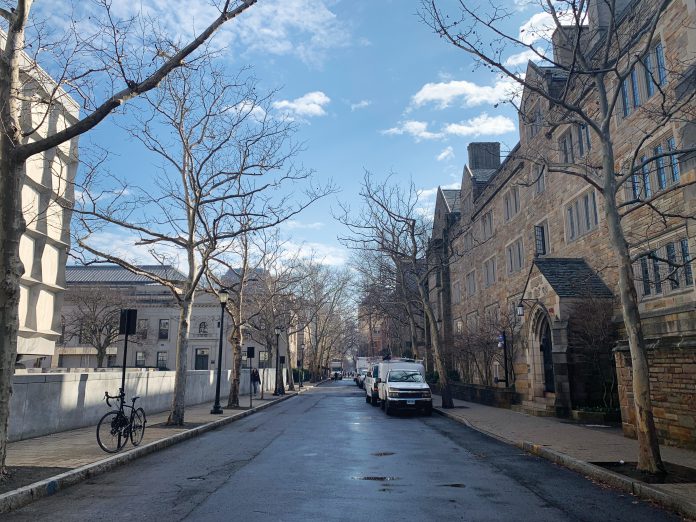
By Hayley Wong in Connecticut
“Where are you from?”
“I am from Georgia.”
“No, but you must be from somewhere else.”
Born and raised in the United States, Chinese Americans are no different from other American citizens. But their identity is often questioned, as their surnames carry a special accent.
About 4.95 million Chinese resided in the United States, accounting for 24 per cent of the Asian American population, according to the “2015 American Community Survey One-Year Estimates” by the U.S. Census Bureau.
Chinese immigrated to the United States for different reasons, and the history could be dated back to the mid-19th century.
Migration history of Chinese Americans
The first wave of immigration began in the 1850s. According to the Migration Policy Institute, a think tank that researches on immigration and integration policies in North America and Europe, Chinese immigrants at that time were primarily male manual labourers. They went to the West Coast to search for low-skilled jobs, ranging from agriculture and mining to railroad construction.
The second wave began after the implementation of the Immigration and Nationality Act in 1965, which removed racial barriers favouring professionals. Chinese immigrants during that period were mostly skilled labour who worked in commercial sectors.
Chinese immigrants have been applying for permanent residency by showing intentions to help promote economic growth in the USA in recent years. Entrepreneurs can file an application under the EB-5 Immigrant Investor Visa Program, under which they are required to make contributions to job creation and domestic investment. Chinese constituted 90 per cent of all applicants of such visa in 2015.
Being stereotyped
In spite of the significant number of immigrants, Chinese population only comprised of 1.2 per cent of the total population of the United States, a report by the U.S. Department of Commerce in 2010 revealed. Despite the long history of Chinese immigrants in the USA, racial discrimination and stereotype issues still exist.
When asked about the change in attitude towards Chinese Americans over the years, Nancy Yao Maasbach, president of the Museum of Chinese in America (MOCA), says: “A lot of things have changed, but unfortunately a lot of things have not changed, and have not changed quickly enough.”
She explains why it is difficult to get rid of prejudices. “[In] every period of time, there seems to be prevailing stereotypes,” she says. While some assume Chinese to be smart and good at mathematics, some believe they all know Kung Fu, traditional Chinese martial arts.
Anti-Chinese propaganda revealing resistance to Chinese immigration in the past are displayed in an exhibition in MOCA
“Even though the model minority part (Chinese’ talents in mathematics) seems like they are positive and a compliment, obviously they are still a stereotype because many Chinese are not good at maths,” she continues.
The contributions of Yung Wing
Chinese Americans now enjoy a higher social status comparing to the past. “I am grateful to our Chinese ancestries because they really fought for civil rights. They really broke down some of those ceilings so I can go to a liberal college…There were times that these were impossible and there was so much discrimination,” says Maasbach.
She attributes the success to the efforts of Yung Wing, the first Chinese student studying at Yale University. “He did such an amazing job in contributing to the understanding between the U.S. and China, and also this educational priority that he placed on giving these young boys such exposure to the Chinese education mission,” she says.
A bronze statue of Yung Wing stands in Sterling Library at Yale University
Yung Wing (1828-1912) impressed his schoolmaster at a missionary school in Guangzhou, and was brought to America for further education. In 1850, he was admitted to Yale University, where he realised the importance of popularising American education among Chinese students.
Upon the completion of studies, he founded the Chinese Educational Mission. Over a decade, he sent 120 Chinese students to schools in the United States, according to the Council on East Asian Studies at Yale University.
Discrimination in small towns and metropolitan cities
Despite the breakthrough in striving for education equality, discrimination still exists. “A lot of the treatment has to do with the initial way we look,” says Lin Ming-yee, a Chinese-American attorney, who works at the New Haven Legal Assistance Association.
Born and raised in a suburb in Atlanta, the capital of the U.S. state of Georgia, the 31-year-old could still recall stories of prejudicial treatment in her life.
Lin believes the level of knowledge about Chinese culture affects people’s behaviour towards Chinese Americans. As one of the three students with Chinese origins in her school in Georgia, Lin recalls her classmates were curious about the trio in school, and totally lacked understanding about them. They asked questions like “how do you see when your eyes are so small”.
“I don’t think it was motivated by malice. It was really like I was so unusual that they had all these questions that they had never been able to ask before,” she adds, “but it did create a situation that made me feel very isolated.”
To Lin’s surprise, her experiences in the metropolitans were not better than those in the remote areas. They reveal more ignorance and stereotype Chinese in more offending ways.
There were also several times when Americans, mostly white men came to Lin and practised Chinese with her. “They would continuously keep trying to speak Chinese to me. It was a very frustrating experience because it made me feel like I am not from here,” she says.
Chinese Americans face tough times dealing with challenges. Lin says her parents could not believe she was going through discrimination and sexism. Even though her family has always had her back, they never talked about politics and racism until the presidential election in 2016. In 2016, Donald Trump, representing the Republicans, defeated Democratic nominee Hillary Clinton and became the president.
“Because they weren’t minority as the same way as me, they don’t understand the pain I was experiencing, growing up to be isolated and totally different,” she says.
The relationship between stereotypes and personal factors
Joy Qiu
Chinese American students studying at Yale University share their stories of growing up with prejudgements and stereotypes with Varsity reporters. Joy Qiu, a 20-year-old Chinese-American student, says: “I think it largely depends on what space you are in and what the environment is.” Studying at Yale, being one of the 19.3 per cent of Asians, she feels more at ease.
Qiu believes there are moments when others judge her based on her appearance and expect her to behave in certain ways. For instance, people would say her voice was so loud, as a Chinese girl. Even so, she says: “I’m definitely proud to be a Chinese American.”
Ivory Fu
Another Chinese American at Yale University, Ivory Fu, 20, lived in Kansas and New York City before. She thinks the way Chinese Americans being treated does not only vary in different environments, but also personal traits. “I found that the way you present yourself can also attract biases,” she says.
When she was in high school, her friends who were more reserved and shy, often faced more discrimination than she did. As she was a more sociable and outgoing person, no one has questioned if she really is an American.
Identity struggles of Chinese Americans
Other than interpersonal relationships, Chinese Americans have to struggle with identity issues. Rocky Lam, 20, also a student at Yale University, recalls how he tried to present himself as an American in his teenage years.
Rocky Lam
To fit into the social circle, he never spoke Chinese outside his house, and would only talk about English TV shows and music. “That’s actually a divide that I kept throughout my entire life,” he says.
Fortunately, this is no longer something he cares about so much now. “I think my college has done a lot to me in terms of exposing me to so many of my community members and allowing me to be proud of my heritage,” he says.
Alternative tour operators offer new choices to diversify the city’s tourism offerings
By Lasley Lui & Laurissa Liu
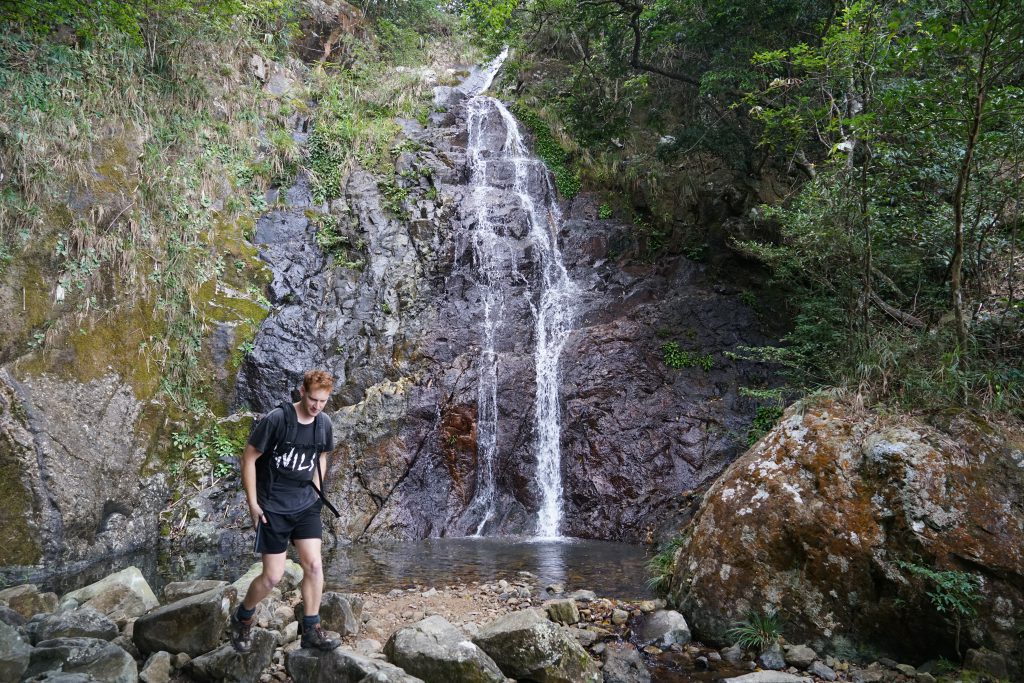
As the slope gets steeper and steeper, the breath-taking sight of Ng Tung Chai Waterfalls comes into sight of Lourdes Peronace, who joins a guided hiking tour in Tai Mo Shan. “It took me just an hour to get here [from the city] and it’s completely different,” says Peronace, who comes from Germany. It is her first expedition in Hong Kong.
Back in her
hometown, Hong Kong is portrayed as no more than a metropolitan city. The
natural landscape is to her, as to many locals, an unfamiliar scene in Hong
Kong.
Tourism is one
of the four pillar industries of Hong Kong economy. In 2018, the Mainland
remained the largest visitor market for Hong Kong, accounting for 78 per cent
of all visitors to the city. The number of Mainland travellers rose by 14.8 per
cent last year, while visitors from other markets only went up by 0.6 per cent.
While the city is branded as “Asia’s World City” bearing the title of “Shopping
and Eating Paradise”, the gem of the city’s natural and cultural sights is unknown
to most visitors.
Starting from 2017, the Hong Kong Tourism Board (HKTB) has highlighted “diverse travel experiences” as one of the targets in their annual work plans. For the year 2019/20, the board will focus on promoting “living culture, the outdoor, and the arts” in hope of winning over other travel destinations.
Hong
Kong natural beauty
Regarding
ecotourism, the HKTB proposes to launch the Great Outdoors Hong Kong 2019: Hong
Kong Back Garden platform, which aims to promote Hong Kong’s hidden green treasures
to visitors from Europe, America, Japan, and Taiwan. The five themes include
geological landscapes in Sai Kung, beaches and reservoirs in Southern District,
sunset scenery in Ha Pak Nai and Lau Fau Shan, the biodiversity in Fung Yuen
and Hok Tau, and the fishing village in Tai O.
Rory Mackay guiding a hiking tour to Ng Tung Chai Waterfalls
Rory Mackay is a hiking tour guide. He founded Wild Hong Kong, a tour operator which offers guided adventures and eco tours. He believes Hong Kong is a unique travel destination with great potentials to develop ecotourism.
Around 40 per cent of land in Hong Kong is designated as country parks or special areas with a rich diversity of flora and fauna – and all these are just a doorstep away from urban areas. “The contrast, to have a big city, and right next to the big city, not just like one little country park, but so much terrain with it,” Mackay says. “It’s beautiful…[there is] a variety of things you can do as well.”
The ecotourism market in Hong Kong is still in its infant stage. The biggest challenge for start-up tour operators offering niche travel experience is to “get on the map” and to be known to potential clients, as the industry is highly “review-driven”. Websites and online review platforms like TripAdvisor are important channels for brand building and marketing. Mackay says: “It took about three years before we actually have customers.”
Their eco tours
are most popular among Western travellers and young professionals aged between
25 and 35, according to his experience in the trade. Alternative tour operators
like his are still growing under the mainstream current.
Hong
Kong Stories
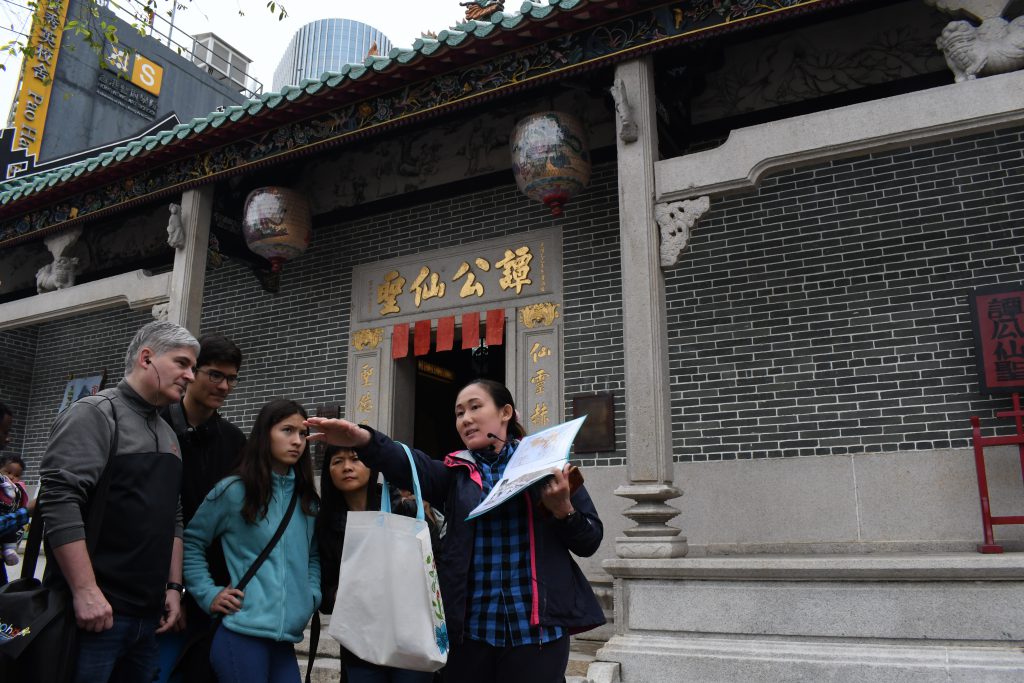
Ling Ho, who finds travelling experience in Hong Kong unappealing and uninspiring, founded Ho Ho Go Experience Limited in 2014 to explore the niche market of cultural tourism. She thinks the local tourism industry in Hong Kong is monopolised by a few large travel agencies. Her agency organises tailor-made “life tours” which aims to show tourists the unique history and way of living in Hong Kong. Each of its thematic tours tells stories of Hong Kong’s history.
The “Seaside Stories” tour of Ho Ho Go features coastal heritages in Shau Kei Wan
To enrich their
tours with meaningful stories, the team has to conduct in-depth research and look
for local stories. According to Ho, it is difficult to employ and train a guide
who fits the job. They need to keep on developing new routes to avoid their ideas
being copied by other operators. “Nowadays everyone claims they are offering cultural
tours, but the quality is in question,” she says.
Ho, similarly, finds it hard to survive in the market when she just started as a small operator. In an attempt to gain public recognition, the travel agency joined the New Tour Product Development Scheme under the HKTB. Two of their tours were approved in the sixth and seventh rounds of the scheme in 2016 and 2017 respectively.
Launched in 2012, the scheme aims to boost Hong Kong’s tourism industry by offering unique and diverse travel experiences to tourists. Funded applications will receive marketing and promotion funding support for developing new tour products, while applicants in the non-funded section will enjoy official promotion of their product on the “Explore Hong Kong Tours” promotion platform under the HKTB. So far, the scheme has approved 39 products and attracted the participation of about 50,000 visitors.
“Our Childhood”,
one of the theme-based tours offered by Ho, features historic housing estates,
and “Bloggers Playground” depicts the nostalgic neighbourhood in Yau Ma Tei.
Both tours are two of the approved products in the non-funded section.
“Tourists usually rely on official travel websites for information,” Ho says.
“So we try to get ourselves onto the list of the Tourism Board to get more
exposure.”
Hong
Kong arts stories
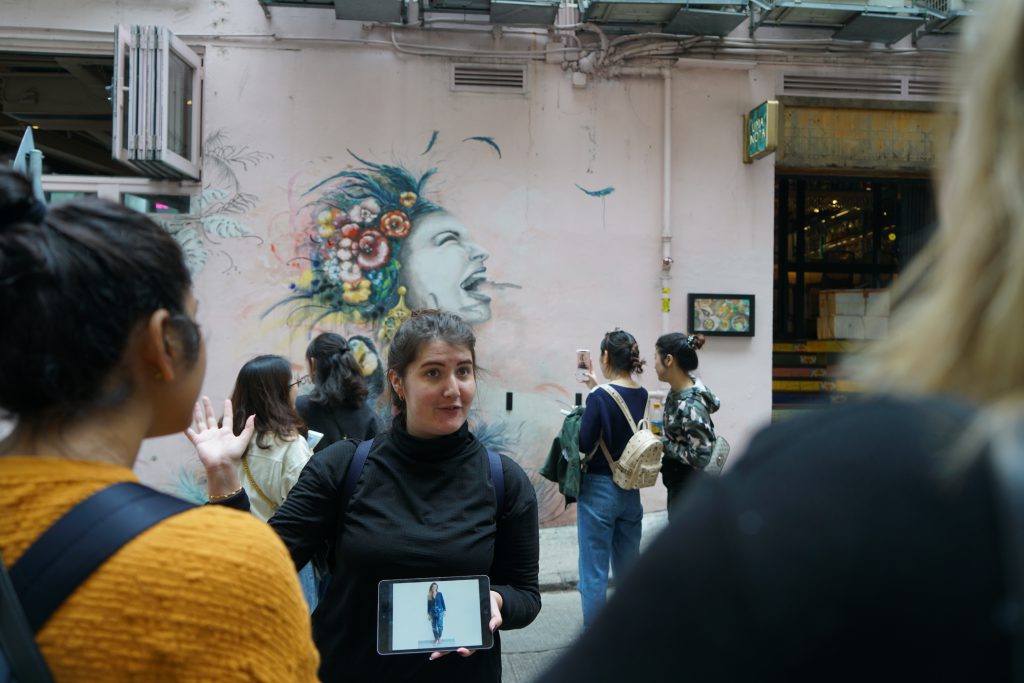
Suyin Haynes is a guide for Central Street Art Tour organised by Accidental Art, which organises guided art tours and other art related events. The Central Street Art Tour features street arts by Alex Croft, Cleon Peterson, Fin Dac, Matt Gondek, Cath Love, Elsa Jean de Dieu, Rob Sketcherman and so on. As an expatriate from London, she sees Hong Kong as an unusual city with different layers of culture and wishes to share her “version of Hong Kong” with other visitors.
Suyin Haynes introducing a street art by French artist Elsa Jean de Dieu to tourists
“With each tour
guide you get something different,” she says. The walking tours, in her
opinion, are unique experience that formulaic travel routines cannot offer.
“It’s not just people that wanna come and take the photo for Instagram,” she
says. “It’s people who are actually curious and wanna know a bit more about
either Hong Kong or the artists.”
Candy Hou,
founder of Accidental Art, is optimistic about the development of local
cultural tourism. “I think it will be more and more promising. Tourists
nowadays value unique experience more than shopping,” she says.
Unbalanced
investment
About 50 per cent of tourists said they were interested in famous tourist spots, but some expressed their willingness to learn about other sides of Hong Kong, according to a report on “Diversifying Hong Kong’s Attractions to Boost Tourism” released by Youth Research Centre in 2016.
In terms of
tourism resources, grants are allocated to preserve new historical and cultural
landmarks in various districts such as Central and Western District and West
Kowloon Cultural District, and to conserve natural scenic beauty like Hong Kong
UNESCO Global Geopark. But most resources are given to major tourist
attractions. Some recent examples are the expansions of Ocean Park and Disneyland
which cost almost HK$20 billion.
Lawmaker Yiu Si-wing pointed out the problem of unbalanced investment in local tourism resources in a Legislative Council meeting on November 7, 2018.
In the meeting, he cited the lack of concerted efforts of different government departments to conserve antiquities, rural environment, country parks and hiking trails as the examples. “If Hong Kong can make full use of its unique local culture, green tourism, and ecotourism,” he said. “It would really add to our tourism character and effectively divert tourists according to their demands.”
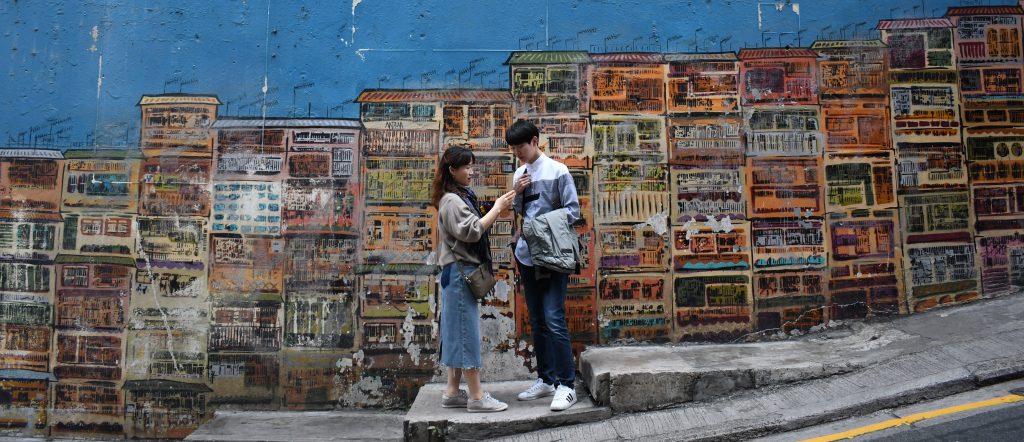
Inspired by the Kowloon Walled City, the mural by Alex Croft on Graham Street is a popular photo spot for tourists