












Home Blog Page 52

A Hospitable City?

Tourists voice their frustration over Hong Kong’s poor customer service quality, while workers complain of low wages and long working hours

By Regina Chen & Charleen Chen 

Wang Jiying, a 20-year-old Chinese student, who studies in the United Kingdom, travelled to Hong Kong earlier this year. High expectation of her Hong Kong visit turned out to be very disappointing.

“The service quality in Hong Kong is terrible,” Wang complains after visiting a restaurant. “No one came to serve when my friend and I entered a dessert restaurant, so we had no choice but to hail the waitress. Shockingly, she responded by throwing a menu on the table,” she vividly recalls.

Wang’s bad experience about service quality of restaurants in the city was not an isolated case. Lin Shih-hsiung, a Taiwanese tourist who visited Hong Kong two years ago, had similar experience at a chain restaurant. He says a waiter was very impatient and unfriendly when he tried to order his food.  

“Once I entered the restaurant, the waiter told me to step aside if I was not ready to make an order,” Lin says. He was shocked and felt unwelcomed. “It seemed like he did not care about losing a customer,” he says.

Both Wang and Lin vow they will never visit Hong Kong again.

Service without a smile

The government launched a campaign featuring pop star Andy Lau to promote and encourage quality customer service in Hong Kong in 2002. The tag line in the advertisement, “Service like this just isn’t good enough in today’s business environment”, has become proverbial to every Hongkonger. However, after nearly two decades since the advertisement was first aired, the city still fails to serve tourists with a friendly smile.

Hong Kong ranks the fourth lowest in the 2019 Smiling Report, a survey which was compiled based on assessments of mystery shoppers in 29 countries and regions. The smile score, from 0 to 100, grades quality of customer service. Hong Kong’s smile score was only 56, 10 points lower than its record last year and way below the global average of 80.

Meanwhile, the Consumer Council told Varsity that the number of complaints from Mainland tourists surged by 93 per cent in 2018. Among the more than 4,000 complaints from Mainland visitors, over 300 were complaints about “Quality of Services”. In a survey conducted by PTT, the biggest online forum in Taiwan, netizens voted Hong Kong as their most hated city in the world. Taiwanese visitors who joined the poll were upset with shop assistants and waiters’ attitude, accusing them of lacking courtesy and patience.  

Sales assistants serving customers in a jewellery shop

Where have all the smiles gone?

While visitors say poor customer service is casting shadows over Hong Kong’s image, workers in service industries say intense pressure at work is hindering them from delivering quality service. Established in 2015, “The Beggar in the Restaurant” (乞客) is a Facebook page which has been posting creative cartoons inspired by common grievances shared by restaurant workers. Page administrator who named herself as Mary Little Two has been working in the catering industry for more than a decade. She says restaurant workers are under huge pressure, as they often have to put up with customers’ disrespectful behaviour and unreasonable demands. Most of them are also frustrated by their heavy workload.

“Restaurant workers in Hong Kong are often considered as ‘Supermen’ considering the amount of work they are loaded with. For example, I often have to take care of a full house of 75 guests with only three other co-workers,” she says.

Tsoi Chung-kin, chairman of the Retail and Wholesale Trades Employees Association, agrees that overwhelming workload has adverse impact on service quality.

“Nowadays, manpower shortage is a common problem for restaurants. A waiter now is responsible for taking care of 10 tables of customers, compared with three to four before. Sometimes when a customer hails a waiter, the waiter might be busy serving others,” he says.

Hong Kong is infamous for long working hours and that could be another reason behind poor customer service in the city. Tsoi says some workers in the service industry may have to work 12 hours a day, from 10 a.m. to 11p.m., without any break. “The working hour is long, and it requires workers to stand for a long time. These affect workers’ attitude and performance,” he says.

Many shops in Hong Kong have long business hours

Tsoi says sales assistants at shops or boutiques in tourist areas are prone to long working hours, making it even more difficult for employers to recruit and retain talents.

“Working in the retail industry means low wage and heavy workload. Employees are put under enormous pressure… Young people cannot stand it, so fewer people are willing to join this industry,” Tsoi says.  

Help Hong Kong smile again

In a bid to recruit more new blood, Tsoi says shop owners should consider giving workers a pay rise. He says a wage increase is the most effective way to improve the high turnover rate of the retail industry.

Tsoi also says employers should step up effort to improve working conditions in the retail industry. He says arranging resting time for employees is particularly important to let them recharge themselves. In 2003, the Labour Department issued a guideline encouraging employers to make suitable rest break arrangement with their employees through negotiation. But Tsoi says it is far from enough, as the guideline is not mandatory.

“After standing for two or three hours, retail workers should be allowed to rest for ten to fifteen minutes. Or they should be given chairs to sit for a while,” says Tsoi. “The government should legislate to make it mandatory for employers to let workers take a rest after working for two to three hours.”

Tsoi adds that shoppers, especially tourists, have a higher expectation of service quality nowadays. They do research about products they want to purchase and ask for information from shop assistants. He reminds employers to deploy more resources to offer training for their employees.

“When employees were new to a company, the company used to teach them skills about how to treat customers, how to smile, and how to deal with customers’ complaints…This kind of training is quite rare now,” he says.

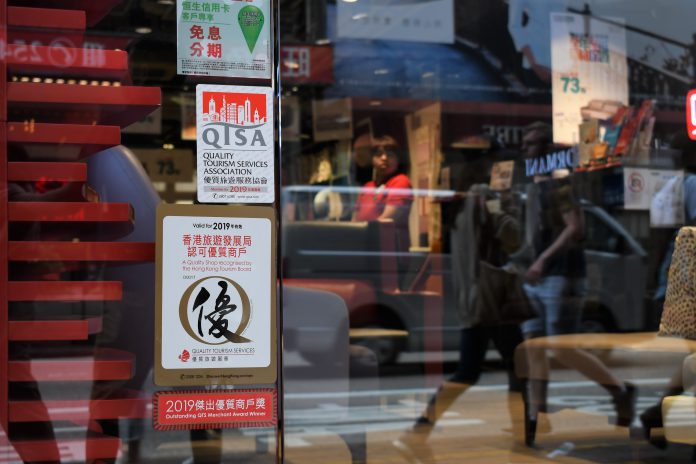
A shop accredited by the Quality Tourism Services Scheme under the Hong Kong Tourism Board

Cheung Lai-ha, General Secretary of the Retail, Commerce and Clothing Industries General Union, says retail workers should be given more time and resources to enrich themselves by acquiring new knowledge about their work.

“The government should offer more support to employees in the retail industry to upgrade their skills and equip them with more knowledge about the trade. If they have no time to learn, it’s not good for the future development of the industry and their own development,” she says.

Edited by Iris Yeung
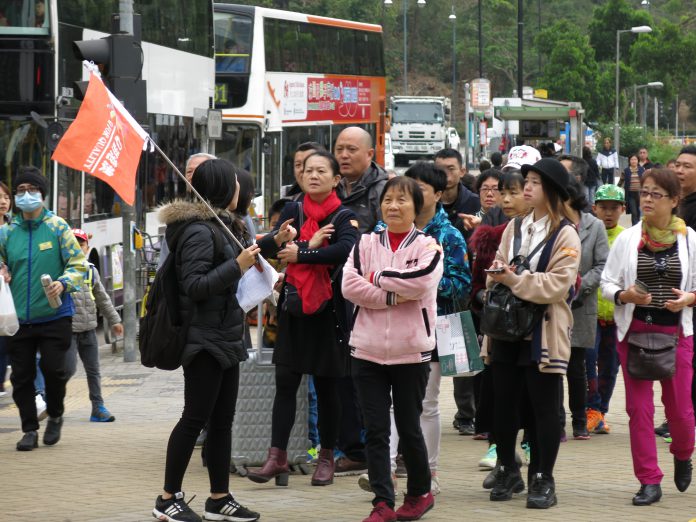
Rage against Tourism

Swarms of tourists cause nuisance in local neighbourhoods in Tung Chung, To Kwa Wan and Choi Hung

By Kelly Chan & Tiffany Chong

Nuisance in Tung Chung

Long queue for tables in restaurants, crowds, trash, and influx of tourists, are upsetting the quiet and cozy Tung Chung. Tourists have flooded the distant town recently and many residents are annoyed and frustrated.

Christina Ho, a Tung Chung resident, complains the influx of tourists has caused disturbance to her daily life.  “We have to endure much longer queueing time for restaurants,” she says. “Worse still, there is rubbish everywhere,” her sister Adelaide Ho adds.

Hong Kong is one of the most popular travel destinations in the world. In the past five years, the city of 7.5 million residents has received an annual average of 60 million visitors, with a record-high of 65 million in 2018.

Despite the enormous economic benefits brought to the city, nuisance caused by tourists has become a headache for residents. Conflicts between residents and tourists arose in Tung Chung after the opening of Hong Kong-Zhuhai-Macao Bridge (HZMB) last year, which attracted hundreds of flag-wielding one-day tour groups flocking to Tung Chung, the closest residential zone to the port facility.

Mainland tourists who came on public transport swarmed into the town and caused disturbance, leading to a series of protests.

In the wake of the situation, the Transport Department introduced a new measure in November last year, requiring tour agencies and group organizers to purchase shuttle bus tickets through a pre-booking system to regulate traffic flow for some specific days.

Lau Wing-yin, chairman of Tung Chung Concern Group, says police’s scrutiny on tourists’ activities has improved after residents’ protests were widely reported in the media. “Police check tour guides’ identity cards and license whenever they suspect unauthorized tour guides.” But Lau says the new measure which only cracks down Mainland tourist groups that are suspected of violating regulations only brings them temporary peace. No prosecution has been made so far.

Lau believes poor town planning should be partly blamed for the residents’ discontent, as there are mostly chain stores and outlets inside Tung Chung’s shopping malls, which transform the residential zone into a shopping attraction. “The residents will not be that disgruntled if the government encourages more small shop tenants to set foot in the district to serve residents’ needs,” says Lau.

Lau suggests the government sets a daily quota on a number of cross-border coaches to put a halt on the influx of tourists and advise the Mainland authority and travel agencies to remind tourists to behave themselves.

Tung Chung’s Citygate Outlets Mall is packed with tourists after the opening of Hong Kong-Zhuhai-Macao Bridge in 2018

To Kwa Wan – Hell’s Kitchen

Similar problems also are observed in To Kwa Wan where crowds of tourists flood the district every day. Although the district is not a major tourist and dining attraction, half of the city’s registered souvenir shops locate in the residential areas and more restaurants are opening its doors to embrace Mainland package tours.

“No locals dine here. Most of our customers are Mainland tourists,” says Ah Chiu, a chef of a Chinese restaurant in To Kwa Wan. He admits the restaurant only accommodates Mainland group tours, even though it is situated in a local residential area.

Mr. Cheng, a resident who has been living in To Kwa Wan for 30 years, says many restaurants only serve mainland tourist groups in a shopping mall. “This is a vicious cycle. The residents do not visit the mall, more shops will serve tourists,” says Cheng.

Cheng also worries these package tours may ruin the reputation of the city. “Some Chinese tourists wrote on commentary websites reflecting the food served in these restaurants are mostly refrigerated and reheated,” says Cheng.

Nette Tsang Wing-tung, spokesperson of a concern group, Synergy Kowloon, says long queue of travel coaches places significant traffic burden on To Kwa Wan. She has seen police officers putting barriers in crossroads to manage crowds of tourists to queue outside a restaurant, forcing students on a school bus to get off in the middle of the road.

Tsang says even if a tourist breaks a law and receives a penalty ticket, they can still leave Hong Kong without paying a fine.  “I once saw a tourist throwing a stub to a potted plant outside a store. The owner yelled and asked him to pick up the cigarette bud and demanded an apology, but the tourist just ran back to a coach,” says Tsang.

To alleviate nuisance brought by inbound tour groups, the Kowloon City District Council has launched a pilot project to recruit tourism ambassadors to station in the district since 2016. The ambassadors are responsible for keeping the environment clean and advising coach drivers not to pick up, drop off or park illegally at popular gathering spots. They can also call upon law enforcement agencies to take follow-up actions on-site.

However, Tsang doubts the effectiveness of the project, as there are reports about some ambassadors failing to do their duties due to lack of supervision from the authority.

She suggests that the government should collects tourist tax and requires souvenir shops to obtain operation permissions after a thorough assessment and public consultation.

When the Instagrammable Choi Hung Estate sparks privacy concern

Apart from buying souvenirs, tourists enjoy visiting local photo spots. Choi Hung Estate has become a hotspot. Renowned for its colourful and vividly painted housing blocks, a picture taken in the estate won the Sony World Photography Awards in 2016.

Shenzhen tourist, surnamed Chen, says she learned about this photographic gem from Xiao Hung Shu (小紅書), a Chinese social media platform. She says it is a widely recommended picture-perfect place, but she does not find the spot very special.

Chen says some residents of other public housing estates do not welcome tourists to take pictures. “There is a reminder from Xiao Hung Shu asking us not to disturb the residents,” she adds.

Lorraine Lee, who has lived in the estate for five years, thinks it is fine for tourists to take pictures inside the estate. “To me, the most disturbing thing is when visitors ask me for directions. But I think this is also a good way for tourists to learn about public housing estates in Hong Kong,” says Lee.

The internet fame of the 56-year-old public housing estate also comes along with public nuisance and privacy concerns.  “The court is always packed with visitors on weekends and there is no space for residents to play basketball. A basketball player once broke a tourist’s camera and conflict just erupted,” says Wu Chi Kin, a district councillor of Wong Tai Sin.

Wu says the use of drones equipped with aerial cameras make residents feel worried, as bathrooms are near the balcony side. In the wake of the situation, the Housing Authority provides a guideline to prohibit the use of drones. But Wu believes the effect is minimal and stresses the authority has no right to forbid tourists from visiting the estate. “We want to respect their freedom of photo-shooting, but they should also avoid causing disturbances to the residents,” says Wu.

Wu says all he could do is to ask security guards to remind visitors to behave during peak hours. He hopes online media will stop promoting the estate as a tourist spot.

Edited by Daphne Li

Artist Career: Viable or Impossible?

Art graduates struggle to become full-time artists

By Ariel Lai & Sarah Ryou

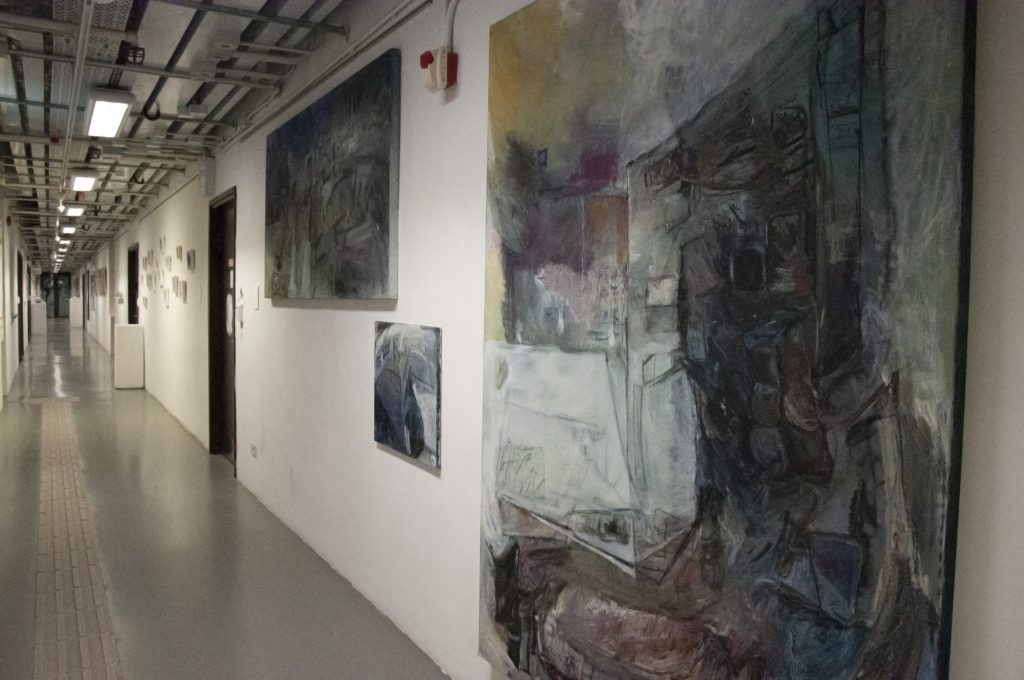
“You can’t survive simply by selling art creations, unless you were born in a rich family,” says Jay Lau Ka-chun, a Year Four fine arts student of the Chinese University of Hong Kong(CUHK). Lau thinks it isvery difficult to make a living as a full-time artist in Hong Kong because of unstable income and keen competition. Making art in Hong Kong is also very costly.

A struggle to survive

“It’s not cheap to rent a studio in Hong Kong. Art supplies are also very expensive,” Lau says. “We often need to take up other jobs to make more money in order to strike a balance between our income and expenditure.”

Lau also says it is hard for full-time artists to make ends meet if they lack the necessary connections in the art industry such as gallery owners or curators. He says artists have to work day and night to build their career.

Another final year fine arts student of CUHK, Thomas Fung Yee-tin, says he wants to be a full-time artist after his graduation. He says some of the artists try to create commercial artworks that are welcomed by the market for more stable income. He specialises in Chinese painting now, an art genre that is relatively popular in Hong Kong.

Fung says that a Chinese painting can be sold for about HK$40,000 to HK$50,000 in an exhibition. But the income is unstable, as they can only afford to hold one or two exhibitions with around 30 paintings in each event every year. There is no guarantee that the sales will be good in every exhibition. “If the sales of artwork is good in an exhibition, the artist can earn HK$300,000 to HK$400,000, but he or she has to share the earnings with the gallery in a 50:50 or 40:60 ratio,” Fung says.

Fung now takes up a part-time job as an event campaigner for more income. He adds that he needs to spend around HK$10,000 to HK$12,000 for renting a studio, purchasing materials for his artworks and daily expenses.

Artists have to share profits made from artworks sale in exhibitions with galleries

Fierce competition

Currently, publicly-funded fine arts or visual arts programmes are only available at the CUHK, the Hong Kong Baptist University (HKBU) and the Education University of Hong Kong (EduHK). Only 19 out of the 1,675 applicants were admitted to the fine arts programme at CUHK in 2018. The visual arts programme offered by HKBU admitted 51 students from 2,827 applications, and a similar program at EduHK only took 10 students out of 2,134 applications in 2018, according to the Joint University Programmes Admissions System (JUPAS) admission results.

Despite the small intake of fine arts students at the three universities, there is no guarantee that the labour market can accommodate all 200 to 300 graduates each year.

Zhang Jiayu expresses concerns over her future career

Zhang Jiayu, a Year Four CUHK student, who changed her major from cultural management to fine arts, aspires to be a full-time artist after graduation. “As a fine arts student, I hope that my [future] job will be related to my interest”, she says.

However, Zhang reckons that chances are slim. She says career support for fine arts graduates from her school is insufficient. Even though her school has introduced a summer internship course this year, Zhang says other parts of the curriculum are note practical enough to help them develop future career in the field.

“It’s difficult to ask for more support after we graduate. The university can provide more support to help us better understand the dynamics of the art field when we are still in school. That will help us build connection with people in the [art] circle,” Zhang says.

Professor Ho Siu-kee believes that universities are not for vocational training

Professor Ho Siu-kee, Director of M.A. Programme and Associate Professor at the Department of Fine Arts at CUHK, believes that universities are not for vocational training. Nevertheless, they have the responsibility to provide support to help students build their career. He says universities should train students to put classroom knowledge into practice.

He adds that CUHK and other schools have included a course “professional practice”, in which different people from the art field, such as gallery owners, local artists and museum managers, are invited to share their experience with students. Students can learn the dynamics and updates of the art industry by talking to them.

Ho says the Department of Fine Arts at CUHK also tries to do as much as it can to offer practical training to help students gain exposure. Students are invited to work as helpers for some foreign artists and at some art events. But he says a better way to let students learn more about the work of artists is to allow them to get involved in art projects at schools.

“Most of the teachers are also full-time local artists. Students can better understand the work of professional artists if they can take part in some art projects led by their teachers,” Ho says.

More government support needed

Recruitment ads posted on HKADC website are mostly related to administrative duties or marketing
(Screen capture from the HKADC website)

In the year 2018/19, the Grant for Emerging Artists, offered by the Hong Kong Arts Development Council (HKADC), has received 52 applications with a success rate of 62 per cent. HKADC also provides overseas and local internship opportunities, and operates an online platform providing job market information – though most of the posts are not related to art creations.

Ho thinks the government should also provide more financial support for students to join university-wide exchange programmes in which they can meet and build more connections with foreign artists around the world. He also says a government fund should be set up to support non-mainstream artists whose works are yet to be accepted by the commercial market. He says such a move can help diversify development of the local art
field.

“Cultural, art and creative industry is the new driving force of society,” Ho stresses.

Edited by Tommy Yuen

Take a U-Turn

Instead of pursuing white-collar jobs, some university graduates choose to follow their passion in career building

By Agnes Lam & Lambert Siu

Franco is not an ordinary taxi driver. He graduated from the Department of Chinese Language and Literature at Hong Kong Shue Yan University. Passionate about writing, he also manages a Facebook page (我的你的紅的) where he shares his encounters with passengers of diverse background.

“In the past, I valued a lot on the importance of a degree certificate. I have neglected other skills that we have learnt at universities,” says Franco, who has been a taxi driver since 2016.

Realising his passion for being a driver

Franco worked as a tutor for five years before he became a taxi driver. While he was in tutoring, he asked himself: “How far could I go in ten years?” Reaching a deadlock in his career with no hope of promotion opportunities, he resigned.

What attracted him to be a taxi driver was the high degree of autonomy. “You may get scolded as an employee. But when you are a taxi driver, the power hierarchy is reversed. You will never see a passenger who dares to rebuke a driver,” he says.

Despite having higher academic qualifications, Franco still has to learn from experienced taxi drivers. “I respect them [other taxi drivers] very much,” he says. He appreciates how the experienced drivers observe and analyse traffic patterns of passengers.

“You have to know these skills to look for passengers in order to maximise profits. But you can never learn these from textbooks,” says Franco.

Discovering one’s talents and potentials

Photo courtesy of Franco

Looking back, Franco firmly says that he does not regret going to university. For him, the functions of university education are to nurture critical thinking skills, and more importantly, interpersonal skills.

But a certificate does not mean a promising future. “It is not a must to study at universities. What matters is that you have to find a particular area in which you can excel,” he says.

He cites the case of Steve Jobs, who had already found his own talents before dropping out of college. With a clear direction in mind, Jobs further explored his potentials and made ground-breaking inventions.

Others may not agree with his choice, but his way of living gives him a sense of accomplishment. “All occupations deserve equal respect. There isn’t one that is more superior to the other,” he says.

According to a report conducted by two political groups in 2018, 16.4 per cent of degree holders in Hong Kong worked in low-skilled positions.

Following her heart to be a tattooist

Franco is not the only case. Jayers Ko, a female tattoo artist who graduated from the Department of Psychology at the Chinese University of Hong Kong (CUHK), realises the importance of staying true to herself.

Before studying at CUHK, she pursued veterinary education in Australia. “Australians are different from people in Hong Kong,” she continues. “They lead a completely different lifestyle, but they still survive.”

When she returned to Hong Kong, she was disappointed with the one-way teaching approach. She decided to explore more outside lectures. She later learnt she was actually very interested in tattoos.

During her first year of studies at CUHK, she travelled to Thailand, where she had her first tattoo on her wrist. After that, she started to get several more tattoos, such as a shuttlecock, to remind herself of her passion in life.

The values of tattoos

When asked about the meanings of tattoos, she believes it is a form of commitment. “After you get a tattoo, there is no turning back. It is the most suitable medium to convey my philosophy,” Ko says.

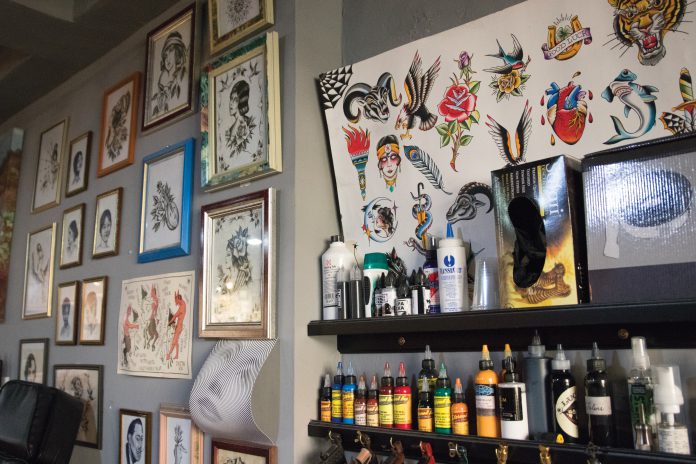
Jayers Ko stands in front of some paintings in her studio Lovinkit Tattoo

As she loved how tattoos are conduits of her self-expression, she started to consider the possibility of being a tattooist. She looked up for information online and found herself a mentor in tattoo painting.

“It’s like martial-art novels. You follow your master and learn from him,” she says. As a dedicated mentee, she treasured every opportunity to observe and learn.

Comparing with her time in college, she says learning from her mentor was more down-to-earth. Other than teaching practical skills, her mentor also shared his views towards life. It was the first time when her values were recognised by a senior.

“I clearly know what type of person I want to be,” she says, “I do not only aim for titles and achievements.” She thinks her mentor plays an important role in her journey of pursuing her life goals.

Despite so, she still believes university education has its values. She used to think there is only one solution for every question, as she studied science in high school. But from the eyes of social scientists, there are many possible answers to one question. The new insights have transformed her into a more open-minded person.

The meaning of university education in the maritime industry

From the examples of Franco and Ko, some may draw a conclusion that university degrees are not really necessary. However, some occupations favour employees with higher academic qualifications.

Kelvin Tsang Chun-wun, who majored in International Shipping and Transport Logistics in the Hong Kong Polytechnic University (PolyU), is now a sailor of the Royal Institution of Naval Architects. He also took courses offered by the Maritime Services Training Institute (MSTI) during his school years.

Kevin Tsang Chun-wun (second row, first from the left) and his colleagues on a container ship
Photo courtesy of Kelvin Tsang

While there is no significant difference in starting salaries of a degree and a non-degree holder, a university certificate is a prerequisite if one wants to work in the Hong Kong Marine Department. In view of this, Tsang says: “Some sailors from the MSTI are going back to university to get a qualification.”

Although the programmes by PolyU and MSTI both cover shipping and logistics, they differ significantly in the curriculum. While PolyU provides more theoretical knowledge of business management, the MSTI focuses on practical skills.

However, Tsang says a promising career is still attainable even for sailors without a degree. Some higher-ranking positions, such as captain, chief officer and chief engineer, do not require a degree.

Courses for sub-degree holders by Employees Retraining Board

The government offers comprehensive support to cater to the needs of low-skilled workers. According to a written reply from Employees Retraining Board (ERB), it funds and co-ordinates a network of 80 Training Bodies, providing around 700 training courses across 28 different industries.

The courses by ERB target employees aged 15 or above, with educational attainment at sub-degree level or below. In other words, university graduates are not eligible for application and are only accepted under special consideration.

Growing popularity of make-up artists in the labour market      

University graduates have joined private institutions for retraining opportunities. One example is GLOW Makeup Academy by Janice Lam. Many of their students are university students, and some are banking professionals.

Lam putting make-up on a model at a promotional event of a cosmetics brand
Photo courtesy of Janice Lam Shun-ka

Academy owner Janice Lam Shun-ka says their programme consists of 20 classes and is approved by the government’s qualifications framework. Apart from in-class learning, students can gain hands-on experience by working as helpers in freelance jobs. She says one-third of her academy’s graduates end up being full-time make-up artists.

A career as a make-up artist has gained more recognition in society. “The income of an average make-up artist is already comparable to that of a manager in a large firm,” Lam says.

“University education is more rigid, in comparison with vocational training courses,” she adds.

Edited by Sarah Poon

Let Them Grow

Anxious mainland parents with children studying in Hong Kong find comfort in chat groups

By Katherine Wang & Wayne Chang

“Has any of your kids been to UC Berkley for exchange before? Which hostel is a cheaper option? Thanks!”

“From what I have heard, most students, including term exchange students, rent an apartment there.”

These dialogues are spotted in a QQ (a popular instant messaging software in Mainland China) chat group formed by mainland parents whose children study at the Chinese University of Hong Kong (CUHK). They are seeking advice from other parents on their children’s exchange programme.

Separation anxiety

When mainland students leave their hometowns to study in Hong Kong, a city different from any other cities in the Mainland, their parents across the border are anxious to learn how their children are coping in Hong Kong. Numerous WeChat and QQ chat groups with some up to hundreds of members are formed by mainland parents to stay in touch with other parents and talk about their children’s school life in Hong Kong. 

These chat groups allow parents to keep their fingers on the pulse of what is going on in Hong Kong, information about the latest programmes, exchange and internship opportunities. These parents then share such information with their children. They also seek comfort from each other in the chat group, as they all have to bear separation from their children who lived under their care for nearly 20 years. Most of their children were born under the mainland’s one-child policy.

School policy regarding admission and application for exchange programmes is one of the hot topics mainland parents discuss in chat groups

Parents also make use of these chat groups to “check on” their children. For example, some parents post group pictures of students took in orientation camps. When other parents recognise their own children in these pictures, they will start talking about their children who joined the same event in the chat group.

A Hong Kong University of Science and Technology student, who reveals his name as Jack, complains these parents’ chat groups go beyond their original purposes of sharing school information. “These chat groups can exist but the content should not be like these. Parents can contact one another, but they should just share how their children are doing, or chat with others when they feel lonely,” says Jack.

Faces behind chat groups

Zhu Xin, established a CUHK parent chat group (香港中文大學內地家長群) on WeChat with another parent in 2013. Its original intention was sharing experiences of getting a student visa since the application procedure was complicated. Little did she expect the group would grow to more than 700 people in just six years. She is now frustrated about having too many people in the chat group, as it is difficult to manage.

However, she still thinks the chat group is beneficial for parents in the sense that they can learn what their children are doing. “To be frank, this group is for us, parents, to console one another, not to supervise the children…And you should think about how unaccustomed your parents are to your absence, considering that you [the children] have been with us for around 20 years,” says Zhu.

Regulations of a CUHK parent chat group

Ma Renjie is another administrator of the CUHK parent chat group. He says joining the group is a channel for him to express his care for his daughter by learning the updates about her school. But he does not interfere his daughter’s school life directly.

“Parents just want to know what is going on in their children’s school life. My child can deal with all these things by herself…I don’t want to bother my daughter too often,” says Ma. 

His daughter Ma Yunxue, a Year One CUHK student, is aware of her father’s leading role in the chat group. She says the group can help reassure her parents that she is doing fine in school, because it is impossible for her to keep in touch with them every day.

“It is necessary for the group to exist…When the parents are anxious about something, they can talk and comfort each other. Even though it might not help solve the problems, they can learn what happens, and they will be less anxious,” says Ma.

Building trust

Dr. Eva Lau Yi-hung, Associate Professor and Associate Head of the Department of Early Childhood Education of the Education University of Hong Kong, says family support continues to be a significant factor that impacts on university students’ self-esteem, wellbeing and adjustment to their university life during the first year of their study. 

“Support is good, but too much parental involvement might have a negative impact on their independence,” says Lau.

Mainland parents seek advice from each other about exchange programmes for their children

As a mother of two, Lau reveals she does not engage in her children’s school life directly. Though she joins a WhatsApp group of her elder daughter’s primary school from which she can get useful information such as school system and curriculum, she encourages her daughter to try sorting out everything relating to her studies herself.

Lau points out family support is important for university students. She believes the right way for parents to support their children is to have empathy for their children and communicate with them, rather than to completely take over and directly engage in their lives. And children need to learn to be independent and update their parents about their school life on a regular basis.

“By sharing more information and telling them [the parents] that I’m independent enough, parents will eventually learn to let go,” says Lau.

Edited by Fangdong Bai

Behind the Masks

Can the opening of Xiqu Centre rejuvenate Cantonese Opera?

By Alice Wang

Every Saturday, Cheng Tin-ho, 10, goes to the Mills, a revitalized arts and cultural complex in Tsuen Wan to attend a class. It is not piano or ballet class that many children in Hong Kong join but Cantonese opera.

The underlying mask of Cantonese opera

His mother, Wong Ching-han, admits that she had no knowledge or interest in the traditional Chinese art before getting her son studying in the Cha Duk Chang Children’s Cantonese Opera Association. “Originally, Cantonese opera was just noise in my mind,” she says, adding that she hoped her son would learn to be patient by attending the class.

But her interest in this centuries-old art has grown. “When I pass by Sunbeam Theatre, I will start checking out the upcoming shows,” she says, and no longer finds Cantonese opera noisy, but an art to appreciate.

Children warming up for the class

The Cha Duk Chang Children’s Cantonese Opera Association’s site inside the Mills is divided into two parts. One for visitors to take pictures with different Cantonese opera costumes, another one for students to learn skills and methods of vocal and dramatic training that performers have to master.

Cantonese opera with singing and spoken scripts delivered in Cantonese dialect is popular in Cantonese-speaking regions, such as Guangdong, Hong Kong and Macau. Its variegated costumes, distinctive singings and symbolic gestures attract people from all over the world. In 2009, it was inscribed onto the UNESCO’s Representative List of the Intangible Cultural Heritage of Humanity.

However, the younger generation in the city may not know how to appreciate this traditional art form.

Is education enough?

While teaching Cantonese operatic music is compulsory in the HKDSE Music curriculum, not all music teachers are equipped with the knowledge to teach it.

Li Yin-hing, Program Officer of the Cha Duk Chang Children’s Cantonese Opera Association, says: “If a school teacher teaches Cantonese opera by himself or herself, he or she will play pieces of traditional music and videos of Cantonese opera, or just open a textbook and ask students to sing a Cantonese opera song together.”

In Li’s view, making Cantonese opera compulsory in school’s music class can let students learn Cantonese opera. But such teaching methods are inefficient to cultivate children’s interest or increase their participation in Cantonese opera.

In 2005, to help develop Cantonese opera, the Home Affairs Bureau (HAB) set up the Cantonese Opera Development Fund (CODF) for local associations. CODF aims to support and fund different kinds of projects to help promote Cantonese opera. Meanwhile, some non-governmental associations also offer funding to support Cantonese opera, such as the Hong Kong Jockey Club Music and Dance Fund. But resources are still limited, so not all schools have the financial ability to seek help from Cantonese opera associations to train music teachers.

Nowhere to perform

Li points out small opera associations struggle to find suitable performance venues due to expensive rents in private sites. “For some local small troupes, we cannot afford the rent for performance sites if there is no subsidy,” she says. Cantonese opera associations find it hard to book public performance sites which are much cheaper to rent. While major performance sites are often reserved by big opera associations, local small troupes can only turn to sites they can afford.

“It is difficult for us to set the stage or carry performance props,” she says. Li shares their experience of using Youth Square in Chai Wan, which turns out to be an unsuitable site, as it is not specially built for performing Cantonese opera.

Xiqu Centre at the West Kowloon Cultural District

Officially opened on January 20, 2019, Xiqu Centre, is the first completed project of the West Kowloon Cultural District and the first professional Cantonese opera performance centre in Hong Kong. Occupying a total of 28,164 square metres, the Xiqu Centre holds a Grand Theatre, a Tea House Theatre, eight professional studios and a seminar hall. They are all specially designed for different types of functions and activities related to Chinese opera.

But some insiders reflect that the government may give priorities to famous Cantonese opera troupes to use performance sites at the Xiqu Centre, so it may not be available for the small-scale ones. Also, the expensive rent may not be affordable for them.

“Having one more performance site is better than one less,” says Lau Wai-ming, Artistic Director of Yeung Ming Cantonese Opera Troupe. She believes the opening of Xiqu Centre is good news for Cantonese Opera. While she appreciates that the government has put effort into the Xiqu Centre, she believes another challenge is that there are not many performance sites specifically designed for Cantonese opera.

Who can help?

Other than shortage of performance sites, Lau believes the development of Cantonese opera is not on the right track. “We are now developing arts with government resources and we have to comply with government policies, but not all activities from the creative industry are supported by the government,” she says. Lau thinks it is inappropriate for arts association to change their principles in a bid to receive government support.

Lau also points out the current policies tend to favour younger artists, which could drive current artists out of the field due to the lack of support. When the quality of current performance is affected, it can possibly lead to loss of audience. But, Lau stills feel optimistic about the future of Cantonese opera, with the growing population of old people in Hong Kong. “It is absolutely normal for a 60-year-old to appreciate Cantonese opera as an art form with their own life experience,” she says.

Future of Xiqu

Lau believes there is a need to sow the seeds for younger audience to accept this traditional art form now. “The main purpose of promoting Cantonese opera to children is not just to cultivate actors, but also to cultivate the audience,” Lau adds.

In order to preserve Cantonese opera, Ching May-bo, professor of History at the Department of Chinese and History at the City University of Hong Kong, believes it is a collective responsibility. “No one should be blamed for the problems in the development of Cantonese opera today,” she says.

Ching stresses that we should respect opinions from Cantonese opera performers, while we as audience, can give honest comments to them so that they can improve. Also, we should advise the government to follow up and review its funding allocation and adjust it accordingly.

All in all, Ching believes Cantonese opera will embrace a glorious future. “Since everyone knows that there is a problem, it is a good start for Cantonese opera,” she says.

Edited by Erica Li

Catch Me if You Can

Kabaddi – a sport that brings Hongkongers of different ethnicities together

By Bonita Wong

“Kabaddi is in the blood of everybody,” says Jazz, former professional Kabaddi player from Punjab in India. He simply cannot hide his love for the competitive contact sports. He loves it so much that he is trying to form a professional team in Hong Kong.

What is Kabaddi?

Jazz says the rules of Kabaddi are so simple that a five-year-old child can easily learn how to play. Originated from ancient India and South Asian countries, such as Nepal, Pakistan and Bangladesh, Kabaddi is an easy-to-learn and crowd-pleasing contact sport, but it remains unknown to many people in Hong Kong.

Kabaddi has been an official event in the Asian Games since 1990. The World Cup Kabaddi 2019 will be held in Melaka in Malaysia from July 27 to August 4 this year. A total of 32 men’s teams and 24 women’s teams, including representatives from Hong Kong, will participate in the tournament.

To play Kabaddi, all you need is a flat and rectangular area. Similar to a badminton court, a Kabaddi court is surrounded by boundary lines, with a middle line to indicate the area two teams occupy.

Dimension of a Kabaddi court

The match is divided into two halves and each session lasts for 20 minutes. Each team can send seven players onto the field and the two teams alternate between raiding and defending. To attack, one player from the raiding team runs across the midline to the defending side of the court and tag as many opponents as possible to score.

The raider must keep yelling “Kabaddi” from the moment he crosses the mid-line until he returns to his own team’s side. If the raider fails to do it in one breath, his team scores no points. The more defending team members the raider tags, the more points he scores. But if the defending team can prevent the raider from returning to their original side, the raider also scores no point.

Players are sent off when they are tagged, captured, or break a rule, and can be “revived” by eliminating an opposing player. The team with the most points at the end of the game wins. “The difference of Kabaddi [with other sports] is its high flexibility,” says Ho Yan-yee, a Kabaddi coach. She believes Kabaddi requires both speed and strength. “Comparing with basketball or football which have fixed strategies, it is a blend of all sports,” she says.

Bonding the society

Kabaddi United Hong Kong, founded in 2014, aims to promote social inclusion by introducing Kabaddi. Lo Yuk-kwong, one of the cofounders, says the sport is an active and concrete way to empower ethnic minorities (EM) in Hong Kong.

Lo explains why Kabaddi has been used to help solve the social inclusion problem. “There are people who want to help EM, unfortunately they only advocate policy changes, which turns out to be empty talks since it could not help explain why we should not discriminate them,” he says.

Kabaddi United Hong Kong aims to foster social integration and encourage the public to learn more about cultural diversity through the game. Since its inauguration, the group has collaborated with 42 organisations and arranged more than 150 Kabaddi workshops with a turnout of over 2,000 participants.

It has also organised Kabaddi fun days and beginners’ classes in the community with the help of its intercultural ambassadors. After playing Kabaddi, participants of different nationalities and ethnicities are encouraged to join a sharing session, in which they introduce their beliefs, culture, and languages.

Promoting culture through sports is not common in Hong Kong. “The major purpose is to integrate Chinese with other ethnic groups. Also, EM They can get very delighted when people in Hong Kong are actually interested in their sport and culture Lo Yuk-kwong Ho Yan-yee members can also be given job opportunities related to Kabaddi,” says Lo.

However, Lo believes career support is not the ultimate solution for EM to integrate into the society. “You may still get labelled with low-paid or simple jobs,” Lo explains. As the EM are not able to find their values, they have low satisfaction in life.

Currently, there are seven to eight EM intercultural ambassadors working in Kabaddi United Hong Kong. “They can get very delighted when people in Hong Kong are actually interested in their sport and culture,” he says. Lo added that there is a change in their identities. “They can gain satisfaction when they share their culture with Hong Kong people,” he says.

Kabaddi as a language

Language is always a barrier when it comes to communication with people from different countries, but Kabaddi is a sport that requires no verbal language at all. It enables people to communicate easily with physical touch. “If you are [only] learning the fundamentals, it’s very easy to communicate with everyone, whether we have a language barrier or not,” says Royal Sunar, a Nepali intercultural ambassador.

“When you belong to minority, whether others show it or not, you’re gonna feel you are left out,” he says. Even though he was born and raised in Hong Kong, Sunar always reminds himself to stay positive when trying to interact with people of different ethnicities. “Whether I’m understanding them or not, I just stay with them and then get to know them,” he says.

Mutual effort

Language barriers can only be overcome with collective efforts. Wyman Tang Wai-man, adjunct assistant professor of the Department of Anthropology at the Chinese University of Hong Kong, is grateful that the Hong Kong Kabaddi Team members have the awareness to translate messages for each other in their WhatsApp group.

“They got the idea that it won’t feel good when you try to leave somebody out, and they start to have this kind of sense and take further actions,” Tang says. He hopes others can do the same. “Nowadays, the biggest problem for Hong Kong Chinese is not to have this kind of awareness. They take it for granted,” he adds.

Tang believes having fun is the key to arouse others’ interest in enthic minorties and help them intergrate into Hong Kong mainstream society. He adds: “But if we think: ‘We’re going to play, you’re going to have fun,’ then we can create something that is intercultural.”

Kabaddi can be played anywhere, anytime.
Photo courtesy of Kabaddi United Hong Kong

Kabaddi is not just a notch on the belt of social integration. “It is actually mutual empowerment. It is mutually beneficial,” Tang adds.

Edited by Erica Li

Saving Homeless Cats

Volunteer cat rescuer Lisa Olausen, who has saved thousands of cats in Hong Kong, speaks of her love and care for her furry friends

By Cynthia Sit

An impulsive thought to take a stray cat back home becomes the first step of her life as a cat rescuer. Lisa Olausen’s house is a shelter for stray cats waiting for adoption. Over 2,000 homeless kittens have stayed at her home temporarily for the past 16 years.

Now a full-time individual cat rescue volunteer, her life has changed since 2003 when she brought the first stray cat for neutering. She sold her beauty parlour business and decided to devote her time to cat rescuing. The cat was not the first stray animal she took home. In 2000, when she was still working in the construction industry, she saved a stray dog in a construction site.

Olausen does not regard cat rescuing as an achievement. Her belief is simple – to save cats whenever she can.

Cat rescue takes hard work

To save stray cats, Olausen has to first catch a targeted cat and bring it to a vet for body check and neutering. Then she calls for adoption through her Facebook page, which has more than 10,000 followers. In order to screen potential adopters, Olausen asks them their family situations and living conditions and even arranges home visits.

Lisa Olausen with her cat

Olausen is also a volunteer for the Cat Colony Care Programme (CCCP) under the Society for the Prevention of Cruelty to Animals (SPCA). She regularly looks for stray cats in her neighbourhood and sends them to the SPCA for further neutering operations. She is a supporter of this scheme, as it saves cats instead of euthanising them.

Olausen encounters many difficulties during her daily rescuing works, like suffering from mosquito bites in summer and cold in winter. Having no driving license, every time she takes a stray cat to a vet, she has to find a driver. She also faces oppositions from villagers. “Some villagers might be unfriendly to cat rescuers and forbid them from capturing stray cats,” she says. Despite the difficulties, she still enjoys her work.

Love and struggle

Olausen sees cats as an important existence in her life. She sees helping cats find new owners as “arranging marriage for her sons and daughters”. She hopes these cats can live in a new home happily ever after.

Having rescued stray cats for so many years, Olausen says there were moments that she thought of giving up, especially when someone returned her the cats she had taken care of before. There was once an adopter who claimed an 11-year-old cat that he adopted from her, attacked his new-born baby. The adopter returned the cat to her and she was very disappointed. “Sometimes it might be the baby attacking the cat first. The cat only attacked the baby once!”

She is often worried if the cats she takes home will be adopted and if the adopter is irresponsible. Some of the cats that no one wanted eventually became her pets.

For Olausen, a responsible cat owner should be able to protect a cat and should not abandon it in any situation. “You have to take care of it till the end of its life once you decide to raise it,” she says. She adds that cats need to be educated as well. Pampering them does not mean loving them.

She finds it hard to maintain her cat shelter financially. The medical expenditure for pets is high. “When you love them [the cats], you just have to do it,” she says.

Outside the shelter

As a cat rescuer, Olausen supports the idea of establishing animal cops since she believes many animal abuse cases are ignored by the police. “Actually, many of my adopters are police officers,” she says. “They support this policy too but unfortunately, they do not have the power to investigate into these cases.”

To improve the current animal policies, Olausen thinks giving more freedom to animal rescue volunteers is the best solution. “The government does not have to implement any specific measures. It is more than enough if officials support our voluntary work,” she says. She adds that it would be a win-win situation since the government does not need to bear the cost of human resources, while volunteers can protect the animals.

Speaking of her future plan, Olausen says she would like to extend her career further to educating the public about animal welfare. She is now promoting animal protection by encouraging her friends and adopters to work in cats neutering and become volunteers in the CCCP. “It is essential to start the education from cat population management and then work in neutering,” she says.

Recently, she started to reduce the number of cats she takes home as she is preparing to move to Malaysia later this year in order to provide her family and cats with a better living environment. Though the culture and religious practices may be different, Olausen hopes to continue her cat rescue in Malaysia. “Cats are my genuine companions. I will not give up easily,” she says.

A warm and cozy home for Olausen’s cats

Edited by Sam Kwong

A Wanderer’s Story

Siuming shares stories of her soul searching journeys and charity work in India

By Emilie Lui

In a hectic city where everyone works overtime for a living, she chooses not to have a full-time job but to wander around. 27-year-old Ho Kit-ming, also known as Siuming, spent more than a year away from the hustle and bustle of Hong Kong to discover meanings of life through travelling.

Protester demanding social justice

Born and raised in a single-parent family, Siuming and her sister, Willis, are passionate in helping the vulnerable in society. They joined several social movements between 2009 and 2013, when they were university students. However, an unpleasant experience stopped Siuming from staying in the front line.

During a protest in 2013, Siuming was spotted to be “back-hugged” by a policeman. “It was quite stressful. I had to hold a press conference and be interviewed by media outlets,” she recalls. “I did a lot of things back then such as suing the policeman involved in the case and giving the public an account of the incident.” She found it hard to handle harsh comments circulating on different social media platforms. “Some netizens mocked me as a ‘prostitute’ just because of my little tattoo.” She could not bear such stress, and gradually she becomes less engaged in social movements.

Wandering around the globe

At 21, Siuming broke up with her ex-boyfriend. She then travelled to Cambodia alone for a two-week soul searching trip, hoping to recover from the breakup. In a youth hostel, she met a Canadian backpacker who had been travelling abroad for three years. After listening to his enlightening story, she felt amazed. Since then, she began to embrace the idea of backpacking to broaden her horizons.

Upon graduation, Siuming began travelling. With only a backpack and a one-way ticket to Lhasa, Tibet, she kicked off her life-changing journey as a wanderer. “I told myself that I would go home after I had spent all my money, which was around HK$20,000,” she says. “The less I spend, the longer my journey would be.”

Backpacking is gaining popularity among young adults in recent years. There is an increasing trend of youngsters travelling alone to less developed countries. Siuming believes everyone has their own ways to travel. She thinks the genuine meaning of “travelling” depends on what one gains and learns during a journey. “In the past, I would insist on travelling overland with a backpack.” She now has a different view: “It is not the way I travel that matters, but the attitude and lessons learnt.”

A Bowl of Compassion

By coincidence, Siuming met the founder of “A Bowl of Compassion”, a charity which builds schools in India, during her journey. The school built by the charity is located next to a hostel where backpackers drop by to teach students voluntarily. She was one of those enthusiastic volunteers. Siuming did not think of leaving the students behind until she decided to head back to Hong Kong.

Siuming volunteered for A Bowl of Compassion to help children in Bodhgaya, India

After her year-long journey, she decided to return to Hong Kong to find a job. She chose not to become a social worker, though she was a social work major graduate. She believes that it is not what she really wants.

Instead, she brought another HK$20,000 with her and flew back to India. She purchased some traditional handmade scarves from some Indian suppliers and sold them in her online shop called “Wish You Were Here”. Her shop now also sells goods made by people in other developing countries such as Nepal.

The shop has been a great success, attracting over 6,000 followers on Instagram. But Siuming says she has never thought of expanding the business. “I prefer doing it on my own and I don’t want to put too much pressure on myself,” she says.

A portion of the revenue from the online shop is shared between two schools in India – “A Bowl of Compassion” and “The Flowers of Lakshmi”, for their development and renovation.

“I think that what I am doing now celebrates the value of sharing which is also relevant to social services,” she says. Her work has made impact on the vulnerable ones by providing them education. With the help of Siuming, the two schools in India are now well-developed. She is now planning to share some of her revenue with an orphanage in Nepal.

Siuming travelled to Pakistan last year

As an experienced wanderer, Siuming encourages teenagers who like travelling to be brave and give it a try. “However, we have to strike a balance between expectations and reality,” she says. She acknowledges that some people may need to take care of their families. “We actually need to plan ahead before travelling instead of leaving without any preparation.”

Siuming is ready to start a new phase of life. She will soon embark on another journey in South America, where she plans to stay for around three months. Siuming’s travelling story… to be continued.

Edited by Sam Kwong

A Tale of Two Streets

Lee Tung Street and Tai Yuen Street in Wan Chai face different fates under urban development

By Kayi Tsang & Shell Zhang

The “tong laus” in Lee Tung Street were demolished during the redevelopment project and replaced by modern skyscrapers. After the renewal, traditional stores featuring wedding-product could not survive the high rents and moved out of Lee Tung Street. Different high-end stores become the new occupants. Themed installation arts in Lee Tung Avenue are popular photo spots for visitors. At the entrance of the avenue, two puppets dressed in Tang suit sit in the middle of the pathway. Their fat and round body shapes signify blessing in Chinese culture. Red lanterns, flowers, and large piggy decorations are displayed in Lee Tung Street. A lot of people visit the street for its festive vibes. During Chinese New Year, stalls in Tai Yuen Street sell festive supplies such as red hanging ornaments, red packets, and piggy dolls for the Year of the Pig. Tai Yuen Street is a narrow alley situated between hgh-rise commercial and residential buildings. A colourfully painted stall in Tai Yuen Street. After redevelopment, the government modified the stalls by adding lighting system and roofs for the stall owners, forming the business model that we now find in the street. The watch repairer has been selling and repairing watches in Tai Yuen Street for 28 years. A lady is trying to sell jade accessories she bought from another stall in Tai Yuen Street. The second-hand products’ circulation rate is high as the residents often buy or sell their own goods. Lai-deng has lived in Tai Yuen Street for over 70 years. He is well-known in the neighbourhood for his knowledge of the area. There are still some old toy stores in Tai Yuen Street. Most of them sell comic figures to Japanese manga fans.

Wan Chai, one of the business districts in Hong Kong, is densely packed with skyscrapers and landmarks. Walking underneath buildings of modern architecture in Lee Tung Street, few people still remember the past glories of Hong Kong’s printing industry and the street where it was nurtured.

During the 1950s, Lee Tung Street was a street famous for printing and manufacturing of wedding cards. It is why the street was also known as “Wedding Card Street”. Printing shops lined up along the sideways in tenement houses or “tong laus” in Cantonese (唐樓). Back in those days, visiting Lee Tung Street for invitation cards of a wedding banquet was a must for the bride and groom-to-be.

In 2005, the Urban Renewal Authority resumed all the property rights of Lee Tung Street and initiated a revitalisation project. Its old buildings were demolished in 2007 and replaced by newly designed architecture. High-class boutiques, specialty shops, restaurants, cafés and hotels moved in and became the new occupants.

Lee Tung Street, renamed as Lee Tung Avenue after its remake, has become a popular tourist spot, for Instagrammers in particular. People from all over the world love to visit the place especially during festivals when seasonal decorations fill the pathway with festive spirits.

The outlook of the street seems to have improved. However, former tenants who were forced to leave and gave up their businesses, could not return to where they belonged. The shop rents in Lee Tung Avenue have soared after the renewal. Most of the shops are luxury chain stores selling cookware, accessories and cosmetics, or restaurants offering Japanese and French gourmets without any relations to the wedding card business.

Target customers of the street have shifted from local grass-roots to upper class and foreign tourists. The traditional culture, as well as the interpersonal relationships among residents, can no longer be found.

Adjacent to Lee Tung Avenue is another street with strong nostalgic local style – Tai Yuen Street. Even the locals may not be able to tell you where Tai Yuen Street is, because they may only know its nickname – “Toys Street”. A diversity of classic toys is sold in the myriad of toys stores there. It is a paradise for toy collectors and young children, and it also has a wide variety of stores selling daily necessities to residents in the neighbourhood.

While grown-ups can recollect their fondest childhood memory at a low price easily, the future of Tai Yuen Street is uncertain. Like Lee Tung Street, Tai Yuen Street is part of the Wan Chai old district development project.

In 2007, Tai Yuen Street underwent redevelopment. Eighty-six stores in southern Tai Yuen Street were relocated to ease the traffic problem in the district. The original plan of the government was to demolish the whole street, but it aroused strong objections from the public. The upper part of the street has been preserved. Lai-deng, 80, who has lived in Wan Chai for more than 70 years, says Tai Yuen Street was known for selling old clothes in bygone days. It only became “Toys Street” about 20 years ago. “It all began with the street markets, then the trolleys. The stalls only started to appear 10 years ago,” he says.

As a witness to the changes of Tai Yuen Street, he says he misses Shuang Xi Lou, a Chinese restaurant in the street the most. Renowned for its traditional and nostalgic characters, Shuang Xi Lou now lives only in the memories of those who dined there in its prime.

Leung, a grocery owner who has been selling umbrellas in a street stall since 1962, says more people visit the street after its redevelopment in 2007. Electricity was provided and lightings were installed. Individual stalls were reorganised. “It has become more convenient for shoppers, and for us as shop keepers,” she says. Leung adds that the variety of goods sold in the street has been multiplied after the renovation, attracting customers looking for different commodities.

“Tai Yuen Street is a unique place and it is worth preserving,” says one of the owners who has been running her street stall business in Tai Yuen Street for more than 10 years. Although she never makes huge profits from her business, she is unwilling to relocate her store or to quit the business, no matter how much compensation the government is offering them.

Under rapid economic development, old streets seem to have lost their original appearance and identities. Yet, the history they hold, the cultural values they carry and the community stories they record, are priceless treasures of the city. The destiny of the two streets and the story of our time are still in our hands.

Edited by Edith Chung & Valerie Wan