




Home Blog Page 73

Localist Chan Chak-to seeks to collaborate with other members of Election Committee’s IT Subsector

By Elaine Ng and Rivers Zhang

Chan Chak-to, who stood as an openly pro-Hong Kong independence candidate in last year’s Legislative Council Election, says there’s no conflict between his pro-independence stance and his being in the Election Committee.

The 32-year-old engineer doesn’t think that in seeking a seat on the 1194-member committee that will pick Hong Kong’s next chief executive, he is acting against his political beliefs.

“I’m trying to get as much airtime as possible to explain our beliefs,” Chan says. “Being part of the Committee allows us to spread our influence and prevents it from being dominated by pan-democratic and pro-establishment voices.”

In last September’s Legislative Council election, Chan won 12,854 votes in Kowloon East, 30,000 votes short of getting elected. He announced his support for independence after his nomination was approved, despite his refusal to sign a form confirming he agreed Hong Kong was “an inalienable part” of China.

He has brushed off the loss and moved on. He joined the 30 member IT Vision bloc to contest the Election Committee elections and the group bagged all 30 seats in the subsector.

The group spans the non-establishment political spectrum, with pan-democrat members such as the Democratic Party’s Sin Chung-Kai, the Civic Party’s Chan Yu-ming, and Francis Fong Po-kiu, the president of Hong Kong Information Technology Federation, as well as young radicals like Chan.

Sitting around the table with pan-democrats, Chan acknowledges the need to compromise some of his values. “Our collaboration goes rather smoothly,” he says. “Some pan-democrats have political views even more radical than mine.”

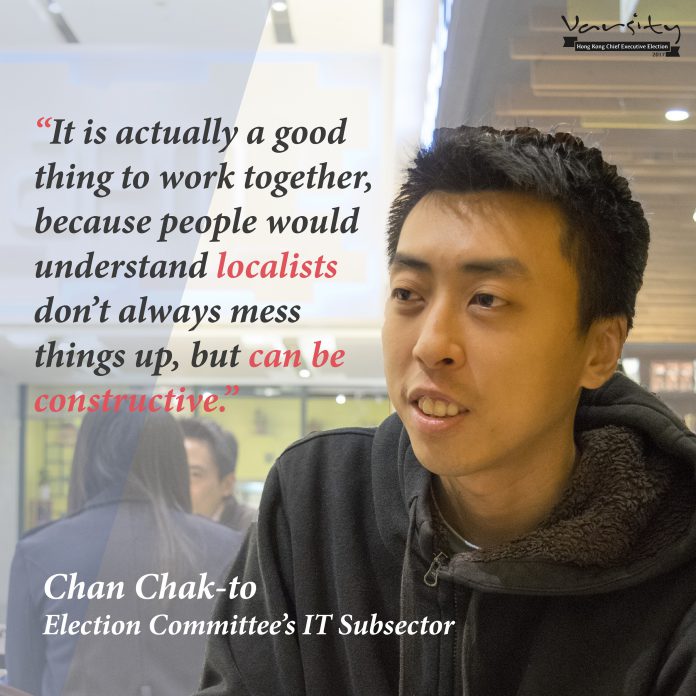
Chan says there is mutual respect between IT Vision members despite their different political orientations. “It is actually a good thing to work together, because people would understand localists don’t always mess things up, but can be constructive.”

When asked to comment on the chief executive contenders’ manifestos, Chan thinks retired judge Woo Kwok-hing’s stands out from the other three. He says Woo has ‘thought it through’ and looked at the big issues, such as how to bypass Beijing’s ‘831 decision’.

By Monday morning, Chan’s nomination form was one of the 180 handed in by Woo as he crossed the required threshold to enter the race. All of his nominations came from pro-democracy Election Committee members, including eight from IT Vision. Another 21 members from the group nominated John Tsang.

Chan says that for him, “The decision of who to nominate should be based on the contenders’ platforms instead of their public image.”

As to who he will vote for on March 26th, Chan says it is too early to say as that will depend on candidates’ performances in the election debate and circumstances at the time.

“If a [majority of say] 800 votes [from the establishment camp] go to a single candidate, then I will probably cast a blank vote. If my vote is vital to the result, then it’s not impossible that I will vote for John Tsang half reluctantly,” he says.

Edited by Stanley Lam and Chloe Kwan
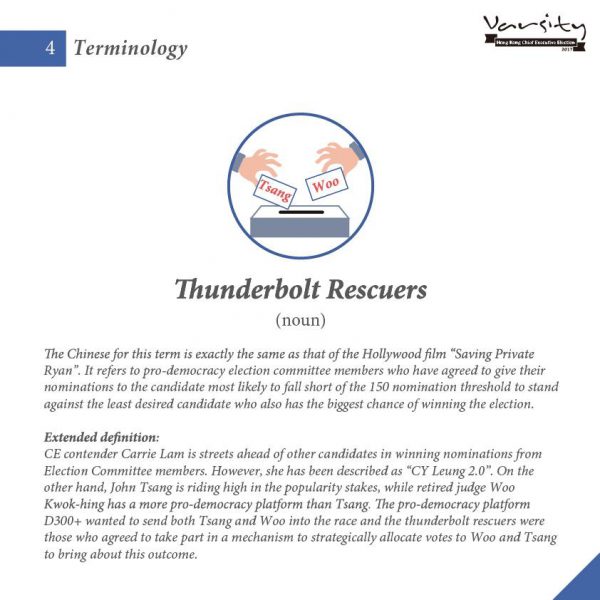
Chief Executive Election 2017 Terminology – Kingmaker

When pro-democracy candidates won an unprecedented 327 seats on the 1200 member Election Committee,  some commentators started to discuss whether the group – making up more than a quarter of the body that nominates and elects the Chief Executive – could act as a “kingmaker”. What does this mean?

kingmaker

Chief Executive Election 2017 Terminology – Conspirary theories

Who is Beijing’s Pick?

Reporters: Marilyn Ma, Rivers Zhang

Veteran China watcher Willy Lam Wo-lap says he believes the Chinese central government fully supports Carrie Lam Cheng Yuet-ngor, not John Tsang Chun-wah in the Chief Executive Election.

“It is beyond doubt that Beijing would support Carrie Lam,” says Lam. He explains that John Tsang may win more support from pro-democracy groups, but Carrie Lam is better at knowing how to please the Chinese government and takes a harder-line than Tsang on the execution of policies important to the central government, such as legislation of Article 23 and the interpretation of the Basic Law.Terminology_conspiracy theories1-01

Sing Pao Daily News has played an important role in triggering a wave of conspiracy theories about Beijing’s real preference for Chief Executive. Lam says many people believe the conspiracy theories that President Xi Jinping prefers Tsang and doubt National People’s Congress Standing Committee chairman Zhang Dejiang can represent the real will of the central government.

However, Lam disagrees with the theory that there are two “cores” in the Chinese central government because Beijing’s backing for Chief Executive has to be determined by a consensus in the Politburo Standing Committee of the China. The all powerful group includes members from the different factions in Chinese politics, including the so-called Shanghai clique and Xi’s faction.

Lam says it is unreasonable to assume that Zhang, described as a member of the Shanghai clique, to openly challenge Xi, especially as Xi has expanded his power following his anti-corruption campaign.

“Chinese politics is opaque and operates in a black-box. So we can only surmise which faction supports which candidate based on trends we can see, we black and white evidence,” he says.Terminology_conspiracy theories quote-01

Lam says Beijing is showing its backing much earlier than it did five years ago. In the last chief executive election, Leung Chun-ying won 689 votes while there were only two candidates competing for 1200 votes. He says the central government has learnt its lesson and wants to ensure Carrie Lam can win comfortably with a large margin.

Editor: Lynette Zhang, Minnie Wong

Graphics: Doris Yu

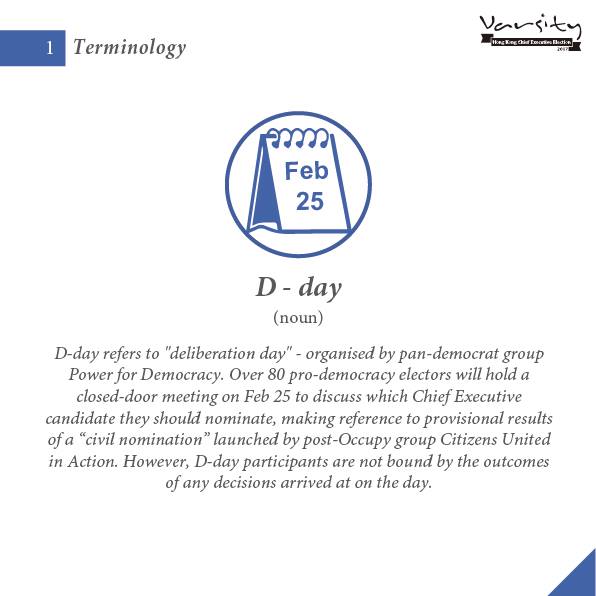
Chief Executive Election 2017 terminology – D-Day

In the first of our election buzzwords, we bring you D-Day:d-day

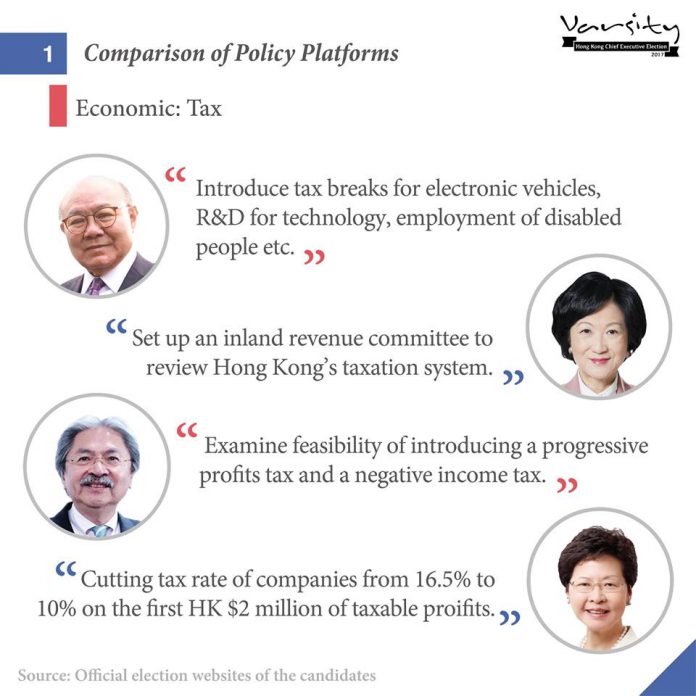
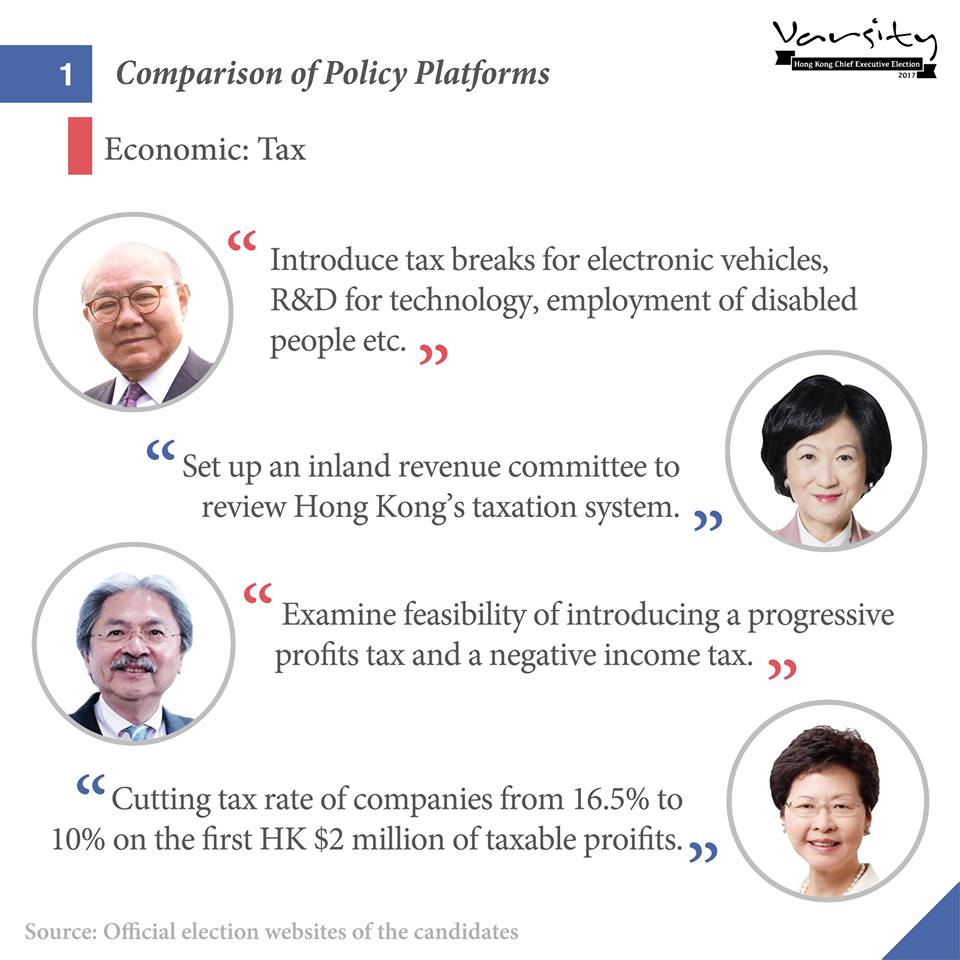
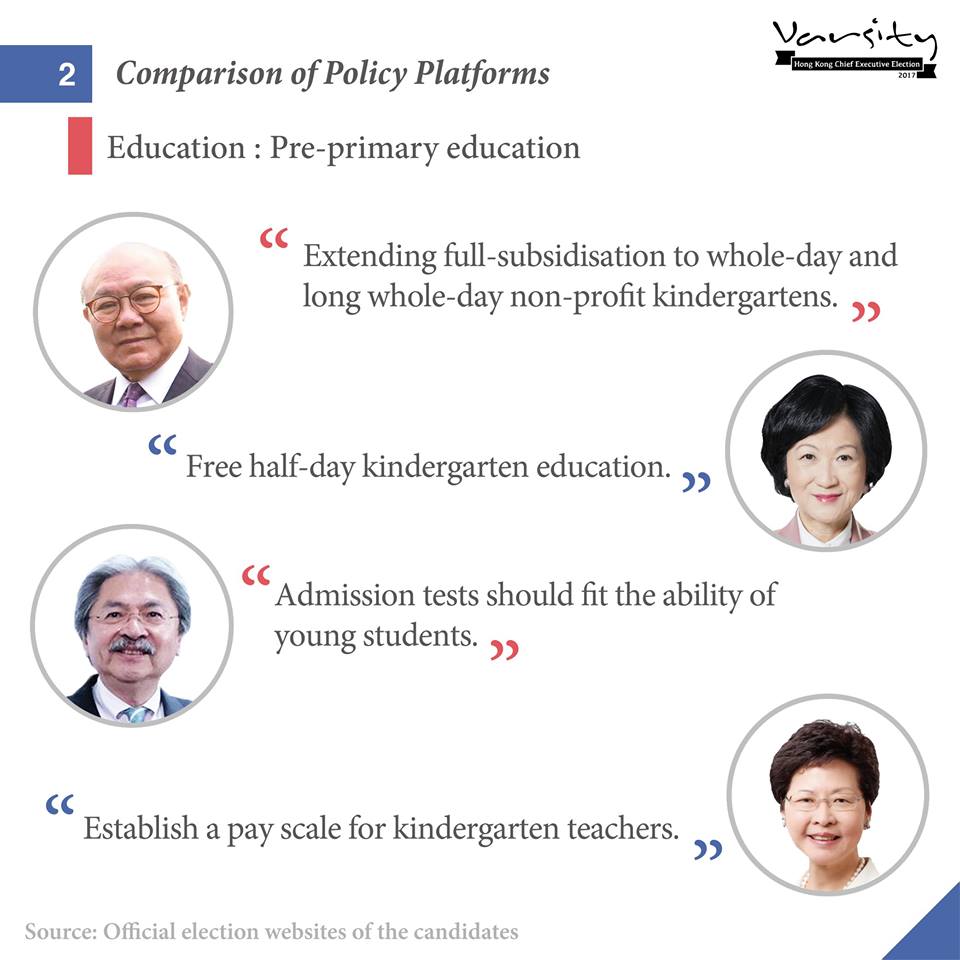
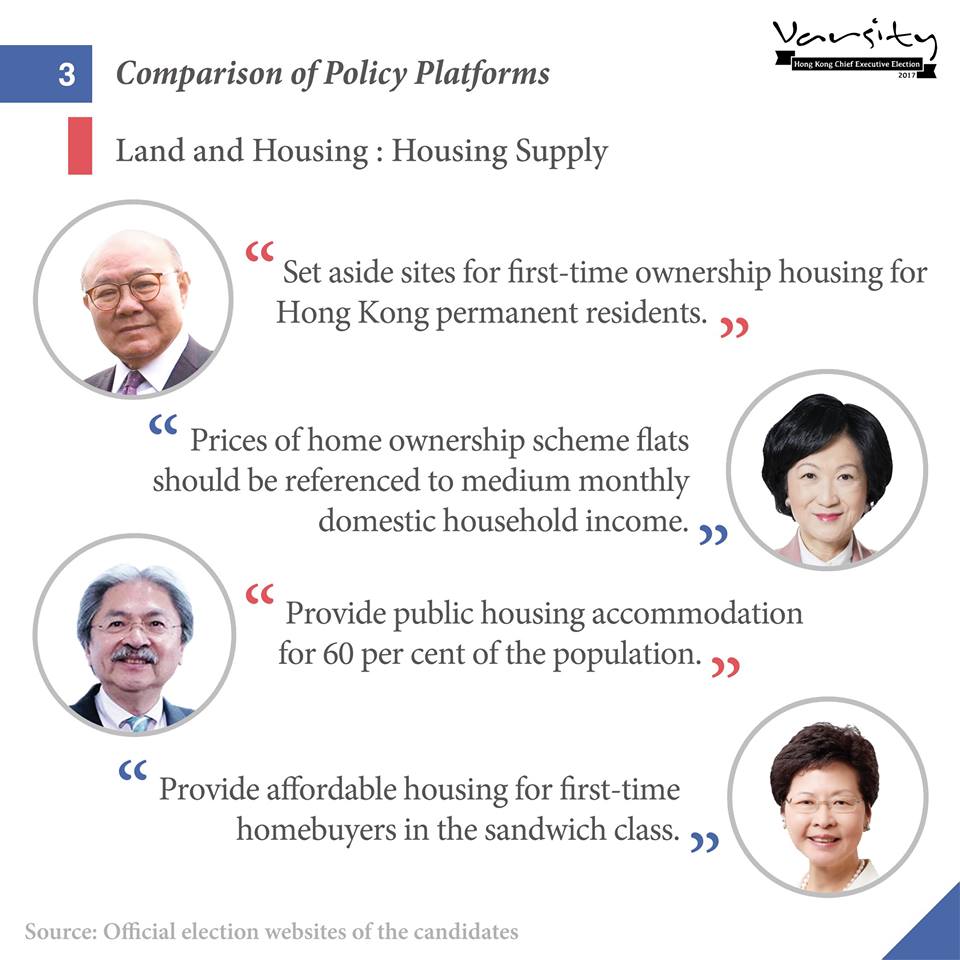
Comparison of policy platforms of would-be Chief Executive candidates

Where do the four main would-be candidates for the Chief Executive election stand on issues like tax, education and housing?


policy1policy2policy3

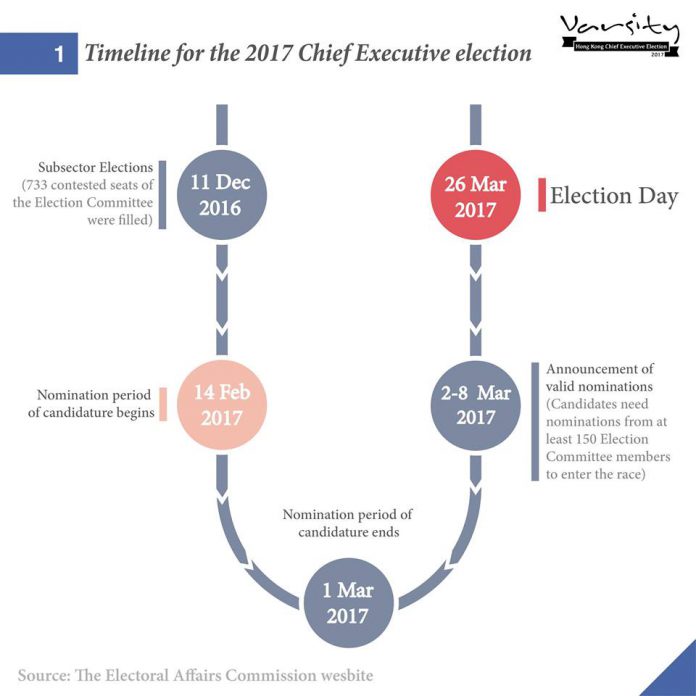
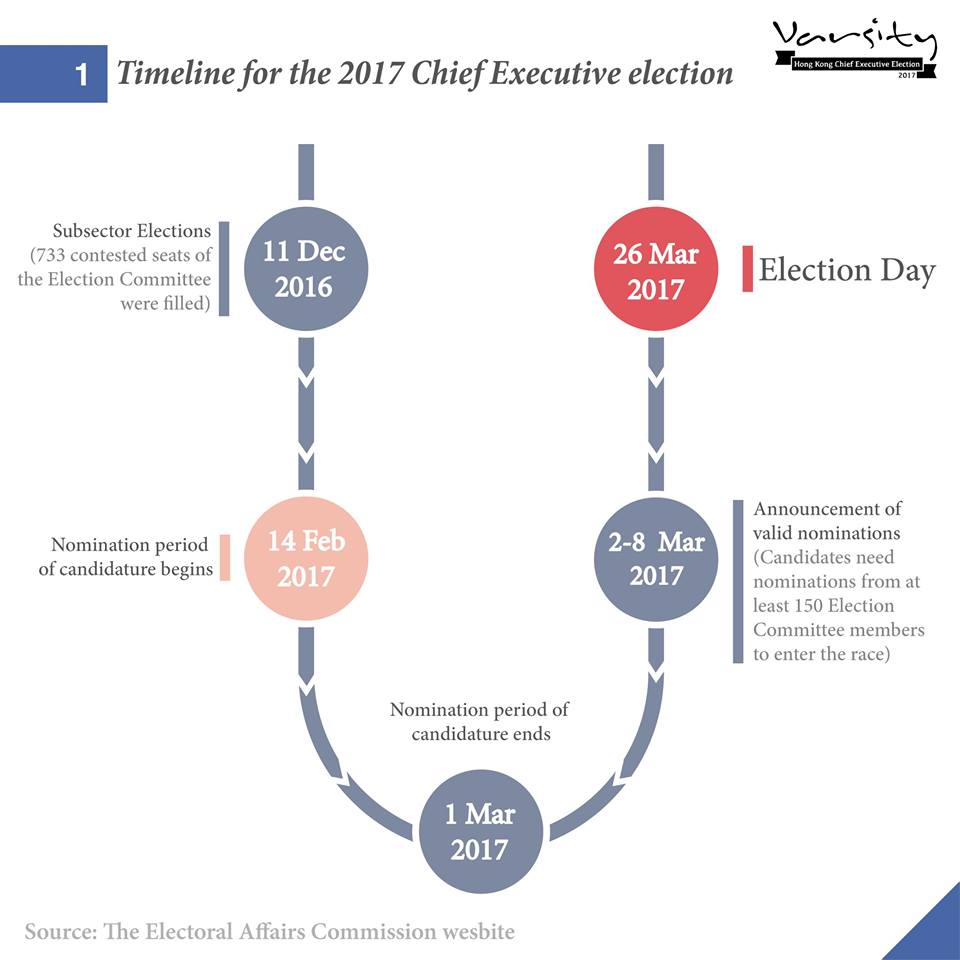
Timeline for the 2017 Chief Executive election

Important dates for election of the Chief Executive of the HKSAR, 2017

Life with an Extra Chromosome

People with Down Syndrome live long and meaningful lives, but will they soon disappear?

Reporters: Fiona Chan, Rammie Chui, Jessica Li

Editor: Tiffany Tsim


Down Syndrome, a condition where babies are born with an extra copy of chromosome 21, is the most common genetic disorder, affecting around one in every 792 live births. The anamoly affects physical and mental development, and people with Down Syndrome have varying degrees of usually mild to moderate intellectual disabilities.

However, with advances in medical care, knowledge and support, people with Down Syndrome are increasingly integrated into mainstream society, lead rich, meaningful lives and make full contributions in the workplace.

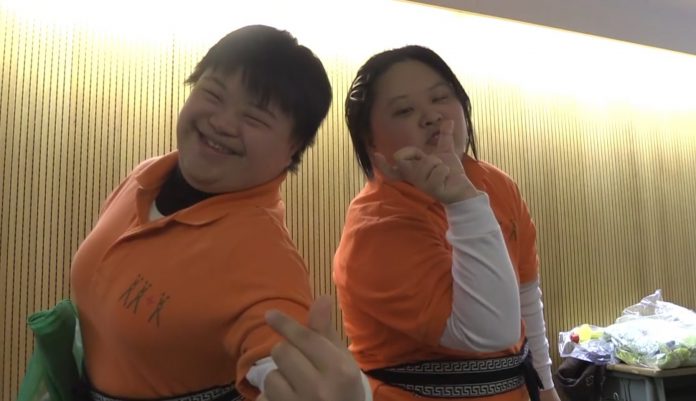
Ho Kit-ting and Fong Ho-pong both work seven hours a day as cleaners in the Down’s Kwan Ngai Service Team, doing tasks that range from car “beauty work” to cleaning public facilities and offices. They have received positive comments from employers for their diligence and sense of responsibility.

Outside of work, people with Down Syndrome pursue their interests and develop their talents. The Down’s Cantonese Opera Group was set up by the Hong Kong Down Syndrom Association (HKDSA). The troupe consists of 13 members who have Down Syndrome, and some of their parents. In December, the group put on a public performance at The Chinese University of Hong Kong after months of practice.

Most of the group’s members have been performing Cantonese opera for years. For example, Wu Hoy-yue, who played the boatman in the performance of “Legend of the White Snake”, has already been learning Cantonese opera for 10 years. Wu enjoys performing on stage and hopes to keep doing it for many more years to come.

His hope is not far-fetched, given that people with Down Syndrome typically live well into their sixties and beyond. This is a huge improvement to decades ago when life expectancy for people with Down Syndrome was much lower, and in 1910, a baby with Down Syndrome would probably not live to 10 years-old.

Advances in medicine and technology have also improved pre-natal tests for detecting Down Syndrome. In the past, such tests would involve the extraction of fluid from the uterus or placenta using a needle or probe. This invasive test carries risk of miscarriage and a chance of false-positive results.

In recent years, the director of the Li Ka Shing Institute of Health Sciences, Professor Dennis Lo and his team developed a non-invasive procedure testing fetal DNA found in maternal blood plasma. This procedure is much safer and more accurate than the invasive tests.

However, it has not been completely free of controversy. In some western countries, there has been concern in the Down Syndrome community that the new test may lead to an increase in the number of foetuses with Down Syndrome being aborted. They think this may lead to the “extinction” of Down Syndrome people.

Maggie Yeung Pin-mui, director of the Hong Kong Down Syndrome Association says she has not observed any obvious drop in the number of the new cases of Down Syndrome people in Hong Kong so far. But regardless of how many people there are in Hong Kong’s Down Syndrome community, she hopes mainstream society can put aside their prejudices and treat them as people just like everyone else but who may just have a different way of learning.

Where Will They Go? To Kwa Wan’s Ethnic Minorities, Repair Shops and Workshops

Redevelopment is threatening To Kwa Wan’s unique culture

Reporters: Maggie Suen, Verena Tse, Ryan Li

Editor: Cindy Gu

For years, To Kwa Wan was a working-class residential and commercial urban area in Kowloon. Many of the buildings are relatively low-rise due to the height restrictions set because of nearby Kai Tak Airport.

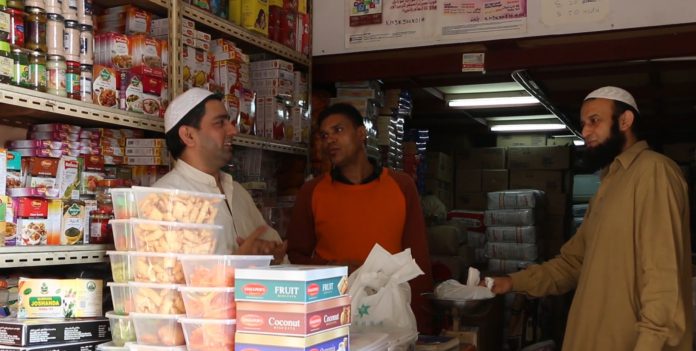
Not connected to the MTR system, and less well-connected by public transport than some other urban areas, To Kwa Wan mostly kept its grassroots, local character, after the airport closed, complemented by a vibrant ethnic minority community.

Now, redevelopment, a subway station and with it gentrification is coming to this corner of Kowloon. Several redevelopment projects have been and will be carried out in the area. Instead of redeveloping the area building by building as they do most of the time, the Urban Renewal Authority has said it has adoped a community-based approach instead.


But for Paddy Ng, a social policy analyst, this is little more than lip service. Ng says the government has neglected the human part of a community. Human connections are the most important element of a community, says Ng. Merely putting up buildings and arranging similar facilities for the shop owners and residents is not enough to keep the community complete, he adds.

For example, in a neighbourhood known as “13 Streets” there are many car repair shops and among them there are some Cha Chaan Teng local diners, which serve the car repair shops workers nearby. If the car repair shops have to move away, the Cha Chaan Tengs would also vanish. The mini-economy would be destroyed by the redevelopment, says Ng.

Hendrik Tieben, Associate Professor at the School of Architecture of the Chinese University of Hong Kong, said To Kwa Wan is an arrival district for immigrants. He says the government is not doing enough in urban planning to cater for the needs of the minorities and keep the cultural diversity in the area.

The area’s ethnic minority residents have long had a raw deal from the government. Most of the time, they are unable to get even basic information about policies that will affect them. For instance, many notices regarding the redevelopment are in Chinese-only and they say government officials did not explain clearly to them about the redevelopment projects.


To Kwa Wan may be old and rundown, but it is also a vibrant community with both a strong local culture and rich cultural diversity. Residents, community workers and academics are working together to try to preserve the character and spirit the area, but they face an uphill struggle.

A Blow to Social Enterprises

Social enterprises struggle to keep their shops under a new tender system

Reporters: Eunice Ip, Venice Lai, Karin Li

Editor: Karen Yu


On the face of it, social enterprises are thriving in Hong Kong. There are 574 such businesses in the Social Enterprise Directory 2016, an increase of almost 9 per cent compared with 2014. The term “social enterprise” generally refers to companies which bring social benefits and operate as a business. The government has put a lot of effort into supporting social enterprises since 2007. For instance, enterprises can apply for up to HK$3 million in funding under the Enhancing Self-Reliance Through District Partnership Programme of the Home Affairs Department and HK$ 2 million under the Enhancing Employment of People with Disabilities through Small Enterprise Project of the Social Welfare Department in their intitial years.

However, with increased market competition, sustainability is an issue for social enterprises. A number of them, such as Gingko House Restaurant in Lai Chi Kok and Fantastic Ladies Café in Tsuen Wan were forced to close in October and August respectively. Both were unable to renew their rental contracts under a revised tender system.

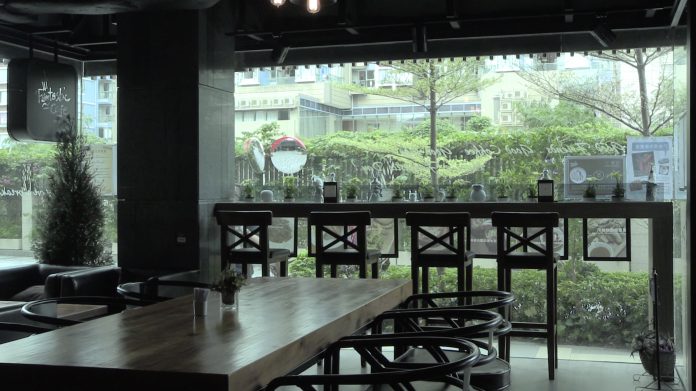
Fantastic Ladies Cafe had been operating for six years. Anaka Ma Lai-wah, general secretary of the Free Methodist Church of Hong Kong Social Service Division, says they had intitially been invited to rent the Tsuen Wan space by the Leisure and Cultural Services Department itself. Ma says the tender system back then would consider a company’s background, operations, employment criteria and terms, food quality and price in awarding a contract. However, according to Ma, the quotation system used now solely takes into account the price offered in a bid.

“[There is] No way to complain. No way to appeal. We have to close the café and give the business to another one,” says Ma.

Ma wants to run her social enterprise like a professional business, but that does not mean just making a profit. Through working for a social enterprise, she believes members of underprivileged groups can gain self-esteem and earn their own living rather than relying on welfare.

Health and medical supplies retailer Cheers Gallery was started up by MentalCare Connect, a social enterprise overseen by the Mental Health Association of Hong Kong. The business received initial funding from the government to start operations, but lost two stores in Hospital Authority premises under the new tender system early this year. Chief Executive Officer Chung Wai-shing says the Hospital Authority puts a high weighting on price and this put them in a disadvantaged position. However, the Hospital Authority says it looks at a wide range of factors.

Chung suspects some companies are likely able to offer higher rents by cutting staff pay and benefits. He says the tender system is causing vicious competition no different from the commercial world.
Many social enterprises struggle to self-sustain their operations.

Doris Leung is the founder and CEO of Diamond Cab which has been providing wheelchair-accessible taxi service since 2010. Her business requires high operation costs including license fees, salaries for drivers and administration staff, maintaining a call center, purchasing custom-made cabs, maintenance and taxes. Leung has to raise funds from various sources, for instance through selling advertising and getting sponsorships, and holding events like the Diamond Sedan Competition. This year, the event raised HK$600,000 for the company.

Like Fantastic Ladies’ Café’s Anaka Ma, Leung does not see Diamond Cab as a business that sets profit as a goal. Instead, she hopes to create a better community for the disabled. “I have the social mission. I really want to see the inclusion, the true inclusion of the community of the wheelchair [users] and non-wheelchair [users]. So I will do this kind of competition to get more income and promote the social mission,” Leung says.