



















Reporters: Alexa Lau and Chloe Nguyen
Editor: Alexa Lau and Chloe Nguyen
Varsity students have canteen food tasting sessions at Kyuyshu University, Chinese University of Hong Kong and Polytechnic University of Hong Kong.



Varsity students have canteen food tasting sessions at Kyuyshu University, Chinese University of Hong Kong and Polytechnic University of Hong Kong.

By Mike Chu
The passionate journey of Hong Kong football fans supporting their team overseas.
Watching the Hong Kong football team playing outside the city offers soccer fans an unique experience that many are willing to pour a lot of effort to rally behind the team with unwavering support.
Mocked by some fans as the ‘battle of the underdogs’, about 300 Hong Kong people travelled to Liechtenstein, which is a 12-hour flight to the city, to watch in person the friendly match on October 10.
Hong Kong eventually lost 0-1 to the host but supporters got the rare opportunity to light up the stadium with pyro, a firework commonly used by football fans in Europe and South America to show support, which is impossible in Hong Kong.
One of the 300 Hong Kong supporters was Carey Tsui, who has been supporting the Hong Kong team since the 1990s.

“Going to Liechtenstein costs us tens of thousands of dollars,” Tsui says.
He notes that fans are undeterred by money issues and that they are even willing to sacrifice more when deciding to leave Hong Kong to support their team.
Tsui also followed the team to Iran, Turkmenistan and Uzbekistan during the AFC Asian Qualifiers for the 2026 World Cup, and their trip to Turkmenistan in June 2024 was not easy.
He adds that some travelling agencies in Hong Kong offered packages as much as HKD$30,000 that most of the fans could not afford.
Together with 18 other fans, Tsui eventually contacted a travelling agency in Turkmenistan, and they were granted visas only half a month before the match, which ended with a goalless draw. Hong Kong failed to advance to the next stage.
He adds that internet access is also very limited outside the fans’ hotels, which made contact with other supporters in Turkmenistan and with Hong Kong extremely difficult.
“Travelling to support the Hong Kong team was uncommon before the 2023 Asian Cup in Qatar, until we started making whatsapp groups for coordination. Finding travelling pals has been easier since then,” Tsui says.
The 2023 Asian Cup marked Hong Kong’s first presence in the tournament in 55 years. Some 500 fans went to Qatar to witness history. Calvin Choi Man-hou was one of them, and shares a similar view with Tsui.

“Fans bonded together after the Asian Cup. We started to realise that going on away trips is not as difficult as it might seem,” Choi says.
As the leader of a cheering team called “Chi Sin Lo”, which means ‘crazy man’ in Cantonese, Tsui said he has an emotional attachment to the Hong Kong team.
“Supporting Hong Kong is unique in a sense that they are representing my place of birth,” Choi says.
Hong Kong is not an Asian football powerhouse. Out of the 15 matches played in 2024, they have won only six of them. They have also never qualified for the World Cup.
But the team made some historic achievements in the past two years apart from qualifying for the Asian Cup.
In the 19th Asian Games Hangzhou, they beat Iran and qualified for the semi-final.
Number of fans supporting the team on home soil has not increased like the number of fans supporting them playing abroad however.
Only around 5,000 fans attended the friendly match between Hong Kong and Mauritius in the city in November 2024, while 12,000 fans attended the friendly match against Myanmar in 2022.
Ng Chi-hang, the leader of another fans group The Power Of Hong Kong, thinks more could be done to attract people rallying behind the Hong Kong team.

“The number of fans fluctuates based on the performance of the team, which is rare elsewhere. Fans in Europe keep on cheering despite the team having poor results,” Ng says.
“Building a dedicated fan base is essential in sports development, and Hong Kong football needs precisely that,” he adds.
Sub-edited by Jen Lam

Hong Kong volunteers unite for beach clean-up highlights growing marine pollution concerns.
By Suzana Li
Vivi Au is a beach clean-up volunteer who had her first try at Starfish Bay in Ma On Shan with 14 other volunteers including office workers and university students.
“I joined the activity because I think it is very meaningful. Hong Kong has so many beautiful beaches, and we need to take action to protect them,” Au says.
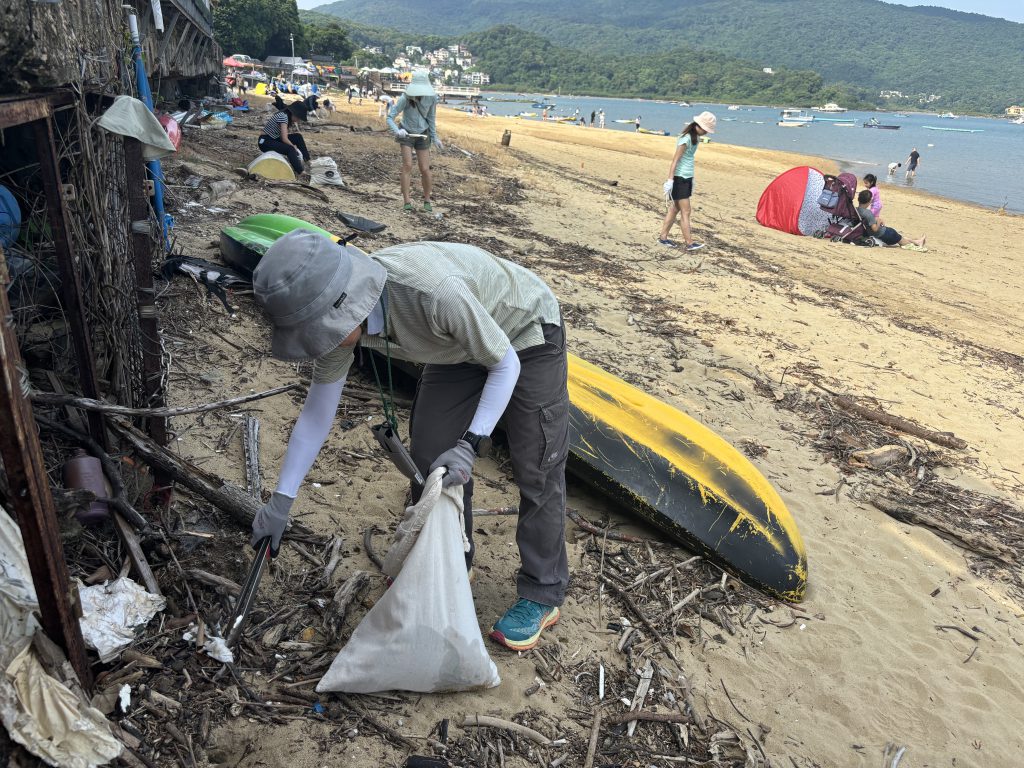
Another volunteer, Alice Ho, who has joined the clean-up activity held by A Plastic Ocean Foundation two times before, is a beach lover. She is sad to see so much rubbish at beaches in Hong Kong.
“After picking up rubbish from beaches, I’ve started thinking more about what I can do. I have encouraged my friends to join the programme,” she says.
“I read many articles and news about marine pollution and microplastics which threaten health. I really want to make an effort to combat the problem,” the university student adds.
The garbage volunteers collect is usually plastic packaging, plastic containers, flip-flops, lighters, toothbrushes and fishing nets.
The NGO organizes two to three clean-up events at different non-gazetted beaches each week.
Non-gazetted beaches are those not regulated or managed by the government, while gazetted beaches are maintained by the Environmental Protection Department, with cleaning frequency ranging from two times a month to six times a week.
Before heading out to clean beaches, volunteers are given a talk on the programme and marine pollution.
They are also given gloves, litter pickers, and baskets for a two-hour clean-up session.
In 2023, the marine pollution concern group collected four tonnes of waste from beaches in Hong Kong.
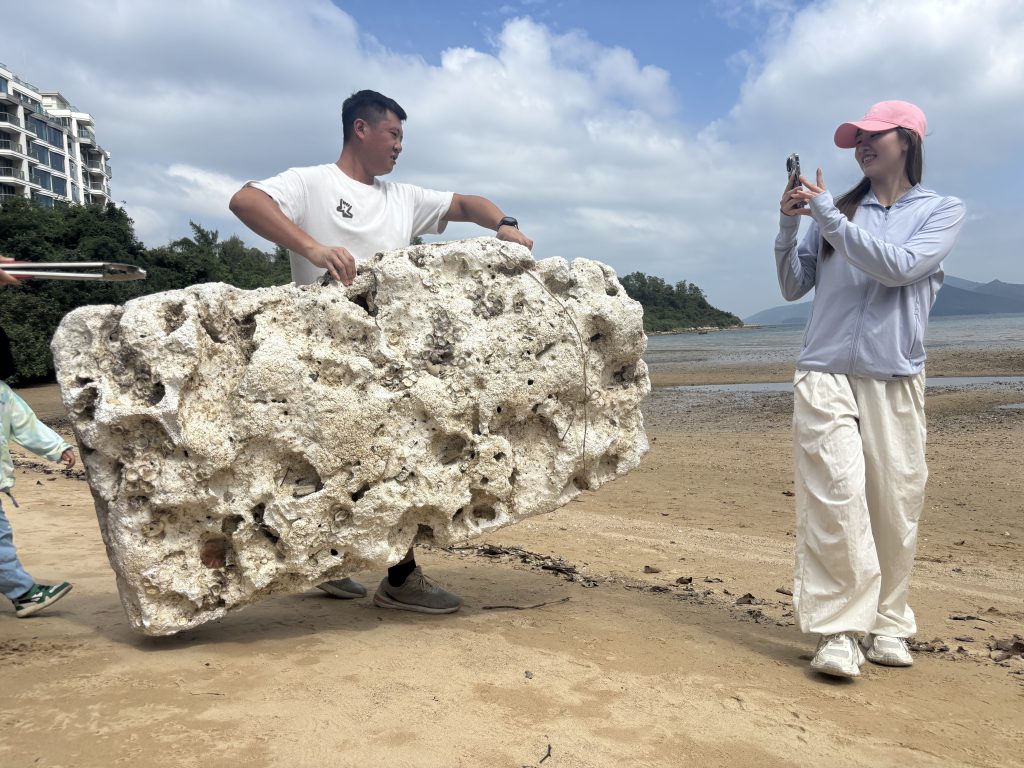
The partnership manager of the concern group Isabella Bailey Tung points out that the source of rubbish is from different parts of the world.
“We can tell some rubbish is not produced locally by the packaging. We collect rubbish in different languages on their packaging,” Tung says.
“It’s like people dumping whole rooms of furniture out here. I’ve seen everything from toilet bowls to kitchen sinks on the beach,” she adds.
Over 5,123 tonnes of waste were collected in 2023, according to the Beach Water Quality in Hong Kong issued by the Hong Kong Environmental Protection Department.
Of this, 1,121 tonnes were collected from non-gazetted beaches which were estimated to fill approximately five standard-sized basketball courts.
“If we do not collect the waste, they will degrade into microplastics then flow into the ocean, and ultimately invade our food supply, harming our health,” Tung warns.
Tung shares rubbish collected is sent to landfill, while some is reserved for research.
She stresses that the best long-term solution lies in reducing plastic usage.
“Hong Kong’s microplastic concentration isn’t as severe as some developed regions, thanks to good water filtering. But in terms of larger plastic waste, our beaches are littered. And the recycling rate is disappointingly low, even when compared to some Southeast Asian countries,” Tung adds.
Hong Kong disposed of approximately 852,600 metric tons of plastic waste in landfills, accounting for roughly one-fourth of the total municipal solid waste composition, according to the Waste Statistics for 2022 issued by the Environmental Protection Department.
Of this, only 114,600 metric tons were recycled, resulting in a recycling rate of approximately 11.9 per cent.
In contrast, Taiwan achieves a plastic recycling rate of 40 per cent, according to the Resource Circulation Administration Ministry.
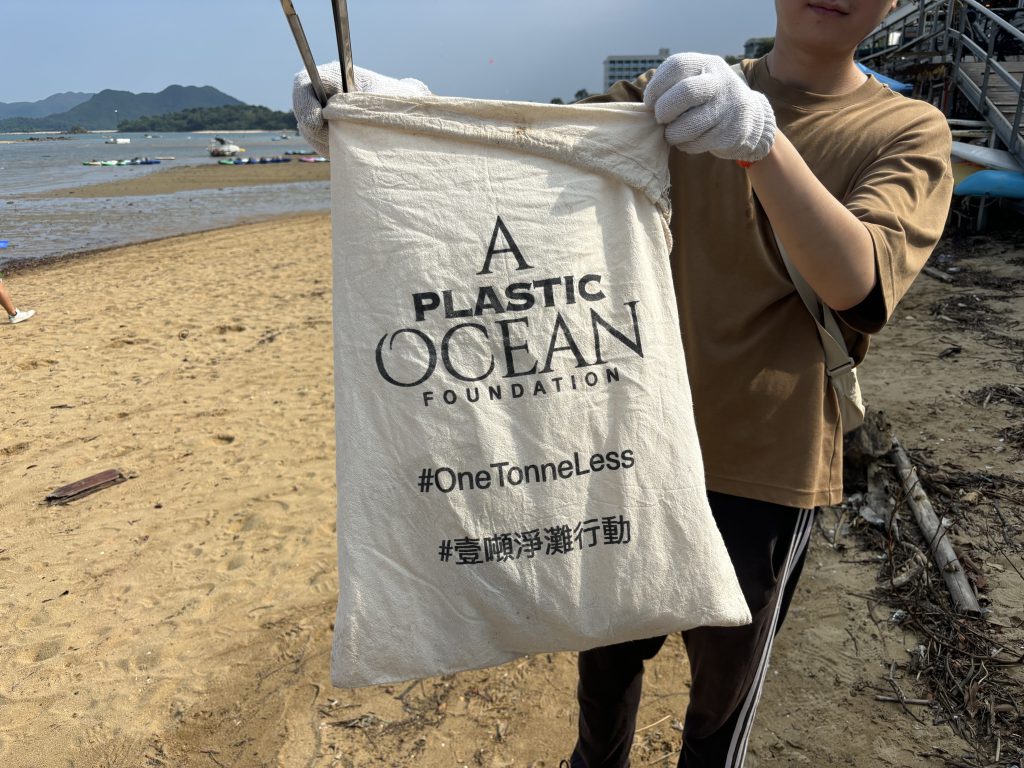
On April 22, 2024, Hong Kong officially launched regulations on single-use plastic products, prohibiting the sale and free provision of regulated items.
Senior education officer of the concern group Jasmine Siu says the concerted effort is vital in fighting marine pollution.
“Changing public use of single-use plastics is essential. Ordering takeaway food is a big part of Hong Kong culture. Single-use plastics are convenient and free, so changing habits is a challenge,” Siu says.
“Many people eagerly join cleanups, but it’s hard for them to grasp the vast scale of ocean trash, especially in distant regions. While awareness of plastic pollution is already there, its global severity is still underestimated. Solving this problem requires global investment and action,” she adds.
Sub-edited by Enya So

Our December 2024 issue – Peace is now published.
Peace has always been a tough lesson in human history. We are now still witnessing persistent warfares in different parts of the world. Some are committed to fight for peace. This year’s Nobel Peace Prize is awarded to Nihon Hidankyo, a group representing atomic bomb survivors of Hiroshima and Nagasaki, for their effort to raise people’s awareness on nuclear weapons.
To ride on this, our Periscope of the December issue for the first time presents a series of short clips featuring atomic bomb survivor, Teruko Yahata from Hiroshima. She shares how she recovered from the atomic bomb trauma, and her views of the Japanese government after the bombing and after learning more about the causes of World War II in Singapore. The reporting is conducted by Varsity reporters who visited Hiroshima.
On a positive note, new content about travel in Japan and canteen food at universities in Hong Kong and Japan is launched under the December issue multimedia section. Check out videos of Varsity reporters reporting about canteen food quality and fun places to hang out with friends. Video of food review on canteen food at the Chinese University Of Hong Kong and Polytechnic University of Hong Kong is another highlight of the issue.
In the People section, a Dutch short track speed skater Yara Van Kerkhof retires after 27-year career and strives to inspire children with congenital heart disease through sports.
Other topics covered include Americans’ reaction to the US election result, extreme dieting among young girls and young people fake to be rich by posting on social media in China, mainland Chinese students studying in Hong Kong can visit Taiwan.
From the pursuit of peace to personal struggle in stories featured in Periscope, this issue reminds us of the importance of resilience, learning history, and cultural exchange. Together, let’s stay hopeful and soldier on.
Enjoy your read!
Carrie Lock
Managing Editor

Our November 2024 issue – Long Live the Truth is now published.
Post-pandemic 2024 sees a world in wars. From the ongoing Russia-Ukrainian and Israel-Hamas wars to the recent Lebanon conflict, the call for peace is pressing. In this issue, our reporters travelled to Japan and brought back the message of peace-making.
Our Periscope features how Hiroshima Peace Memorial Museum presents an incomplete narrative of Japan as an atomic bomb victim without addressing the true causes of World War II. A Hiroshima atomic bomb survivor, having learned about Japan’s war crimes in Singapore at the age of 78, is now dedicated to tell the truth and promote peace.
In the People section, a retired Vietnam soldier searches for remains on the battleground.
A TV host learns to be a better mother after running a people-hunting show in China. A Chinese craftsman dedicates his life to making traditional paper.
Other stories tell the struggles of Hong Kong democrats and an investigation into illegal mainland Chinese photographers working in Hong Kong. Away from the negativity, Hong Kong athletes are trying to make rope skipping an Olympic event. A local organisation provides free sports classes to those in need. In China, a new online game Wukong drives tourists visiting the real-life game locations. Our reporters are concerned about the environment, with stories highlighting the carol restoration in Hong Kong and the sole paper recycling factory in Hong Kong.
Our era is fast-paced, complex, and unpredictable. In times of conflict and uncertainty, Varsity stands with those in need and strive for peace together.
I hope you have an enjoyable read.
Cynthia Chan
Chief Editor

Young Chinese fake to be rich by self-branding on social media.
By Celina Lu
Posing as an elegant lady leading a luxurious lifestyle, online content creator Xiao Shu has a taste of living like a princess for one day – an experience of a lifetime by hiring a team of make-up artists and photographers to do a photo shoot in fancy places, albeit wearing a counterfeit designer dress and carrying a fake luxury handbag.
The service package covers photo taking at a Michelin restaurant called Yihenyue by Seven Villas, an infinity swimming pool, a golf course, and Conrad Hangzhou.
Xiao filmed the whole experience and made a video which was then shared on her own social media accounts on various popular social media platforms in China, including TikTok, Xiaohongshu (the Little Red Book), and Bilibili.
“I want to start an online business by creating video content myself. I wrote a story about boys taking pictures of luxurious lifestyles for social media posts when I worked for GQ magazine. I find faking to be rich is an interesting topic, so I tried it myself and made a record of it,” the 28-year-old woman says.

Xiao spent RMB ¥2,488 (US $349.37) for a 12-hour shooting session and she was guaranteed to have nine photos finished.
“I’m not used to wearing gorgeous clothes and posing for photos for hours. The experience made me feel that I was pretty and happy at that moment. I also felt a little bit awkward, as I was not used to that,” Xiao adds.
The video about the experience earned her 22,000 likes on Xiaohongshu, 432,000 likes on TikTok, and 2,242 likes on Bilibili.

Out of curiosity, fund investigator Zhou Qian also signed up for a service package like Xiao. She had her first photo taking session at the Guangzhou Elegant Hotel. She posted the photos she took on Xiaohongshu.
“I have seen videos of other girls doing this on TikTok before, and then I wondered what it was like. I gave it a try on my 28th birthday in a five-star hotel,” Zhou says.
“I booked the photo shoot two weeks earlier and paid RMB ¥400 (US $56.18) for a 30-minute photo session. Costumes were provided and I had to do my own make-up,” she says.
“The service also includes providing a fake Louis Vuitton bag. The photographer took pictures of me with my mobile phone and told me to pose in various ways. But I actually didn’t feel right because I was faking to be rich,” the 28-year-old woman says.
“After half an hour, another customer came. There were about at least 20 girls waiting to take pictures that day,” Zhou shares.
“Young girls find it appealing to pretend to be rich elites. Many are willing to spend money to fake it for a day. After all, who doesn’t want to become rich and smart,” she adds.

Advertisements about the “Fake Socialite” photo service can be found on various social media platforms offering the service charging from RMB ¥400 (US $55.24) to RMB ¥2,500 (US $345.22).
Lucky King is one of the studios posting messages about such “Fake Socialite” photo service in Xiaohongshu.
It charges RMB ¥1,188 (US $166.90) for an hour of photo session at a five-star hotel the Bvlgari Shanghai and RMB 1,088 (US $152.85) per hour at the Banyan Tree Shanghai.
95 per cent of their customers are girls and five per cent are boys. They are mostly between 20-35 years old, according to the studio.

“In recent years, senior cadre style or gentle style photography have become increasingly popular on TikTok. Most of the girls who purchased the service are to get a nice set of photos for their birthday and want to maximise the value for the money they can afford to spend,” a staff of the studio says.
Assistant Professor Lin Jian from the School of Journalism and Communication of the Chinese University of Hong Kong points out that photo services of such kind are popular among internet celebrities.
“Some internet celebrities want to create an illusion that they live a luxurious life to impress their fans. Some want to make use of the service to create content for their social media accounts,” Lin says.
“Internet celebrities want to make use of this to boost their fame and number of followers. They might profit from the fame they build in the future. Private companies might approach them to advertise some products or run live online sales,” Lin comments.
Lin also points out that some young people are yearning for a celebrity lifestyle and want to get a taste of it.
“Consumer culture is an important part of contemporary youth culture in China. This kind of photography service is also a kind of consumption behavior. They can have a taste of being at five-star restaurants and hotels,” he says.
“Consumption has actually become a solution for dealing with stress and the urge to be successful. A solution to the fact that it’s hard to find ways to turn us into a so-called ‘successful’ person,” Lin adds.
Edited by Cynthia Chan
Sub-edited by Carrie Lock

A-bomb survivor Teruko Yahata shares her story about the aftermath of the atomic bomb attack in Hiroshima in this series of clips.

A message of peace from Hiroshima A-bomb survivor Teruko Yahata, calling for a world without war and urging global leaders to foster unity and understanding.
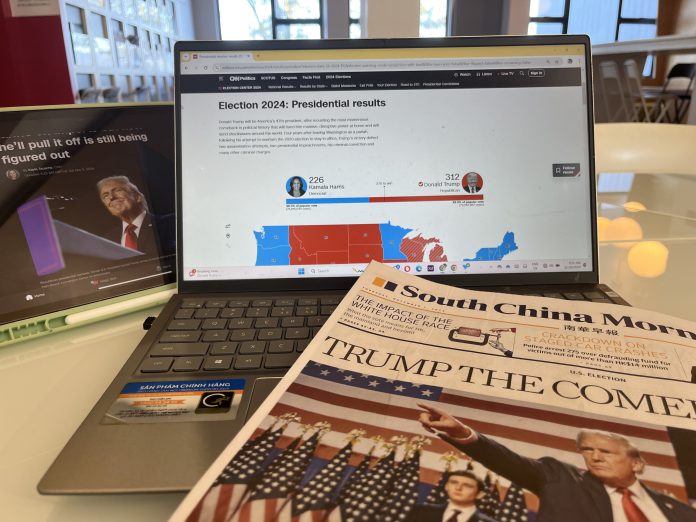
Many Americans are worried about Donald Trump’s return to the White House.
By Ken Nguyen
A victory for Donald Trump in the United States (U.S.) presidential election stokes concern about the country’s future economy, healthcare and welfare of immigrants.
“I voted for Kamala Harris, but this result is what I did expect”, says Timothy Esau, an American, who is now a full-time Business student at the Chinese University of Hong Kong.
Esau says that he is worried that the president-elect would likely worsen the U.S. economy with the upcoming tariff policy that targets every country.
Vowing to end inflation in the U.S., Trump, who defeated Democrat Kamala Harris by a significant margin, plans to install a blanket tariff of 10 to 20 per cent on all imports, with additional tariffs of 60 to 100 per cent on goods brought in from China.
“I don’t think tariffs are good for America. The thing is that there are still ways for China to sell their products to the country, which is through a third party,” Esau says.
Aiming at curbing Russia’s Ukraine war efforts, the U.S. imposed individual and economic sanctions. Esau points out Russia manages to sell their products to some companies in Kazakhstan, and from which export to the U.S.
“This way can also help China bypass the tariffs, but of course their products will go up in prices. Even so, expensive Chinese goods will still be more competitive than U.S. goods, and consumers are those who get hurt,” he says.
“So basically, it is tariffs for everybody, especially for the U.S., the one who made the tariffs”, the student adds.
Another American living in Hong Kong, Professor Stacilee Ford from the Department of History, the University of Hong Kong, fears that Trump will limit abortion rights, one of the items discussed in the far-right policy recommendations in Project 2025.
Project 2025 is a comprehensive policy document created by the Heritage Foundation, a prominent right-wing think tank that has influenced Republican administrations since Ronald Reagan.
“It is a document that Trump has tried to distance himself from, but it is pretty clear to be a roadmap of sorts for his second term as the president,” Ford says, adding that she voted for Kamala Harris.
“At one point, Trump was pro-choice (supporting abortion-right), but in his need to be a flag-bearer for conservative voters, he flipped his stance,” she says.
Ford adds that Trump supported judges to the Supreme Court who do want to roll the clock back and ban abortion.
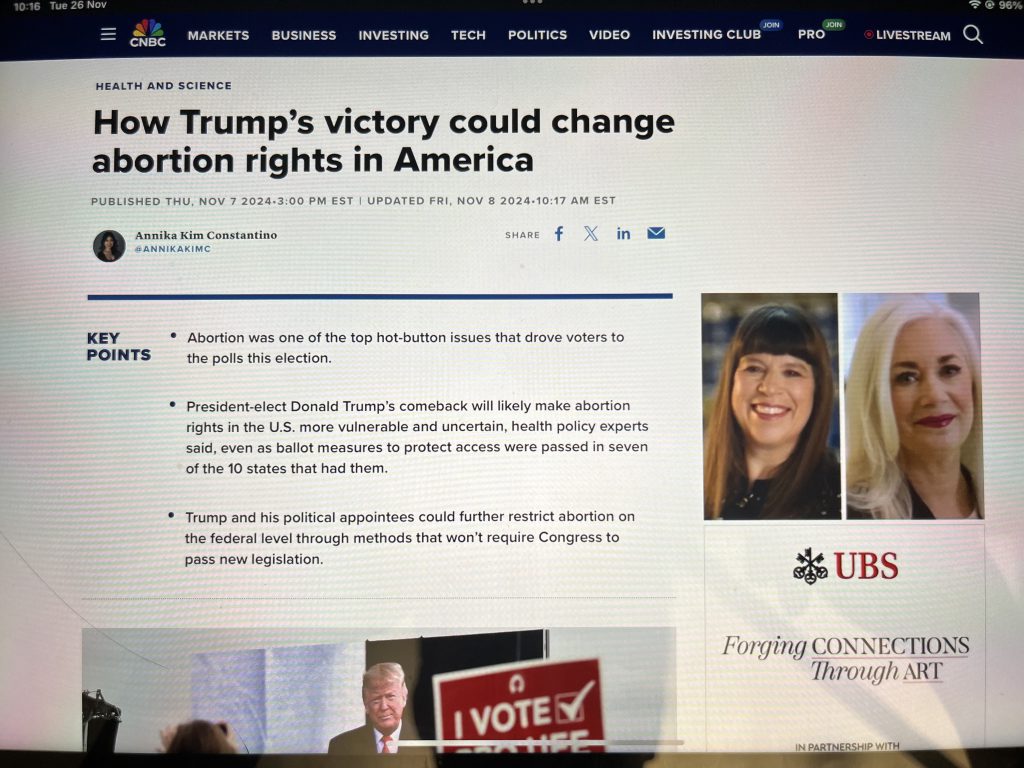
“We will see what he (Donald Trump) does. Note that his wife, Melania Trump, recently wrote in her memoir that she is pro-choice,” she says.
Amaru Ordóñez-Jacobson, an American who is now an exchange student at the Chinese University of Hong Kong, expresses his concern over the healthcare system as Trump calls for sweeping changes to the Affordable Care Act.
“It is incredibly concerning,” he says.
The Affordable Care Act, also known as Obamacare, is a comprehensive health care reform that was signed into law by former president Barack Obama in March, 2010. The reform aims at making healthcare more affordable and accessible for Americans by expanding insurance coverage, reducing healthcare costs, and improving the quality of care.
The student recalls watching a live presidential race debate, in which Trump talked about having ‘concepts of a plan’ to replace Obamacare when being asked how his government would manage to guarantee healthcare for U.S. citizens without the law.
“It was just crazy. How can anyone see a man saying ‘concepts of a plan’ and still think he is the right person to run our country for the next four years,” Jacobson says.
“The fact that Trump wants to remove the policy that has helped tons of Americans better access to healthcare is terrifying,” he adds.
Jacobson shares that he grew up in Texas, where there are many white people showing negative attitudes towards Mexican immigrants.
He worries that the situation will get worse since Trump repeatedly stated in many rallies that he plans for mass deportations of millions of immigrants and expanding the U.S.-Mexico border. Trump claims that this will benefit American workers by raising wages and improving job conditions.
“I am really concerned about how unapologetically racist Trump’s campaign was,” Jacobson says.
Sharing the same concern, Asian American Chloe Yu-Ning Cheng, who is now an exchange student at the Chinese University of Hong Kong, thinks it is worrying that Donald Trump sees deportations as the answer to everything.
“Why are immigrants seen as un-American? This just got me to question what are American values” Cheng says.
The 21-year-old believes Trump only protects and cares about the white and the wealthy. She adds that she does not understand why the president-elect and his team demonises immigrants while talking about preserving ‘American values’ in their rallies.
“According to them, I am not sure if they mean immigrants would change American values, or destroy it, or something. I don’t quite understand what the concern is about,” the student says.
Watching live broadcasting of the election results with her American classmates in a university lecture room, Cheng recalls people were shocked when seeing each of the battleground states being taken by Trump.
“All Americans that I know are processing the result right now. It feels unreal,” says Cheng.
Sub-edited by Iris Jiang

Extreme diets take toll on health.
By Zora Yan
Being called as “fat pig” by her university classmates, Zhang Zichu adopted various extreme diet plans she found online as she could not stand the discrimination and insult.
While studying at Xiamen University in 2016, Zhang strictly controlled her food intake, eating poached food only for eight months. She might even only eat 500g of poached spinach or an apple with skimmed milk or 50g of corn kernels with a tomato in a meal.
“Sometimes, 10 cherry tomatoes were enough for me to have a meal,” Zhang recalls the torment when she was 21 years old.
Not only controlling what she ate, but Zhang also used “Fairy Tube” she bought online which cost RMB ¥76 (US $10.5) to induce vomiting.
It is a 40cm long rubber tube with a diameter of 2.5cm that she would insert directly from her mouth into her stomach along the esophagus, allowing food to spit out along the tube.
“I used the tube to help me vomit after I eat a large amount of food,” Zhang says.
“The ‘Fairy Tube’ allowed me to enjoy a wide variety of food without worrying about getting fat. I had to start every meal by having some ice cream and drinking water throughout the whole eating process to help vomit all the food easily after every meal,” she adds.
Zhang used the method twice a week during the horrible eight months. She would also do eight to nine hours of exercise in the gym every day.
The extreme diet, the “Fairy Tube” and exercise led her to a loss of 70kg. But for five years, she experienced a lack of menstruation, she also lost a lot of hair and teeth.

Feeling immense pressure in life, Zhang told her mother that she had a desire to end her own life.
Having noticed Zhang’s emotional disturbance, her mother took Zhang to the Peking University Sixth Hospital for treatment in 2019, out of concerns for Zhang’s personal safety.
Zhang was diagnosed with anorexia nervosa, an eating disorder with a serious mental health condition, that one would try to keep the weight as low as possible.
Standing at 160cm, Zhang’s weight dropped to 25kg, the lowest point of her life in 2019 from 105kg in 2016. And her heart rate was only 39 beats per minute whilst the normal resting heart rate for adults is between 60 and 100 beats per minute, according to Britain’s National Health Service.
“I felt like I was not a human anymore. I was just like a devil living in this world,” Zhang says.
After three months of hospital supervision, she had three balanced meals a day and took medications such as Olanzapine, Quetiapine, and Prozac, to treat her mental conditions. She gradually recovered.
Also diagnosed with anorexia nervosa was Shao Panpan, who adopted extreme diets she found online in 2023. She weighed only 30kg with a height of 160cm at that time.
Her classmates laughed at her because of her weight, so Shao decided to lose weight when she was in high school in January 2023.
“There is a popular weight loss method called liquid fasting (only drink liquid without sugar for 3 meals) on social media, so I imitated it to achieve my weight loss goal,” Shao says.
She recalled that she quickly lost 2kg in one day, but her weight rebounded easily, so she tried to find other methods on the Internet.
During her online research, she was misled by many “skinny” bloggers on social media, who shared their daily food intake and their slim bodies, making her believe that she could lose weight if she ate less than them.
Shao also regarded her parents who tried to help her regain health as “enemies”.
“I just put food in my mouth and spit it out when my parents were not looking at me,” she says.
In April 2024, after a year of experiencing these extreme diets, Shao lost weight to 30kg. She was unable to concentrate in class, unable to stand, and even experienced urinary and fecal incontinence.

Worried about Shao’s health, her parents brought her to the hospital. She even developed severe pneumonia and she was in critical condition a week after because of her low body weight.
“When I was about to lose my life because of my extreme weight loss, I realized that the methods shared online were actually incorrect,” Shao says.
“The excessive weight loss had caused me great distress because of various side effects it brought, such as irregular menstrual cycles, hair thinning, and mental fatigue,” she adds.
Shao learns from her personal experience that health is the most important thing when it comes to losing weight and urges everyone not to blindly follow extreme diets shared online.
Lecturer Peggy Yip Pui-Sze from the School of Life Sciences at the Chinese University of Hong Kong, warns people should not rely on online information regarding extreme diets and notes the information is not clinically and scientifically proven.
“Those who adopt these diets may experience malnutritional, as they do not have a balanced diet and only eat one type of food or avoid certain kinds of food groups,” Pui says.
She says extreme diets might lead to a sharp fall in weight at the beginning, but such diet plans may have detrimental effects on the body.
“There is no shortcut to weight control. Changing unhealthy eating habits in daily life and exercise are required,” she says.
Pui urges those who are experiencing eating disorders to seek help from professionals.
Edited by Molisa Meng
Sub-edited by Carrie Lock