


















Home Blog Page 9

Skating Against All Odds

A skater’s journey from heart surgery to Olympic triumph.

By Cathleena Zhu

Having won 15 gold medals in international competitions, including the Olympic Games, World Championships and European Championships, Yara Van Kerkhof thinks the last race at the Short Track Speed Skating World Championships in her home country, the Netherlands, as the perfect end of her 27-year career. 

Van Kerkhof and her three teammates won gold in the women’s 3000 metres relay of the Championships held in Rotterdam in March 2024. She wept as she accepted her last medal.

“It was a great feeling to have tens of thousands of people cheering for us. I think their encouragement led to our team’s victory,” Van Kerkohf says.

Yara and her teammates celebrating their victory in winning the 3000m relay gold medal. (Photo courtesy of Yara Van Kerkhof)

“When I stood on the podium, I saw my seven-year-old self again. If that little girl could see what I have achieved today, she would be very proud,” she adds, recalling her childhood memory.

At the age of seven, Van Kerkhof was diagnosed with congenital heart disease and had an open heart surgery. Thanks to the treatment, she was able to keep her dream of becoming a short-track speed skater alive.

The Dutch athlete has always loved skating since she first stepped on the ice when she was three. But her parents did not want her to do athletic training because of her medical condition.

Van Kerkhof insisted on doing simple exercises such as jogging every day for three years. Her parents were convinced by their daughter’s passion and were determined to find the best doctors for her.

“My family asked almost everyone they knew. One of my father’s colleagues had a child who also had heart problems and was treated at a facility called Stichting Hartedkind, so they sent me there too,” the 34-year-old athlete recalls.

Stichting Hartedkind conducts scientific research on inherent heart defects in children. The non-profit organisation (NGO) also provides children with free treatment and rehabilitation after surgery.

Founded by Wesley Keesomlaan in 1995, the organisation is funded by donations and gifts from individuals and businesses.

The short-track athlete underwent her open heart surgery with the help of the organisation in 1997 followed by a six-month recovery.

“Not only they brought me physical repair, but also a lot of emotional support. I was scared that I wouldn’t be able to get back on the ice because of the risk of surgery, but the staff always encouraged me that I would be able to achieve my dreams after treatment, so I trusted them,” Van Kerkohf says.

7-year-old Yara just finished her heart surgery. (Photo courtesy of Yara Van Kerkhof)

After the surgery, a tailor-made recovery exercise regimen was developed for Van Kerkohf. The NGO is still in constant contact with the athlete and checks on her monthly.

Van Kerkohf made a good recovery from her disease in ten years. She could do the same amount of exercise as a professional athlete.

“When I was 17, I decided to try out for the Dutch national team. My goal was to stand on the Olympic field,” the short-track skater says.

In 2018, Van Kerkohf achieved her Olympic dream. She won silver and bronze medals in the 500 metre 1000 metre races respectively in Pyeongchang Olympic, a historic breakthrough for the Dutch short-track speed skating team. She was 28.

The athlete thanked her doctor for making her dreams come true for the first time after the competition.

Van Kerkhof says the director of the NGO told her that many children with congenital heart disease become braver because of her. More than 100 children born with heart disease are now doing short track speed skating.

“I was very moved, as the Olympic spirit is to inspire people to be strong. But I wouldn’t be where I am today without the help,” Van Kerkhof says.

The world champion is an ambassador of the NGO to encourage more children with heart disease.

Van Kerkhof holds lectures, hosts fun games and does bike rides for the children treated there every year when she has no race.

“I hope the kids here can gain friendship and bravery in these fun games. It’s important to let them know that there are no limits in what they can do,” Van Kerkhof says.

“A big reason for my decision to retire this year is also to explore more outside of sports,” the world champion adds.

The Dutch athlete says she will continue to help more children with heart problems achieve their dreams by learning more human biology and medicine.

“As for my next step, I hope to learn more medical expertise to provide these children with both treatment and training support,” Van Kerkhof says.

Edited by Enya So

Sub-edited by Cynthia Chan

Falling in Love with Taiwan

Mainland students living in Hong Kong enjoy travelling to Taiwan after a visa policy change.

By Bliss Zhu

Studying in Hong Kong, university student Xie Guofan from Sichuan went to Taiwan this year for the first time in her life, as she takes advantage of a policy change which allows mainland Chinese staying in the city to apply for travel permits.

“Taiwan is very nice. The food and sightseeing are amazing. People there are very kind and welcoming,” Xie says.

“I felt surprised that a ticket agent rushed to help me when I was trying to buy a bus ticket at the airport. The staff helped me even though I didn’t ask for it. I felt so grateful. Without her help, I would have bought a wrong ticket,” she recalls.

“My homestay host in Hualien was also very nice. Knowing that we are mainlanders coming to Taiwan for the first time, he gave us travel tips about restaurants and some fun attractions including Qi Xing Tan and Taroko National Park,” the year three student says.

“Despite the political tension between Taiwan and Beijing, I don’t think the relationship between Taiwanese and mainland Chinese is affected at all,” she adds.

Xie Guofan was chasing dolphins in Hualien. (Photo courtesy of Xie Guofan)

Mainland travellers used to take up around a quarter of about 11 million visitors to Taiwan in 2018 counting for the biggest group until a solo travel scheme was suspended due to cross-strait tensions in 2019. Group travel was suspended because of COVID-19 in 2020.

Under the current policy which was introduced on September 1, 2023, mainland Chinese living in a third country or region are eligible to apply for a permit to visit Taiwan. 

Visas allowing one-time entry or multiple entries are available for application and cost NT $600 (US $18.47) and NT $1000 (US $30.78) respectively.

“I find many posts about permit applications to Taiwan on social media platforms such as Xiaohongshu (The Little Red Book). I regret not applying for a visa for multiple entries, as I want to visit Taiwan again,” Xie says.

Another student Li Yixuan, from the Chinese University of Hong Kong, went to Taiwan for the second time in September 2024. 

The student from Beijing shares that she falls in love with Taipei after first visiting the city in March.

“I wish I could live there for the rest of my life if I have enough money. The living pace is very slow, and I enjoy walking in the streets. There are many old streets, where you can find a lot of museums and old bookshops,” the Mathematics and Internet Engineering major student says.

“The Taiwanese are very thoughtful and caring, which is better than those in mainland China and Hong Kong,” she adds.

A sticker on the wall of Tainan Art Museum says: “I have the right to decide about my uterus.” (Photo courtesy of Li Yixuan)

She observes that many public facilities are designed to be wheel-chair friendly, such as having more ramps rather than stairs. There are many left-handed chairs in universities.

Li also finds the concept of gender equality prevalent in Taiwan, and the discussion of feminism is more popular than in mainland China and Hong Kong.

A gender-inclusive sign in Taipei’s busy area, Ximending District. (Photo courtesy of Li Yixuan)

“There are many film festivals about women, feminist bookshops and feminism-related public discussions,” the year three student shares.

“Taiwan is also very acceptive of the lesbian, gay, bisexual, transgender and queer (LGBTQ) community, which is a taboo in the Mainland. I can find many LGBTQ-related research and books. I think Taiwanese pursue personal rights and civil democracy, so they care more about the rights of different groups. I think this makes the cultural industry in Taiwan more diverse,” Li adds.

The toilet design is gender and religion inclusive in Taipei Huashan Cultural and Creative Park. (Photo courtesy of Li Yixuan)

Hong Kong university student Zhou Wenxiao from Henan also took advantage of the visa policy and flew to Taipei just to join the pride parade in 2024. This is her second visit to Taiwan.

“Being a journalism major student, I am always interested in parades. I have seen many parade-related press coverage and never seen so many sexual minorities in a rally. The feeling was foreign to me. I enjoyed it,” the year five student says.

Zhou recalls there were many half-naked men in the parade, and the homosexual male was the main focus.

Signs at parade gatherings read: “Liberation for all genders.” (Photo courtesy of Zhou Wenxiao)

Zhou points out that other non-governmental organisations (NGO) also attended the parade to campaign for their agenda, such as an NGO focusing on labour rights in developing countries.

“It is an opportunity to learn about people who are doing different things trying to change the world. That is appealing to me. I will go to Taiwan again for bookstores, parades and Taiwanese cuisine,” she says.

Edited by Cynthia Chan

Sub-edited by Molisa Meng

Beatbox all the way

Beatbox advocate THE-O promoting beatbox in Hong Kong

By Pauline Yau

World champion beatboxer Ko Ching-hei, who recently clinched the Haten World Championship title in 2024 has now turned his passion into teaching. He teaches secondary school students beatboxing, the art of mimicking drum machines.

“Beatboxing is still a relatively new culture and art form. Not many people are familiar with beatboxing as it has not become mainstream. I hope I can change that,” Ko says. 

During the one-hour sessions, Ko teaches about 30 form one to three students basic beatboxing skills such as eight beat rhythms, kick drum, and the snare at Ellen Yeung College. 


Ko Ching-hei teaching his students the basic beatboxing skill siren. 

“I try to engage students by making the lessons more fun. Sometimes I play groovy beatboxing tracks to catch their attention or allow them to jam together with beatbox cypher – a gathering of beatboxers in a circle, improvising beats together,” the year four university student says. 

Ko started self-learning beatboxing at 12 after being inspired by a video of Hikakin, a famous Japanese beatboxer. 

“I thought it was really to mimic musical instruments only with muscles, and that there was no music sheet to follow,” Ko says.

“I never feel bored of beatboxing. The freedom for creativity is infinite. There are countless combinations of rhythm and notes. I discover new beats and sounds every time I go freestyle. The sense of satisfaction is beyond words,”  he says.

Ko devotes his time to beatboxing whenever he takes a break from his study. 

“During my free time, I film beatboxing tutorial videos to put up online,” Ko says. Although the videos only garnered a few hundred views, he gained enough exposure to be invited to teach beatboxing at  schools. This encourages him to pursue beatboxing as a career.

“When I was a year one student, I felt depressed about my future. I didn’t want to take the path that  most people follow – just graduate and work for money. I hope my work in the future can be related to something I believe in,” Ko says.

In 2019, after six years of beatboxing, Ko founded Cyphinal Beatbox to promote Hong Kong beatbox culture through education and events.

Ko Ching-hei demonstrating his beatboxing skills for students.

Cyphinal Beatbox YouTube channel has gained 907 followers, featuring regular videos of beatboxing battles and tutorials. The platform allows beatbox enthusiasts to learn, compete, and jam together.

“Whenever I have contests overseas, I learn a lot and feel the high energy there. People are genuinely moved by the music. The vibes are great. That is why I want to hold these activities in Hong Kong as well, to show Hong Kong beatbox lovers that beatboxing is about jamming together, not just practising alone,” Ko says.

Apart from promoting beatbox education, Ko competes in international competitions to gain exposure. 

In 2024, he became the fourth Hongkonger to qualify for the Grand Beatbox Battle, an international beatboxing competition held by Swissbeatbox, the largest beatboxing platform in the world.

His stage name THE-O comes from his English name Theo. “Advanced beatboxing skills like D-low, B-art and Show-Go have a hyphen in it, so I put one in my stage name as well,” Ko says.

“Personally I think resilience and creativity are what make a great beatboxer. You learn how much effort a beatboxer puts into a beat when they perform, as well as their personality. Humility is also something I value. It makes the music more empathetic and easier to relate,” he says. 

Despite efforts to promote beatboxing, Ko knows well the path he has chosen is a less travelled one.

“Many Hong Kong people think beatboxing is ‘noisy’, ‘dirty’, and ‘playing with saliva’,” Ko says.

Another major concern for beatboxers is the financial burden. “Beatboxers usually have to pay their way to participate in international competitions and symposiums. Our income is unstable. Many take on side hustles or become producers and DJs,” Ko says.

“My ultimate goal is to make beatboxing a viable career. If beatboxing can sustain our basic needs, we will invest more time on beatboxing, honing our art, instead of spending time on other side jobs to support ourselves… this is my passion, and I will continue to pursue it despite all odds,” he adds.

Sub-edited by Hannah Tang

The First and Only Drink Cartons Recycler in Hong Kong

Harold Yip Man-ki shares his journey in the recycling industry.

By Ken Nguyen

“I started my recycling career in 2009 but waited almost 10 years to set up Mil Mill because back then, running a pulp mill was not profitable,” says Harold Yip Man-ki.

Mil Mil is the first and only drink cartons recycler in Hong Kong, converting used beverage boxes and other paper wastes into pulp, which is the main material for paper making.

The company can handle up to about 50 tonnes of drink cartons daily, which is equivalent to nearly two million boxes.

In 2009, Yip founded Secure Information Disposal Services Limited (SSID), which is a confidential documents destruction and professional wastes consulting company, targeting businesses, accounting firms, law firms, universities and many others.

A year later, Yip wondered whether there were better ways to deal with paper wastes in Hong Kong.

“In Hong Kong, people simply collect wastes and export that to other places, mainly to Mainland China. It is nothing more but a simple trading business,” he says, noting that this is ineffective.

Pulp making inside Mil Mill’s factory.

And from Hong Kong landfill statistics, he found that there were more than 2,000 tonnes of paper wastes being discarded every day. He wanted to make a change.

“Paper recycling is very simple. You don’t put paper in a rubbish bin but a recycling bin. Why are there still many people not doing it?” he adds.

However, the founder at first believed that a paper mill was not feasible in Hong Kong due to limited space and infrastructure.

“To prepare for the setting up of Mil Mill in 2019, I applied for recycling fund to raise budgets. It took me more than one year to find an appropriate site and another nine months to construct the whole plant”, Yip says.

In 2015, the government introduced a HK$1 billion Recycling Fund to support recycling businesses with the hope to recover 55 per cent of municipal waste to achieve a goal of “zero-landfill” by 2035.

The pulp processed by Mil Mill is transported mainly to Mainland China as materials for the manufacture of different paper products such as tissue, A4 paper and packaging.

Processed pulp are ready for export.

The founder highlights the importance of networking with different enterprises and institutions to form collection points of paper wastes and sources for raw materials.

“The challenge with Mil Mill is that its model has two ends. Even if we collect sufficient amounts of waste, it would be useless if there are no places to send the pulp to”, Yip says.

Efforts of Mil Mill in the past years have been recognized by many institutions. The company has partnered with most shopping centers and residential estates in Hong Kong to build up over 600 collection points of paper wastes in 2024. 

But the way to its success today was not easy. The COVID-19 broke out shortly after Mil Mill’s opening.

“We just built the factory and held a big opening ceremony, and then nothing, no materials coming in, no institutional investments. If I failed, I would have lost all the money and efforts”, Yip recalls.

“I was very worried about Mil Mill being shut down”, the 60-year-old man says.

The situation changed in 2020 when Mil Mill received support from many newly elected young district councilors, who helped set up collection points in their office and let the community know more about the recycling mission of Mil Mill.

“We could then expand the network with more enterprises and collect wastes from them. Gradually, our brand image became more popular that even some big corporations wanted to work with us”, Yip says.

Subsidies from the government during the pandemic and support from green groups helped the factory survive difficult times.

“We got a lot of support and were very lucky to overcome difficulties”, says the founder.

The biggest challenge for Mil Mill came late in 2022 when the government-backed landlord, the Hong Kong Science and Technology Parks Corporation, refused to renew its lease and forced the company to leave Yuen Long.

“Right after COVID-19, the landlord kicked us out. We tried very hard and finally relocated to a new site in Fanling”, Yip says.

Moving to a new location, the company can only keep 20 per cent of its old facilities and has to install new machines.

“Capacity of the electricity supply is limited, so we have to find smaller and more energy-efficient machines”, the founder says.

Luckily, the plant could still manage to process relatively the same volume of wastes as the old site.

Having been through so many ups and downs, Yip’s passion in recycling wastes is undeterred.

“I want everyone to know that some kinds of paper wastes like milk cartons, ketchup cans and coffee cups are not rubbish and they can be recycled for a better purpose”, he says.

Yip now is no longer involved in day-to-day operations of the factory, though he is the largest shareholder.

But his journey with recycling continues.

“I am working in a new company that handles agricultural wastes to produce board fabrication for furnishing. I can not disclose much. Let’s wait for the official announcement,” Yip says.

Edited by Jenny Lam

Sub-edited by Carrie Lock

A Game for All

NGO Game On offers free sports training to underprivileged children.

By Hanne Chan

Three years ago, four passionate teenagers came together with a shared vision: to use sports as a vehicle for change.

A three-on-three basketball tournament inspired 15-year-old Owen Ng Yat-san and three others to take action. 

“I felt my victory was not entirely honourable, as the opponent we beat lacked even basic equipment,” Ng says.

Ng recalls the teams he played against were incredibly talented, yet they got no basketball shoes, no jerseys, and no coaches. The stark disparity in the resources sparked Ng’s desire to make a difference.

Owen Ng gears up the participants with a quick briefing, setting the stage for a day of fun and learning.

Teaming up with his younger brother, Charlie, and friends Marcus Wang and Nick Tsang, they founded Game On, a student-led organisation offering basketball, tennis and table tennis sessions to children who lack access to equipment and facilities.

The journey was not without its challenges. As secondary school students, they do not have the resources to hold their own events, what they can do is to find community centres for venues, volunteers and participants and hold collaboration events.

“Back then I was only 13 and Charlie was 11. When we first approached different community centres for collaboration, they thought we were just kids joking around and didn’t really trust us. We got rejected quite a few times,” Ng recalls.

Despite facing rejection, their determination only grew stronger. They continued to reach out with improved proposals, eventually catching the attention of the Saint Barnabas Society and Home (St. Barnabas).

Recognising their shared mission to empower the underprivileged, St. Barnabas eagerly partnered with them to organise their first collaborative basketball event.

“After we did a few events, other community centres started to recognise who we are, and we gained their trust,” Ng adds.

Today, Game On boasts over 200 volunteers and partnerships with organisations like the YMCA and the Society for Community Organization (SoCO). They have hosted a variety of collaborative events, including basketball camp, kendama workshop and tennis day.

Volunteers in Game On are mainly youngsters aged 12 to 20. “I was hoping to offer teenagers like me a new pathway of voluntary work, through something they’re passionate about, rather than doing tasks they don’t enjoy, like handing out free lunch boxes,” Ng explains. 

Participants practicing their skills by aiming at targets, guided by enthusiastic young volunteers at their side.

Their efforts have benefited thousands of children, earning Ng the Children’s Champion Youth Award 2024 from Save The Children Hong Kong — an award that recognises those who make a significant positive impact on children’s lives in Hong Kong or around the world. 

One heartwarming story stands out for Ng. “There was a little boy who attended our three-week basketball camp and found his passion there… It was his first time playing basketball — he didn’t even have a ball, so I gave him mine. A year and a half later, we met him again and found out that he joined the school basketball team and already got a few trophies,” he says.

He continues, “witnessing children improve, seeing more volunteers join our mission, receiving support from various community centres and even strangers online — all of this drives us to go furthe.”

It is this unwavering passion and kindness that fuels Ng and the volunteers, who are all secondary school students, organise everything from fundraising to event logistics to persist through every obstacle.  

Ng notes the group is trying to register as a non-governmental organisation (NGO).   

“Right now we can’t receive monetary donations, so we are thinking about becoming an ‘actual’ NGO, to get more volunteers involved and work with international organisations,” Ng says.

Game On usually holds three to four events a month. “We mainly do the events for underprivileged kids who lack sports training resources, and kids with special education needs,” Ng says. 

The organisation also reaches out to minority groups, like at a recent tennis event where new immigrants from mainland China learned basic techniques for free, helping them blend into the community.

“This is my first time playing tennis in my whole life,” says a 12-year-old participant, Wu Wan-ting.

Wu has always dreamed of playing tennis. “I’ve wanted to play tennis since I was young, but it’s kind of hard for me to try out these activities unless they’re free, so I never had the chance to try it, until I saw the Game On poster in Sheung Shui,” she says.

With excitement, she adds, “I’m really grateful that I can finally try my dream sport and make new friends!”

Volunteers do more than just teaching participants sport skills. “More importantly, we help them become passionate about the sport,” a 14-year-old volunteer Maxwell Wong says.

Volunteer Maxwell Wong demonstrating tennis techniques to participants.

Wong, who joined Game On a year ago, loves coaching. “From the first time I was invited to be a volunteer, I found that I am really passionate about it. It brings me joy to see participants motivated to challenge themselves and give their best.”

But as an English speaker, Wong finds it challenging to communicate with participants. 

“Sometimes there’s a language barrier — it’s pretty hard for me to connect with kids who speak Cantonese or Putonghua. There’s a lot to learn!” he laughs.

Wong is now responsible for creating and organising the group’s tennis events. “It never gets tiring for me. It’s a really good experience that everyone should at least give it a go!” he encourages. 

Wong believes anyone can volunteer with Game On. “We welcome all kinds of volunteers, as long as you come from a sports background, as long as you’re willing to be kind and help others,” he says.

Sub-edited by Iris Jiang

Illegal Photographers in Hong Kong

Mainland photographers work in Hong Kong without permit.

By Celina Lu

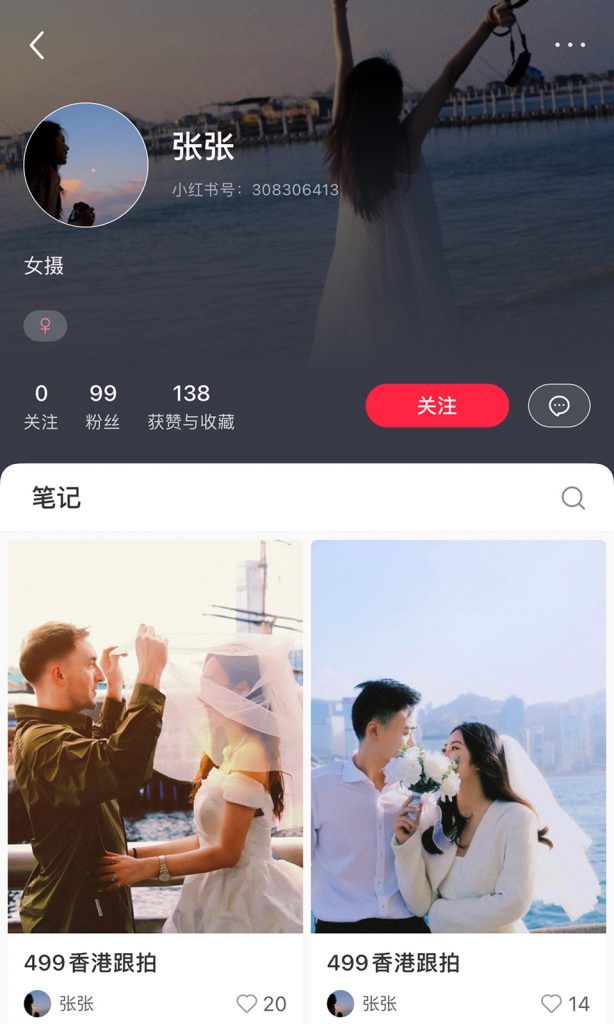
Mainland photographer Zhang Yaqi puts up posts about offering photography services in Hong Kong on Xiaohongshu, a widely used social media platform in mainland China, under the nickname Zhang Zhang.

Posing as a potential customer, a Varsity reporter spoke to Zhang on Xiaohongshu in September. Zhang then requested to continue the conversation with WeChat, China’s main instant messaging application, for further consultation.

 “The price for shooting in Hong Kong is RMB ¥499 (US $70), which includes nine retouched photos and all raw photos,” she says in a chat.

Zhang offers portrait photography for couples who are getting their marriage certificates. She also provides portrait photography for solo customers.

She says there is no limit for photo taking time, but each shooting session usually lasts for 1.5 hours.

Zhang charges RMB ¥199 (US $28) in Shenzhen, RMB ¥300 (US $42) cheaper than in Hong Kong.

“Since I live in Shenzhen, the extra charge of RMB ¥300 (US $42) is for transportation fee,” the photographer explains.

According to Zhang’s posts on Xiaohongshu, she has already photographed two couples in Shenzhen and three couples in Hong Kong. In the comments section of her social media account, there were a number of users inquiring about the price of her photo-taking service.

The fees charged by mainland Chinese photographers range from RMB ¥300 to RMB ¥600 (US $42 to US $85) per hour, much cheaper than the usual hourly rate of RMB ¥800 to RMB ¥1500 (US $113 to US $214) charged by Hong Kong photographers per hour.

Zhang Yaqi’s Xiaohongshu homepage.

A Hong Kong photographer who prefers to be named as YY also posts on Xiaohongshu to hunt potential customers.

YY charges RMB ¥2800 (US $399) for photography services. She is a solo photographer specialising in single-portrait photography.

“If you want to confirm the shooting schedule, you need to pay half of the full fees as a deposit and settle the final payment after the shoot,” YY says.

The Hong Kong photographer says the whole shooting process lasts for two hours, and customers can get 12 retouched photos and all raw photos.

Social media posts about providing photography services in Hong Kong are widely circulated on Xiaohongshu. Some of these service providers are Hong Kong photographers, but most of them are mainland photographers who offer competitive fees.

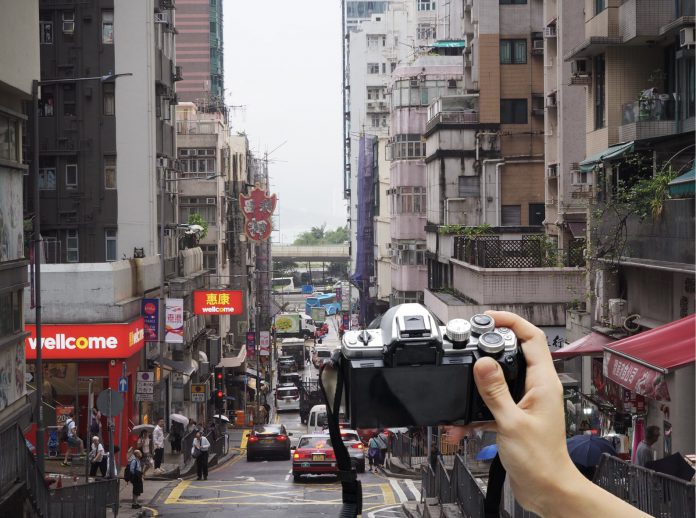
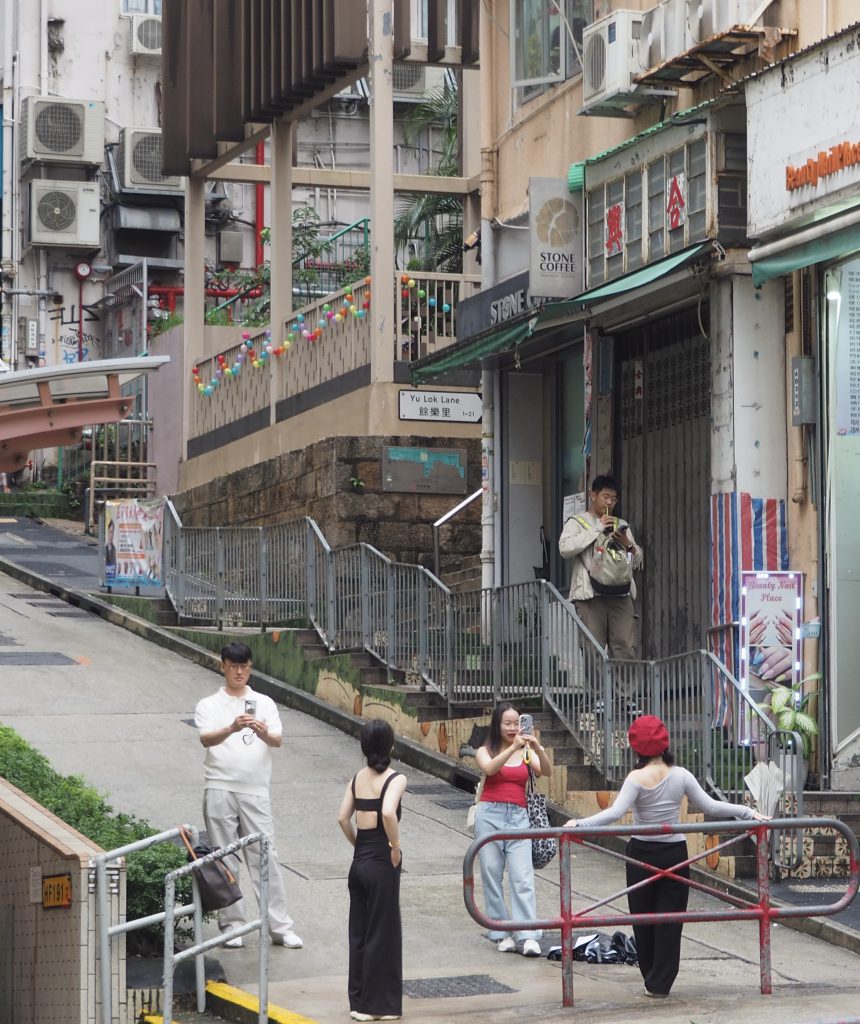
People taking photos on notable street in Hong Kong.

Although this kind of post is common in Xiaohongshu, it is illegal for mainland Chinese photographers to work in Hong Kong.

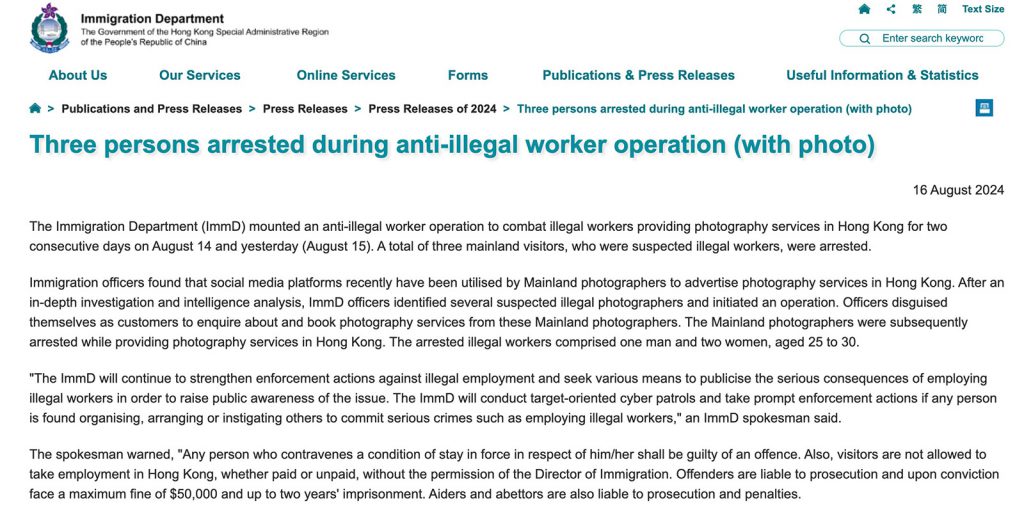
The Immigration Department launched two enforcement operations against illegal workers providing photographic services in Hong Kong on August 14 and August 15, and arrested a total of three Mainland visitors suspected of engaging in illegal employment.

Officers posing themselves as customers booked photography services from these Mainland photographers. The Mainland photographers were then arrested while providing photography services in Hong Kong.

Speaking in a press conference on October 31, Senior Principal Immigration Officer So Chun-ho said in another joint operation with mainland China authorities and the Immigration Department, 97 people in Hong Kong and 104 in mainland China were arrested targeting a forgery syndicate of Hong Kong identity cards for illegal workers.

Investigators disguised themselves as delivery workers and arrested the recipients of the parcels across various locations in Hong Kong. The investigation started in May 2024 with arrests carried out in July and August.

He explained all the workers had entered Hong Kong legally as visitors. Forged identity cards were delivered to them using courier services in the city.

Investigation found most suspects worked in restaurants or as cleaners, earning between HK$500 (US$64) and HK$1,200 (US$154) a day. It is unclear if the employers know about the workers’ illegal immigration status.

Under the Immigration Ordinance, the maximum penalty for an employer hiring a person who is not lawfully employable will be a fine of HKD $500,000 (US $64,342) and 10 years imprisonment.

Announcement issued by the Immigration Department on arrest of Mainland illegal photographers.

“Visitors are not allowed to take employment in Hong Kong, whether paid or unpaid, without the permission of the Director of Immigration. Aiders and abettors are also liable to prosecution and penalties,” an Immigration Department spokesman warns.

“The Immigration Department will continue to strengthen enforcement actions combating illegal employment and publicise the serious consequences of employing illegal workers to raise public awareness of the issue,” the spokesman says.

Edited by Iris Jiang

Sub-edited by Cynthia Chan

Clean Before You Dump

Most of the carton boxes in Hong Kong are dumped unwashed.

By Bliss Zhu and Suzana Li

University student Joelle Xu Jiawei drinks paper-packaged lemon tea every day. Instead of washing empty cartons for recycling, she simply dumps them into rubbish bins.

“I don’t know that I have to wash them before recycling. Even if I know, I wouldn’t do it. I think it is time-consuming to wash them. Also, I need to carry this rubbish with me until I can find somewhere to rinse it,” Xu says.

This poses a challenge to Mil Mill, the first factory in Hong Kong which recycles paper cartons into pulps.

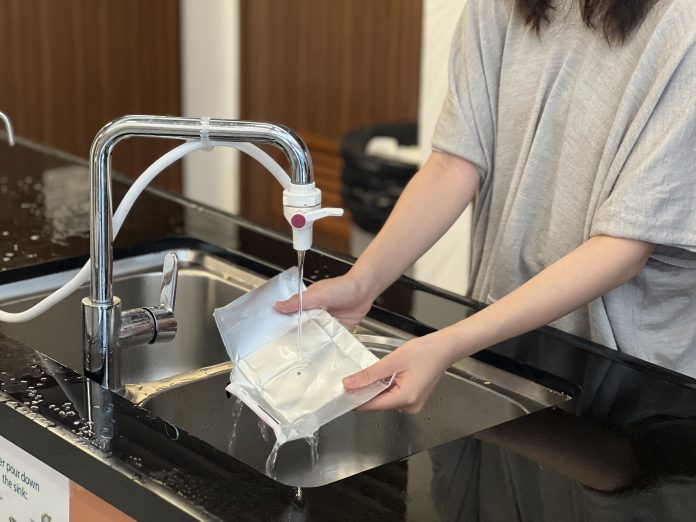
“If someone dumps beverage cartons without cleaning it, it will make the whole bag of cartons dirty. We need to clean them before recycling,” marketing manager Gary Cheung Yik-wai says.

“And if recycling bins are too dirty, people may think that those are rubbish bins and dump something else, making it harder for us to do recycling,” Cheung says.

“Also, dirty paper cartons become smelly at collection points, particularly during summertime, attracting insects to enter these cartons, so we need additional staff to clean them,” he adds.

A Mil Mill worker is producing pulps from recycled carton boxes.

The factory hires three workers to clean these cartons before recycling them. Cheung shares that they employ housewives who want part-time jobs and some with disabilities to do cleaning duty.

“We want to promote not only recycling but equality as well,” he says.

In 2022, Hong Kong’s daily waste of Tetra Pak – the material used to make carton beverage boxes – amounted to 75 tons, which could potentially be recycled into 150,000 standard Tetra Pak milk boxes.

Hong Kong’s paper carton recovery rate was 3.85 per cent in 2022, while that of Japan reached 38.7 per cent for the same year. 

“Education is the key reason why environmental awareness is much higher in Japan. Hong Kong does not pay as much attention to ecological education as Japan,” Cheung says.

“From a young age, Japanese children are taught to sort their waste into designated recycling bins. It is crucial for us to have similar initiatives in Hong Kong for sustainability education,” he adds.

The factory now offers workshops and visits to school and hosts a Recycling Bus Campus Environmental Education Activity to promote recycling. 

Gary Cheung Yik-wai hosting a paper-making workshop for students.

Apart from education, the Environmental Protection Department says that the complexity of packing carton beverages hinders the progress of recycling in Hong Kong.

“Recycling of beverage cartons requires specific technologies for separation. The high recycling cost and low recycling value of beverage cartons currently limit the operating environment of the recycling trade, thus resulting in a relatively lower recycling rate,” a spokesperson of the department says in a written reply.

“We are now working at full steam on the legislative amendment exercise to introduce the Producer Responsibility Scheme on Plastic Beverage Containers and Beverage Cartons. We estimate that the drafting of the legislation can be completed in the first quarter of 2025 and the government will introduce the bill as soon as possible,” the spokesperson adds.

Collected paper cartons are waiting for recycling in Mil Mill’s factory.

The department started planning a large-scale paper pulping plant in EcoPark, Tuen Mun in 2021. This facility is expected to commence operations in 2025. By then, Hong Kong will have the capacity to process all locally-collected beverage cartons.

The department is also expanding its community recycling network, GREEN@COMMUNITY, by increasing the number of public collection points from 500 to 800 by early 2025.

Edited by Cynthia Chan

Sub-edited by Enya So

Explore China with Monkey King

Many people visit real landmarks featured in Black Myth: Wukong.

By Zora Yan

Fascinated by the astonishing temples and mesmerizing landscapes in Black Myth: Wukong, many enthusiastic gamers make a beeline for the real-life locations featured in the blockbuster video game.

Released on August 20, 2024, Black Myth: Wukong, China’s first AAA video game – an unofficial designation for premium games with large budgets and long development times, amassed a sale of 8.4 million copies in just three days. 

Inspired by the classical novel Journey to the West, the action role-play game also topped the Most Played Games list on Steam, one of the largest digital distribution platforms for video games, with more than 2.2 million concurrent players, not only in China but worldwide.

“I can’t imagine that the game scenes are really so realistic that they look so close to those in the real world and I have an opportunity to visit there for free!” says Wang Changchun, a Black Myth: Wukong player.

Ten days after the game’s release, Wang took a four-hour high-speed train ride from Wuhan to visit the scenic Zhangjiajie National Forest Park. Known for its towering quartzite sandstone pillars, these majestic pillars served as inspiration for the floating mountains seen in both the game and the movie Avatar.

Wang Changchun took a picture of the famous towering quartzite sandstone pillars in Zhangjiajie. (Photo courtesy of Wang Changchun)

Through meticulous research across many provinces and cities in China, the game’s scenes extensively replicate ancient Chinese architecture, and relics not only captivate gamers but also breathe new life into China’s tourism.

Some of the landmarks featured in the game offer free entry to players who have completed specific game levels. 

Wang got free tickets to the Zhangjiajie National Forest Park and can save RMB ¥227 (US $31.88) after showing staff at the tourist ticket office his purchase records and completion records of Black Myth: Wukong.

“While exploring Zhangjiajie, I was fortunate to have the company of wild monkeys. It felt like I had transformed into Wukong, the Monkey King, leading a loyal group of followers on my challenging journey,” he says.

After the visit, Wang posted a travel guide on Xiaohongshu (a Chinese social media platform) to help more players to know the landscape depicted in the game and how to obtain free tickets.

Within a week, his post got 50,000 views and he has received many private messages and comments from other gamers telling him they also want to go.

Another game player Wang Xiaopeng earns a lifetime free visit to Lingyan Temple in Shandong, another ancient temple site that is featured in the online game after completing all the challenges in the first three parts of this game.

“When I saw on social media that the temple offers free lifetime admission tickets, I quickly finished these chapters within a week,” Wang says. 

“The game is extremely difficult, and I have to spend six hours on it every day because there are so many monsters that need to be defeated,” he adds.

The breathtaking real-life scenery in Lingyan Temple surpassed his expectations and sparked his curiosity to explore other tourist destinations featured in the game. 

Wang Xiaopeng took a picture of Lingyan Temple. (Photo courtesy of Wang Xiaopeng)

Within a month, Wang visited nine historical locations in the game in Shanxi-Qianfo Temple, Foguang Temple, Yungang Grottoes, Xuankong Temple, Huayan Temple, Shanhua Temple, Chongfu Temple, Nine Dragon Wall and Hengshan Mountain.

“I feel like visiting the scenic spots one by one in the game is just like going on a journey with the game protagonist, Monkey King,” he adds.

What impressed Wang the most was Qianfo Temple where Wukong battles the final boss in the third chapter of the game. While playing, he was amazed by the colour design and intricate character carvings of the temple in the game.

“When I arrived at the actual site, I discovered that it is far more exquisite than what is shown in the game. I greatly admire how ancient people were able to carve such delicate patterns under harsh conditions!” the player says.

Wang believes that the collaboration between scenic spots and games in the tourism industry provides an excellent opportunity for more people to visit famous historical sites and personally experience the excitement beyond what games can offer.

“Following the release of Black Myth: Wukong, visitor numbers to Shandong Lingyan Temple surged by 128 percent compared to the previous year,” says Cha Tianqi, the strategy manager of Shandong Lingyan Temple Tourism Corporation.

Shandong Lingyan Temple also offers a lot of derivative products to visitors, such as gourd-shaped dolls that appear in the game, ceramic toys, and fridge magnets featuring the image of Wukong.

”We are surprised that gourd-shaped dolls were sold out within two days after going online,” Cha says.

Wei Changren, founder of btiii.com, a tourism-related financial news portal, points out the game has boosted tourism across China.

“People’s passion for the video game, and the ‘set-jetting’ tourism that the game has brought about, show people’s growing confidence in Chinese culture,” Wei says.

Edited by Molisa Meng

Sub-edited by Cynthia Chan

Long Wait for the Truth

A Hiroshima atomic bomb survivor learnt English at 80 to promote peace.

By Cindy Lee in Hiroshima

Teruko Yahata, is a Hiroshima A-bomb survivor. Determined to promote peace, she learnt English at the age of 80 to share her experience through talks.

“I was a child at the time of the bombing, so I didn’t know anything about the historical fact,” says the 86-year-old survivor. “But as I grew older and learned about facts,  I found out that the Japanese government at that time was wrong, it made me angry.” 

She attended a conference in Singapore 11 years ago, where she finally discovered the truth about World War II and the war crimes committed by Japan. At that time, she was 76.

Yahata recalls a time in her childhood when the people in Japan were convinced that their country would win the war. 

The United States Military dropped an atomic bomb in Hiroshima killing 140 thousand victims on August 6, 1945.

“I was eight years old when the atomic bomb was dropped…… All of a sudden, the sky was flashing, illuminated in blueish white,” she recalls, describing that morning. The force and impact of the atomic bomb knocked her to the ground, causing her to lose consciousness.

“The inside of the house was turned upside down, with shattered glass scattered everywhere,” she recalls. Although they lived 2.5 kilometres from the hypocenter, her family of eight felt the full force of the explosion’s devastation.

“Let’s die together, while we are still together.” She remembers her mother’s words as they thought they would surely die soon. Her mother covered every one in her family with a large quilt. 

“I will never forget what it felt like as a child to be surrounded by my family in the warmth and security of the blanket,” she recalls.  

“We fled to the mountain when the huge drops of rain began to fall, and it soaked us to the skin. We did not know that it was the black rain,” she says. 

The A-Bomb Dome, remains of the former Hiroshima Prefectural Industrial Promotion Hall.

Black rain is the result of huge amounts of radioactive matters entering the atmosphere, which may affect the human body. 

“Some of the dead bodies were completely burned, with their skin peeling off from their arms and dangling from their fingertips,” Yahata says.

“The crippled figure of tens and hundreds of bodies were flocking towards us like a legion of ghosts,” she says, describing the victims coming from the area near the hypocenter.

“The city continued to burn through the night” she adds.

When she received first aid at a school, she was terrified by the horrifying screams and cries of mourning.

“In the hallways and classrooms…….. The floor was strewn with tightly packed bodies, faces blistered so badly that they could no longer open their eyes,” she says.

While some could still be saved, many lost their lives.

“I was shocked to find bags that were not filled with sweets, but ashes of cremated bodies,” she says, adding that she was hungry and desperate for food at that time.

“Among the 2,000 bodies cremated there, a large number of them were sacrificed during demolition duty. They were first and second grade students,” she says.

Yahata dare not imagine how much pain the children suffered and how much they desired to live.

“Even until now, the memories of those scenes still haunt me from time to time,” she says. 

She recalls a victim kept opening a lid of a pot so that she could spit blood into it during the night. She died from coughing up blood at the end. 

Another scenario that was ironed in her memory was about her father’s friend. “Everyone put their hands together in prayers as we looked at the remains of our once bright and cheerful man,” she says. The skeleton of her father’s friend was found one week after the devastating day. 

“Even now when I look at the drawings depicting this scene, an eerie sensation comes over me, and in those silent moments, I feel that something is tugging at my heart,” she says. 

The damage done by the atomic bomb continued to haunt those who survived. Yahata’s friend Susan Kimiko was diagnosed with acute leukemia 16 years after the bombing. She passed away when she was 25. 

Beyond suffering from the loss of loved ones, Yahata and other survivors also face discrimination. 

“Many suffered from burns on their bodies and faces, while some developed keloid. When they went to school, others called them monsters…Survivors were all exposed to radiation,” she says.

Teruko Yahata shares her story about witnessing the aftermath of the A-bomb attack.

She shares that young people were told they were not good for marriages. There were also rumours saying radiation was contagious. “But it is not true. Some children were exposed to radiation in their mothers’ wombs causing deformities,” she says.  

“All that I have left to do is to tell the truth of the atomic bomb to the world and to continue to sound the alarm bells,” she says, explaining the reason why she is still working hard to spread the message of peace to this day. 

Edited by Jen Lam

Sub-edited by Iris Jiang

Jumping onto the Olympic Stage

Hong Kong athletes trying to make rope skipping an Olympic event.

By Alexia Leung

The International Jump Rope Union (IJRU) is campaigning to make rope-skipping an Olympic event. 

President of the union Shaun Hamilton says the Olympic Task Force was formed in August to gather industry sources about the opportunity to deliver a rope-skipping presentation at the Los Angeles 2028 game, how to be shortlisted and make the sport more visible to the public. 

“We talk to international federations, the Olympic Family and people who went through the process of making a sports event an Olympic item,” Hamilton says.

The union with 63 country members became a signatory of the World Anti Doping Agency in 2021 and signed an agreement with the Olympic Channel in 2022. In 2023, the union hosted the biggest World Jump Rope Championships. 

Shaun Hamilton, the president of the The International Jump Rope Union (right) and Tina Wong, the chairperson of the Hong Kong Rope Skipping Association (bottom right) with the Hong Kong team and the American team. (Photo courtesy of HKRSA).

“We are getting more partnerships in terms of more competitions, with Olympic movements such as trying to be a part of the Youth Olympics, the World Games and the International School’s Sport Federation,” Hamilton says.

“Rope jumping is certainly something appealing and fun to watch. Youths and kids want to do it. Parents have nostalgia associated with it. There is the rope speed sprint which is quantifiable, but we also still have the artistic side as well,” he adds. 

The organization is trying to engage the public to make the sport more visible. 

“We’re pushing more campaigns for all of our National Governing Bodies to take part in these few months, asking more people to join us for another task force for the Everybody Jumps Campaign, where we get a rope in every person’s hand,” he says. 

The Hong Kong Rope Skipping Association (HKRSA) is a member of the IJRU, and they are working towards the same goal – getting rope skipping into the Olympics.

Tina Wong Ting, the chairperson of the Hong Kong Rope Skipping Association hopes she can help Hong Kong athletes take part in the Olympic Games once rope jumping is made an international event. 

“I hope that I can help every rope-jumping athlete become qualified for the Olympics. The goal of getting into the Asian Games is achievable. We are planning to perform at the Youth Asian Games next year. I hope that we can first make it a sports event in Asia then go international step by step,” she says.

The Hong Kong team performing at the Urban Parc. (Photo courtesy of HKRSA).

Invited by IRJU, the team performed at the Urban Parc, Place de la Concorde, Hôtel de Ville and the Champions Park with the American, French and Japanese team.

Sonic Lee Chon-meng and his three teammates performed a 15-minute sequence every day during their week in Paris.

“We did solos, duos, quads, Double Dutch and played with the audience. We taught the audience how to rope-jump and let them try out the Double Dutch showing that rope-jumping is not that simple,” Lee recalls. 

Hong Kong has always performed well at rope-skipping international contests. In the 2023 World Jump Rope Championships, Hong Kong team won a total of 157 medals.

In this year’s Olympics, multiple urban sports such as skateboarding, breakdancing, BMX freestyle and 3X3 basketball were included in the games. 

Cheukki Ho Cheuk-Ki, Tango Seto Ming-Hei, Chloe Yuen Hiu-Tong and Sonic Lee Chon-Meng (Left to Right). (Photo courtesy of HKRSA).

“I think we completed a rope-jumping mission as we brought the sport to the Olympics in Paris. We let people know that rope-skipping is not just about jumping forward. People can also dance and do flips. We let the Olympics know that just as skateboarding and breakdancing, we have the potential for competition and we have ornamental value,” says Tango Seto Ming-hei, who has been rope-skipping for 17 years. 

Seto’s teammate, Cheukki Ho Cheuk-ki also agrees that there is a future for rope-skipping in the Olympics.

“As we were invited by the Olympics to perform for seven days in Paris, I think that rope-jumping may end up like breakdancing which is one of the events in the Olympic Games. There’s a chance that rope-skipping can become a sports event,” she says. 

The Hong Kong government provides funding and support for Olympic athletes such as Elite Training Grant and the Sports Aid Grant. However, as rope-skipping is not yet an Olympic sport, the athletes do not receive much support.

“We book rooms ourselves or even practise in the streets such as outdoor basketball courts and football courts,” Seto says. 

He urges the Leisure and Cultural Service Department to provide more big-sized training rooms in sports centres so that they can do bigger scale performance.  

Edited by Hannah Tang

Sub-edited by Carrie Lock