Restaurant recreates demolished Lai Yuen amusement park
By Wing Chan
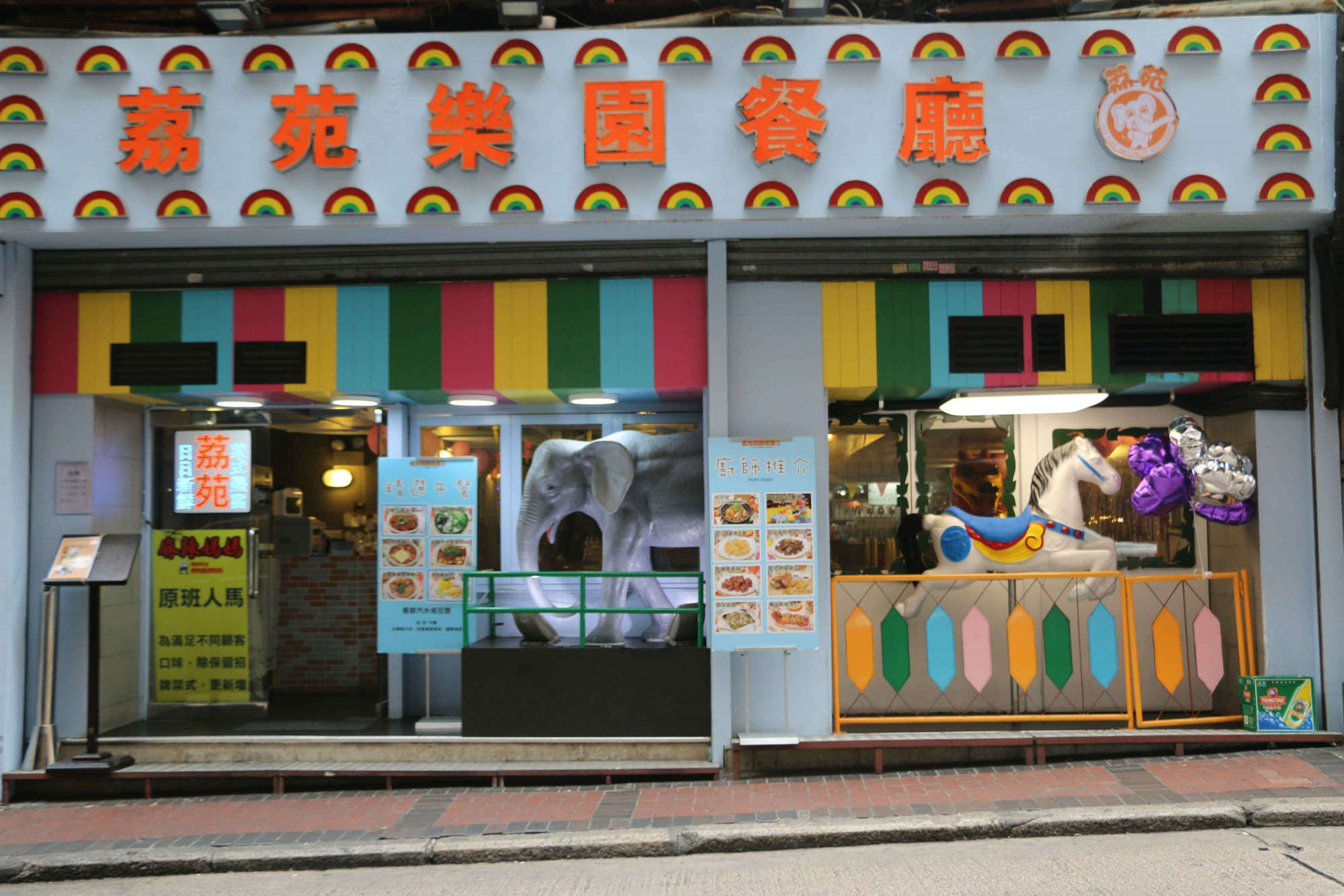
In a city full of chain stores with unified looks and dull commercial buildings, this Jordan establishment may come as a complete surprise. Step into Lai Yuen Amusement Restaurant in Tak Hing Street and you will find yourself transported back in time. The restaurant’s most striking feature – a giant model of an elephant – leaves no doubt that this is an eatery dedicated to the memory of the Lai Chi Kok Amusement Park.
The park, founded in 1949, was once the largest amusement park in Hong Kong. It was demolished in 1997 after 40 years of operation because of fierce competition in the market as Ocean Park took off.
Matthew Chan Sze-long is one the owners of the restaurant. The 42-year-old and his partner Kenji wanted to reconstruct parts of Lai Yuen in their restaurant. At the entrance, is the model of the Asian elephant Tino, the star attraction of the park.
Other features of the park have also been incorporated in the interior design. The slot machine on the wall, the dragon-boat-like roller coaster seats, the Dinosaur house entrance at the back all evoke the collective memory of many Hong Kong people.
The restaurant serves mainly Chinese dishes and a few Western dishes. As customers flip through the menu, they can also find some old photos of the park. The menu is designed as a photo album to trigger nostalgia. The cost of a typical meal ranges from $50 to $100.
The idea for the restaurant was born in September, when the Occupy Movement was just beginning. Chan and Kenji noticed that negative emotions stemming from political conflicts were overwhelming society. They wanted to inject joy and synergy into the city and to remind Hong Kong people of the value of old things.
Their concept strikes a chord with many people. Chan recalls an experience that particularly moved him. Once, a very old and frail gentleman with a walking stick was passing by when saw the restaurant and decided to eat there. The gentleman, who used to work in Lai Yuen, really appreciated Chan’s idea. When he left, he said, “Youngster, keep on!” Although he has heard many encouraging remarks from customers, this man’s words touched him deeply.
Many people have tried to conserve lost landmarks in the form of artwork, photography or books but Lai Yuen Amusement Restaurant demonstrates an innovative form of conservation that can be shared by many people simultaneously.
Check out the restaurant at 7A-7B, Tak Hing Street, Jordan. You can also call 23770222.
The 79 day occupation of sites in Admiralty, Mong Kok and Causeway Bay ended without protesters winning any concessions from the government on their demands for open elections for Chief Executive in 2017. Post-Occupy, Hong Kong seems more polarised than ever. But some have argued that the Umbrella Movement has led to a civic awakening in the city that will have long-lasting implications. In this issue of Periscope we look at some aspects of this civic awakening:
When police cleared, Causeway Bay, the last of the occupied areas, in December, the 79-day Occupy Movement finally drew to a close. The occupation which became known as the Umbrella Movement began in late September and drew together citizens from different walks of life in a push for genuine universal suffrage.
As the government did not reply to the movement’s demands, some protesters retreated from the occupied sites in Mong Kok, Causeway Bay and Admiralty with tears. Some left behind yellow banners and slogans stating, “We will be back” and one giant banner proclaimed “It’s just the beginning”.
Indeed, the occupation may have ended, but for many Umbrella Movement participants, the struggle for democracy continues. Society may be more polarised than ever, but the movement has also awakened many Hong Kongers, particularly the young, to be more aware of the city’s political development. As the debate over political reform continues, we can expect citizens to participate more actively in political issues and events.
In our March 2015 issue, Varsity looks at the political awakening of young people, celebrities from the local entertainment industry and professionals, and at the challenges they face in their struggle.
Young people were often seen at the forefront of the Umbrella Movement, which was largely student-led. The scale of their involvement in civil disobedience was to some extent a reflection of their disillusionment with established electoral politics. There is an element of irony, therefore, in the fact that some of them are now planning to join future elections and enter the system to challenge the pro-establishment camp.
We hear from these young people, some of whom have already begun their community work to build up support for the district council election later this year. As the pro-establishment camp was the biggest winner in the previous election, what strategies do these young people with limited resources have?
Apart from young people, the presence of celebrities on the stage in the occupied area was also a striking feature of the Umbrella Movement. As these public figures have big followings and attract media attention, we look at their unique impact on the movement.
The high-profile and active participation of stars, like singer Denise Ho Wan-see, may be surprising as celebrities have not been as vocal in politics since the 1989 Concert for Democracy in China. However, their participation comes at a high cost. The mainland entertainment market is huge and outspoken stars stand to lose big bucks and career opportunities.
Compared with the previous two groups of people, professionals may be less vocal, but their impact on the city’s political development is also significant. With stable jobs and income, professionals tend to be rather quiet when it comes to politics. However, in recent years, they too have been awakened and are speaking up to safeguard the city’s core values.
We talk to pan-democratic professionals who have set up new platforms to gather like-minded peers to advocate for democracy within their sectors. These groups are seen by some as challenging the existing associations and organisations representing the profession. We talk to the professionals who have joined elections for functional constituency and election committee seats, as well as those who are spearheading new platforms.
We hope these stories will help to explain how young people, celebrities and professionals have been politically awakened, and how they hope to continue sowing the seeds of democracy.
Varsity’s reporters and editors have put tremendous effort into producing the March issue. I sincerely hope you enjoy your read.
Young people preserve the spirit of Occupy Movement by joining elections
By Natale Ching and Venice Lai
September 28, 2014 was the most unforgettable day in the 21 years of Wong Sui-lung’s life. On that day, the Hong Kong government fired 87 canisters of tear gas at non-violent protesters in Admiralty and set in motion what would become the 79-day Occupy Movement in Hong Kong.
Wong, who was a steward for Occupy Central with Love and Peace (OCLP), was enraged by the police’s use of excessive violence against unarmed protesters. But he was also heartened to see many friends he had thought were politically apathetic coming out to support the movement after the scenes broadcast on television. “When I saw that Central, Admiralty, Wan Chai, Causeway Bay and even Mong Kok were crowded with citizens striving for democracy, I started to believe that there is hope for Hong Kong,” says Wong.
Although the Occupy Movement eventually came to an end with the police clearing out the occupied sites and arresting the last protesters, its spirit continues in other forms. The movement awakened a whole generation of young people who stood up and voiced their strong desire for genuine democracy.
Initiated by a students’ class boycott campaign against the Standing Committee of the National People’s Congress (NPCSC)’s restrictive framework for electing Hong Kong’s Chief Executive by universal suffrage, the Occupy Movement grew to become the largest student-led protest in the history of Hong Kong.
The end of the occupation without winning any concessions from the government has left some participants struggling to find a way to extend and build upon its achievements. Some young people have set their sights on District Council elections later this year as a starting point for changing the established system and directly spreading the concept of democracy to communities across Hong Kong.
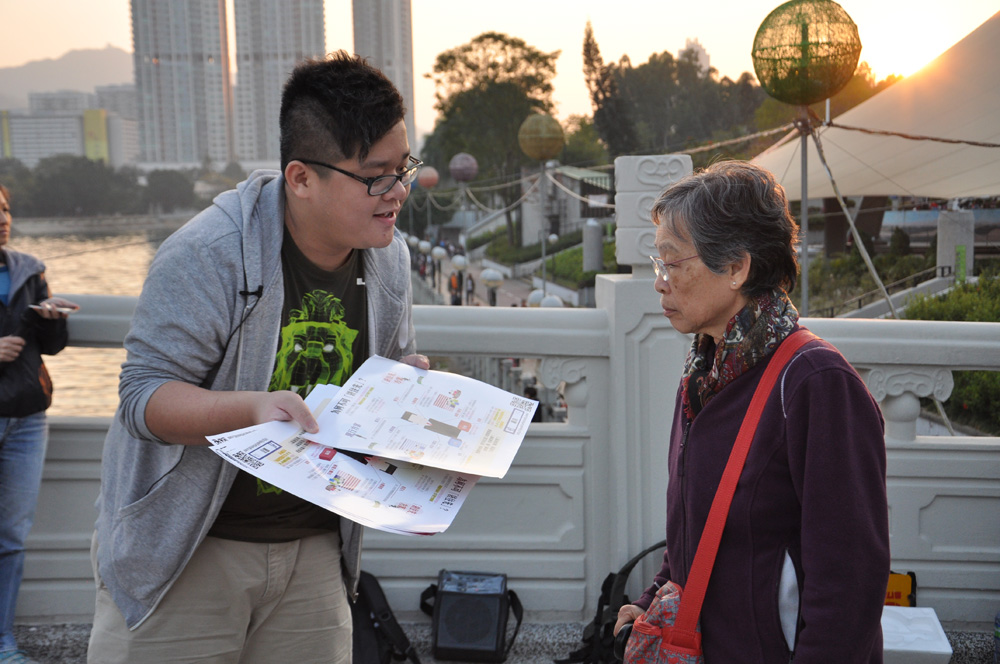
Wong Sui-lung – who quit his office job during the Occupy Movement – is now considering standing in the upcoming District Council elections. As a member of Umbrella Blossom, a group of former OCLP volunteers, Wong has been visiting districts like Sham Shui Po and Shatin to spread the spirit of the Umbrella Movement to local residents. Wong now spends most Sundays in Shatin, where he lives, setting up booths, distributing flyers and knocking on doors.
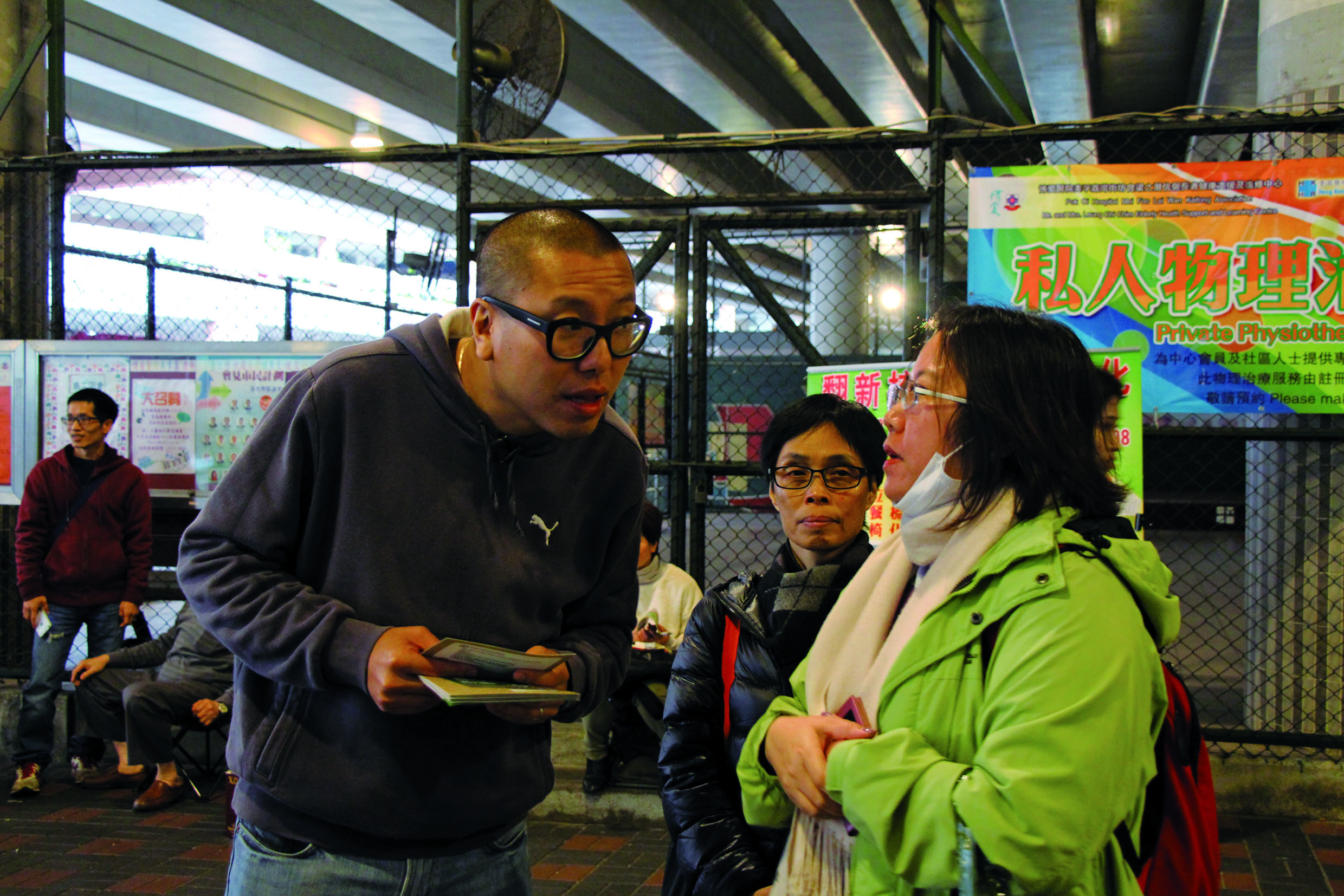
His work does not always go smoothly. Wong recalls confronting a group of residents with opposing views during one of his community visits in Sham Shui Po. Wong and his friends were scolded and accused of creating chaos by crowds who surrounded their booth. But by reasoning with them Wong managed to turn the dispute into a constructive discussion. “It’s actually not that bad,” he says. “Even if we can’t persuade them [the blue ribbons], when a group of people are listening…some neutral citizens may find our arguments reasonable.”
This experience motivated Wong to stand for election. He believes as a district councillor, he could make use of the district council’s resources to do community work without being heckled in the streets. Eventually, he hopes to change people’s mindsets and raise their awareness of and involvement in community affairs.
Local celebrities take bigger risks to support social movements
By Wing Chan & Karen Yu
One week into the 79-day-long occupation movement for universal suffrage, a young woman wearing black rimmed glasses and a simple T-shirt took to the makeshift main stage in what became known as Umbrella Square. The theme of the rally that night was resisting violence. The mood in Admiralty was defiant but sombre – just a day before, peaceful protesters had been attacked by anti-occupy elements in Mong Kok.
The young woman did not display the trappings of a star, she was not made up and did not have a retinue of dancers by her side. But there was no mistaking her confidence and stage presence as she condemned the violence and commended the courage of Hong Kong’s young people before introducing a new song.
“This song is called Hold Up Your Umbrella. We hope those who have clear consciences can stay strong. This song belongs to all Hong Kong people,” said singer Denise Ho Wan-see, an outspoken supporter of the Umbrella Movement and a founder of Hong Kong Shield, a group of people from the culture and arts sector supporting Occupy.
It is not the first time she has spoken out on social issues; Ho has been active in fighting for gay rights since she came out as a lesbian to the general public in 2012. But in taking such a high-profile stand in supporting and participating in the Umbrella Movement, and being arrested when the Admiralty site was cleared, Ho has become Hong Kong’s most prominent celebrity-activist.
Although few artists have gone as far as Ho in supporting what was an overtly political struggle, she is not alone in expressing sympathy and solidarity with the students and other protesters. Singer Anthony Wong Yiu-ming, actress Deanie Yip Tak-han, actors Anthony Wong Chau-sang, Chapman To Man-chat and Stephen Au Kam-tong are among the others.
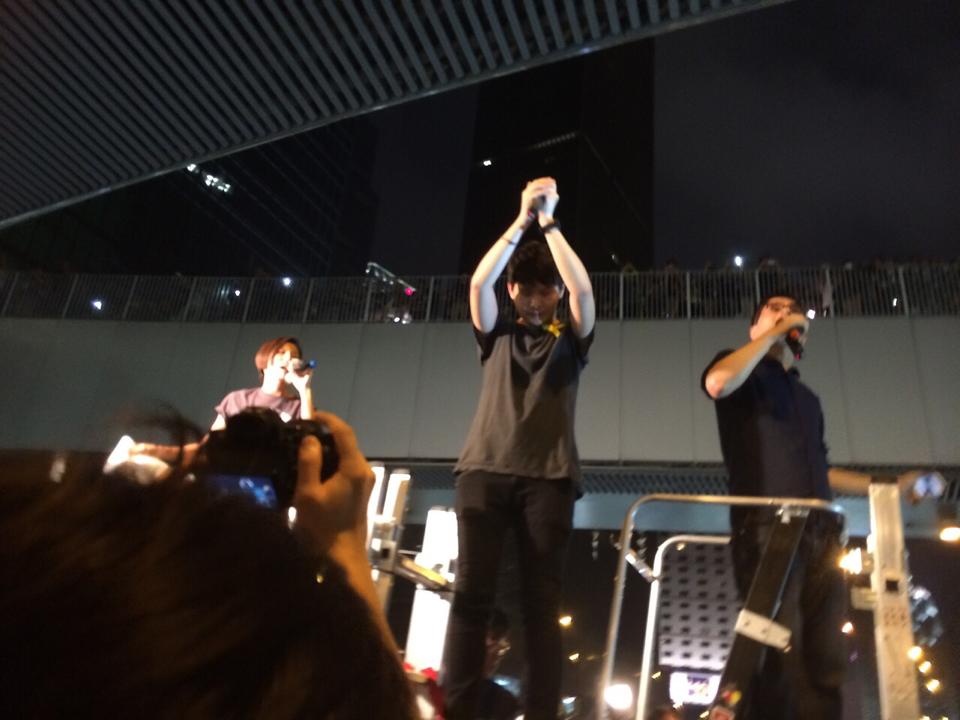
Local singer Denise Ho Wan-see speaks on stage
And while it is not the first time celebrities have spoken up on social and political issues in Hong Kong, artists have never had so much to lose in terms of losing jobs, sponsorship deals and even the right to perform in the lucrative mainland market.
For some performers, like Denise Ho, that seems to be a price worth paying but it is worth asking whether celebrities can really make an impact on political issues.
Karen Man Tsz-tung, a 21-year-old business student and part-time event management assistant, has been a Denise Ho fan for nearly three years. Man says she used to be ignorant of current affairs and politics. She rarely read newspapers and found political issues to be too complex and irrelevant to her daily life.
That all changed during Occupy Movement. Reading Denise Ho’s posts on Facebook and Instagram every day and watching her interviews on television, Man began to take an interest in current affairs. She even went to the Mong Kok occupied area to support the protesters.
Of all Ho’s interviews in the media, Man was most impressed by her appearance on the RTHK programme Face to Face. “When the host asked if she would be afraid of the consequences [of joining the protest] on her career, she replied that being a singer was just her occupation…She is like saying, we are all Hong Kong people,” recalls Man.
Enoch Cheung, a second year chemistry student at the Chinese University of Hong Kong, was a member of the university’s Class Boycott Committee and frequently went to Admiralty. He thinks the presence of celebrities in the movement was positive because they could draw public attention. However, Cheung adds the impact of celebrities is limited and they were not the only people who could mobilise support. “Being an artist is just [one kind of] occupation. If a doctor went on stage, she’d be able to influence doctors,” he says.
Cheung thinks people were more concerned about how the movement could achieve true universal suffrage and police violence against protesters than they were about celebrities chanting slogans on stage.
While this may be true for participants and supporters of the movement, there is little doubt that celebrities do play a role in raising awareness and getting the attention of the general public. In October, screen legend Chow Yun-fat’s response to rumours that he had been blacklisted by the Chinese government for supporting the students went viral. Chow’s simple answer, “I’ll just make less then” struck a chord and got people talking about whether and what Hongkongers should be willing to give up to achieve their ideals.
Professionals becoming more vocal in upholding core values and democracy
By Julian Ng & Zoe Lai
On August 14 last year, the Law Society of Hong Kong passed a historic motion of no confidence in its president. “We have witnessed one of the most unexpected results in the history of Hong Kong professional bodies,” said Kevin Yam Kin-fung, the 38-year-old solicitor who moved the motion. With tears in his eyes, Yam thanked the society’s members for supporting it.
The unprecedented move came after Beijing issued a white paper on the “one country, two systems” policy in Hong Kong on June 10, 2014. The paper referred to judicial personnel as “administrators”, and said they had to “love the country”. Many lawyers considered this a threat to judicial independence, but Ambrose Lam San-keung, the pro-establishment president of the Law Society, publicly supported the paper. He further drew the ire of some lawyers by calling the Chinese Communist Party “great” in a radio interview.
Eventually, the no-confidence motion was passed with 2,392 votes in favour, and 1,478 votes against. Lam resigned a few days later.
Traditionally, Hong Kong’s professionals, including solicitors, have been seen as not particularly active in politics. With stable jobs and incomes, they tend to support the status quo. But in recent years, more professionals like Yam, have been willing to speak out to safeguard core values and promote democracy.
Yam says the white paper triggered the awakening of legal practitioners, including him. Up till its publication, he was, he says, a June 4 and July 1 democrat, meaning his activities were limited to participation in the annual vigil and protest.
Still, he tabled the no-confidence motion with the encouragement from like-minded solicitors. Originally, he thought it would fail because many veteran solicitors supported Lam. What he had not bargained for was that mainland-backed institutions and the Central Liaison Office would interfere by lobbying solicitors to vote against the motion.
“Once the country’s machinery tried to pressure them, [the solicitors] felt that the profession’s independence was under threat,” Yam says. He thinks this may have prompted more solicitors to support his motion.
Kevin Yam Kin-fung launches the Progessive Lawyers Group with other lawyers Photo courtesy of Kevin Yam
For Yam, it proved to be just the beginning. On January 27 this year, he announced the launch of the Progressive Lawyers Group to provide a platform for young lawyers to comment on social issues and promote core values, including judicial independence and democracy, in the community. The group now has around 50 members.
At the group’s inaugural press conference, he emphasised it did not intend to challenge the Hong Kong Bar Association and Law Society.
Collective bargaining rights remain out of reach for Hong Kong workers
By Brian Yu & Kelly Wong
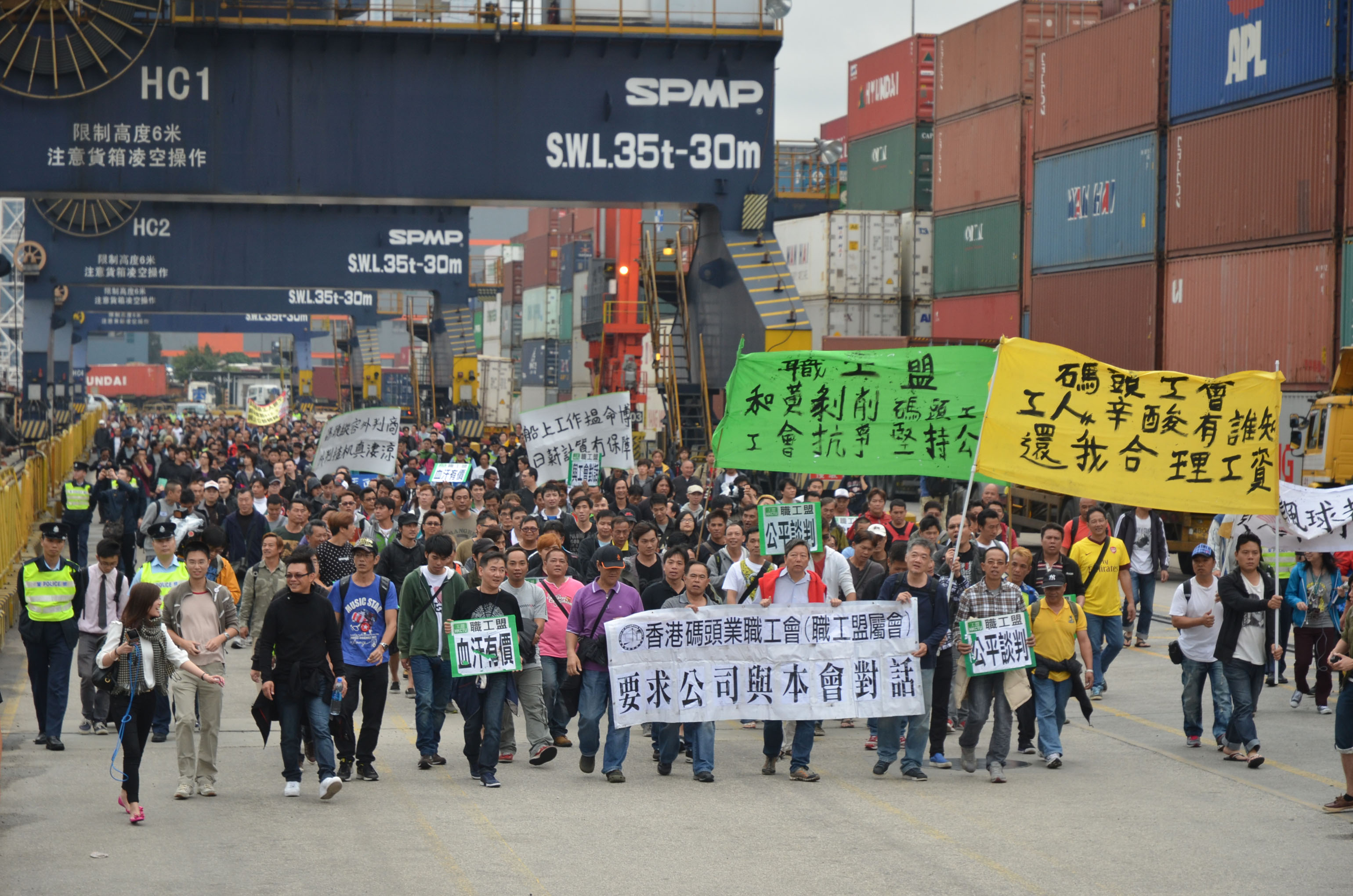
Stanley Ho Wai-hong will never forget the 40 days that began on March 28 2013. “At eight o’clock in the morning, over one hundred dockworkers blocked the entrance of Terminal Six and stopped the cargo vans from entering the terminal,” says the unionist. “This is how the strike started.”
As the General Secretary of the Union of Hong Kong Dockers, Ho led more than 500 dock workers in the longest strike in Hong Kong history for better pay and working conditions. Their employers were contractors working for Hong Kong International Terminals, a subsidiary of tycoon Li Ka-shing’s Hutchison Whampoa.
It was a David and Goliath scenario and the dockers’ cause earned them widespread public support. People donated tents, food and drinks and daily supplies to sustain the strike. Even when it rained down hard, many supporters put on their raincoats to join the striking workers.
Don Chan Hing-lung (second from the right) has long been involved in union affairs Photo courtesy of Don Chan Hing-lung
In the end, the workers settled for a 9.8 per cent pay rise and promises of better working conditions, such as meal breaks and toilet breaks, allowing Ho to step back from the frontline. He is still doing union work and carrying out labour education.
Although the dockers managed to get a deal, Ho hopes Hong Kong can implement a collective bargaining law to protect workers’ rights.
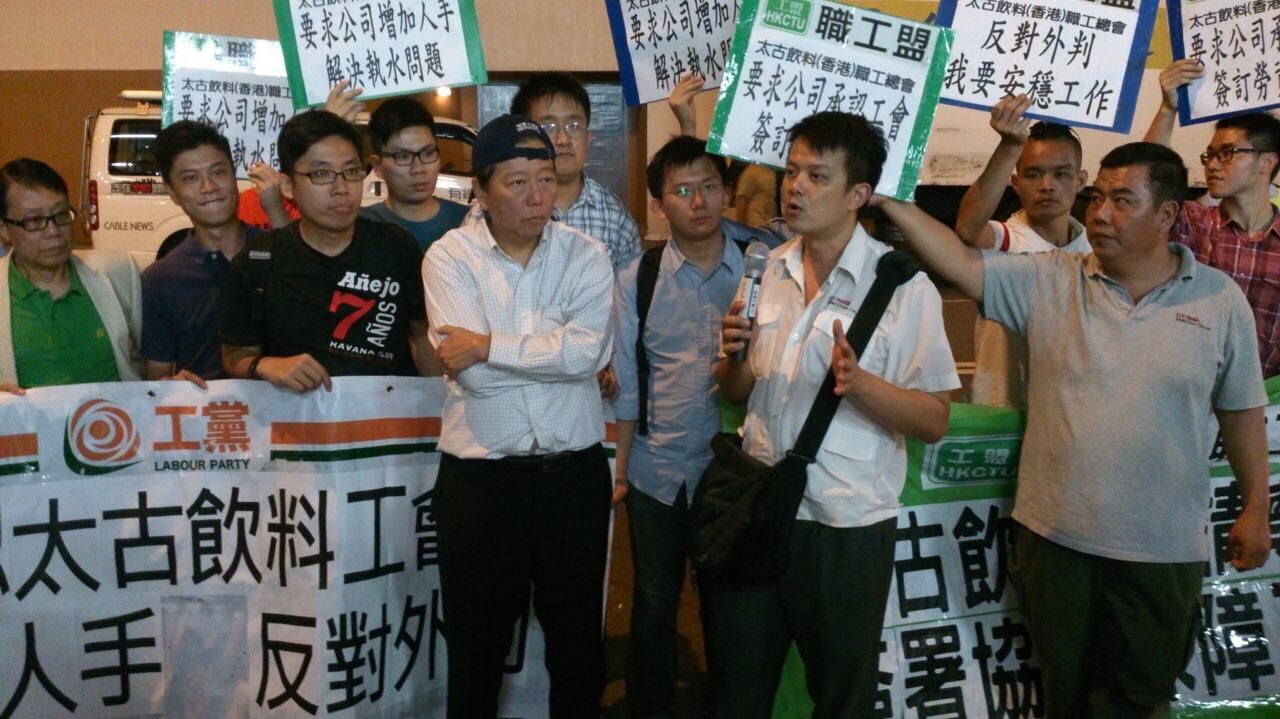
Under Hong Kong’s Employment Ordinance, every employee has the right to strike and join a trade union. However, they do not have collective bargaining rights. This means there is no legal responsibility for employers to either enter negotiations with employees or to respond to their demands.
Ho says all three rights are of paramount importance in defending labour rights and the absence of a collective bargaining law leads to many unnecessary strikes and conflicts. He says that since employers are not obliged to participate in negotiations, employees can never bring their grievances and demands to the negotiating table. “Without the collective bargaining mechanism, we have no choice but to go on strike and let more people hear our voice,” says Ho.
That is not to say that Ho thinks a law on collective bargaining would necessarily eliminate or even reduce strikes and conflicts. However, it would at least provide an opportunity for employees and the employers to sit down to rationally discuss their concerns or even reach a consensus. “Why can’t we calmly negotiate in a civilized society?” says Ho.
Another reason to have collective bargaining is to ensure employers strictly follow any agreements made in the negotiation process. In the absence of legislation, employers are not legally bound to follow any verbal agreement reached with a trade union and there are no legal consequences to reneging on it.
Before they went on strike, dock workers’ representatives tried to negotiate with their employers, the contractors. One of the representatives was Ken Lai Ma-kin, who has worked in the terminal for more than 20 years and operates the lifting gear.
Lai recalls the company said they would follow up on workers’ demands after their meeting but no real progress was made. The labour representatives later also handed in a petition but the employers did not respond to it. With dialogue not working, the representatives called on more workers to join the strike.
Lai thinks collective bargaining legislation would put pressure on employers to respect negotiations with their employees. “If we do not put the consensus in black and white, they can deny all promises at any time,” he says.
The irony is that Hong Kong workers did briefly enjoy collective bargaining rights, thanks to a private member’s bill submitted by unionist and lawmaker Lee Cheuk-yan, which was passed in the last session of the pre-handover Legislative Council. Less than four months after the handover, the law was repealed by the Provisional Legislature. The reason given was that it would adversely affect Hong Kong’s competitiveness and attractiveness to overseas investment.
Changes to the rules after the handover mean that it would now be impossible for a lawmaker to table a private member’s bill on collective bargaining. While for its part, the government has no intention to reintroduce the law despite heated debate following the dock strike.
As number of Mainland visitors grows, what can Hong Kong do to woo international tourists?
By Emily Man, Eric Park
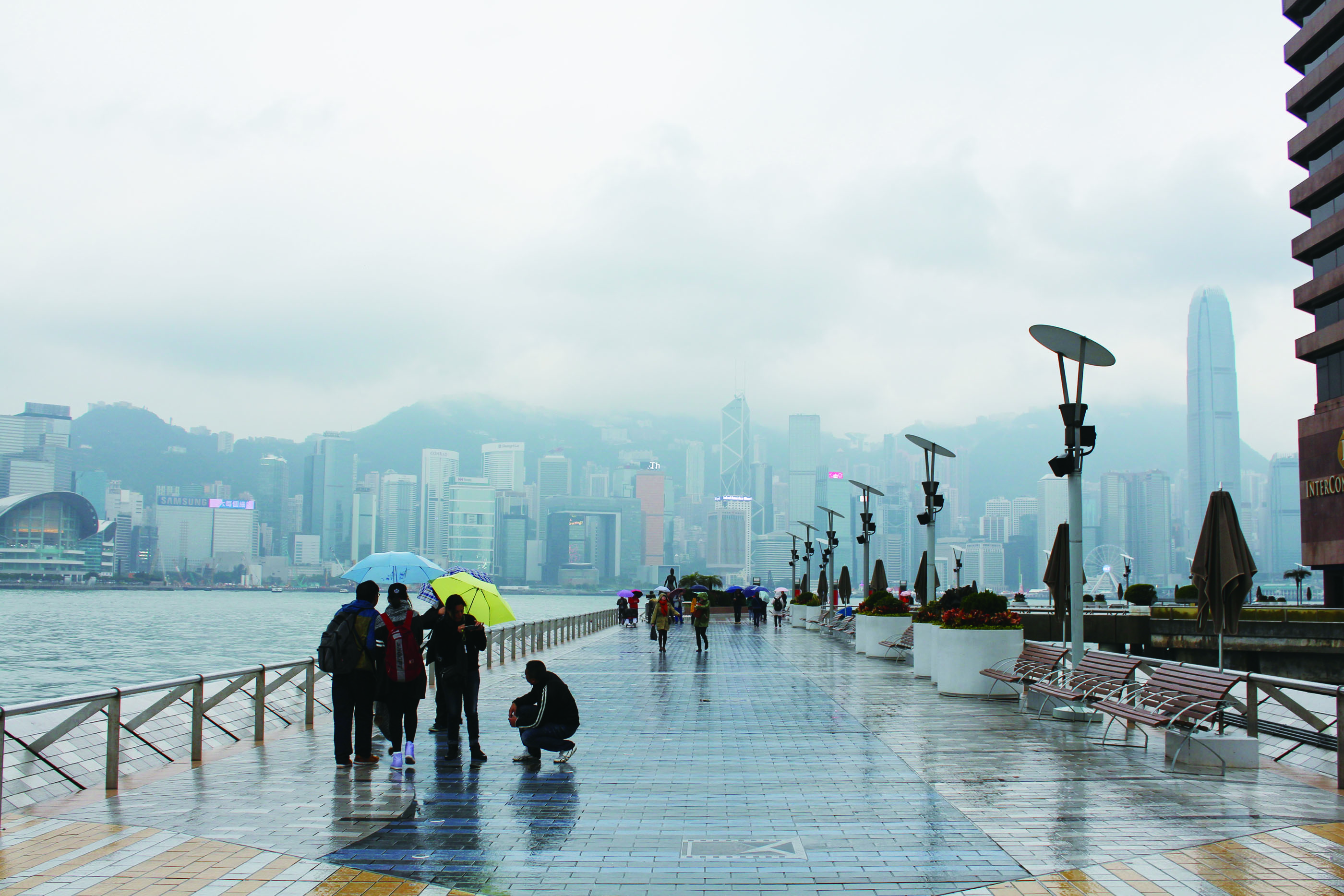
Crowds of mainland tourists jostle for the best photo-shooting spots with Victoria Harbour in the background at Tsim Sha Tsui’s Avenue of Stars, oblivious to the curious looks from other tourists. A slightly different scene plays out in Sheung Shui, a new town on the Hong Kong-Mainland border every day. Here, mainland visitors with multiple-entry permits crowd the entrances of dispensaries, where they stock up on milk powder and other daily necessities, either for personal use or for illegal resale later.
The influx of mainland tourists with high purchasing power has brought massive revenues to the retail industry, but it has also caused inconvenience to local residents and led to conflicts between Hongkongers and mainlanders, which boiled over last month in protests against parallel traders in Shatin and Tuen Mun that saw police use pepper spray inside a shopping mall.
It is not just the inconvenience that has triggered resentment in Hong Kong, but also the changes to the local landscape, with the ever increasing number of shops and businesses which seem to merely cater to mainland tourists.
According to the Hong Kong Tourism Board, Hong Kong accommodated more than 44 million mainland visitors last year, which means that the Mainland continues to be the territory’s biggest source of visitors. In 2009, mainland visitors accounted for about 60 per cent of total arrivals. That has steadily increased to almost 79 per cent in five years.
Crowds of Mainland paraellel traders gathering at Sheung Shui Station
The government is aware of this trend and the Hong Kong Tourism Board has put its focus on expanding international markets and maintaining a diverse portfolio of visitors, in order to uphold Hong Kong’s image as Asia’s World City.
The board’s Work Plan for 2015-2016 will allocate nearly half of its marketing budget of HK$352 million to promotions targeting overnight visitors. Of this, 76 per cent will be spent on reaching out to international markets. But before the efficacy of these measures can be seen, companies targeting non-mainland tourists are already struggling to attract business.
Local PhD graduates face tough search for university teaching and research jobs
Reporter by Karin Li and Kate Kim
Many parents dream that their child will one day earn a doctorate and consider it the key to a successful career, particularly in academia. Indeed, with greater numbers of people receiving a tertiary education, a Doctor of Philosophy (PhD) degree – which requires several years of in-depth, supervised research – is seen as a basic requirement for pursuing academic work. Yet, what is required to complete a PhD varies greatly among countries, universities, and subjects. Some programmes involve classes and examinations, some require undergraduate-level teaching experience, and some only research.
Professor Douglas Kerr
Regardless of the variation in course requirements, one thing many PhD students share in common is frustration over uncertain prospects. After devoting long years to studying and watching their peers who entered the job market earlier race ahead in their careers, PhD candidates may struggle to find suitable jobs related to their academic specialty after graduation.
This may, perhaps, explain in part the decline in local students pursuing PhD degrees. According to Graduate Employment Surveys (GESs) conducted by UGC-funded institutions (from 2009 to 2013), the number of local students embarking on PhD studies is dropping whereas the number of non-local students is increasing.
Intense competition for scarce jobs in academia is nothing new. It has always been a struggle for PhD students to find academic career opportunities as academia is overcrowded globally. Professor Douglas Kerr, dean of the Faculty of Arts at Hong Kong University, says that in the competitive job market, applicants are getting more impressive and well-qualified, and not just in terms of having PhDs from decent universities.
As a result, the recruitment standards for academic candidates are even higher than before. Kerr says universities will not only expect to see good PhDs but also expect at least one or two publications from applicants, even from postdoctoral candidates at the start of their career.
“It’s getting tougher, or you could say the environment is just changing with PhDs,” he says. A person coming after a PhD programme is unlikely to get a job unless he or she has publications already, even in the humanities, while that has been the case for science for many years.
Even publications will not guarantee PhD graduates a job at a university and local PhD graduates find they are losing out to those who have earned their PhDs from overseas institutions.
Those who study for their PhDs overseas establish networks with people engaged in relevant research in those countries. Once a local university hires a graduate from an overseas university, it has an opportunity to develop a closer relationship with that university. Specifically, recruiting a graduate from a famous university brings prestige to the local institution. Departments may even use the fact their faculty are trained overseas as a selling point.
Professor Nora Tam, a professor in City University and vice-president of The Society of Hong Kong Scholars, stresses that local students should challenge themselves to leave their comfort zones and go overseas to get more and wider exposure.
Tam thinks local students are weak in this regard when compared to their peers from the Mainland who would definitely strive to go overseas to get their PhD. “They will choose the good university and good group to go and after that they will go to another city to follow another group to do post doc and therefore you can see the link or the connections of these people; is it better than the local Hong Kong people,” she says. “Local Hong Kong born and trained [professors and PhD students] are becoming minority or endangered species”.
Tam says there are fewer opportunities for PhD students to do research in Hong Kong universities, so they do not have promising prospects of landing a good academic post after they graduate.
“If you want to do it because you want to find a good job, it is a bad investment,” she warns, “you should do it if you find it interesting.”
Besides having a PhD from a good overseas university, having good English is also an advantage as this is essential to writing for international publications and journals. Professor Michael Chan, an associate professor in the School of Journalism and Communication at the Chinese University of Hong Kong, says: “At the end of the day, English is the lingua franca in academia.” Compared with those who studied in predominantly English-speaking environments, local PhD graduates are likely to be at a disadvantage in this regard.
Even for those with publications under their belt, bagging a teaching post at a university also hinges on supply and demand issues. There are far fewer job openings in universities than there are PhD holders, so the competition is keener.
This is understandable, given Hong Kong is a small place, says Chan, which means candidates have to try even harder. “The rule of the game is really the publications,” he adds.
In many cases, holders of local PhDs find jobs teaching in community colleges and the private sector. The tertiary education sector has expanded in recent years, with the opening of new colleges and private universities such as the Centennial College of Hong Kong University.
For those who want to pursue their career in research in an academic setting, finding a suitable job may be even harder. Victor Li Chun Chiu, earned his PhD in chemistry in 2010 at the Hong Kong Polytechnic University but found the opportunities for research were too narrow. Li chose to develop his skills in other areas instead. He now works as a programme manager for Oxfam and is working on cultivating his leadership and management skills.
“Actually I still have an interest in research but don’t think I will get any further breaks in this field,” he says.
As for his peers from his university days, he says: that “very few people” are still working in chemistry, in the field of science. Li says some have joined the police or gone into sales. “Maybe the portion is six to four or seven to three. Seven is other fields. Three is field of science,” he adds.
Ho Wai-shing, an assistant professor at Caritas Institute of Higher Education who obtained his PhD in the University of Hong Kong (HKU), worked as a part-time lecturer at HKU for seven years. Failing to get a full-time regular teaching post at a research university, he switched to working at a self-financed tertiary institute and is now earning a better salary.
Ho points to the lack of support for research in Hong Kong as one of the critical reasons why the research output of local candidates for postdoctoral posts pales in comparison to that of top candidates worldwide.
Funding and resources for research in Hong Kong are limited and there tend to be few vacancies for purely research jobs, although this varies among different disciplines. Ng Tsz Wai, a research assistant in the School of Life Science at the Chinese University of Hong Kong, says there are more opportunities for research posts in biomedicine or chemistry, but few for his discipline of environmental science.
Ng says it is hard to pursue a career in research in Hong Kong, because the jobs are always contract-based. Without funding support or connections with supervisors, even research assistant posts are insecure. Ng returned to his current position helping his supervisor’s research project after unsuccessful attempts to find teaching posts at universities.
Wyman Tang Wai-man
It is said that the most common path for those who want to pursue research is to go overseas and come back. But this is not always advisable due to the inflexible nature of the research field.“I’ve got a collaborator in the US who asks me if I want to be his postdoc or not. But after second thoughts, I think it’s not so secure,” says Ng.
After completing the research project, he would have to work or find further research projects in America to earn a living since there is not much research in Hong Kong related to the professor’s research topic.
Like Ng, Wyman Tang Wai-man, a part-time anthropology lecturer at both the Chinese University of Hong Kong and the University of Macau, is also trying to strike a balance between making a living and trying to conduct research.
With a new-born baby in the family, Tang – who got his PhD from CUHK – cannot just give up his teaching jobs easily although that means he has no time to pursue research. “I have to be a superhuman in order to manage both (doing research and teaching),” Tang says.
His ultimate goal is to go to the US to continue post-doctoral studies and make a living by doing research there. “The advantage of getting a post doc oversea is that I get paid and at the same time I can focus on my research but now I get paid but I cannot focus on my research and that is the problem.”
After years of study and research, PhD students breathe a huge sigh of relief once their dissertations are handed in and they can finally graduate. But their worries may be just beginning. Choosing a career path after graduation is no simple matter and while a lucky few will go on to find a job teaching or in research, many more may be forced to make a living in a field that has little or nothing to do with their area of expertise.
For those who grew up in Hong Kong in the 1970s and 1980s, the annual Miss Hong Kong Pageant was one of the biggest entertainment events of the year. Families sat around television sets at home, rooting for their personal favourites and sharing in her joy or disappointment at the result. The next day, those results would be discussed in school, at work and on the streets.
Some young women and girls looked up to the beauties on the screen and imagined being in their place, waving elegantly at the audiences, or representing Hong Kong in international beauty competitions and getting a start in the glamorous entertainment industry.
But Hong Kong society has changed since 1973 when Television Broadcast Limited (TVB) first broadcast the pageant. Instead of rushing to wait for the show to start, Hongkongers are just as likely to be channel surfing while the show is on. Today Miss Hong Kong contestants can seem like old-fashioned throwbacks rather than iconic stars.
Winners of Miss Hong Kong Pageant 2013 celebrate after the ceremony
Acca Shum Kwai-ching, one of the top 10 finalists of the Miss Hong Kong Pageant 2013 says the image of Miss Hong Kong has been declining in recent years. She thinks that rather than a competition for physical beauty and grace, today’s pagaents are a vehicle to recruit attractive young women for the entertainment industry. “The ultimate goal for TVB in the Pageant is to search for potential artists,” Shum says, “I can tell that if the girl is not keen on acting or doesn’t fit the profile of what TVB is looking for, she is less likely to win.”
Although TVB still presents Miss Hong Kong as a paragon of beauty and wisdom, it is increasingly difficult to sell this carefully constructed image to viewers. Compared to classic beauty queens, such as Loletta Chu Ling-ling and Olivia Cheng Man-nga in the 1970s and 1980s, the winners of Miss Hong Kong in the 21st century seem to lack mystique. In the past, winners would spend their year-long “reign” as unofficial ambassadors for Hong Kong, taking part in international competitions and charity activities. Now, they are immediately trained to be actors in TV dramas or as presenters for entertainment shows. In other words, they are not much different from other newcomers in the TV industry.
Veronica Shiu Pui-sie, Miss Hong Kong 2014, disagrees that the contest is simply a means to find entertainment industry recruits. “I think the winner of each year represents that particular year,” she explains, “and to do that she should use her own way to display both her inner and outer beauty.” Shiu says the audience’s definition of beauty varies over time and amiability now seems to be a more important virtue for beauty queens.
Emphasising the personality of the contestants, today’s production teams try to establish a more approachable image of Miss Hong Kong and contestants are given more individual time to express themselves in front of the cameras and interact with the audience. They often speak to their fans through social media, posting selfies, behind-the-scene details about the pageant preparations and updates from their daily lives. Through blogs and platforms like Facebook they are encouraged to get fans to post messages of support.
Beauty pageants have long been seen as a commercial gimmick for the Hong Kong TV industry to attract the public’s attention, and that extra attention can in turn be monetized. Different companies sponsor the jewellery and luxury goods for the contestants during the broadcast to maximise publicity, while the TV companies sell commercial time during the live competition.