













Home Blog Page 58

Best of Both Worlds

Footballer-turned traditional Chinese physician Jacky Pang Kam-chuen runs a successful clinic – and still keeps his eye on the ball

By Gloria Li

At first glance, the array of football match photos and club pennants that cover the walls makes you wonder whether this is really a traditional Chinese tie da (bone-setting) clinic. But then Jacky Pang Kam-chuen, owner of the clinic, is no ordinary traditional Chinese physician — he was also a renowned football player in the 1980s.

Pang’s clinic in a shopping mall in Tai Po.

Pang works in his small clinic in Tai Po from Monday to Saturday, treating patients with sports injuries, his specialty, and residents nearby. On Sundays, the 56-year-old dons his bright red No.2 jersey, runs onto the football pitch and plays friendly matches with his old teammates from the South China Football Team.

Pang resolved to become a professional football player in his childhood. Back in the 1970s, there were very few leisure activities for kids so he used to play football on the streets every day after school. That was the start of his strong interest in football. “My dream was an ordinary one which was shared by many children [at that time],” Pang says.

“My dream was an ordinary one which was shared by many children [at that time].”

Unlike his peers, Pang held on to his football dream and made it come true with talent and effort. He honed his football skills through playing on the streets for years and joining the football team in his secondary school. His flair was soon discovered by one of his teachers who was a retired football player.

Thanks to his teacher’s recommendation, Pang then joined the youth training programme affiliated to the South China Football Team. South China is regarded as one of the most popular football clubs in Hong Kong, winning multiple champions in local league competitions.

Balancing a career and family expectations is not easy. Pang’s family did not support him pursuing a career as a full-time football player at first. Fortunately, his family ran a siu mei (charcoal-grilled barbecue meat) shop, so he did not have much of an economic burden to bear. He told his parents at that time: “Give me two to three years’ time; if I don’t succeed, I will come back home [and help with the family business].”

Dubbed “Shaolin Temple”, South China Football Team has been home to many talented football players. For Pang, life in South China’s youth football team was hectic. Trainees had to follow strict routines and undergo four hours of training every day. “It was tough, but to be able to do what I like, I had no choice,” he says.

Money was also a problem — as apprentices received little remuneration, he had to earn pocket money by helping out at his family’s siu mei shop. That is how he earned his nickname, Siu Lap Chuen.

Two years later, Pang officially became a professional football player at South China Football Team, serving as a right back. He was very successful throughout his 10-year career and in 1991 and 1992 he was selected to be one of the “Hong Kong League XI” who play for the Lunar New Year Cup, an annual football event held by the Hong Kong Football Association. The League XI is selected from the Hong Kong First Division League.

Pennants of the South China Athletic Association and other different football clubs hung up in Pang’s clinic.

An encounter with South China’s team doctor, Yau Wing-ching, a Chinese tie da specialist led Pang to take a different path. The countless matches and ongoing training made injuries inevitable for professional football players like Pang. As he preferred Chinese medical therapies with herbal treatments for his wounds, he often visited Yau’s clinic for check-ups. Over time, he developed an interest in Chinese medicine. “This job allows me to help people while earning a stable income [after retirement from his football career]. Plus it’s not a routine nine-to-five office job,” he says.

He later started to help out voluntarily at Yau’s clinic, spending hours there after finishing football practice. Through observation and hands-on experience, he learnt many useful skills which came in handy at his future Chinese medicine practice.

Pang declined contract renewal with South China in 1992 at the peak of his football career, fearing Hong Kong’s political environment after the handover. He and his wife decided to migrate to Toronto, Canada a year later where he got a job in a cha chaan teng (local Hong Kong-style restaurant) and worked as a part-time football commentator at a local Cantonese radio station.

During his days in Canada, he never forgot his passion for Chinese medicine. He started a tie da clinic in the basement of his home, serving patients living nearby — and putting his Chinese medicine knowledge into practice for the first time.

In 1998, Pang and his wife returned to Hong Kong where he soon got a job at his former master Yau’s Chinese medicine clinic. After working there as an apprentice for a few years, he began to think about starting his own clinic.

To prepare for this, he had to attain a professional qualification — which was not easy. The problem was that he had only started learning Chinese medicine in his mid-20s and he did not have sufficient knowledge of the essential foundation of the profession. To make up for it, he studied whenever there was no patient in the clinic. “Apart from reading books, I met different patients every day. These clinical experiences were definitely more helpful than simply learning from the books,” he says. He eventually passed the professional test on his third attempt.

In 2001, Pang finally opened his tie da clinic in Tai Po, a district he is familiar with. “At least I know more about this place [Tai Po], the residents, the neighbourhood. I have many friends and old teammates here,” he explains.

He started his practice in a small space of around 120 sq ft located in a local shopping centre— which cost him around HK$30,000 and managed to break even in a few months. The fame from his glory days as a football player certainly helped, as even patients from other districts came after hearing the news.

Specialising in treating sports injuries, including bruises and sprains, he was able to use his own experience as a former athlete to explain to patients their conditions in great detail. He also gave residents in the district a special discount. Over the years, he has won a fine reputation and attracted a group of loyal patients.

Pang demonstrates how he treats a patient in his clinic.

“You have to take care of your patients wholeheartedly, in every possible way, especially if you are a medical practitioner,” Pang says. “I treat all my patients the same. Although I can’t guarantee that I can cure all of them, I treat them equally and try my best.”

“You have to take care of your patients wholeheartedly, in every possible way, especially if you are a medical practitioner.”

If cases are too complicated to cure with tie da, such as bone fractures, Pang refers them to hospitals for further treatment. “I don’t have advanced equipment here [in my clinic], so I ask them to go to hospitals for check-ups. This is what a responsible medical practitioner should do,” he says. “I don’t think I should prevent patients from getting proper medical treatment.”

He is a successful tie da physician now but Pang still remains humble. He questions himself all the time: “Why doesn’t [the patient] come back? Did I use the wrong medicine on him?” This helps him treat patients more effectively. “Chinese medicine is very complicated. I’ m still learning by doing,” he says.

Pang’s diligent attitude is perhaps what helped him advance in both careers. Now he devotes himself to tie da but football will always remain special to him. He says Sunday is the most anticipated day of the week because he can return to South China Football Team’s pitch and play with fellow veterans. “Even in my eighties, if I could still stand in the field and play football, I would be satisfied,” he says.

Edited by Angela Siu
Back to the Cold Weapon Era

Jones Chan Kowk-chung’s lifelong love affair with swordsmanship

By Jasper Cao

If he hadn’t dipped into that Japanese comic book, Jones Chan Kwok-chung might have been a fashion designer with stable income. But Chan is a man who is guided by his instincts which led him to turn his childhood dream of becoming a master of Japanese swordsmanship into his career.

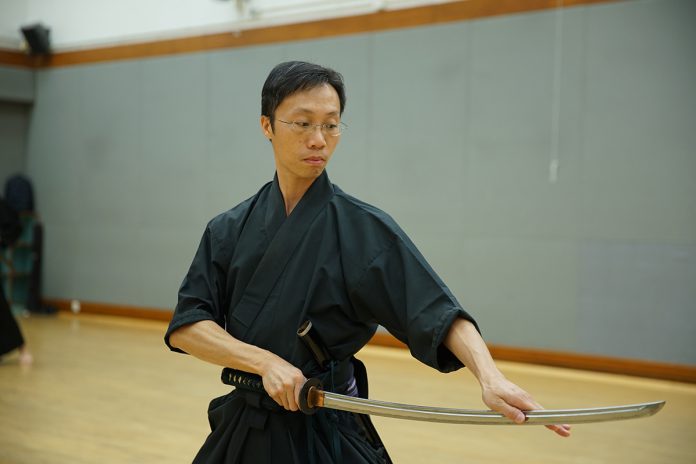
The 45-year-old kenjutsu trainer started learning the 400-year-old Japanese martial art when he was a secondary school student. After years of struggling to balance his family and job commitments and intensive training in Japan, Chan became a professional coach. Now he spends most of his evenings teaching over 100 disciples kenjutsu in Pei Ho Street Sports Centre.

Chan’s love affair with kenjutsu began in a summer vacation when he was just a teenager. He randomly picked and read a Japanese comic book, Musashi no Ken, named after a legendary samurai, Miyamoto Musashi, who was regarded as one of the best swordsmen in Japanese history. The story is about an elementary school boy who determines to master kendo, a Japanese sword sport that was once used to train samurai. He practices so diligently that, eventually, he wins the national competition.

“It is a comic book filled with positive energy and encouragement,” Chan recalls. As he finished the comic book with excitement, Chan quickly identified himself with the character and dreamed of becoming a kendo expert one day.

He found an advertisement for the Hong Kong Kendo Association on the final page of the book. Without hesitation, the young Chan made a call to the association. His lifelong journey with Japanese swordsmanship started after that phone call. He attended the kendo class twice a week after school and stood out as the youngest learner in class for all other learners were adults. “I didn’t compare myself with them though, we all just learned for fun,” Chan recalls.

In 1994, Chan crossed paths with his first kenjutsu master. Knowing Chan’s affection for kendo, a friend of his invited him to visit a sword shop in Sheung Wan, where he met the shop owner, Chan Chun-fu, a kenjutsu master. Touched by the young man’s strong passion for Japanese martial art, Chan Chun-fu made the young boy his disciple.

Chan helps a disciple adjust his position.

“Chan Chun-fu was the first man who introduced kenjutsu to me and showed me the difference between kenjutsu and kendo, he was my very first master,” Chan says.

Young Chan studied with the master for four years and learned Toyama-ryu, a branch of kenjutsu. This experience laid a solid foundation for him to master kenjutsu techniques in his later days.

Chan fell into a period of confusion four years later. Like many other young college graduates, he was not sure about his career choice. Although he tried different kinds of jobs, he still could not settle with a career goal and even stopped taking kenjutsu classes for some time.

After four years of twists and turns, in 2003, Chan finally settled down as a designer of female fashion. Once he was accustomed to the new working environment, he quickly reunited with his old hobby again by learning another classic kenjutsu style, Suio-ryu.

Chan overcame the language barrier with the help of a friend who was fluent in Japanese and called the sōke (the head family) of Suio-ryu in Japan. Chan obtained approval from the sōke to visit them in Shizuoka, a Japanese town where the sōke lives.

“When I first met the master, he asked me to demonstrate the kenjutsu techniques that I had learned,” Chan says. With his determination and experience gained in years of learning, Chan successfully convinced the master to accept him as disciple. Chan’s Japanese master, Katsuse Yoshimitsu Kagehiro, is the 15th generation headmaster of Suio-ryu.

Given his family commitments and his job in Hong Kong, Chan could not stay in Japan for too long, so he reserved all of his annual leave from work to train in Japan.

Unlike Tokyo, life in Shizuoka is peaceful, but it can also be quite dull for a foreigner, as there are not many entertainment options, Chan says.  During training days, Chan had two hours of training in the morning, and another two hours after dinner. As his time in Japan is limited, he often practiced for an extra hour in the afternoon. “I was alone, but not lonely, because I had a very clear goal that is to master kenjutsu ,” he says.

Chan practises with his followers.

Chan has fond memories of his training days in Japan. He has developed strong bonding with other disciples and especially with the master. “We had tea and chats after we had finished training every evening,” Chan recalls.

“The master is a kind and amusing old man,” he adds.  “My master even offered to teach me for free after we have known each other better.” In recognition of the master’s kindness, Chan gives his master a present every time he goes to Japan. “I usually bring antiques because he likes antiques very much,” Chan smiles. “Every year I carefully select a piece of antique for my master.”

Chan has been travelling to Japan for regular training for the past 15 years. Having forged a loving friendship and trust with his master, Chan received his master’s blessing to be the head of a Suio-ryu Hong Kong branch in 2017 and the head of the mainland China branch in 2018. He now also offers free lessons in three affiliates founded by his friends in Xiamen, Shenzhen and Guangzhou to promote the Japanese martial art.

Although he has a prestigious title bestowed by his master, Chan does not want to profit from it. “Money is important. But I don’t want to make money in the name of Suio-ryu,” Chan says.  “I just want to share my passion for kenjutsu by becoming a coach, but not to make money out of it. I have my own philosophy of screening students.”

When choosing disciples, Chan always considers candidates’ character flaws. Chan explains he will not let those who have aggressive character and enjoy fighting to become his disciple, because he thinks kenjutsu is a dangerous martial art. “Figuratively speaking, I will not train someone with personality like a tiger,” he says. “If I train a tiger and equip it with skills, it might attack people. That is extremely dangerous.”

And those who learn kenjutsu with the sole purpose of getting a certificate are not qualified for him either.  “Only those who are really passionate and keen to learn kenjutsu can be my disciples.”

Only those who sincerely love this martial art and share my passion to learn kenjutsu can be my disciples.”

Chan says teaching kenjutsu is just a hobby and he makes a living mainly by investing in the stock market. He wants to take on the responsibility of introducing kenjutsu to more people. He is also planning to set up more affiliates in other cities so he can share his interest with more people.

When asked what kind of role he wants to play in the story of kenjutsu, Chan says  he has no interest in chasing fame. He admires the life of swordsman Linghu Chong (令狐冲), a fictional character in one of Louis Cha Leung-yung (Jin Yong)’s novels. “To wander around the world with my sword and wine, that is good enough for me.”

Edited by Grace Liyang

Music beyond Boundaries

Musician Ng Cheuk-yin blends different genres to bring freshness to the local music scene

By Johanna Chan

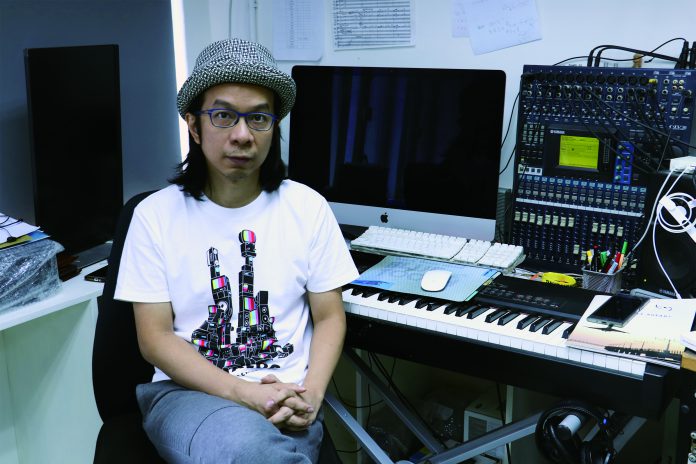
In a cramped room, a man sits in front of a desk covered by handwritten musical scores, composing with his electronic keyboard and typing musical notes into his computer. The blinds are pulled halfway down, allowing sunlight to pour into the room, revealing a shelf full of CDs and the mountains of drafts that are piled up beneath. The room is silent except for the sound of the tapping.

This is a typical work day for 41-year-old Ng Cheuk-yin, a renowned local musician. He owns a number of titles – composer, producer and performer. He also delves into a variety of music genres, including pop music, chamber music, Chinese music, a cappella, to name but a few.

“To me, [music] is something natural. It’s just like my hand,” Ng says.

“To me, [music] is something natural. It’s just like my hand.”

Music is deeply rooted in Ng’s life. His first exposure to music came at the age of six when his parents first signed him up for piano lessons. Two years later, he began to learn the sheng, a Chinese reed instrument consisting of vertical pipes, at the government’s music office. At school, he was also a member of the choir and orchestra. He gradually developed a passion for music.

Looking back, Ng is grateful for these childhood experiences. “Adults may have a better grasp of music, but they lack time and patience. That’s the privilege of kids,” he says.

Growing up with the dream of becoming a musician, Ng chose to major in music at the Chinese University of Hong Kong. He knew that connection is the key to entering the music industry, so during college days he seized every opportunity to attend workshops and music events in order to build connections.

Success never comes easy. After graduation, Ng became a freelancer for eight years, teaching different kinds of music, such as the piano, the sheng, music theory and composition. But he knew that teaching was never his ultimate goal, so he constantly reached out for opportunities, pitching his pieces to different orchestras and sending tons of demos to record companies.

“In this industry, you have to take the initiative. The companies won’t come to you right from the start because they wouldn’t know who you are,” Ng says.

Eventually, Ng’s hard work paid off. He became a renowned artist, working with the Hong Kong Chinese Orchestra, Hong Kong Dance Company and soprano Alison Lau. He also composed for famous pop singers such as Andy Lau, Eason Chan and Hins Cheung, producing hit songs like Under the Sakura Tree.

(Photo courtesy of Ng Cheuk-yin)

Speaking of his success, Ng says although building connections is crucial, the quality of works also matters. He believes that every piece of work contributes to his reputation, therefore he always puts full effort into his work. “It’s not easy to create something new. Deadline is the biggest pressure,” he says. “But I can’t tolerate producing below-standard work. It will leave people with a bad impression and they would think I’m a poor composer.”

Ng believes that another crucial aspect in composing is communication with performers. He says the performers sometimes may not understand his work or come up with different interpretations. Therefore, he needs to discuss it with them multiple times and occasionally may even have to alter and reinterpret his music.

Moreover, Ng’s success does not stop him from pursuing new goals. With his diverse background of music, he strives to break the boundaries between different genres of music. “In this era, the distinctions between genres are no longer clear,” he says. “Working on different genres always brings me new inspiration, because there are often materials that can be shared between different genres.”

In 2004, Ng and some of his friends founded SIU, which stands for Sheng It Up, a fusion band which performs with both Chinese and Western instruments. Later on, Ng established the second generation of the band, SIU2, which mainly plays original music written by him. He also plays the sheng and electric organ in the band. Other instruments include the zheng, sanxian, the piano, bass guitar, and drums. The band has been invited to perform in China, Taiwan, France, the Netherlands and many other countries.

Ng Cheuk-yin and other SIU2 band members perform at the OzAsia Festival organised by the Hong Kong Arts Development Council in 2016. (Photo courtesy of Ng Cheuk-yin)

In 2008, Ng started his own record label, Flower Music, not just to manage his music businesses, but also with the aim of bringing new culture to the local music scene. He says apart from fusion music, a cappella is another main focus of the company.

Ng’s first experience with a cappella dates back to 1990s, when he formed a cappella group Gay Singers with several fellow music major classmates in college. “Very few people were doing a cappella at that time; there were maybe only two active groups,” he recalls. “Now there are much more people joining, with nearly 20 active groups.”

Ng thinks the local a cappella scene is still developing. He devotes himself to further promoting it. He is now a co-artistic director of Yat Po Singers, the first professional a cappella choral theatre company in Hong Kong. In 2011, he released a one-man a cappella album, Single Singers, in which he imitates instrumental sounds and vocal percussion.

Being in the industry for more than 10 years, Ng never gets tired of composing and performing. For him, music brings energy and spirit which has helped him to stay young at heart and allowed him to appreciate the simple events and people in his life.

One of Ng’s most cherished memories is touring with his band SIU2 in France in 2012. They performed at a wine festival, which took place at a riverside, packed with stalls serving different kinds of gourmet food and wine. After performing, he and the band members casually strolled along the river, holding glasses of wine while watching fireworks blossoming in the night sky, and indulging themselves in music. For him, it was a moment of pure joy and happiness.

Ng is currently writing for several productions, including musicals featuring dance music such as, I Wish I Could Make A Wish, which is adapted from the work of the famous Taiwan illustrator and picture book writer, Jimmy Liao. He hopes to continue to write large-scale compositions and further refine his music in the near future. “For me, the most difficult thing is that every piece of work needs to be up to standard, but I will take it as a challenge,” he says.

“For me, the most difficult thing is that every piece of work needs to be up to standard, but I will take it as a challenge.”

Edited by Grace Liyang

Poles Apart

Pole dancers ignore the misconceptions of others and strive to be themselves

By Fangdong Bai & Valerie Wan


Lights! Music! As the black curtains slowly pull open, the mid-year performance at N2 pole studio with the theme “The Nostalgic Ballroom” takes off and Narlton Tsang, a local male pole dancer and founder of the studio, moves majestically across the floor, showing off his acrobatics skills.

His students, in fashionable pole- wear and gowns, follow his opening showcase with performances accompanied by popular old tunes. They climb on the poles and show off a series of spins, splits, climbs, drops and inversions, wowing the audience by their incredible strength and flexibility. Shining in sweat under the spotlights, the dancers smiled with confidence and satisfaction as they bathe in the applause and cheers from their audience.

Pole dancing, which is believed to have developed from a traditional Indian sport in the 12th century, has a strong association with strip clubs and eroticism. But the story does not end there. For over just two decades, pole dance has gained popularity in Hong Kong. Some people view it as a healthy and acrobatic sport, while some label it as a sexy performance showcasing the dancer’s body. Tsang thinks that pole dance itself is neutral in nature and is simply a dance form which features a pole.

Tsang was the first male pole dancer to represent Hong Kong in international competitions. He entered his first international competition in Hong Kong four years ago, but that was a bitter experience. “Hong Kong is an international city, but you can’t show your nipples [in a pole dance competition]. Isn’t it ridiculous?” says Tsang, recalling the rule imposed not by the competition host, but the management staff of the competition venue. Only when the competitors, including Tsang, agreed to comply with the rule were they allowed to join the competition.

“We are not flashers. We don’t wear less out of wanting to expose our bodies,” pole dance instructor Dimple Lin Ho-yan explains, responding to a common misconception that all pole dancers wear less for erotic reasons. “We do it because our moves require it.” Lin adds. Pole dancers have to use the friction created by their skin to grip the pole. Some advanced moves even require dancers to use their chins, necks and underarms to grip the pole.

Lin first learnt about pole dancing from a friend in 2012, then fell crazily in love with it. She sustained injuries during her practices quite often and even had her collarbone displaced once. Lin says: “You have to go through a hundred failures, enduring pain, getting bruises and wounds… until you finally succeed.”

And finally succeeding ignited her enthusiasm for pole dancing to such a degree that she gave up her job so she could train five days a week, every week. Her hard work paid off and she became an instructor in 2014 and currently teaches at Melody Pole Studio.

Lin finds that pole dance has been more readily accepted by the public recently, and more people are willing to appreciate it as a sport and pursue it as a hobby. Its public image has changed so much that mothers enroll their kids in mini pole dance classes.

More importantly, it has also attracted more men. At Melody Pole Studio, male students make up a tenth of the class. Whilst some of them come for their wives or girlfriends, others are here to pick up a new hobby.

Christopher Ng Chun-yeung, 29, a student of the Melody Pole Studio who has dance background in hip hop, jazz funk, and contemporary dances, started learning pole dance a year and a half ago. Having started pole dancing in high heels, he has now developed an interest in pole drama, which is a genre of pole dance involving bolder and more striking moves, with fewer feminine elements. “It [gender type] is more like a gender spectrum, instead of being clearly black and white,” he says. “Everyone has both the masculine and feminine sides.”

Ng thinks that male pole dancers belong to a minority within a minority, and it will take time for society in general to accept male pole dancers. He once received malicious comments on social media and even his ex-boyfriend did not support him. “When I told my ex-boyfriend that I was going to learn pole dance, he replied simply that I had better not dance in front of him. I didn’t care about his comment because this is what I like,” he says.

Ng believes his actions speak louder than words and will continue his pursuit of pole dancing to inspire more people. “I hope people can try to understand more before judging and giving their opinion,” he adds.

Narlton Tsang, founder of N2 Pole Studio, has a slightly different view. “I wanted to change people’s perception, but now I give up,” he says. He has realised that male pole dancers simply do not need the public’s acceptance to pursue their interests. “I never think about [others’ opinions], as they won’t stop me,” says Tsang. “How the world thinks of me is none of my business.”

When Tsang first set up the studio in 2016, he intended to offer a haven for his students to take refuge from the outside world, so that they could set themselves free and be their true selves. “I can’t change people’s thoughts, so the only thing I can do is to be the best of myself and do my part to provide this hideout for people who want to be themselves,” he says.

Edited by Crystal Wu

Time to Watch out

Local watchmaker Leung Yau-saint promotes mechanical watches through his workshops

By Valerie Wan

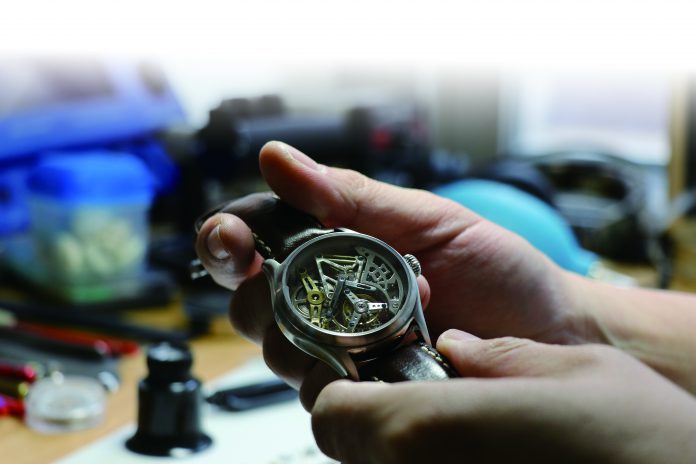
Shabby stalls in forgotten corners of a street often spring to mind when it comes to watch repairing and crafting. Few can relate the profession to people in white lab coats working in a studio in a fancy commercial building in Sheung Wan. But that describes exactly Leung Yau-saint, one of the few independent watchmakers in Hong Kong who crafts original mechanical watches.

Leung’s passion for watches started in his childhood when he received his first watch from his mother. He was fascinated by the ticking sound of watches and developed a hobby taking apart and reassembling watches. In 2003, he entered the Hong Kong Institute of Vocational Education (IVE) to study horological science and technology. After graduation, he was involved in research and development projects related to mechanical watch movement.

In June 2017, Leung founded S3 Workshop with two watch enthusiast friends. S3 stands for “self, space and sense”, indicating that he hopes the workshop will serve as a gathering place for people who want to take a break from tedious urban life. Here, he offers a range of watchmaking workshops, including watch jamming, mechanical watch assembling and watch-surface crafting.

Although Hong Kong has one of the world’s largest watch markets, the local watchmaking industry is relatively undeveloped compared to countries with a long tradition of watchmaking like Switzerland. Leung says while many Hongkongers purchase watches as symbols of status, few can appreciate the artistic value of watches. “Many Hong Kong people put an equal sign between ‘mechanical watch’ and ‘Rolex’,” he says. “They
are unaware of other brands besides the mainstream ones.”

Every handcrafted timepiece is unique and takes months of dedication and patience to finish. To watchmakers, the most challenging process is the pursuit of precision – using their knowledge and skills to find a subtle balance between different components. Even a minor error can lead to a watch malfunctioning. “Sometimes you fail in your first attempt, so you have to start over again,” Leung says. “It can take days and weeks to create a single component.”

Unlike electrical watches, which have components that are usually mass produced, mechanical watches are one of a kind. They can continue to function as long as watchmakers can replace the worn components. Leung thinks a mechanical watch is
something a family can cherish for generations.

Want to make your own watch or learn about the mechanism behind it? Pay a visit to the S3 Workshop at Room 202A, 2/F, Kai Wong Commercial Building, 222 Queen’s Road Central or go to their website for more details.

Edited by Crystal Wu

Go Chasing Waterfalls

Explore Hong Kong’s hidden natural beauty through stream trekking and canyoning

By Fangdong Bai

Climbing a cliff under the blazing sun and jumping into cold water seems an unlikely activity in a bustling city like Hong Kong. But in Ping Nam, just less than an hour away from the city centre, Gordon Hon Wing-chau is guiding a team to explore a waterfall and do just that.

Hon is the founder of Hong Kong Rock Climbing Adventure, a company which provides outdoor adventure guides. He has been exploring Hong Kong’s streams through stream trekking and canyoning for two decades.

Stream trekking is a mixture of climbing and hiking up the mountains along rivers. One can either walk around the water flow or in the river. In contrast, canyoning is an extreme sport which requires participants to make their way down the streams using abseiling, climbing and diving techniques.

Hon first came across stream trekking when he was working as a hiking guide for youth centres. Later he found stream trekking more intriguing and started to encourage teenagers to join the sport, as they can swim in the cool streams after hiking on a hot summer day.

For Hon, stream trekking and canyoning are not only part of his job, but also a way to avoid the summer heat. He also believes that these sports can push people to go beyond their limits. “Diving and canyoning boost your confidence,” he says.

Like other extreme sports, both stream trekking and canyoning have potential risks, but canyoning is more dangerous in comparison, especially for beginners. The choice of location is important and has to be decided according to the ability of participants. Using equipment such as anti-skid shoes, helmets and protective clothing can help minimise the risks. And there are certainly risks; Hon suggests that beginners should buy insurance.
He advises beginners to start with stream trekking which is easier. If they want to try canyoning, they should join training courses first or do it under the guidance of an instructor. The Hong Kong Rock Climbing Adventure provides courses taught by experienced instructors for canyoning and other adventurous sports such as zip-lining and rock climbing.

“Hong Kong has the geological environment and resources for stream trekking and canyoning. This is what I want to let more people know,” Hon says. And if you do take time to learn the skills, there is the added advantage of discovering that Hong Kong has a lot more to offer than streets and highrises.

Want to try out stream trekking and canyoning? Go to Hong Kong Rock Climbing Adventure’s website for more details.

Edited by Crystal Wu

Kowloon West By-election Buzzwords Explained

In our terminology series, Varsity explains a few of the buzzwords in the upcoming Legislative Council Kowloon West By-election.

The first one is “invalid nomination”. Ousted lawmaker Lau Siu-lai’s nomination was deemed invalid in the Kowloon West By-election.

The second buzzword is “vote splitting”. Veteran lawmaker Frederick Fung’s decision to join the by-election raised fears of a split vote for the pro-democracy camp.

The third buzzword is “Plan B”. Lau Siu-lai’s fellow Labour Party member Lee Cheuk-yan is regarded as a “Plan B” when she was barred from the by-election.

11.25 LegCo Kowloon West By-election – All You Need to Know

The Legislative Council Kowloon West By-election will take place on Nov 25. Varsity has prepared a series of graphics, explaining all you need to know for this by-election.

The Kowloon West Constituency consist of three districts, namely Sham Shui Po, Kowloon City and Yau Tsim Mong District. It has the least number of Registered Electors – 487,160 – among all the constituencies.

Let’s look at some major developments of the by-election during the past month.

The nomination period started on Oct 2, on which Labour Party’s Lau Siu-lai, former ADPL member Frederick Fung Kin-kee and independent Chan Hoi-yan submitted their nominations.

On Oct 12, Lee Cheuk-yan, another member from the Labour Party, submitted his nomination. Hours later, Lau Siu-lai was barred from the by-election.

The nomination period came to an end on Oct 15, with two more candidates – independent Ng Dick-hay and Judy Tzeng submitting their nominations.

On Oct 26, five candidates were validated and confirmed eligible to stand for the by-election.

So who are these candidates and what are their political affiliations?

Calling for More Tree Surgeons

Shortage of tree experts hamper management of Hong Kong’s urban trees

Reporters: Johanna Chan, Iris Yeung, Howard Li

Editor: Nannerl Yau

Trees can be deadly if they are not managed properly. In 2014, a tree in Mid-Levels fell and killed a pregnant passerby. Accidents and fatal falls such as this one have brought the issue of tree maintenance and safety to public attention in recent years.

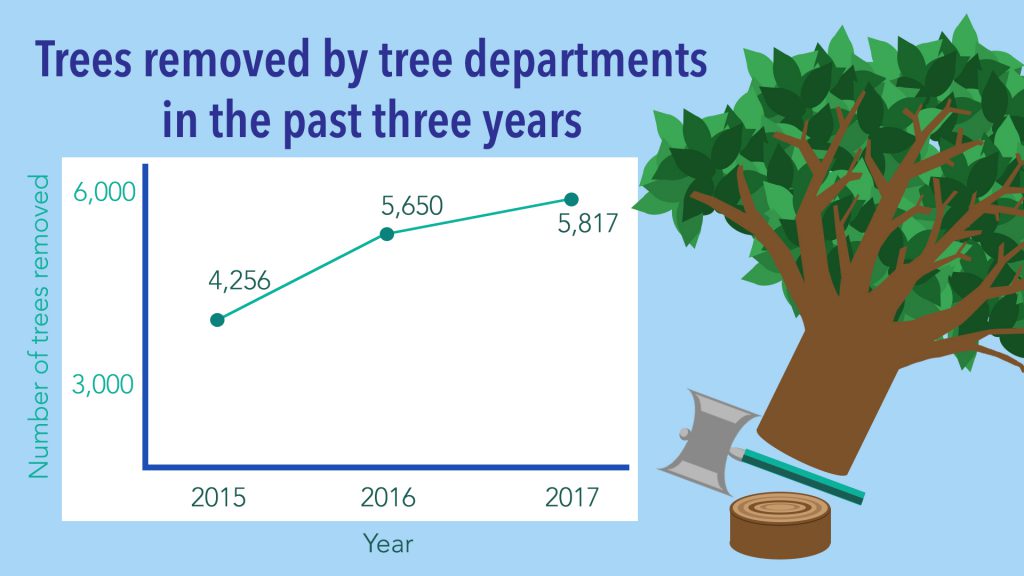
The government began to catalogue urban trees in 2013, creating an inventory to assess the locations and condition of the trees. More than 1,500 trees have been removed in the past three years as a result. The number of injuries caused by trees has decreased, with no major injuries recorded during this time.

Despite concerns about both public safety and the need to protect the city’s trees, the government has ruled out the drafting of a Tree Law. In February, Development Secretary Michael Wong Wai-lun told lawmakers this was due to a lack of tree experts, especially arborists.

The decision highlights the limited development of Hong Kong’s arboriculture industry, despite signs of growth of in the past few years.

Increasing public awareness of and interest in tree health means there are now more people interested in aboriculture. Organisations, such as the International Society of Arboriculture (ISA) Hong Kong Chapter, conduct school visits and host tree activity days for children, interested individuals, and families.

Ian Robinson, the vice-president of the ISA Hong Kong Chapter, says one of the reasons behind the shortage of tree experts is people’s perception of the field.

“It isn’t that sort of thing that parents would generally encourage. They don’t want to see their sons and daughters working in the landscaping industries,” he says.

Robinson thinks more will value the profession once people understand it’s a career with prospects.

There are some encouraging signs, for instance there has been a recent increase in students attending higher education courses related to tree risk assessments.

Caroline Law Man-yee, a teaching fellow at the Department of Environment, Faculty of Design and Environment at THEi, says she sees a steady growth in the enrollment numbers in her department’s four year programme in horticulture and landscape management. Law says she is pleased that newcomers are joining the sector after seeing its growth potential.

The duties of tree management staff include performing regular check-ups on trees, pruning and chainsaw operation. They are also required to have knowledge in plant botany and biology in order to determine whether a tree is living healthily in its environment.

But Chiu Siu-wai, a retired professor at the Chinese University of Hong Kong, who is also a tree expert, says the starting salaries for budding arborists are too low. She thinks the government needs to do more to improve their career prospects.

The arboriculture industry was incorporated into the Qualifications Framework in 2015. This means tree management staff can better map out their futures in the arboriculture field, whether as frontline staff or in management.

Anna Yau Wai-yu, the tree management program manager at HKU SPACE says that using competency levels to categorize staff with different amounts of training helps those in the sector to see where they are, and what they need to learn to achieve a higher professional standard.

“Those who want to enter the industry will know clearly what the job requires, and if they want to work in this industry, and they need to train or study, this will make it clearer to them,” she says.


The Digital Divide

Rural residents and the elderly  left behind in Hong Kong’s digital transformation

Reporters: Erica Li, Sarah Poon, Edith Chung, Valerie Wan

Editor: Yeung Yi

In 2011, the United Nations Human Rights Council passed a non-binding resolution that suggested Internet access is a basic human right. The Internet is no longer seen as a luxury, but a necessity in modern society.

Hong Kong is one of the most connected cities in the world when it comes to broadband internet, but for those living in Hong Kong’s rural areas it can be a different story. According to statistics from the Legislative Council, 21 per cent of households in Hong Kong still did not have Internet access in 2015. Presently, large swathes of the population living in the New Territories and outlying islands either experience patchy services or remain unconnected.

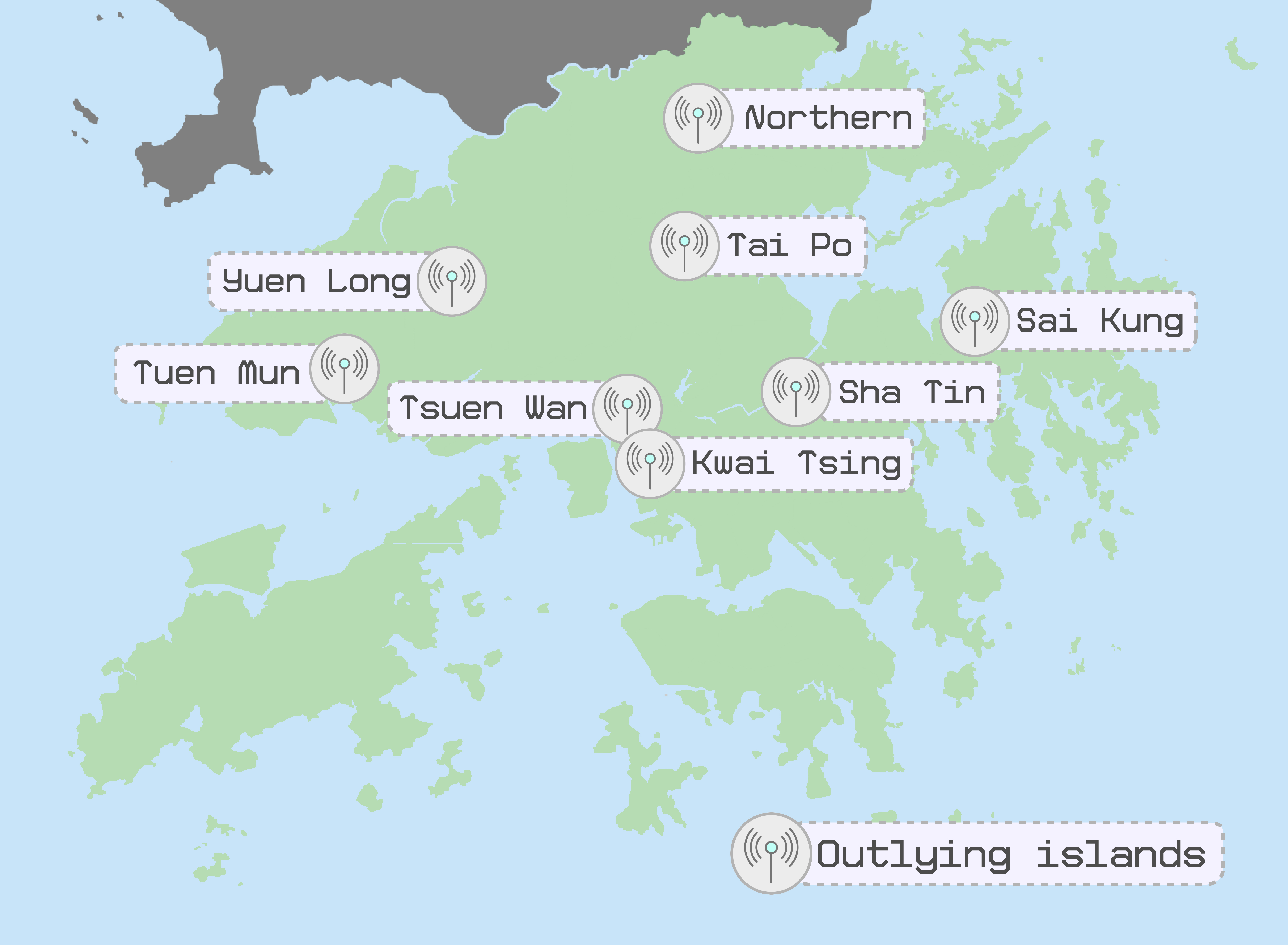
Following the 2017 Policy Address, preparatory work on the Subsidy Scheme to Extend Optical Fibre Networks to Remote Villages in the New Territories and Outlying Islands is underway. The scheme will subsidise fixed network operators to extend optical fibre networks to the entrances of villages, while the “last mile” to individual households will be connected by the existing copper wires. Rural villages that only have basic broadband services of below 10 Mbps in nine districts will benefit:

The nine districts covered in the subsidy scheme

The plan is scheduled to undergo consultation at the Legislative Council in May 2018. Once it’s approved, Internet service providers will be invited to submit a proposal to the Office of the Communications Authority (OFCA) for tender. OFCA will consider price attractiveness, construction time, system designs and subsidy amounts as factors in selecting a winning bid. The winning operator is required to share at least half of the network capacity with other service providers. The aim of this ‘interconnectivity requirement’ is to introduce competition.

The subsidy scheme will be implemented in phases over the course of five years. In 2021, it is expected to benefit over 300 remote villages and over 170,000 residents living in rural areas and outlying islands.

Closing the gap for the elderly

Other than building infrastructure, digital and technological literacy is essential if a society is to achieve digital inclusion.

Many elderly and disabled people in Hong Kong do not possess digital skills. In 2015, only 35 per cent of senior citizens owned a smartphone, far below the territory-wide figure of 83 per cent. While some profess no desire to get online, others strive to connect with online society.

“We are detached from the society,” says 85-year-old Mr. Ng. Despite government efforts to fashion Hong Kong into a “smart city”, members of the older generation find it hard to adapt to an increasingly digital world.

With more services becoming only accessible via e-platforms, some charitable organizations are trying to educate the elderly on basic Information Technology skills. Workshops have been set up to introduce them to new devices, gadgets, digital applications and social media platforms.

Already, some senior citizens have proved it’s never too late to close the gap and there is no reason why the older generation can’t join the e-generation.