














Home Blog Page 67

A Marriage of Linguistic Minds

Linguists Virginia Yip and Stephen Matthews blaze a trail in Cantonese and bilingualism studies at work and at home

By Elaine Ng

W

hen Hongkonger Virginia Yip and Englishman Stephen Matthews met at graduate school in the United States 30 years ago, they could not have imagined they would go on to achieve so much together as partners in life. They have become renowned linguists, raised three multilingual children in Hong Kong and co-authored award-winning books. Today, the 55-year-old Yip is a professor of linguistics at the Chinese University of Hong Kong, and her 54-year-old husband teaches linguistics at the University of Hong Kong.

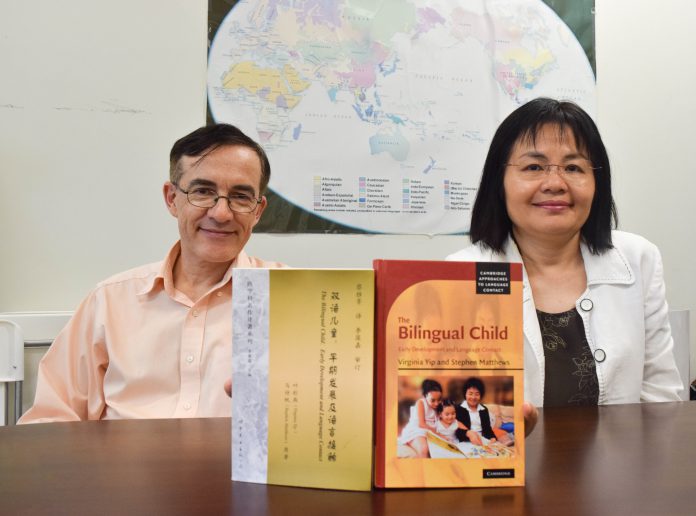
Yip and Matthews are the only local linguists to be awarded the Leonard Bloomfield Book Award in 2009, for their co-authored 2007 book The Bilingual Child: Early Development and Language Contact. The award from the Linguistic Society of America is regarded as the Academy Awards among linguists. It was published 13 years after their first co-authored book Cantonese: A Comprehensive Grammar. Published in 1994, this was the first-ever Cantonese grammar book written in English, and has since been translated into Japanese. The book became the go-to reference for many foreigners who want to learn Cantonese.

Photos of Virginia Yip and Stephen Matthews when they received the Leonard Bloomfield Book Award in 2009 in San Francisco for their book The Bilingual Child: Early Development and Language Contact.


Before they met, the couple developed their desire to understand languages differently. Yip’s passion for linguistics blossomed when she studied the subject as an undergraduate at the University of Texas at Austin, whereas Matthews recalls being fascinated by how languages function from around the age of eight. Despite growing up in a mostly monolingual environment, he remembers keeping a tiny “dictionary” where he would collect words and numbers in different languages. This childhood habit paved the way to his studying for a degree in Modern and Medieval Languages at Cambridge University.

Their paths converged at the University of Southern California, where Matthews and Yip both studied for their PhD in linguistics. The young Briton tried to learn Cantonese, which he had barely encountered until the age of 26, both to impress Yip and out of his own interest. At first, he struggled with the segmentation and tones of Cantonese words, but Yip guided him through the process by being as encouraging as she could.

“Cantonese speakers seem to appreciate foreigners speaking Cantonese however badly,” says Matthews, recalling how his then girlfriend never picked holes in the flawed Cantonese he spoke and always appreciated his efforts.

After they completed their doctorate degrees, Yip and Matthews moved to Hong Kong, Yip’s hometown, and they married in 1990. They did not have a specific plan for how long they would stay, and were just testing the waters to see how things would pan out. It turned out to be the right decision. Looking back, the two unequi-vocally describe it as a “big blessing” to have stayed and embarked on their academic careers in Hong Kong.

It all started with their observation that there was a research gap in the study of Cantonese. As Matthews continued to devote himself to learning the language after arriving in Hong Kong, he was shocked and disappointed at the lack of Cantonese learning materials in English, particularly those about grammar. He could see how this would make it hard for foreigners who wanted to delve deeper into Cantonese beyond memorising phrases.

“The way it seemed to me was that, whatever I wrote about Cantonese would be new to the English-speaking world,” Matthews says.

He was right. The book, Cantonese: A Comprehensive Grammar, combined Yip’s expertise in Cantonese grammar and the notes Matthews’ jotted down while watching movies or speaking with his wife in everyday life. It was hailed as comprehensive and down-to-earth and its success motivated the couple to stay in Hong Kong to explore further possibilities of research on Cantonese.

While working on the first book, the couple had observed another gap in the field. Their first child Timmy was born in 1993 and they realised there was little available literature on language acquisition of bilingual children involving a non-European language. After Timmy’s birth, followed by those of their daughters Sophie and Alicia, Yip began to develop a research interest in bilingual acquisition.

Yip and Matthews decided to experiment with the one-parent-one-language approach on their own children, with the mother speaking only Cantonese and the father English at home. “We were going to have children, and they were going to be exposed to both Cantonese and English anyway, so why not?” says Yip as she explains how they initiated the Hong Kong Bilingual Child Language Corpus, which contains longitudinal speech data of her three children and another three who were exposed to Cantonese and English from birth.

The parents started with recording and transcribing what their children said. After documenting the way they acquired English and Cantonese simultaneously throughout their childhood, Yip and Matthews published their monograph The Bilingual Child: Early Development and Language Contact in 2007, which went on to win the prestigious Leonard Bloomfield Book Award.

Matthews describes their three children as having “the best of both worlds”, being raised by an English father alongside a Chinese mother. Yip still finds it amazing that their kids, when immersed in cultures of both sides, had the innate ability to differentiate between different cultural practices and apply them in the right contexts. For instance, they would call their grandparents from the father’s side by their first names, while sticking to greeting Yip’s parents as “gongong, popo” (公公婆婆), or grandma and grandpa in Chinese.

To further expose Timmy, Sophie and Alicia to other languages, the couple is also keen on bringing them to different countries. “If we expose the children to different cultures and different countries, in a way it’s expanding their worldview,” says Yip.

Although the children seemed to effortlessly pick up on how to navigate cultural differences, it took the adults a while to get used to each other’s way of living. Ever the Englishman, it used to bother Matthews that his wife would “order” him to do things without saying “could you?” or “would you mind?”, the polite way to request help in English.

“I think in a lot of cross-cultural marriages, couples have to clarify things all the time to avoid miscommunication,” Yip says, recalling how she explained to her husband that the use of imperatives is not meant to be impolite in Cantonese, eventually resolving the dispute.

Being partners both at work and at home, it is inevitable for that the pair will get into arguments of this kind and worse. However, they both regard mutual respect as the basis of their relationship. “We respect each other as scholars, and we tend to respect each other in other ways as well…then the disagreement is limited by the fact that we respect each other,” says Matthews. As Yip and Matthews gradually learned to embrace their respective cultural attributes, they began to turn their differences into complementary strengths.

Yip and Matthew co-founded the Childhood Bilingual Research Centre at the Chinese University of Hong Kong.

These strengths helped them to set up the Childhood Bilingual Research Centre in 2008 at the Chinese University of Hong Kong. Yip’s specialty is language acquisition, whereas Matthews’ is the structure and comparison of languages. Putting their two areas of expertise together, they draw on different approaches in their analysis and study of childhood bilingualism. “Some areas are his expertise and some are mine; together we attain synergy,” says Yip.

Speaking of the development of Cantonese over recent years, the couple is deeply concerned about how the language is being undervalued by some families and society at large. They have noticed that more and more Cantonese-speaking parents are allowing their children to learn only English or Mandarin, and choosing to sacrifice Cantonese. Yip and Matthews see the one-parent-one-language experiment on their own children as a demonstration of how parents can have it both ways instead of giving up Cantonese. “Cantonese is a vulnerable language, at risk of becoming endangered; the symptom of that is that not all families are transmitting it to their children,” Matthews says.

Yip and Matthews consider themselves to be contributing to, respecting and maintaining Cantonese. Matthews, who learnt the language through watching Hong Kong films and listening to Cantopop, says he finds it particularly sad to witness Cantonese and the culture that goes with it disappearing bit by bit. Meanwhile, Yip finds it ironic and maddening that foreigners like Matthews and many overseas Chinese families who really make an effort to learn Cantonese, seem to cherish the language more than locals do.

Yip stresses that it is only through transmitting Cantonese from generation to generation that the language will continue to exist. She hopes that the public can see the value of Cantonese as a heritage that is worth passing on. “The vitality of a language is determined by the number of children who acquire it as a first language; when fewer and fewer people speak the language as their mother tongue, its future remains questionable,” says Yip.

Edited by Stanley Lam

A Splash in the Ocean

Sunrise swimmers start the day in the sea

By Crystal Wu & Marilyn Ma


At 5.45 am, before dawn has really broken and many are still wrapped in their dreams,  a dedicated few are already out and doing their stretching exercises by the shore. They exchange greetings and chat before dipping into the sea for their daily morning swim as the sun slowly rises over the horizon.

Chan Hak-chi, 70, has been coming to the shore area in front of the Tai Wan Shan Swimming Pool in Whampoa every day since 1977. He and his wife, 67-year-old Li Kit-hing prefer to swim in the sea, without the limits of time and space, rather than in the adjacent indoor pool. They started swimming here four years after they arrived in Hong Kong from the Mainland – swimming from Shenzhen in a signal number nine typhoon to escape the Cultural Revolution.

Chan recognises the area he chooses to swim in is not an official swimming spot permitted by the government. Therefore, he holds himself responsible for the risks he encounters and the accidents he has experienced. On occasion he has swum out further into the open sea, and come across mainland cruise ships and dredging vessels that often show no intention of slowing down when passing areas where there are swimmers.

Unless the sea’s surface is covered by oil due to an oil spillage, nothing can stop Chan  from swimming, not even a typhoon. He remembers one time a foreigner was amazed to see him swimming during a typhoon and took pictures of him.

“I am quite stubborn, sometimes when the wave hits the shore, it scares off some of the swimmers, but for me, I will still swim,” says Chan. He says the waves in the area are much bigger than in Victoria Harbour but still cannot be compared to the weather conditions he endured when he and his wife swam down to Hong Kong all those years ago.

“The waves were as high as the height of one floor of a building,” Chan says. “I was quite young at the time. I tried to swim out of the wave when it hit me, but in the end, I hit my face on rock fragments behind me.”

His experience of swimming to Hong Kong to flee the Mainland helped him to bond with other morning swimmers in the area who had similar experiences of escaping. They often go to “yum cha” together after swimming in the morning.  One of Chan’s swimming buddies of many years is Lee Fu-po, who has been swimming in the sea for decades, ever since his psychologist recommended it as a way to treat his depression.

Lee says that over his years of sea swimming, he has encountered nine dead bodies in the water, not all of them drowned. He even discovered a floating suitcase that turned out to contain a corpse. He recalls that after he got the suitcase ashore, he “used my feet to kick the suitcase, and some blonde hair peeped out from it.”  Judging from the smell, Lee thought it must be a dead body and urged a taxi driver to call the police.

Bonding and friendship can also be found among morning swimmers in Approach Beach in Tsuen Wan, where they have developed their own community with established routines, habits and ways of communication.  For instance, they greet everyone, including newcomers and visitors, wait for a group of around 10 to form before diving in and plan strategies for their swim. Afterwards, they eat apples to recharge.

Morning swimmer Wu Chi-kong used to swim in pools, but he switched to Approach Beach four years ago because he found swimming pools were too crowded, dirty and full of chemicals. Besides, he felt more buoyant in the sea. He says that as Approach Beach is not a curved bay, there is more flowing water there that makes the water quality better.

Every morning at 6 a.m., Wu and his friends warm up on shore and then dive into the sea together to swim countercurrent. This way, when they swim back, the current will help them.  “After I came here, there was no going back to the pool,” says Wu.

During these four years, the 57-year-old swimmer has built up friendships with others who swim with him every morning. Besides swimming together, they often have dim sum in Tsuen Wan and even go hiking and on holiday together. Wu says their recent trips have been to Xinjiang and Vietnam.

Hui Siu-kin has been swimming at Approach Bay for 12 years. He says sea swimming is challenging but most swimmers persist in doing it every day.  He does if for health reasons.   “You don’t usually notice it, but on that one day when you didn’t swim, you will feel sore and pain all over your body,” he says.

He adds newcomers join them constantly, many of whom are not strong swimmers at the beginning. More experienced morning swimmers from the Lai Chi Kok Swimming Association usually volunteer to teach them.

Leung Kwok-ping, 60, is a member of the association and began swimming every morning at Approach Beach three decades ago. He was attracted by the good water quality and wider swimming space, as well as the challenging environment brought about by changing weather conditions.

Apart from teaching newcomers, Leung says members of the association often take on the role of lifeguards, rescuing drowning swimmers and administering cardiopulmonary resuscitation.

Leung says it is rare to see swimmers between 40 and 50 years of age among the Approach Bay swimming community, let alone younger people. He says his daily swim and the friends he has made here have made him a happier person, and he hopes some youngsters will join them.  “Young people would like to sleep more and rest more, but because of this, they might have less time to exercise, but exercise is something we should do throughout our lives,” he says.

Edited by Chloe Kwan

Strike a Pose in Qipao

Rent a qipao for your personal photoshoot at Yan Shang Kee

By Marilyn Ma

Renting kimonos in Japan and hanboks in South Korea for photo sessions is a popular tourist activity, and now Yan Shang Kee in Sheung Wan is leasing the traditional Chinese qipao.

Yung Ting-ting is a fan of the qipao or cheongsam, the modern form of which is a tight-fitting one-piece dress that was developed in Shanghai and was popular among upper class women. The 28-year-old started Yan Shang Kee in March this year, and offers 180 to 200 different types of hand-made qipao for women as well as cheongsam for men.  Yung’s qipao come in different sizes, lengths, patterns and number of buttons.

Few people in Hong Kong wear qipao because high quality ones cost from HK$6,000 to over HK$10,000. Many young girls also consider the qipao as old-fashioned and only worn during Chinese New Year or by waitresses in Chinese restaurants. Yung hopes that by injecting new elements into the qipao design and charging HK$250 to HK$380 for a full day’s rental, she can make the qipao popular again.

For instance, Yung incorporates checked, dotted and geometric patterns to replace the traditional ink sprays, fish and lotus prints. She also uses alternative fabrics with different textures in place of the traditional silk. She flies to Japan regularly to buy different types of fabric and sends them to a tailor in Shanghai to produce more stylish qipao.

Yung says precisely fits a woman’s body shape to show off her curves

“A qipao is sexy but conservative at the same time,” says Yung.  The qipao, she says, precisely fits a woman’s body shape to show off her curves, and makes the wearer carry herself more elegantly.  “Traditions are not necessarily bad, but as time goes by you have to slightly modify them so that people accept them more easily,” she says.

Interested customers have to first make a reservation and send in their measurements through Yan Shang Kee’s website. Yung helps customers with the fitting when they arrive on the day.  The shop provides a hairstyling service and a selection of accessories like earrings and purses to spruce up the look. If you want more professional photos, the shop also offers a photography service.

Yung says more people are renting qipao from her, especially tourists from Taiwan, and some customers even want to buy her qipao for work after wearing them for the day.  Yung wants to start her own qipao brand, printing her own cloth patterns and designing original versions of the dress. Her goal is to integrate qipao into daily life, to make it a beautiful outfit that can be worn any day instead of just on special occasions.

“It’s like the name of my shop, ‘Yan’ stands for beauty and happiness, while ‘Shang’ stands for beautiful qipao. I placed ‘Yan’ before ‘Shang’ because there is no point in wearing qipao if you are reluctant to wear it, even if it is beautiful,” she says.

Yan Shang Kee is at Flat C, 1/F 16A Elgin Street, Central.  For more details, visit Yan Shang Kee’s Facebook page.

Edited by Chloe Kwan

Treasure Hunt

Browse through a huge collection of Hong Kong memorobilia at Select-18

By Crystal Wu

At first glance, vintage shop Select-18 looks more like a storeroom for junk. The window display is messy, stacked high with miscellaneous objects such as typewriters, rotary dial phones, vinyl records, a random bowling pin and even a barber’s pole.

Unlike the antique stores one block away on Sheung Wan’s Hollywood Road that sell Chinese porcelain and Buddha statues,  Select-18 offers colourful bits and pieces that made up Hong Kong life in the past, especially during the colonial period. There is a framed photo of Queen Elizabeth that used to hang in Hong Kong schools in the 1970s, an empty bottle of Green Spot, a popular orange soda brand back then, and guest badges issued by the Royal Hong Kong Jockey Club, which was renamed The Hong Kong Jockey Club after the handover. Old clocks, cameras and McDonald’s Happy Meal toys cover the walls, while vintage fans, lights and posters hang from the ceiling. The dimly-lit store is a treasure trove of memories.

Dhillon’s favourite item in his shop is the framed photo of Queen Elizabeth that used to hang in Hong Kong schools in the 1970s

Mido Dhillon, the owner of Select-18, says his obsession with collecting old items stemmed from his identity as an ethnic minority in Hong Kong.

“I had this question since I was a kid: Why was I in Hong Kong when I wasn’t Chinese?” says Dhillon, an Indian Hongkonger. He began digging into Hong Kong history to find out how Indians came here. He soon fell in love with local history, and began collecting items.

“I will collect anything with historic value and background, and put them here so that someone with a feeling for it can get it,” he says. Sometimes he takes in everything from old stores when they go out of business, save a couple items for his own collection, and sell the rest in Select-18.

“After 1997’s handover, a lot of things from the colonial period are disappearing, which is why I want to collect them,” he says. Born in the 1970s, Dhillon grew up living in civil servants’ quarters and has a fervent passion for collecting civil servants’ furniture from colonial times. He says the furniture is different according to the rank of the civil servants and he has a warehouse in Kwai Chung dedicated to his furniture collection.

He picked Sheung Wan as the location for his store because this is where the British first settled in the 1840s. “This is where Hong Kong was first developed … I think this place is very colonial, and I find it is not as commercial,“ says Dhillon.  The store used to be an old fridge repair shop, and he has kept its old green and white checked tiles.

Whether you are a professional collector looking for a specific article, or just someone who is interested in Hong Kong’s past, Select-18 is a good place to start looking.  You can visit the store at 18 Bridges Street, Sheung Wan or go to its Facebook page.

Edited by Chloe Kwan

Ma Ngok predicts victory for the Liberal Party in the Peak, chance for Democrats in Tung Wah

Ma Ngok

By Crystal Wu

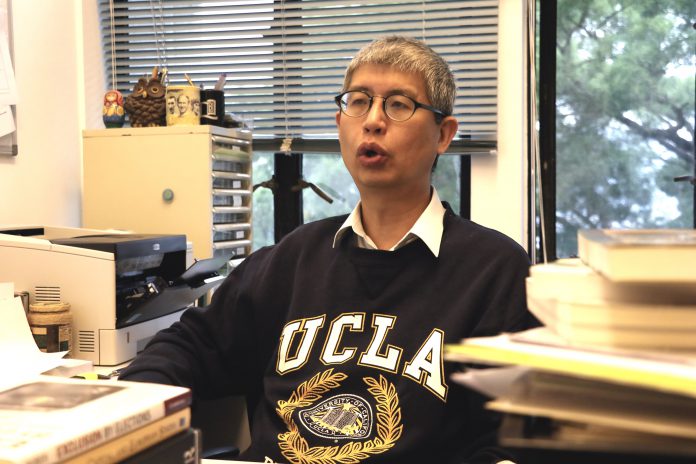
Varsity spoke to Ma Ngok, an associate professor at the Department of Government and Public Administration at the Chinese University of Hong Kong, about his thoughts on Sunday’s by-elections for two seats in the Central and Western District Council.

Peak constituency

Ma predicts the pro-establishment camp has a high chance of  winning the Peak Constituency. He points out that the Peak Constituency is  one of the wealthiest districts in Hong Kong and its voters are senior civil servants or wealthy individuals. Independent candidate Edward Chin Chi-kin was a high profile supporter of the Occupy Central movement, which might make him less popular with this group of voters. Ma thinks this gives the Liberal Party’s Jeremy Young Chit-on the edge in this two-horse race.

Tung Wah constituency

Lui Kam-keung is campaigning as an independent candidate, but Ma believes voters are sensible enough to see that no one is ‘independent’ in this three-way race. Ma says voters can tell which camp a candidate is in by the people who are endorsing them, and in Lui’s case, it is the Democratic Alliance for the Betterment and Progress of Hong Kong (DAB).

“The crux of this election is whether Principal Lui can effectively receive the ‘iron’ votes of the The DAB,” says Ma.

Ma says there have been cases where a party whose incumbent resigned to take up a post in government has lost its seat in the subsequent by-election.

He thinks the fact the Democratic Party has its own base in the district is advantageous to its member Bonnie Ng Hoi-yan. She faces an additional challenge from former Labour Party member Olivia Lau Shu-yin, who was accused of vote-splitting in the previous District Council election. But Ma does not believe Lau will succeed in splitting many votes from Ng.

“I think the voters have enough sense,” Ma says. “Even though she was a Labour Party member, it is useless as there won’t be any pan-democrats endorsing her.”

Ma on the atmosphere and turnout rate

Ma believes that by-elections tend to favour the pro-establishment camp. This is because in a by-election, the pro-establishment side can consolidate its people and resources to secure a seat.

Ma also predicts the turnout rate this year will be slightly higher than in 2015, because both the pan-democrats and the pro-establishment camp have poured more resources into this by-election.

Edited by Jessica Li


Pan-dems’ candidate Bonnie Ng Hoi-yan finds herself under attack from two sides in Tung Wah by-election

By Elaine Ng

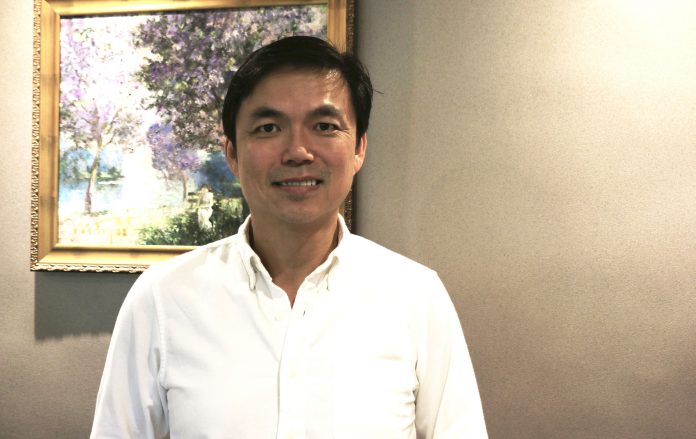
The Democratic Party’s Bonnie Ng Hoi-yan is playing down her chances of winning in the Central and Western District Council by-election for the Tung Wah constituency. Ng says she’s under “attack from both sides” – the two sides being school principal Lui Kam-keung and administrator Olivia Lau Shu-yin.

Ng is the only acknowledged pan-democrat out of the three candidates vying for the seat left vacant by the DAB’s Kathy Siu Ka-yi who was appointed political assistant to the Chief Secretary in August.

Both of her rivals claim to be independents but pan-democrats believe Lui is backed by the pro-establishment camp. As for Lau, she describes herself as a member of the “progressive democratic camp” in her campaign literature, but some pan-democrats suspect she is taking part in the race to ‘split votes’ from Ng. In last year’s District Council Election, Lau is said to have snatched 148 votes from the pan-democratic camp in the Ma Hang Chung Constituency.

Ng did not wish to speculate on Lau’s motives, but she accused Lau and Lui of being “pseudo-independent” and “pseudo-democratic”.

Although the pro-establishment camp won the Tung Wah seat in 2011 and 2015, Ng says she’s confident that voters are aware of her contributions in the largely middle-class Sheung Wan district and of her clear political stance. She adds she is the “only candidate who has promised to serve the community on a full-time basis”.

Ng says that as a senior community development officer for the Democratic Party, she has been involved in District Council affairs over the past 11 years. She is also a co-opted member of the Central and Western District Council Transport and Traffic Committee.  

If elected, Ng says she hopes to review the appropriation and interest declaration systems currently adopted by the District Council so that the use of public funds can be better supervised.

*The other candidates in the by-election, Lui Kam-keung and Olivia Lau Shu-yin declined to be interviewed

Edited by Howard Yang

Edward Chin Chi-kin challenges Liberal Party in the Peak constituency: They are not doing a good job

By Katie Cheng

The Liberal Party has held the Peak constituency of the Central and Western District Council for 18 years. But hedge fund manager Edward Chin Chi-kin is challenging the pro-business party’s candidate Jeremy Young Chit-on in the by-election because he says he believes the Liberal Party cannot inherit the seat forever.

“You cannot go uncontested,” says Chin. “I am not challenging the Liberal Party on purpose, but they are not doing a good job.”

Chin, who is standing as a pro-democratic independent, says some of his friends who live on the Peak are angry that Liberal Party district councillors have still not resolved the neighbourhood’s transport and security problems after so many years. He says he will manage the traffic flow of tour coaches and private cars in the district if he is elected.

“You cannot go uncontested,” says Chin. “I am not challenging the Liberal Party on purpose, but they are not doing a good job.”

There are 5,314 registered voters in the Peak Constituency, and Chin thinks there is more focus on this by-election than there was on the race for this seat during the District Council election two years ago. He also thinks this by-election is significant because it is the first election to be held after the disqualification of the legislative councillors elected in last year’s Legislative Council polls, starting with the Youngspiration duo Yau Wai-ching and Sixtus Leung Chung-hang.

Compared to his rival Jeremy Young, Chin says he has the advantage of being unafraid to tackle political issues. “He (Young) does not dare to comment on some issues, but I think there is no problem in supporting true democracy in Hong Kong,” says Chin. “Does he (Young) dare to say this? That is the difference.”

Chin won’t be drawn on what he thinks his chances of winning are, saying he will just do his best.

Edited by Rubie Fan

Jeremy Young Chit-on: District Council election is not about politics, but who can serve “practically”

By Jennifer Leung

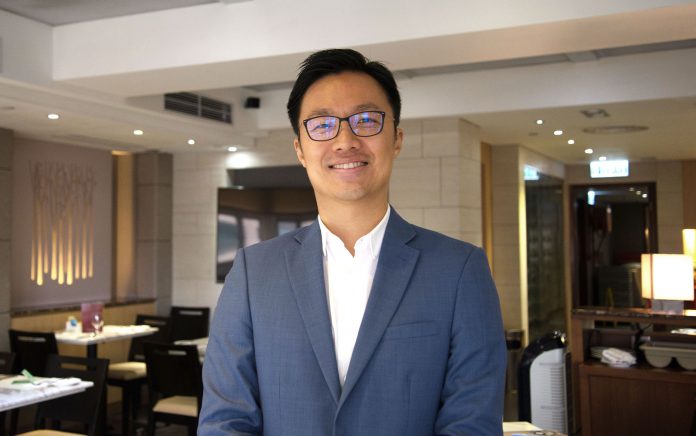
For Jeremy Young Chit-on, the Liberal Party’s candidate in Sunday’s by-election for the Peak constituency Distrcit Council seat, politics is in his blood.

His father is the former Liberal Party legislator Howard Young How-wah, and he started helping his father on his election campaigns from a young age. Young says the older man’s influence was what led him to join the Liberal Party and to serve the community. He joined the government in 2008, working as the political assistant to the Education Secretary until 2012.

As a resident of Pok Fu Lam, Young stood in the 2015 district council election for the Pok Fu Lam constituency, but lost to Paul Zimmerman. He says this loss taught him that to earn residents’ support he had to serve them in a concrete way,  respond to their needs quickly and build networks with them based on a two-way communication.

“I have more confidence in winning, but you’ll never know what happens until the election day,” he says.

In late July, Young was asked by the then incumbent district councillor, the Liberal Party’s Chan Ho-lim, whether he would be interested in standing in the by-election for his seat, as he would be resigning to take up a post as a political assistant.

Young says he grew up in the Peak area and is familiar with local issues. He says he has been working on various issues around the district, especially the traffic problems.

“I have more confidence in winning, but you’ll never know what happens until the election day,”  he says. He adds there are a number of unknown factors that could affect the polls, such as the weather, which could impact the turnout rate.

The pan-democratic camp has thrown all its support behind his rival, Edward Chin Chi-kin, but Young says this election is about choosing somebody who can serve the community practically, rather than choosing a candidate from a particular political camp. He says he is more suitable for the district, given his background and way of working.

Edited by Chloe Kwan

November 2017 – Out of sight, out of mind

A rare spotlight has been shone on prison life lately, a result of so many prominent Hong Kong figures behind bars or facing prison terms. They include a former Chief Executive, a former Chief Secretary for the Administration and one of Hong Kong’s richest men, to prominent activists like Joshua Wong, Nathan Law and Raphael Wong.

In this issue of Periscope, we take a look at some of the lesser heard stories of those who are doing or have done time in Hong Kong’s prisons and detention centres.

Juvenile offenders, defined as those aged between 14 and 21, are speaking out publicly about the abuse they say they suffered at the hands of prison guards. We hear them describe what they see as a broken complaints reporting system.

With more Hong Kong people travelling to, working and living in the Mainland, it’s inevitable that some will run foul of Chinese law. We talk to Hongkongers who have been detained in the Mainland and hear how the Hong Kong government is unable to offer much help.

Hong Kong has the highest ratio of women prisoners as a percentage of the prison population in the world. We talk to former prisoners about the difficulties women, including mothers incarcerated with their children, face in prison.

November 2017 – Editor’s note

Few of us pay much attention to prisons and prisoners. But this year has seen a number of prominent figures put behind bars. Former Chief Executive Donald Tsang Yam-kuen was imprisoned for misconduct in public office in February. In August, student activist Joshua Wong Chi-fung, disqualified lawmaker Nathan Law Kwun-chung and former student leader Alex Chow Yong-kang were sentenced to jail for storming “Civic Square” outside the government headquarters, an event that precipitated 2014’s Occupy Movement. Shortly before that, 13 activists who stormed the Legislative Council in 2014 to protest northeast New Territories development plans were also imprisoned.

The public is curious about what life must be like in jail for all these familiar faces who keep appearing in news photos in prison uniforms. But out of the spotlight, other prisoners live through experiences that few know or care about.

Prisoners are usually labelled as difficult, damaged or even dangerous individuals. Once they are convicted and the cell doors are closed, they are mostly forgotten by the media and the public. Prison life seems distant for most of us – both because we do not see ourselves being imprisoned, and also due to the lack of transparency about the daily lives of inmates. Those doing time are often seen as merely “paying their price” and garner little sympathy.

But behind the bars, there are untold stories and voices unheard. We hear from former prisoners who say their basic rights were violated, we listen to their tales of physical and emotional suffering. But most of all, we hear about how they felt helpless within prison walls, separated from the outside world.

Periscope looks at the problems faced by female prisoners in Hong Kong. Women who have spent time in jail say their basic physiological needs were not met while imprisoned mothers lament the lack of sufficient resources and facilities for the young babies and children living in prisons with them. In Hong Kong, women make up nearly 21 per cent of the prison population, the highest percentage in the world. We talk to lawyers and activists in order to understand why this is the case.

We also talk to Hong Kong people who have been detained or jailed in the Mainland. The Mainland has a very different criminal justice and prison system to Hong Kong, which makes Hong Kong people detained or jailed there feel especially helpless. Detainees and their family members find it hard to get adequate information. Those who spoke to us say the Hong Kong government is of extremely limited help, particularly with legal assistance.

And we hear the stories of juvenile inmates in Hong Kong. Former juvenile offenders have recently stepped forward to share their experiences of being abused and humiliated during their imprisonment. Given their young age, their fear of having their time in custody lengthened and the emotional scars from their treatment, few of them dare to resist. Much of their sense of powerlessness arises from the shortcomings in the current complaint system. Varsity talks to former juvenile prisoners, social workers, legislative councillors and advocates who speak out about how the system fails to protect young inmates’ rights.

In this issue, we also look into the question of whether men can be raped, we learn about how more Koreans are coming to study in Hong Kong’s universities, and we explore the prohibitions on play in Hong Kong’s playgrounds. We hope you enjoy the read!


Fiona Chan
Editor-in-Chief