





Home Blog Page 97

Dressing across Gender Borders

Expressing individuality through cross-dressing

by Jeffery Loa

Beavis Wong Pak-fai
Beavis Wong Pak-fai

A slender lady dressed in a chic navy and red dress sits down elegantly and takes out a mirror. She meticulously applies her lipstick, oblivious to the gaze of passers-by.

“I get used to the gaze. At the very beginning, of course I minded. But now I know that I want to be a woman, I dress like a woman,’’ she says.

This is Beavis Wong Pak-fai, a 34-year-old who was born a biological male but identifies as female. Wong is receiving counselling for Gender Identity Disorder and is considering sex reassignment surgery. In the meantime, she says, “Cross-dressing is a platform for me to try dressing like a lady. I can find myself when looking at mirrors.”

Cross-dressing is the practice of wearing clothes traditionally worn by the opposite sex. Cross-dressers are a sub-group under the transgender family which includes transsexuals as well as those who are comfortable with their biological gender. Strictly speaking, anyone can be a cross-dresser, regardless of their biological sex and sexual orientation.

Living in a city where traditional ideas about gender roles and expectations are deeply entrenched, it is very hard for individuals to break gender norms. For many people, dresses are women’s attire and men should not wear them. But Wong has always been  fascinated by dresses.

Wong recalls that as a child, she used to observe women wearing long dresses in the street. She would cut out appealing photos of women from magazines and arrange them tidily in a folder.

While still at primary school, she started to secretly wear her mother’s dresses, but was disappointed that she only had a few.

In her teens, she saved up pocket money to buy dresses. To keep them a secret from her mother, the young Beavis locked the women’s clothes in a metallic box and placed a bunch of compact discs on top to cover them.

It was not until her twenties that Wong began to cross-dress in public. But the transformation was prolonged and gradual. First, she started off with gender-neutral outfits – from trousers, to shorts with leggings to long dresses.

Because the transformation was gradual, Wong’s mother reacted rather calmly when she learned of the situation. Once, when Wong was in hospital suffering from enterogastritis, she did not have time to hide her women’s clothing. Her mother discovered the stash, and that was when Wong confessed to suffering from Gender Identity Disorder, where one has a strong feeling of identification with the opposite gender.

“She noticed that I’m changing. She wants to know the answer,’’ says Wong. Nowadays, she makes sure she is always well dressed when meeting her mother. She wears dresses with high heels and applies makeup. Her mother even reminds her to not be too sexy.

Apart from her mother, Wong’s colleagues are also unperturbed by the gradual change in her appearance. She sometimes goes to work as an assistant information technology officer in a dress and full makeup.

Although Wong is not directly criticised by her colleagues, she does hear some tittle-tattle about the way she looks. “I don’t care too much. I’m there to perform my job,’’ says Wong.
The Body Politic

Performance Artists use the body and mind to express the soul

by Benny Kung

On the last day of August this year, those who had been hoping for a more open nomination process for choosing candidates in the 2017 Chief Executive election were dealt a severe blow. The National People’s Congress Standing Committee announced a framework that would limit the number of candidates and make it almost impossible for a pan-democrat to get on the ballot paper. Two weeks later, thousands of supporters of the Occupy Central movement took to the streets on a “black cloth” march. The mood was sombre when participants joined together to carry a 500-metre long black cloth but the event did not seem to differ too much from the many protests that take place year-round in the city.

An old man pulled a plastic tube attached to a piece of rope on the “black cloth” march.
A man pulls a plastic tube attached to a piece of rope on the “black cloth” march.

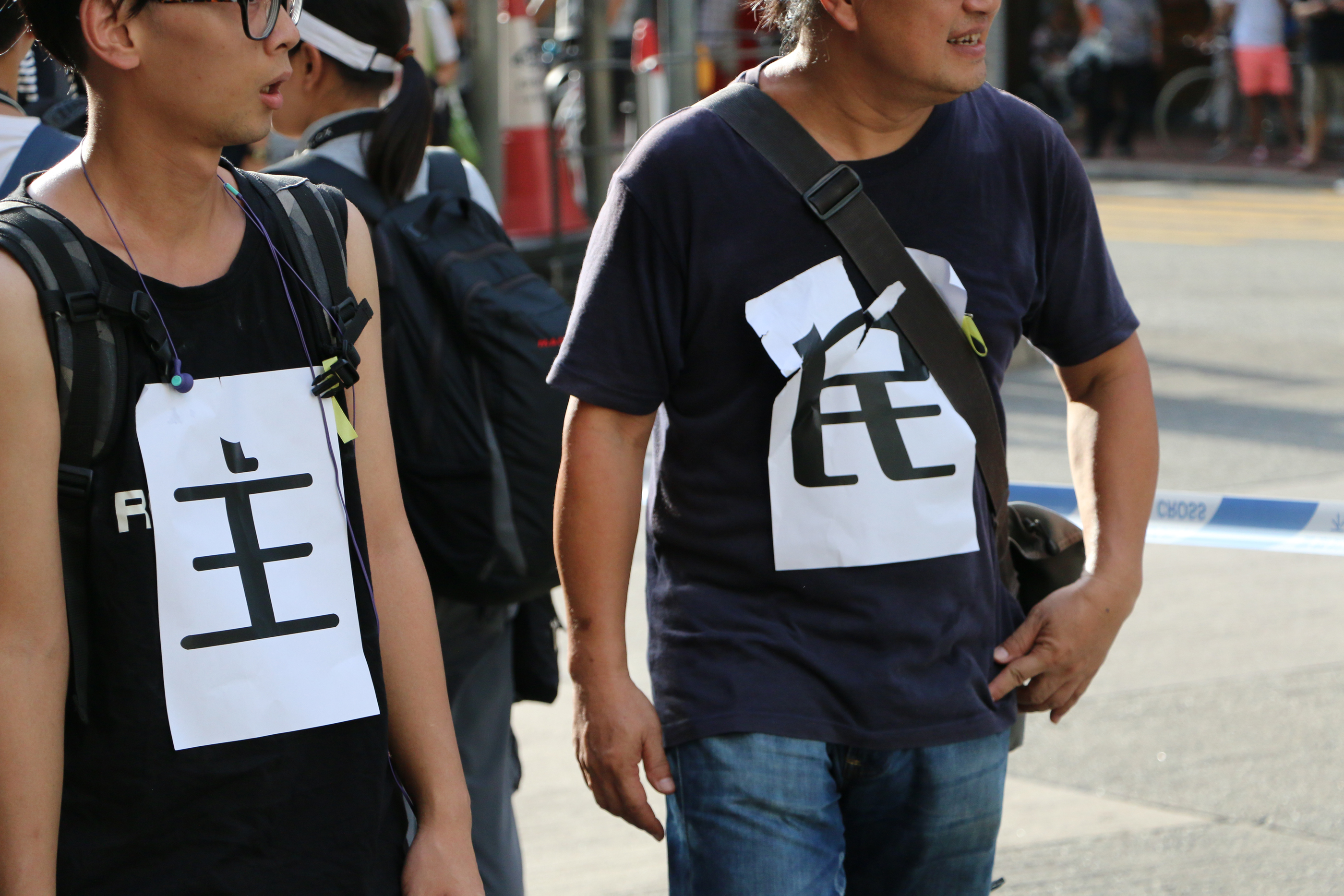
However, at the tail-end of the march, four protesters were walking backwards with Chinese characters stuck on their black clothing to suggest that democracy is regressing. An old man pulled a plastic tube attached to a piece of rope. On the tube were words attributed to Zhang Xiaoming, the head of China’s Liaison Office in Hong Kong, which suggested the central government was already very tolerant of the opposition in Hong Kong.
Other protesters and passersby took notice.  “Oh, that tube is actually a used sewage pipe!” a woman yelled after staring at the tube for a while. Others, showed their appreciation more quietly.

The “happening” was actually a performance art piece.

While some may perceive performance art as a new art form, it has in fact been around since the 1950s. But it was not until the 1970s that it began to be regarded as an independent subject for study.

In 1975, renowned artist “Frog King” Kwok Mang-ho first introduced performance art to Hong Kong as an experimental art form. He splashed the contents of a big black bag of burnt ox bones next to his own award-winning sculpture at an exhibition, then sat down and discussed the ideals of art with his audience. Kwok’s work shocked local artists.

After almost four decades, Hong Kong now has 30 performance artists and the diversity of artwork has expanded accordingly.

Sammu Chen was one of the five artists at the black cloth march.

Sammu Chen, is a 51-year-old construction foreman who has been practising performance art since 1986. He was one of the five artists at the black cloth march. For him, the crucial element behind performance art is the thought behind the action, the thought which makes the artwork unique. “If someone is eating dog excrement on the street, it is not an artwork but abnormal behaviour. Actions without thoughts cannot be regarded as performance art,” Sammu explains.

He describes himself as “a supporter of humanitarianism” and his work is closely related to this theme.

The Pastor of Civic Square

American Bob Kraft is on a mission to “do the right thing”

By Henry Lee

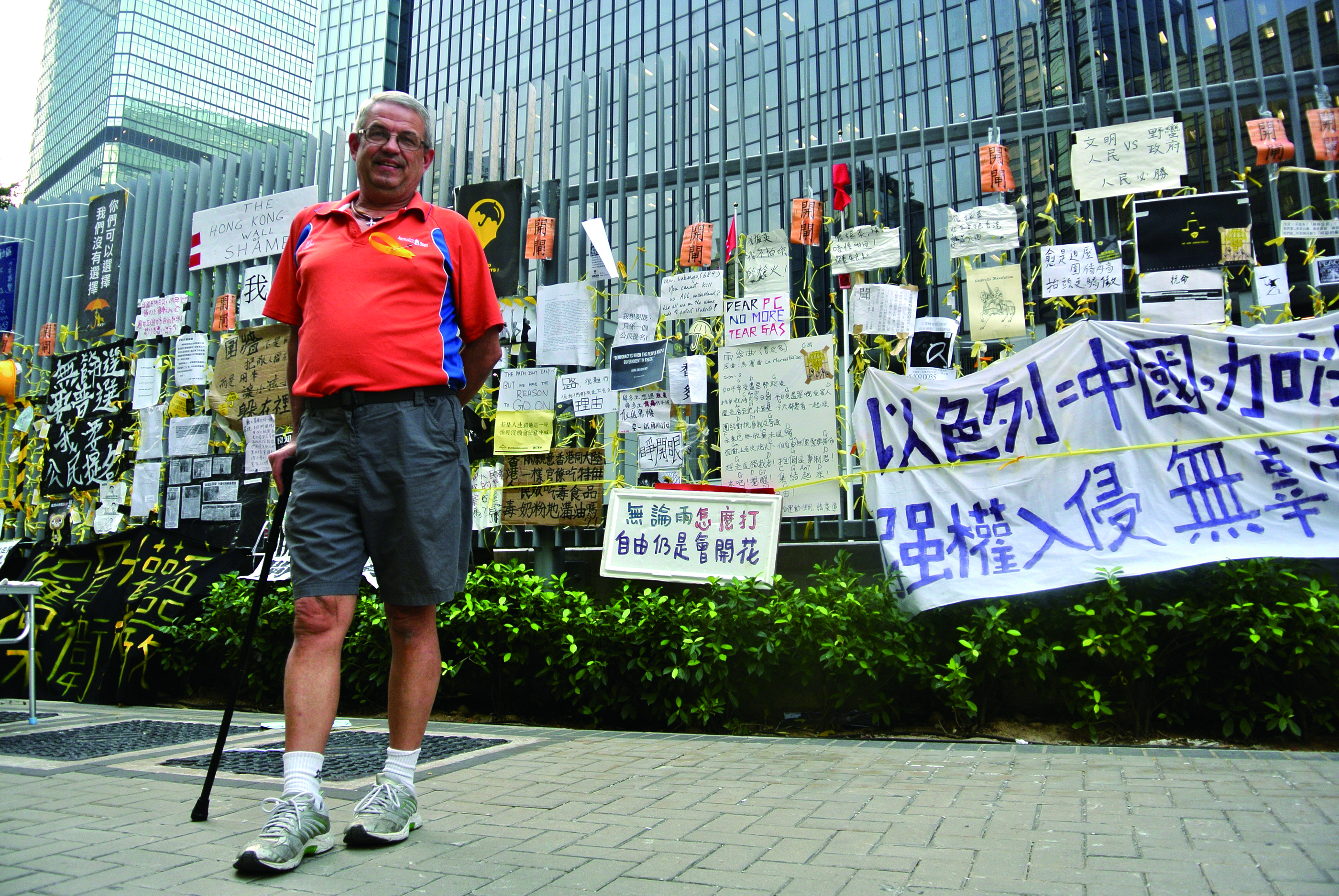
In the scorching sun and pouring rain, protesters taking part in the occupation of Admiralty starting in late September sometimes sat quietly, sometimes sang songs, sometimes conducted heated discussions and sometimes slept. Among them was a silver-haired, 57-year-old American man, sitting on a folding chair and facing the now fenced and heavily guarded forecourt of the Central Government Offices popularly known as Civic Square.

Varsity first met the American, Pastor Bob Kraft, before the Occupy action began. He was setting up a tent and some hand-made banners outside the District Court in Wan Chai. Kraft was there to protest about what he saw as inadequate family rights and child rights in Hong Kong.

bobkraft6

Kraft is always speaking out against injustice in society and is often seen at political events and protests. He undertook a 106-hour hunger strike for family rights and child rights in the summer of 2013; he protested on behalf of the elderly who do not have money to fix their teeth and he went to the “Black Cloth March” organised by Occupy Central to call for genuine   universal suffrage in Hong Kong. His devotion to such causes is driven by his past.

Kraft was a high school student in the United States during the 1960s and 1970s when there were lots of protests against the Vietnam War and racism. He recalls that on his first day of high school, students started a class boycott to demand more student rights. He says this made a big impact on him.

After high school, Kraft says he joined the army and was stationed in West Germany during the Cold War. This experience consolidated for him the idea that freedom could make a difference to people’s lives.

Although he served in the military, Kraft’s great interest was, in fact, in tennis. After he left the army, he worked as a tennis coach and ran a business selling sportswear. All went well for him, but he started to question his life.

“You reach a point when you just say, this is really not the most important thing in a person’s life. You can’t go any further,” says Kraft. “I just turned my life into a direction; that is helping people, instead of helping myself.”

So, in 1986, Kraft sold his business and went to the Pacific and Asia Christian University in Hawaii before embarking on church work in Asia. He travelled to seven nations in Asia, including the Philippines, and was shocked by how the disadvantaged lived there. The experience opened his eyes to inequality and injustice and showed him that where there is injustice, there can be no human rights. Kraft resolved to lead a meaningful life, helping the underprivileged and speaking out against injustice.

In 1992, Kraft settled down in Hong Kong after marrying his Chinese wife. As a pastor, he has to be concerned about the lives of the people in his community. He sees people in Hong Kong facing worsening social problems, such as unfair working conditions, housing problems, poor family relations, and unfavourable government policies. “The anger of the people is about the living standards of people…It’s becoming unbearable for people…They almost can’t sustain their living,” he says.

Dancing on a Tightrope

Lyricist Chan Wing-him stays hopeful and lives life his own way

by Macau Mak

On New Year’s Day this year, while others were making their new year’s resolutions, musicians dressed in glitzy brands attended the Ultimate Song Chart Awards Presentation, waiting to learn how the pop industry’s year-end “report cards” would be distributed. It was a night on which the same familiar faces claimed their designated prizes, until it came to the Best Lyricist Award.

For 18 years, the prize had alternated between Lin Xi and Wyman Wong Wai-man but this year, a young man broke the dominance of the duopoly. To thundering applause, 27-year-old Chan Wing-him stepped up to receive the golden trophy with shaking hands.

Chan has written Chinese lyrics for nine years and worked with stars such as Eason Chan Yik-shun, Hacken Lee Hak-kan and Pakho Chau Pak-ho, to produce notable hits, including Swipe Card (碌卡), Sky Lantern (孔明燈) and My Vow (我的宣言). The prize was like a vindication – Chan was glad he had kept up with lyric writing because he had a track record of easily giving up halfway in childhood and adolescence.

Chan with artist Eason Chan Yik-shun
Chan (right) with singer Eason Chan Yik-shun

In primary school, Chan had a greater interest in mathematics than music and was once a member of the Hong Kong team for the Mathematics Olympiad. However, the mischievous boy was dismissed from the team after being caught sticking joke memos about teachers in the staff room and using school trophies to make a robot. Explaining why this episode ended his interest in maths, Chan says, “When I was small, I was rebellious. [I thought] if you give up on me, I’ll give up on you.”

Upon entering secondary school, Chan developed an interest in singing. Nevertheless, he disliked training in the school choir because it only practised a few songs for competition. “I think using music for competition is the most disgusting thing to do,” says Chan. Instead, he joined the Hong Kong Children’s Choir because it focuses on performance.

Chan’s studies went well until he was in Form Six. That year, he formed a group with his friends and ran for the students’ union election. Despite being the only choice on the ballot paper, they lost due to Chan’s notoriety in the school. Chan says that, at that time, some of his football companions used to bully the younger kids and he was tarred with the same brush. As a result, Chan’s group received a significant number of no confidence votes. He felt ashamed and played truant for nearly two months.

Although he later resumed his studies, he gave up on preparing for the Hong Kong Advanced Level Examination (HKALE). Instead he chose to concentrate on debate training and won the title of Best Debater in a territory-wide competition. Eventually, Chan got disappointing grades in the HKALE.

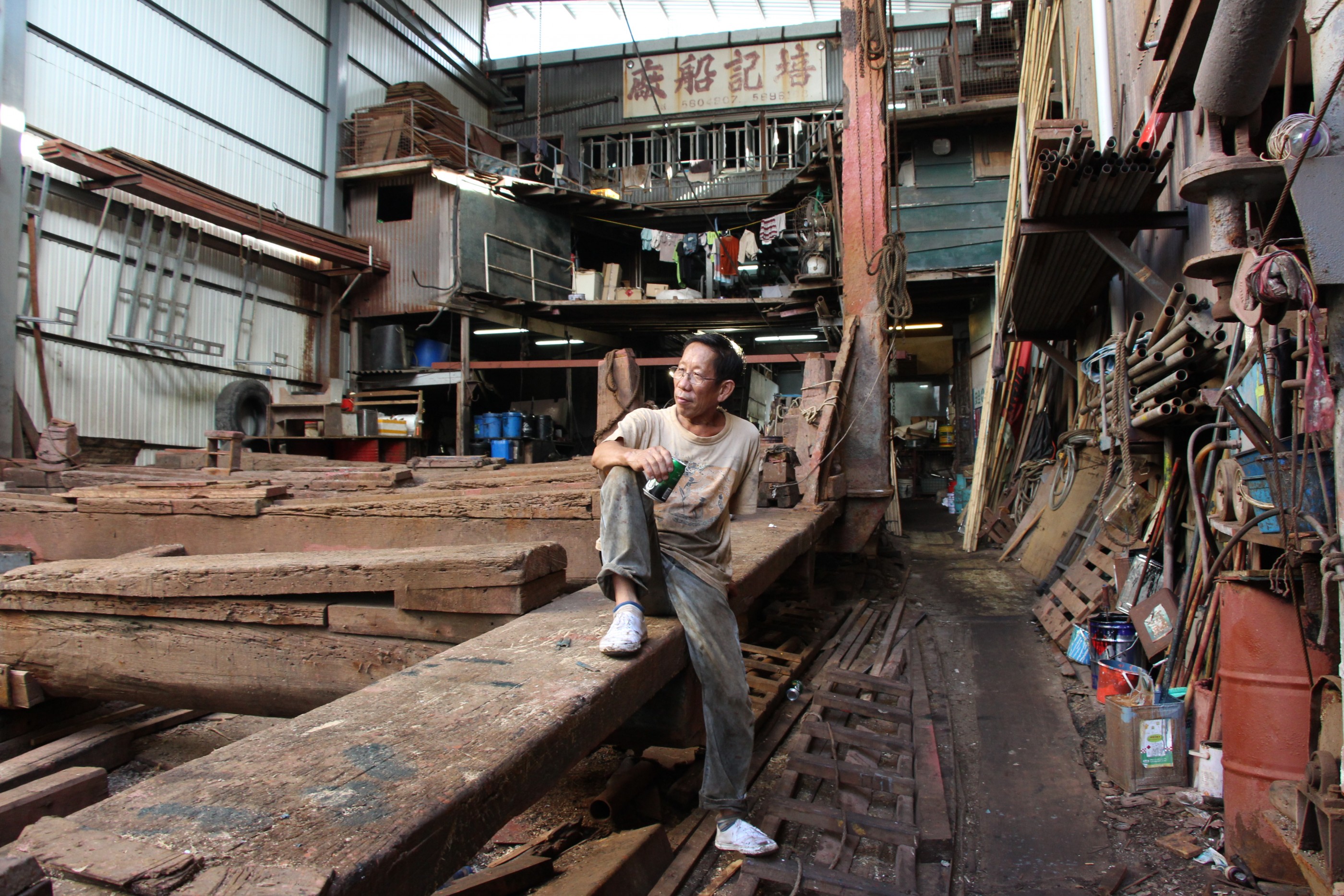
Band of Brothers: Hong Kong’s Last Shipbuilders

Master shipbuilders turn to yacht repairs to revive dying industry

By Vivian Lai, Kanis Leung, Yan Li and Zoe So

Dockyard_FILE_Page_1

Edited by Rachel Cheung

Make An Impression

Make your own greeting cards with letterpress printing

By Vivian Lai

Many people love to send greeting cards to their loved ones on special occasions and during holiday seasons but we all know how difficult it can be to find a personalised card. And without a creative mind or great drawing skills, creating your own can be easier said than done. Fear not, Ditto Ditto, one of the very few local card design studios, can help you.

At Ditto Ditto, you can try your hand at card making with the help of professional artists. Don’t worry if you can’t draw very well because at this workshop, you can create a personalised card using techniques such as letterpress, which makes use of raised letters to create impressions on paper.

If you thought letterpress moulds can only form mundane and repetitive patterns, think again. In fact, there can be a lot of variations in designs produced using this traditional equipment. “They are very sensitive! Different texture, thickness and malleability of the papers or even humidity can affect the outcome.” says Nicole Chan, who founded the company in 2012. “I really like these characteristics rather than considering them as its limitations. These limitations are why I think they’re beautiful!”

OLYMPUS DIGITAL CAMERA

Chan, an art graduate, designs all the cards and calendars in the store herself with the hope of sharing the trivia of our routine daily lives.  The post-80s local artist  worked as graphic designer in a local design company for about five years but failed to find the inspiration for her artwork.  So, with encouragement from her sister, Chan decided to open her own studio and design greetings cards.

Chan applies different techniques in her products, ranging from hand-drawing to offset printing, from silver plating to letterpress printing.  But the one she uses most frequently is letterpress. To show its distinctive features,  Chan designed a collection of cards depicting the Hong Kong landscape, such as morning on the Peak and night in  Aberdeen.  Chan wants to send a message to the world through her detailed sketches – slow down and appreciate the minutiae of daily life.  “Knowing that people are inspired by the effort we put in the artworks is the reason I love handicrafts,” says Chan with a satisfied smile.

Eager to share her enthusiasm for the arts with the public, Chan also co-organises different workshops with other local artists.  “The main purpose of having these workshops is not for money, but for the public to be aware of us and understand more about the skills and beauty of letterpress printing,” she adds.

OLYMPUS DIGITAL CAMERA

Participants can design cards for different purposes in the workshops, but they must correspond to the theme set by Chan and the cost for each workshop is around HK$100.  

If you are interested in joining the workshops or would like to make a customised order, check out Ditto Ditto at 4a, 24 Wong Chuk Hang Road, Aberdeen, or call 3678 9881.  Latest collections and other stationery are also available at Eslite (Causeway Bay) and Kapok (Central PMQ).  For more details, visit www.dittoditto.net.

Edited by Rachel Cheung

Dyeing for the Blues

Try your hand at indigo dyeing

by Yan Li

Max To puts on a pair of latex gloves and dips a twisted cloth into a bucket of blue liquid. After several minutes, he takes it out, carefully removes some pegs and rubber bands and flattens it out. What had been a plain white Tee has now became a unique top with an intricate pattern of various shades of blue.

This magical process is called indigo dyeing – a dyeing method using a genus of plants named Indigofera, together with ingredients such as ash water. You can create all sorts of patterns by dipping various parts of the cloth into the dye and soaking it for varying amounts of time.

While it is a very simple DIY craft, getting the required materials and cleaning up afterwards can be a chore. However, at Indigo 11.50, they are chores you needn’t worry about.

000012

Indigo 11.50 is Hong Kong’s first natural indigo dyeing workshop. Tucked away in Tai Long Wan Village in Lantau, it is a relaxing oasis where you can create your own unique product, be it a shirt, a dress or a tote bag.

Max To, the founder of Indigo 11.50, was a former lighting cameraman. Suffering from severe low-back strain, a common problem among cameramen, To took a long vacation in Taiwan where he learned about traditional indigo dyeing.

After coming back to Hong Kong, To’s passion for indigo dyeing motivated him to open his own workshop. With three like-minded friends, he set up Indigo 11.50 in May.

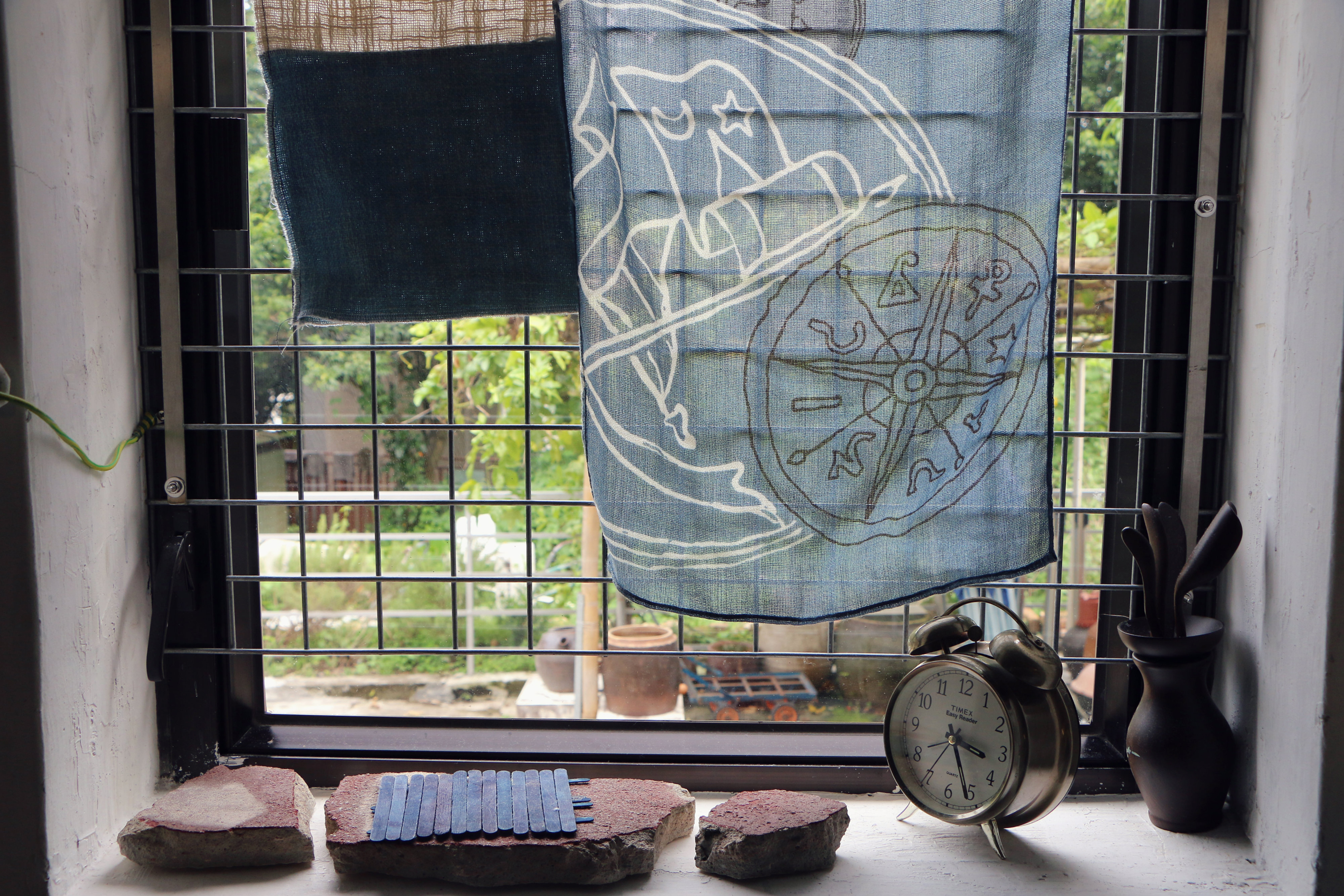
To renovated his deserted family house in Lantau and turned it into a simple workshop. A clothesline runs across the backyard, allowing people to hang their designs as they wait for them to dry. He also takes advantage of the natural environment – using wood ash as an ingredient of the dye and washing fabrics with mountain water.

Opening a dyeing workshop in a remote village seems like a crazy idea in a city that emphasises profit and efficiency. But that is exactly what makes Indigo 11.50 so special. The motto of the workshop is: “Having a wonderful moment is the profit while earning money is extra bonus”.

“The workshop is to promote a kind of attitude towards life or work. You can choose a different path. You should choose a way of working that makes you happy,” To says.

The classes usually last for three to four hours. For HK$250, you can have a shot at indigo dyeing after learning about its history and techniques. If you are interested in needlework, you can take the advanced class that costs HK$300.

Apart from holding classes, Indigo 11.50 also sells handmade and chemical-free indigo products, such as tote bags and shirts. Unlike traditional indigo products that feature fancy and feminine patterns, Indigo 11.50 adopts a minimalist style, emphasizing simple patterns. For more details, please go to Indigo 11.50’s Facebook page at https://www.facebook.com/lantaublue

Edited by Rachel Cheung

The Hong Kong Fatshionistas

Proudly pursuing fashion to flatter the fuller figure

Reporters: Grace Cheung, Sherry Tsui, Brian Wong

Editor: Natalie Tsoi

Hong Kong may be acclaimed as a hub for international fashion brands. But the glamorous showcases of luxury boutiques and coveted clothing created by top-notch designers hide an inconvenient truth: here, fashion is for the thin.

Wearing a white top and a pair of black Gallus short trousers, Bertha Chan exudes style. To put together her fashion-forward looks, Chan buys her clothes online from overseas labels to satisfy her taste. She does so not because she could not find styles she likes locally, but simply because of her size.

Chan writes a fashion blog Curvasian to share her findings and comments on new fashion designs. “Because I’m Asian, and I’m curvy,” she says.

Fashion for the fuller figure is often referred to as ‘plus-size fashion’. “Plus-size fashion is to differentiate the sizes from what we call straight size, which is from US size 0-12,” says Chan. “Especially high fashion, they stop at size 12 and they don’t go up anymore because some fashion designers tend to think that it’s actually ruining their brand image.”

Boudoir photographer Agnes Chan also finds it difficult to buy larger sized, fashionable clothes. She meets Varsity dressed in a body-clinging leopard print dress which is unavailable through ordinary channels. Despite the trouble of sourcing clothes to her taste, she refuses to adopt the conservative approach. “Is it a must for fat people to wear loose, multi-layered clothes, covering the tummy or legs with a jacket even at over 20°C?”

“It is normal to be slim in Hong Kong, but having more muscles would be abnormal,” she adds.

In a town where it seems everyone is aspiring to be thin, fashion designers tend to create clothes for slim figures. Local designer Esther Lui says this is inevitable as designers tend to choose slimmer models for what they believe to be a better visual effect. “People appear fatter through the lens, no matter how slim you are,” says Lui, “for designers, they would of course choose a slimmer model so as to balance the resulting visuals.”

Pacino Wan, lecturer of the Department of Fashion and Image Design, Hong Kong Design Institute, says Asians are more likely to pursue slim figures, as they are inherently smaller in body size. However, he thinks larger-sized people should also express themselves through fashion. “Sometimes I hear from stylists that larger-sized people should avoid wearing bright and floral clothes,” Wan says, “but I would encourage them to try out different clothes. If not, how could you wear fashionable clothes?”

“Fashion boosts self-confidence. It also gives you vitality for the whole day.”

Farming without Soil

Hydroponics, an alternative way for local agriculture

Reporters: Henry Lee, Zoe So, Kanis Leung

Editor: Yoyo Chan


Loosening the soil, seeding, daily irrigation and harvesting – these are the inevitable stages in the farming process with which we are familiar. But the introduction of hydroponics and aquaponics, in which plants are grown in water without soil, take a lot of the toil out of the first two stages.

Hydroponics was introduced to Hong Kong since 1980s, but it has not become popular until Vegetable Marketing Organization started up a Controlled Environment Hydroponic Research and Development Centre in Cheung Sha Wan in 2012. The 2,500 square feet government-funded centre now produces around 3.5% of Hong Kong’s agricultural industry, together with other local farmers.

Using Japanese technology with 24/7 computer monitoring cost nine millions to start up. The computer system creates microclimate for the plants, controlling the amount of nutrients, levels of carbon dioxide and the temperature, involving very less human labour like traditional farming, thus it is comparatively much more expensive for the renovation of the site and the high technology. This indoor approach also allows vertical farming which produces more vegetables than traditional.

Instead of following the Japanese approach where the government is trying to promote, Janet Chan Yuet-kwai took references from other countries and set up a simpler model by buying tools from Amazing Green , a company promoting hydroponics. Covering 10,000 square feet, Chan’s site costs around HKD 250,000 to set up thousand dollars, but it involves more human efforts than computer monitoring method to take care of the vegetables.

Amazing Green’s publicist, Kit Lau thinks that hydroponics is more a more suitable farming method for Hong Kong because it saves space and is something citizens can try at home. Lau says there is 70 per cent less water loss than in conventional farming, and saves on the labour required for ploughing and irrigation.

However, Simon Chau Siu-cheung, founder of the environmental group Green Power has doubts about the quality of hydroponic products, because natural nutrients in the soil cannot be easily substituted by mineral nutrients, which are chemical rather than organic. “The risk of using this new technology, we still don’t know,” he says.

Aquaponics, a combination of raising fish and hydroponics, attempts to address these concerns. The system is more organic as vegetables absorb natural nutrients from fish waste in the water.

Whether or not hydroponics and aquaponics can be a viable and safe alternative to traditional farming on a larger scale remains to be seen. But as a way for the elderly, disabled and city dwellers in urban apartments to get involved in growing their own food, the potential is undeniable.

infographics

infographics (2)

Demolition of carparks to cause more congestion in Central and Tsim Sha Tsui

Reporters: John Cheng, Tracy Cheung, Vivian Lai, Jeffrey Loa

Editor: Emily Chung

In December 2013, the Executive Council passed a proposal to redevelop Tsim Sha Tsui’s Middle Road Multi-Storey Car Park for commercial use. The carpark has around 800 parking spaces for private cars and motorbikes. But according to the latest statistics from the Transport Department, the average daily utilisation rate of Middle Road Car Park is only 37 per cent. The low utilisation rate is one of the reasons given by the government to redevelop the land.

However, a random visit to the carpark during peak hours showed it was completely full and both Wilson Parking, which operates the carpark and the Town Planning Board, refused to provide a more detailed breakdown of the usage rates.

Hung Wing-tat, Associate Professor of the Department of Civil and Structural Engineering of The Hong Kong Polytechnic University says the average daily utilisation rate measures the overall 24-hour daily parking situation and fails to address usage at any particular hour.

Apart from Middle Road Carpark, the government also announced plans to redevelop Murray Road Carpark in Central and the Rumsey Street Carpark in Sheung Wan to increase land supply for commercial and business use in Central and Wan Chai, in this year’s Policy Address.

Hui Chi-fung, Vice-Chairman of Traffic & Transport Committee of Central and Western District Council warns the demolition of these two carparks will worsen the already bad situation of unauthorised on-street parking in the district and lead to more congestion.

Rumsey Street Carpark offers 822 parking spaces for private cars, while Murray Road Carpark provides 388 spaces. The redevelopment of the two largest carparks in Central and Sheung Wan will drastically cut the number of parking spaces in the district.

The price of parking is another concern for the drivers, as private carparks nearby charge between HKD 5 and HKD 25 more per hour than Rumsey Street Carpark.

Hui stresses the government has ensure the Rumsey Street and Murray Road sites’ developers will comply with requirements to provide enough parking spaces. But in the long term, he believes the government must implement an Electronic Road Pricing System to ease traffic congestion in central business districts.