










Home Blog Page 110

Down and Out in Sham Shui Po

How the street sleepers find their place on the street
By Rene Lam and Nicole Chan

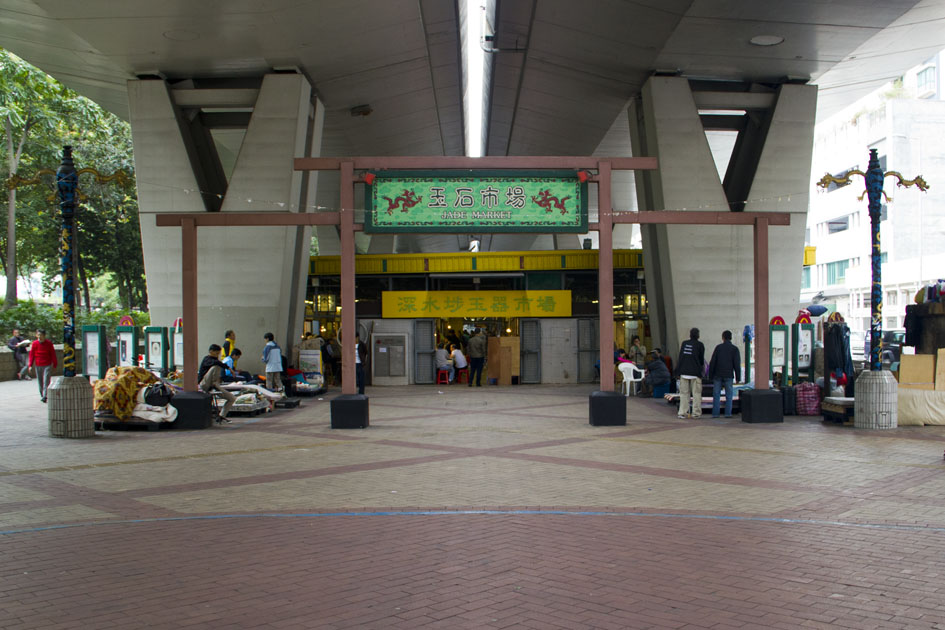
Right on cue, there is a “pop” sound and the floodlight switches off. This means it is 8 p.m. The scent of brewing Vietnamese tea mingles with the stench from the rubbish station and the smog from West Kowloon Corridor overhead hangs in the air. A group of homeless people chitchat, gamble and unwind after another tough day.

This scene plays out every day in front of the Jade Market in Sham Shui Po. It is less than a home but at least it is a refuge to a community of street-sleepers.

The area became a hub for street people in the early 2000s after their previous spots in Yau Ma Tei and Mongkok were cleared for redevelopment.

Street sleepers in Hong Kong can be generally divided into three categories, people with mental health problems, drug users, and the jobless elderly. Their family members have abandoned them for various reasons and with no other alternatives, sleeping on the street is their last resort. The majority are men who mainly fall into the first two categories but there is also a community of Vietnamese former asylum-seekers.

“For some, Hong Kong is a blessed place,” says Fung, a street sleeper in his 50s. Looking out from the footbridge he sleeps on, Olympic City and the new and fancy West Kowloon residential developments are just a stone’s throw away.

When Varsity visited him, Fung had been sleeping there for one week. Before he settled on the street, he used to rent a sub-divided unit in Sham Shui Po. He recalls that the space was the size of a single bed. The fleas and the odour due to high humidity and poor ventilation made it unbearable to stay any longer.

Life is simple. During the daytime, street sleepers stroll around to find their friends, go to the library to read newspapers and listen to groups of the elderly singing in the park – Chinese opera on weekdays and old pop songs at weekends. They usually stay within walking distance as they cannot afford public transport.

But life is not completely free on the streets. There are certain hidden rules Fung feels obliged to follow. For instance, street sleepers usually put their important personal belongings on or near to their mattress. Everyone’s mattress marks their own “territory”. He explains he never sits on others’ mattresses, for fear of being accused of thievery. Also, he only sleeps beside someone he knows.

“This is not a hotel. You cannot sleep wherever you want,” he says.

Choi Yuen Villagers’ Brave New World

Shared memories and old ties help Choi Yuen villagers find ways to build their new home
by Kris Lee And Caleb Ho

Many people in Hong Kong dream of a good salary and a comfortable flat in the city. These are among the goals that drive them as they commute to work every morning.

No doubt, the residents of Tin Shui Wai in the northern New Territories share similar ambitions as they rush to offices in Kowloon and Hong Kong. Not so Fancy Fung Yu-chuk who farms 30,000 square feet of land in Pat Heung, Yuen Long and follows the time-honoured cycle: plough, sow, water, weed, feed and harvest. Then she delivers the produce to customers by bike.

Fung was born and grew up in Choi Yuen Village, which was demolished in May last year to make way for the Hong Kong section of the Guangzhou-Shenzhen-Hong Kong Express Rail Link. Some 500 people in 150 households were forced to move despite staunch protests.

Some of them decided to build a new Choi Yuen Village and since May last year, they have been creating an organic farm on rented land near the site of the new village. The farm, which they have named Pioneer Field, is jointly owned by some of these villagers and a few non-villagers.

Fung’s home may be gone, but her attachment to the old village, to the land and to the people, has not diminished.

“Shek Kong Airfield and Shek Kong Military Field used to be our playground. We let our cattle out to pasture there and ran around with bare feet. This is what differentiates us from children who grew up in the city, they never had these experiences,” Fung says.

Although she has moved to Tin Shui Wai, she still comes to the new village to farm and to see her old friends and neighbours. “My homeland has been demolished now, where else could I go?”

Hong Kong Rainbow Families

Race no barrier to family ties in interracial adoptions

By Vivian Ng

A white mother is holding the hand of a little Chinese girl on the street. They talk to each other just as any mother and daughter would but you soon notice that passers-by may stare at them for a moment. Some seem suspicious, even annoyed, while others may give them a wide, cheerful smile.

According to Victoria Woodyatt, this is exactly what she and her daughter Jessica have experienced in the past. The seemingly disapproving stares come from those that disagree with interracial adoption. They question whether it can replace the blood link between mother and daughter and the cultural links between members of the same ethnic group whereas the friendly looks come from those who appear to support it.

There are usually around 100 adoptions in Hong Kong every year and according to the group, Mother’s Choice, around a third of these are interracial adoptions.

The Social Welfare Department has accredited three non-governmental organisations to work with its Adoption Unit, namely the International Social Service Hong Kong Branch (ISSHK), Mother’s Choice and Po Leung Kuk. These organisations arrange and process the adoptions.

Under the government’s adoption programme, priority is given to matching children with families of the same cultural or ethnic background to minimize the cultural changes and the child’s adjustment problems. Single people also have the chance to adopt, but they, together with the non-ethnic Chinese families, are usually at the bottom of the list.

People who want to adopt a child can go to any of the four approved units to start their applications. They have to provide comprehensive details about their family background, income, education and adoption motivations in their application form and provide supporting documents.

After being informed of any new cases of children given up for adoption, the Adoption Unit will discuss placing the children with suitable families with the NGO’s. Social workers will then let qualified applicants have some basic information about the children they are being offered and let them decide whether they want to go ahead.

If the applicants decide they would like to adopt the child, social workers will conduct a home study to assess the family’s readiness and suitability for the child. It takes between six months and two years to process the applications, depending on how quickly the applicants can provide all the required documents.

The adoption cases will then be referred to the Court after six months. Once the Court grants an Adoption Order to the families, follow-up work from the social workers ends.

Safeguarding Personal Data

Consumers combat cold-callers as law strengthens privacy protection

By Viola Yeh & Yannie Mak

There can be few adults in Hong Kong who have not received unwanted direct marketing ads in their letter boxes and email inboxes, or received cold calls from companies they have never heard of, selling services they are not interested in. Often, we wonder how they got our addresses and phone numbers.

Concern over personal data reached new heights in 2010 when, after months of denial, Octopus Cards Limited finally admitted it had sold the personal data of two million Octopus Card holders to third parties, for a total of more than HK$44 million. This information included their names, telephone numbers, gender, identity card numbers and even Octopus Card purchase histories.

In the wake of the fiasco, the Privacy Commissioner on Personal Data (PCPD) issued a set of guidelines on direct marketing practices. But they were just that, guidelines lacking teeth. Those teeth have now finally arrived after the Legislative Council passed a set of amendments in July that will tighten restrictions on the use and transfer of personal data, impose strict regulations on direct marketing, introduce heftier fines for violations and make it easier for consumers to take legal action against those who misuse their personal information.

The amended ordinance creates a new offence of disclosure of personal data obtained without consent. Data users – organisations that collect data from customers and other individuals – are required to notify consumers about what their information will be used for and get their written consent before it can be used for direct marketing. Likewise, if the user wishes to transfer that data to any third party for other marketing uses.

If the data user discloses any personal data obtained without a person’s consent in order to gain benefit, they face a maximum fine of HK$1 million and a five-year jail term.

The changes also mean the PCPD will have greater powers to enforce the provisions and provide legal assistance to people whose data has been misused. This means people can pursue compensation claims without being deterred by enormous legal costs or necessarily going to court. The first phase of the ordinance came into effect in October, and the other provisions that include those related to direct marketing are expected to be implemented early next year.

A spokesman for the PCPD said the amendments were necessary because, “the collection and use of personal data in this era of ‘big data’ can create great economic and societal value. But they also pose immense risks to privacy and raise serious concerns about the protection of personal data.”

Cultural Crossover in Yau Ma Tei

Neighbourhood fusion of arts, culture and community

By Thee Lui

Yau Ma Tei is a familiar place to Hong Kong’s art and culture addicts. They can catch an arthouse movie at the Broadway Cinematheque and browse through the books and magazines at the Kubrick bookstore next door while taking in the aroma of freshly brewed coffee. Afterwards, they might want to attend a talk given by post-80s activists at one of the spaces run by local cultural groups.

Meanwhile, some construction workers, who have just finished work sit on the edge of the flower boxes outside the cinema and drink a can of beer or two. The historical Wholesale Fruit Market is a stone’s throw away and next to it and you may find food stalls selling cheap yet delicious beef brisket noodles.

Hemmed between the tourist spots of Jordan and the neon retail paradise of Mong Kok, Yau Ma Tei retains its traditional shops, trades and artisans. In recent years, the area has also seen the arrival of local artists, designers and cultural workers. They are drawn by the sense of community, authentic Hong Kong culture and relatively cheap rents.

The incomers include people like Simon Go Man-ching, founder of HULU Culture, a non-profit organisation dedicated to promoting local arts and culture. Go says today’s Yau Ma Tei is a fascinating fusion of traditional arts, grassroots culture, and a strong sense of neighbourhood.

“Yau Ma Tei still retains many distinctive community cultures and neighbourhood features that were prevalent during the 1960s and 1970s,” he says.

Although he was not a Yau Ma Tei resident, Go spent a lot of time hanging around in the district during his student days. He is impressed by the street culture and especially by the close, neighbourly bonds people there enjoy.

“I always chat with the neighbours. It feels like we have known each other for so long. The old people here are eager to share their experience with me. I appreciate their belongingness and gratefulness about where they live,” Go says.

Go was able to showcase Yau Ma Tei’s unique character when HULU Culture won funding from the West Kowloon Cultural District Authority and the Arts Development Council (ADC) to organise the six-month “Yau Ma Tei Cultural Celebration Project”. The project aimed to encourage active community participation through a series of community arts projects, exhibitions and performance activities. Although the Celebration Project ended in January, HULU Culture still organises heritage tours that take visitors to local sights such as Tin Hau Temple, the Wholesale Fruit Market and the Red Brick Building.

HULU Culture is not the only cultural group to make a base in Yau Ma Tei. In recent years, a number of young cultural enthusiasts have quietly moved into the neighbourhood. Woofer Ten was one of the first. It moved into a space in Shanghai Street provided by the ADC in 2009.

Collecting Childhood Memories

Toys are not only meant for children 

By Jennifer Lam

The walls are lined with glass cabinets packed with popular Japanese cartoon characters from the 1970s. Figures of the Transformer Mazinger, the lovable robot Robocon and the pigtailed candy mascot Peko Chan sit neatly on display in this local toy shop tucked away in a corner of a shopping centre in Wan Chai.

Ben Cheng Chun-nam is one of the employees at Waikukok which specialises in vintage toys imported from Japan. Cheng, who is 40, started collecting toys when he was in primary school and developed a passion for making models early on. He says building toy models brings the unique satisfaction of making things from scratch. He recalls that when he was in primary six he would walk to school in order to save money to buy toy models.

He once spent three whole days on building a Gundam model from the popular Japanese animation series featuring giant robots. Cheng says what he enjoys is the all-encompassing process of building toys. “You stay up all night to build the toy model and won’t even think of anything else,” he says with a satisfied smile.

Before working in Waikukok, Cheng used to run a restaurant. At that time he was a regular customer at the shop and would often work there for free in his spare time. Two years ago, he decided to quit the restaurant and work full time in Waikukok. “I love working in this particular industry; I love toys,” says Cheng.

Ironically, now that he has given his working life over to toys, he can no longer collect them. Cheng says there is a hidden rule in the toy retailing industry that retailers are not allowed to collect vintage toys, so there will be enough toys for customers to buy. “If we all keep collecting toys then there would be nothing for sale!” Cheng laughs. Nevertheless, he says he does not mind sharing the toys with customers because it is good for the trade overall.

Cheng admits collecting vintage toys can be an expensive hobby. He says he used to spend over HK$10,000 every month on buying toys and some customers of Waikukok spend as much as HK$80,000 to HK$100,000 a month on collecting toys. Cheng says vintage toys like robot models are not just pieces of plastic, but are channels through which people can relive their childhood memories, and that is simply priceless.

While Waikukok mainly sells vintage toys imported from Japan, some local toy collectors are enthusiastic about collecting old toys that were made or designed in Hong Kong.

Santa Mario’s Magic Kingdom

Mario Ko – the local magician who won third place in an international Santa Claus competition
By Vicki Yuen

Wearing a red costume, black boots and small-round glasses, the man with rouged cheeks, white beard and a big belly is dancing frenetically in a video, turning the viral Korean pop rap hit “Gangnam Style” into a promotion for the 2012 Santa Claus Winter Games. He is Marco Ko Tim-yu, who as Santa Mario, was the second runner-up in the 8th Santa Claus Winter Games in 2011.

A Hong Kong representative has competed in the Santa Claus Winter Games, held in Sweden, every year since 2007. The event was founded in 2003 by a retired Santa Claus, Santa Svensson in Gellivare, a small town in Sweden. The aim is to gather Santas from all corners of the globe and to test their physical skills.

The tasks can include riding on an electric rodeo bull, running around a massive candy cane, eating a traditional Swedish Christmas meal of porridge, kicking Christmas presents and competing in a sack race.

In order to better prepare himself for the games, Ko practised by running around a massive candy cane for a whole afternoon, training himself to finish the task within 15 seconds. But there were two tasks Ko could not practise for because they were kept confidential until the day of the competition.

Riding on the electric rodeo bull was one of the unexpected tasks. It required contestants to grab the bull tightly to stay on while it bucked back and forth and side to side. Ko managed to stay on for 25 seconds but found this task the most difficult and physically demanding.

Behind the Santa Claus costume and rodeo heroics, Ko is a magician who loves to perform in a humorous and playful way. He sometimes wears a Mario Brothers costume to attract his audience’s attention. With his mop of curly hair, and his slim frame, Ko who claims to have forgotten his age, appears to be a young man in his thirties. He is hardly anyone’s idea of what Santa Claus should look like.

It was his sense of playfulness that attracted Ko to the Santa Claus Games, an experience he believed would be amazing and unforgettable. He shows Varsity his prizes from the games – a bronze medal, a wooden sceptre and a red cape and says the Santa Claus Winter Games were not about victory or defeat. It was about spreading love and care. He did not care about winning the games, but treasures the interaction with the participants from other countries and the experience of being a Santa Claus in Sweden.

Stand by Our Gays

Mr Gay Hong Kong 2012 Benjie Caraig vows to support local community
By Matthew Leung

To the beat of the music and the endless cheers from the audience, five muscular young men walk confidently on stage and introduce themselves one by one. They are taking part in a beauty pageant with a difference. In addition to sculpted bodies, great personalities and the desire to make the world a better place, the contestants in this beauty pageant are proud to be gay and parading in the Grand Finale of Mr Gay Hong Kong 2012.

The man taking home the title on the night is Benjie Caraig, a 30-year-old fitness and dance instructor who came to Hong Kong from the Philippines almost seven years ago. With his tanned complexion, muscular build and sunny smile, Caraig lives up to the image of a pageant winner. But there is more to him than a pretty face.

Caraig has a passion for contributing to the local gay community, a passion he attributes to his strong connection to Hong Kong. He first came here to work as a parade performer at Disneyland, a job he did for five years. He says they were the most unforgettable years of his life and the experience shaped the person he is today.

“I’ve learnt to be independent, strong, brave, creative and to always be happy, trust my instincts and stand for what I believe is true,” Caraig says.

For Caraig, Hong Kong is “the place to be”, a place full of opportunities which has given him the chance to explore himself. But his mind is also never far away from the Philippines because that is where his parents are.

Today Caraig is very close to his parents and sisters but he remembers a time when he became a self-imposed “outcast”. Caraig says he first realised he was gay at the age of 18 and after that he isolated himself from the family, fearing they would find out.

Caraig was raised in a devout Catholic family. When he was in the Philippines, his family, including himself and his three sisters, took part in voluntary church work to help people with drug and alcohol abuse problems. Even today, he adheres to his mother’s teaching that he should put God first in everything he does. It is a message he takes to heart and he says he is grateful about everything he owns today, including the title of Mr Gay Hong Kong 2012. “When they announced the winner, I just shouted, looked up and said ‘Thank You Lord’,” he says.

Looking back on his childhood, Caraig recalls his parents would tell him how to live his life properly almost every day. But he says he was a rebellious kid who never listened to their advice. “I always ignored their opinions about me and their advice. I thought I can live my life on my own,” he says.

Caraig’s decision to come to Hong Kong to pursue dancing as a career was a turning point for both himself and his family. That same year, his sisters moved to New Zealand and the family was split into three. It was after this that he finally realised family was the most important thing and everything his parents had told him was true.

Gift of the Gag

Hong Kong entrepreneur Ray Chan profits from online laughs
By Astina Ng

The cramped Home Ownership Scheme flat would not strike anyone as being the base of a successful internet company that has attracted backing from venture capitalists in Silicon Valley. Almost every surface in this home-office is covered with books, papers, cardboard boxes, family photos and framed words of encouragement. Electric cables, extension cords and plugs complete the “look”.

The brains behind the business, Ray Chan Chin-ching looks similarly unremarkable. Dressed casually in a T-shirt, shorts and flip-flops, he greets Varsity with sleepy eyes and an easy-going manner. He could be any boyish 28-year-old Hong Konger – except he is the founder of, 9GAG, which describes itself as the world’s largest and fastest growing online comedy community.

The name 9GAG takes its inspiration from the Cantonese pronunciation of “making jokes” and the site features jokes, memes and comics submitted by users. Since its launch in 2008, Chan says 9GAG has grown to more than 70 million unique visitors and more than a billion page views per month.

However, Ray Chan has not allowed success to turn his head. “9GAG is not very successful. It is just a good start,” says Chan who constantly makes such remarks during the interview.

Chan manages the feat of coming over as both confident and assured and modest and down-to-earth. This may be in large part due to his family background. One of three siblings in a family from the grassroots, he was taught to be self-sufficient and never be a parasite on society. He and his brother even made an agreement with their parents that they would start to earn their keep once they turned 15.

Chan landed his first job as a kitchen hand in a branch of the Fairwood chain of fast-food restaurants when he was in form three of secondary school. He has also worked as a summer librarian and done tutoring jobs to help the family make ends meet. He believes these early work experiences helped him understand how hard it is to make a living.

“Dad and mum want my brother and I to be men with their feet on the ground,” he says.

Although he has always been a driven young man, his ideas about what he wanted to do with his life have changed over time. When he was a secondary student, he was determined to become a barrister.

He scored good enough grades to qualify for university entrance a year earlier through the Early Admissions Scheme. But he forfeited the chance because his HKCEE results did not meet the admissions requirement of the Faculty of Law of The University of Hong Kong. Instead he went on to take A-levels and managed to get into his faculty of choice.

Getting onto his dream course at his dream faculty was one thing, but managing to excel once he got there was another. Chan threw himself into extra-curricular activities, becoming leader of the Chinese debate team and an active participant in hall life. He found it difficult to juggle academic study and extra-curricular activities and ended up skipping classes, believing he was smart enough to cope with the exams. He now regrets this.

“Being smart does not mean that you do not have to study. Even an open-book examination killed me, as I was not prepared at all,” he says.

Chan ended up with a lower second which meant he could not enroll in the examination for the Postgraduate Certificate in Laws (PCLL). His hopes of becoming a barrister were dashed.

Saying Goodbye to Lung Mei

Text and photo: Derek Li & Nectar Gan

Public seizes last chance to view diverse and abundant marine life as government presses ahead with fake beach plan