Home Blog Page 109

Plant a Pencil

Turn your used pencil stubs into beautiful and edible plants

By Louie Cheng

Have you ever experienced the situation where your pencil has been sharpened to only a thumb’s length, and you have no choice but to throw it away? Now, an innovative design called “Sprout” may help relieve your guilt over wasting those pencil stubs. By scrapping the eraser and replacing it with a seed, rubbish bins are no longer the only destination for old pencils. Instead, they can grow into something beautiful, delicious and fun.

At first glance, Sprout is just another wooden pencil. However, once it becomes too short to hold after many times of sharpening, don’t throw it in the bin. First find yourself a pot of soil and gently press the top of the pencil down. The line painted on the pencil indicates how deep it should go in the soil. And then, just take care of it as you would any other plant: water it daily and expose it to sufficient sunlight.

The seed in Sprout is embedded in a water-activated capsule. After several waterings, the protective capsule will dissolve and the seed will start sprouting. With proper care, the once useless pencil stub will eventually grow into a plant that brightens up your office or garnishes your salad.

The wooden pencil shaft can be removed after the plantlet’s sprouts. But you can also keep it as a labelled planting marker if you like.

There are currently 22 different seeds available, including flowers such as marigolds and forget-me-nots, vegetables such as radish, tomato and eggplant, and herbs such as mint, rosemary, thyme and parsley.

To increase the chance of germination, at least two seeds of the plant of the user’s choice are placed in each capsule. Most of them will sprout in around a week.

However, the water-activated capsule cannot distinguish between intentional irrigation and accidental spills. Whenever the pencil tip gets wet, the capsule will start dissolving and the seeds will be ready to sprout. Therefore, if you spill your coffee over your pencil, you may have to get planting although the pencil may still be long enough to write.

So what about the pencil chewers? If you do not want your seed capsule to activate and dissolve in your mouth, maybe it is time to break the habit.

Sprout is now available for online ordering. A single basil Sprout pencil costs HK$40. Different sized packages with a variety of seeds combinations are offered with discounts. The detailed planting instructions for each type of seed can be found on the website. If you are interested, visit http://democratech.us/sprout/.

Getting a Hong Kong Passport, Becoming a Chinese National

Hong Kong’s ethnic minorities call for more a more transparent and fair naturalisation system 

Editors: Jennifer Xu, Carmen Shih    Reporters: Sabrina Poh, Nectar Gan, Jennifer Lam

For most Hong Kong-born children of permanent residents in the S.A.R., getting a HKSAR passport is a straightforward affair. But for those who are not ethnically Chinese, it can be a mysterious and difficult process. Some fail altogether.

Since the British handover in 1997, thousands of ethnic minorities born in Hong Kong have applied for an HKSAR passport. In accordance with the Chinese Nationality Law of the People’s Republic of China, a non-Chinese person must apply to be naturalised as a Chinese national before they can be considered for a passport.

Statistics from the Hong Kong Immigration Department show that between  July 1997 and August 2012, there was a total number of 13,959 applications for naturalisation. Of these, 12,502 were successful.

Country

Accumulated no of applications received (from July 1997 to August 2012)

Pakistan

4,465

Indonesia

3,736

India

3,171

Vietnam

1,558

Philippines

546

Others

1,766

Total

15,242

Top 5 countries for naturalization applications as a Chinese national since July 1997 are set out above.
Variance in total numbers differ due to withdrawal of applications for personal reasons.

Vehka Harjani was the first documented ethnic minority person with no Chinese relatives to successfully obtain an HKSAR passport. The 25 year-old had held an Indian passport from birth  but chose to apply for the Hong Kong passport when she was 15.

“I was born in Hong Kong, I was raised in Hong Kong. Inside, I feel like my nationality is more of a Hong Kong person, that’s why I wanted to apply for the Hong Kong passport,” Harjani explains.

It took her about 10 months to get her HKSAR passport.

“At first, [immigrations] refused to grant me the application, stating that because I was not from a Chinese family, I did not have Chinese blood, I could not be granted the passport.”

It was only after Harjani’s father claimed racial discrimination that the Immigration Department clarify their previous response, stating that the above-mentioned requisite[u1]  was merely one of the requirements. There were other considerations for a passport application as well.

Fermi Wong, executive director of Hong Kong Unison, says  ethnic minorities apply for the HKSAR passport because of their sense of belonging in Hong Kong. Hong Kong Unison is a non-governmental organization that advocates for the interests and concerns of ethnic minority residents.

“Nowadays, the minority population is growing, and they have a longer history of being in Hong Kong. They may start considering Hong Kong as their home. They want to take root here, to be naturalized and to get the HKSAR passport.”

Not everyone who applies for the passport succeeds. Sandeep Singh is a 24 year old Hong Konger of Indian descent who applied for an  HKSAR passport in June 2010. He was rejected in 2011.

“I was not happy,” Singh says. “I think it’s strange. I have an Indian friend who came to Hong Kong when he was four years-old. He was born in India. He lived for seven years here and applied for the HKSAR passport, and he got it. I was born in Hong Kong but could not get it. So [the policy] is not totally transparent. I don’t know why some people can while others cannot, because they never give you a full explanation.”

Without transparency and an appeals system, unsuccessful applicants sometimes turn to the media.         Although she was born in Hong Kong and adopted by a local Chinese family as a baby, Maggie Cheung’s passport applications were twice rejected, in 2010 and 2011 respectively.

In November 2012, after three years and several media organisations reported on her case, Cheung was finally granted Chinese nationality and will apply for her HKSAR passport following her naturalization.

“I think it’s because of the pressure [from the media],” she says.

For Fermi Wong, Cheung’s case highlights the need for a more transparent and accountable system.

“Are the standards of accepting these people to become real Hong Kong citizens strict or lenient? [the Immigration Department] has a set of criteria, but how should we carry out the criteria? How strict or lenient should it be? The government should make it clearer.”

Ultimately, Wong believes that if Hong Kong wants to retain its role as an international metropolis, it should start by accepting people of different ethnicities and cultures living together and becoming a part of the country, starting with their passports.


The ten requirements to be considered for naturalization include:

(Taken from the Hong Kong Immigration website)

  1. Whether you have a near relative who is a Chinese national with the right of abode in Hong Kong
  2. Whether you have the right of abode in Hong Kong
  3. Whether your habitual residence is in Hong Kong
  4. Whether the principal members of your family (spouse and minor children) are in Hong Kong
  5. Whether you have a reasonable income to support yourself and your family
  6. Whether you have paid taxes in accordance with the law
  7. Whether you are of good character and sound mind
  8. Whether you have sufficient knowledge of the Chinese language
  9. Whether you intend to continue to live in Hong Kong in case your naturalisation application is approved
  10. Whether there are other legitimate reasons to support your application

Calls for Tougher Laws and Animal Police to Stop Animal Abuse in Hong Kong

Editors: Carmen Shih,Cherry Ge    Reporters: Natalie Cheng, Rene Lam, Derek Li

Hong Kong lacks animal police and specific treatments for animal abusers

In November, a photograph of a stray cat in Sau Mau Ping, bleeding from its mouth was uploaded onto social networking sites and was immediately widely shared. This was picked up by the mainstream media and led to a very public hunt for the cat’s abusers.

It turned out that Miu, as it was named by residents in the area, had been brutally abused by five youngsters. The stray was euthanized due to severe internal injuries. That incident, and other recent cases of abuse have led to an outpouring of anger and for calls for action to halt the abuse. Concern groups have sprung up to add their voices to those that have long been speaking out for animal welfare and rights.

In a 2010 review of the existing legislation on animal welfare, Professor Amanda S Whitfort and Dr. Fiona M Woodhouse highlighted shortcomings in the system. Hong Kong’s Prevention of Cruelty to Animals Ordinance (the Ordinance), Cap 169 was enacted in 1935. Critics say it has a confusing definition of cruelty and in any case, enforcement is ineffective.

Although penalties under the law were raised in 2006, Whitford and Woodhouse say the law itself is outdated and is inadequate to fully protect animals in Hong Kong.
Besides legislation on animal welfare, many members of the public are calling for the establishment of an Animal Police to enforce the law and prevent abuse.

At present, the Agriculture, Fisheries and Conservation Department (AFCD) is primarily responsible for animal welfare. It also works with the Food and Environmental Hygiene Department (FEHD) and the SPCA inspectorate team to deal with any issues regarding animals, including animal abuse.
But these three bodies have no power to prosecute, even if an abuse has been witnessed. It needs the help of police, although the SPCA provides professional knowledge and veterinary reports on the animal victim in the event of a prosecution.

Various studies have suggested a link between animal abuse and interhuman violence.  Acts of cruelty towards animals are seen as a possible indicator of violent psychopathology and mental disturbance. Psychologists have found that aggressive criminals tend to harm those who are weaker than themselves, including children, elderly people, and animals.

In some countries, such as the United States, issues such as a registry for animal abusers have been raised, as well as the need for psychological treatment for those who abuse animals.

Although there are as yet no known programmes specifically for the treatment and rehabilitation of animal abusers in Hong Kong, education is both urgent and needed to foster respect for animals.

Hong Kong’s Under-Stairs Shops Priced Off the Streets

Under Stairs Shops Lose Out as Hong Kong’s Retail Rental Prices Top World Rankings

Editors: Lotus Lau,Charlie Leung   Repoters:Viola Yeh, Yannie Mak, Kris Lee

A recent report named Causeway Bay, Central and Tsim Sha Tsui as the most expensive shopping areas in the Asia Pacific Region. In fact, Causeway Bay has overtaken Fifth Avenue in New York to be the district with the most expensive shop rents in the world. The area saw a 35 per cent hike in retail rental prices last year, nearly eight times higher than the average increase in other countries.

An influx of mainland visitors with high purchasing power has attracted numerous international brands to establish branches in these popular shopping areas, leading to an overall increase in rental price.

This has had a huge knock-on effect on small shop owners. Many are being forced to close down their businesses as they are unable to afford the rents.

Mr Yam, who has been selling mahjong sets and accessories from an under stairs shop will be squeezed out when his rent triples. His landlord recognized an opportunity to lease out the shop at a much higher price to another tenant.

After 32 years of operation, Yam has no choice but to close up shop. “Of course I think it’s a pity to close down my shop,” sighs Yam. “But I cannot afford the rental price. What other choices do I have?”

Yam’s case is just the tip of the iceberg. Over the past years, small shops in Causeway Bay, especially those in Russell Street, Lockhart Road, Jaffe Road and Yun Ping Road have been gradually replaced by chain stores operated by international companies.

Russell Street is poised to become the world’s priciest street for shop rents with an average rental price of $1710 per square feet.

Brand chain stores selling watches, jewellery, and cosmetics are replacing former high street mainstays like traditional Hong Kong diners (Cha Chan Teng), grocery stores and small pharmacies and many more. While enjoying the economic gains, Hong Kong is suffering the loss of its local flavour.
Debra McGlynn, who has been living in Hong Kong for four years, was shopping for mahjong from Yam’s store during Varsity’s visit. McGlynn feels that Hong Kong is losing its uniqueness and attractiveness as traditional local stores are being closed down.

“To me, Hong Kong is all about the charm and the character of traditional stores,” McGlynn says.

Wan Chai District Councilor, Yolanda Ng Yuen-ting acknowledges the impact of high rental prices on small shop owners in Causeway Bay. She finds it absurd to see multiple branches of the same chain stores along the same street in the district.

Other then the influence on small shop owners, Ng points out that the rise in rental prices affect residents as well. To satisfy mainland visitors, the basic daily needs of residents are neglected and their living costs increase.

The huge revenue from mainland visitors and investment from international companies undoubtedly bring economic benefits to Hong Kong; however, it may be time to consider how to retain Hong Kong’s unique character.

Hong Kong’s Hand-crafted Violin Makers

Editor: Gienne Lee   Reporters:Ian Cheng, Vivian Ng, Matthew Leung

Local violin-makers labour for love in face of stiff competition

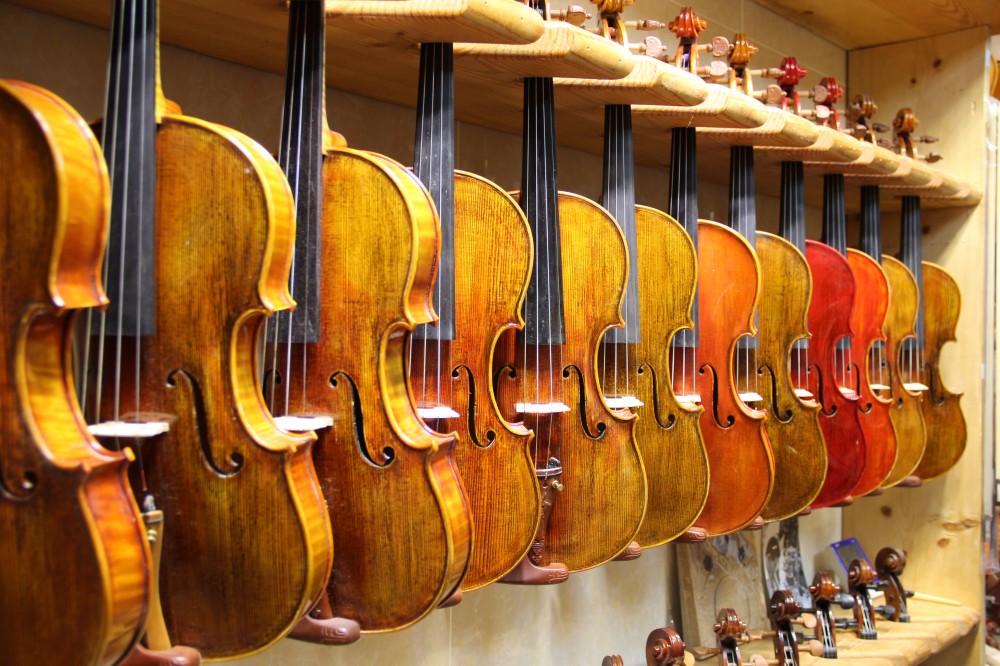
Rows of violins hang on the walls of a cozy violin, softly illuminated by the warm spotlights. Behind a small door in the middle of the shop, a violin maker is busy planing down pieces of wood.

Ngai Tin-wai, in his 50s, is a local violin maker who started learning the from a master in mainland China more than 20 years ago. He opened his workshop in 1993 and has been making violins to sell since then.

Ngai is so obsessed with violins that he spent years refining the design of his instruments so he could improve their sound quality.  After numerous attempts, he finally made a violin with the sound quality that he is satisfied with. On average, it takes around three years from placing an order to receiving a customized hand-made violin. Nevertheless, there is no shortage of customers who are willing to wait for a violin that meets their specifications.

Unlike Ngai, Timothy Spencer learnt to hand-craft violins at a formal violin making school in England. Spencer had started off as a furniture maker but turned his hand to violins because he finds them unique and beautiful to make.

Spencer says the skills involved in violin making are more challenging than it seems. “It is one of the most precise forms of wood work that you can do.” Spencer explains that hand-made violins are often made from better materials and produced better sound. He says customers benefit from the experience of a violin maker.

Spencer does not solely rely on just selling violins for a living, as it can take as long as two years to sell a hand-made violin. Like most of the violin makers in his native Britain, he also repairs violins.

Despite the skill and care that goes into making a violin by hand, professional violinist, Andrew Choi Wai-wah says most ordinary players will find it hard to tell a hand-made instrument from a factory-produced one.

Choi says are mainly three types of violins. Firstly, factory made violins; secondly, hand-made violins made by one individual violin maker and thirdly, hand-made violins assembled from different parts crafted by different makers.

Choi says only very experienced violinists can identify a hand-made instrument from a mass-produced one.

Henry, a local violin seller who does not want to disclose his full name, is pessimistic about the local violin making industry. He says local makers face fierce competition from those in the Mainland and cannot match the prestigious reputation of European violins. Yet, when deciding on their purchases, local customers place price and reputations high on their list of considerations.

However, Henry still sees the value of hand-made violins produced solely by one carpenter. He believes these instruments have refined design and structure and therefore better sound quality. This may be why local violin makers still have a  market for their work.

The Art of Protest – Politics Finds Artistic Expression in Hong Kong

Editor: Billy Leung    
Reporters: Thee Lui, Caleb Ho, Lindy Wong, Vicki Yuen

In April 2011, Chinese political artist Ai Wei-wei was taken into custody by Beijing authorities. He was secretly detained for 81 days, sparking international outcry and protests in Hong Kong.

Ai’s detention seemed to galvanize artists in Hong Kong, who had been introducing political elements into their art works in recent years. His face began to appear on Hong Kong’s streets in Banksy-like graffiti.
Art Citizens was founded after Ai was detained. The group gathers artists to “fight against all kinds of ambiguous censorship towards artistic practice, and to develop different forms of expressions creatively”.

Founder, Kacey Wong-Kwok choi had been determined not to create politically-related works. That changed after Ai was arrested, but Wong still chooses humour to express his political views. For example, during the July 1st protest last year, he called himself the “Real Cultural Bureau Chief” and steered a pink tank named the Cultural Bureau.

The suspicious death of the former June 4th dissident and Hunan labour activist Li Wang-yang in June 2012 prompted another wave of protests. In one rally, protesters calling themselves “We are all Li Wang Yang”, tied white cloth over their eyes and read poems to mourn for Li, while others played music.

Kitty Hung Hiu-han was one of the organisers of the event and is an editor of the Chinese Literature magazine, Fleurs des Lettres. Hung’s preferred method of delivery for political messages is poetry as she believes it is a medium that manages to be both succinct and provides room for multiple interpretations..


Other artists choose other forms. Fong So, a former journalist who is now a Chinese painter, agrees with Aristotle that “Man is by nature a political animal”. He thinks it is important to tell the audience the truth, while they may interpret some more meanings than the artists overtly provide.

As a form of protest, art can take on many forms. It can be challenging and provocative and it can be subtle or direct. Unlike ‘conventional’ political protests and speeches, the art of protest is more abstract and ambiguous. It leaves room for audience to have different interpretations. Sometimes, the abstract nature of the work may mean it can avoid being censored heavily as the meanings may be too subtle to judge.

Historically, there has always been a relationship between art and politics. For some artists In Hong Kong, art has become a form of protest.


Singing in Sign

Editors: Kritzo Chan   Reporters:Nicole Chan,Astina Ng,Yan Cheng, Stephanie Yee

Sign language songs help promote sign language, not harmony between deaf and hearing say Deaf advocates

On a Monday night, a group of people were practicing sign language songs at the YMCA Y’s Men’s Centre for the Deaf. Alongside music, there is expressive sign language incorporated to reinterpret a song.

Back in 2002, the YMCA has launched the first sign language song competition and constant sign language song workshops to welcome groups from both the hearing and the deaf to join, in an attempt to promote sign language, i.e., the culture of the deaf, to the hearing people, fostering a community of mercy and understanding.

They may perform different songs with various music genres chosen, like “Christmas is Coming to Town”, “It’s a Beautiful Day”, “Glorious Days”. With the lively sign language reinterpreted and the flow of music, participants could grasp the chance to express themselves in sign language via such artistic performance.

Nowadays, Hong Kongers become more aware of the culture of the deaf. With the help of the mass media, people are now more knowledgeable of what the deaf people are experiencing. Learning sign language songs is a vital way to introduce the hearing to the world of the deaf. The sign language song workshop is an effective medium in helping people to know more about the culture of the deaf. With the combination of music and sign language, people may now find it a more interesting way to learn sign language.

Added to the music and the sign language comes the dramatic body movement which can further facilitate the story-telling effect of sign language songs. The Hong Kong Sign Language Musical Theatre has been an illustrator of that. They have been using dance and rhythm of music to express a song in sign language to tell a story to both the hearing and deaf.

Despite the attempt to integrate the hearing and the deaf, sign language song itself has in turn cast disappointment on the deaf people. Initially, there were deaf people joining the sign language groups, however, now they have all quit as they cannot catch up with the rhythm of lyrics, or simply, they cannot hear well.

Throughout the whole process of learning the sign language songs, there are various expectations and thoughts among the learners. As some have suggested, they regard it as merely another kind of entertainment which excites them and makes them feel “happy”.

Ultimately, the goal of introducing sign language songs is to initiate a community with understanding and integration between the deaf and the hearing.

On the contrary, the two founders of Hong Kong Sign Language Association take a different view from the hearing. The deaf have a community with their own language and culture, which should be respected and understood by the hearing. They do not have to be integrated into the hearing community.

Neither should any side give way or give up anything for the merging—— two sides should have an equal footing with each other. Understand, respect and appreciate, is definitely the key to a real “integration”.

A Place Called Home

Home is, as they say, where the heart is and this issue of Varsity begins by looking at some of the places Hong Kongers call home.

An apparently spontaneous movement to “Reclaim Sheung Shui” in September highlighted the concerns that have been building up about the dramatic changes in Sheung Shui. Residents vented their anger over the disruption caused by mainland parallel traders’ activities.

It is easy to forget that before Sheung Shui became a rather chaotic traders’ hub, the area was occupied by farmland and rural villages. This was transformed first by large-scale public housing and then private residential developments as urban people moved to look for more affordable housing. Varsity talks to different generations of Sheung Shui residents and hears about their affection for their town.

An abrupt clean-up operation in Tung Chau Street in February this year swept away the homes and belongings of 19 street sleepers in Sham Shui Po. While passersby may consider street sleepers as living in a borrowed place, they have, over time developed certain rules among their community and connections with some nearby residents. They may be living rough but they are keen to maintain their dignity.

After the demonstrations and campaigns against the demolition of Choi Yuen Village, some villagers accepted the government compensation and planned to build a new village. It has not been easy and they have encountered a lot of difficulties. Construction of their new houses is expected to finish in late 2013. The years of struggle have left many of them exhausted and what keeps them going is the wish for a stable home.

True family ties are not just written in blood. In the Our Community section, Varsity hears the stories of adoptive parents and children who come from different racial backgrounds.

In the Lifestyle section, we explore the cultural fusion in Yau Ma Tei by looking at how the arrival of local artists and cultural workers have injected new vitality into this old district.

Enjoy, and perhaps it will remind you of your own stories about the places you belong to.


Billy Leung Tsz-hong

Managing Editor

Winds of Change Sweep through Sheung Shui

Parallel traders merely the latest new phenomenon in this former rural backwater
By Ian Cheng and Natalie Cheng 

Sheung Shui station is the last stop on the East Rail Line before passengers in Hong Kong reach mainland China. Positioned close to four major access points to the Mainland, today’s Sheung Shui has taken on the feel of a modern day Silk Road trading post with Chinese characteristics.

Cross-boundary parallel traders crowd the platforms of the train station with cartloads of parallel goods, ranging from milk powder and cosmetics to iPads and mobile phones, turning this former sleepy market town into a hub for those who buy goods in tax-free Hong Kong to resell in the Mainland.

The rapid development of Sheung Shui in recent years has caused some parts of it to become unrecognizable. More and more shopping centres have sprung up and the types of shops found in the town have changed as well.

Pharmacies, jewellery shops, and health care retailers and chain stores, mainly catering to mainland consumers, have multiplied, pushing out independent local businesses.

“Things cost more and there are fewer choices,” says Leung Wai-sze, a   freelance writer in her early thirties who has lived in Sheung Shui since the age of two.

In September, protesters responding to a call on the internet to “reclaim” Sheung Shui, gathered outside Sheung Shui station. They complained that parallel traders had pushed up the prices of local goods and caused disturbances to daily life for residents in the town.

Leung wrote an article later that month, describing the changes and impact of development in Sheung Shui since the 1980s.

“I tried to interpret my feelings… that is to say if I want to ‘reclaim’ anything, then it is the life that we had always enjoyed before [in Sheung Shui],” she says.

The article struck a chord and was widely shared on social networking sites. Among those who share her sentiments is Andrew Choi Tsz-hong, a 22-year-old journalist who was born and raised in Sheung Shui. Choi feels uncomfortable about the changes to his home town to the point where he feels it is gradually being stolen by mainlanders.

“Shopping in Tsim Sha Tsui is acceptable, as Hong Kong is a tourist place, a shopping paradise. However, Sheung Shui is not for tourists. Buying daily necessities that are supposed to be for local residents is not a normal phenomenon,” Choi says.