










Home Blog Page 87

Veteran councillor Andrew Cheng is fed up with the district council elections

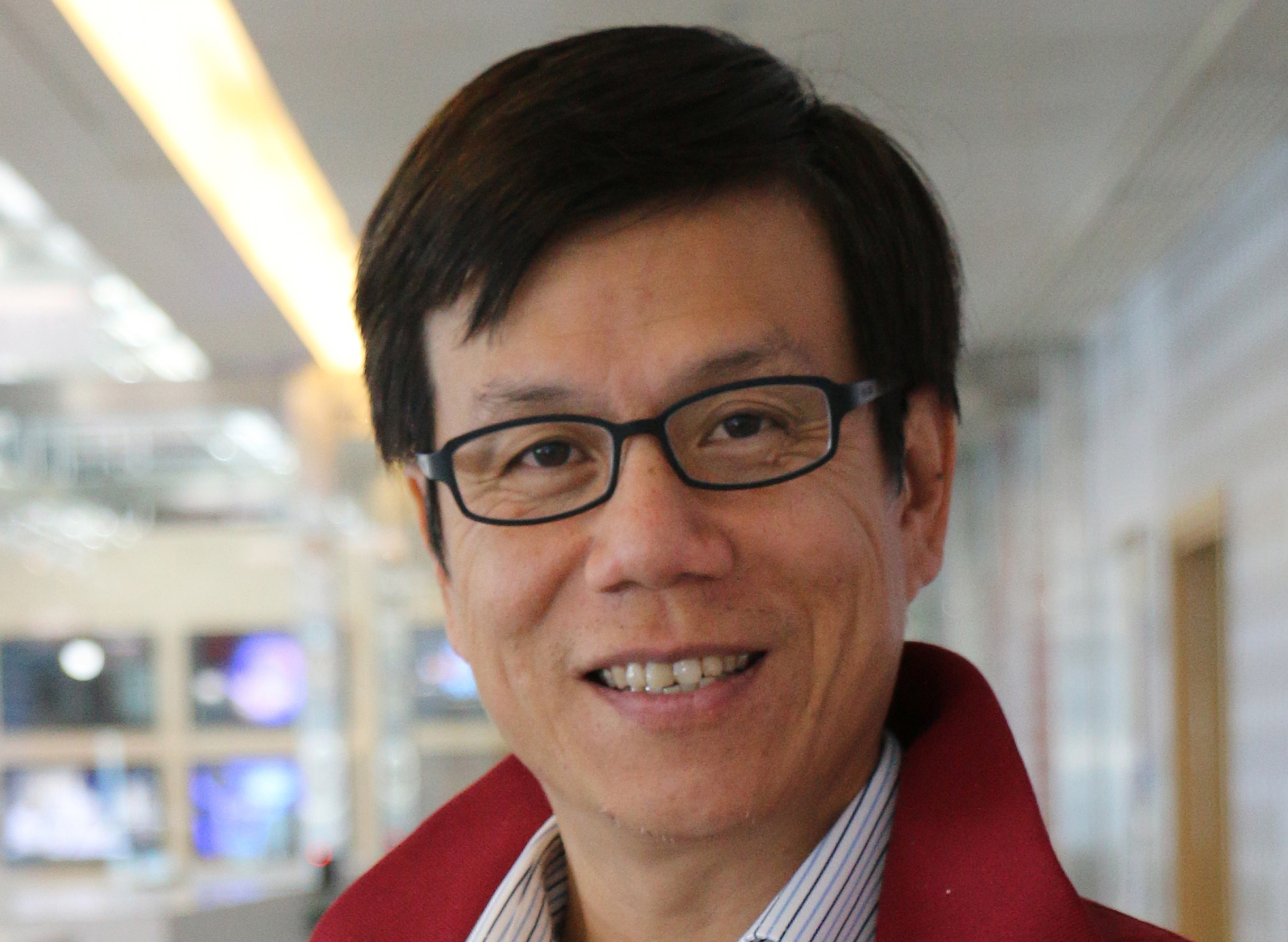
Veteran district councillor Andrew Cheng Kar-foo

Former Democratic Party legislator and district councillor explains why he decided not to stand in the local level elections anymore

By Vivienne Tsang & Julian Ng

After seven years of being a district councillor and 17 as a legislator 55-year-old Andrew Cheng Kar-foo says he is too tired and discouraged to run again.

That is because of the many injustices he has seen in the election system.

“The appointed district councillors are mostly pro-establishment, and they usually get more resources in a district. The current system is warped and many councillors who actually have public support can’t get a seat to reflect the voices of the community,” he explains.

Cheng is also a lawyer and one of the founding members of the Democratic Party. Between 1994 and 1999, he was a member of the Southern District Council. He was then elected as a Tai Po district councillor between 1999 and 2011. After that ended, he decided not to run in future elections.

As someone who had been elected to the district council before and after the handover, Cheng says he does not see many changes within the election process. He says the one major difference is that political corruption has worsened.

“It seems that bad habits from mainland China, such as giving out benefits or paying for meals to get elected, have changed the corruption-free tradition that elections in Hong Kong used to have…I fear future elections will only get worse.”

Cheng said he also felt powerless as a district councillor. Throughout his four terms in office, he provided local services such as facilities maintenance, welfare, and free legal consultations. But that was probably as far as he could go. “The system does not give district councilors enough power to change policies. The district council is like a ‘ornamental flower vase.’”

Cheng says district councillors mostly deal with district affairs.

“It would be much better if the council had more power to improve the environment of a community.”

Cheng has another reason for calling it quits – “we need some new ideas.” He wanted to give a chance to members of the younger generation who have been waiting a long time.

Cheng thinks that after the 79-day Occupy Movement last year, more young candidates are running in the upcoming district council election, and young voters are paying more attention to the political views of candidates.

But he also points out that young people are still outnumbered in a district, so they can hardly threaten the more experienced pro-establishment candidates.

“Votes for democrats will definitely increase, but not more than 10 per cent,” he says.

Cheng was also a member of the Legislative Council from 1998 to 2011. Currently he is a founder of and radio host at D100 and is still considering whether to run for a seat on the Legislative Council next year. But he says, ‘if I were to participate in the coming election, I’d run as an independent.”

Edited by Thomas Chan & Godric Leung
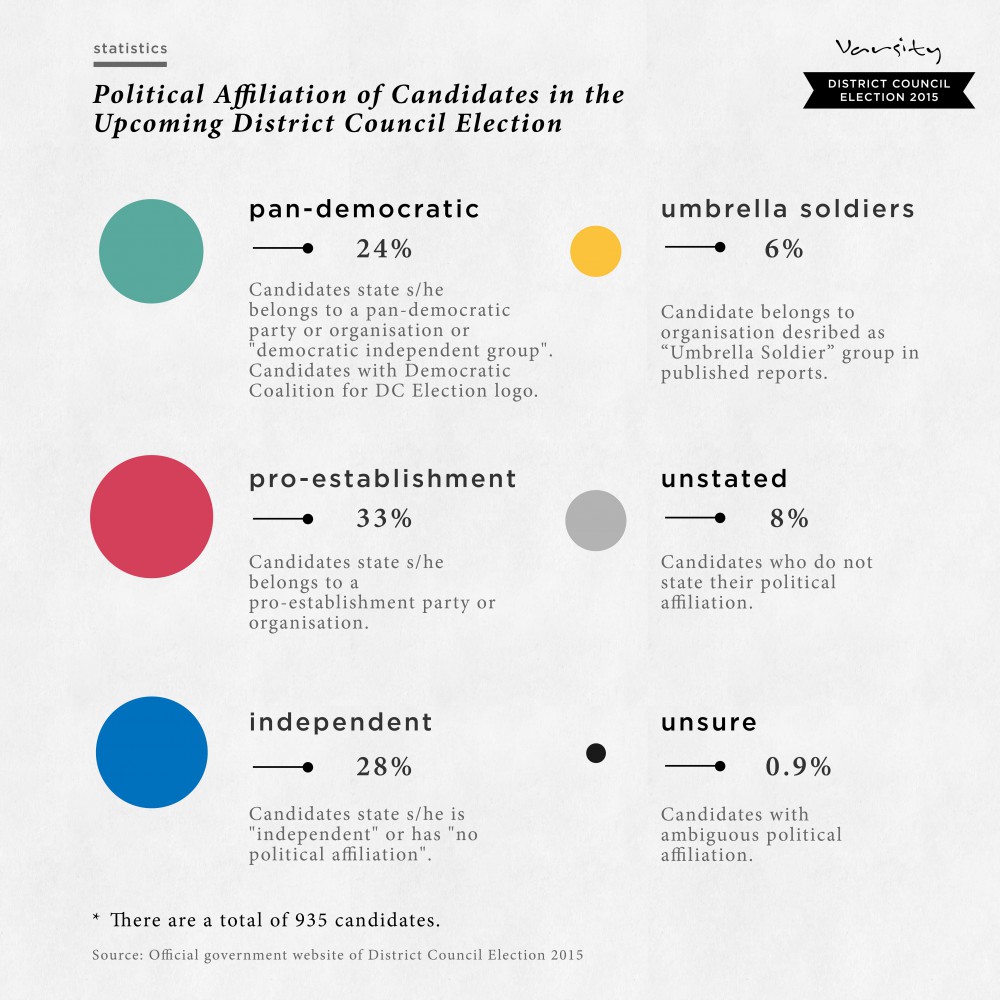
Political Landscape of the District Council – are independent candidates really independent?

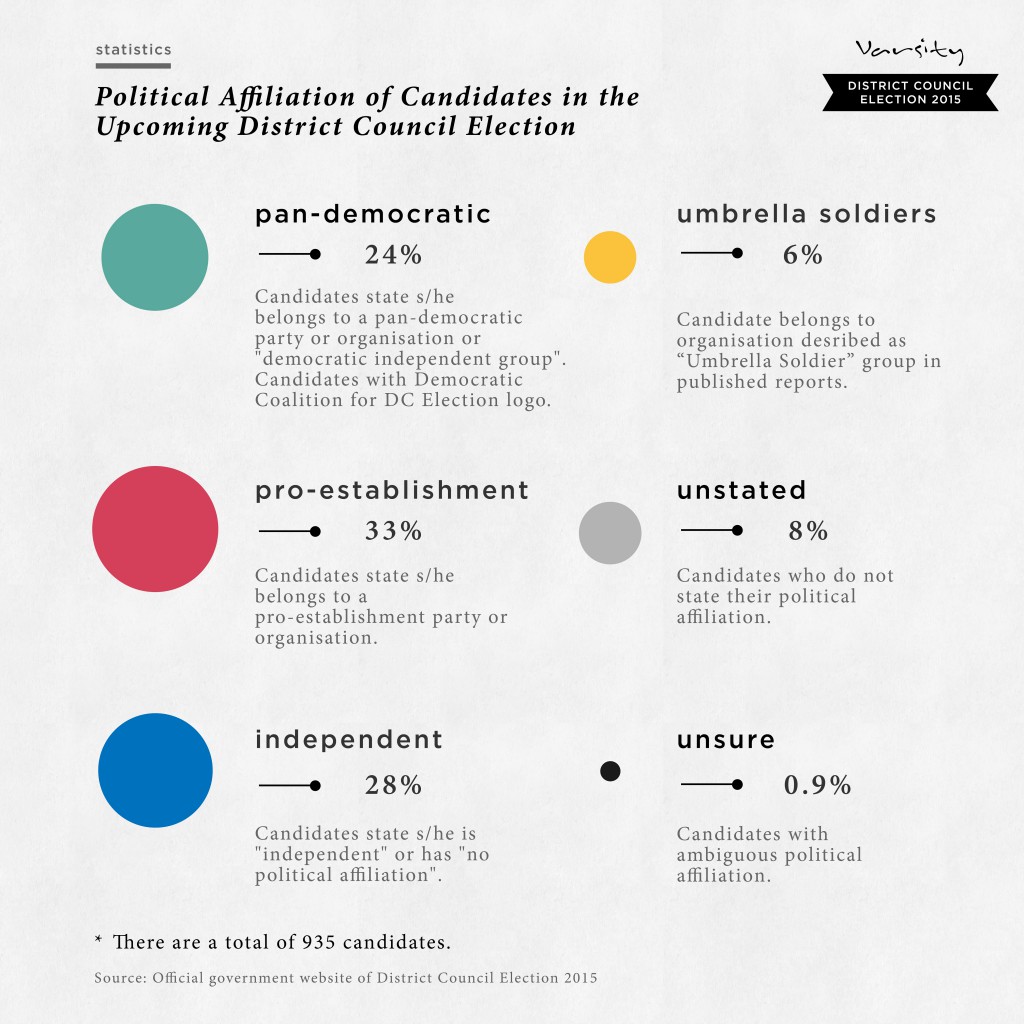
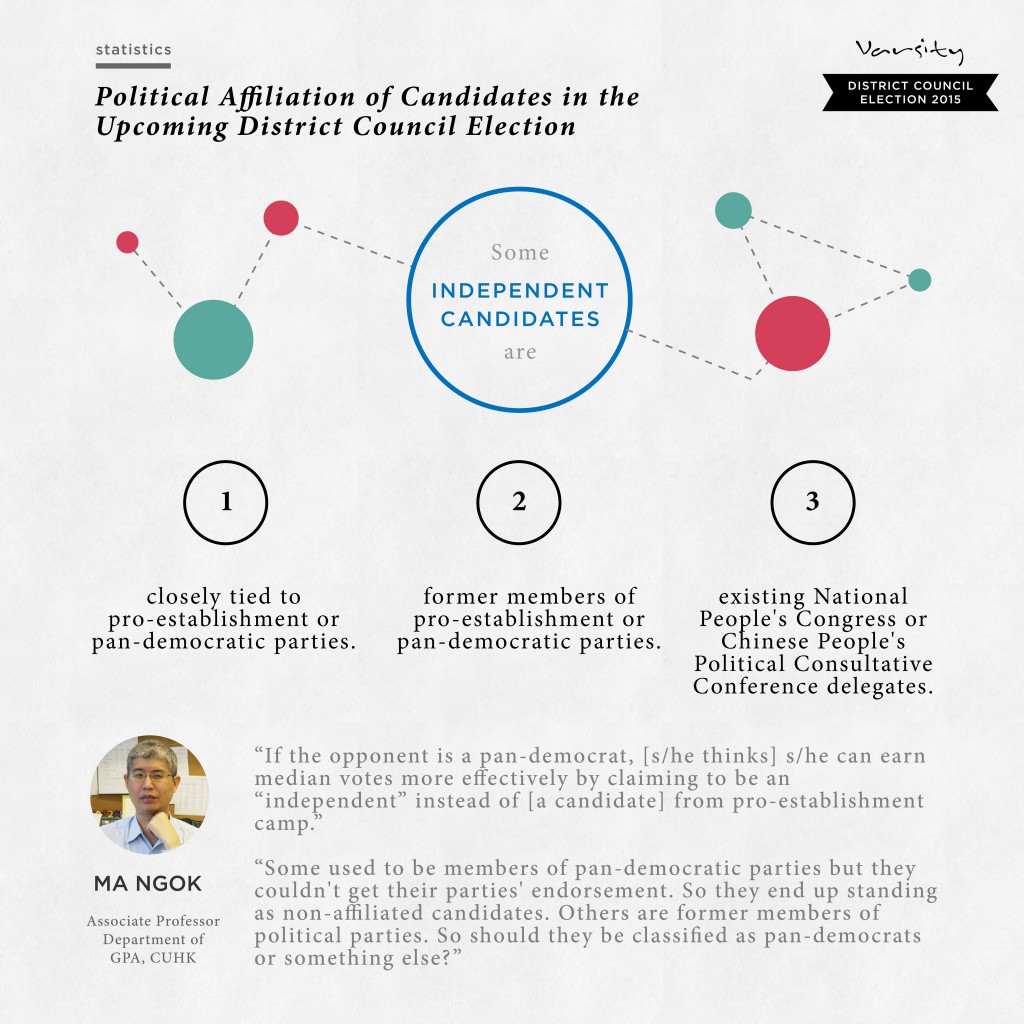
We bring to you the political landscape of this year’s District Council election. Are “independent candidates” really independent? Why is it difficult to decode “independent candidates”? We explain to you through a few graphics.

Varsity-DC_infographic_stat_political affiliatn-03 Varsity-DC_infographic_stat_political affiliatn-04

Ole Chiu – Serving the people through politics instead of medicine

Ole Chiu of Youngspiration plans to serve the community as a district councilor rather than a nurse, despite strong opposition from other parties.

By Emily Man

Full-time nurse Ole Chiu Yuk-kwong finishes work at the North District Hospital in Sheung Shui, then spends two hours rushing to Mongkok to campaign for his bid for a district council seat. Then it is another two hour journey from Mongkok back to his home in Tuen Mun. This has become Chiu’s routine for the past two months.

Ole Chiu of Youngspiration

Campaigning is all he does other than work, which leaves him with only four to five hours of rest a day.

“I rest when I’m going from one place to another,” says Chiu.

Despite living in Tuen Mun, Chiu, who is a Community Officer of the newly formed political group Youngspiration, is running to represent the Tai Nan Constituency in Mong Kok. Youngspiration is fielding nine candidates for the 2015 District Council Elections and three of them are competing in the Yau Tsim Mong District.

Chiu explains the district is traditionally a stronghold of the pro-government, pro-Beijing camp, but the pan-democrats have not invested enough in campaigning in this district because they are unlikely to win. Chiu and his group say this leaves residents in the district with no choice but to vote for the pro-government camp.

“We are not afraid to lose and we won’t give up any district,” says Chiu, “If we give up any district, China can easily turn Hong Kong into her colony.”

Traditionally, voters in district council elections will pick someone according to how much the candidate has contributed to the community.  However, Chiu thinks the Occupy Movement will have a large impact on this election and will be the key to success. He cites the 2003 district council election as an example.

Back then, the pan-democracy camp pulled off a great victory due to strong opposition to the proposed Basic Law Article 23, the controversial national security law.  Chiu says crucial issues like Article 23 will bring out people who usually do not  bother to vote.

Chiu is hopeful that what happened in 2003 will happen again this Sunday for the district council elections. “If the turnout rate reaches 50 per cent, half of our group of nine candidates stand a chance of winning,” says Chiu. The turnout rate in last District Council Election in 2007 was 41 per cent.

Chiu says he would quit his present job as a nurse and become a full time district councillor if he is elected. Although being a nurse is more stable and has a higher salary, Chiu says people need to think about more than just money.

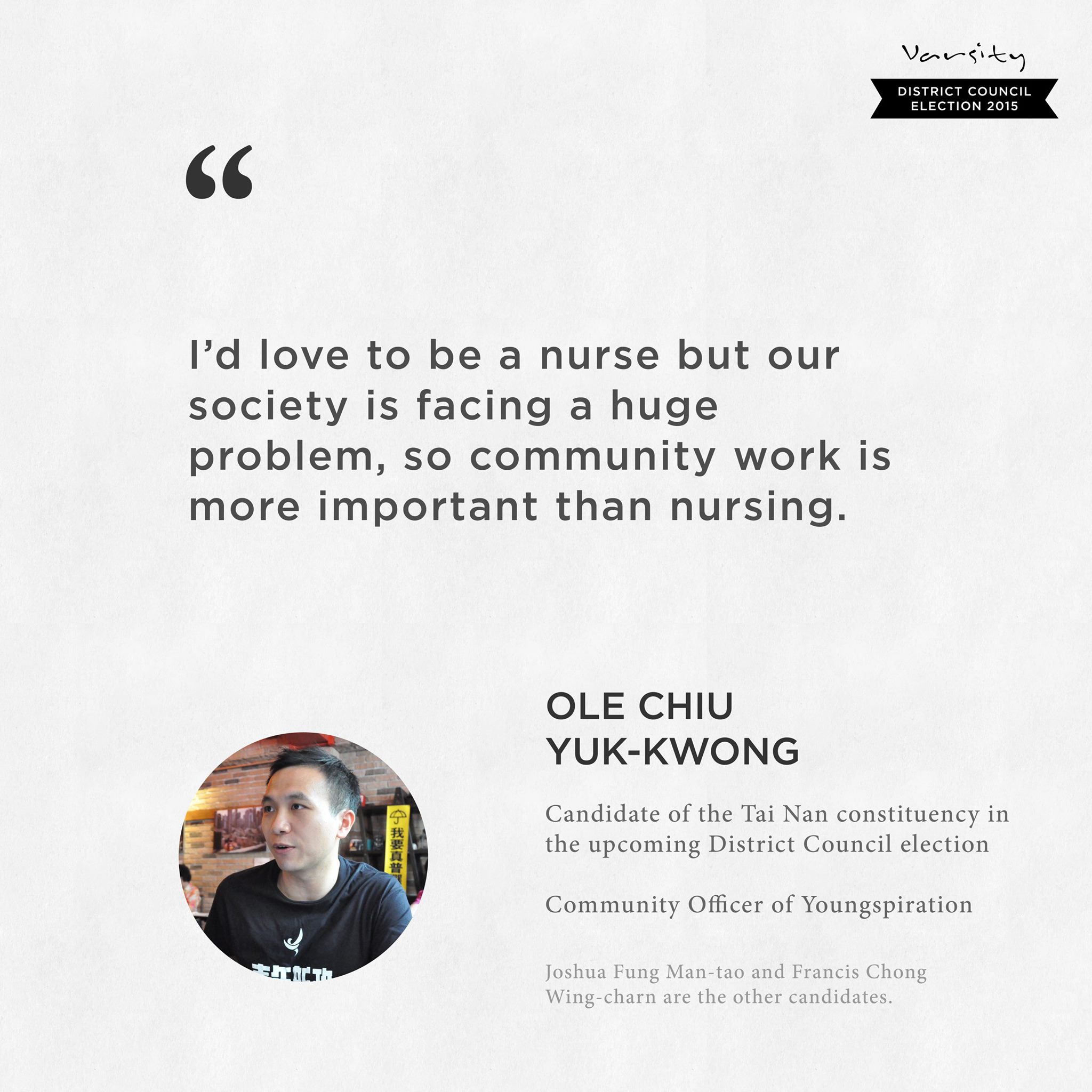
I’d love to be a nurse but our society is facing a huge problem, so community work is more important than nursing.”

Joshua Fung Man-tao and Francis Chong Wing-charn are the other two candidates for the Tai Nan Constituency.

Edited by Edith Lin


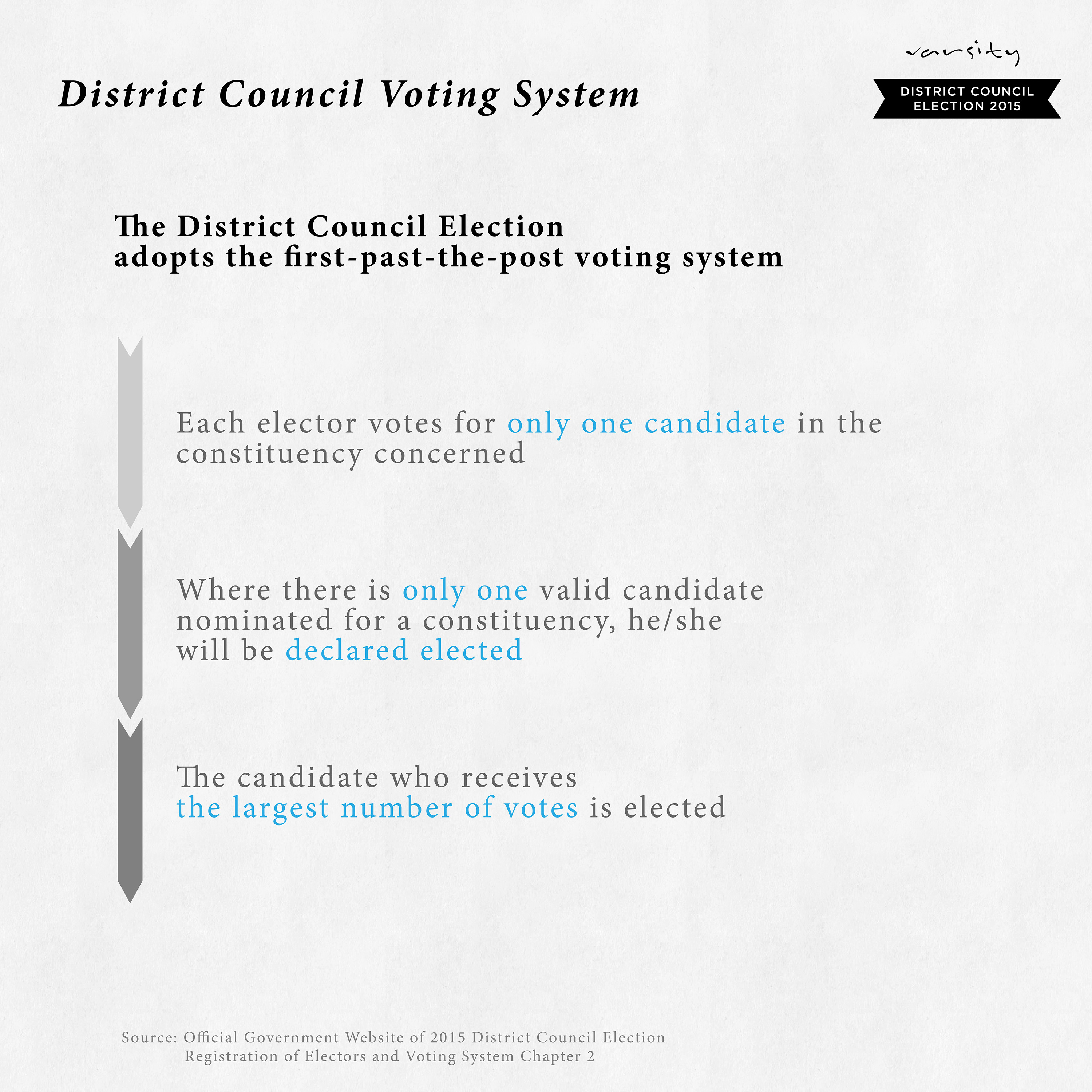
What you should know about District Council Voting

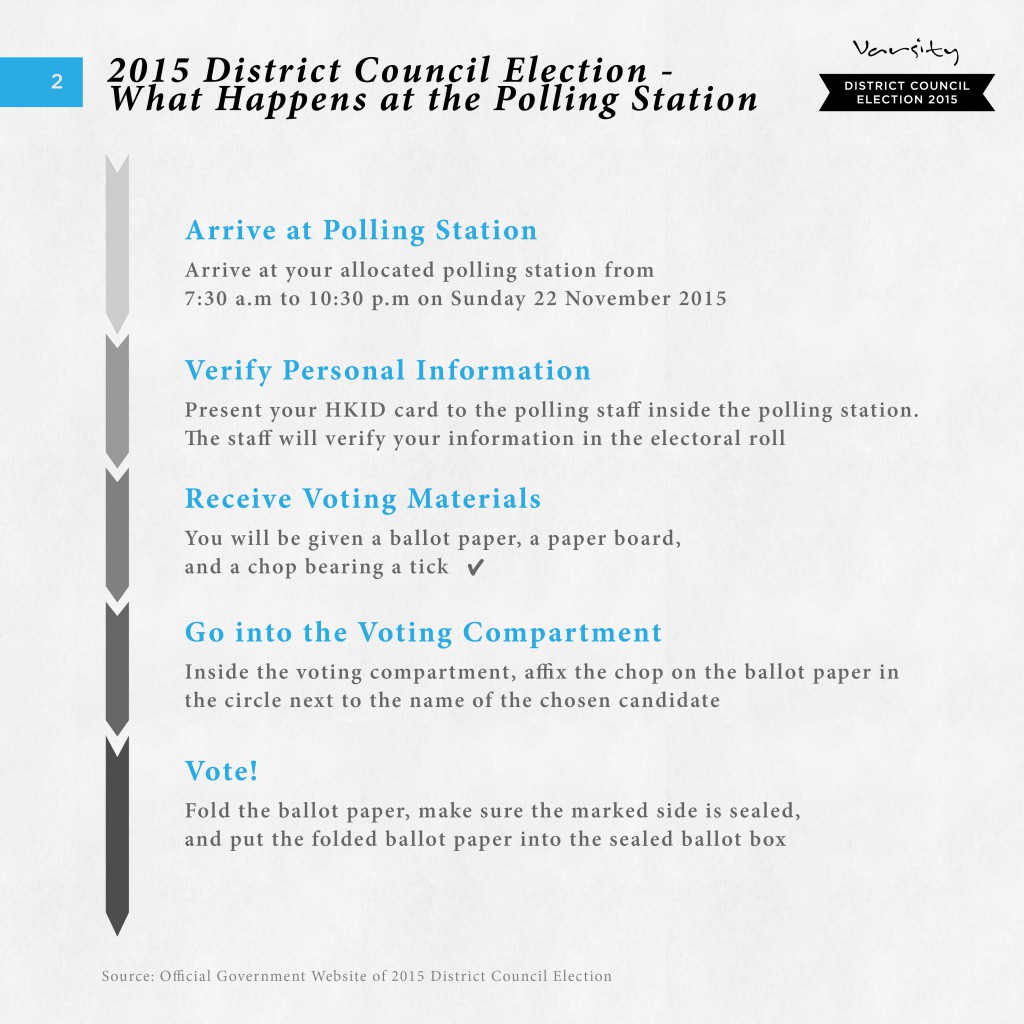
To prepare you for tomorrow’s District Council polls, we present a brief guide to voting, letting you know who is eligible to vote, what happens at the polling station, and several reminders for voters.

Vote  (2)Vote  (3)

Vote  (4)


Football: A New Way to Promote Civic Awareness?

Mei Foo Home and Public Affairs experiment with new ways to arouse civic awareness and contribute to the community.

By Kelly Wong

Nov 21 - DSC_0098
Kenny Poon Kwan-yin at the football watching party


Kenny Poon Kwan-yin was anxious. The 28-year-old convenor of the group Mei Foo Home and Public Affairs was organising a football watching  party. This was the first time they had such an event  under a bridge, an often-ignored public space. Plus, Poon had no budget and was not  sure how many people would show up.

Finally, more than 500 residents of Mei Foo Sun Chuen gathered for Hong Kong’s World Cup qualifier against China. As the match ended with a 0-0 draw, the audience chanted slogans and waved Hong Kong flags – it was just like being in Mong Kok stadium where the match took place.


Varsity
interviewed Mei Foo Home and Public Affairs soon after solicitor Kevin Yam Kin-fung started the community-based concern group last December. Yam hoped to engage residents about the city’s democratic development and district affairs after the Occupy Movement ended. Since then, Poon has been active in the group.

In the upcoming District Council election, Mei Foo Home and Public Affairs does not have a candidate, nor did they endorse one,  despite their active participation in various issues in the community, like petitioning for the management company to test for lead in tap water.

Nov 21 - DSC_0103
Poon hopes activities like the football screening party can get the community more involved in district affairs

Instead, the group hopes to promote civic awareness. As the election approaches, the group set up booths to try and get residents interested in voting by asking them basic questions, like which constituency they belong to, and how much is the salary of a district councillor.

Poon says the group aims to monitor the performance of the District Council.

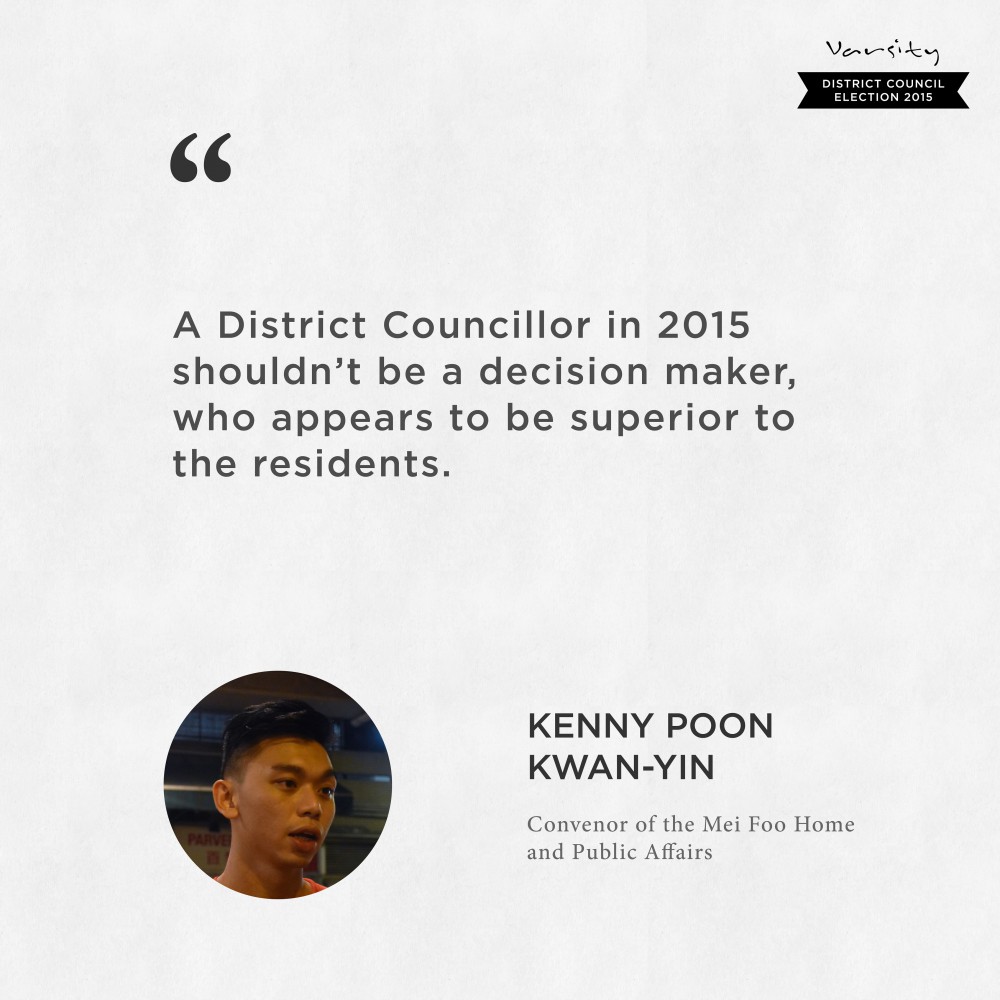
“We do not need district councillors to decide everything for us,” says Poon. “We can use our own knowledge to think of ways to allocate resources effectively.”

As citizens can just go online to find out how much the District Council is spending on its projects, Poon says the group would use that access to introduce a bottom-up approach in policy-making.

“A district councillor in 2015 shouldn’t be a decision maker who are superior to residents,” Poon says. He says now is the time to change that image and to encourage more civic participation.

However, he is sad to see that many of his neighbours do not really care about the first election after the Occupy movement.

Poon says some residents do not even know the current district councillors, who are supposed to have represented them in the political system for four years,“I think their worst reaction is to feel indifferent”.

That partly explains why the community group organized the football screening party: Poon says he wants to bring members of the community together. He also hopes the event can become a “seed” to lead residents to get more involved in district affairs in the future.

Wearing a red T-shirt with the word “extraordinary superb” splashed across it, Poon enjoyed the joyous atmosphere at the match screening. But now, he’s anxious again, “what I’m most worried about is the voter turnout, which has always been low”.

Edited by Benny Kung

For Home and Justice – Cultural advocate Clarisse Yeung joins the election

Cultural advocate and district council candidate Clarisse Yeung Suet-ying takes her ideals of a community to Tai Hang

By Benny Kung

Clarisse Yeung Suet-ying campaigns in Tai Hang

A dog and a rat, buses and cars – these specially designed foam boards are supposed to show what residents of Tai Hang care about. That’s where the independent candidate Clarisse Yeung Suet-ying is running in the District Council election this Sunday.

Varsity spoke to the cultural advocate back when she co-founded the Umbrella Movement Visual Archives and Research Collective last year. She and her team systematically curated protest art, and tried to show them in exhibitions.

However, Yeung does not identify herself as an “umbrella soldier” because she says the movement isn’t what made her run for district council. Back in 2012, Yeung had already helped her friend run for the Sports, Performing Arts, Culture and Publication Functional Constituency in the Legislative Council (LegCo).

Yeung decided to take a more active role in politics when LegCo’s Finance Committee passed the budget of the Northeast New Territories Development Plan last summer. She says the decision was taken without due process and gave her the impression that the council is falling apart.

She says the best way to change the system is join it. As a part-time lecturer teaching cultural policy at tertiary institutions, Yeung has many ideas about community and she thinks the people shouldn’t just be “represented”.

Yeung has been actively engaging residents while building a platform. One of her proposals is to set up a pet garden – the local dog owners have been demanding one for a long time, but without success.

Yeung has had to learn how to bring her lofty ideals back down to earth. She says Tai Hang is a diverse community – “a place where the elderly, children and dogs live together comfortably,” and the people should not be lectured to. Instead of passing out wordy leaflets, she visualizes her plans, making use of her artistic background.

Yeung says that local residents appreciate her efforts; more and more of them are joining her team of volunteers. Some even donate to her campaign. During our interview, a secondary school student gave Yeung a birthday card, cheerfully saying her parents would definitely vote for Yeung – their first vote after moving to Tai Hang almost a decade ago. Yeung just turned 29 this Tuesday.

Despite all the talk of policy, some voters just have one question: is this candidate a “yellow ribbon” or “blue ribbon”? – labels commonly used to distinguish the pro-democracy and pro-establishment camps since the Occupy movement.

“Tags don’t matter at all,” Yeung says, “(What is) important is that we work for the common good of Hong Kong”. She says if she loses, she will keep looking for ways to contribute to the community.

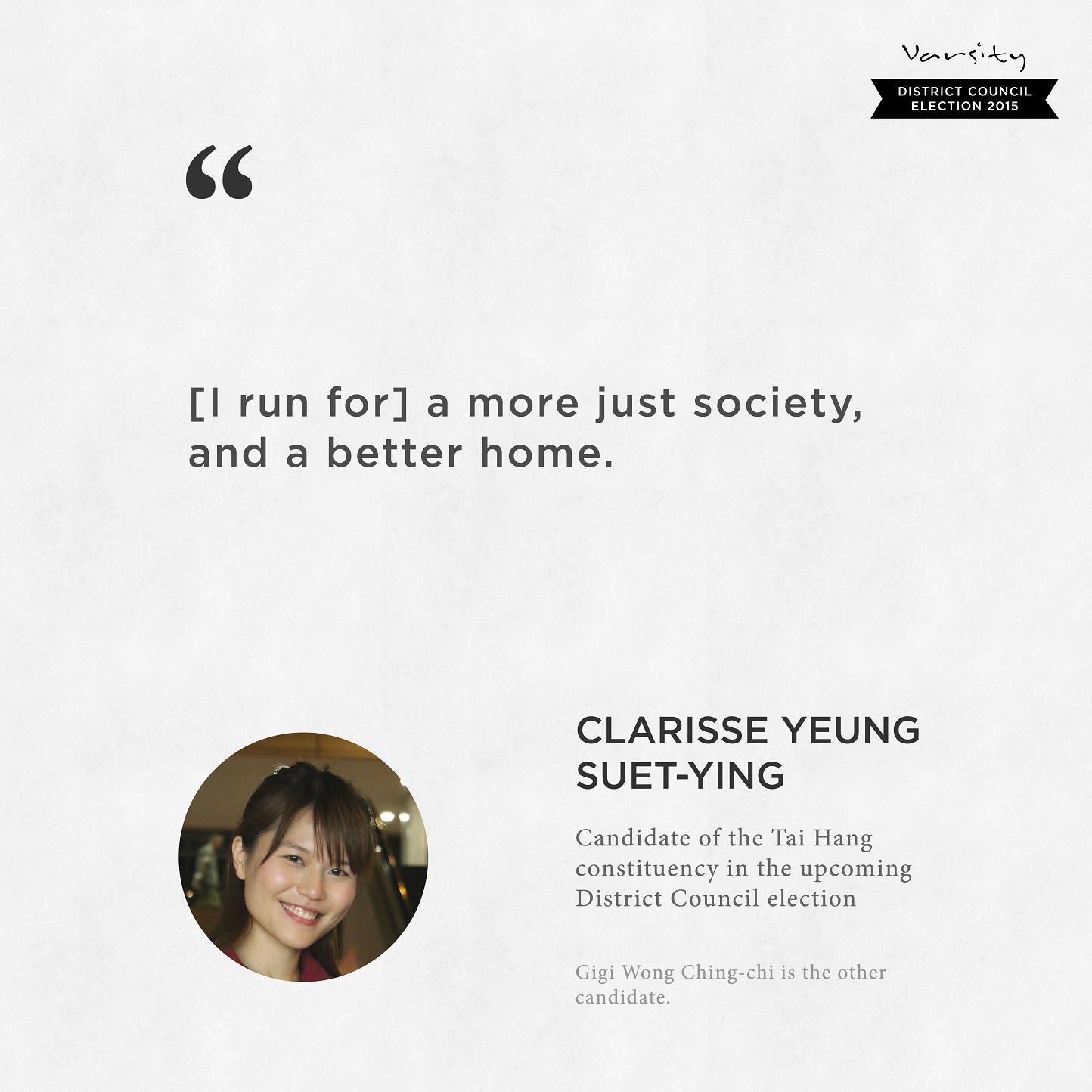
As the election approaches, Yeung is physically exhausted. But she says it’s worth it because she’s working “for a more just society, and for a better home”.

Gigi Wong Ching-chi is the other candidate.

Engineer Patrick Wong Chun-sing joins the election

The civil engineer wants to use his expertise to stop the district from building more pavilions that can’t keep people out of the rain

By Macau Mak  

Engineer Patrick Wong campaigns in Tai Koo Shing

 On a weekday evening before the election, Patrick Wong Chun-sing distributed flyers next to Taikoo Shing Road, not far from his competitor Marcus Tse Tsz-kei from the New People’s Party. Several residents stopped to encourage him and tell him they are already familiar with his platform.

“I know many residents living in Tai Koo Shing East and some of my secondary school classmates and teachers also live here,” Wong says. The 40-year-old civil engineer was born and raised here and moved out only a few years ago because of family reasons. “Many of them said they support me when I decided to join the election.”

Professionals have been participating more actively in social movements, as society became more politicized. Wong was president of the University of Hong Kong Students’ Union in 1997, and his passion for politics was reignited in 2012.

“Fewer and fewer politicians and officials are willing to speak the truth,” Wong says. “The problem got worse after the national education incident in 2012.” For example, Wong explains how the government blamed the plumber at the beginning of the recent lead-water crisis, while trying to hide loopholes in the system of oversight.

Wong would like to bring integrity into the District Council. He believes the public still trusts professionals like him because integrity is one of their core values. Wong also thinks that being an independent candidate gives him an edge, as political party members sometimes have to toe the party line even if it goes against the interest of their constituents.

Wong says his engineering expertise would help him serve the district – for example, he can monitor building works and road constructions. As an engineer, he says he understands how much local infrastructure costs, and how to design it well. He points out how a recently-built pavilion that could not shelter people from the rain, was quickly demolished. The public still does not know how much it cost.

“A professional engineer would not allow such a construction to happen,” Wong says. Wong adds he will make official Council spending much more transparent, because he says the people can only hold their Councillors accountable when they have all the details.

Apart from serving the district, Wong’s election platform also focuses on fundamentally changing the electoral system. He supports genuine universal suffrage in the elections for the Chief Executive and the Legislative Council, as well as scrapping functional constituencies.

Residents in Tai Koo Shing East are mainly middle class, and Wong says most of them have strong views on district issues as well as the electoral system. “They seldom scold each other over differing views. I enjoy having rational discussions with them,” Wong says, recalling his experiences of talking to both supporters and opponents. “The discussion is fruitful.”

He does not want to speculate on his chances of winning the election on Sunday, and promises he will continue serving the district through Our Community at TaiKoo (OCTK). He founded OCTK with his friends earlier this year, and OCTK organised activities and lectures in the community to bring people together and make them aware of social issues. Wong says it is too early to decide whether or not he will join the next election if he loses this one.

Wong’s participation may have set a precedent and encouraged professionals to run for election. “I have faced many new challenges upon joining the election for the first time, as I have to handle huge campaign workload within a short period of time,” Wong says.

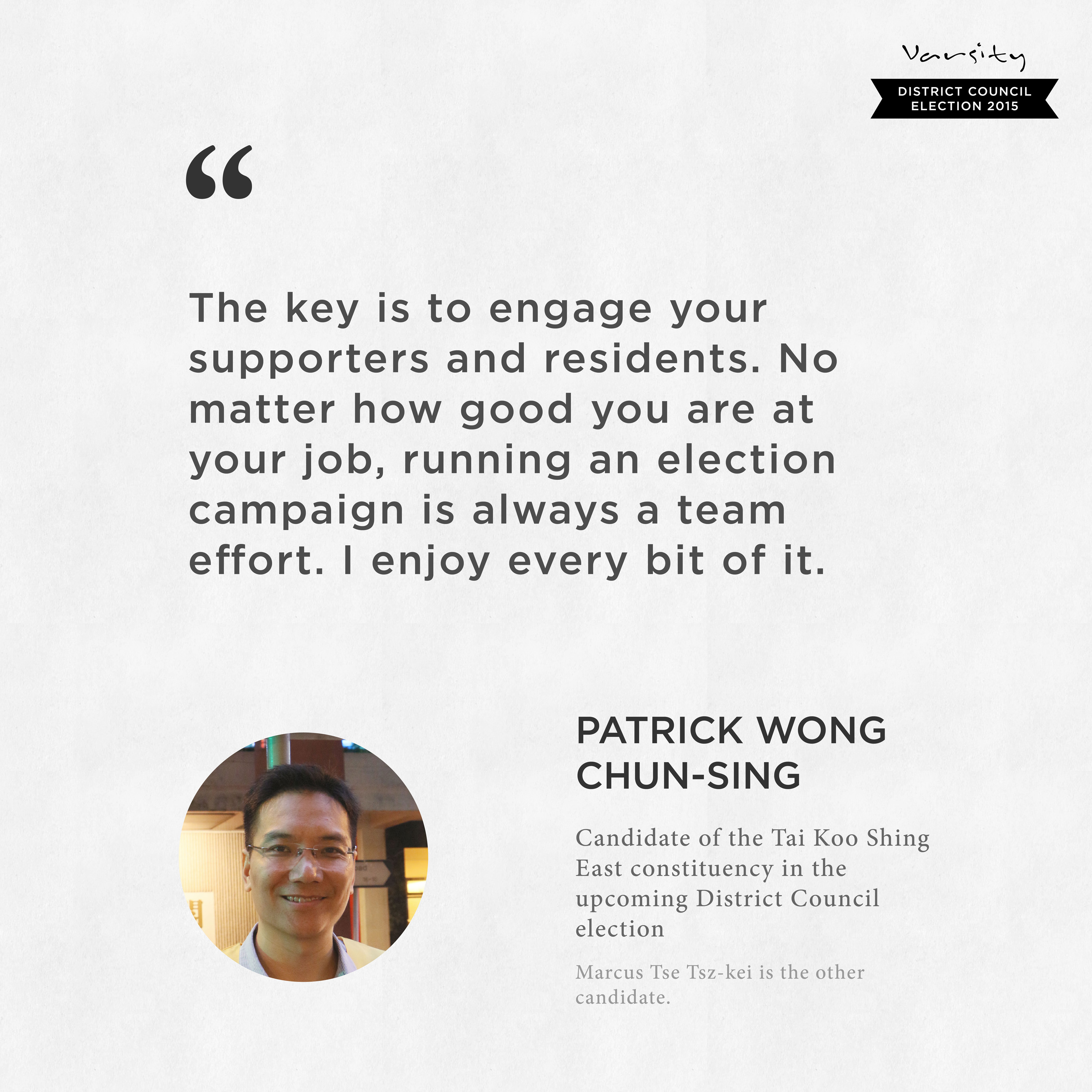
“The key is to engage your supporters and residents,” Wong adds. “No matter how good you are at your job, running an election campaign is always a team effort.”

“I enjoy every bit of it.”

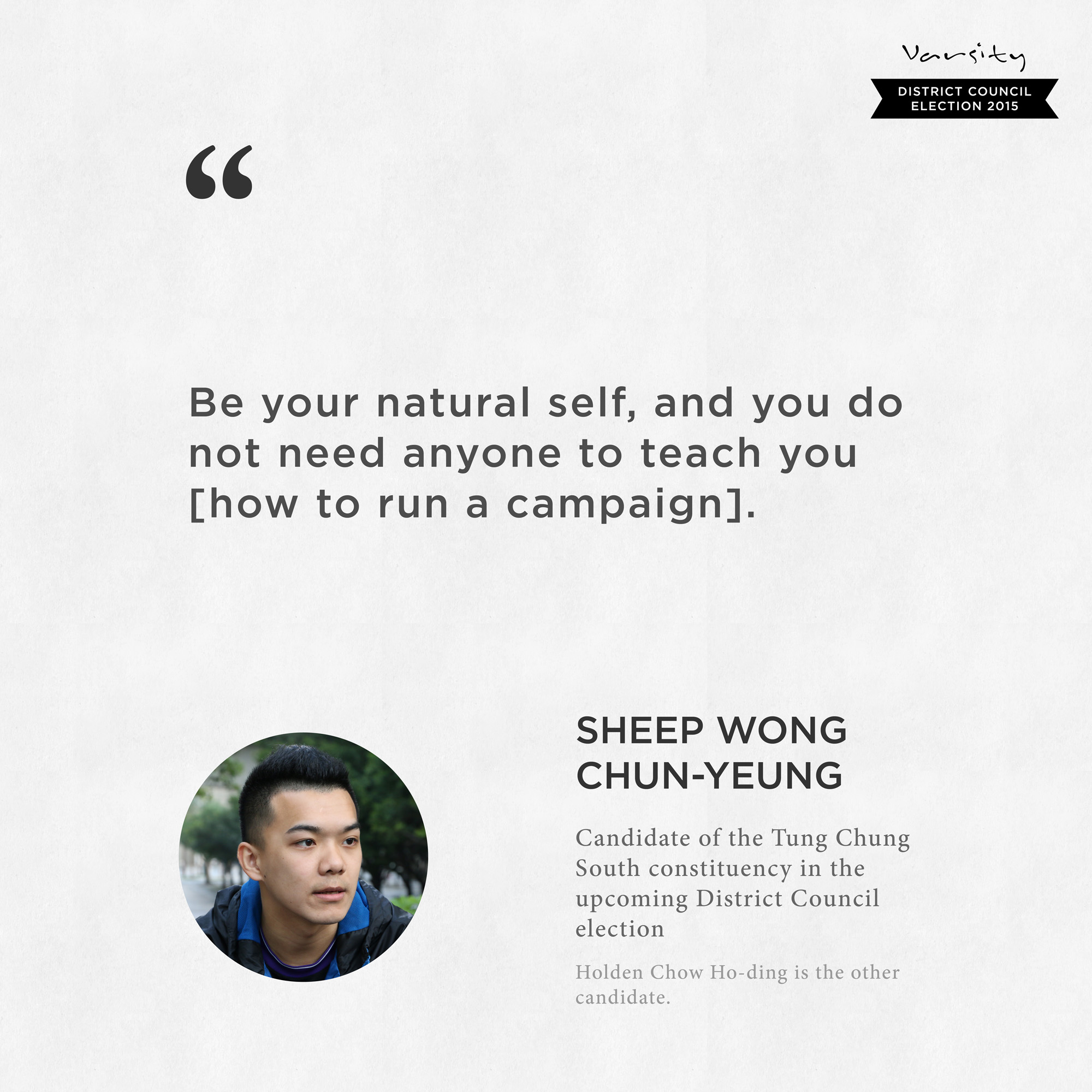
Be Your Natural Self: Sheep Wong Finds His Own Way of Running a Campaign

Young candidate inspired by Occupy Movement finds his own way of running an election campaign

By Teenie Ho

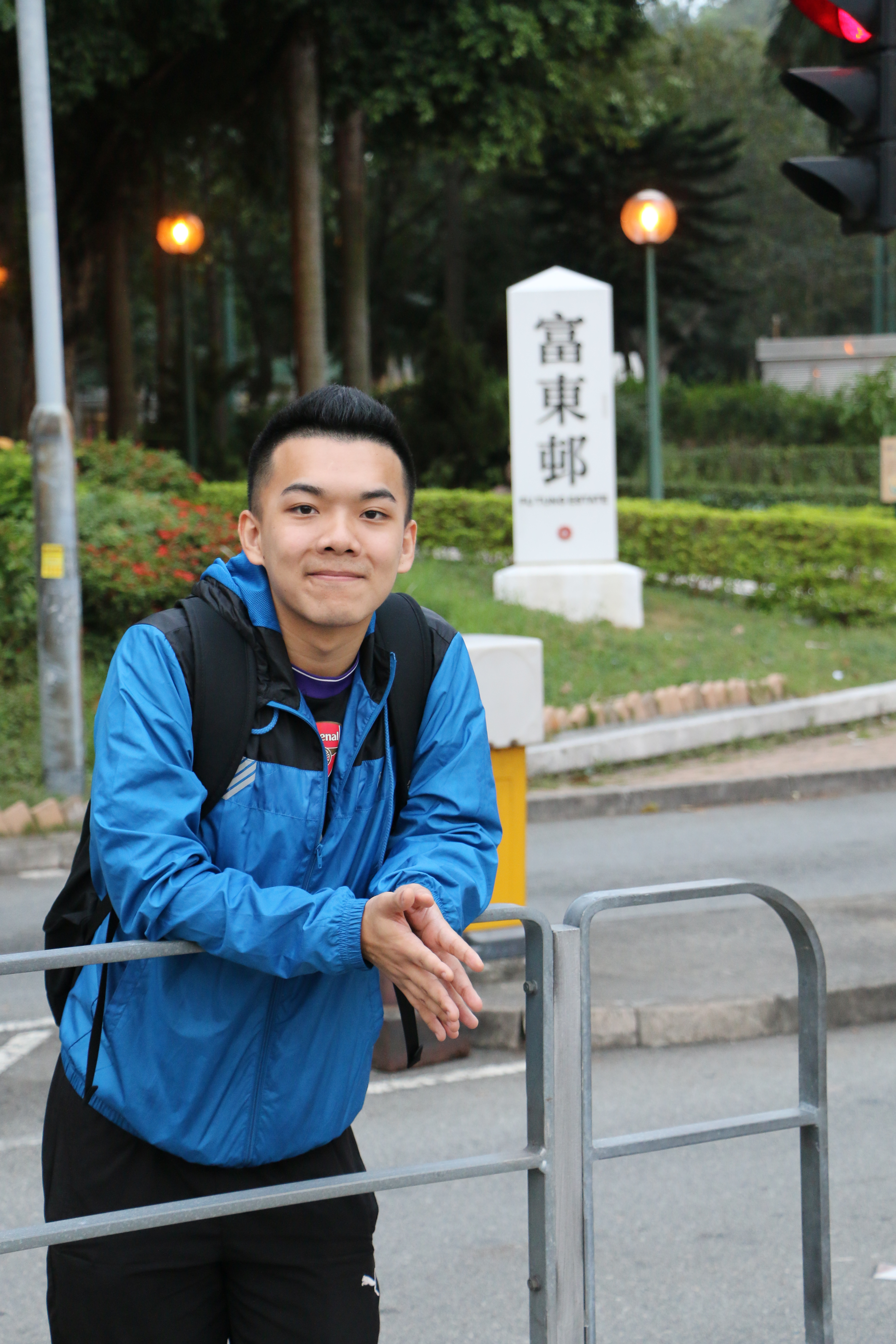
Nov 19 - Sheep Wong. JPG
Young ‘Umbrella Soldier’ takes on the D.A.B. in Tung Chung South

Sheep Wong Chun-yeung sits on a bench in a park surrounded by the high-rise buildings that make up the Tung Chung Crescent, He is wearing comfortable sportswear that hints at his youth, and exhibits a steady composure.

The 21-year-old Wong is a District Councillor candidate standing in Tung Chung South, and he also serves as the Community Development Officer for the community organization Tung Chung Future. He focuses on reviewing infrastructure projects that affect the livelihood of Tung Chung residents, and alleviating the impact of other local problems like rising prices.

Varsity met Wong earlier in January to observe how the Occupy Movement last year motivated youngsters to participate in politics.

At that time, he was worried about running his campaign without guidance from veterans. “We did not know our direction or how to enhance our popularity and familiarity in the district,” Wong says. Earlier in his campaign, Wong campaigned the traditional way, like printing his wordy manifesto on flyers.

But those mostly went in the bin. So instead he addressed people’s doubts directly on the handbills – whether he is too young and inexperienced, and whether he has enough resources.

“The advertising effect is rather good…more people approach me when the new handbills are distributed,” Wong says. “This is good enough; no matter whether they come to question me or to criticize me.” He says it is important to get people’s attention because his team has been around for less than a year.

Proving his credibility and calibre is as important as getting attention, Wong says. He recalls a resident who challenged him by questioning whether he could deal with noise pollution that would come from nearby air traffic if the Third Runway got built.

Wong responded months later with a successful application for a judicial review of the project’s funding, which earned him compliments from the people who doubted him at first. This brought him more support among the constituency.

“Because of this, I eventually become confident of myself, though there were still occasional moments when my team and I were very distressed,” Wong explains.

Wong admits that he is not as educated as his competitor, Holden Chow Ho-ding, the vice-chairman of the Democratic Alliance for the Betterment and Progress of Hong Kong. Wong left school after getting his Diploma of Secondary Education, while Chow is a solicitor. But Wong firmly believes his aspiration and efforts will make up for this.

Looking back on the previous ten months, Wong no longer seeks professional input as he did when Varsity interviewed him earlier this year, because he says the opinions of so-called “experienced people” are incompatible with those of the new generation to which he belongs. “Be your natural self,” he concludes, “you do not need anyone to teach you that.”

He’s very grateful to his parents, who used to be pro-establishment supporters but have been very supportive to their son’s campaign. Wong managed to lead his parents to question their pro-establishment views by occasionally discussing social issues with them.

At present, Wong says he has just as much of a chance of winning as Chow. Wong promises that he will continue to serve the community, promote democracy, and join the next election if he loses the one on Sunday.

Wong’s greatest aim is to encourage as much civic participation as possible. “No matter if one votes me or Chow, participation is the most important.”

Edited by Macau Mak