Collective bargaining rights remain out of reach for Hong Kong workers
By Brian Yu & Kelly Wong
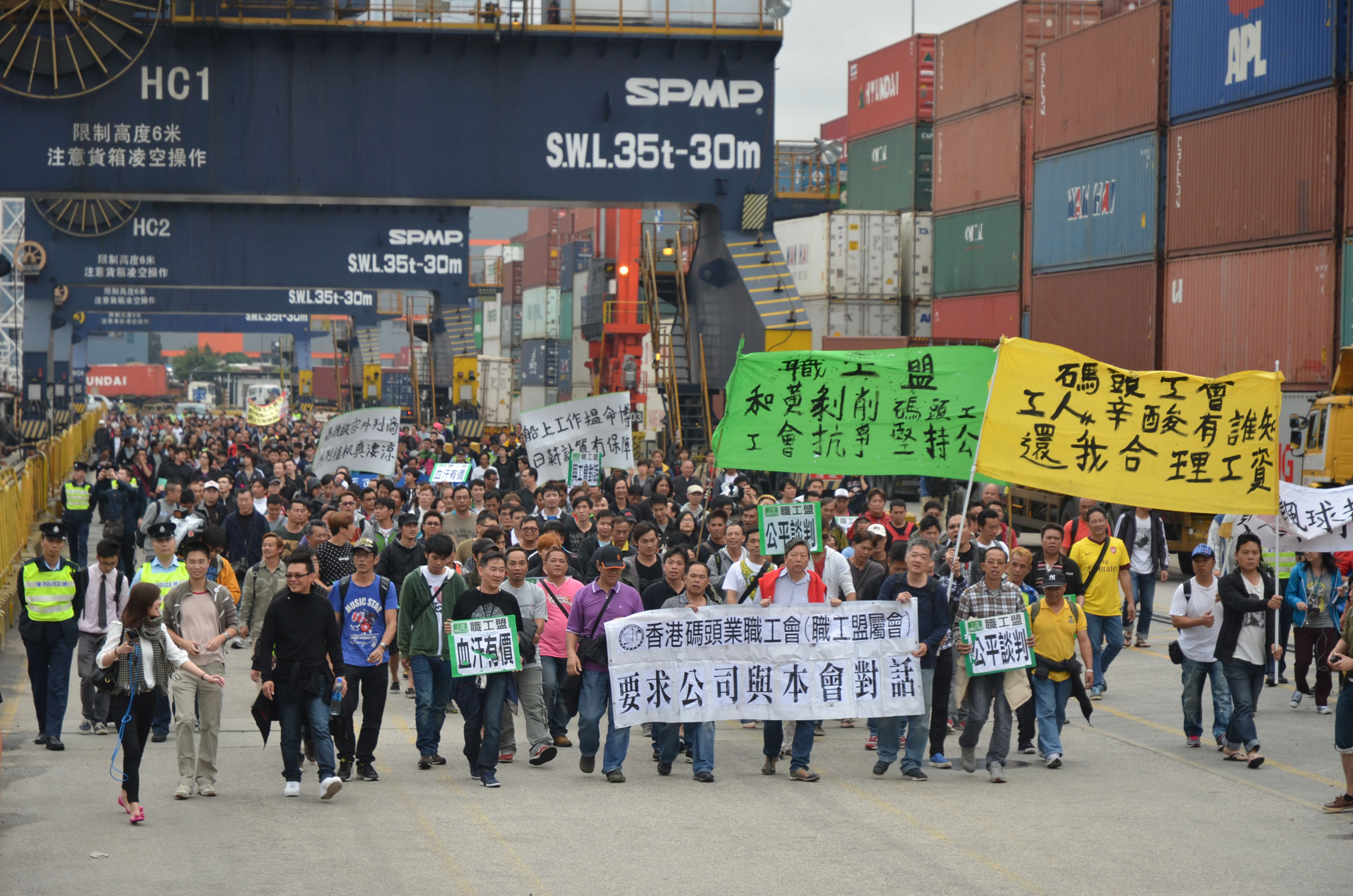
Stanley Ho Wai-hong will never forget the 40 days that began on March 28 2013. “At eight o’clock in the morning, over one hundred dockworkers blocked the entrance of Terminal Six and stopped the cargo vans from entering the terminal,” says the unionist. “This is how the strike started.”
As the General Secretary of the Union of Hong Kong Dockers, Ho led more than 500 dock workers in the longest strike in Hong Kong history for better pay and working conditions. Their employers were contractors working for Hong Kong International Terminals, a subsidiary of tycoon Li Ka-shing’s Hutchison Whampoa.
It was a David and Goliath scenario and the dockers’ cause earned them widespread public support. People donated tents, food and drinks and daily supplies to sustain the strike. Even when it rained down hard, many supporters put on their raincoats to join the striking workers.
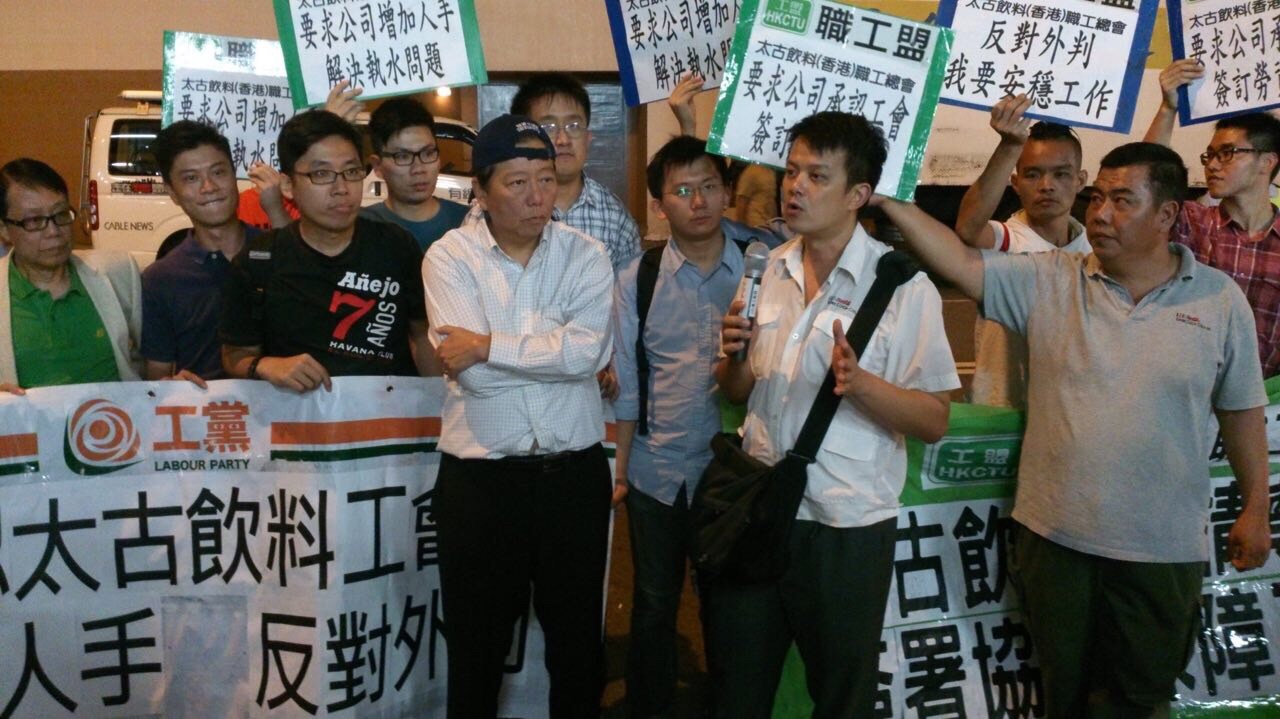
Don Chan Hing-lung (second from the right) has long been involved in union affairs Photo courtesy of Don Chan Hing-lung
In the end, the workers settled for a 9.8 per cent pay rise and promises of better working conditions, such as meal breaks and toilet breaks, allowing Ho to step back from the frontline. He is still doing union work and carrying out labour education.
Although the dockers managed to get a deal, Ho hopes Hong Kong can implement a collective bargaining law to protect workers’ rights.
Under Hong Kong’s Employment Ordinance, every employee has the right to strike and join a trade union. However, they do not have collective bargaining rights. This means there is no legal responsibility for employers to either enter negotiations with employees or to respond to their demands.
Ho says all three rights are of paramount importance in defending labour rights and the absence of a collective bargaining law leads to many unnecessary strikes and conflicts. He says that since employers are not obliged to participate in negotiations, employees can never bring their grievances and demands to the negotiating table. “Without the collective bargaining mechanism, we have no choice but to go on strike and let more people hear our voice,” says Ho.
That is not to say that Ho thinks a law on collective bargaining would necessarily eliminate or even reduce strikes and conflicts. However, it would at least provide an opportunity for employees and the employers to sit down to rationally discuss their concerns or even reach a consensus. “Why can’t we calmly negotiate in a civilized society?” says Ho.
Another reason to have collective bargaining is to ensure employers strictly follow any agreements made in the negotiation process. In the absence of legislation, employers are not legally bound to follow any verbal agreement reached with a trade union and there are no legal consequences to reneging on it.
Before they went on strike, dock workers’ representatives tried to negotiate with their employers, the contractors. One of the representatives was Ken Lai Ma-kin, who has worked in the terminal for more than 20 years and operates the lifting gear.
Lai recalls the company said they would follow up on workers’ demands after their meeting but no real progress was made. The labour representatives later also handed in a petition but the employers did not respond to it. With dialogue not working, the representatives called on more workers to join the strike.
Lai thinks collective bargaining legislation would put pressure on employers to respect negotiations with their employees. “If we do not put the consensus in black and white, they can deny all promises at any time,” he says.
The irony is that Hong Kong workers did briefly enjoy collective bargaining rights, thanks to a private member’s bill submitted by unionist and lawmaker Lee Cheuk-yan, which was passed in the last session of the pre-handover Legislative Council. Less than four months after the handover, the law was repealed by the Provisional Legislature. The reason given was that it would adversely affect Hong Kong’s competitiveness and attractiveness to overseas investment.
Changes to the rules after the handover mean that it would now be impossible for a lawmaker to table a private member’s bill on collective bargaining. While for its part, the government has no intention to reintroduce the law despite heated debate following the dock strike.
As number of Mainland visitors grows, what can Hong Kong do to woo international tourists?
By Emily Man, Eric Park
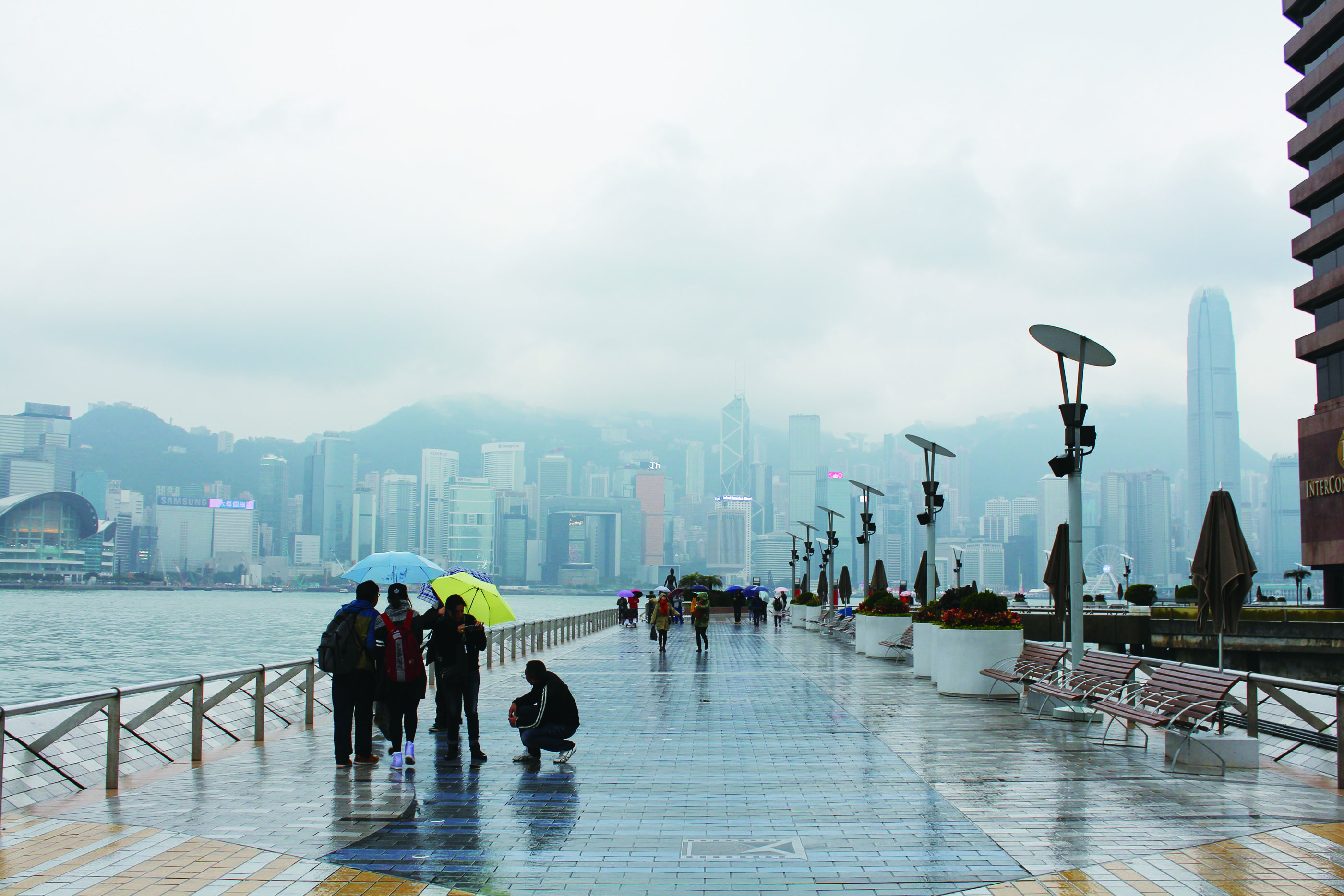
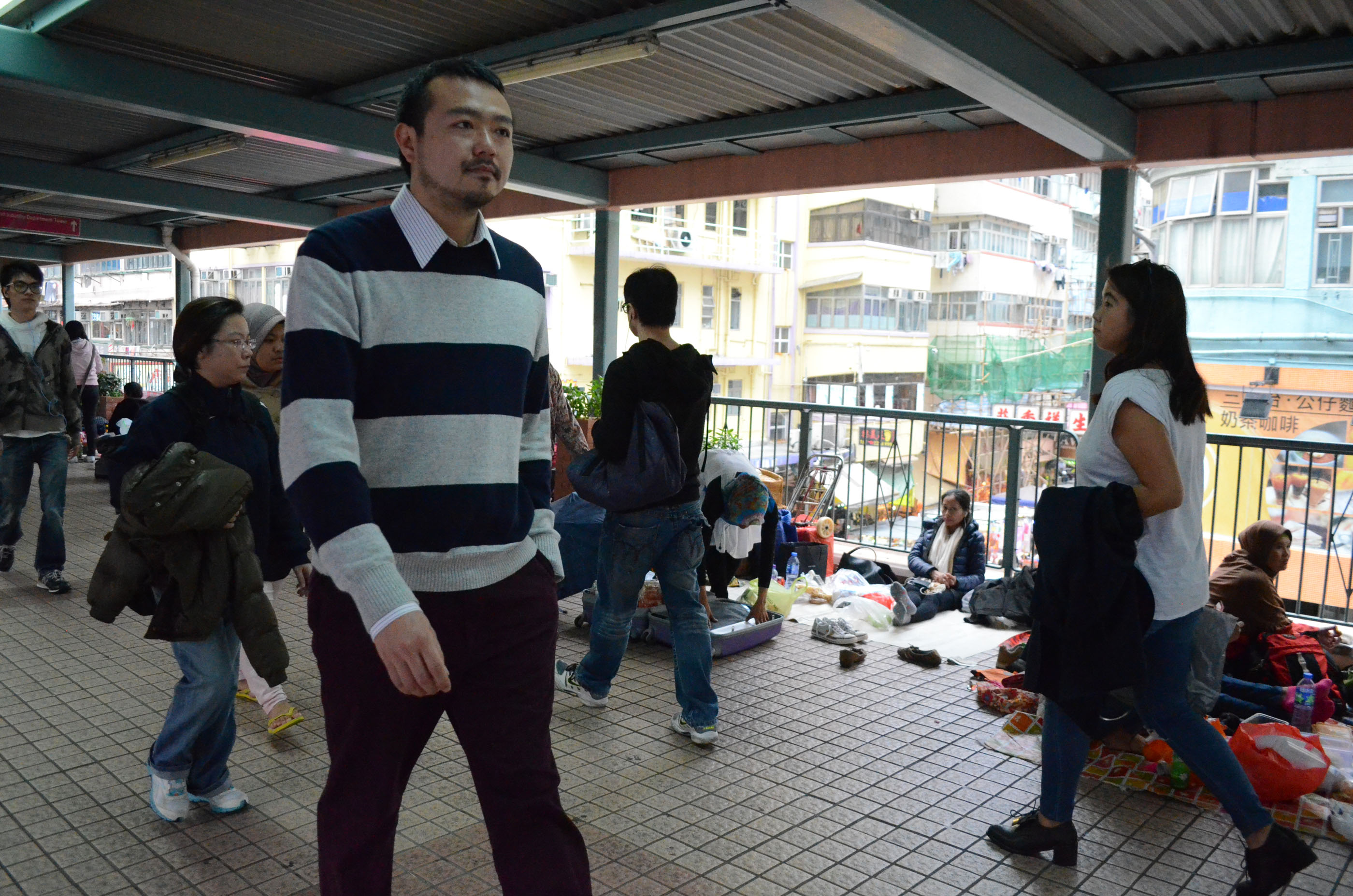
Crowds of mainland tourists jostle for the best photo-shooting spots with Victoria Harbour in the background at Tsim Sha Tsui’s Avenue of Stars, oblivious to the curious looks from other tourists. A slightly different scene plays out in Sheung Shui, a new town on the Hong Kong-Mainland border every day. Here, mainland visitors with multiple-entry permits crowd the entrances of dispensaries, where they stock up on milk powder and other daily necessities, either for personal use or for illegal resale later.
The influx of mainland tourists with high purchasing power has brought massive revenues to the retail industry, but it has also caused inconvenience to local residents and led to conflicts between Hongkongers and mainlanders, which boiled over last month in protests against parallel traders in Shatin and Tuen Mun that saw police use pepper spray inside a shopping mall.
It is not just the inconvenience that has triggered resentment in Hong Kong, but also the changes to the local landscape, with the ever increasing number of shops and businesses which seem to merely cater to mainland tourists.
According to the Hong Kong Tourism Board, Hong Kong accommodated more than 44 million mainland visitors last year, which means that the Mainland continues to be the territory’s biggest source of visitors. In 2009, mainland visitors accounted for about 60 per cent of total arrivals. That has steadily increased to almost 79 per cent in five years.
Crowds of Mainland paraellel traders gathering at Sheung Shui Station
The government is aware of this trend and the Hong Kong Tourism Board has put its focus on expanding international markets and maintaining a diverse portfolio of visitors, in order to uphold Hong Kong’s image as Asia’s World City.
The board’s Work Plan for 2015-2016 will allocate nearly half of its marketing budget of HK$352 million to promotions targeting overnight visitors. Of this, 76 per cent will be spent on reaching out to international markets. But before the efficacy of these measures can be seen, companies targeting non-mainland tourists are already struggling to attract business.
Local PhD graduates face tough search for university teaching and research jobs
Reporter by Karin Li and Kate Kim
Many parents dream that their child will one day earn a doctorate and consider it the key to a successful career, particularly in academia. Indeed, with greater numbers of people receiving a tertiary education, a Doctor of Philosophy (PhD) degree – which requires several years of in-depth, supervised research – is seen as a basic requirement for pursuing academic work. Yet, what is required to complete a PhD varies greatly among countries, universities, and subjects. Some programmes involve classes and examinations, some require undergraduate-level teaching experience, and some only research.
Professor Douglas Kerr
Regardless of the variation in course requirements, one thing many PhD students share in common is frustration over uncertain prospects. After devoting long years to studying and watching their peers who entered the job market earlier race ahead in their careers, PhD candidates may struggle to find suitable jobs related to their academic specialty after graduation.
This may, perhaps, explain in part the decline in local students pursuing PhD degrees. According to Graduate Employment Surveys (GESs) conducted by UGC-funded institutions (from 2009 to 2013), the number of local students embarking on PhD studies is dropping whereas the number of non-local students is increasing.
Intense competition for scarce jobs in academia is nothing new. It has always been a struggle for PhD students to find academic career opportunities as academia is overcrowded globally. Professor Douglas Kerr, dean of the Faculty of Arts at Hong Kong University, says that in the competitive job market, applicants are getting more impressive and well-qualified, and not just in terms of having PhDs from decent universities.
As a result, the recruitment standards for academic candidates are even higher than before. Kerr says universities will not only expect to see good PhDs but also expect at least one or two publications from applicants, even from postdoctoral candidates at the start of their career.
“It’s getting tougher, or you could say the environment is just changing with PhDs,” he says. A person coming after a PhD programme is unlikely to get a job unless he or she has publications already, even in the humanities, while that has been the case for science for many years.
Even publications will not guarantee PhD graduates a job at a university and local PhD graduates find they are losing out to those who have earned their PhDs from overseas institutions.
Those who study for their PhDs overseas establish networks with people engaged in relevant research in those countries. Once a local university hires a graduate from an overseas university, it has an opportunity to develop a closer relationship with that university. Specifically, recruiting a graduate from a famous university brings prestige to the local institution. Departments may even use the fact their faculty are trained overseas as a selling point.
Professor Nora Tam, a professor in City University and vice-president of The Society of Hong Kong Scholars, stresses that local students should challenge themselves to leave their comfort zones and go overseas to get more and wider exposure.
Tam thinks local students are weak in this regard when compared to their peers from the Mainland who would definitely strive to go overseas to get their PhD. “They will choose the good university and good group to go and after that they will go to another city to follow another group to do post doc and therefore you can see the link or the connections of these people; is it better than the local Hong Kong people,” she says. “Local Hong Kong born and trained [professors and PhD students] are becoming minority or endangered species”.
Tam says there are fewer opportunities for PhD students to do research in Hong Kong universities, so they do not have promising prospects of landing a good academic post after they graduate.
“If you want to do it because you want to find a good job, it is a bad investment,” she warns, “you should do it if you find it interesting.”
Besides having a PhD from a good overseas university, having good English is also an advantage as this is essential to writing for international publications and journals. Professor Michael Chan, an associate professor in the School of Journalism and Communication at the Chinese University of Hong Kong, says: “At the end of the day, English is the lingua franca in academia.” Compared with those who studied in predominantly English-speaking environments, local PhD graduates are likely to be at a disadvantage in this regard.
Even for those with publications under their belt, bagging a teaching post at a university also hinges on supply and demand issues. There are far fewer job openings in universities than there are PhD holders, so the competition is keener.
This is understandable, given Hong Kong is a small place, says Chan, which means candidates have to try even harder. “The rule of the game is really the publications,” he adds.
In many cases, holders of local PhDs find jobs teaching in community colleges and the private sector. The tertiary education sector has expanded in recent years, with the opening of new colleges and private universities such as the Centennial College of Hong Kong University.
For those who want to pursue their career in research in an academic setting, finding a suitable job may be even harder. Victor Li Chun Chiu, earned his PhD in chemistry in 2010 at the Hong Kong Polytechnic University but found the opportunities for research were too narrow. Li chose to develop his skills in other areas instead. He now works as a programme manager for Oxfam and is working on cultivating his leadership and management skills.
“Actually I still have an interest in research but don’t think I will get any further breaks in this field,” he says.
As for his peers from his university days, he says: that “very few people” are still working in chemistry, in the field of science. Li says some have joined the police or gone into sales. “Maybe the portion is six to four or seven to three. Seven is other fields. Three is field of science,” he adds.
Ho Wai-shing, an assistant professor at Caritas Institute of Higher Education who obtained his PhD in the University of Hong Kong (HKU), worked as a part-time lecturer at HKU for seven years. Failing to get a full-time regular teaching post at a research university, he switched to working at a self-financed tertiary institute and is now earning a better salary.
Ho points to the lack of support for research in Hong Kong as one of the critical reasons why the research output of local candidates for postdoctoral posts pales in comparison to that of top candidates worldwide.
Funding and resources for research in Hong Kong are limited and there tend to be few vacancies for purely research jobs, although this varies among different disciplines. Ng Tsz Wai, a research assistant in the School of Life Science at the Chinese University of Hong Kong, says there are more opportunities for research posts in biomedicine or chemistry, but few for his discipline of environmental science.
Ng says it is hard to pursue a career in research in Hong Kong, because the jobs are always contract-based. Without funding support or connections with supervisors, even research assistant posts are insecure. Ng returned to his current position helping his supervisor’s research project after unsuccessful attempts to find teaching posts at universities.
Wyman Tang Wai-man
It is said that the most common path for those who want to pursue research is to go overseas and come back. But this is not always advisable due to the inflexible nature of the research field.“I’ve got a collaborator in the US who asks me if I want to be his postdoc or not. But after second thoughts, I think it’s not so secure,” says Ng.
After completing the research project, he would have to work or find further research projects in America to earn a living since there is not much research in Hong Kong related to the professor’s research topic.
Like Ng, Wyman Tang Wai-man, a part-time anthropology lecturer at both the Chinese University of Hong Kong and the University of Macau, is also trying to strike a balance between making a living and trying to conduct research.
With a new-born baby in the family, Tang – who got his PhD from CUHK – cannot just give up his teaching jobs easily although that means he has no time to pursue research. “I have to be a superhuman in order to manage both (doing research and teaching),” Tang says.
His ultimate goal is to go to the US to continue post-doctoral studies and make a living by doing research there. “The advantage of getting a post doc oversea is that I get paid and at the same time I can focus on my research but now I get paid but I cannot focus on my research and that is the problem.”
After years of study and research, PhD students breathe a huge sigh of relief once their dissertations are handed in and they can finally graduate. But their worries may be just beginning. Choosing a career path after graduation is no simple matter and while a lucky few will go on to find a job teaching or in research, many more may be forced to make a living in a field that has little or nothing to do with their area of expertise.
For those who grew up in Hong Kong in the 1970s and 1980s, the annual Miss Hong Kong Pageant was one of the biggest entertainment events of the year. Families sat around television sets at home, rooting for their personal favourites and sharing in her joy or disappointment at the result. The next day, those results would be discussed in school, at work and on the streets.
Some young women and girls looked up to the beauties on the screen and imagined being in their place, waving elegantly at the audiences, or representing Hong Kong in international beauty competitions and getting a start in the glamorous entertainment industry.
But Hong Kong society has changed since 1973 when Television Broadcast Limited (TVB) first broadcast the pageant. Instead of rushing to wait for the show to start, Hongkongers are just as likely to be channel surfing while the show is on. Today Miss Hong Kong contestants can seem like old-fashioned throwbacks rather than iconic stars.
Winners of Miss Hong Kong Pageant 2013 celebrate after the ceremony
Acca Shum Kwai-ching, one of the top 10 finalists of the Miss Hong Kong Pageant 2013 says the image of Miss Hong Kong has been declining in recent years. She thinks that rather than a competition for physical beauty and grace, today’s pagaents are a vehicle to recruit attractive young women for the entertainment industry. “The ultimate goal for TVB in the Pageant is to search for potential artists,” Shum says, “I can tell that if the girl is not keen on acting or doesn’t fit the profile of what TVB is looking for, she is less likely to win.”
Although TVB still presents Miss Hong Kong as a paragon of beauty and wisdom, it is increasingly difficult to sell this carefully constructed image to viewers. Compared to classic beauty queens, such as Loletta Chu Ling-ling and Olivia Cheng Man-nga in the 1970s and 1980s, the winners of Miss Hong Kong in the 21st century seem to lack mystique. In the past, winners would spend their year-long “reign” as unofficial ambassadors for Hong Kong, taking part in international competitions and charity activities. Now, they are immediately trained to be actors in TV dramas or as presenters for entertainment shows. In other words, they are not much different from other newcomers in the TV industry.
Veronica Shiu Pui-sie, Miss Hong Kong 2014, disagrees that the contest is simply a means to find entertainment industry recruits. “I think the winner of each year represents that particular year,” she explains, “and to do that she should use her own way to display both her inner and outer beauty.” Shiu says the audience’s definition of beauty varies over time and amiability now seems to be a more important virtue for beauty queens.
Emphasising the personality of the contestants, today’s production teams try to establish a more approachable image of Miss Hong Kong and contestants are given more individual time to express themselves in front of the cameras and interact with the audience. They often speak to their fans through social media, posting selfies, behind-the-scene details about the pageant preparations and updates from their daily lives. Through blogs and platforms like Facebook they are encouraged to get fans to post messages of support.
Beauty pageants have long been seen as a commercial gimmick for the Hong Kong TV industry to attract the public’s attention, and that extra attention can in turn be monetized. Different companies sponsor the jewellery and luxury goods for the contestants during the broadcast to maximise publicity, while the TV companies sell commercial time during the live competition.
If you have a social media account and you have checked it today, the chances are you will have seen a selfie in your feed. The term “selfie” started to appear in 2005 when people began to post self-portraits on social media like MySpace and Facebook. With newer versions of smartphones incorporating front-facing cameras and the popularity of photo apps like Instagram, the taking and sharing of selfies grew into a worldwide phenomenon.
In 2013, Oxford English Dictionary picked “selfie” as the “word of the year” – just a year after it was selected as one of the “top 10 buzzwords” of the year by Time magazine. On Instagram alone, the word is used as a tag for over 220 million photos. Meanwhile, the hashtag #selfie appeared in more than 150,000 tweets on Twitter during a single week in October 2013.
Daniel Lau’s selfie atop The Center went viral on foreign media. (Courtesy photo from Daniel Lau)
Photographer Daniel Lau became an international a sensation when online media published pictures of him atop The Centre, a 346-meter, 73-storey building. The 23-year-old and his friends had scaled Hong Kong’s fifth tallest building last August and online footage shows Lau swinging his monopod – otherwise known as the “selfie stick” – to film his friends munching bananas with Victoria Harbour and Central’s high-rises as their backdrop.
Considering himself an explorer, Lau aims to take photos that are extreme but aesthetically pleasing, and taking selfies on the rooftop is a way to combine the two. “They are daring, but at the same time, they are beautiful,” Lau says. “People are always saying my selfies are so extreme, and maybe people are looking for those extreme selfies that they can’t take.”
Lau shares photos of his adventures on his public account on Instagram. With over 200 posts, he enjoys a following of over 55,000 from all over the world.
Armed with his selfie stick and a GoPro, a compact camera used for sports and action filming, Lau travels to various cities and takes photos on the rooftops of the tallest buildings and down below ground on construction sites. In Lau’s hands a selfie is like a passport stamp, proof that he was there, especially in extreme and dangerous environments. “This is the sense of presence. I am telling people I am really there,” he says.
Christine Fung Hiu-tung prefers taking selfies of her sporty side.
Few people would go to the extremes Lau does to take a selfie, but some do think of selfie-taking as a form of self-expression. Christine Fung Hiu-tung posts selfies of herself doing sports and working out because she feels that is when she is expressing her authentic self. “There’re some beautiful moments I see in girls,” says 25-year-old Fung who works in marketing for a sports company and sometimes engages in freelance modelling. “When they work out, when they sweat, it’s the best moments for us to see.”
She is not concerned about what others think of her selfies and is not a frequent poster on Facebook and Instagram. When she does post a selfie, it would most likely be of her running or practising yoga. She wants to convey a lifestyle that is “sporty, natural, strong and healthy”.
“There are a lot of messages that one can convey [through selfies], but I choose to tell people the life that I sweat,” Fung says. “That’s how I define myself. It shows my personality, my character, my attitude towards life.”
Fung does not post selfies to keep her followers entertained and is not bothered about constructing an image of herself on social media. “I usually say what I feel when I’m taking that photo,” she says, “If I feel like I want to post a selfie, I just go ahead.”
Former tearaway, lecturer Li Chun-hong now inspires and serves
By Tiffany Tsim
In a lecture hall filled with laughter, a man standing at more than 1.9 metres tall gives a lecture to his class of enraptured humanities students. Li Chun-hong is a lecturer at the Chinese University of Hong Kong’s (CUHK) General Education Department and, at 35, he is the picture of respectability. But as a child he very nearly went off the rails and joined the triads.
Throughout Li’s childhood, his mother spared much of her time taking care of his intellectually disabled younger brother. His father worked as a seaman and only saw his family once a week. Li and his older brother were pretty much left to their own devices and they shoplifted from supermarkets, stationary shops and toyshops when Li was just in primary two. He would also get into frequent fights in the streets of Mong Kok where the family lived.
Li ran with a bad crowd, hanging around with gang members who considered him one of their own. But although Li stole, lied and fought, he still believed he was a good person. “When I was with the triads, I insisted on stealing from the chain stores only. I never shoplifted from small shops,” explains Li. “And I gave [the goods] to the foodless!”
He attributes this to the influence of his mother who he describes as gracious and kind-hearted. Despite the complex circumstances of her family, she never grumbled and complained. However, she was strict with her sons, and would beat Li when he did something wrong.
The turning point in Li’s life came when he was in secondary one. He defended a girl who was threatened by a triad from a rival gang. As a result, he was badly beaten up in a revenge attack and ended up in hospital. News of the incident spread fast and caused a scandal in his school and his family.
“It was the first time I saw my mum crying,” Li says. “She did not utter a single word.” Her silence was more damning than the most severe tongue-lashing. Li recognised how disappointed and helpless she felt at that moment. He started to reflect upon his past. “I’m a good person but why do I let myself become scum?” he asked himself. Li resolved to change.
During the summer holiday of secondary two, Li quit swearing, “I [used to] swear a lot. Every sentence I spoke included a four-letter word,” Li says. He also avoided his former gang friends for the entire holiday. Instead of hanging out with them, he picked up a new hobby, basketball, to pass the time during his holiday.
Li Chun-hong delivers a general education lecture at the Chinese University of Hong Kong
Playing basketball helped him to stay motivated to be positive. He decided that people needed to have a goal and realised that education would give him more chances in life. The former tearaway became a diligent student who crammed for the public examinations.
The hard work paid off and, in 1998, Li was admitted to CUHK to study for a degree in religious studies. He says he was fascinated by humanities subjects, such as religious studies, anthropology and philosophy, because he was interested in interpersonal relationships. The majority of religions advocate equality and human dignity regardless of people’s social class or if they are disabled.
Club 71’s Grace Ma Lai-wah refuses to call time on cultural hangout
By Vivienne Tsang
Tucked away in a non-descript alley in the trendy Soho district, Club 71 comes as something of a surprise. At the entrance, there are three ceramics of human heads by a local potter, Caroline Cheng, with the words ‘THERE’, ‘IS’ and ‘HOPE’ engraved on their foreheads. In the corner of the colourful painted interior of the bar, a musician is playing violin. Grace Ma Lai-wah, Club 71’s owner, extends Varsity a warm welcome.
The bar, named after the annual July 1 protests is the 61-year-old Ma’s second business venture. The first was the iconic Club 64 in Lan Kwai Fong which Ma ran for 14 years. Those were years that spanned the aftermath of the June 4 crackdown in 1989 to the 1997 handover, SARS and the 2003 July 1 protest against Article 23.
Throughout that time, Club 64 was a place where people from Hong Kong’s local culture, arts, social activist and media circles would gather to socialise, relax, talk politics and have a drink. Watching over the bar throughout those years was Ma.
Surprisingly, she says: “I’ve hated doing business my whole life, not to mention running a bar.”
Ma was enlisted to help by her former husband, a scriptwriter, who was one of the original 12 partners when the bar opened in 1990. Others included the late social activist Ng Chung-yin and media veteran Lung King-cheong.
Ma chats with customers
Although she was still working as a secretary in a nursing unit at the time, Ma started working at the bar in the evening after work. “Men do the talking, and the women do the work,” she complains. She worked without pay for half a year before she began running the bar full-time.
Unlike the other bars and pubs in the area, the atmosphere in Club 64 is peaceful. No one plays hand games while drinking in the bar, instead they chat, read or play music. Ma says she did not deliberately create the vibe. “Perhaps it’s related to my personal character. I don’t like tumult,” she surmises.
The early days of Club 64 were tough for Ma. The business struggled to break even and her marriage broke down in 1993. She drank heavily.
There was also trouble with gang members who visited the bar and harassed Ma frequently. As she was new to bar business, she was at her wit’s end. One day, a gangster asked her for protection money. “I really had no money to pay him, so I told him, ‘I think no one can protect anyone’, she recalls. Eventually, she learnt how to deal with them and earned their respect. Over time, things became easier for Club 64 and for Ma.
For many of her customers, and even Ma herself, the name Club 64 conjures up memories of the Tiananmen crackdown in 1989, an event that had a great impact on her. During the pro-democracy protests, Ma joined rallies in support of the students in Beijing. Until the news broke of gunshots in the capital, she held on to the hope that China would change. The violent suppression left her shocked and speechless.
“It’s too much to handle, using a name like this for a bar or business.”
When your friend declares, “See, I’ve just visited the South Pole”, you may not believe him – until he shows you a photo of himself standing in the middle of a large crowd of penguins. But wait, how could he only be wearing a T-shirt and short trousers in such a chilly place?
Here is the answer – the photo is taken at the city’s first three-dimensional (3D) painting museum, Hong Kong 3D Museum. Opened in July 2014, the museum provides a unique experience for visitors to take offbeat photos with friends and family and interact with interesting paintings that appear three-dimensional when photographed. Over 70 3D paintings are displayed in the museum’s 10,000 square-foot hall.
The museum is divided into five zones of different themes, “Love Journey”, “Imaginary Wonderland”, “3D Experience Zone”, “Chinese Culture” and “Hong Kong Culture”. Visitors can create their own romantic love stories or exotic adventures with surreal backgrounds.
The essence of local culture is highlighted in the museum. “Elements of local culture make our museum unique,” Zaccheus Law Man-hing, managing director of Hong Kong 3D Museum, says. He says the museum hopes to promote local culture, both modern and old, through a special medium, 3D painting.
Some paintings are based on iconic Hong Kong cityscapes, including famous landmarks that now only exist as part of the collective memory. For example, there are paintings of the demolished Queen’s Pier and Kai Tak Airport, bringing visitors back to the good old days.
Law says the museum does not only offer a fun photo-shooting experience, but also an opportunity for visitors, especially the young ones, to learn more about the city’s history through the creative artworks.
This month, the museum is holding “The First Ever One Piece 3D Exhibition”, featuring the popular Japanese comic character, Luffy and his crew. It enables visitors to engage in the comic like never before. If you are a One Piece lover, don’t miss this unprecedented event.
Visit Hong Kong 3D Museum at 1/F Hilton Tower, Tsim Sha Tsui East. For more information, please visit www.hk3dm.com.hk
Create your own pressed flower products at Heart of Heartz
By Jayce Lai
Do you want to send real flowers that will never wilt or preserve the beautiful blooms that you have received? Pressed flower craft will let you do just that. At Heart of Heartz Press Flower Association, you can create your own beautiful and elegant pressed flower products.
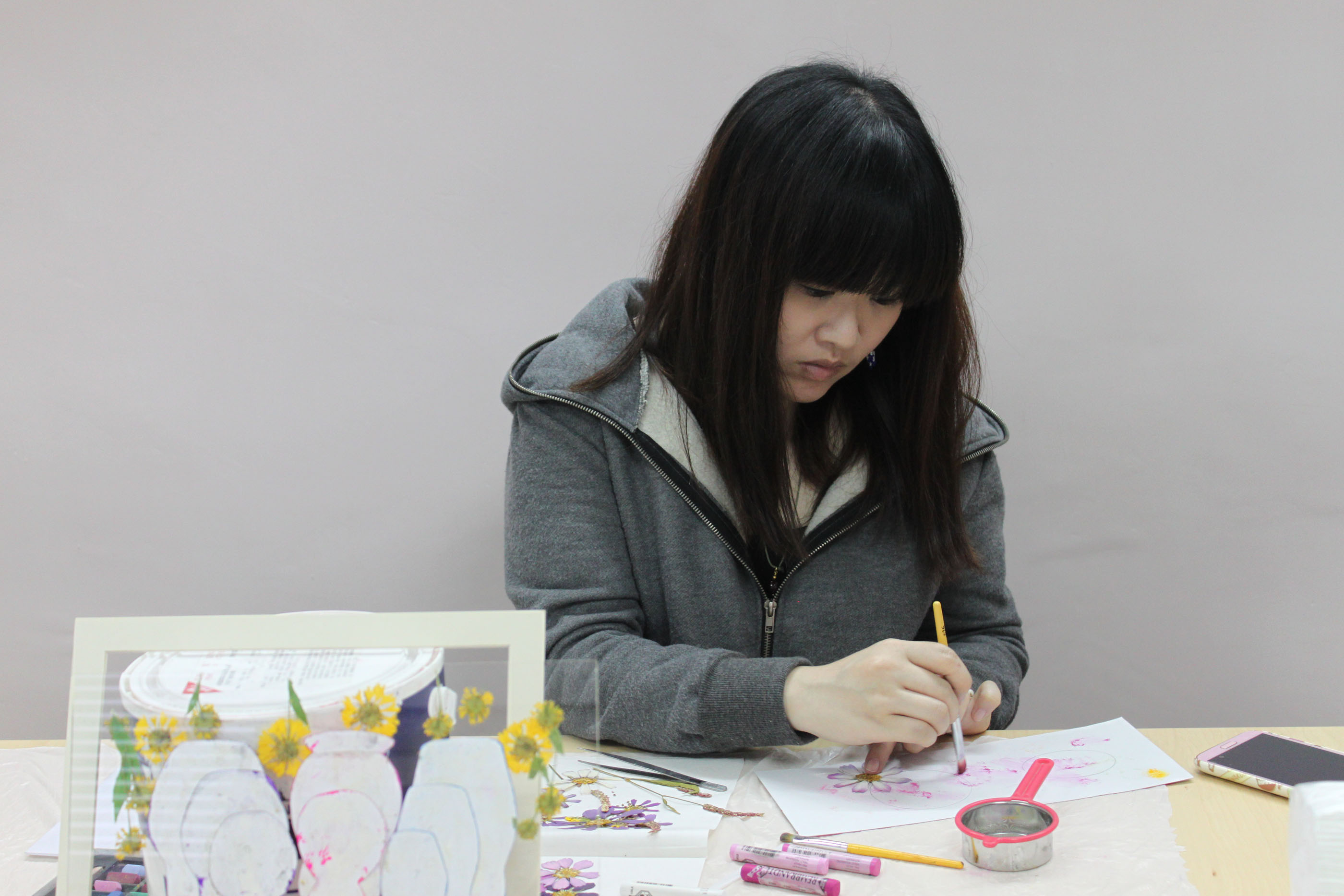
The craft of pressing flowers has a long history. Originating in England in the Victorian era, it has experienced a revival in the last few decades. The process of making pressed flowers consists of drying and pressing flower petals and leaves to remove the moisture. The pressed flowers and leaves can then be used to in various ways, such as incorporating them into paintings or different handicrafts and accessories.
Trista Tse, the founder of Heart of Heartz Press Flower Association, was a banker before she became a pressed flower instructor. Inspired by a pressed flower exhibition during a trip to Taichung in 2012, Tse decided to quit her job because she found herself more interested in making pressed flowers. She decided to take a pressed flower course in Taipei and returned to Hong Kong to set up Heart of Heartz Press Flower Association.
To Tse, pressed flower art is a kind of meditation that brings her deep-down peace. “[When I’m doing pressed flower] I forget about the world as I only focus on making the product,” says Tse with a satisfied smile on her face.
Tse says that pressed flower art has inspired her to enjoy life in the slow lane and appreciate the beauty of nature more. As Hong Kong is a hectic place where people are often too busy to savour and enjoy life, Tse hopes to promote the attitude of slow-living through her pressed flower workshop.
Heart of Heartz offers workshops that allow people to create their own pressed flower products. Don’t worry if you do not have any prior experience of the craft as Tse will provide detailed instruction. Classes are usually small, with two to six people in each class. Fees range from HK$380 to HK$980, depending on the type of products made and the number of lessons required.
Apart from holding classes, Heart of Heartz also sells many lovely pressed flower products, from accessories, clocks, to kitchenware and bouquets for weddings. Every product is uniquely designed by Tse.
If you are interested in pressed flower art or simply want to treat your loved ones with a special gift, head to Heart of Heartz. You can also check out its Facebook page at www.facebook.com/heartofheartz