










Home Blog Page 116

Read All About Me!

Lenders check out living books at the Human Library

Reporter: Viola Yeh

In January this year, more than a hundred people gathered at West Kowloon Waterfront Promenade to meet people they had never met before and listen to first-hand stories they could never have imagined. And, while they were listening, sitting or recliningon colourful mats, they also gazed out to sea and breathed in the scent of fresh grass.

Those doing the listening were “readers” and those telling the stories were human “books” at the fourth Human Library event to be held in Hong Kong.

The Human Library is a platform for communication rather than a physical collection housed in a particular space.

The concept originated in Denmark in 2000. Its purpose was to raise awareness of minorities and to mobilize people against violence. Slogans like “Don’t judge a book by its cover” were used to encourage readers to get away from stereotypes and look into people’s stories.

After the first Human Library in the Danish capital, Copenhagen, the concept spread around the world, including to the United States, Japan, and China.

The first Human Library in Hong Kong was held in August last year. It was co-organised by youth magazine Breakazine! and A Generation, a Christian organisation involved in youth and theatre work. The event was held at a youth camp near Sha Tin. Since then there have been other venues and other organisers.

The Human Library aims to break stereotypes by offering a platform for people to communicate directly with one another. Readers are free to ask questions in order to enhance their understanding of the books. Mutual respect is the key to creating in-depth dialogues.

The collection in Hong Kong now consists of 50 human books, but they can only be read when there is a library event. These living books come from all walks of life.
There are people from minority groups, people outside of the mainstream, including sex workers, transsexuals and former convicts. Many have been marginalized due to their occupation, race or beliefs.

Anyone over 15 can apply to borrow a book. To do so, you browse the catalogue of books on the official Human Library website, choose the ones you are interested in and register them. You will then be able to read them on the day of the event. Each reader gets 45-minutes at most to communicate with each living book.

Reader Phoebe Ng Yuk-ying, a 19-year-old university student, says she often used to question the way certain groups were portrayed on television programmes but had never looked into the issues seriously.

The first living book she read was a sex worker. Before chatting with her “book”, Ng had thought that sex workers were forced to take up their jobs. She was surprised to learn the living book was happy with her job and was willing to share her interesting work experiences.

“We usually judge others subjectively and imagine they view things in a certain a way, but in fact they may not,” says Ng. She thinks the Human Library has offered a channel for people to meet others they would not otherwise come into contact with.

The Animated Storyteller

John Chan Yu-fung creates tales to warm Hong Kong hearts

Reporter: Vivian Ng

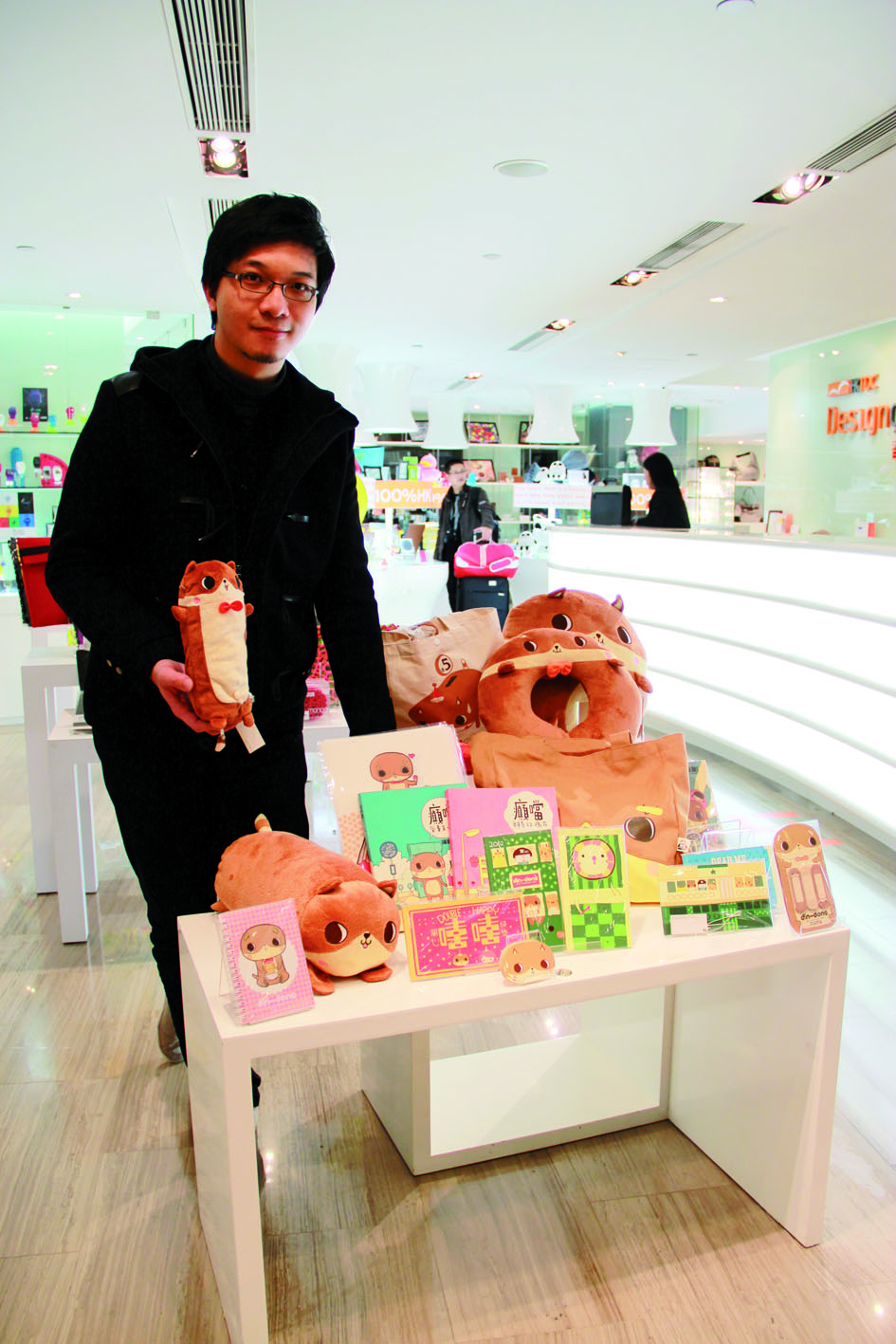
A slim, bespectacled young man carefully arranges a display featuring soft toys and other products based on cartoon characters at the Design Gallery at the Hong Kong Convention and Exhibition Centre. What shoppers do not know is the man is actually an acclaimed animator and the creator of the Din-Dong character that the products are based on.

The attention to detail which he shows in arranging the products for a photo-shoot provide a clue to his training as an illustrator.

John Chan Yu-fung has won numerous local animation awards and is the first Chinese to win the grand prize in the TBS DigiCon6 Awards. But the 34-year-old prefers to call himself a “storyteller” rather than an animator.

Chan’s twin passions for storytelling and animation were planted in childhood when his parents took him to the cinema to watch an animated feature film, Laputa: Castle in the Sky.

The film, by prominent Japanese animator Hayao Miyazaki, tells the story of a boy who helps a girl with a flying gem from Laputa, a castle in the sky, to save the world.

Chan was hooked. “I realised that the scenes in a cartoon could also touch some of the audience members,” says Chan. “Then I started to think if I could do something similar in the future.”

After that, Chan’s enthusiasm for drawing blossomed. He excitedly recalls how he drew different cartoon characters in his primary school textbooks. This interest in drawing continued into his teenage years.

Chan learnt the basic skills of drawing in secondary school and continued to sketch but these skills did not help in his ambition to be a storyteller.

The turning point arrived when Chan’s secondary school art teacher told him a story about a colour-blind artist. The teacher inspired Chan by telling him how the artist used colours differently because of his disability, but created artworks with a strong personality.

The story gave Chan an insight into the process of creation. It helped him to think creatively and independently. “Those of us engaged in creation, we sometimes need to use things outside the normal confines, we have to use things other people haven’t thought of before,” Chan says.

After graduation, Chan worked as an illustrator at a company where he drew very detailed sketches. However, he soon left this job and, persuaded by a friend, he travelled to Australia in 1995.

Chan spent two years Down Under, taking drawing and language courses and travelling around the country. However, he learned most from his daily experience of life in Australia rather than the classes.

Chan found mixing with other international students an interesting experience. “You could see everyone had a distinct personality!” he says.

He particularly appreciated the humility the Japanese students showed towards learning. At the time, Chan had sometimes thought he was superior to others as a Hongkonger. He soon realised he was wrong.

“I discovered that if I continued with such an attitude, I would never learn anything,” says Chan. “But the Japanese could because they were humble enough to learn.”

One-man Crusade

Activist Pong Yat-ming takes on the developers and conglomerates
Reporter: Thee Lui
Pong talks about his action - “A Year without Patronising the Business of the Conglomerates” for TED.


A 38-year-old man with a shaved head walks onto the stage with a guitar and a bicycle. He opens his talk by strumming and singing lines from John Lennon’s Imagine,

“Imagine no possessions
I wonder if you can
No need for greed or hunger
A brotherhood of man
Imagine all the people sharing all the world.”

In December, the freelance teacher, veteran activist and now “local hero”, was invited to give a talk by Technology, Entertainment and Design (TED), the American non-profit group that organises talks by inspirational people around the world under the slogan “ideas worth spreading”.

The invitation was just one manifestation of the recognition Pong Yat-ming has received since he launched his civic action, “A Year without Patronising the Business of the Conglomerates.”

Pong began his campaign in October 2010, seeking to show it is possible to break the domination of Hong Kong’s developer conglomerates. Since then he has boycotted chain-stores and transport companies run by property developers and stopped using products and services owned or operated by big corporations.

Pong’s home is a unit in an industrial building in Fo Tan. A big curtain divides a large open space. On one side of the curtain, Pong has a compact living space that he shares with his two cats. On the other side there is a work and exhibition space Pong shares with a friend. The walls are lined with paintings and foreign handicrafts. His bicycle, which he rides to jobs and to visit the small shops and restaurants in his local community, is parked outside.

Pong’s independent personality was shaped early in his childhood. His parents divorced when Pong was young and the boy was sent to live with his grandparents. The young Pong learnt to make his own decisions and be responsible for his own life from an early age.

There were never any discussions about what kinds of extra-curricular activities he should join and he did not have to ask permission before going out. He remembers when he was in Primary Three, he informed his grandparents he was going camping just the day before he went. When it was time to go to secondary school, he applied for the schools he wanted on his own and without his parents’ input.

Pong sees positives in how he was raised. He says he was allowed to follow his heart, rather than his parents’ expectations. He believes every person’s life story is written through the individual decisions they make. “Otherwise, everyone would just look the same, our faces would be blurred. So I strongly think we should follow our own desires.”

In Pong’s case, the great passion has been for education. He began tutoring younger children when he was still a secondary student himself. In one case, a parent asked him to teach her child how to be a good person rather than any particular academic subject. So Pong took the child on local visits and to join community activities.

Since graduating in cinema and television studies at Hong Kong Baptist University, Pong has had a succession of freelance teaching jobs. He has taught classes in every district in Hong Kong in everything from painting to drama, to English and general education in schools, community centres and churches. He refuses to be tied down to a full-time job.

Back in the 1990s, Pong started helping new immigrants from the mainland. He has also worked with various non-profit organisations, such as Breakthrough, which mainly focuses on youth services, and joined local civic movements.

He has taken part in protests against the demolition of the Star Ferry Pier in Central and the campaign to save Choi Yuen Chuen, the village that was demolished to make way for the Hong Kong Express Rail Link to the mainland.

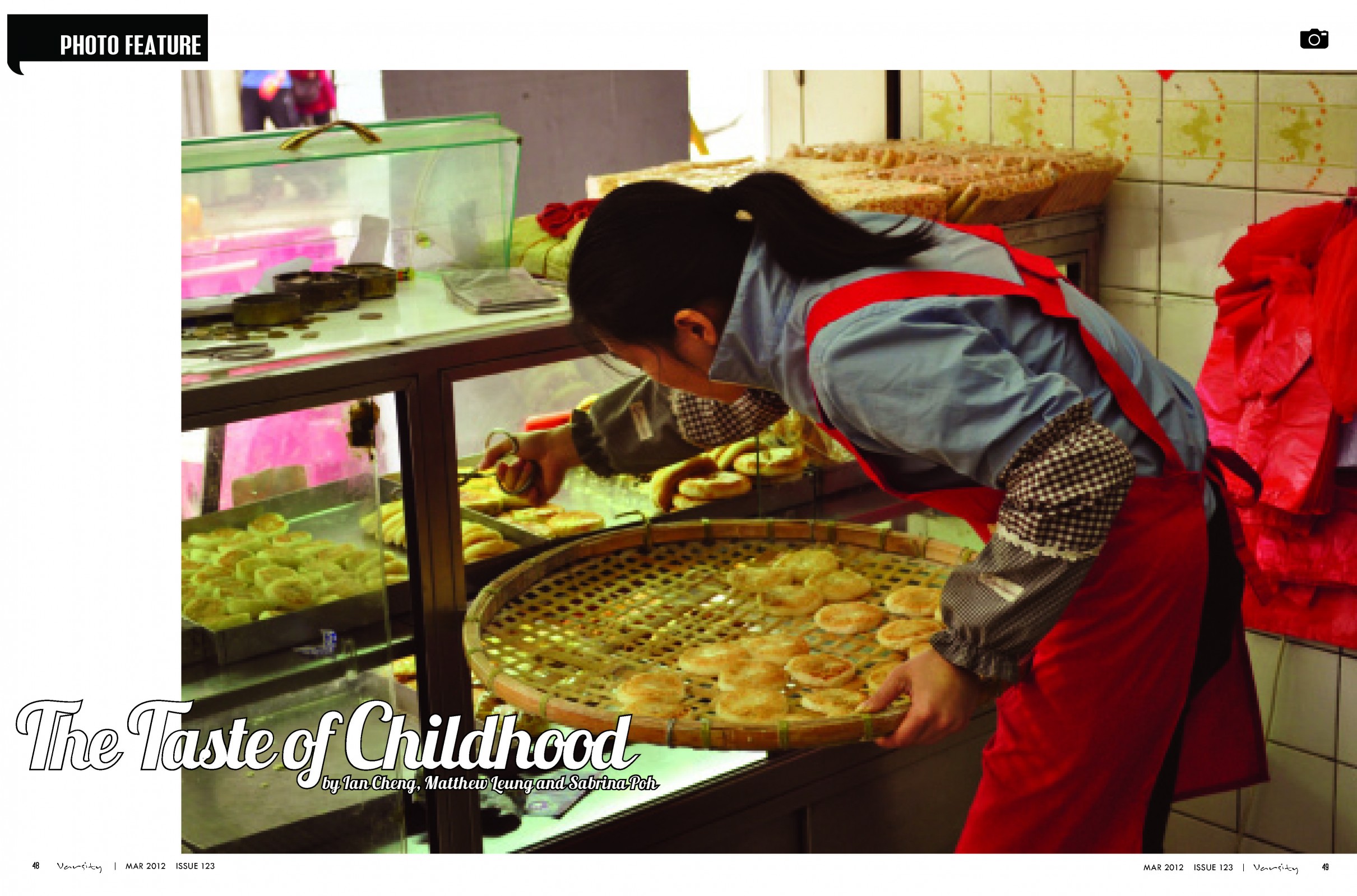
The Taste of Childhood

Reporters: Ian Cheng, Matthew Leung, Sabrina Poh


Cabs to Bags

Local company gives new lease of life to old taxi seats

Reporter: Matthew Leung


It is black, it feels like leather and it has a distinctive smell. You have seen it somewhere before, and more than once. It may have taken you a minute or so, but eventually the penny will drop. You will recognize the materials of these bags are sourced from local taxis.


Founded in 2010, Handsome Co. designs bags and accessories that are made of useable parts of discarded taxis such as vinyl seat covers and seat belts.


It all started when co-founder Billy Potts was walking around Tai Hang one day and noticed there were lots of garages fixing taxis, leaving behind many spare parts. He saw some upholsterers changing seat covers that still looked useable, so he bought two seats from an upholsterer and experimented with them.


Potts, a lawyer, teamed with his friend architect Joseph Ng Sheung-yi, and scavenged for suitable discarded taxi materials after work. They decided to do something for the environment and the community.

Be Good!

Popular App enables users to experience the inconvenience of being disabled by holding onto a button on their smartphone

Reporter: Sabrina Poh

Holding a mouthwatering ice-cream cone, you are savoring a triple scoop under the hot sun. Oops, your cell phone suddenly rings and it looks like an urgent call. There is nothing to panic about, you may enjoy the ice-cream and take the call at the same time.

Wait, what if one of your hands is missing? Having only one hand means it may be tough or even impossible to pick up the phone and finish the ice cream cone.

Welcome to the iTunes application A Good Button.

It is a simple way to help you empathize with those with physical disabilities through direct experience. Experience it temporarily; build an understanding for life. The rules of the game are simple: Just press the button and hold it.

With one hand on the button, try to carry out daily tasks with your other hand and see how long you can hold on before letting go. At the end of the challenge, a question will appear, asking you how you feel after experiencing a disability for a certain number of seconds. You may either feel touched, challenged or moved.

A Good Button was developed by the Hong Kong Society for Rehabilitation to educate the general public on the difficulties and challenges faced by disabled people.

Most users find it meaningful and worth giving a try; so they share it with their friends.

Among them is Ann Yiu Fung-Yee, a second year students at Chinese University of Hong Kong. Yiu felt challenged after attempting to tie her shoelaces and put on a jacket whilst holding onto the button. She experienced disability for 183 seconds.

Salon Culture Brews Taiwan Blend Democracy

Taiwan’s cafes and bookstores host  a vibrant salon culture that played an important part in the development of the  island’s democracy and as Varsity discovers, continues to provide a platform for debate today

By Victor Chan and Nia Tam


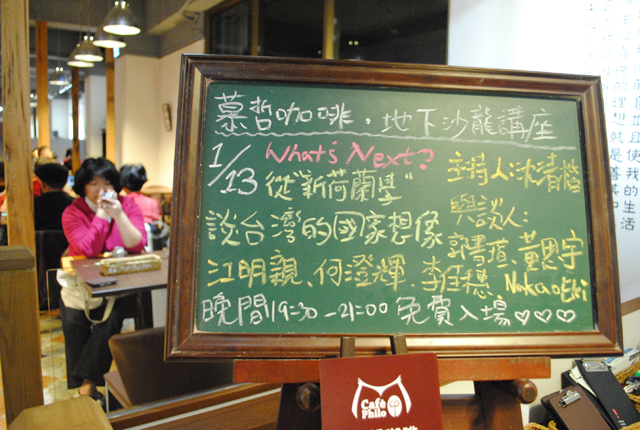
On a Friday night before the day of Taiwan’s presidential election, customers at a café in Taipei sipped their coffee and read books. In the basement space below them, around 50 people gathered to discuss what Taiwan could learn from its past colonial masters, the Dutch.

As they hotly debated issues ranging from animal welfare to language and culture, they shared their concern about Taiwan’s development. They came from different backgrounds; authors, cooks, students, workers and retirees.

Some of them were regulars at salons, places where people can exchange opinions on the issues of the day.

Raphael and Muller, both in their twenties, attend this kind of salon almost once a week. They believe public discussion helps people to understand more about their society and gain meaningful insights through rational debate.

Salon culture has played an important role in shaping Taiwan into the most democratic society in the Chinese-speaking world.

The liberal culture sprouted in the Wisteria Tea House, a Japanese-style teahouse situated in Taipei, in the 1950s. David Chow, the late owner of the teahouse, invited political dissenters to secretly criticise President Chiang Kai-shek’s dictatorship when Taiwan was still governed under martial law.

As more and more discussions about democracy and other public issues were held there, the teahouse was transformed into the archetype of the present-day salons. Now, many forums can be found in Taiwan’s cafes.

As active participants in the debates held in Wisteria Tea House and other salons, Liao Hsien-hao, professor of foreign languages and literatures at National Taiwan University, thinks salon culture helps foster social stability by providing an open platform for the general public to vent their anger towards the authorities through conversation.

Apart from cafes, salon culture in Taiwan has also spread to some independent bookstores. Mandy, who works at Fembooks, a feminist bookstore in Taipei, takes part in various talks and forums about gender and social welfare that are held in the store. She believes that when the public’s voice grows stronger and louder, it can directly influence real politics.

It is no surprise that running a cafe or a bookstore for regular public discussions is not a lucrative business. Even so, Hung Jane, who runs a cafe named Humanity Space, says she gains in other ways through the discussions. “A sense of deliberation can also be developed among the citizens by critically debating the public issues,” Hung says.

However, some other cafes and bookstores choose to deliberately distance themselves from public issues. They still offer spaces for talks about the arts and literature, but they do not describe these spaces as salons. The shopkeepers of Whose second-hand bookstores says they do not want to get involved in public or political issues. They say theirs is an alternative attitude towards salon culture.

This alternative positioning of salon culture is itself an indication of the democracy and diversity which salon culture has helped to nurture. “Salon culture is a process that the public has to experience when learning modern democracy,” says Kuang Chung-shiang, assistant professor of the department of communication at National Chung Cheng University. To Kuang, democracy can only be learnt through rational discussion and dialogues in society.

Partisan Taiwan Press Splash Political Colours on the Page

By Samuel Chan, Elizabeth Cheung, Lam Cho-wai

Partisan and Proud

There was nothing showy about the star. But the atmosphere was as much rock concert as it was political rally,“Ing-wen! Ing-wen! I love you!” shouted members of the crowd –supporters of Tsai Ing-wen, the Democratic Progressive Party (DPP) candidate in January’s presidential election.

The DPP and its allies form what is known as the Pan-Green camp in Taiwan politics. And among those wearing their political colours literally at the rally were some green-clad reporters and news photographers.

These journalists are very proud of their political stance but insist it would not affect how they report the news as that would be determined by their media organisation’s editorial stance.

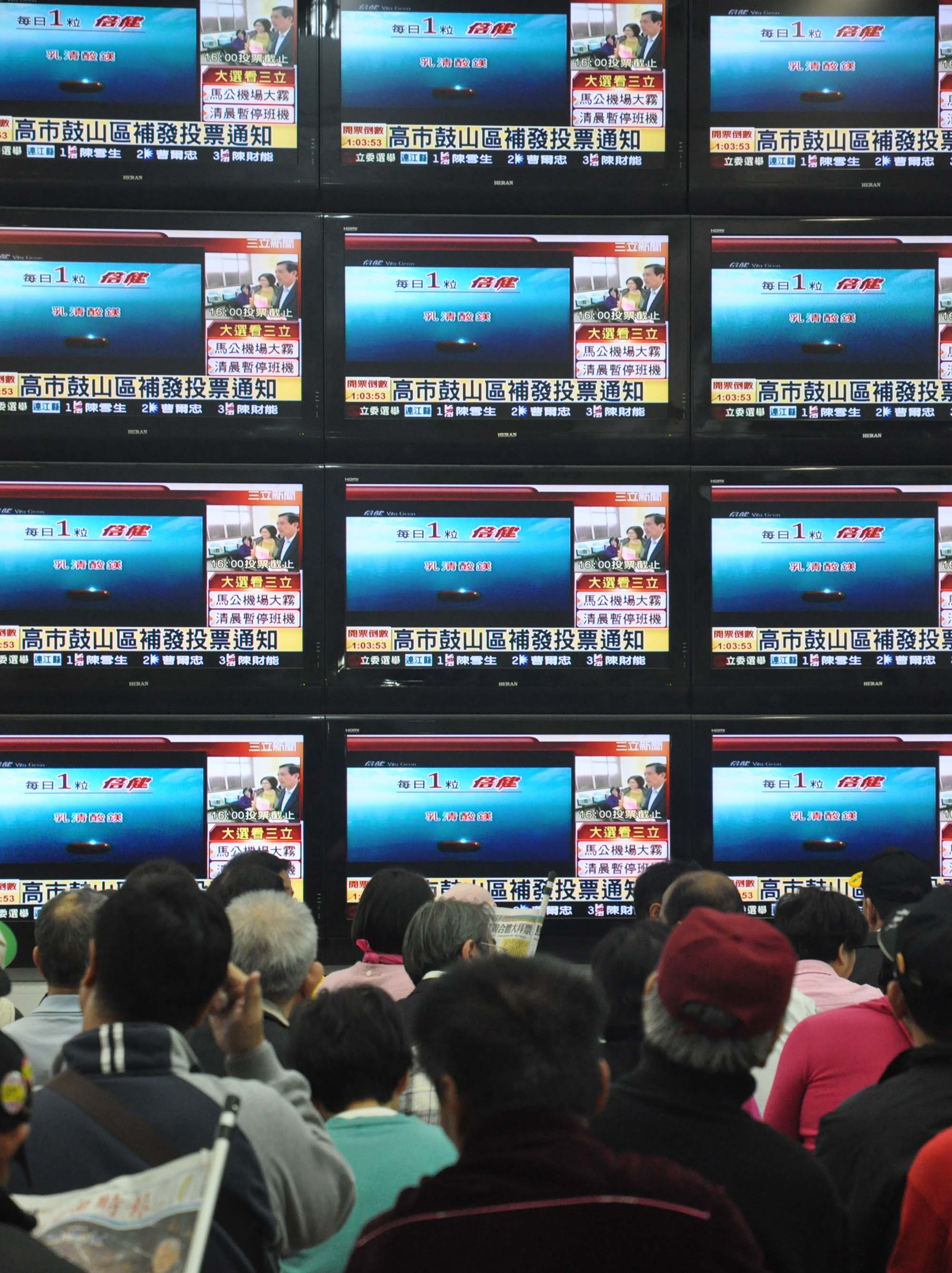
It is not just individual reporters, Taiwan’s media organizations are not shy to run unabashedly partisan headlines. On the day after the election in which Tsai lost out to her Kuomintang (KMT) rival, Ma Ying-jeou, the dailies ran headlines such as “MA YING-JEOU HAS WON! THE 1992 CONSENSUS HAS WON!” and “THE FUTURE OF TAIWAN CANNOT BE SOLD”.

Such headlines suggest the news stories in the papers are unlikely to be free of bias. While completely impartial and objective reporting is an ideal that often remains just that, having a highly partisan media is almost accepted as a fact of life in Taiwan.

The island’s media organisations are usually aligned with either the Pan-Blues which consist of the Kuomintang (KMT) and its allies and the Pan-Greens.

The KMT-led Pan-Blue coalition favours closer economic links with the Chinese mainland while the DPP-led Pan-Green coalition favours eventual Taiwan independence. A newspaper betrays its allegiance easily through its headlines, layouts and photo arrangements.


A Fact of Life

Some Taiwanese are so used to partisan politics in the media that they do not feel the need for change. Ms Guo, a KMT supporter, says a political stance is merely a selling point for newspapers or television channels.

What really matters to her is the accuracy of news, which she believes is not affected by the political stance of a media organisation. “That’s why I would still opt for Pan-Blue newspapers for neutral news,” she says. Guo only reads the traditionally Pan-Blue China Times and United Daily News.

.Members of the  younger generation may read more than one newspaper and browse news feeds provided by search engines to gather the information to form their own thoughts.

Taiwan’s journalists are themselves only too aware that news organizationsare rarely politically neutral. “When covering election news, media are advocates, not neutral bodies,” says the deputy editor of the Pan-Green Liberty Times, Tzou Jing-wen.

Tzou says there are reasons why a newspaper reports stories the way it does.  The length of a story and where it is positioned implies which candidate the newspaper prefers.

Having said that, Tzou does not believe this is a problem. She says American newspapers such as the Washington Post and New York Times are known for their clear political standpoints. “It is acceptable to have your own standpoint as long as it is limited to the editorial only,” Tzou says.

She does, however, agree that news stories should not carry any personal viewpoints, while avoiding commenting on the reporting style of her own newspaper.

Ho Jung-shin is a China Times editor but he used to work at a Pan-Green newspaper. He says many newspapers show their stance in both news stories and editorials. However, he points out that even among the partisan press,, some offer a more diverse range of voices than others. “Some newspapers have one voice only. They support either the KMT or DPP unconditionally, with little room to accommodate other opinions,” he says.

Animal Paradise or Prison?

Reporters: Dora Chiu, Joyce Lee, John Yip
Editors: Nia Tam, Beverly Yau

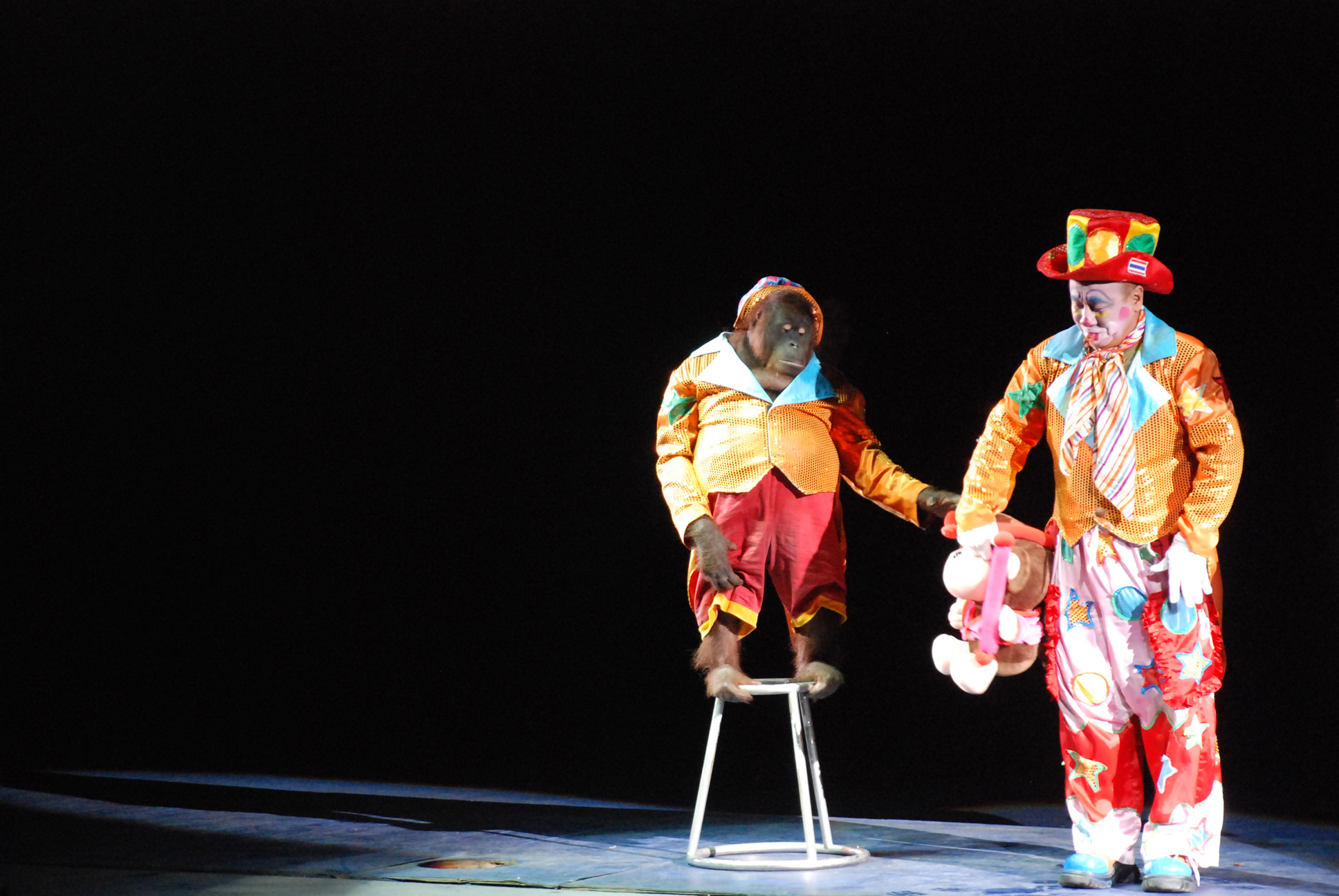
On a lazy Sunday afternoon, a group of monkeys and orangutans, dressed in colourful costumes, get ready for the Monkey King performance. They step out of their cages onto the stage. They drive a car and play tug o’ war. Humans clap and cheer as they show off their “talent”.

They are performing at the Chime-long Xiangjiang Safari Park in Panyu, China. The park houses a wide range of species including monkeys, tigers, elephants, chimpanzees, hippos and pandas. Some are kept outdoors while others are kept in small indoor enclosures..

Animal welfare groups like Animals Asia and Asian Animal Protection Network monitor Chinese zoos regularly. They have found living conditions for animals in many zoos are inadequate. Most zoos stage performances for which the animals undergo cruel training and are forced to perform tricks.

The groups have written scathing reports about Chime-long in their previous investigations in the past few years. During a visit in early November 2011, Varsity found the situation has generally improved. Some of the most dangerous performances, such as tigers jumping through fire hoops, have been eliminated. The zoo is large and the living environment of most animals is fair. Visitors say the animals look healthy and happy.

Zoo staff members say the animals are fed regularly on diets that include raw fruit or chopped meat. Apart from their basic daily portions, the zoo encourages visitors to feed the animals with food prepared by the zoo. Visitors can throw bananas to elephants and chicken meat to tigers.

While humans may consider it a luxury to be fed everyday, animals spend most of their time looking for food in the wild. They need stimulation, not ready-to-eat meals. “Animals need to be allowed to look for food. They need something else to do. You won’t be happy in a featureless prison with food pushed in every day,” says Dr John Wedderburn, founder of Asian Animal Protection Network.

Dr Jill Robinson, founder of Animals Asia, condemns the zoo’s practice of feeding chopped up food to wild animals. Meat-eating animals should be taking down live species and eating the whole animals, which include the fur, the skin and the bones.

Some wild animals are kept in sparse, small cells. They are prevented from portraying their natural characters. The lack of space causes different manifestations of ‘zoochosis’, psychotic behaviour displayed by animals kept in captivity. Chimpanzees bang their heads on an iron door and tigers walk along a repetitive path.

Animals go cage crazy in such tiny place. “Going to a zoo to see wild animals is like going to a prison or a mental hospital. You don’t see normal behaviours,” says Wedderburn.

The zoo holds animal performances several times every day. Elephants play football and basketball during the performance. They also have to walk on a balance beam on their hind legs. Monkeys perform human acts such as sweeping the floor and planting vegetables.

Animals also perform in the Chime-long International Circus Show. In between the acrobatic shows, animals come out to demonstrate tricks. Elephants ‘dance’, orangutans perform magic tricks, and black bears jump through a hoop. Most members of the audience think the animals look happy and healthy in the show.

Although these seem to be less dangerous than tricks performed in past years, Jill Robinson, believes the zoos are still conducing cruel training regimes behind the scenes. She says they train animals through negative reinforcement. Even if the animals like the food rewards, it is only because they are hungry and starved before the performance. For Robinson, the fundamental issue is animals do not want to be in the arena in the first place.

People enjoy the show because they have yet to realize the animal suffering. Circuses and safari parks are becoming more aware of their unacceptable practices today. Zookeepers are closing down their some of their shows as they know the public does not want to see cruelty.

Animal rights activists agree animal welfare in China is improving overall. Robinson says there are more than 70 animal welfare NGOs in the mainland now. Most of them participated in pushing for an anti-animal cruelty bill. But these groups are still small and have limited resources. They rely on volunteers and donations. Still, after years of campaigning, animal rights activists are beginning to see increased awareness and hope.

Heritage vs Development in HK’s Walled Villages

Reporters: Amy Leung, Gavin Li, Liz Yuen
Editors: Duke To, Ling Tang

Hong Kong’s walled villages

Hong Kong is known more for its high-rises than its rural villages but even in this crowded metropolis, some local communities have managed to retain their own distinctive features from the past. In parts of the New Territories, such as Yuen Long, Fanling and Sheung Shui, Tai Po and Sha Tin, you can still find walled villages.

A study of 131 villages conducted by historian Siu Kwok-kin and his coworkers in 1995 found 71 villages with the word Wai (walled) in their name.

Residents in the New Territories built walled villages for better security in the past. These villages usually contained brick houses, moats and wells. Today, most villagers welcome the conservation work on their walled villages, but some complain that their own rights have been overlooked.

Mr. Tang, who has lived in Kat Hing Wai in Kam Tin for more than 40 years, says the government must protect the benefits of the villagers while conserving their villages. Tang says the villagers have lost their privacy to conservation efforts.

“So many constraints come along with conservation. We have to open up the area to tourists on specific days at specific times.”

Tang describes the villagers as being animals in a zoo.

Tang rebukes the government for depriving the rights of the land owners in the name of conservation. He says this encroaches of the house-building rights of male indigenous villagers in the New Territories, adding that is why some villagers choose to sell their rights under the Small House Policy to property agencies.

Another Mr. Tang, a villager of Lo Wai in Lung Yeuk Tau, believes that the conservation of his village prevents him from improving his living conditions.

Although only the entrance tower and village’s enclosing walls at Lo Wai are declared monuments, Mr. Tang says villagers were not allowed to renovate their homes, even though they were falling down. He says the regulations have been eased now but it did make life difficult in the past.

Tang is also skeptical about conservation work carried out by the Antiquities and Monuments Office. He says repairs for structural problems often take too long, while renovation work on the ancestral hall would probably draw laughter from tourists. Tang explains that what he calls “so-called conversation” amounts to little more than applying a fresh lick of paint.

A visitor to San Wai, another walled village in Lung Yeuk Tau, says villagers should be allowed to make their own decisions about their properties. He suggests guidelines could be issued, but that villagers should still have the right to choose their preferred way of development.

Historian Siu Kwok-kin, who heads the Centre of Studies of Hong Kong History and Culture of the Chu Hai College of Higher Education, says Hong Kong’s conservation work lags behind places like the mainland and Germany.

Siu says Hong Kong people are pragmatic. When villagers know their houses will be taken over and they will receive compensation, they want to make sure they get the highest possible amount.

Some villagers may want to get financial aid from the government to renovate their houses. Others think they have the right to demolish their traditional houses and build new ones with several storeys.

But Siu believes traditional houses have to be preserved. He suggests the villagers could be relocated to facilitate the preservation of the walled villages.

But San Wai villager, Mr. Wong, says it is very unlikely for the villagers to move away from the walled villages because they are used to the lifestyle there. “For some villagers, they will not move even if a public housing is provided,” says Wong. Other considerations are feng shui and the roots they have in the village where generations of their family have lived.