











Home Blog Page 42

Screen Crisis

Parents struggle to control children’s use of electronic devices during lockdowns.

By Charleen Chen in Hsinchu

It is not easy for Kyra Kuo, a mother of two, to take care of a 2-year-old son, Enzo, and a 10-month-old baby. Anti-COVID19 measures such as class suspension make it even more challenging for Kuo.

“I gave up strict control over Enzo’s television time, because I was just too busy,” Kuo, a Taiwanese blogger and housewife, who is now living in the Netherlands after spending five years in Singapore, recalls. “I literally handled the baby and Enzo 24/7 with no breaks during the lockdown,” she says.

Schools were shut down from March till June in Singapore in 2020 when the country was under lockdown. Enzo, Kuo’s 2-year-old son had to stay at home, as his kindergarten closed.  

Longer Screen Time Under Lockdown

“Enzo watched television for roughly one hour [every day] during the lockdown,” Kuo recalls.

The kindergarten pupil used to only watch 15 minutes television every day and do outdoor activities such as picnicking and playing at parks. The family also took him to the zoos and aquariums on weekends before the pandemic.

The toddler’s television time jumped four times after the world has been affected by the pandemic. His mind sometimes went blank after watching television for an hour. “He sometimes threw temper tantrums when I turned off the television,” Kuo says. “When staying indoor for so long, it was very hard to keep my elder son away from the electronic devices during the pandemic,” Kuo adds. 

“When staying indoor for so long, it was hard to keep my son away from the electronic devices.”

Wang Chun-ping, a Taiwanese blogger who has been living in France for over 10 years, encountered similar problems. Her two sons, Alexandre, aged 9, and Andre, aged 6, stayed at home when the country was under lockdown from March to May this year.

“They used electronic devices indeed more often when staying home all day,” Wang says. Apart from having online lessons, the brothers used the devices for games and surfing on the Internet during the lockdown.

Her children used to enjoy going to school and doing outdoor activities such as hiking and swimming. But now they switched to indoor activities such as playing with building blocks and cleaning the garden.

“Our family used to travel a lot. When we couldn’t go out all of a sudden, the boys actually needed some mental preparation,” says Wang. “I explained to them that we must stay indoor because we have to protect ourselves and others.”

Asking for More Cartoons to Watch

Lin Tien-yu, a Chinese teacher in Taiwan, has a daughter, aged 5, and a son, aged 2. Her children used to join many activities such as drawing, sightseeing, and simple DIY projects. But all these activities and their art classes have been cancelled due to the pandemic.

“They ask if they can watch Disney cartoons more often,” Lin says. Her children used to watch television for 10 to 20 minutes a day. But they now spend more time on television as they have to stay home most of the time and avoid going out to reduce the risk of infection.

Lin’s children ask to watch Disney cartoons more often during the pandemic.

“When the kids watch cartoons, I can take the chance to relax a bit,” Lin says. As working parents, Lin and her husband, an engineer, have become much busier juggling between family and their work, as their children stay home all the time. They cannot let the childrens visit their grandparents as usual to prevent infection. And that deprives the couple of their time to rest. “Their grandparents used to look after the kids at their place on Saturday afternoon, so my husband and I could rest or go shopping,” Lin says.

Lin lets her children watch more cartoon. “But I find the children really are addicted to watching TV,” Lin says. “They ask for more cartoons and become emotionally unstable. They will throw a tantrum and it is difficult to communicate with them when they cry and act naughty,” Lin adds.

In Search for Solutions

To reduce screen time for children, parents try hard to think of alternative activities for their kids. Kuo let Enzo make chalk paints on the balcony. The toddler also used boxes to build a 3D parking garage with his father. “Enzo sometimes joined me in cooking dinner and bathing his baby brother. This allowed me to keep him company when doing the chores,” Kuo says. Wang tried reading books and playing board games more with her children to reduce their use of electronic devices during the lockdown. “I also encourged my children to play basketball and clean the yard at home,” she says.

Similarly, Lin tries to shift her children’s attention away from the cartoons. She purchased teaching packages for her children to make homemade soap, build blocks, and assemble magnetic building toys. 

Cut Down Screen Time

Cecilia Lam Wing-chi, the professional consultant of the Department of Educational Psychology at the Chinese University of Hong Kong, says it is “unavoidable” for children to use electronic devices during the pandemic. “Parents should try to minimize their screen time,” she says. Lam suggests 30 minutes per time for primary school children, and 15 minutes for preschoolers.

Lam thinks that parents should arrange engaging games and activities as alternatives. Toys sets such as Lego, arts and crafts, readings, and family board games are recommended. “For preschoolers, hands-on toys are more suitable for them,” she says. “Parents are encouraged to create toys corners for preschoolers to get them fully engaged,” she adds. 

Enzo was making chalk paints on the balcony during the lockdown in Singapore. 
(Photo Courtesy of Kyra Kuo)

Lam points out that e-learning has positive and negative effects on children. “On the positive side, children are more comfortable with learning in the virtual classrooms,” she says.

“Since teachers now are making efforts to make online lessons more interactive and engaging, children have fun in learning too,” Lam says. “For kids who are shy, they feel more comfortable to speak up,” she adds.

“On the other hand, online lessons deprive children of social interactions, like learning the social cues and social positions,” Lam says. Socializing is an important part of children development, when children learn how to form friendships and interact with others.

“Long period of exposure to screens is bad for their eye sight,” Lam says. “It provides too much stimulation to children’s physical and mental health. Children tend to get emotionally unstable when stimulated by digital content,” she adds.

“Children tend to get emotionally unstable 
when stimulated by digital content.”

Edited by Emilie Lui

Sub-edited by Howard Li


U.S. Cancels China Student Visa

Chinese students who graduated from universities which are listed on the U.S. sanction list are banned from getting student visa. 

By Gloria Wei in Harbin & Lynne Rao in Luzhou

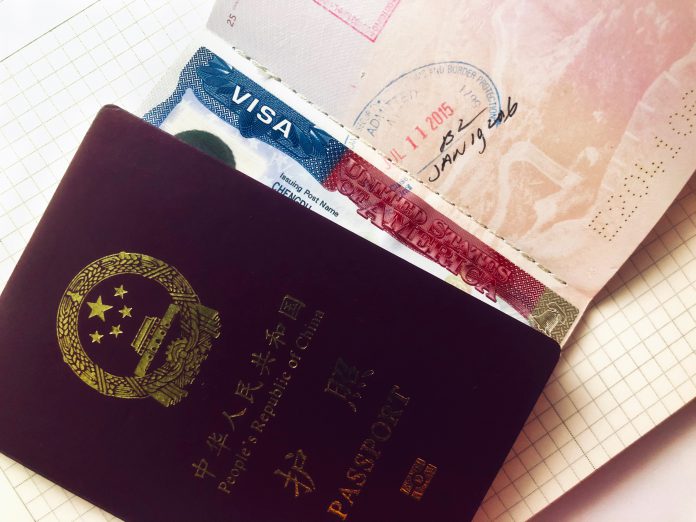
On September 9, Ashley Liu* received an email from the U. S. embassy in Beijing informing her that her student visa had been revoked by the U.S. Department of State.                                                                       

The civil engineering major student returned to China in December 2019 after getting her master’s degree in University of Illinois. Her visa was expected to expire in November this year and she had planned to pursue her P.H.D degree in the U.S. But now she cannot fly to the U.S. without a valid visa.

“I graduated from Beihang University in 2018 and the university is now on the American sanction list,” Liu says. “I broke down when I learnt that my visa was revoked,” she adds. The “Entity List” comprises institutions that the U.S. believes are linked to the Chinese military.

Liu had to cancel her plan of applying for a P.H.D program in civil engineering in the United States after her visa was revoked. She is preparing to file application for P.H.D program offered by the University of Science and Technology of China.

“The stupid policy damages academic freedom because we (students who graduate from universities on the sanction list) cannot go to the U.S. for research and academic exchange,” Liu says. “Trump stated that he did this to prevent Chinese students from stealing technology from America. But why does he punish innocent people?” Liu adds. She regrets going to Beihang University for undergraduate study, as the university is on the sanction list which means she cannot go to the U.S. for higher education now.

“The stupid policy damages academic 
freedom because we cannot go to the U. S. for research and academic exchange.”

Donald Trump, President of the U.S., signed a proclamation on May 29, barring Chinese graduate students and researchers who have ties with the People’s Liberation Army (PLA) from entering the United States, claiming to stop China from using graduate students to steal intellectual property and technology from America. 

Seven military-affiliated universities in China are included in the list. They are Northwestern Polytechnical University, Harbin Engineering University, Harbin Institute of Technology, Beihang University, University of Aeronautics and Astronautics, Beijing Institute of Technology, Nanjing University of Science and Technology and Nanjing University of Aeronautics and Astronautics. Graduates of these universities are banned from studying in the U.S.

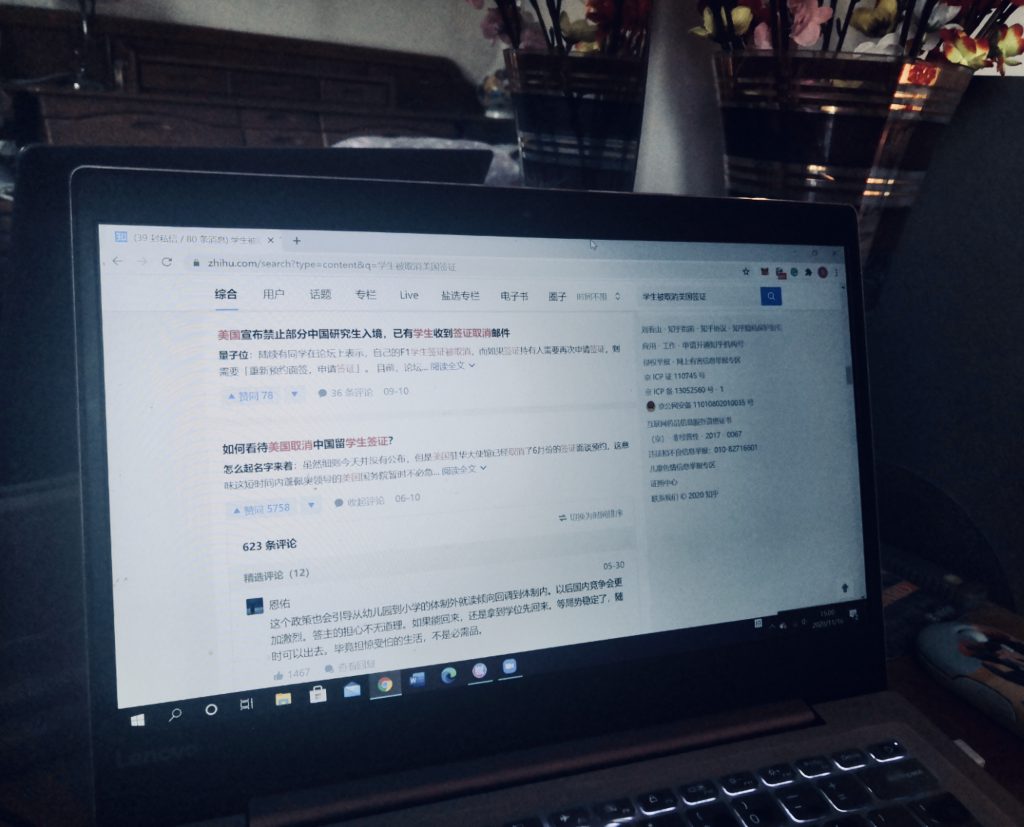
Netizens talking about the U.S. revoking Chinese students’ visas on a forum.

China-U.S. relations have hit historic lows with the world’s two biggest economies clashing over issues ranging from trade and human rights to Hong Kong and the coronavirus. 

On 2020 State of the Homeland Address on September 9, Chad Wolf, Acting Secretary of the Department of Homeland Security of the U.S., said, “We are blocking visas for certain Chinese graduate students and researchers with ties to China’s military fusion strategy to prevent them from stealing and otherwise appropriating sensitive research.”

Foreign Ministry Spokeperson Zhao Lijian critizised the U.S. for revoking visas of Chinese students and reseachers in a regular press conference of Ministry of Foreign Affair of People’s Republic of China on September 10. “The measures taken by the U.S. government blatantly harm the legitimate rights and interests of Chinese students in the U.S., which are outright political persecution and racial discrimination and seriously violate the human rights of these Chinese students,” Zhao said.

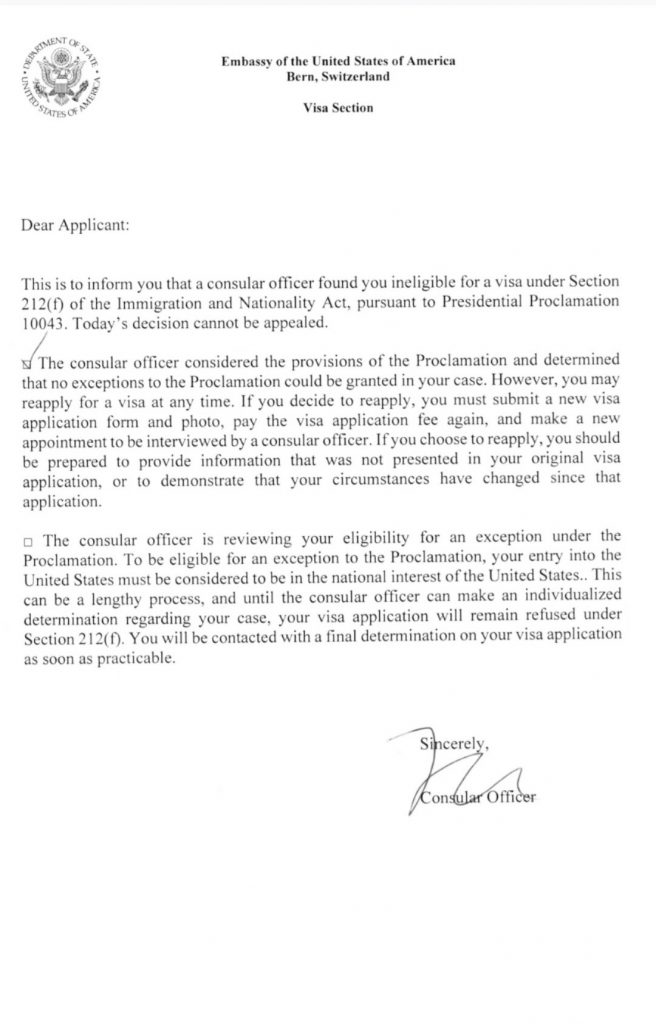
Jay Yang* was another student affected by the presidential proclamation. Yang received an email informing that his visa application was rejected by U.S. embassy in Bern, Switzerland on August 31, 2020. “It was not surprising. But I still felt upset when I knew the result,” Yang says. He graduated from Harbin Institute of Technology, one of the universities on the sanction list, in 2017.

Refusal letter from U. S. embassy Jay Yang recieved in Bern, Switzerland. (Photo courtesy of Jay Yang)

Yang graduated from a university in Switzerland with a master degree this year. He refused to reveal the name of the university. Yang was admitted to a P.H.D program in Computer Science in the University of Chicago in February and now he is attending classes online. “I planned to study in the U.S. when I was an undergraduate,” Yang says. He thinks his visa application should not be rejected since the U.S. stated that the sanction only targets ‘sensitive subjects’, which are linked to national security such as Material Science and Defense Engineering. “It is unfair because my major is computer science and it is not sensitive,” he adds.

He hopes the U.S. will change its visa policy after the election. “I considered studying in other countries if nothing changes next year,” Yang says.

China has been the biggest markets for the U.S. universities. According to the Student and Exchange Visitor Program (SEVP) 2019 SEVIS by the Numbers Report, an anual report on nonimmigrant student trends released by U.S. Immigration and Customs Enforcement (ICE) in September 2020, 4.7 million Chinese students entered the U.S. in 2019 with a F-1 visa, which is required for those studying in the U.S. as a temporary and non-immigrant visa-holders or a M-1 visa, which is required for those studying in the U.S. as a vocational, non-academic school. The report of ICE also reveals that the number dropped by 4,235 compared with 2018.

Daxue Consulting, a market research and management consulting firm focusing on Chinese market, published a report titled “Education elsewhere: China seeks out exchanges in other countries” on June 23, 2020. The report found the U.S. remained the top destination in the past few years because of the high quality of the U.S. education. Also, many Chinese students hoped to stay and live there after graduation in order to enjoy the lifestyle of a developed country.  

Yet according to English Learning, a multimedia news platform widely known as EL, American universities are starting to see steep declines as political tensions between the two countries escalate. Several universities in the U.S. have reported drops of 20 per cent or more in the number of new admission from China this fall. At the Bentley University in Massachusetts, the number of new Chinese students arriving for graduate level work dropped from 110 last autumn to 70 this fall. As a result, officials from Bentley University are wondering whether all of its graduate programs can survive.

Ya Waning, manager of an agency based in Beijing, has helped students studying overseas to apply visa for more than 15 years. Ya realises graduates from universities on the sanction list cannot obtain study visa. “It is just a waste of time to apply for American universities unless Biden wins the election and changes the visa policy,” he says. 

Given the situation, many Chinese students have changed their study plans. A report investigating undergraduate program applications in the U.K. in 2020 by Universities and Colleges Admissions Service shows the number of Chinese students applying for universities in the U.K. increased by 23 per cent year on year as of June 30, 2020. Other countries such as Japan, Korea and Singapore, are also gaining popularity among Chinese students as the destination for higher education.

Sam Qi*, who graduated from the Harbin Institute of Technology (HIT) in 2018 used to dream of going to the U.S. for higher education in the field of civil engineering. But since the HIT is one of universities on the sanction list, he thinks his visa application will not be successful.

Qi has applied for other universities in the U.K. and Canada as his backup plan. “I’ll be thrilled if I can get the visa for studying in the U.S., and I’m still praying for it,” Qi says.

“I’ll be thrilled if I can get the visa for studying in the U.S., and I’m still praying for it.”

*Names changed at interviewees’ request

Edited by Emilie Lui

Unbearable Pressure of Parcels

The rise of online shopping during the pandemic has made couriers in South Korea overwork. The unbearable pressure of parcels is pushing them into a corner.

By Soweon Park in Seoul

“I have to deliver 300 parcels a day. I cannot work without taking muscle relaxer,” Lee Hyeong-goo says. The 55-year-old courier in South Korea has been working in delivery service for two years.

More and more consumers are shopping online for daily necessities and food such as sanitisers, bottles water or fresh sushi and have them delivered to their doorsteps.

“My daily workload jumped by 30 per cent,” Lee says. 

The average daily working hour of courier stretched to 14 hours a day during the pandemic, as people are urged to practice social distancing, and many are working from home. “Most couriers including me work for more than 12 hours a day these days,” Lee says.

Lee’s daily work starts at 7 a.m., loading up a truck with parcels to be delivered. At 12 p.m., he starts dispatching parcels to consumers. It is already 9 p.m. when he can finally go home after all parcels are delivered.

Couriers’ daily work starts with loading up a truck with parcels to be delivered.

“My whole body is in pain every night. It strains my leg to deliver heavy parcels where there’s no lift (at some locations),” Lee says. Despite of the heavy workload, most couriers do not have any day off. They can only rest on Sundays and public holidays. “We don’t even have time to eat lunch or dinner. I sometimes grab some snacks from convenient stores and eat in my truck when I’m extremely hungry,” he adds.

First Day Off in Nearly Three Decades

A labour union of delivery workers demanded logistic firms to offer an official holiday for couriers. Four major logistic companies in South Korea – CJ Logistics, Hanjin Express, Lotte Global and Logen – and Post office finally designated August 14 as ‘No Parcel Day,’ amid surging workload in the wake of the COVID-19.

For the first time in 28 years since delivery service was introduced in South Korea, delivery workers were allowed to take a day off on August 14 – Friday. The government and the firms will also make August 14 a rest day for couriers every year. “With the Liberation Day on August 15, we all had three days off for the first time. I did nothing during the long weekend and just stayed at home and let my exhausted body rest,” Lee says.

With the Liberation Day on August 15, couriers took three-days holiday.

Consumers also support couriers for having their first official holiday, uploading #it’s_okay_to_be_late on their social media. President Moon Jae-in also posted ‘No Parcel Day’ on his twitter on July 18, 2020. “We should keep hard working couriers who are taking the leading role in overcoming the COVID-19 in our minds,” he tweeted.

Death from Overwork

Parcel service is very labour intensive starting from sorting parcels to actual deliveries and requires physical labour. Some workers died from overwork.

The total number of couriers reportedly died from overwork is 18 in the past eight years. In the wake of surging delivery service demand this year, the number of couriers who are believed to have died from overwork this year alone is eight with the latest tragedy reported on October 8, 2020.

“It’s heart-breaking to see young couriers dying from overwork. I’m afraid that I could be next too,” Lee says.

“It’s heart-breaking to see young couriers dying from overwork. I’m afraid that I could be next too.”

Kim Se-kyoo, who is in charge of education and promotion of the labour union of delivery workers says most of the death cases did not have record of suffering from chronic diseases and they worked for more than 14 hours a day before they died. For the latest death case, the concerned delivery worker had to deliver 400 parcels a day. “We believe there are cases that are not made public,” Kim says.

The labour union is worried delivery workers will have heavier workload in the coming months because shipping volume reaches the peak between September to November every year.

In a bid to prevent workers dying from overwork, the labour union is demanding logistic companies to hire supplementary workers for doing parcel classification which is a long and tough process before actual deliveries are made. In the long run, the labour union is planning to discuss with the government about introducing legislation to address the issue of long working hours.

Couriers at the Blind Spot in Law

According to the labour union of delivery workers, the average weekly working hour from this January to August of couriers is 71.3 hours. This is 1.9 times higher than the average working hour of workers of other professions and is much longer than the 52-hours workweek scheme that Korean government regulates.

The Labour Standards Act is applied to company with more than five employees. However, delivery service workers are not protected by the law, as couriers are regarded as self-employed workers (special contract worker), but not employees of a company.

Kim vows to fight for a better working environment for delivery service workers. Established in 2017, the labour union has combated unreasonable and unfair issues for 45,000 couriers face. “Many offices where parcel classification work is done didn’t even have toilets in the past,” Kim says.

“Logistic companies do not recognise couriers as their employees. We really hope these companies will offer a better working environment and treatment to couriers,” Kim says.

“We are still in the process of fighting for couriers to be recognised and treated like other normal employees,” Kim says.

‘Parcel Service’ Exhibition

Kim Jee-youn, a photographer who loves taking photos of marginalised people in society held an exhibition ‘Parcel Service’ in Jeonju, South Korea, praising their contribution to the country.

“I was so surprised when my parcel was delivered to the doorstep at 11 p.m.,” says Kim, explaining why she held the exhibition.

“The shipping volume surges during the pandemic. I read several news articles regarding the working conditions of couriers. It was poorer than I thought. So, I started taking photos of parcels I have received for the photo exhibition,” she says.

The exhibition – ‘Parcel Service’ held between September 9 and October 10 this year showcased photos of parcels, illustrations of work structure of parcel service, screenshots of news articles and piles of parcel boxes.

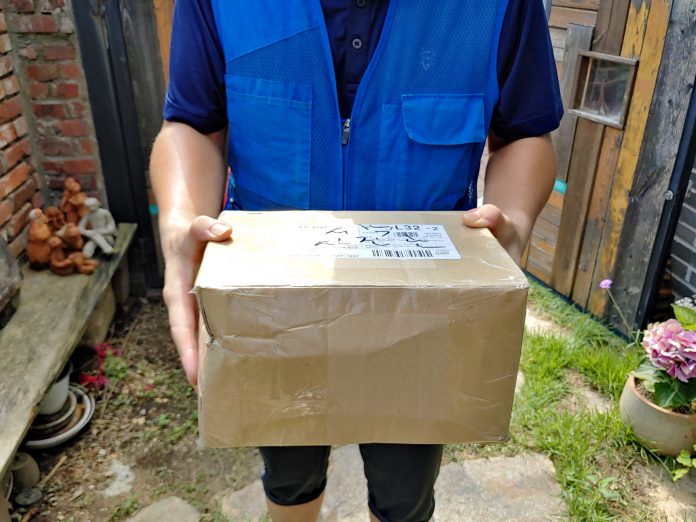
Parcel boxes showcased in the ‘Parcel Service’ exhibition (Photo Courtesy of Kim Jee-youn)

“I wanted to give a courier a bottle of juice in hot summer. But he was too busy that he had to leave my place right away. So I took a picture of his back and showcased the photo in the exhibition,” Kim says.

“We always seek fast and convenient service, but I believe that we need to think of those who provide this speedy service for us all,” Kim says.

Edited by Lasley Lui, Regina Chen


Press Freedom under Threat in Indonesia

Journalists working in Indonesia are struggling with the declining press freedom.

By Sarah Ryou in Jakarta

Kate Walton, a 32-year-old Australian journalist has been banned from entering Indonesia for taking photos of a street protest in Jakarta in June 2019. 

The protest was held to rally against a corruption law, which undermines a government agency to fight corruption.

“As a writer, I loved researching Jakarta and Indonesian culture. Just to get banned so suddenly, it is quite confusing…not only for me but other foreign journalists,” Walton says. She was forced to go back to Australia in 2019 after living in Indonesia for eight year, but she is still writing news stories about Indonesia and Australia.

Walton was not the only one who has been banned by the Indonesian government. Statistics of blacklisted journalists are not open to the public but there are reported cases of foreign journalists being blacklisted, deported, and jailed.

Journalists and academics must have a valid visa when conducting research in Indonesia. Many have been imprisoned because they do not have the correct type of visa. For instance, two British journalists, Rebecca Prosser, and Neil Bonner, who worked for National Geographic were imprisoned for three months after being arrested on Batam Island in May 2015 for filming a documentary without a press visa. 

According to Reporters Without Borders, a non-governmental organisation supporting journalists around the world, Indonesia ranks 119 out of 180 countries in the 2020 World Press Freedom Index. Critiques state that the Indonesian press freedom is still in the developing stage.

President Joko Widodo, popularly known as Jokowi, failed to keep his campaign pledge about safeguarding press freedom in his first term of office. The Journalist Association of Indonesia held a rally to voice their discontent about government’s curb of press freedom and interference of editorial independence after his re-election in May 2019.  

Protestors gathered in Central Jakarta to voice their discontent about government’s curb of press freedom. (Photo courtesy of SBS News) 

Foreign journalists and local fixers in Indonesia are liable to be arrested and prosecuted, according to Reporters Sans Frontiers. Indonesian journalists also say the police and the government are hostile to them, and some journalists have been arrested.

Yoon, a Korean journalist who has worked and lived in Indonesia since 1997, also feels worried that she might be sent back home one day like Walton. “Our visas are issued to us by the Indonesian government. We always have to show them what news stories we are writing lately,” she says.

According to Yoon, after the re-election of President Joko Widodo, stricter guidelines for journalist visa application were introduced in 2019. Applicants are required to submit approval letter from a news agency, detailed disclosure of a company profile and profiles of staff members who will visit the country.

Protestors holding a rally to voice their discontent about government’s curb of press freedom. (Photo courtesy of SBS News) 

Yoon, who writes news for Koreans living in Indonesia adds that censorship has been reinforced since last year. “They used to erase some of our articles uploaded to our website. When we first came to Indonesia, we had to allow Indonesian government to have access to our news website,” she says.

“Now they tell us a certain wording or a sentence is not appropriate by sending us emails. They ask us to avoid writing news stories which are controversial or they ask us to change some wordings in stories,” she adds.

“They ask us to avoid writing news stories which are controversial or they ask us to change some wordings in stories.”

“The biggest challenge to work as a journalist is to stay safe. Our job is to go out and speak to our sources. But if we take any step that the government does not like or go against the law, then we cannot carry on our job anymore,” Yoon added.

Having covered news stories in Indonesia for more than 20 years, Paik Joo Yoon, editor-in-chief of the Korean Community News is upset by the declining press freedom in Indonesia. 

“We feel very sorry that we cannot produce proper news for the Korean community. We sometimes get feedback from our readers saying that our news looks too ‘filtered’,” Paik says.

“We are cautious every time we deal with a news story. If a story causes trouble, our visas may be revoked, and we might be deported right away. Then we will not be able to work in Indonesia anymore,” Paik says. 

While deportation is the worst consequence for foreign journalists, local journalists might have a higher price to pay for press freedom. A 38-year-old Indonesian National Television reporter, Jason* says the government regulations are quite vague and that makes it difficult for journalists to do reporting.

In a bid to protect the journalists, he says his news agency censors news stories to avoid government interference. He adds that many journalists are scared by the government’s curb on press freedom. 

“Not just because I will lose my job, it really does threaten my life. I might have to spend the rest of my life in jail,” he says.

“Not just because I will lose my job, it really does threaten my life. I might have to spend the rest of my life in jail.”

Jason thinks that there should be a turning point for journalism in Indonesia, so that the truth can be reported. He also hopes that journalists can enjoy press freedom and stay safe.

*Name changed at interviewee’s request

Edited by Lasley Lui, Regina Chen

Plastic Pandemic

How is the city fighting against single-use plastics amid COVID-19?

By Kassandra Lai & Fiona Cheung

A student in a traditional blue cheongsam waited in a long queue in front of a restaurant. While other students returned to school with their lunch packed in white styrofoam boxes, she handed out her lunchbox after ordering her takeaway. The waitress looked hesitant while reaching for the container.

Emily Cheung Yee-kwan, an 18-year-old student, was one of the only few in her school to do so. 

“I was taught to avoid using disposable plastics,” Cheung says. “So I bring my containers as I feel uncomfortable and guilty knowing that single-use plastic ones are going to end up in the landfill for years,” Cheung adds.

“So I bring my containers as 
I feel uncomfortable and guilty knowing that single-use plastic ones are going to end up in the landfill for years.”

It takes 500 years for plastics in landfill sites to decompose, according to the Friends of the Earth. 

According to the data from the Environmental Protection Department in 2018, plastics constituted 21 per cent of municipal solid waste with a daily disposal quantity of 2,343 tonnes per day. Almost nine per cent of them were plastic or polyfoam-dining wares. 

People carrying takeaway food in several plastic containers, however, has become a common scene in Hong Kong under COVID-19. 

As confirmed cases of coronavirus surged in March, the government announced its first dining restriction on March 27, and the regulations have been eased and reintroduced for a few times since then. As of September 30, the number of customers at any catering premises must not exceed half of the normal seating capacity and no more than four persons can sit together at one table. 

With uncertainty of the pandemic and changes in dine-in restrictions, many restaurants have rolled out takeaway or food delivery services. Over the past few months, Foodpanda, a mobile food delivery marketplace, has also observed an uplift in demand order by 50 per cent in Hong Kong on the overall platform, including both food and grocery delivery services.

The health crisis seems to have derailed effort against plastic waste reduction and left many in frustrations, as few are bringing their own containers. 

“I feel alone and not supported because none of my schoolmates does the same and some restaurants don’t understand or feel annoyed,” Cheung says. 

“I feel alone and not supported because none of my schoolmates does the same and some restaurants don’t understand or feel annoyed.”

Seeking Alternatives

Noticing the severity of the plastic waste problem, businesses in Hong Kong seek solutions to tackle the issue. Jorch Wong Ching-hei, founder of a recycling business started in late 2019, sees a loophole in Hong Kong recycling chain: unreliable recycling bins. 

“Most Hong Kong people don’t know what is recyclable so they put everything in it, including diapers and masks,” he says. To prevent the recycling from going to waste, his company, The Loops, collects plastics directly from customers’ residences and sorts wastes collected before giving them to recycling factories. 

Wong also sees a drastic increase in plastic use from his customers. “We see plastic use jump by 50 per cent when dining in restaurants was banned all day,” he says.

As of September, The Loops have hundreds of customers in Tseung Kwan O, the only district in which the company is operating. “Up to now (late September), we have recycled about 1.5 tonnes of plastics and we are seeing an increasing trend,” he says. The company hopes to extend its service into other districts in the future.

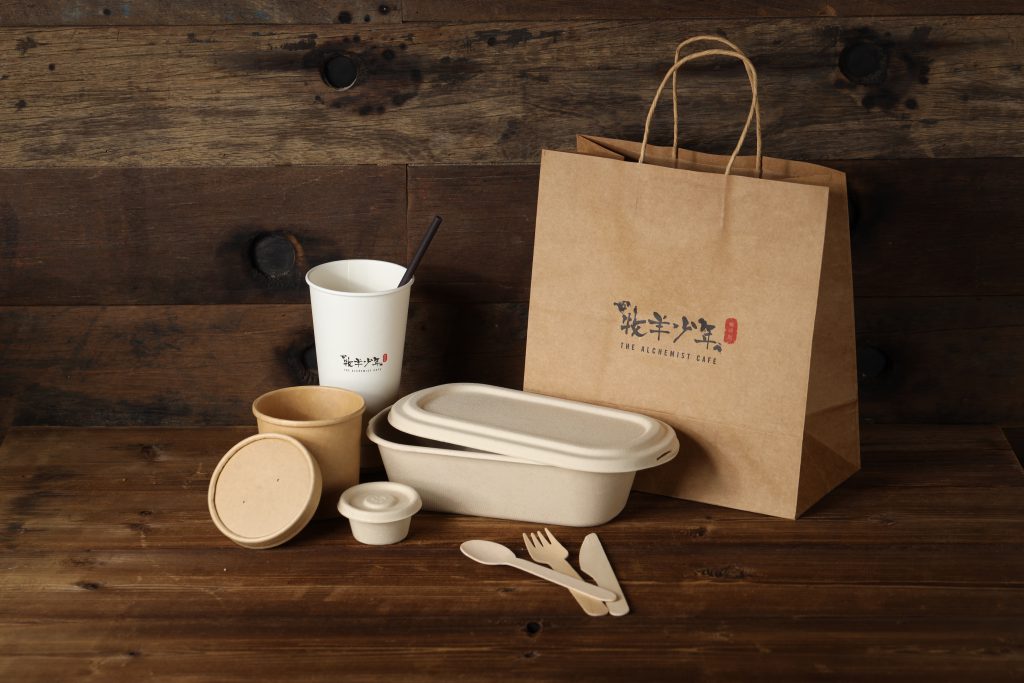
Recycling aside, some restaurants try to eliminate plastic waste source by finding alternatives to replace plastic takeaway containers and utensils. 

The Alchemist Cafe, founded by Dylan Leung Tik-lun in October 2012, has been looking for more environmentally-friendly substitutes for three years. “Plastics are definitely more economic, but just one straw will take hundreds of years to decompose in the landfill,” Leung says. “So we insist to opt for a greener option,” Leung adds.

A restaurant replacing single-use plastics with bio-degradable materials.
(Photo Courtesy of The Alchemist Cafe)

Reactions from customers have proved Leung’s decision right. “I think the majority of  customers support and appreciate our decision,” Leung says. “In fact, I found them very tolerant to situations like straws made of rice becoming soggy after a while,” Leung adds.

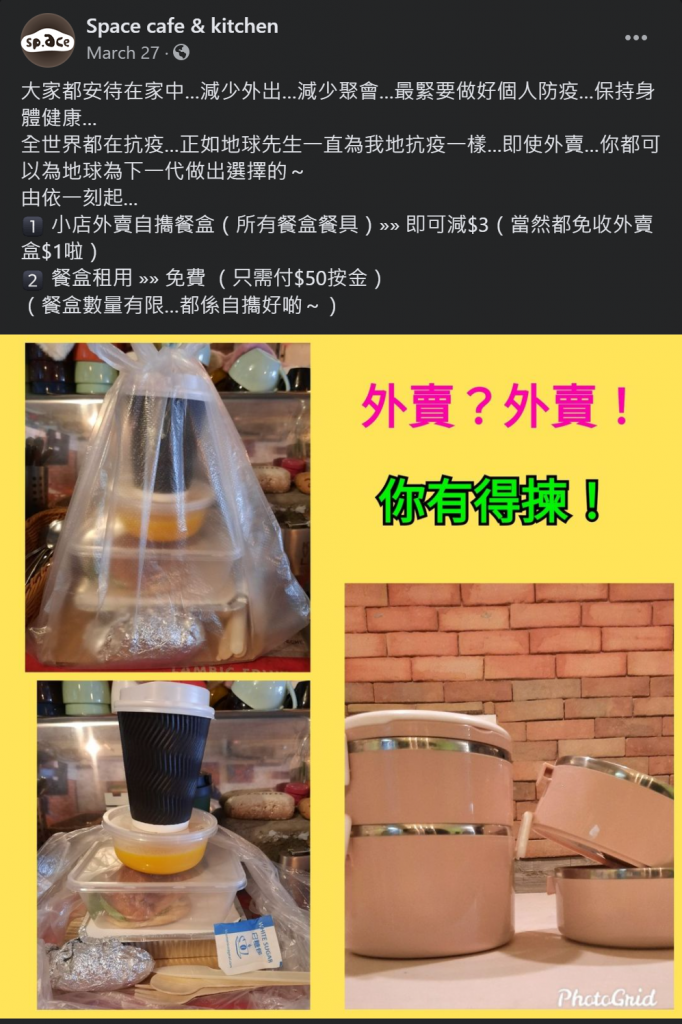
Apart from finding disposable alternatives, Yvonne Leung Yee-wan from Space Cafe and Kitchen, believes using reusable containers is another way out. Since mid-March, the restaurant has been providing discounts to customers who bring their own dining wares, and tableware rental service for takeaways.

“We collect $50 deposit from our customers for every reusable lunch box and they can return it anytime at their convenience. At least one customer would rent a lunch box per day,” Leung says. 

“We put the environment as our priority,” Leung says. Apart from economic cost, she believes one should also take environmental cost into account. “We need to evaluate and strike a balance between both costs,” she adds.

A restaurant offering lunchbox rental service. (Photo Courtesy of Space Cafe and Kitchen)

Plastic ACTion Initiative

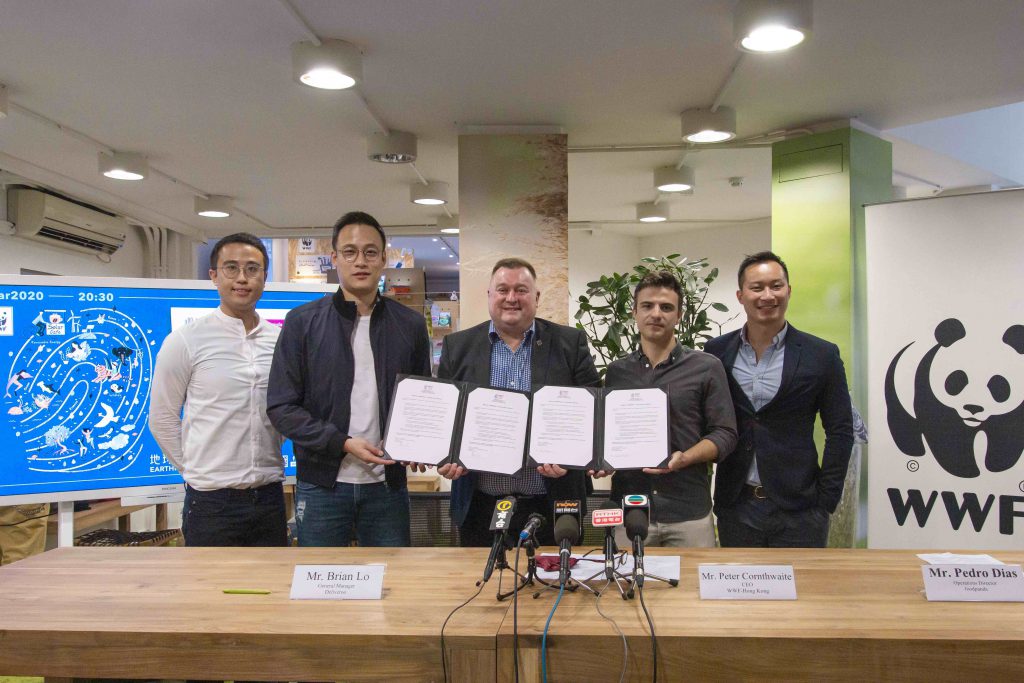
As businesses are trying their best to minimise plastic waste, WWF Hong Kong launched the Plastic ACTion Initiative (PACT) in March this year to target the entire food industry. 

Leading food delivery companies in Hong Kong including Deliveroo and Foodpanda, which accounts for about 90 per cent of the market share in the city, have signed an industry-wide pledge to eliminate plastics by 2025. 

Apart from default cutlery opt-out option, Foodpanda is working with global and local suppliers to source sustainable packaging products for its merchants and restaurants to use in the future, the company says in a written reply. 

Looking into the Future

June Wong, Lead of Marine Litter and Plastic Smart HK from World Wide Fund (WWF), believes that the government should also step up effort to combat the city’s plastic waste problem. 

Leading food delivery companies signing Plastic ACTion Initiative with WWF. 
(Photo Courtesy of WWF HK)

“Hong Kong lags behind when it comes to plastic waste legislation,” Wong says. She believes the “Plastic Shopping Bag Charging Scheme” that bans free plastic shopping bags distribution in the retail industry in 2015, has proved the effectiveness of legislation.

“The amount of plastic bags disposed of at landfills plummeted,” Wong says. “Legislation could definitely help reduce plastic waste effectively because it is legally binding and it could also arouse public awareness,” Wong adds. According to the Environmental Protection Department, the number of plastic bags in landfills decreased from some 660 million before the implementation of the scheme to some 150 million one year after the implementation.

“Legislation could definitely help reduce plastic waste effectively because it is legally binding and it could also arouse public awareness.”

Chief Executive Carrie Lam Cheng Yuet-ngor stated in the policy address in 2018, that the government would “study the feasibility, scope and mechanism of controlling or banning disposable plastic tableware.” 

The Environmental Protection Department (EPD) says it is conducting the study to “draw up proposals suitable for implementation in Hong Kong” and the study is expected to be completed by the end of 2020 in a written reply.

As Wong welcomes legislation for the use of plastic dining wares, she also advises the government to subsidise the food and beverage industry by offering funds.

“If disposable plastic tableware is to be banned in Hong Kong, the government has to provide financial support to the industry during the transition period,” she says. 

Edited by Kayi Tsang


Overworked and Underprotected

Vulnerable migrant workers being discriminated and exploited during COVID-19.

By Bonita Wong

More recognition and protection should be given to nearly 400,000 migrant domestic workers in Hong Kong, especially to those suffering from heavy workload and unfair treatment during the pandemic.

Filipino domestic helper Lia* needs to juggle taking care of a seven-month-old baby and more daily work as her employers are currently working from home. 

“The workload doubles. Before COVID-19, I just need to cook dinner. But then when my employers work from home, I need to cook breakfast, lunch and dinner,” Lia says.

Lia has been working in Hong Kong for three years. “The problem that I am struggling with is pressure. My employers work in a bank, and their work is really a stressful one, especially given the economic status of Hong Kong now. Because they are pressured, and they are at home, so they check every single detail of my work,” Lia says. 

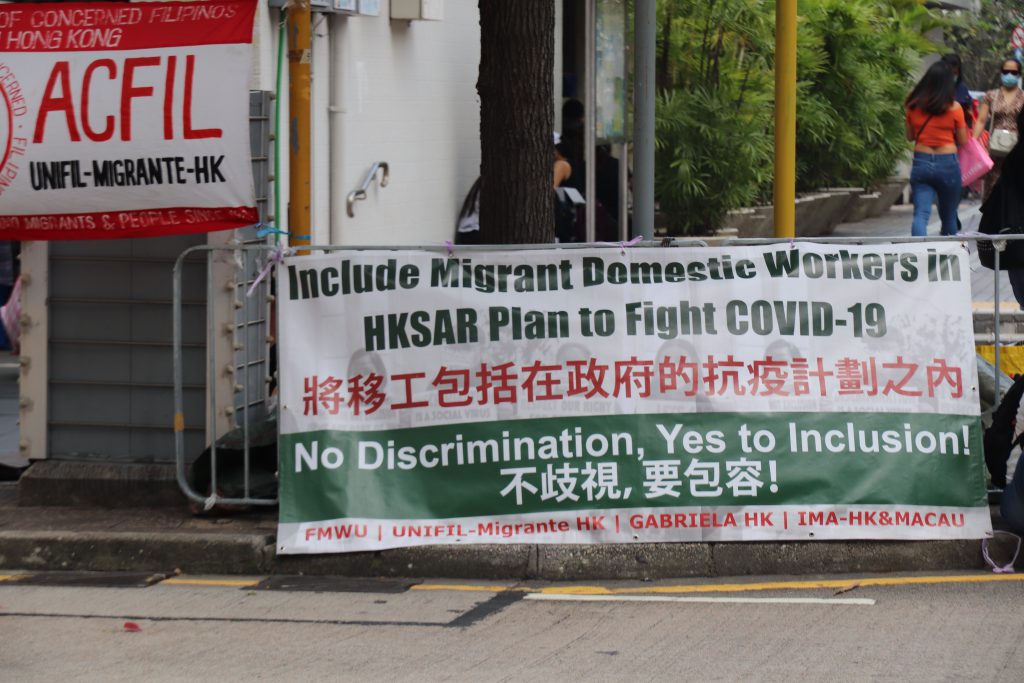
Banner by migrant worker unions on Chater Road, Central.

The situation improved when the second helper reported duty in June. 

“Even we have a second worker, I am responsible for everything. If the second worker did not do her job properly, the blame is on me. Also, both of my employers are foreigners, I am not used to their expressions and I am very sensitive about that, so emotionally I am so depressed at first,” she says.

According to an online survey conducted in March by Asian Migrants Coordinating Body – the first and biggest coalition of migrant worker association and union in Hong Kong, more than half foreign domestic helpers had the same experience as Lia that their workloads increased. 40 per cent of the 1,127 respondents did not have weekly rest days as stated in their contracts.

Lia’s employers asked her not to go out on Sundays when Hong Kong was hit by the third wave of COVID-19 in July. She had to meet her friends online for five weeks. Fortunately, Lia has her own room and toilet, and her employers did not assign her any work on rest days.    

“But the discrimination is still there. When the number of cases goes down, they say ‘okay you can go out but please don’t meet your friends,” Lia says. “Why should I not meet my friends and you can let your friends visit us in the house? We workers have strict self-discipline. We have family in the Philippines waiting for us. If we are sick, we are alone. Why can’t I meet my friends? Do you mean that we Filipinos or migrant workers carry the virus?” she argues.      

Migrant domestic workers packing parcels to send back home.

“Why can’t I meet my friends? 
Do you mean that we Filipinos or migrant workers carry the virus?”

Lia says she is fortunate to have masks and alcohol sprays from her employer because she knows many workers are treated unfairly and do not receive proper protection.

“Migrant workers are frontliners (who fight against the pandemic) as well. We are the ones who look after the cleanliness (hygiene) of the house, going in and out of the house to get food and protective materials for families,” says Shiela Tebia-Bonifacio, chairperson of Gabriela Hong Kong, an alliance supporting Filipinos in the city.

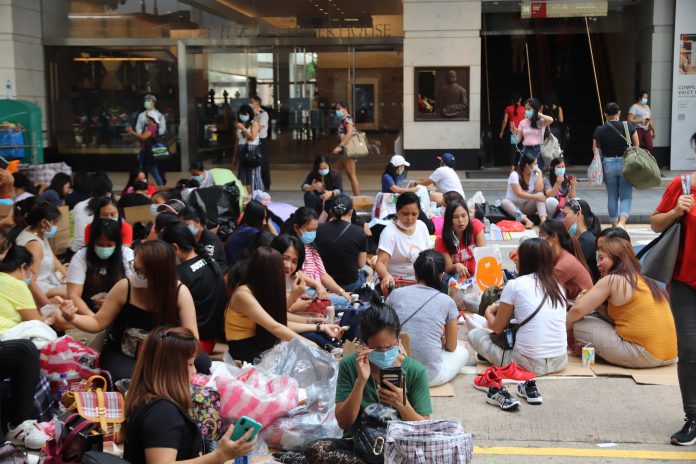
“Many of us cannot go out and some are not compensated well for overtime work. If you don’t have your own room, what can you do inside the house? You work. Do you expect migrant workers to sit down with their boss on the sofa on Sunday?” Tebia-Bonifacio says. “Before COVID-19, migrant workers are already complaining, some are working 16-20 hours a day, staying up till 11 p.m. to 12 a.m. Now it’s worse,” Tebia-Bonifacio adds.

These frontliners in the city’s battle against the pandemic not only need to bear heavier workload and hardship at work amid the pandemic, some are forced to live with their employers when they are tested positive for COVID-19 or had close contacts with the infected. 

Kuya Edwin, a domestic helper from the Philippines, recalled her anxieties in July. She was required to have two-week self-quarantine with her employer after the son of the family had close contact with an infected patient when attending a dinner gathering earlier that month.

“I was so worried during the 14 days. I was also very scared of doing the swab test as I really hate needles and things like that. And he (employer’s son) only kept saying sorry. I stayed at home for two weeks with no holidays,” says Edwin who has been working in Hong Kong for 28 years.  

Luckily, her employer’s son was tested negative. 

“I can say a lot of migrant workers are experiencing long working hours and no day offs. We have a lot of members crying saying about how their employer treated them (badly),” Tebia-Bonifacio says.

“We have a lot of members crying saying about how their employer treated them (badly).” 

But no worker dares to file a formal complaint, fearing they may lose the job.

“Why aren’t they complaining? Just because of termination. If they complain, it means they risk termination. Are they really prepared for termination? No, because they have family back home who are relying on them,” she says.

Gabriela Hong Kong pointed out the government fails to offer a helping hand to foreign domestic workers. It turned its back on worker’s inhumane working conditions and stigmatize foreign domestic workers instead of promoting social inclusion.

Concern groups like Gabriela Hong Kong, Asia Pacific Mission for Migrants and Mission For Migrant Workers designed, printed and distributed information leaflets with updated policies concerning COVID-19 and virus testing. They also teach workers to safeguard their labour rights and welfare and distribute free face masks, hand sanitizers to workers on Sundays. 

Police on standby in Central.

These should be employers and Hong Kong government’s responsibility,” Tebia-Bonifacio says. 

She was furious when the Labour Department urged foreign domestic helpers to stay at home on rest days in January and March and avoid going out for social activities on rest days such as meal gatherings.     

“It’s very discriminatory when they say please don’t go out during your holidays. From Monday to Saturday, you let your helper go to the market, do the errands, and you don’t care about the virus? But then for just the day that they can take a rest, be free from their work, you tell them not to go out to not get the virus. So are you telling us that the virus is only active during Sunday? Or are you telling us the virus is only in the migrant workers’ -community?” Tebia-Bonifacio says. 

“We also need a rest like you. Sitting on the streets is our way of rest. That one day will recharge our body, our mind,” she adds.  “There are a lot of ways to protect migrant workers. But don’t tell us to protect us by not letting us go out on our day off.  The Hong Kong government should at least recognise our contribution and provide us with proper protection. But not singling us out, not discrimination, but inclusion,” she says.

“We also need a rest like you. 
Sitting on the streets is our way of rest. That one day will recharge our body, our mind.”

*Name changed at interviewee’s request

Edited by Howard Li

Strength Training with Babies in Wombs

Melissa Hsieh performed deadlifts in her 26th week of pregnancy. (Photo courtesy of Melissa Hsieh)

Mothers find strength training beneficial for their pregnancy. 

By Linn Wu in Taipei

Melissa Hsieh, a fashion designer, kept doing squats and deadlifts until the week she gave birth to her seven-pound baby boy in late August. The 31-year-old mother thanked the skills she learnt from her training for making her delivery quick and smooth. 

“I only pushed about five rounds with 10 to 12 seconds for each round. My doctor and nurses praised me for making use of my body strength to push the baby out. They didn’t help me push at all,” Hsieh says. “[Giving birth on] an obstetric table is like performing Hatfield squats, which means you hold handles on each side and step on pedals. It’s almost the same.”

Melissa Hsieh performed deadlifts in her 30th week of pregnancy. (Photo courtesy of Melissa Hsieh)

Though strength training has better prepared Hsieh for giving birth to her large-sized baby, her friends and family have different views on her workout during pregnancy.

“They want me to do moderate exercise such as yoga. Many people never train and they don’t understand. But my friends who also work out know that training is good for me. My husband supports me too,” she says.

Hsieh finds the concept of doing exercise during pregnancy alien to older generations. “The elderly usually think pregnant women should not carry heavy things and should avoid physical activities to keep babies safe. At first, I also thought lifting weights could hurt my baby. But I was soon corrected by my coach. She also did training during her own pregnancy,” she says.

Dr Wu, En-tzu, a 37-year-old obstetrician-gynaecologist, explains 80 per cent of miscarriages are due to abnormal embryos in early pregnancy. “Since there was no ultrasound in the old days, causes of miscarriages were unknown to most. It has nothing to do with doing exercise. If an embryo has no heartbeat, it will die eventually no matter what a mother does,” she says.

“Many factors can affect pregnancy. Some can be explained by science but some cannot. When doctors are uncertain, people make up something for the sake of seeking an explanation,” she adds.

Wu points out a mother’s body is gradually pulled forward during pregnancy as her baby grows. But most mothers do not know how to utilise their body strength and adapt to the change.

“They lack muscle strength. So it is easy to get hurt if they lift heavy objects. The problem here is not about whether pregnant women should lift heavy objects. The issue here is they should lift with the right movements,” she says.

“The problem here is not about whether pregnant women should lift heavy objects. The issue here is they should lift with the right movements.”

The Online Community

Wu started a private Facebook group in February. Lee Chia-hsin, a freelancer who is now eight months pregnant, is one of the group members.

“Medical consultation only lasts for about 15 minutes, including taking ultrasound pictures. But we have many questions to ask, such as questions about exercising during pregnancy. What kind of sports can pregnant women do? What kind of workout clothes suits us better? These are not big issues, but they do bother us,” Lee says.

Dr Wu, En-tzu (sitting on the far right) has been giving lectures to trainers at gyms about strength training during pregnancy. (Photo courtesy of Wu, En-tzu)

The 36-year-old mother finds the Facebook community helpful and encouraging. “Even if a doctor assures that you can train, you still feel doubtful because you don’t see any real-life examples. But after seeing pictures of many pregnant women lifting heavy dumbbells or plates in the Facebook group, you believe it’s doable. Mothers will never risk hurting their babies,” she says. 

Group members also find practical suggestions and knowledge about pregnancy that most doctors cannot provide. “Doctors do not study physical education and sports. They may not know details of sports that we want to do. But we can ask those who have experience in the group. Dr Wu, En-tzu also answers most of our questions as she has taken lessons about special training for pregnant women,” Lee says.

“Sometimes the group is more convincing than doctors’ advice, as you see examples in real life going through the same journey as I did. They are all normal people like you and me, so you believe you can do it too,” she says. The group has around 1,150 members as of early November.

The First Learner

Another member of the Facebook group, Jennifer Lin, 29, shares how she starts strength training. The first time mother started lifting sessions instead of jogging in the fifth month of her pregnancy. “Many pregnant women develop back pain and swelling, but I had neither of them during my pregnancy. I think my training helped. I didn’t use the support belt either,” she says.

In mid-September, Lin entered her 37th week of pregnancy, which is considered full-term. “Now I still train my core muscles and lower body. I feel good and plan to continue until I give birth,” she adds.

Jennifer Lin took advice from her doctor and started strength training in her fifth month of pregnancy. (Photo courtesy of Jennifer Lin)

Two Babies, Different Experiences

Another mother, Catherine Chiou, stopped strength training when she had her first baby in 2017. “Not every medical staff knows pregnancy as well as an obstetrician. Their ideas are old-schooled,” the 32-year-old radiographer says.

She switched to light yoga in the second month after experiencing vomiting and vaginal bleeding, which are common in early pregnancy. “The elderly just ask you to sit. One tends to take extra care, as you don’t have any experience in your first pregnancy,” she says. 

Her first baby belonged to the small-sized group, weighting less than four pounds at birth. When Chiou was pregnant again this year, she adjusted her diet and continued strength training at least three times a week. “All the problems during pregnancy were gone, such as gestational diabetes and urinary incontinence,” she says. Her second baby was born in early September and it weighed more than six pounds.

“My second baby came out in less than 10 minutes after I was on an obstetric table. Before the anaesthesia wore off, I felt energetic and posted myself on Facebook after giving birth. I also recovered faster this time. I went to the restroom by myself half a day after giving birth. Two weeks later, my belly was nearly back to normal shape,” she says.

Although Chiou recognised the benefits of lifting weights, she exercised secretly during her second pregnancy because people around her could not understand. 

“I worked from 8 a.m. to 5 p.m. I rushed to the gym and trained for an hour during lunch break. My colleagues always questioned if I would [accidentally] squeeze my baby out earlier due to the heavy weights. But that’s not true,” she sighs.

According to British Journal of Obstetrics and Gynaecology in 2017, exercise can lower the risk of preterm birth by reducing oxidative stress or improving placental vascularisation.

The American College of Obstetricians and Gynaecologists in April, 2020 reported physical activity during pregnancy is safe and desirable. Pregnant women are encouraged to continue or to initiate safe exercise. 

Wu suggests that mothers engage in both strength and aerobic exercise during pregnancy. Since pregnant women often have health problems such as dizziness and low blood sugar, they should avoid new challenges. Using up to 70 or 80 per cent of their maximum strength is preferred.

“If you encounter vaginal bleeding or suspected premature delivery, stop immediately and check with your doctor,” she adds.

Edited by Howard Li


Eating Green

Plant-based dish from the vegetarian café. (Photo courtesy of Years HK)

Modern vegetarian eateries are emerging, in response to the rising demand for plant-based dishes.

By Hayley Wong

Po Chen founded her vegan bubble tea store in Central in August 2020, the first of its kind in Hong Kong.

“I want to turn bubble tea into something healthy, homemade and vegan so that it wouldn’t be a problem for my children to drink bubble tea every day,” Chen says. 

Chen’s bubble tea does not contain refined sugar, but natural, low-glycemic alternatives like coconut sugar and lakanto monkfruit sugar. Chen uses oat milk, almond milk, and hempseed milk to replace dairy milk which is used by most bubble tea stores. They are higher in fibre, anti-inflammatory and contain no lactose.

Plant-based bubble tea. (Photo courtesy of Mother Pearl)

Chen says there is a rising demand for plant-based food options in Hong Kong. “Oat milk and vegetarian meat brands have been widely added to retail and restaurant menus,” she says. “I do think Hong Kong has the potential to develop further on vegetarian catering options, especially during the pandemic when everybody pays more attention to their health.”

Increasing Popularity of Plant-based Diet

According to British Dietetic Association, a plant-based diet is based on food derived from plants with few or no animal products. 

While only three per cent of the population in Hong Kong are full-time vegetarians or vegans, 34 per cent of the 1,000 respondents adopt a plant-based diet at least one day a week, according to the Hong Kong Vegetarian Habit Survey conducted by Green Monday in 2020. The number has increased by 44 per cent compared with the same survey conducted in 2018.

Green Monday, the Hong Kong-headquartered plant-based social venture, was founded in 2012. It advocates the adoption of a plant-based diet, and it owns nine retail stores in Hong Kong which provide plant-based food products. 

The social venture announced it raised US$70 million from global investors to accelerate its market growth on September 22 on its website.  

Modern Vegetarian Startups in Hong Kong

Esther Chan and Joei Lo became vegetarians three years ago. “At that time, most vegetarian restaurants were traditional Chinese restaurants. There were some luxurious vegetarian restaurants, but they were expensive,” Chan says. 

The pair decided to open their own vegetarian restaurant in 2017 – an all-you-can-eat restaurant that serves Southeast Asian plant-based dishes located in Tai Kok Tsui.

My Meat Run Buddy in Tai Kok Tsui. (Photo courtesy of My Meat Run Buddy)

Chan and Lo are determined to prove plant-based dining can be innovative, delicious and diversified with food choices. “We encourage meat lovers to take a small step to try giving up meat gradually for a better me and better world,” Chan says.

“Anti-COVID-19 restriction on seating capacity caused a drop of 50 per cent of our business.  In July and August, we had a six-digit loss in both months.” She adds that the pandemic is the most difficult situation since they opened and they expect no improvement in coming months.

Kay Kwan King-wun and his wife Kit Ho Kit-ting is another pair who opened a vegetarian restaurant. The couple quit their jobs last year at the age of 33 and started a vegetarian café in Sham Shui Po and later in Tsuen Wan. The café serves fusion plant-based dishes such as Spicy Thai Impossible Spaghetti and Tom Yum Risotto.

Front door of the vegetarian café Friends of Years. (Photo courtesy of Years HK)

“More and more people are aware of vegetarianism, but vegetarian restaurant choices (in Hong Kong) are limited,” Kwan says. Inspired by restaurants the couple visited in other countries, they develop fusion dishes for their menu.   

The Online Vegetarian Community

Joe Ching Pui-sang started a Facebook community group “The Vegetarian Youth” 11 years ago in a bid to build networking with vegetarians who also love animals. The group now has over 70,000 members. 

“The platform connects vegetarians, vegetarian-to-bes, and plant-based businesses. Members exchange cooking recipes, recommend restaurants to each other and share diet tips in the group,” Ching says.

The Vegetarian Youth has over 70,000 members on Facebook.

Ching says many vegetarian restaurants have little resources in doing marketing while vegetarians lack an effective tool to find plant-based products. Ching and other administrators of the Facebook group are also building an app – VegFuture, which has lists of plant-based restaurants and plant-sourced shops. The app has a search function for users to identify non-vegan ingredients like additives E120 and E966 which are commonly used in sweets and cakes.

“Even though conscious entrepreneurs are bringing greater variety to vegetarian catering market, we still need to speed up the change,” Ching says. 

“Every bill in a vegetarian restaurant is a life-or-death vote for animals,” he adds. 

Edited by Regina Chen


Surviving Cinemas in China

Cinemas in China are facing hardship caused by COVID-19.

By Alice Wang in Shandong 

Movie lover Shi Xueyan is happy that he can watch films at movie theatres again without worrying about COVID-19.

“Everyone can buy tickets online in advance with one’s real name. Audiences all wear masks and seats are not fully used. Cinema staffs check everyone’s body temperature at the entrance and disinfect theatres regularly,” he says.

Movie theatres reopened on July 20 as COVID-19 restrictions were lifted in China. Old movies were put on screen to warm up the market and discounted tickets were offered for promotion. A First Farewell was the first movie put on screen after temporary closure which began on January 24 and a record of RMB ¥1.5 million in box-office was reported on the first screening day.

But cinema operators are still facing hardship.

Peter*, manager of a cinema chain in China, says profits from re-screening old movies is very limited because only very few cinema fans like watching old movies at movie theatres.

“Many consumers think it is a waste of money to see a re-run film as they can watch these online. They are interested in the latest blockbuster movies such as Mulan. So, film source is the most important,” Peter says.

Apart from film source, government regulation also hurt cinema business. Cinemas only sold tickets for no more than 30 per cent of theatre’s seats from July 20 to August 14. 

“The box office of Chinese cinemas performed better after the release of a Chinese war movie, The Eight Hundred on August 21. But cinemas still cannot make ends meet because of government regulation,” Peter says. 

“Cinemas still cannot make ends meet because of government regulation.”

This is a screenshot of an online platform
where audiences can buy tickets.

Cinemas now are allowed to sell 75 per cent seats in each movie house. “Before the outbreak of COVID-19, more than 70 films were shown in one day at one cinema, but now the number is cut by half. Cinemas also cannot make money by renting out cinema venues as many companies have cancelled business activities. Many theatres are losing money, as their income cannot cover rents and other expenses,” Peter says. 

Professor Anthony Fung Ying-him, professor at the School of Journalism and Communication at The Chinese University of Hong Kong, points out Chinese cinemas need to diversify movie sources, rather than relying too much on Hollywood movies from America to attract audiences. 

“Hollywood movies such as Marvel’s The Avengers contribute a lot to Chinese box-office. But the reduction of imported blockbusters caused by the tense Sino-US relations will affect operation of movie theatres in China,” Fung says.

Fung also suggests the government introducing short-term relief measures for cinemas. “The government can offer rental discount or waive for cinemas using government land,” he says.

According to news reports by People’s Daily, a state-owned publication, revenue from box-office in the year of 2019 reached RMB ¥64.266 billion. But the figure dropped to zero from January 24 to July 20 in 2020 as all of the 12,000 cinemas in China were forced to close due to the pandemic. China Film Association finds that 40 per cent of them are facing bankruptcy. 

No one lines up for tickets.

Another obstacle that cinemas are facing is competition from streaming platforms. Peter says: “Chinese streaming platforms Iqiyi and Tencent have struck a blow to cinemas as more movie lovers watch movies at home. While cinemas are suffering, these streaming platforms are profiting since demand for home entertainment has jumped during the pandemic.”

But Fung believes online media platforms cannot replace movie theatres. “Televisions have not replaced radios and cinemas. Also, cinemas are not only a venue to watch movies but also a social platform, especially for third and fourth-tier cities in China. Cinemas will not disappear,” Fung says.

Peter also shares Fung’s view. He believes cinema is irreplaceable. “We have faith in cinemas although we are facing various kinds of challenges. Only cinemas can create a unique share of space for audience to appreciate movies and exchange views,” Peter says. 

Movie lover Jeff * also thinks the experience of watching movies is different from watching movies online at home. “When you sit inside a movie theatre, the sights, smells and atmosphere enrich the whole experience. I do not just pay for watching a film, I also pay for the atmosphere a cinema creates,” he says.

“The experience of watching a movie in a cinema is so different from watching a movie online. It is not about the movie story itself, but the immersive cinematic atmosphere and the collective experience. For us, movie fans, a cinema is like a palace. Going to a cinema to watch a movie is a pilgrimage,” Jeff says. 

*Names changed at requests of interviewees 

Edited by Lasley Lui, Regina Chen

Sunlight through the Cracks

Running online stores is becoming a popular career choice for graduates hit by the pandemic.

By Agnes Lam

Janice Yeung, 22, a graduate of the class of 2020, is now running her own online boutique Twosloth with her friend who also graduated this year. They sell clothes imported from Japan on their Instagram online shop.

The labour market is gloomy for fresh graduates due to the pandemic. Yeung thinks it is a great opportunity for her to start her own business instead of looking for a full-time job. 

“We think that we have nothing to lose,” Yeung says. “The tough job market during the pandemic discourages me to look for full-time work. Starting my own business is a better choice for me,” she says.

The unemployment rate of people aged 20-29 in April and June 2020 rose to 11.7 per cent from 5 per cent in the same period of 2019. 

Yeung started shopping from Instagram boutiques since her secondary school days. She has been a customer of online boutiques for over five years.

She started preparation work with her partner for their online store in May after their last school term had ended and invested around HK$10,000 in their business. Now they have over 1,400 followers on Instagram since they launched their business in July. 

But not everything goes well for Yeung and her partner. They sometimes have different views about how to advertise and market their products and it takes them some time to settle their differences.

They take reference from other competitors and conduct trial and error. For example, they try posting at different times to learn posting on Sundays can help gain more traffic.

Kwong runs both a physical and online store as her full-time career.

Eva Kwong is also a graduate of the class of 2020. She runs an online store Gem Palace selling crystals on Instagram. 

When Kwong was a secondary school student, she had one online shop selling accessories but it did not work well. She believes that her failing experience has helped her succeed this time around. 

“I thought job hunting might not go well in the current situation of the pandemic so I build my career by expanding my business,” she says. 

“I thought job hunting might not go well in the current situation of the pandemic so I build my career by expanding my business.”

Kwong says starting an online shop is like a stepping stone that helps her set up a physical shop in Kwun Tong in April 2020.

“The financial cost of starting a retail store is three to four times more than an online business,” Kwong says. The profit from her online business was channelled into investing in her physical store.

Unlike many other businesses, Kwong’s business benefits from the pandemic. “More people are buying crystals due to the pandemic. Crystals can help people, as they counteract negatives brought by the pandemic,” Kwong explains. 

“E-commerce has benefited from the pandemic,” says Tim Chan, founder of Growth Marketer Academy.

“But it still depends on product categories. Luxuries and cosmetics are having a much tougher time compared to household products which are experiencing a growth in sales volume,” Chan adds.

He points out marketing products is a challenge for business owners. Many e-commerce starters rely on doing advertisement to market their products.

“Many think advertisements are the most important factor in converting traffic to sales. New entrepreneurs usually misunderstand that posting social media advertisements is the only way to market their products,” he says.

Source: The Census and Statistics Department
Participants learn growth marketing through running an e-commerce store.
(Photo Courtesy of Growth Marketer Academy)

Joy Yu, founder of Swag Hair, is one of those who understands it is important for her store to have its own website so that she can have more control over advertisement, promotion and other features on her website.

The 25-year-old started her online store selling hair products in 2015. She started by using Facebook but later switched to her own website. 

She creates videos and blog posts to educate her audience about hair products. This helps her gain another source of income. During the pandemic, logistics service has been affected.

“I was able to make money through making videos during the pandemic. My videos have more views, as everyone is spending more time at home during the pandemic,” Yu says. 

After graduating in 2017, Yu opened a physical Swag Hair store. But the store closed down after a year. She then started focusing on creating marketing content for her business. It brings her more profit than the physical store.

Dominic Chan, associate professor of practice in entrepreneurship at the Chinese University of Hong Kong, says e-commerce is a great way to start a business, as the cost is low.

“E-commerce platforms are mature. The cost to start an online business is low, so anyone can join the market. But this also means that there is great competition. Expanding business to a large-scale is difficult unless your product is unique,” Chan adds. 

“The cost to start an online business is low, so anyone can join the market.”

“Parents will be more open to the idea of having their children doing online business start-up because of poor career prospects in the job market due to the pandemic,” Chan says. 

Edited by Lasley Lui, Regina Chen