









How to protect Hong Kong’s feral cattle and buffaloes
By Angela Ng & Elaine Ng

Edited by: Gloria Lee



How to protect Hong Kong’s feral cattle and buffaloes
By Angela Ng & Elaine Ng
Edited by: Gloria Lee
Board games put the fate of the world in your hands
By Elaine Ng
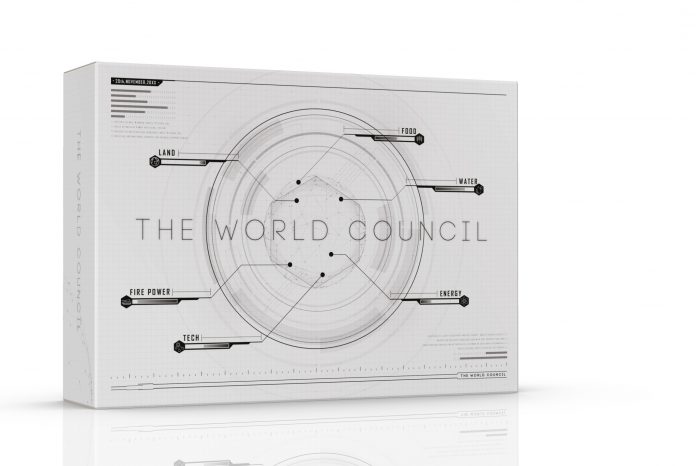
Have you ever imagined what it would be like to be a president who decides the fate of a whole population? The World Council would be the perfect board game to realise this wild dream. Simulating a secret committee that gathers leaders from different countries, The World Council invites players to get a taste of being our world’s policymakers – at a cost.

Lokson Leung Lok-man, Steve Mok and Jewel Sing, the 21-year-old co-founders of Creator Studio, invented the board game in 2016. Leung had the idea of creating a board game about global issues when he learnt about the 2009 Copenhagen Climate Change Conference during a liberal studies lesson in secondary school. “People in island countries have become climate refugees because of the rising sea levels, but all the powerful countries were just arguing over their own carbon emissions instead of helping them,” says Leung. He wants to get players to empathise with these countries and understand their needs through the board game.
The strategic game accommodates three to eight players representing different types of countries. The aim is to achieve their country’s objectives before “Doomsday” comes. At the start of each game, every player draws a country card which determines their power, objectives and resources. During the game, players can use action cards to issue economic sanctions, launch propaganda wars or other tactics. With building cards, they can construct buildings at the expense of the resources their countries are endowed with. As the players get closer to their objectives, a doomsday index increases. When it reaches its 15-point limit, the game ends.
Before the official launch of the game, Leung, Mok and Sing invited some friends to try it out. The feedback was positive. “They reflected on themselves a lot,” Leung says. “It is easy to lose the game, because you forget about the doomsday index when you strive for your own goals.” He says the key to winning is to focus on the common interests shared among players. This mirrors the need to emphasise shared interests when addressing global issues in reality.
Last November, the trio began seeking funding from Kickstarter, the world’s largest crowdfunding platform. Within a month they had collected HK$560,000, five times their original target, from over 1,300 backers. Leung was surprised by such an overwhelming response. “A lot of Hong Kong people do not support local creative talent,” says Leung. “They don’t recognise our creativity until something makes its way out of Hong Kong.”
Leung and his partners regard the crowdfunding campaign as a market survey and assessment of their public relations techniques. “Starting a company requires a lot of devotion at the beginning but the returns are very unstable. You need to bear a lot of risks and have nothing to lose,” says Leung.
Their next step is to collaborate with local schools and non-governmental organisations to use the board game as a teaching material for liberal studies.
Don’t miss out on the fun. The World Council is available for purchase at the Facebook page https://www.facebook.com/csTheWorldCouncil/.
Edited by Gloria Lee
Gingko House restaurants gives retired seniors a second career
By Angela Ng
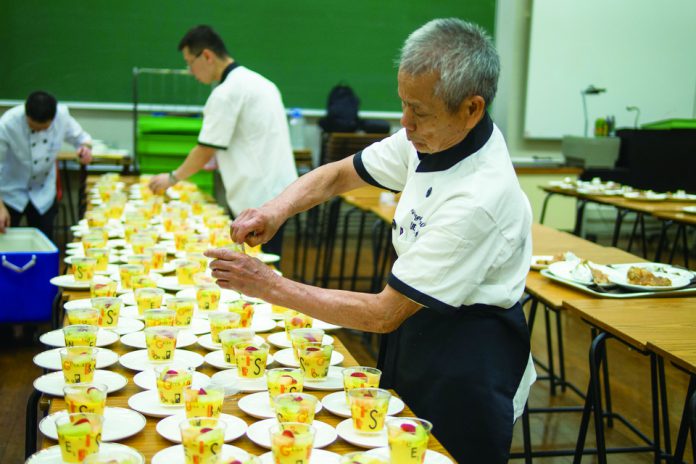
Gingko House offers a unique dining experience – silver-haired waiters and waitresses serve you scrumptious dishes cooked from colourful organic farm products grown by the restaurant itself.
Many senior citizens have no choice but to retire after reaching the statutory retirement age but they still want to work and earn an income to cover their living expenses. Gingko House, a social enterprise advocating senior employment, fulfills their hopes of leading a fruitful work life after retirement.
In 2006, a group of elderly home volunteers founded Gingko House when they realised how depressed senior citizens can become when facing difficulties of re-employment. It is the first restaurant in Hong Kong to “lead by example” in senior employment. As of today, 2,000 seniors have been employed by Gingko House. The group is headquartered at Fo Tan, with four restaurants throughout Hong Kong.
Senior employee George Fung Man-chun, 72, feels that maintaining a career is essential for leading a meaningful life because it helps him keep his mind clear, maintain his physical health and stay relevant to society. When Fung had to retire from his previous career, he felt at loss rather than excited. Luckily, Gingko House gave him the chance to start a new page in life. “Playing mahjong may be entertaining to some people, but working is my kind of entertainment,” Fung says.

Fung’s colleague, Jessica Siu Sui-ching, 72, describes how employment at Gingko House changed her life. “I’m more confident and happier now as I regard getting hired in my sixties as an accomplishment,” says Sin. “I used to think I was useless as no one would hire me and I have no contribution to society anymore.” The former hotel manager may walk with a limp, but it has not stopped her from taking up different positions during her eight years at the restaurant.
In consideration of the physical limitations of its senior employees, Gingko House runs a half-shift system to allow employees to work for four to six hours per day. The restaurant encourages senior employees to work in different positions as long as they can handle the jobs. Among all her duties, Siu enjoys working as a cashier and customer service ambassador the most. She says she likes interacting with customers, which is just what she used to do when she worked as a hotel manager.
Siu says customers and younger colleagues are surprised but delighted to see senior citizens working. Once, when Siu was serving at an event for the University of Hong Kong, students came up to her with words of respect and invited her to take photos with them.
However, Gingko House’s business development manager Kenneth Choi Man-kin says he does not wish to make senior employment a gimmick to attract customers. He thinks the quality of service and food are also important to get customers to visit the restaurant again. “We want to achieve a win-win situation,” says Choi. “Customers, shop owners and senior citizens can all benefit.”
Currently, Gingko House operates a “farm to table, table to home” concept. It has its own organic farm, and customers can buy organic farm products at its restaurants. The social enterprise hopes to continue diversifying its business in hopes of employing more senior citizens.
Visit http://www.gingkohouse.hk/ or their Facebook page 銀杏館 @gingko2005 for more details.
Edited by: Gloria Lee
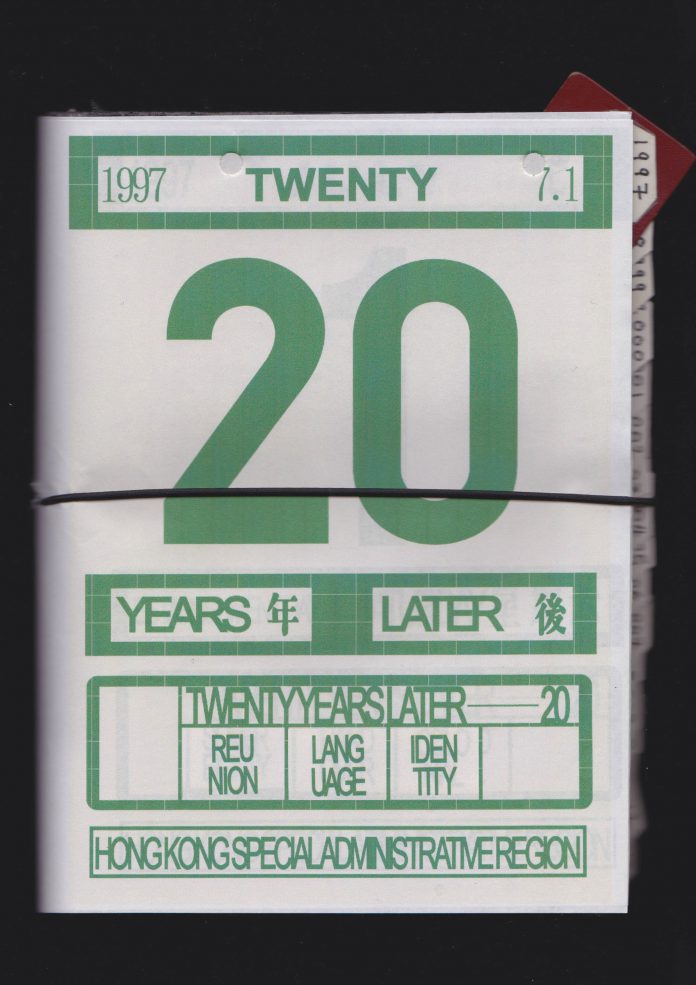
This year marks the 20th anniversary of the handover of Hong Kong’s sovereignty from Britain to China in 1997. That was the year in which most of the reporters working on this issue of Varsity were born. In Periscope, we take a look back on some of the issues that have shaped Hong Kong in the past 20 years.
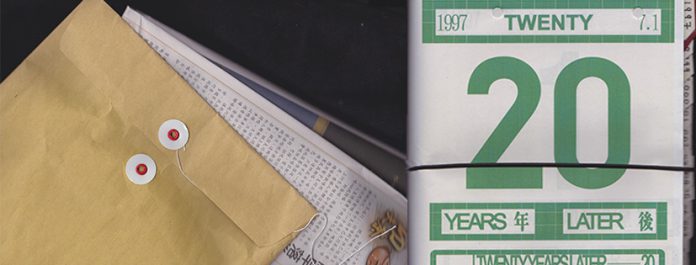
This year marks the 20th anniversary of Hong Kong’s handover and transition from a British colony to a special administrative region of the People’s Republic of China. Some people will recall the tears of the last governor Chris Patten after he gave his farewell speech at Tamar. But for our generation, such scenes are known only from historical news footage and the stories from that era may seem unfamiliar and even strange.
Still, many of the events, issues and emotions triggered during that time still affect us now in many ways. Hong Kong has undergone many changes in the past 20 years, economically, socially, culturally and politically. Its people have had to reflect on what it means to be a Hongkonger, legally and culturally. Teachers, parents and students have had to grapple with far-reaching education reforms, and different generations of Hong Kong people have had to assess how they view China.
On the first working day after July 1, a long line of parents and children queued up at the Immigration Department. They were there to claim the right of abode in Hong Kong under Article 24 of the Basic Law, which had come into effect on July 1. The fight for residency rights for the Mainland-born children of Hong Kong permanent residents dragged on for years, led to a government projection that Hong Kong would be flooded by 1.67 million mainland migrants and resulted in the National People’s Congress Standing Committee’s first interpretation of the Basic Law.
The fallout was, and is, immense. Many in the legal profession believe the interpretation set a bad precedent for Hong Kong’s judicial independence and the discourse around abode seekers and mainland arrivals has had a lasting impact on how Hong Kong people view mainland migrants.
Ironically, with greater economic integration between Hong Kong and the Mainland in the past 20 years, millions of mainland visitors have travelled to Hong Kong under the Individual Visit Scheme. The government has used the Quality Migrant Admission Scheme to attract mainland talent and a wave of babies who were born to non-Hong Kong parents automatically gained residency rights.
A raft of sweeping education reforms have also been instituted in the past 20 years, including some related to the medium of instruction. In 1997, the government announced the widespread implementation of mother-tongue teaching, replacing English with Cantonese as the language of the classroom. In 2008, it handed out funds to schools to promote the teaching of Chinese in Putonghua. And in 2011 it introduced a “fine-tuning” policy to give schools greater flexibility to teach in English again.
Teachers have toiled to keep up with the changes, students struggle under an increasingly heavy workload, employers complain about falling English standards. We look at how the policies related to the medium of instruction in schools since 1997 have affected students, parents and teachers.
Much attention has been paid to Hong Kong people’s changing sense of identity since the handover. We look at how people of different generations perceive China. Those born in 1967 came into the world as leftist riots rocked Hong Kong and the Mainland was in the grip of Cultural Revolution. The Sino-British Joint Declaration on Hong Kong’s future was signed in 1984 and those born in that year grew up in the transition years, when many sought to emigrate, even though Hong Kong’s economy was booming.
It is interesting to see that those born in 1997, who have only known Hong Kong under Chinese sovereignty, are the ones with the strongest sense of localism; while those who experienced British rule feel a relatively stronger connection to China. We talk to Hongkongers born in these three eras and ask how different circumstances during their formative years contributed to their perception of China.
Most of the reporters who worked on this issue were born in 1997. It is not only a special year for them, but also for every Hongkonger. We hope that you will enjoy reading it on this, the 20th anniversary of the handover.
Managing Editor
Gloria Lee


How the social and legal impact of the right of abode saga still affects us today
By Katie Cheng & Catherine Chiang
On July 1 1997, the Union Jack was lowered and the flag of the People’s Republic of China raised over Hong Kong – ushering an end to 156 years of British rule and the birth of the Hong Kong Special Administrative Region. Two days later, on the first working day after the handover, hundreds of people, many of them children, lined up outside the Immigration Department in Wan Chai to claim the right of abode in Hong Kong.
It was the beginning of a saga which would drag on for years, colour the relationship between Hongkongers and Mainlanders and have implications for Hong Kong’s rule of law that legal experts say are still being felt today.
The 1984 Sino-British Joint Declaration on the future of Hong Kong stated that the children of Hong Kong permanent residents of Chinese nationality, who were born outside of the territory would have the right of abode in Hong Kong. This was later incorporated in the Basic Law, under Article 24. With the Basic Law now in effect, these children were claiming their residency rights.
This sparked fear of a massive influx of abode-seekers from the Mainland among the public and the government. Within the space of just one week, the Provisional Legislature – an interim appointed body that replaced the pre-handover Legislative Council – ruled that abode-seekers would have to first return to the Mainland and obtain a “Certificate of Entitlement” before they could come to Hong Kong. The abode-seekers fought repatriation and took their case to the courts. A series of legal battles culminated in the Court of Final Appeal’s ruling on January 29 1999 in favour of the children.
But it turned out that the Court of Final Appeal’s decision was not final. In May 1999, then Chief Executive Tung Chee-hwa sought an interpretation of Article 24 by the National People’s Congress Standing Committee (NPCSC). The interpretation overturned the Court of Final Appeal’s ruling so that only those mainland children born after either of their parents obtained permanent residency in Hong Kong were entitled to the right of abode.
Barrister and former Legislative Council Legal Functional Constituency representative Margaret Ng Ngoi-yee says this set a bad precedent. “The first interpretation cast a very long shadow over the rule of law in Hong Kong,” says Ng. There have been seven interpretations since then.
Ng, who represented some of the abode seekers in court, is particularly irked that the Chief Executive referred the matter to the NPCSC, when according to the Basic Law, that should be a decision for the Court of Final Appeal to make. “It’s [done] without a referral. It’s freestanding,” Ng says. “However independent your judges, some political organisation in the Mainland can tell you what to do.”
Ng adds that after the 1999 interpretation, lawyers representing the government have used the possibility of going to the NPCSC for interpretation as a threat to the courts.
Ng was not alone in believing the government had undermined the Basic Law and sacrificed Hong Kong’s rule of law for the sake of convenience. The legal profession held its first silent march in protest against the interpretation. But despite support from her peers on the interpretation issue, Ng came under political pressure and under fire from society at large for helping the abode seekers. But she has no doubt that no matter how tough the fight was, it was one that needed to be fought.
Keeping up with changes to the medium of instruction in Hong Kong’s classrooms
By Angela Ng & Yi Yeung
Education issues have rarely been out of the headlines in the 20 years since Hong Kong’s handover. Some of the scenes we have witnessed include primary students tearfully describing the pressure of drills and cramming to the Legislative Council and parents collecting signatures to abolish the Territory-wide System Assessment (TSA) tests. Add to that the secondary students protesting against the switch to Putonghua in classes normally conducted in Cantonese and the 120,000 strong crowd surrounding the government headquarters to protest against national education in 2012. These scenes illustrate the controversy that has surrounded many of the education policies of the past two decades.
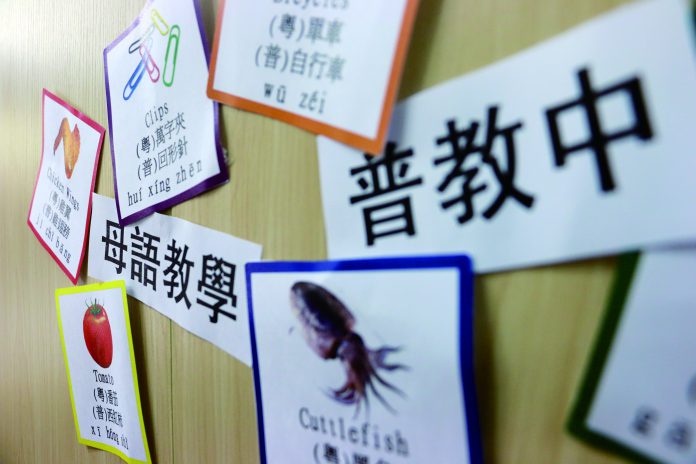
Sweeping reforms have been implemented in many areas of the education system, including school admissions, internal assessment mechanisms, student assessments and standardised test and the curricula. Another big area of change has been in the medium of instruction (MOI), with a widespread switch to mother-tongue teaching in 1998-9 and the active promotion of teaching Chinese in Putonghua (PMIC) in 2008, with the announcement of HK$200 million in funds to help schools make the switch from Cantonese in Chinese language classes.
According to the Education Bureau (EDB), 72 per cent of primary schools and 37 per cent of secondary schools were using Putonghua to teach Chinese by the school year 2015/16.
Some parents have welcomed the move as they think learning more Putonghua will give their children an edge. Lam Yuk-ying is one of them. “You must learn Putonghua, you always need it at work,” says Lam, “Practising more helps to build confidence in speaking Putonghua.”

Lam says her eight-year-old son can now write sentences with fewer structural and grammatical mistakes and credits this to learning in Putonghua. In addition to his Chinese classes at school, Lam’s son also has one Putonghua lesson every week. He has no formal training in Cantonese even though he has a Chinese oral assessment in Cantonese at school every term. Lam says marks are deducted if written language constructions are used in the assessments, but she has no regrets about her son’s Putonghua-only Chinese learning.
Andrew Chan, convenor of a Cantonese language advocacy group, Societas Linguistica Hongkongensis, says the idea that PMIC leads to better learning outcomes for Chinese language is “a fallacy”.
“We should not set the language as MOI just because we want to learn that language,” says Chan. He acknowledges there is a practical need to learn Putonghua but he believes the nine years of Putonghua lessons from primary one to secondary three are more than enough for students to gain proficiency.
For Chan, PMIC contradicts the rationale of mother-tongue teaching, which had been embraced by the outgoing colonial Hong Kong government as a future goal, and by the first Hong Kong SAR administration which implemented a policy of mother-tongue teaching in 1998-9.
“Mother-tongue teaching emphasises learning in everyday life,” says Chan, “but PMIC tells you that what you say daily is wrong.” He suggests a few examples from daily life where objects are named differently in Cantonese and Putonghua. For instance, chicken wing is “gai yik” in Cantonese and “ji chi bang” in Putonghua.
Kwan Yin-lai, a Chinese language teacher teaching in Putonghua, agrees with Chan that teaching in Putonghua creates barriers to classroom learning. “Undoubtedly, the interaction between teachers and students is ‘livelier’ if the classes are conducted in Cantonese,” says Kwan.
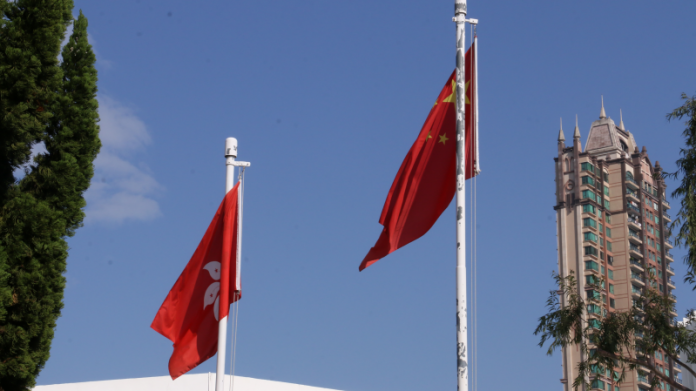
Three generations of Hongkongers show how sentiments towards China are changing
By Rivers Zhang & Nannerl Yau
Anyone browsing Hong Kong social media on November 17, 2015 could not have failed to notice the big showdown set for that evening. Hong Kong’s world cup qualifier against China at Mong Kok stadium was much more than a football match. Inside the stadium, Hong Kong fans booed the national anthem and held up signs saying “Hong Kong is not China”. Emotions were just as highly charged outside the stadium – including at the outdoor screenings of the match in various neighbourhoods.
Fung Long-hei, then an 18-year-old student, watched the match with other Hong Kong supporters at one such screening in Sham Shui Po. Fung, born in Hong Kong in 1997, the year the former British colony was transferred to Chinese sovereignty, was clear where his allegiances lay as he cheered on the local team and swore at its opponents.

Fung’s antipathy towards China is not restricted to the football pitch – like many of his generation he defines himself as a Hongkonger rather than a Chinese, unlike the Hong Kong people of his parents’ generation.
In the 20 years since the handover, the degree to which Hong Kong people have identified with some form of Chinese identity has seen ups and downs, but in recent years, the trajectory has been downwards. The University of Hong Kong’s Public Opinion Programme has been tracking Hong Kong people’s identity since 1997. Between 2008 and 2016, those who see themselves as a Hongkonger or a Hongkonger in China rose from 47.4 per cent to 63.7 per cent while those who identified as Chinese or Chinese in Hong Kong fell from 47 per cent to 33.9 per cent. The figures are even starker when they are broken down into age groups. For 18 to 29-year-olds, those who identify as Hongkongers in a broad sense rose from 58.3 per cent to 83.8 per cent, while those who identify as Chinese in a broad sense dropped from 41.2 per cent to 13.3 per cent in the same time period.
The degree to which Hong Kong people identify with being Chinese is inextricably linked to how they perceive China itself and, according to Brian Fong Chi-hang, a professor at the Education University of Hong Kong, is a reflection of “generational politics”.
“Each generation experiences important historical signature event[s]. These shape that generation’s world view,” he says.
Lau Man-yee, a secondary school liberal studies teacher, was born in Hong Kong in 1967, a year in which Hong Kong was rocked by violent riots against colonial rule that were inspired by the Cultural Revolution in the Mainland.
Her memories of China from her childhood are of visiting relatives with her parents – they often had to bring a lot of clothes and food because resources were scarce. “But after I grew up, it was no longer a must to bring stuff when we visited our relatives,” she says.
Despite China’s remarkable economic growth in recent decades, Lau still retains an image of the Mainland as a bland place. “When you entered a department store in mainland China, it was like all the clothes were blue and grey, and you had no alternative colours.”
For a long time, this image stayed with Lau and so she did not harbour high hopes for the country’s economic and democratic development. “When I was young, I wouldn’t demand or expect that the Mainland should develop in a very ideal way, because it really was very backward,” she says.
The education system is driving students away from STEM subjects
By Selena Chan & Elaine Ng
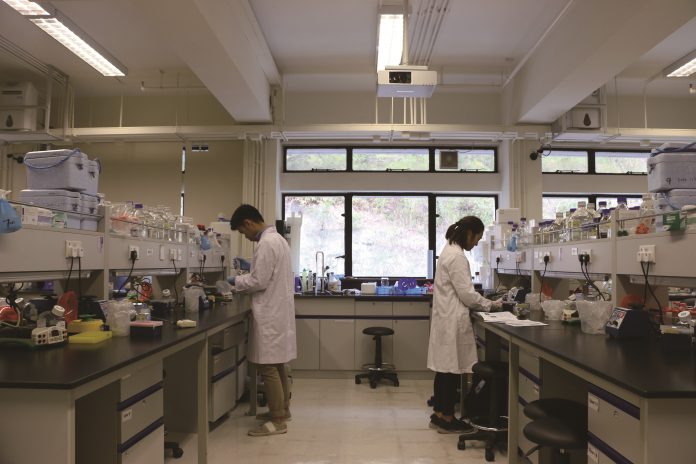
In the science laboratory at S.K.H. Kei Hau Secondary School, cardboard virtual reality glasses are scattered on the tables where little robots hit ping pong balls with their paddles. Student members of the Electronics Club explain the robots were made for a robotics competition. They also demonstrate the use of augmented reality technology used to help students understand the periodic table in an interactive way. When a user looks through the glasses at the symbols of elements in the table, information about them will appear.
Chan Kim-ho, a Form Five student, has been a member of the club since his first year at the school. Kim-ho says that through joining STEM activities, such as interschool science competitions, he has paid more attention to new technologies and the scientific principles underlying them.

The term STEM originated in America and refers to the academic disciplines of science, technology, engineering and mathematics. As applied to education, it relates to a curriculum that uses an inter-disciplinary approach to teaching these disciplines in a hands-on way through real-world applications. S.K.H. Kei Hau Secondary School began taking this approach in 2003, long before Chief Executive Leung Chun-ying first proposed STEM education in the 2015 policy address.
Aligning with the worldwide education trend, the government is promoting STEM in the hope of nurturing talent to cope with rapid economic, scientific and technological developments.
The Education Bureau distributed a one-off grant of HK$100,000 to each primary school in the 2015/16 school year to start new initiatives and enhance existing STEM projects. In this year’s Policy Address, STEM education was again on the agenda with an additional one-off subsidy of HK$200,000 for each secondary school.
These initiatives follow an earlier pilot scheme where the government gave a HK$7.5 million subsidy to eight selected secondary schools in 2014/15 to incorporate IT enrichment programmes. Cheung Sha Wan Catholic Secondary was one of them. Ng Chi-wai, the teacher who designs the class, says not many schools are ready to practice STEM education. Ng explains that initiating a new project takes a lot of resources and time. The school curriculum is already quite packed and students have heavy workloads as it is.
The Academy of Sciences of Hong Kong (ASHK) was founded in December 2015 to promote the development and advancement of science and technology in Hong Kong. Following the government’s efforts to promote STEM education, the institution published the report, Science, Technology and Mathematics Education in the Development of the Innovation and Technology Ecosystem in January this year.
More coordinated support urged for students with SEN in tertiary institutions
By Angela Siu & Kristy Tong
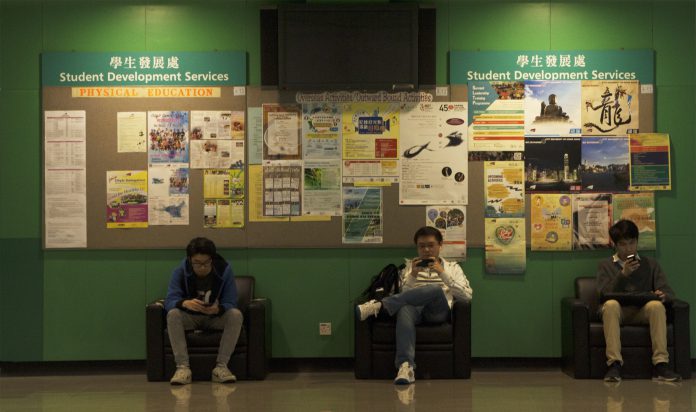
Listening to a long lecture, a student takes out her phone and starts chatting with friends. When she puts down her phone, she starts to draw pictures on her lecture notes. Kerry So Tsz-ching, a Year Two student studying in the Associate of Social Sciences (Behavioural Science) programme at HKU Space Community College, has attention deficit hyperactivity disorder (ADHD) and often finds it hard to remain focused for long periods of time.
She was diagnosed with the disorder – which is characterised by impulsivity, inattention and hyperactivity – when she was in Secondary Four and took medication for a few years.
So is one of the few students with special educational needs (SEN) studying in tertiary education. SEN includes physical and sensory disabilities, as well as developmental and learning disabilities such as ADHD, autistic spectrum disorder, and dyslexia. These learning disabilities are not always apparent to classmates and teachers.

Hong Kong has fewer students with SEN in tertiary education compared with other countries, but the number has increased in recent years. The Equal Opportunities Commission (EOC) says the total number of students with SEN studying in full-time undergraduate degree and sub-degree programmes grew from 532 in 2011 to 1,061 in 2015. Still, this is just 1.4 per cent of the tertiary student population.
Education Bureau figures show that of the 348 SEN students enrolled on UGC-funded programmes in the 2015/16 academic year, 14 per cent have autism, ADHD and other specific learning difficulties.
However, this refers only to those who have declared their disability, which is done on a voluntary basis. Students with SEN can submit information about their disabilities via the Joint University Programmes Admissions System (JUPAS) when they apply to UGC-funded programmes. This allows the institutions to identify them and provide timely and appropriate assistance.
However, Kerry So chose not to disclose her ADHD to HKU Space as she thinks her symptoms are mild. “ADHD had a greater impact on my childhood, but I’ve become more self-disciplined as I have grown up and can control myself now,” she says.
While she was given 20 per cent of added time when she took her secondary school public examinations, she did not apply for similar arrangements from HKU Space because she can now complete her exam papers within the standard prescribed time. She does, however, wish she could have more than one break in a three-hour lecture.
So says counsellors and social workers will follow up on students who have declared they have SEN. But for students like her, who have not disclosed their disability to the school, it is not easy to get information on how to ask for assistance or access the unit responsible for SEN issues.
Unlike So, Queenie Lau Pui-kiu, a Year Four student studying for a Diploma of Vocational Education (Business) in the Vocational Training Council (VTC) Youth College, informed the school that she has autistic spectrum disorder before her admission interview.
The VTC has a special admission procedure for students with SEN, who are offered a place if they meet the entrance requirements and are assessed to be capable of completing the studies during an interview. Because it has this separate admission route, the VTC has a higher intake of students with SEN than other post-secondary institutions. It is also the only tertiary institution to get HK$12 million annually from the government to provide SEN support services since 2013. Compare this with the HK$20 million in total that the UGC has provided as a one-off grant to its eight funded universities in 2015 to enhance SEN support.