New Territories West candidates answer questions on the issues first-time voters care the most about
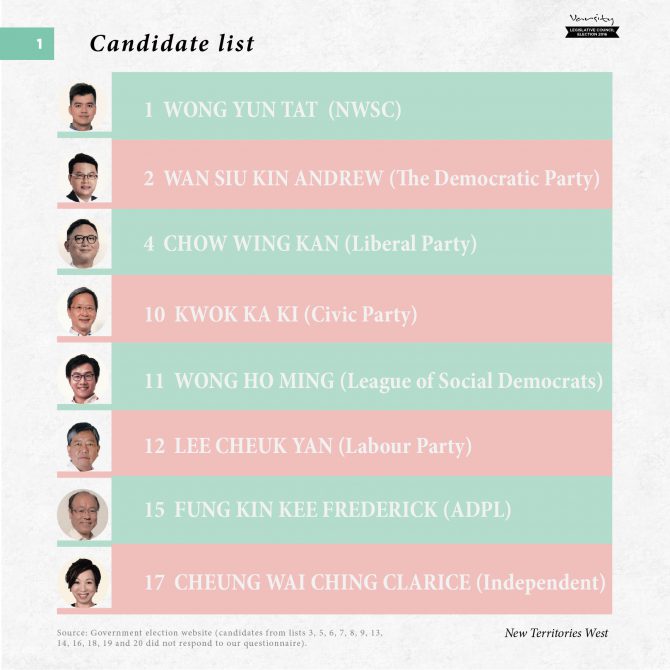
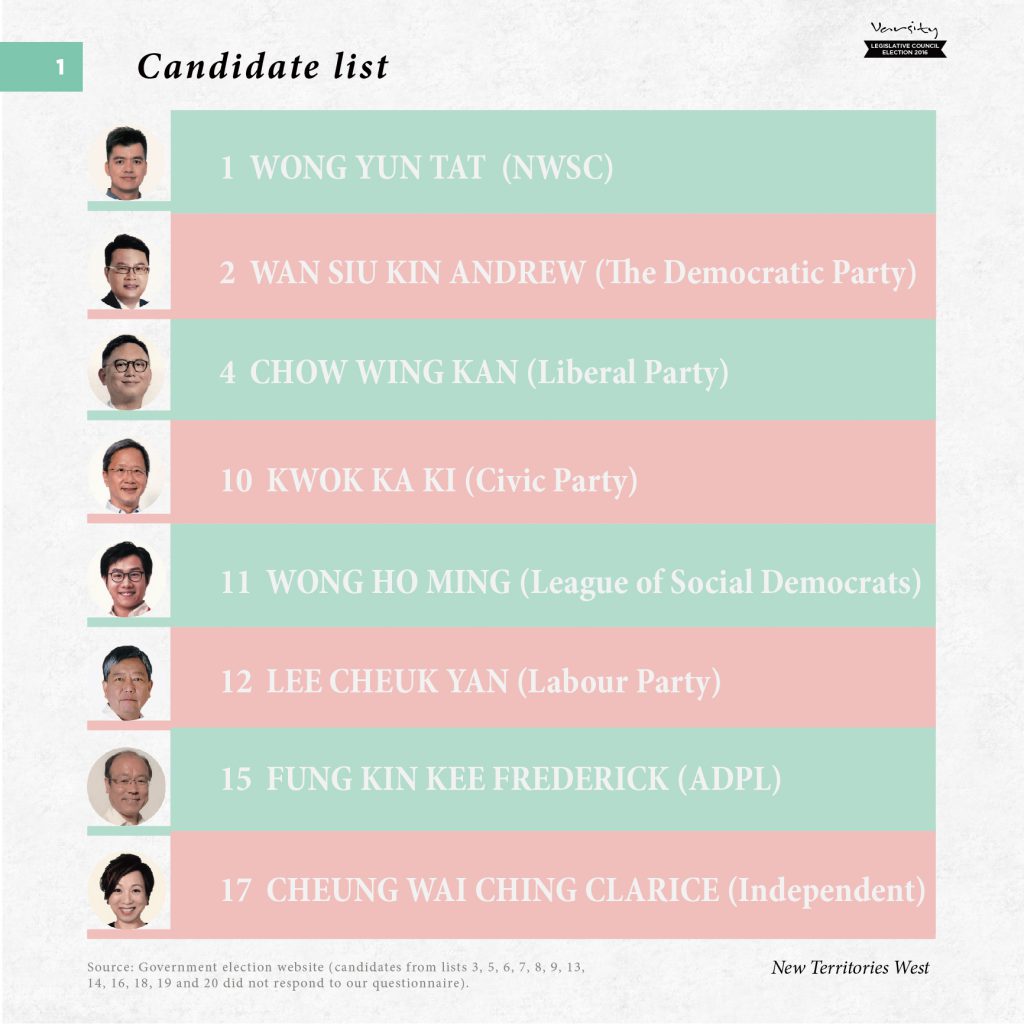
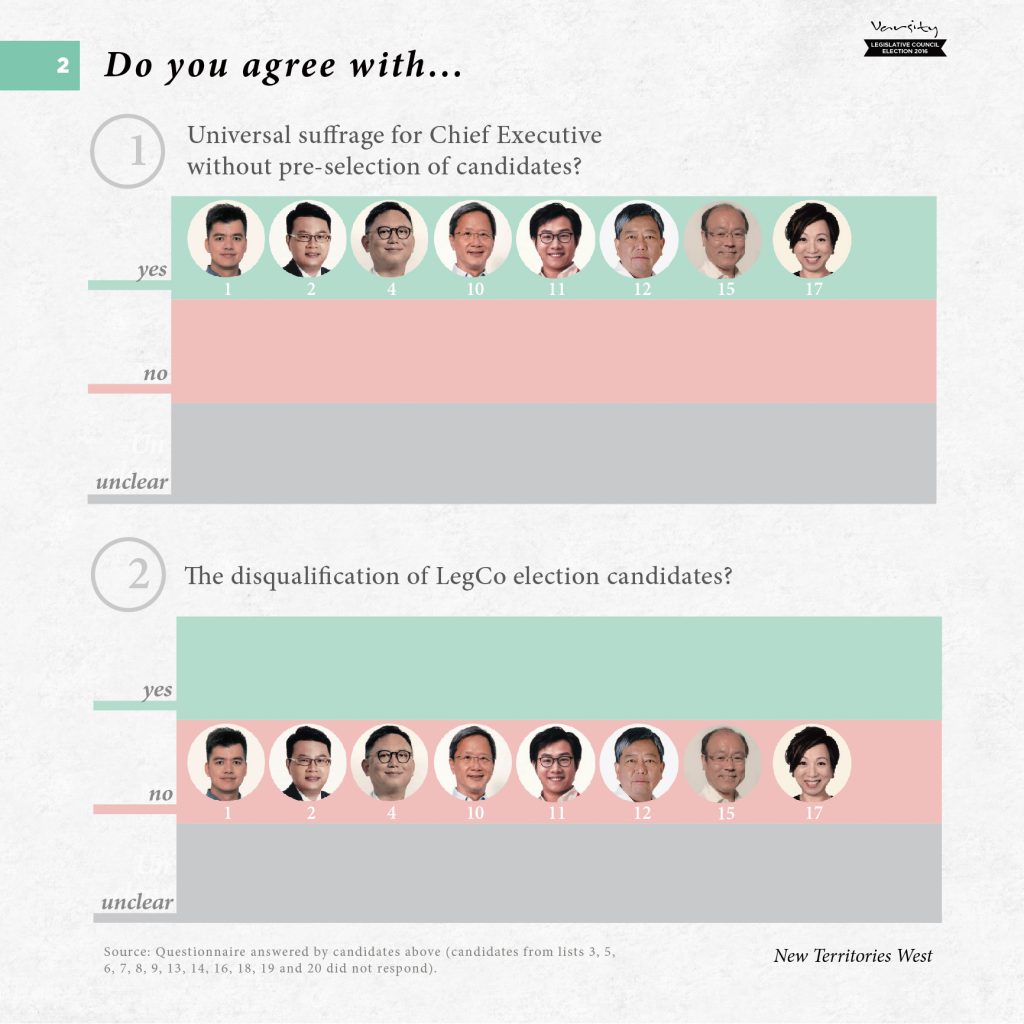
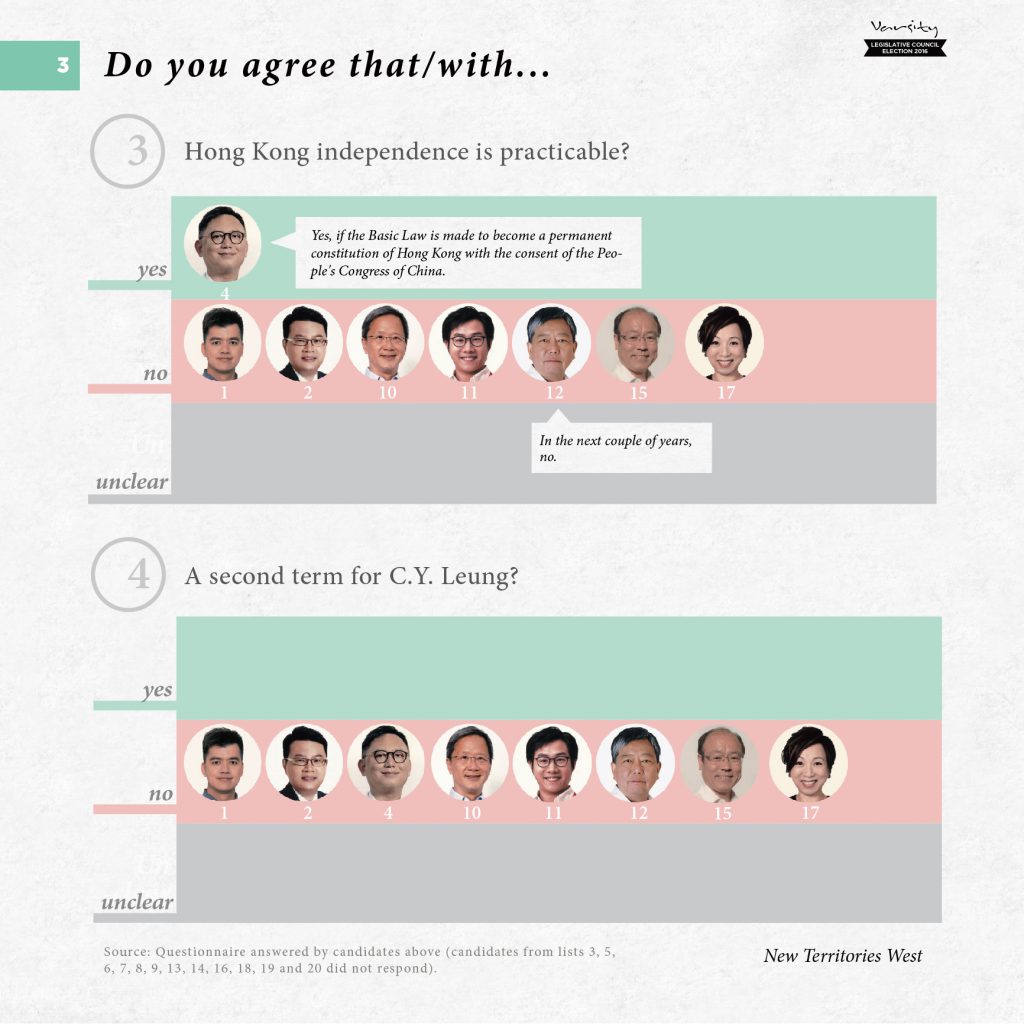
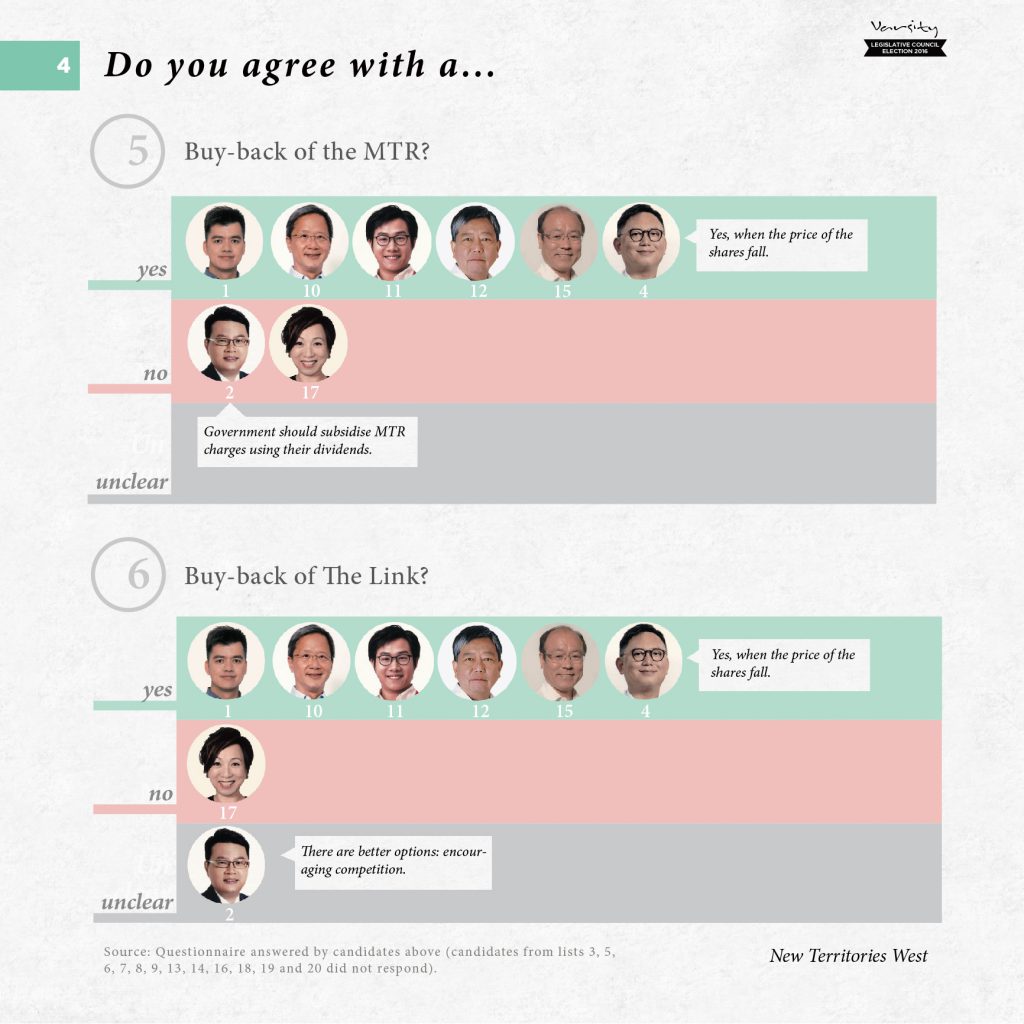
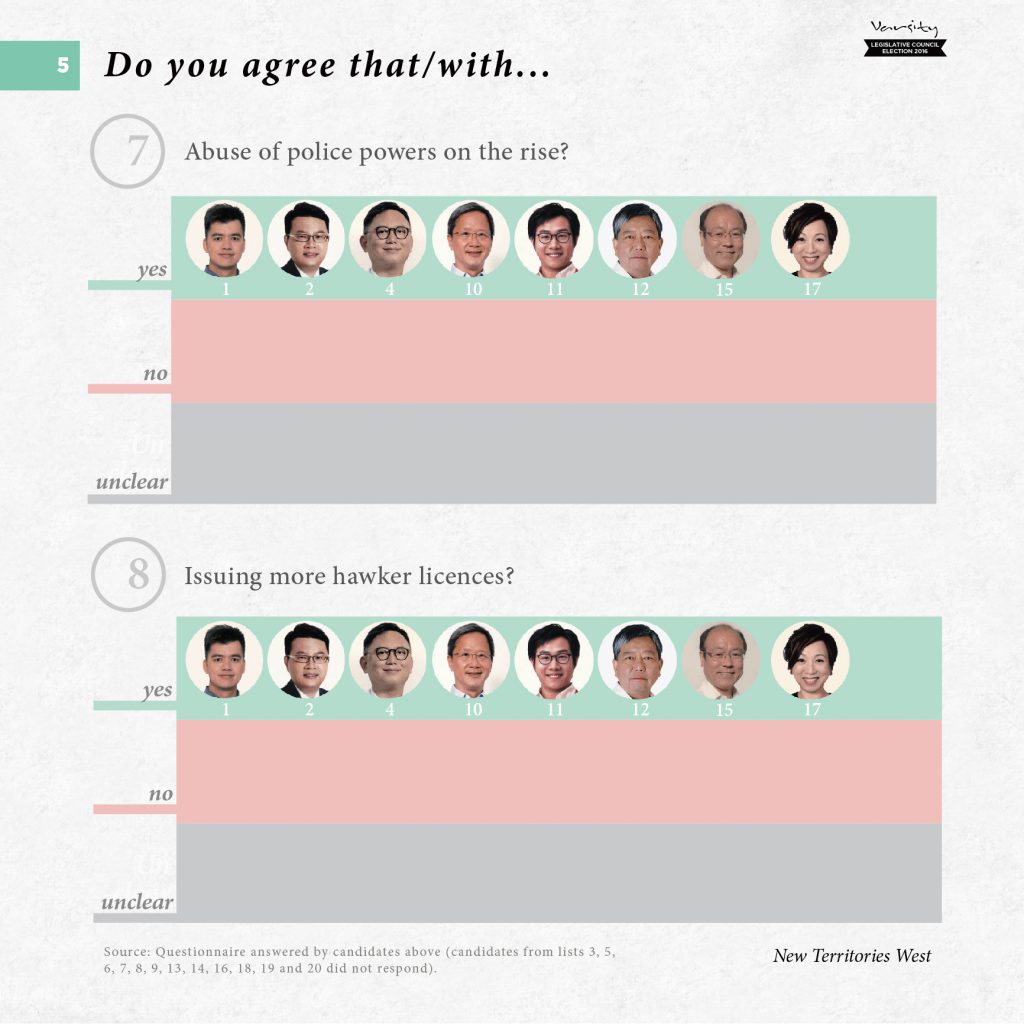
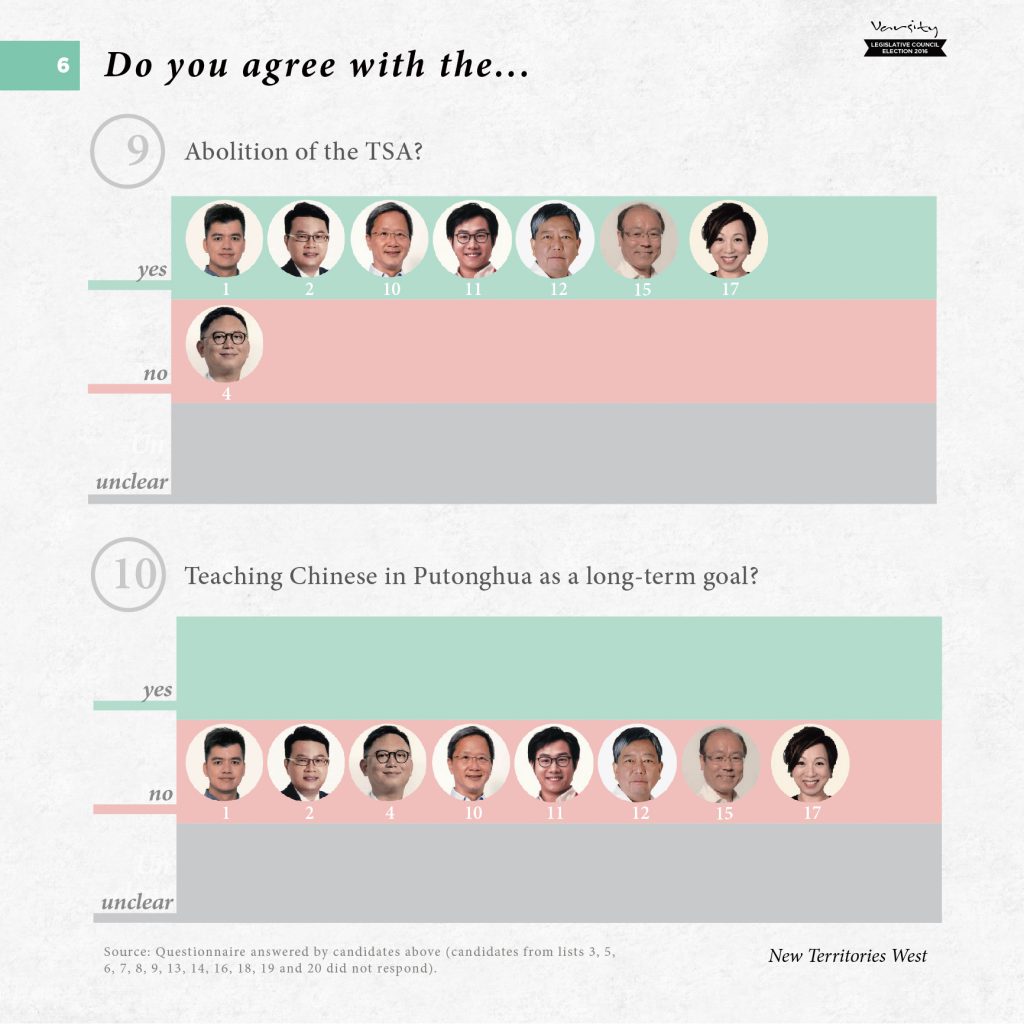
Today, in our series on how candidates responded to the questions first time voters told us they most wanted to ask them, we turn to the hotly contested New Territories West Constituency where 20 lists are vying for nine seats. This is the constituency whose Liberal Party candidate Ken Chow dramatically announced he’d withdraw from the race due to alleged threats. His name will still be on the ballot paper on Sunday and his answers are included in our tables below:
Varsity interviewed 10 first-time voters to come up with the questions they care about the most. We selected 10, covering political, economic, social and educational issues and sent them to candidates from the five geographical constituencies and the District Council functional constituency. Out of 93 candidate lists, 40 replied. Ricky Wong Wai-kay, Kwok Wai-keung (Federation of Trade Unions) and candidates from the New People’s Party directly refused to answer, while others (including candidates from the Democratic Alliance for the Betterment of Hong Kong and Youngspiration did not respond or could not be contacted.
Here are the questions we sent to candidates in full:
Do you support universal suffrage for Chief Executive without pre-selection of candidates?
Do you think it’s reasonable to disqualify candidates based on their political beliefs and platforms?
Do you think independence of Hong Kong is practicable?
Would you support a second term for Leung Chun-ying as Chief Exectuive?
Do you support a government buy-back of the MTR?
Do you support a government buy-back of The LINK?
Do you think the police force has been abusing its powers in recent years?
Do you think the government should issue more hawker licences?
Do you support the abolition of the TSA exams for primary three schoolchildren?
Do you support think the teaching of Chinese in Putonghua should be a long-term goal for Hong Kong schools?
*No replies were received from the following lists: 03 Ko Chi-fai; 05 Cheng Chung-tai (PSS); 06 Kwong Koon-wan; 07 Michael Tien Puk-sun (NPP); 08 Ho Kwan-yiu; 09 Leung Che-cheung (DAB/NTAS); 13 Kenny Wong Chun-kit (Youngspiration/TSWNF); 14 Alice Mak Mei-kuen (FTU); 16 Chan Han-pan (DAB); 18 Hendrick Lui Chi-hang (Christian to the World); 19 Tong Wing-chi; 20 Eddie Chu Hoi-dick
Teenager canvassing for a young localist party wants to help construct a Hong Kong identity at district level
By Fiona Chan
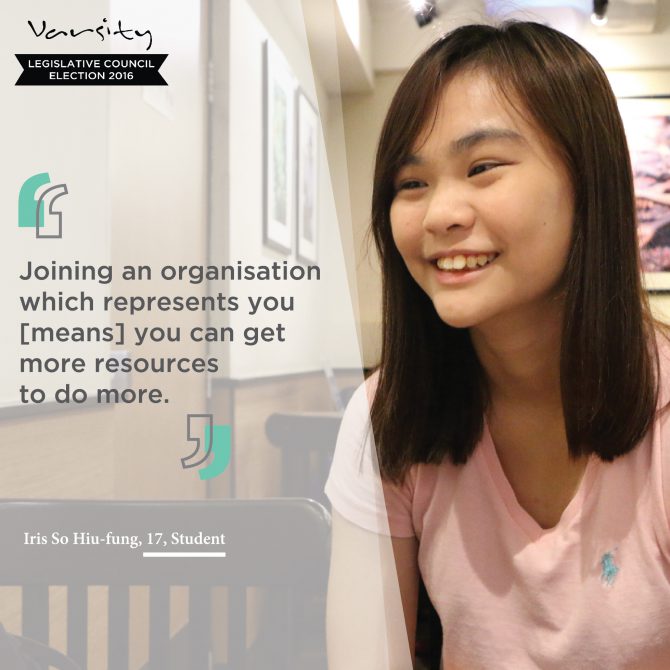
Unlike other DSE graduates who spend their long holiday travelling or doing part-time jobs, 17-year-old Iris So Hiu-fung has devoted her summer vacation to volunteering for the young political party Youngspiration.
“You can achieve more by working with a group of people who share your beliefs than doing things alone,” says So, who will be studying Journalism and Communication at Hong Kong Shue Yan University in September. “Many a little makes a mickle. Joining an organisation which represents you [means] you can get more resources to do more.”
Members of Youngpiration, a localist party formed by a group of young people after 2014’s Umbrella Movement, have been busy campaigning for the Legislative Council Election, which takes place on Sunday. The party has candidates running in the Kowloon West, New Territories West and New Territories East geographical constituencies.
As polling day approaches, So is on the streets almost every day, setting up booths, hanging banners and distributing flyers in various districts to canvass votes and spread the party’s ideas.
Iris So Hiu-fung says sincerity is important when canvassing in the districts (Photo courtesy of So)
So started participating actively in politics after joining the 2012 anti-National Education protests. Her involvement with Youngspiration began in March this year, when she was impressed by the party’s efforts during the District Council Election in November 2015. At the time, she spoke with party convenor Sixtus ‘Baggio’ Leung Chung-hang, who was standing as a candidate at the Kwun Long constituency where So lived. As a result, she came to appreciate the party’s district work in constructing a Hong Kong identity.
“[Youngspiration members] make use of things like the Hong Kong Olympics team in Rio or the Hong Kong National Football Team’s performance at the FIFA World Cup Qualification tournaments [against China] to build up a sense of identity among Hong Kong people,” she says.
Although So currently spends all her time campaigning, she prefers working with residents at a district level. She especially enjoys talking to them face-to-face, which allows her to better understand their needs. She hopes to put in more time connecting with local communities after the Legislative Council Election is over.
“District work can be very diversified,” she says. “It’s no longer confined to just yelling through microphones or distributing handbills.”
Despite her passion and devotion, So does not have her family’s support. She says they are prejudiced against localists, labelling them as gangsters who stir up trouble for money. But after many rounds of heated rows, her family members began to respect her political views and actions. Still, they have a bottom line that she must not to get arrested.
“You’re not supposed to have a bottom line when you choose to fight,” So says. “But you have to know it’s not all about you. They are your family members. They set a bottom line because they are worried about your safety.”
Because she is still financially dependent on her parents, So gave in to her parents’ demands. “I can’t afford to take up criminal liability or pay for bail, so being arrested would jeopardize my family members,” she says. But once she becomes financially independent, So says she is determined to follow her own will.
Campaigning and fighting for her political beliefs may be tiring, but So has persevered, driven by a simple hope to make society better. Although she jokes that she has “evolved from a pig to a rioter in others’ eyes”, So says her experience in Youngspiration has taught her to think more comprehensively about her choice of words and actions.
“In the past, I thought individuals could do nothing on their own. But later, I realised that no matter how small your actions may seem, you still want to do it to the best of your ability,” she says. “That is what I learned from many different people.”
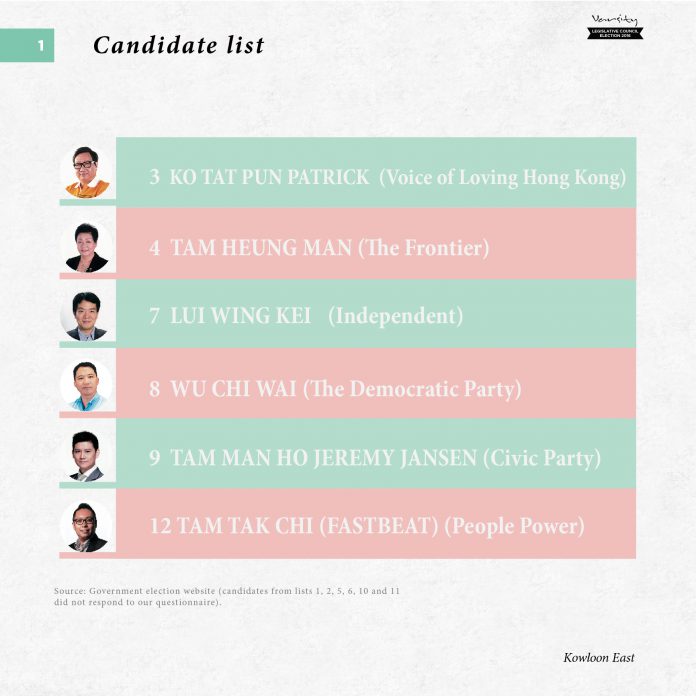
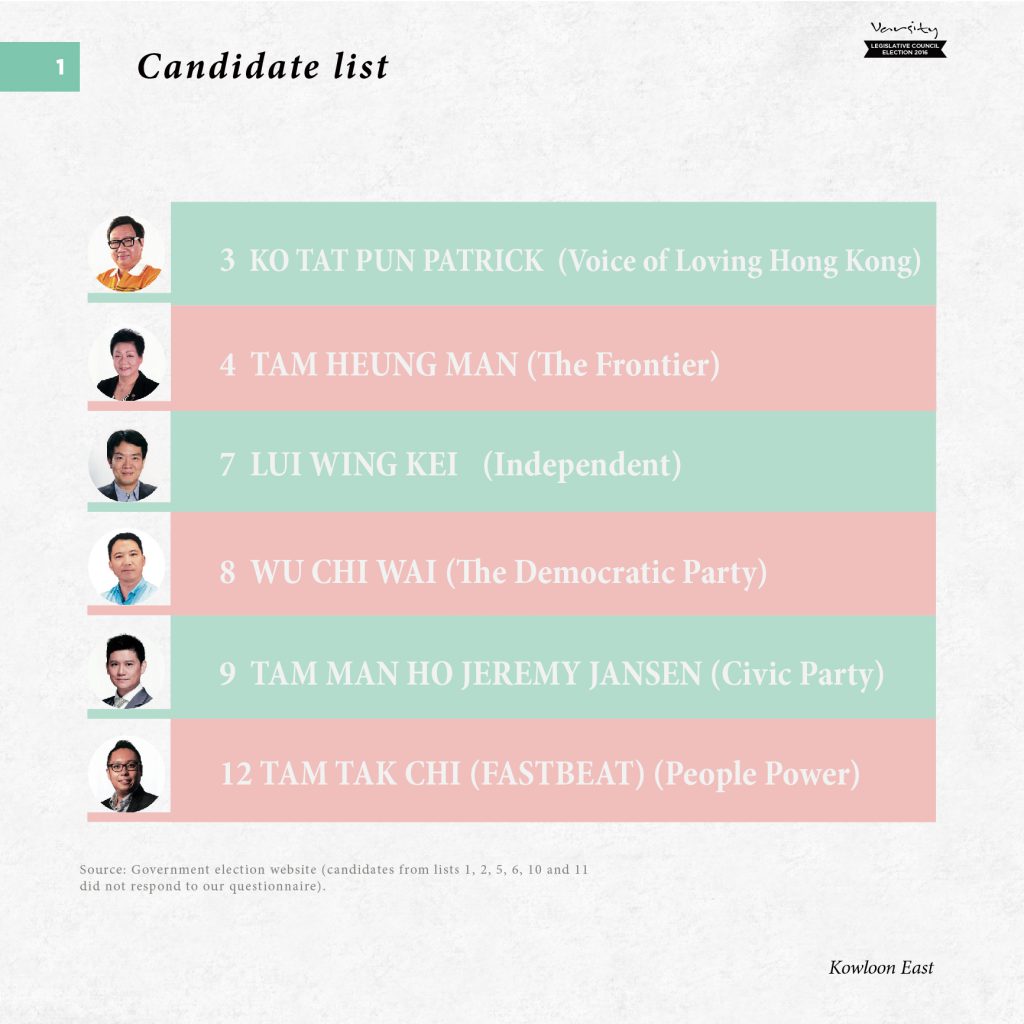
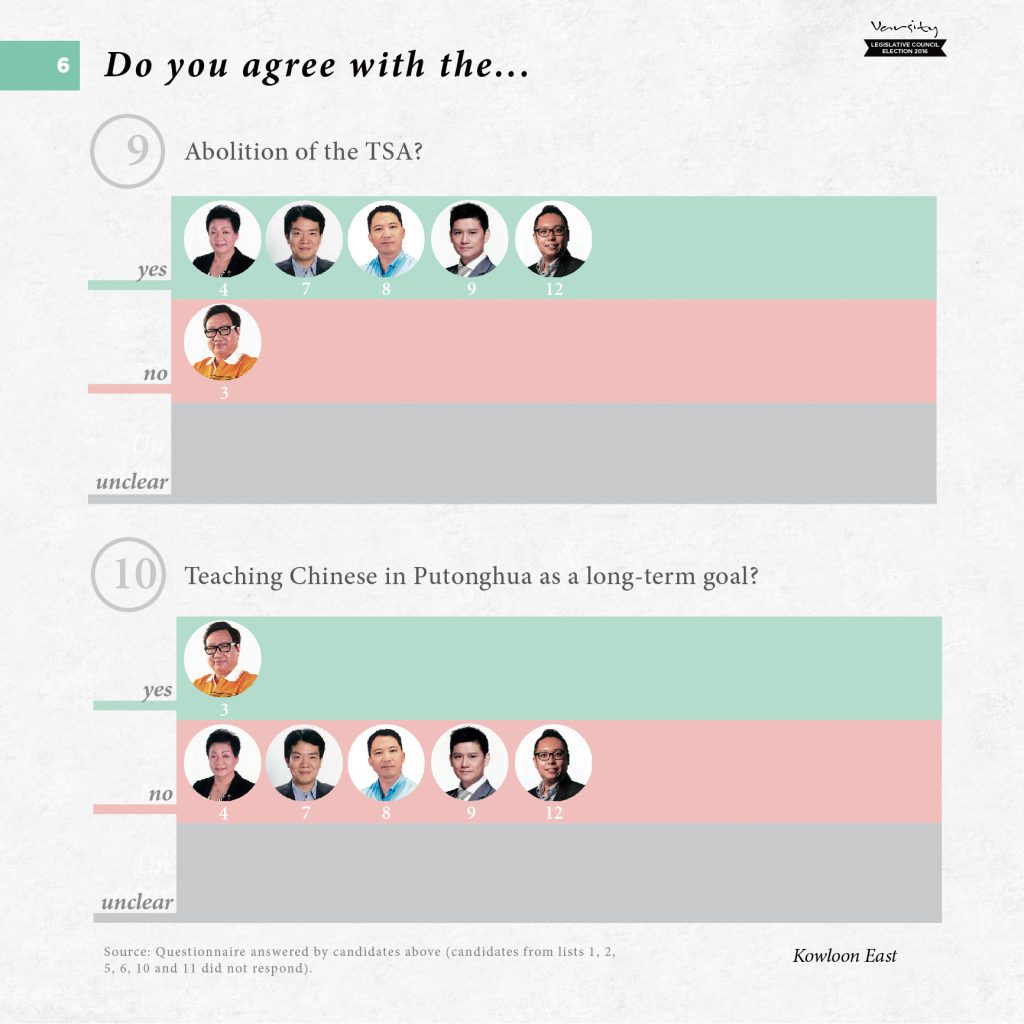
Kowloon East candidates answer questions on the issues first-time voters care the most about
Varsity interviewed 10 first-time voters to come up with the questions they care about the most. We selected 10, covering political, economic, social and educational issues and sent them to candidates from the five geographical constituencies and the District Council functional constituency. Out of 93 candidate lists, 40 replied. Ricky Wong Wai-kay, Kwok Wai-keung (Federation of Trade Unions) and candidates from the New People’s Party directly refused to answer, while others (including candidates from the Democratic Alliance for the Betterment of Hong Kong and Youngspiration did not respond or could not be contacted.
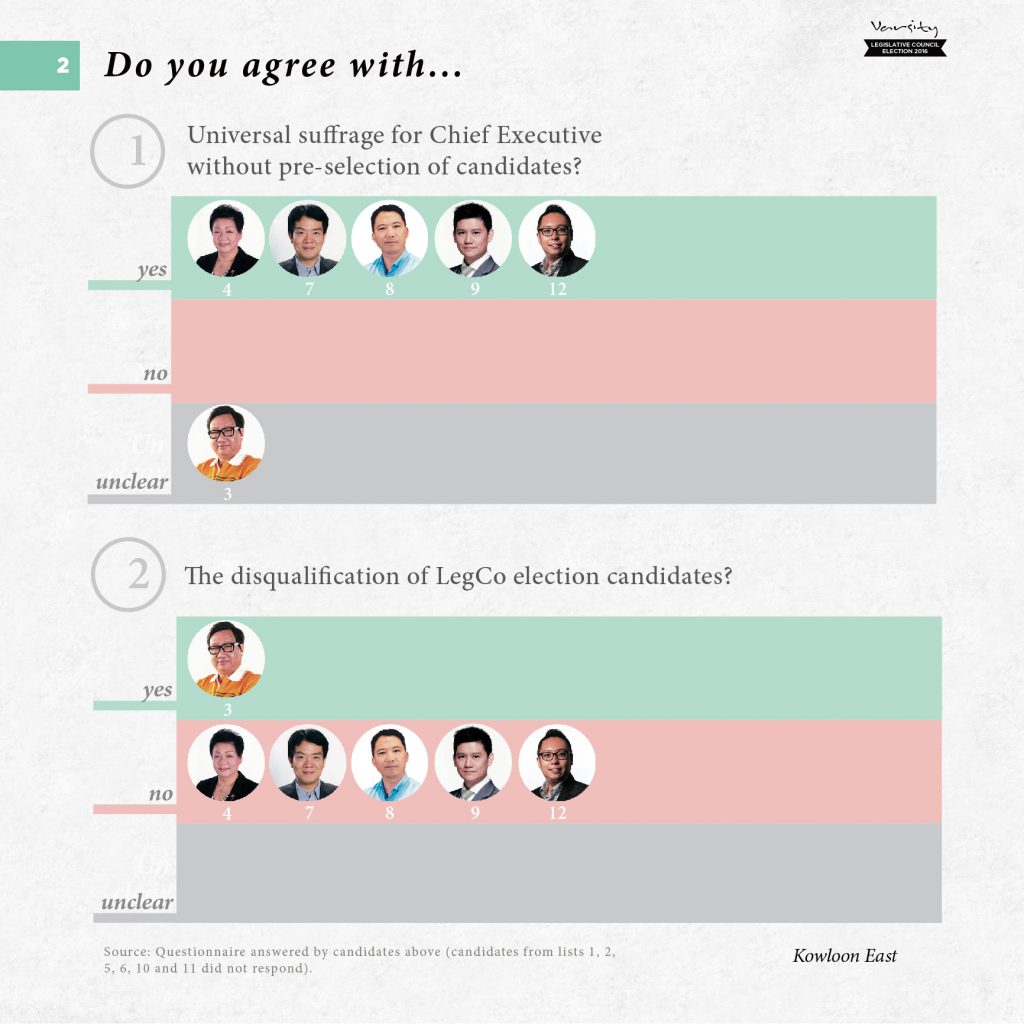
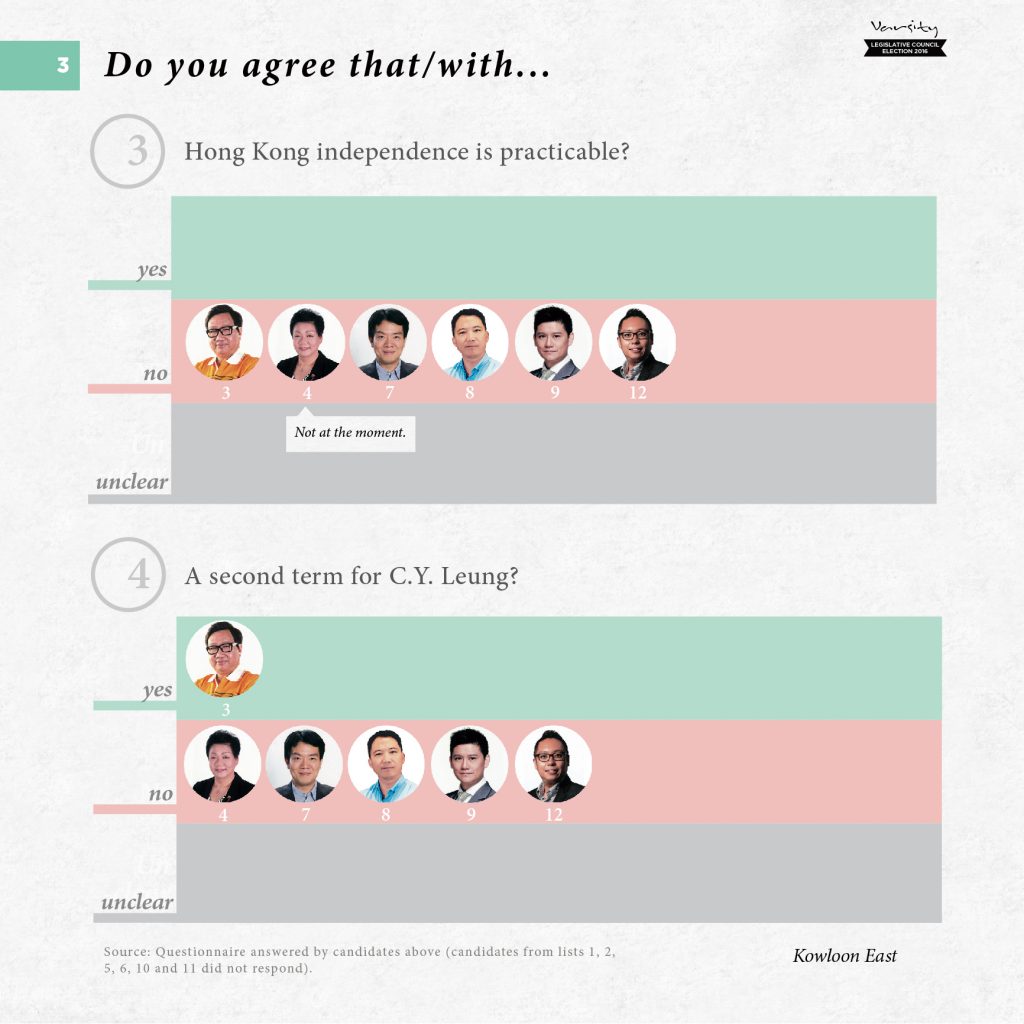
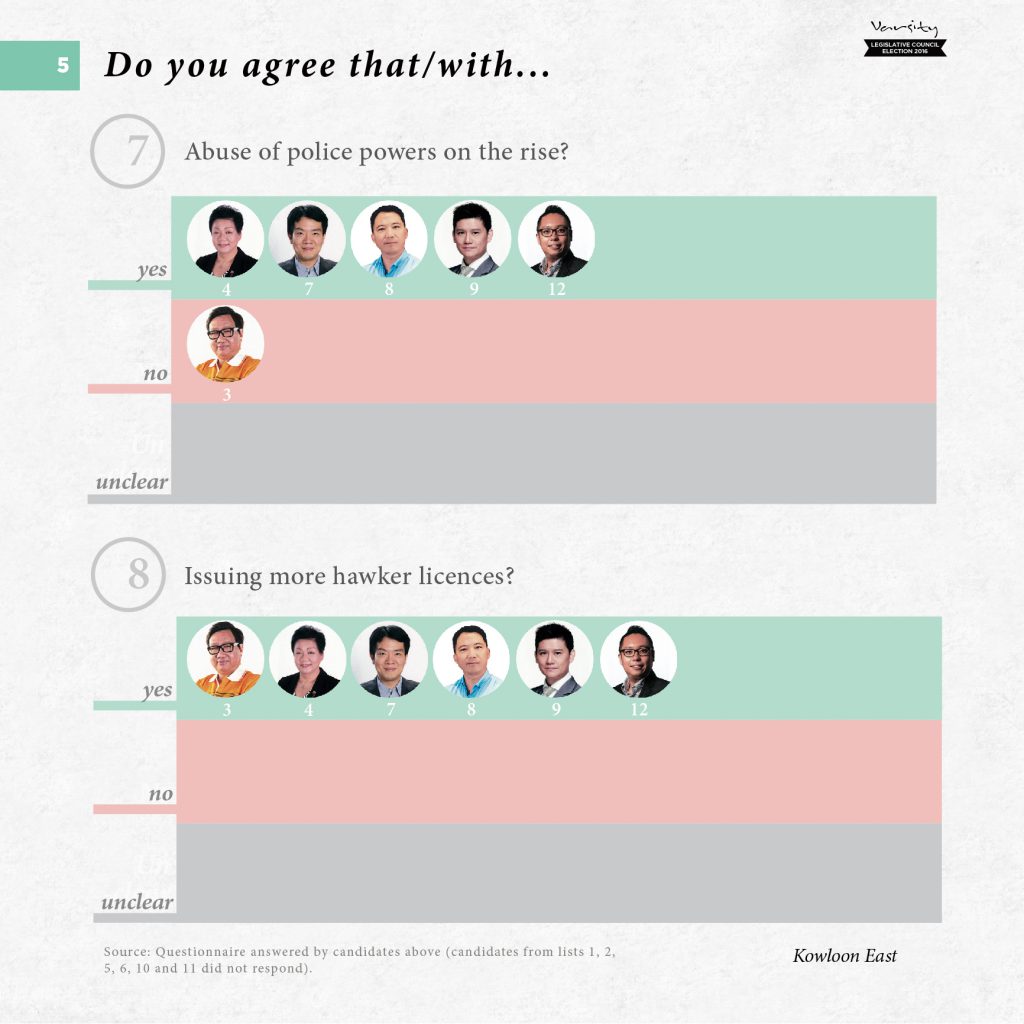
Here are the results for Kowloon East:
Here are the questions we sent to candidates in full:
Do you support universal suffrage for Chief Executive without pre-selection of candidates?
Do you think it’s reasonable to disqualify candidates based on their political beliefs and platforms?
Do you think independence of Hong Kong is practicable?
Would you support a second term for Leung Chun-ying as Chief Exectuive?
Do you support a government buy-back of the MTR?
Do you support a government buy-back of The LINK?
Do you think the police force has been abusing its powers in recent years?
Do you think the government should issue more hawker licences?
Do you support the abolition of the TSA exams for primary three schoolchildren?
Do you support think the teaching of Chinese in Putonghua should be a long-term goal for Hong Kong schools?
Non-responders: 01 Wong Kwok-kin (FTU); 02 Suzanne Wu Sui-shan (Labour); 05 Paul Tse Wai-chun; 06 Wilson Or Chong-shing (DAB); 10 Wong Yeung-tat (Civic Passion); 11 Chan Chak-to (KEC)
Can ‘likes’, shares and comments be turned into votes?
By Stanley Lam
When the Electoral Affairs Commission warned earlier this year that messages people posted on the internet and social media intended to promote or influence the election of a candidate could be counted as election advertisements, it was met with dismay. Critics ridiculed the notion that posts in support of a candidate could be counted as election expenses and said Hong Kong’s rules on social media and elections were out of touch and outdated.
Indeed a reader browsing the social media accounts of Hong Kong users might get the impression campaigning for the upcoming Legislative Council election is being conducted online as much as on the streets. Even more than in 2012, when the last Legislative Council election was held, candidates have turned to Facebook to promote themselves and their ideas.
This leads to two major questions – how do candidates canvas support online and how do they transform their online support into votes?
Facebook is the most popular social media platform in Hong Kong. According to the Internet Usage in Asia Report, there were over five million Facebook users in Hong Kong up to June 2016, accounting for almost 70 per cent of Hong Kong’s population and double the number of users in 2012.
To look at how candidates use Facebook to campaign, Varsity analysed the Facebook fanpage usage of candidates from the New Territories East (NTE) constituency in the 2016 LegCo election using the analytical tool Fanpage Karma.
There are 22 lists of candidates running for the constituency, 20 of which have Facebook pages. Only non-affiliated candidates Estella Chan Yuk-ngor and Clarence Ronald Leung Kam-shing do not have Facebook fanpages.
The most popular Facebook fanpages among NTE candidates as of August 25th
As of August 25, the top five fanpages – those with the most likes – all belonged to pages run by pan-democrat candidates. ‘Longhair’ Leung kwok-hung of the League of Social Democrats topped the list with 206,000 likes, the Civic Party’s Alvin Yeung Ngok-kiu had 85,000. People Power’s Raymond Chan Chi-chuen had 20,000, and the Neo Democrats’ Gary Fan and the Labour Party’s Fernando Cheung Chiu-hung both had 19,000.
However, the number of ‘likes’ is not necessarily an indication of support, still less an indicator of voting intention. Professor Francis Lee Lap-fung, of the School of Journalism and Communication in Chinese University (CUHK) says the number of likes a page has reflects a level of attention more than support.
“It can mean anything. Many people who pay concern to the elections actually like quite a lot of candidates’ pages, despite their disapproval of the candidates,” says Lee.
Turning to candidates’ frequency of posting on their pages, Fernando Cheung was the most prolific candidate, followed by Alvin Yeung and Gary Fan. The highest levels of engagement per post – including likes, comments and shares – were found on the pages of Alvin Yeung, Leung Kwok-hung and the Democratic Alliance for the Betterment and Progress of Hong Kong’s (DAB) Elizabeth Quat in descending order.
Breakdown of the type of posts appearing on Facebook fanpages of NTE candiates as of August 25th
Photos are the most popular type of posts among all candidates, comprising over 60 per cent of all posts. Videos make up to 26 per cent of all post while links amount to around 10 per cent, and text-only status posts are the least common.
The photo post that gained the most engagement (sum of likes, comments and shares) was one that detailed Leung Kwok-hung’s various prison terms due to his involvement in social movements since he was 23 years-old. The top video post in terms of engagement is a clip of Alvin Yeung sparring with other candidates at an election forum broadcast by TVB.
It may be tempting to think that engagement is a better indicator of support than likes, but CUHK’s Francis Lee says this is not the case.
“Many comments or shares could [express] resentment towards the candidates,” says Lee, citing the example of negative engagements with posts on the Hong Kong Police Force page.
Neither does higher engagement on Facebook necessarily translate into better performance in an election. In the NTE Legislative Council by-election earlier this year, six out of seven candidates used Facebook fanpages to promote their campaigns. Six days before election day on February 28, the Civic Party’s Alvin Yeung registered the most engagements per post, while Edward Leung Tin-kei of Hong Kong Indigenous was second in terms of engagement per post and was also the most prolific poster.
However, it was the DAB’s Holden Chow Ho-ding who finished second to Alvin Yeung in the race. Chow’s Facebook posts received less than half of the level of engagement of Edward Leung’s, but he got 80,000 more votes.
This is hardly surprising as pro-establishment parties tend to attract older voters who are not as active on social media.
“It depends on who are we targeting,” says Lee. “Youngsters are the most frequent users of social media, meaning the target voters of the establishment camps are not on social media.”
Edited by Karen Yu
*The other candidates in the NTE race are Christine Fong Kwok-shan, Lam Cheuk-ting, Liu Tin-shing, Chin Wan-kan, Leung Kwok-hung, Cheung Chiu-hung, Alvin Yeung Ngok-kiu, Raymond Mak Ka-chun, Andrew Cheng Kar-foo, Quat Elizabeth, Hau Chi-keung, Dominic Lee Tsz-king, Tang Ka-piu, Gary Fan Kwok-wai, Estella Chan Yuk-ngor, Wong Sum-yu, Leticia Lee See-yin, Raymond Chan Chi-chuen, Sixtus Leung Chung-hang, Clarence Ronald Leung Kam-shing, Yung Hoi-yan and Chan Hak-kan.
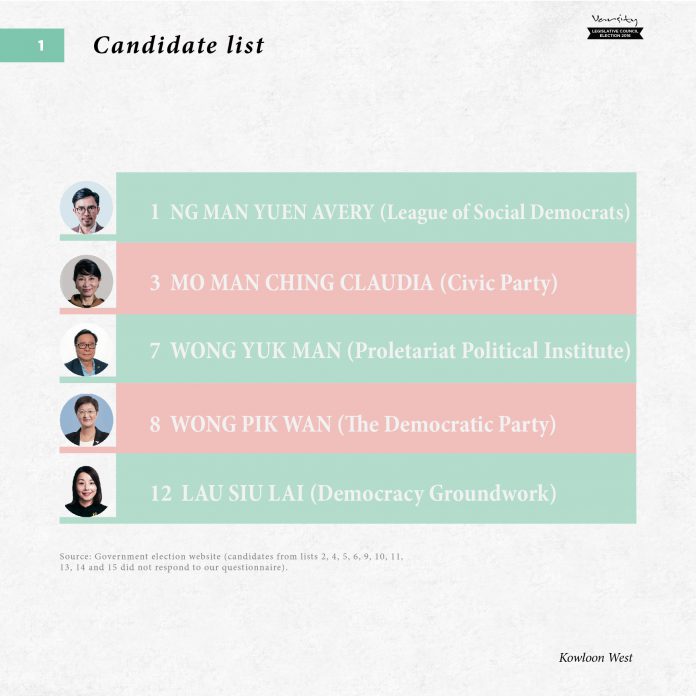
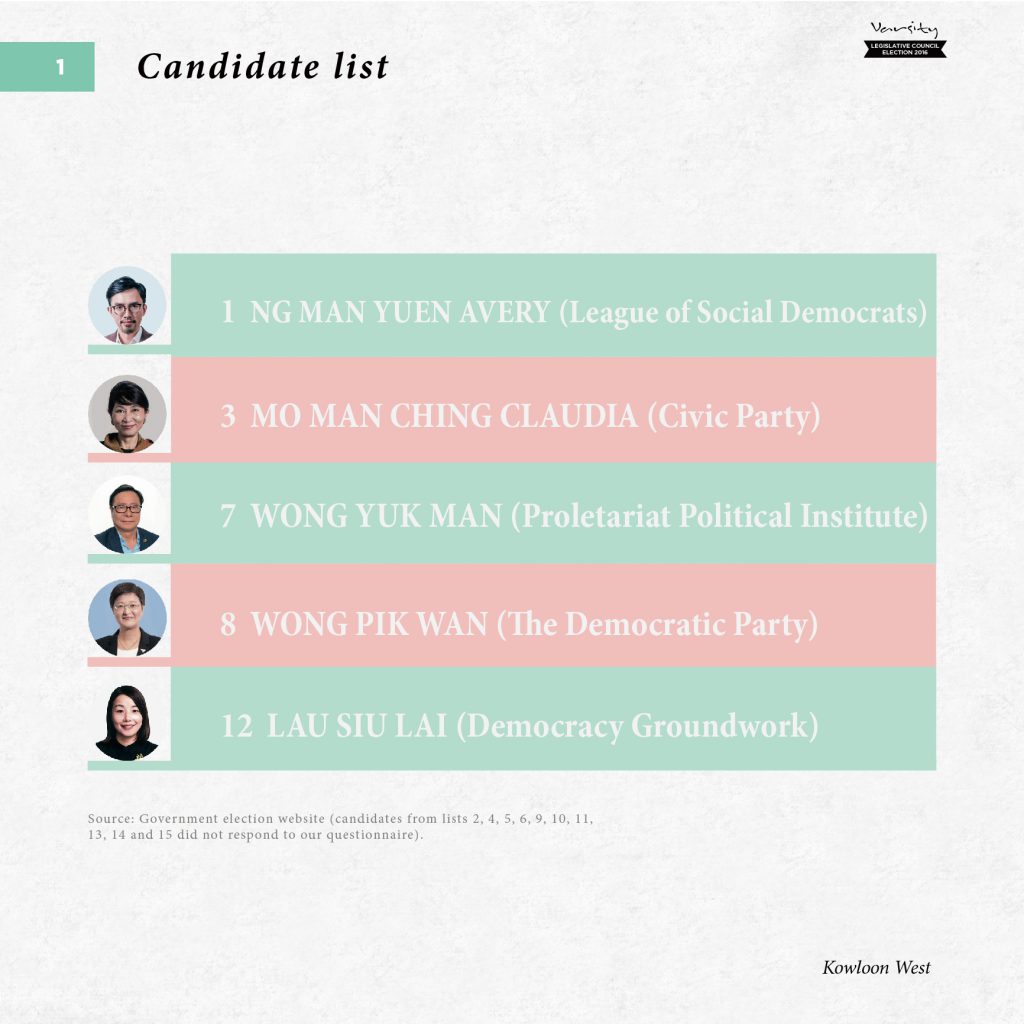
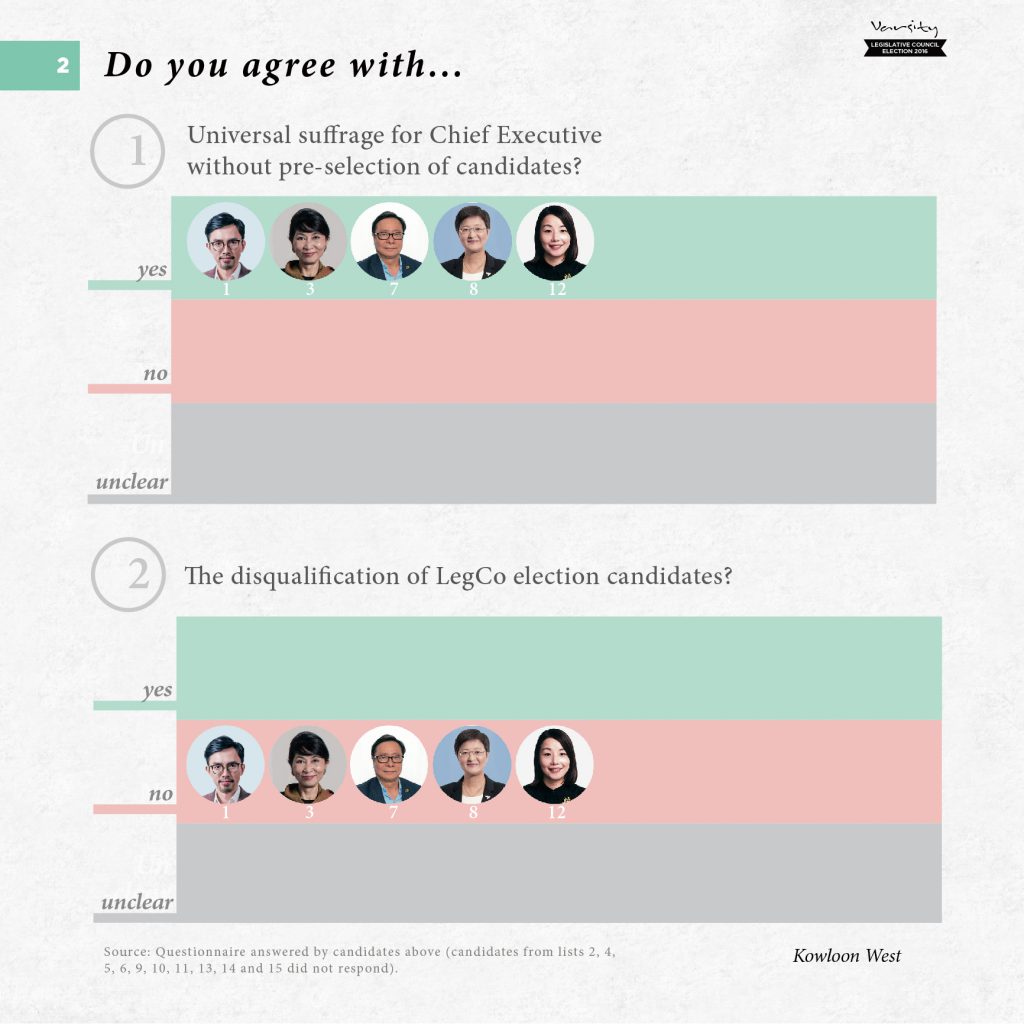
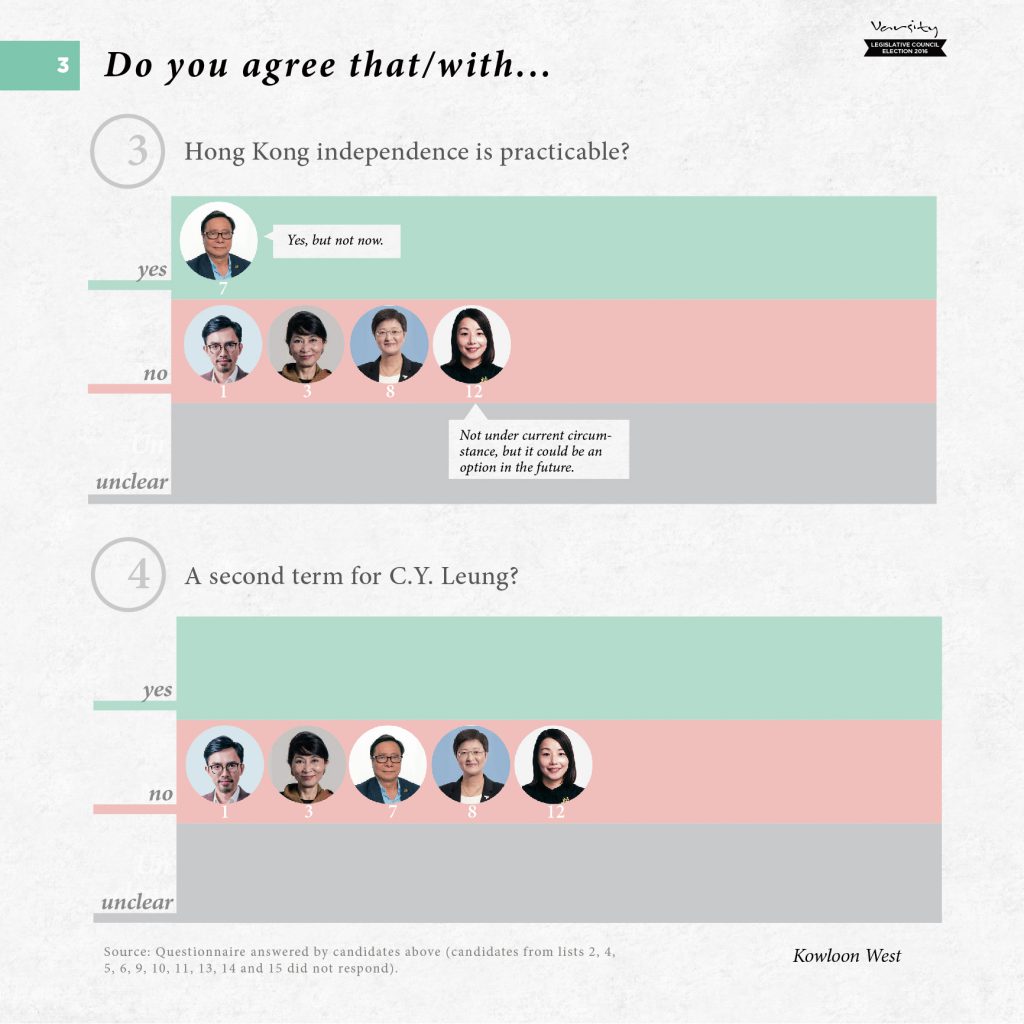
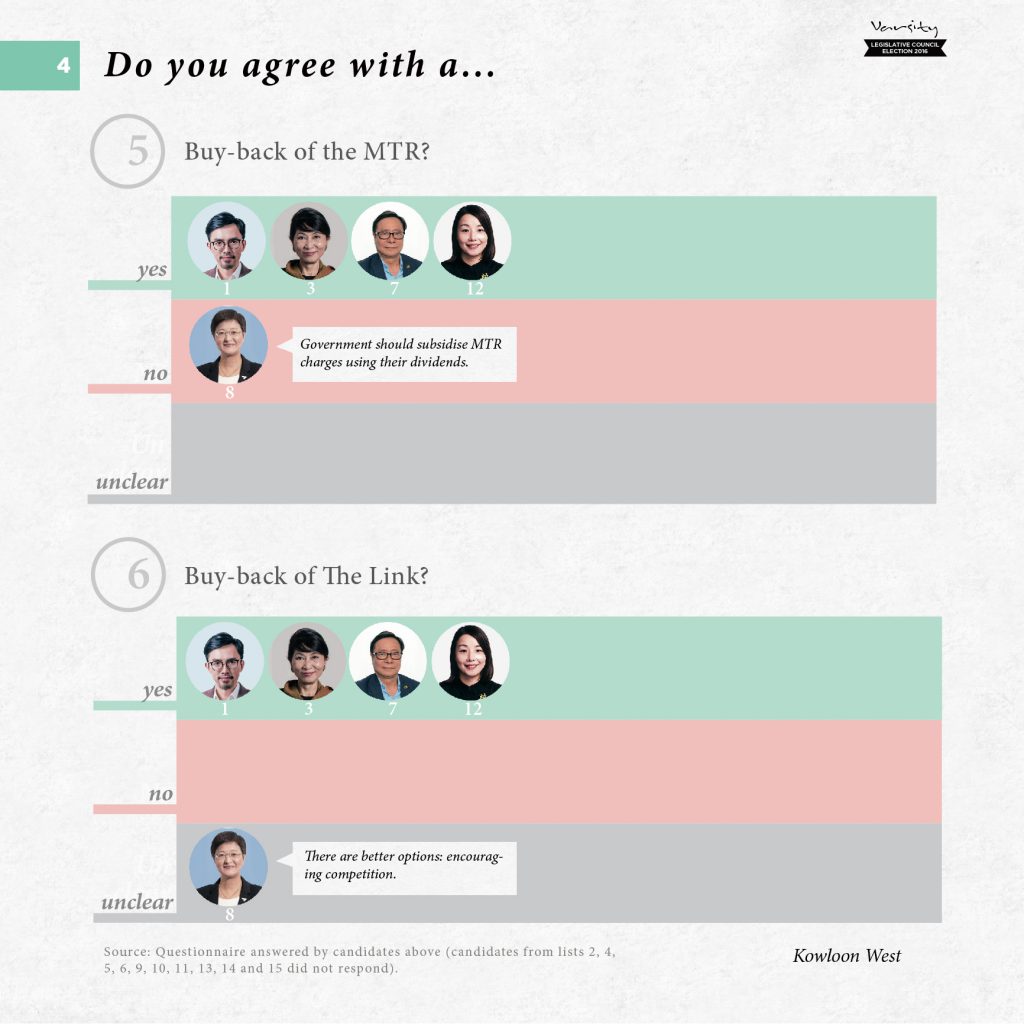
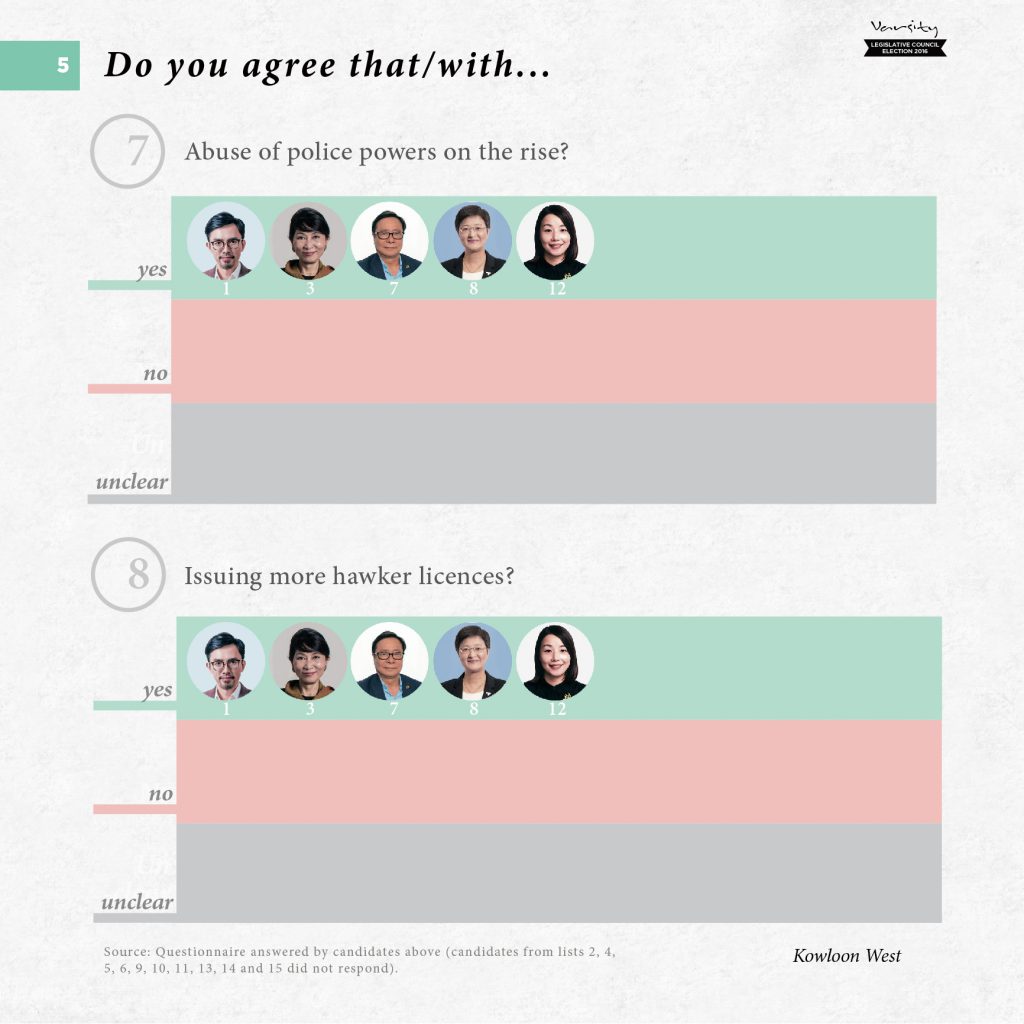
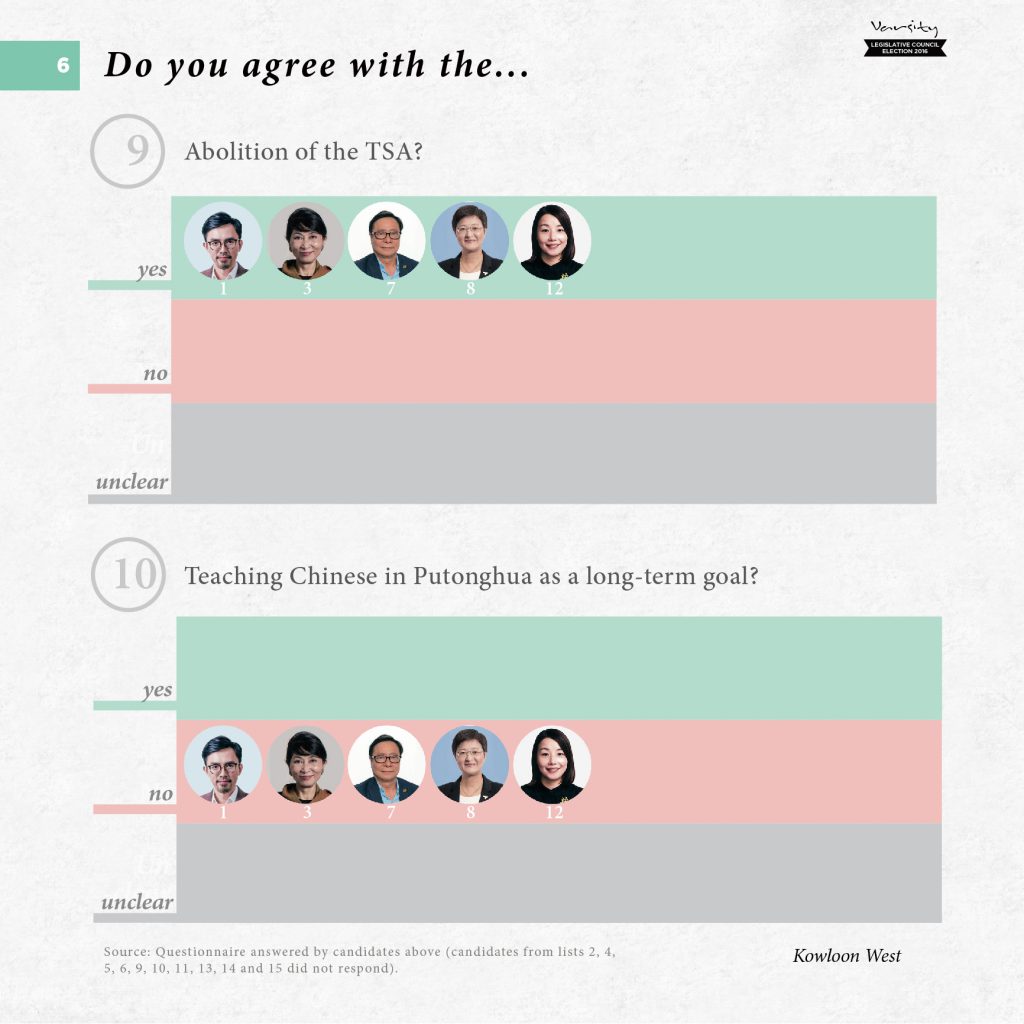
Kowloon West candidates answer questions on the issues first-time voters care the most about
Varsity interviewed 10 first-time voters to come up with the questions they care about the most. We selected 10, covering political, economic, social and educational issues and sent them to candidates from the five geographical constituencies and the District Council functional constituency. Out of 93 candidate lists, 40 replied. Ricky Wong Wai-kay, Kwok Wai-keung (Federation of Trade Unions) and candidates from the New People’s Party directly refused to answer, while others (including candidates from the Democratic Alliance for the Betterment of Hong Kong and Youngspiration did not respond or could not be contacted.
Here are the results for Kowloon West:
Here are the questions we sent to candidates in full:
Do you support universal suffrage for Chief Executive without pre-selection of candidates?
Do you think it’s reasonable to disqualify candidates based on their political beliefs and platforms?
Do you think independence of Hong Kong is practicable?
Would you support a second term for Leung Chun-ying as Chief Exectuive?
Do you support a government buy-back of the MTR?
Do you support a government buy-back of The LINK?
Do you think the police force has been abusing its powers in recent years?
Do you think the government should issue more hawker licences?
Do you support the abolition of the TSA exams for primary three schoolchildren?
Do you support think the teaching of Chinese in Putonghua should be a long-term goal for Hong Kong schools?
Non-responders: 02 Jonathan Ho Chi-kwong (HKLP); 04 Leung Mei-fun (BPA/KWND); 05 Tam Kwok-kiu (ADPL); 06 Chu Siu-hung (PVP); 09 Lam Yi-lai; 10 Ann Chiang Lai-wan (DAB); 11 Kwan San-wai (PSS); 13 Yau Wai-ching (Youngspiration); 15 Tik Chi-yuen (Third Side)
Candidates who could not be reached: 14 Augustine Lee Wing-hon
The disqualification of six candidates for their pro-independence stance has been criticized by both the pan-democrat and localist camps.
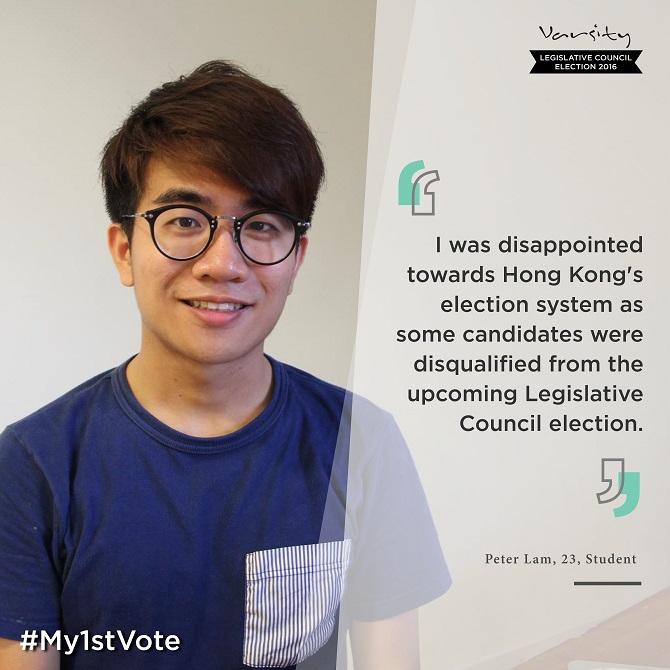
Peter Lam, a 23 year-old student says it has strengthened his resolve to vote for a localist candidate in Sunday’s election.
“I was disappointed by Hong Kong’s electoral system after some candidates were disqualified from the upcoming Legislative Council election. This makes me want to vote for localist candidates, or candidates who holds the same spirit, to fight for our rights and voice our opinions,” he says.
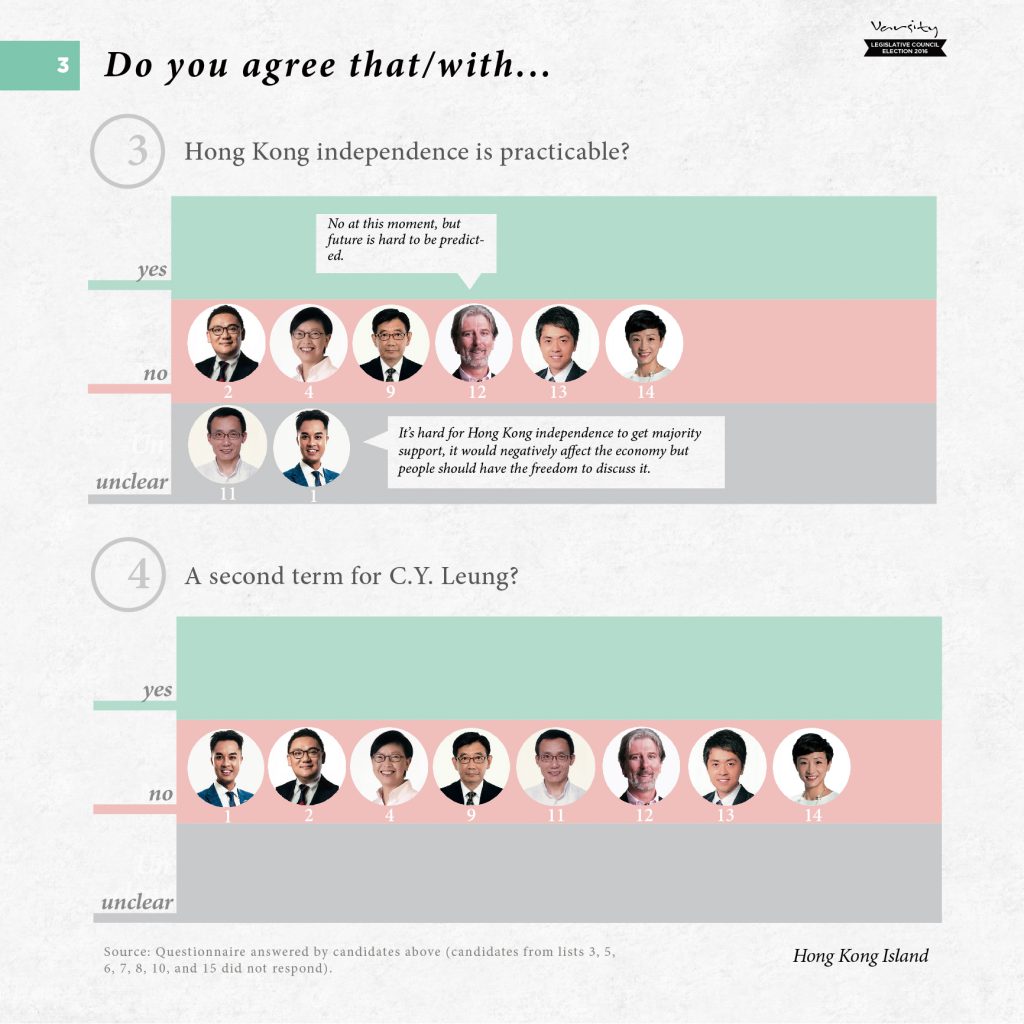
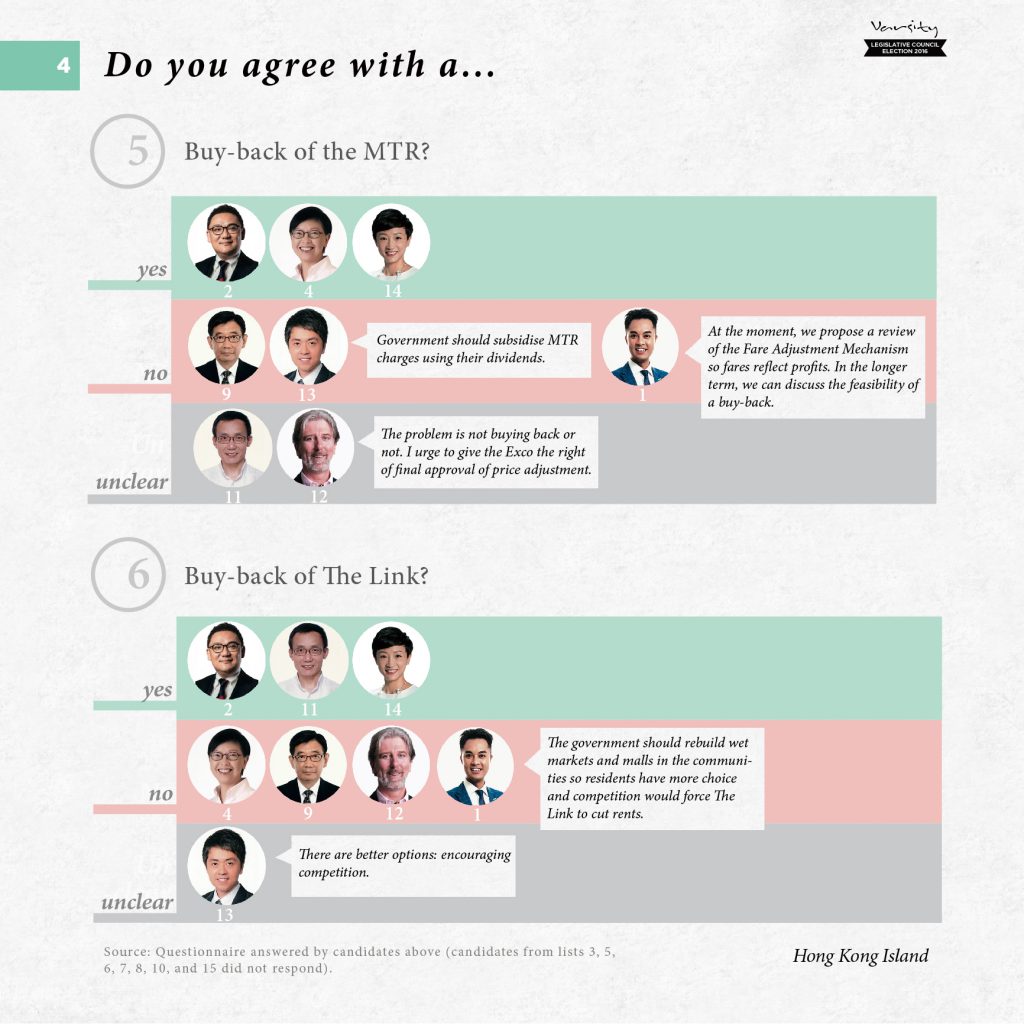
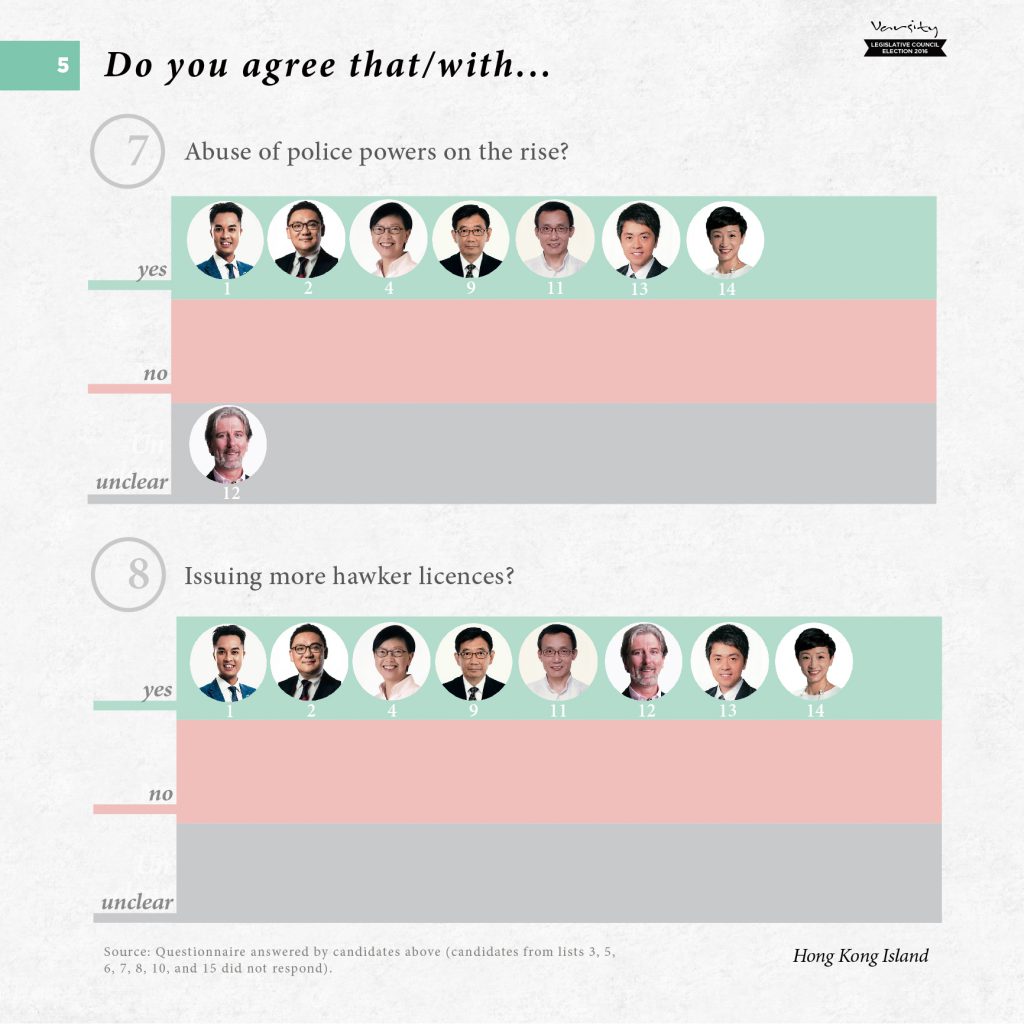
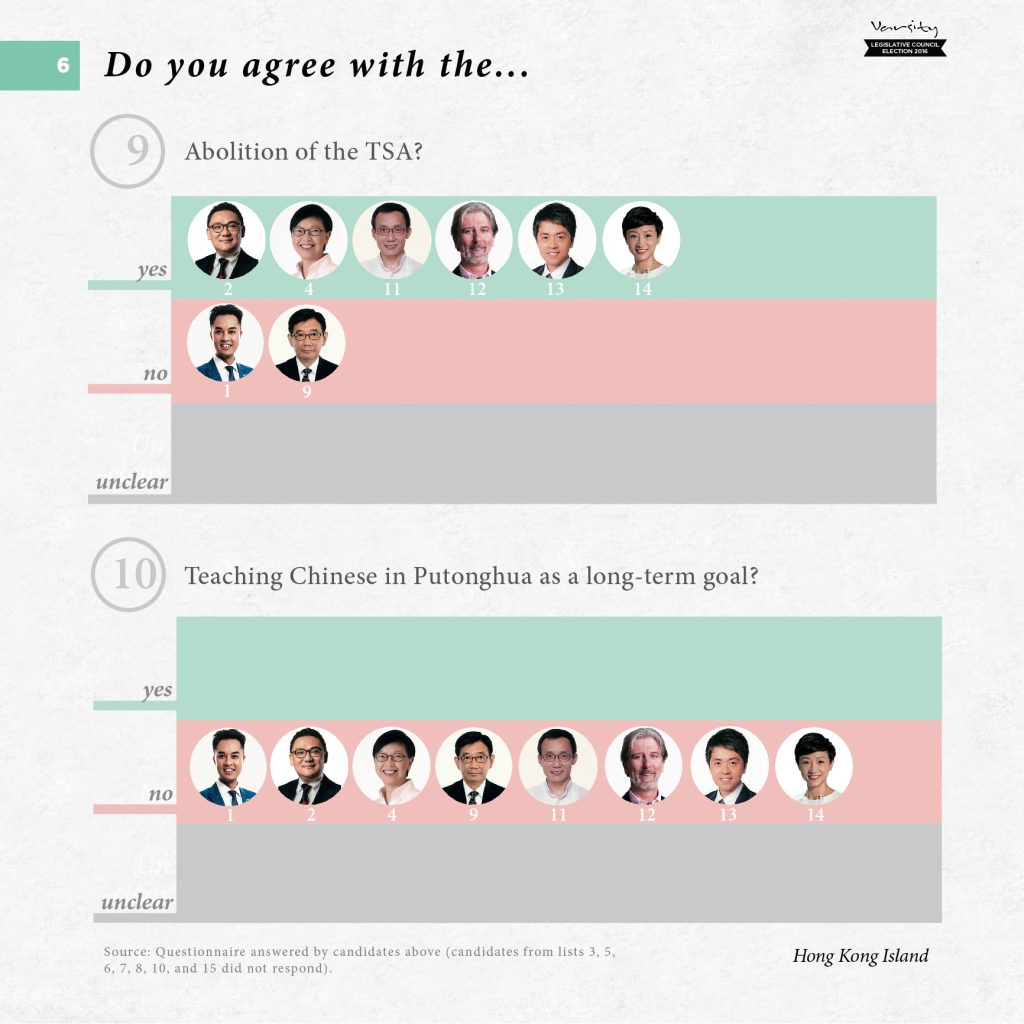
Hong Kong Island candidates answer questions on the issues first-time voters care the most about
Varsity interviewed 10 first-time voters to come up with the questions they care about the most. We selected 10, covering political, economic, social and educational issues and sent them to candidates from the five geographical constituencies and the District Council functional constituency. Out of 93 candidate lists, 40 replied. Ricky Wong Wai-kay, Kwok Wai-keung (Federation of Trade Unions) and candidates from the New People’s Party directly refused to answer, while others (including candidates from the Democratic Alliance for the Betterment of Hong Kong and Youngspiration did not respond or could not be contacted).
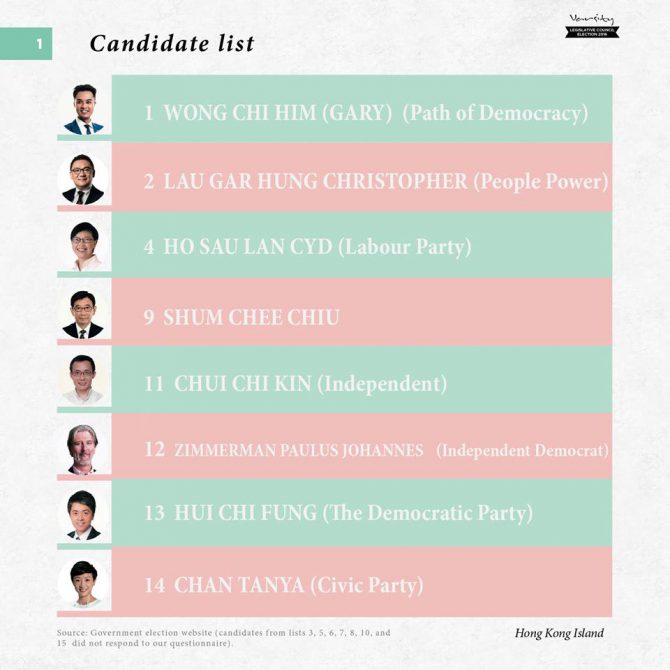
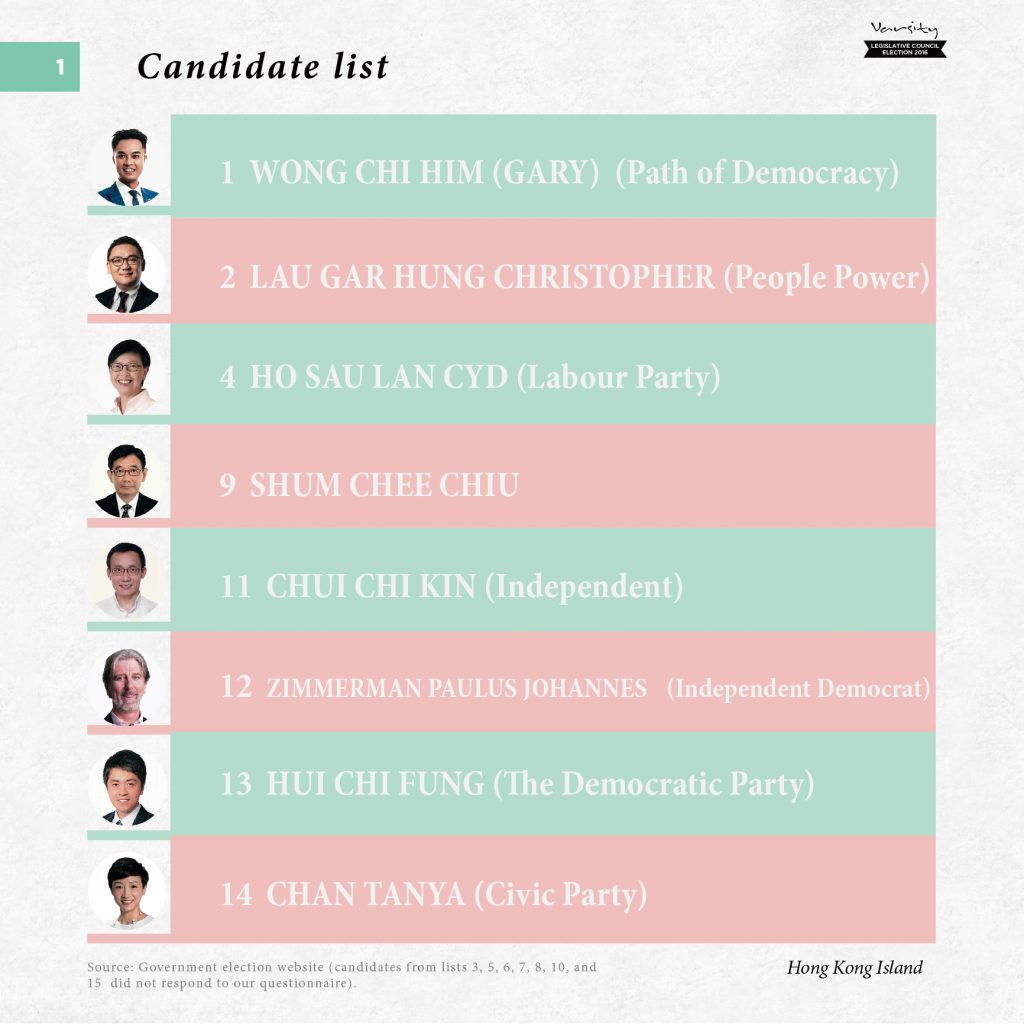
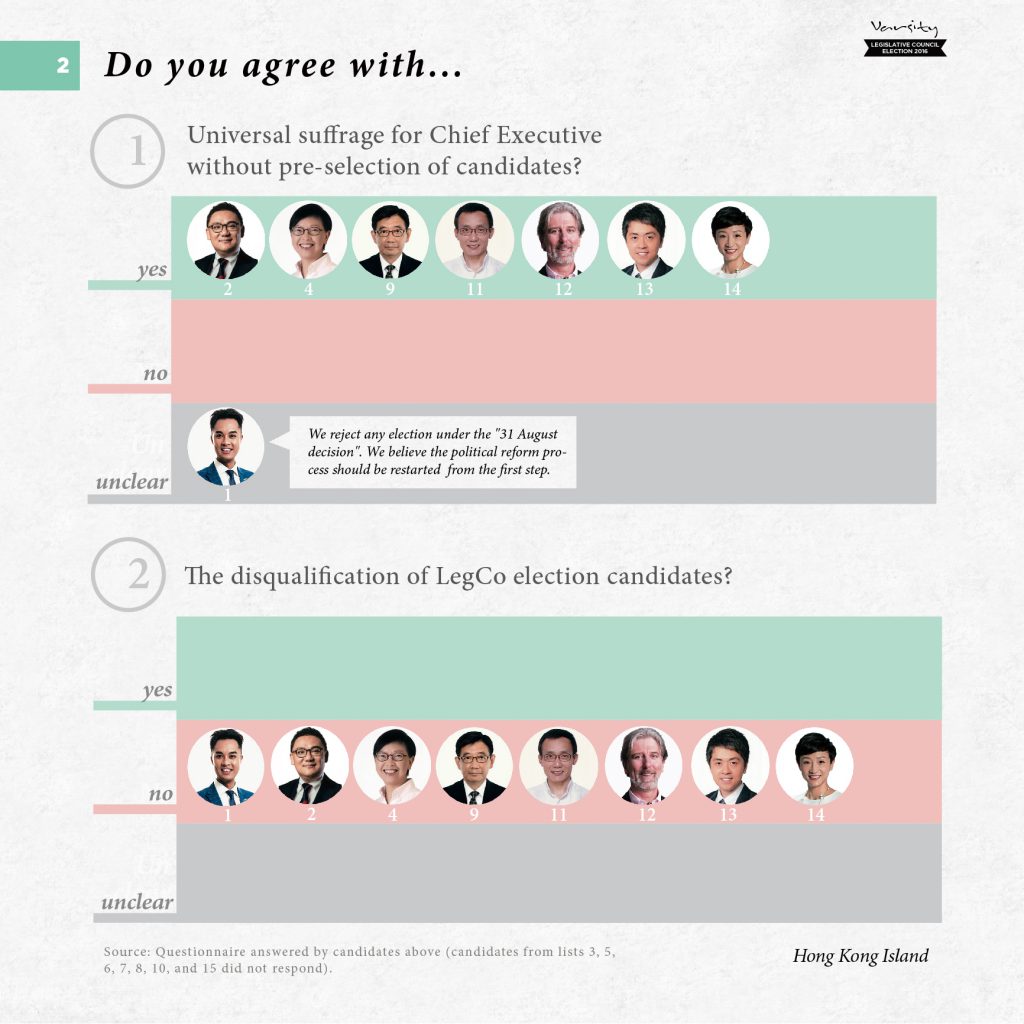
Here are the results for the Hong Kong Island geographical constituency:
Here are the questions we sent to candidates in full:
Do you support universal suffrage for Chief Executive without pre-selection of candidates?
Do you think it’s reasonable to disqualify candidates based on their political beliefs and platforms?
Do you think independence of Hong Kong is practicable?
Would you support a second term for Leung Chun-ying as Chief Exectuive?
Do you support a government buy-back of the MTR?
Do you support a government buy-back of The LINK?
Do you think the police force has been abusing its powers in recent years?
Do you think the government should issue more hawker licences?
Do you support the abolition of the TSA exams for primary three schoolchildren?
Do you support think the teaching of Chinese in Putonghua should be a long-term goal for Hong Kong schools?
* Non-responders: 03 Regina Ip Lau Suk-yee (NPP); 05 Cheung Kwok-kwan (DAB); 07 Alvin Cheng Kam-moon (Civic Passion); 10 Ricky Wong Wai-kay; 15 Kwok Wai-keung (FTU)
Candidates who could not be contacted: 06 Chim Pui-chung; 08 Nathan Law Kwun-chung (Demosisto)
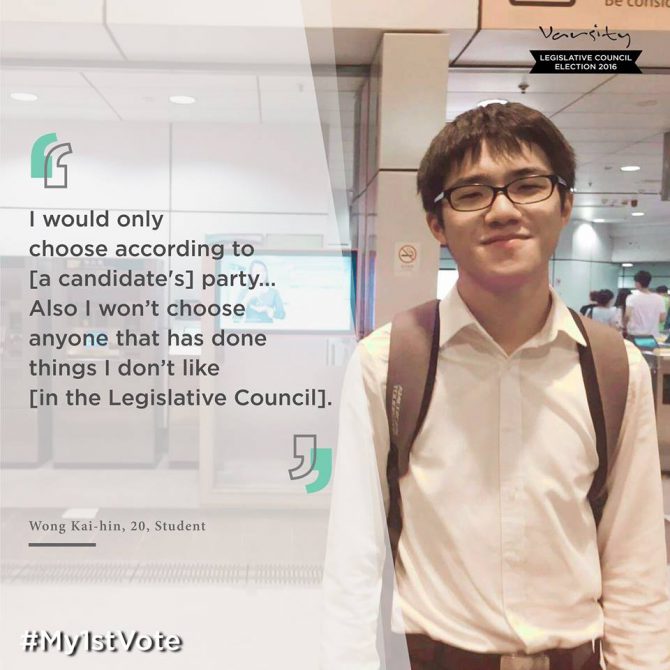
The second first-time voter in the Legislative Council elections in our #My1stVote series is 20 year-old Wong Kai-hin. Wong says he intends to vote for a centrist candidate and he disapproves of those who throw things in the Legislative Council chamber.
“I would only choose according to [a candidate’s] party. I’d only choose a centrist, neither a pro-establishment nor a pan-democratic candidate. Also I won’t choose anyone who has done things I don’t like [in the Legislative Council]. For instance, I won’t choose those who throw things.”
Many terms and buzzwords can be seen and heard in news and discussions surrounding the upcoming Legislative Council elections. Some of these terms -such as toi kiu (抬轎) which literally means “carry a sedan chair” – can be quite confusing. Here, we try to explain a few of them.
Varsity asks first-time voters in the Legislative Council election to share their thoughts about the upcoming polls
As the countdown continues, we talk to young voters about the issues that matter to them and how they will decide on who to vote for. The first in our #My1stVote series is 21 year-old student Alison Li.
Li says she wants to vote for a candidate who is able to fight for Hongkongers interests by negotiating with the central government,
“Compared with the localists, the pan-democrats have a more moderate attitude when they talk to the central government on [things like] freedom of the press. That’s the only way the central government will agree to talk. In contrast the localists play hardball with the central government, which just pushes them further away from the negotiation table and therefore from the goals they promote. So I will vote for the pan-dems.”