Hong Kong experienced its hottest summer last year since Hong Kong Observatory records began in 1884. This January was the wettest since records began and in late January, we were hit by the lowest temperatures since 1955. So it should come as no surprise that the Director of the Hong Kong Observatory Shun Chi-ming maintains that “the trend of more extreme weather under the influence of climate change is obvious”.
Yet, while 195 nations agreed to work to keep the global temperature rise below 2 degrees Celsius from 2020 at the Paris Climate Summit last year, the Hong Kong government reiterates its commitment to achieving a 50-60 per cent carbon intensity reduction target that only goes as far as 2020.
As clichéd as it may sound, it seems the city is an international business centre that values economic development and production of goods and services more than the environment. There appears to be no let-up in development – more big infrastructure projects such as the third runway for Hong Kong International Airport’s Third Runway are on the way, as well as proposed property projects located at green belt zones.
To evaluate the environmental consequences of these government-initiated or private large-scale development plans, the Environmental Impact Assessment (EIA) Ordinance was introduced in 1997 to mandate developers to produce EIA reports.
But many green groups and environmentalists tell Varsity that they doubt the accuracy and independence of EIA reports. Some question the methodology of the research and others suggest the system is vulnerable to potential collusion between developers and the consulting firms they hire to produce the reports. The extent to which the EIA can prevent or mitigate harm done to the environment is debatable.
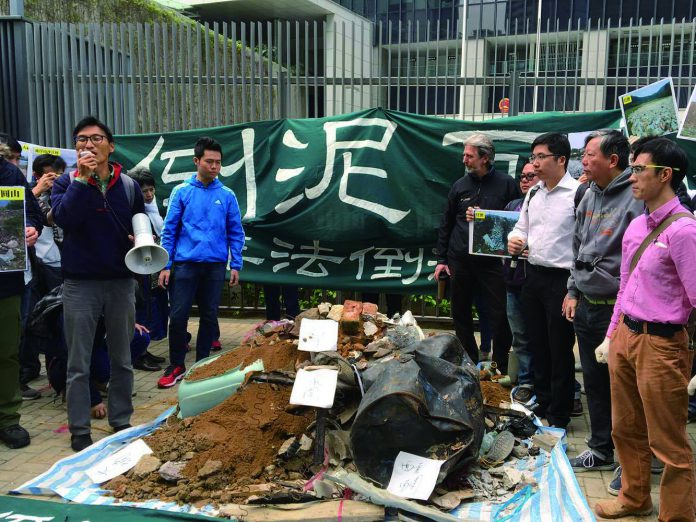
So far opposition to these large infrastructure projects has failed to stop them. The Legislative Council’s Financial Committee approved an extra HK$19.6 billion funding to the polluting and expensive Guangzhou-Shenzhen-Hong Kong Express Rail Link project last month, despite strong protests from lawmakers.
It is not clear whether pro-green politicians can make a difference. Yet some environmentalists still want to enter politics through election to the district councils and the Legislative Council to advance green policies. They tell us about their difficulties in doing so and also why they think Hong Kong does not have a political green party.
Ultimately, whether or not Hong Kong can have a green party and electable green politicians depends on the voters themselves. Just how environmentally aware are Hongkongers, and how willing are they to put green issues first? Despite many years of environmental education carried out by green NGOs and even the government, a Varsity survey finds many people unable or unwilling to transform their environmental awareness into action.
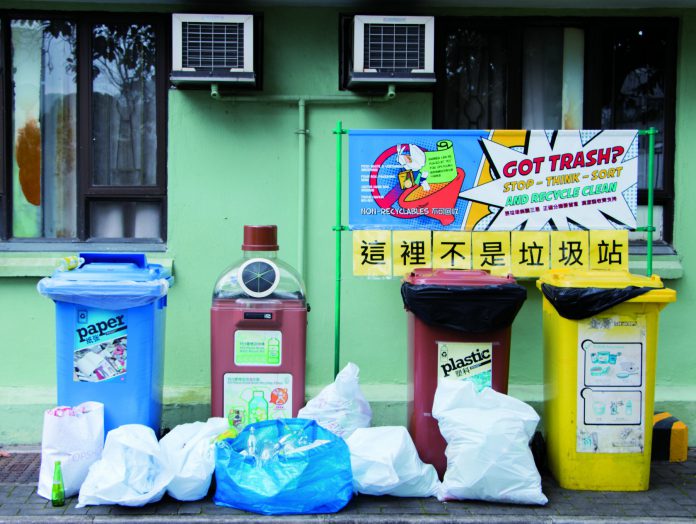
For example, while 90 per cent of respondents know about the Food Wise Hong Kong campaign, more than half of them say they are not motivated to reduce food waste. Perhaps we need to introduce legislation, fiscal deterrents or economic incentives to encourage people to change their behaviour.
Scholar Edward Yiu Chong-yim says something more radical is needed, that we need to change how we conceive of “environmental protection” completely by cutting down on consumption.
Varsity looked at Hong Kong’s ‘Green Awakening’ in Issue 115, when we found more individuals pledging to live a simpler life closer to nature, and organic farming and ecotourism were new trends. That was six years ago but Hong Kong’s green development does not seem to have progressed much.
We hope to raise fresh questions through the stories in this issue, and hope that you enjoy reading them, as much as we have producing them.
System designed to mitigate environmental damage is marred by vested interests and red tape
by Doris Yu & Rammie Chui
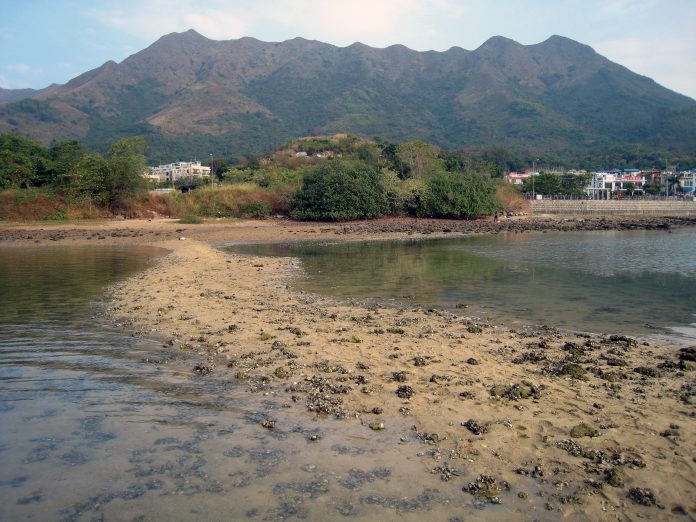
The stretch of coastline next to the Ting Kok mangrove in Tolo Harbour and near Lung Mei Village, Tai Po, is one of Annie Ma Ng Sau-yee’s favourite places. She likes to comb the shore for creatures such as starfish, mudskippers and seahorses while her dog swims happily in the water. This ecological treasure trove is just a 10-minute walk away from her apartment in Lung Mei Village.
“The coastline is a discovery centre which brings me to the wonderful ocean world,” says the 51-year-old homemaker. But she did not always think this way.
In 2008, when she first heard about the government’s plan to turn the natural coastline into a 200-metre-long bathing beach with a low-wall at either end, she and most of her neighbours welcomed it. They were told the works would provide swimming facilities for one million residents of the eastern region of the New Territories. Like many residents in the areas, Ma expected the development would increase the value of their property.
However, taking part in activities at the Tai Po Geoheritage Centre – a centre run by the non-profit Environmental Association to educate people on geoparks and ecological diversity – opened Ma’s eyes to the ecological value of the Lung Mei coastline. She later became a volunteer for the Save Lung Mei Alliance, a group advocating for the protection of Lung Mei’s natural beauty.
But it was too late. The project proposed by the Lands Department had received the green light in 2007, after the Environmental Protection Department (EPD) approved its Environmental Impact Assessment (EIA) report and issued an environmental permit for the construction. The 797-page report characterised the muddy tidal coastline as providing “mainly low-quality habitats” for wildlife.
Under the EIA Ordinance, introduced in 1998, EIA is a process government-initiated and private large-scale projects must undergo before they can be approved. Its stated purpose is to avoid and minimise any adverse impact on the environment and propose compensatory measures. However, critics have identified a number of problems with it, including potential conflicts of interest, inadequate public consultation and limitations of the procedure itself.
Spotted seahorses
The procedure requires a project’s proponent to hire a consulting firm to prepare the EIA Report. After the report is released, there is a 30-day period during which members of the public can review the report and file written submissions to the EPD. Meanwhile, the Advisory Council on the Environment (ACE), which is appointed by the Chief Executive and comprises scholars, green group representatives and business professionals, will examine and comment on the report within 60 days.
After the EPD director has taken the council’s suggestions into account, he or she will issue the environmental permit if the assessment has been approved. Only then can the project proponent start construction.
The 2007 EIA report for Lung Mei’s man-made beach project, used a quadrat sampling method – where researchers isolate random plots and count the organisms and species found within it – to estimate the distribution of flora and fauna. There were two investigations, one in March representing the dry season, and the other in April representing the wet season. The report said only six intertidal species were found and that the coastline had “low ecological value”.
Experts in ecology and conservationists questioned the report’s credibility. Hong Kong Wildlife Forum, an online platform for nature lovers and environmental experts, carried out its own ecological study of the coastline. Their year-long study recorded the presence of 216 marine species, 36 times the number found in the EIA.
The amateur research also discovered spotted seahorses, a species classified as “vulnerable” by the International Union for Conservation of Nature, and 17 other rare species.
Dickson Wong Chi-chun
“The 200-metre coastline wows us! It’s so short, so ugly but with rich with wildlife” says Dickson Wong Chi-chun, spokesperson of the Save Lung Mei Alliance and a member of the Hong Kong Wildlife Forum.
The biology teacher says the quadrat sampling method may not be reliable as the researcher can easily control the result by placing the quadrat on a spot which has fewer creatures. Wong adds that taking samples in March and April is not representative enough as the difference in climate conditions is insignificant. In Hong Kong Wildlife’s research, Wong and his peers actively searched for marine species and recorded every species they found by taking photos.
Responding to public pressure, the ACE ordered a supplementary study in 2008. This time, the consulting firm found 67 species using additional extensive intertidal surveys, including active search and quantitative surveys.
The Lung Mei report was also criticised for unfairly comparing the Lung Mei coastline to three other sites in the East New Territories as possible candidates for the construction of the artificial beach. The alternative sites, Tolo Channel, Hoi Ha Wan and Long Harbour, are also high in ecological value, adjoin country parks and have no nearby existing infrastructure.
Save Lung Mei Alliance’s Dickson Wong is disappointed with the system. “The EIA procedure is a rubber stamp. It twists the reality in favour of the development,” he says.
The alliance suggested alternatives to provide more swimming facilities but the authorities dismissed their ideas. When they attempted to directly talk to the EPD and ACE, officials arranged for them to watch the ACE’s discussion of the findings of the supplementary report live via videolink instead.
Having exhausted other means, the alliance filed an application for a judicial review of the project on the grounds that the EIA report was misleading because it omitted the ecological value of a rare species of seahorse. It hoped the court would withdraw the project’s environmental permit.
In 2014, the High Court rejected the argument and the alliance appealed. It lost that case in February this year.
Green politicians struggle to put environmental issues at the top of the public agenda by Verena Tse & Minnie Wong
In an open space outside the Star Ferry Terminal in Tsim Sha Tsui, a young man stands holding a microphone, a loudspeaker at his feet. Behind him a roll-up banner bears the slogan: “Vote for a Green Hong Kong”. Around a dozen other young people around him wear T-shirts printed with the same slogan. Some of them hand out leaflets to passers-by and others hold up boxes with “Leaflet Recycle Box” written on them.
This is a flashback to 2008, when the then 28-year-old Roy Tam Hoi-pong was campaigning for election to the Kowloon West Constituency in the Legislative Council as an independent candidate.
Tam Hoi-pong on the campaign trial before the 2008 Legislative Council election. Photo Courtesy of Tam Hoi-pong.
Tam has been interested in environmental protection since he was a student at the Chinese University of Hong Kong where he studied Environmental Science. He joined green student groups and published a student magazine to promote environmental awareness on campus. In 2004, he founded Green Sense, a watchdog non-governmental organisation (NGO) aiming to monitor environmentally unfriendly policies.
Looking back, Tam says he was just a “pure environmentalist” at the time, who could steer clear of politics. But the more he confronted district councillors on district affairs, the more he realised politicians had the power to push green policies and to reject non-environmentally friendly ones.
“It struck me then that instead of being the one protesting and handing over petitions, why not be the district councillor instead?”
Tam decided to contest the 2008 Legislative Council election as an environmentalist but lost resoundingly. He thinks this was down to his being a complete unknown back then, and because he was campaigning on a single issue –environmental protection.
While he continued to address green issues, Tam also started taking part in other social movements and campaigns with a localist slant, such as demanding restrictions on the Individual Visit Scheme for mainland visitors. In 2014, he joined the Neo Democrats, a breakaway party founded by former Democratic Party members who stressed localist values. Last year, Tam ran in the district council elections as a Neo Democrat candidate and won a seat in Ma Wan in the Tsuen Wan district.
Carrots and sticks are needed to motivate people to change their non-green habits
by Maggie Suen & Fiona Chan
On the “photo day” to celebrate her graduation from university last year, Sandy Lee Mei-shan who is now 22, was delighted to be given a very special bouquet. While other students had their arms full with elaborate floral arrangements wrapped in layers of paper and adorned with ribbons, Lee proudly held a vegetable bouquet made up of broccoli, yellow peppers, and sweetcorn wrapped in newspaper. To Lee it was a sign that her friends acknowledged her commitment to green values and put them into action.
Lee did receive flowers, but she made sure she used some of them to make environmentally friendly floral enzyme detergent while others became dried flowers. As a core member of CU X Rubbish, a green organisation established in 2013 at the Chinese University of Hong Kong, Lee does not just talk the talk, she walks the walk.
Sandy Lee Mei-shan holdi a vegetable bouquet on her “photo – day”.
The group hopes to minimise waste at the university and one of their best-known activities is the Annual Hostel Check-out Recycling Scheme. Members collect items such as cooking utensils, clothes hangers and bedding that are no longer used at the end of a semester, and reserve them for their free second-hand goods exchange platform at the beginning of the next semester.
Their push to reuse second-hand materials has helped to reduce the amount of waste generated when students leave their hostels but Lee says many students only visit their booths to get stuff for free. They show little interest in listening to the group’s sharing and tips on how to reduce waste on a daily basis.
Lee’s experiences illustrate a common tendency to pay lip-service to or take advantage of efforts to encourage environmentally friendly living without a change in lifestyle.
Adrian Kwong Chi-hang, 25, finds himself facing similar difficulties to Lee. Kwong has worked in a multinational publishing company for two years. He has been concerned about the environment since he was a teenager and is acutely aware of many environmentally irresponsible practices in his workplace.
For instance, all printers in the office are set to print on single sides by default, and many of his colleagues simply dispose of used or even blank sheets of paper in regular bins instead of recycling bins. He also notices the huge amount of rubbish generated during lunchtime. Recyclable takeaway containers and utensils are tossed after lunch and the pantry bins are always overflowing. Those who bring their own lunches leave the tap water on continuously when they wash their lunch boxes; they use a lot of detergent and many paper napkins to clean one single container.
So Kwong took it upon himself to clean and collect all the recyclables from the pantry bins as well as the bins near each colleague’s seat before the cleaners came to clear them. After work, he takes the items to residential estates with credible established recycling programmes. He also makes sure one of the three pantry bins is always empty to save one plastic rubbish bag each day.
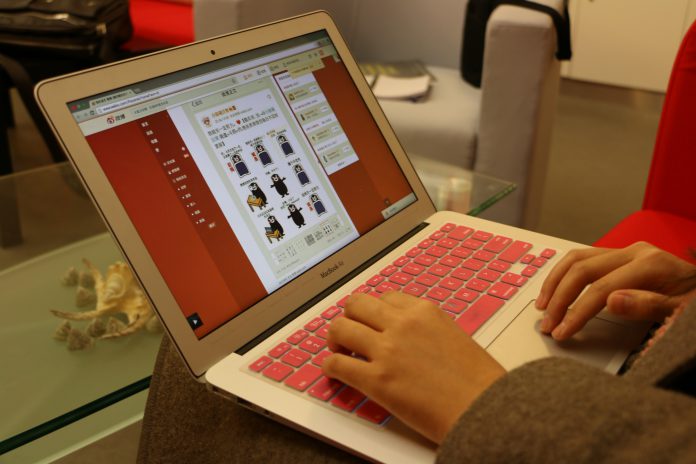
Parents concerned about online safety as children spend more time on the internet and playing with electronic gadgets
By Gloria Lee & Howard Yang
Last October, a Hong Kong primary school banned an online game in which players need to control a character who falls off a building and has to avoid being slashed, smashed, sawn to bits and impaled by various obstacles on his way down. Castle Peak Catholic Primary School in Tuen Mun issued a notice to parents urging them to prohibit their children from playing games like “Falling Fred” and “Mr Jump” at home, due to fears they could encourage pupils to commit suicide.
Tse Pui-chi, the deputy principal of the school says they issued the notice after receiving complaints from parents who were worried some mobile games may promote distorted values to their children. Tse says the school has already taken measures to guide students on how to use the internet correctly through talks and lessons, and by installing a firewall on each computer on campus. But ensuring children’s online safety outside of school is another matter and is a job that requires parents to take control.
The description of “Falling Fred” in the Apple App Store and Google’s Play Store carries a warning saying that the game features zombie violence and is not suitable for children under 12. Despite this warning, there is no way to stop children from downloading such games to their mobile phones and devices. Today, as more and more parents allow their children to play with electronic gadgets in order to entertain them or keep them quiet, this can be a problem.
A survey on the use of the internet and electronic screen products by more than 5,400 preschoolers, and primary and secondary school students conducted by the Department of Health in 2013, revealed they are very popular among preschool children. The youngest age at which children started using tablets and computers is one month and around 19 per cent of preschoolers played video games for an average of 27 minutes each day.
The survey also shows that children are spending more and more time on the internet, with 20 per cent of primary and secondary school students spending more than three hours a day online. More than half of primary school students and over 90 per cent of secondary school students have smartphones. All this increases the chance that they may play games with violent features, visit inappropriate websites, and see indecent and obscene visuals online. For instance, pornographic or violent videos may pop up unexpectedly while children are browsing, watching videos or playing games online.
Gordon Tsui Pak-long
Primary Six student Gordon Tsui Pak-long loves playing mobile games but not violent ones. However, he sometimes comes across them anyway when he is playing on his phone.
“When I finish playing a game and close the window, some adverts and short clips will pop up,” he says.
He adds these clips and ads sometimes contain pornographic images. Gordon says he always closes these windows as they disgust him and hinder him from playing games.
“I don’t think I want to see those adverts,” says Gordon. “If something suddenly pops up, I will just delete it at once. Especially when I am playing a football game because I don’t want to lose the match.”
Luo Zhi-mei
Gordon’s mother, Luo Zhi-mei is aware of the importance of online safety, so she prohibits her son from playing violent games involving zombies and bloody death scenes. Although she has succeeded in stopping Gordon from playing such online games, she has had other problems.
A few years ago, Luo found Gordon had been added by his classmates to a Facebook group where pornographic images were uploaded.
“I secretly logged into his account when I sensed something wasn’t going well and I at once helped him leave the group,” she says.
After the incident, Luo felt she had to tell Gordon why she logged into his Facebook account.
“I explained to him that I have to know who his friends are and what he does on Facebook,” says Luo.
However, she says she finds it difficult to spend lots of time scrutinising her son’s online footprint.
“I can’t tell whether my son watches bad materials online or not,” says Luo. “If I’m free, I will help him hide all the bad materials. But I can’t really do much if or when I’m not free.”
Luo suggests that apart from schools and parents, online platforms could also make some changes to make it harder for children to access inappropriate material. One way would be introduce a compulsory payment system.
Francis Fong Po-kiu, president of the Hong Kong Information Technology Federation and founder of e-Learning Consortium, believes that, technically, the industry could set up a compulsory payment system to restrict children’s access to the mobile applications, but he doubts companies would be willing to do so.
“Most of the mobile applications are free,” says Fong. “If you need people to pay for every application, who would be willing to download them?”
Fong says he thinks the most effective way for parents to protect children’s online safety is to activate the parental control mode built into electronic screen products.
However, he acknowledges parental control systems are not flawless, they cannot filter everything but are better than nothing.
“I once searched ‘brownie’ on the internet, but the results came up with a clip full of foul language,” Fong recalls. He points out that although parents can find a lot of different filtering software for kids, the internet has no boundaries which makes it difficult to establish more controls.
What do mainland net warriors achieve by trolling Taiwan?
By Lynette Zhang & Chester Chan
It was coordinated with military precision – at 7 p.m. on January 20 this year, an army of Mainlanders went to war with Taiwan. Except this was not a physical assault but a virtual one, waged by mainland netizens on what is perhaps best described as a trolling expedition. Most of them were members of a “post bar” or online forum run by Chinese internet giant Baidu called Di Ba, literally “imperial bar.” They called their action a “Great War” and rallied under the battle-cry: “When Di Ba goes into battle, not even a blade of grass can survive.”
What they did was flood the Facebook pages of Taiwan media such as Apple Daily and Sanlih News along with that of president-elect Tsai Ing-wen of the pro-independence Democratic Progressive Party.
Tsai’s historic victory four days earlier was what triggered the concerted attack as the Di Ba warriors circumvented China’s Great Firewall to deliver their message that, “Taiwan belongs to China.”
They trolled webpages and social media by posting jingoistic slogans, photos of Chinese food and of natural scenery in the Mainland as well as propaganda images featuring Chinese leaders. There were nearly 40,000 Facebook comments within just eight hours under one of Tsai Ing-wen’s Facebook posts alone.
Lou Jia-ming, a year two student studying in Fudan University, joined the Di Ba operation that day. He posted a screenshot of an online news article from the Global Times about a statement from the Norwegian Ministry of Foreign Affairs reaffirming Oslo’s adherence to the one-China policy since 1970. Lou says he did this in response to a report in Sanlih News that said the Norwegian government recognised Taiwan as a state.
“The Taiwanese are afraid when we present them with the facts,” Lou says, “They keep resisting because these facts violate what they believe.”
In order to join the Di Ba operation, Lou had to connect to a virtual private network (VPN) to bypass the Great Firewall and gain access to sites banned on the Mainland, such as Facebook and some Taiwan media. It was not his first time.
Lou started jumping over the wall after the Taiwan presidential election because he has never been to Taiwan before and wanted to know more about the island. What he saw on the other side came as a huge shock.
Lou used to believe Hong Kong, Taiwan and mainland China belonged to one family. He recalls that when there were disputes between Vietnam and Taiwan over islands and reefs in the South China Sea in early January, many mainland netizens supported Taiwan online. Therefore, he was surprised and hurt by Taiwan netizens’ hostility towards their mainland counterparts.
He thinks Taiwan netizens have an irrational attitude towards mainland netizens and blames this on the Taiwan media.
“What we [Di Ba warriors] are doing is to show the Taiwanese that we are actually very nice,” he says.
In order to win hearts and minds, Di Ba’s administrators set some ground rules – members could only use “civilized” language, they were banned from using insulting images and pictures of leaders. Lou stresses the operation was aimed at fostering friendly communication.
“First of all, Taiwanese are our compatriots. This is for sure and we are not fighting against them,” he says.
The genteel approach surprised Remy Xu Zi jian, a senior Di Ba member, who compared it to previous attacks.
“My first impression was ‘it’s impossible!’ How come there is no one using dirty words?” he laughs.
Xu is 22 and has been active on Di Ba since his teens. He has taken part in many attacks, most of them targeted at the online forums for mainland fans of Korean pop stars. These attacks were usually triggered by what Di Ba members viewed as the “idiotic” things Chinese K-pop fans said or did in support of their idols. The Di Ba army would flood the forums with insulting messages.
Xu recalls one of his most memorable attack experiences, targeting a forum for Chinese students in Japan called “Home of Japanese”. He says a netizen was banned by the administrator of “Home of Japanese” after a post titled “Viva the People’s Republic of China!”. Di Ba members retaliated and the forum collapsed after Di Ba’s attack.
When he is asked about the content of “Home of Japan”, Xu cannot give an answer.
“I’d never been to that post bar before the attack,” he says with an embarrassed smile.
Di Ba was set up in 2003 on a relatively small scale and is now a giant forum with over 20 million registered members. Xu thinks its mega scale has turned it into a “rendezvous with bored people”.
“Most people who participate in Di Ba’s post attacks know nothing about the context,” Xu says.
Looking back at his own past involvement, he admits the attacks did not achieve anything but rather just satisfied the members themselves. Xu thinks the “victories” they score in post attacks feed their vanity.
Occasionally, the post attacks may give Di Ba’s members the illusion that they are contributing to society.
“If it is supported by a moral cause and makes people feels like ‘I am helping the country’, everyone joins.” Xu says.
Xu did not join the “Great War” but, as an experienced hand, he guesses the warriors who participated in it must believe that they are helping the central government to educate the Taiwanese. The Di Ba warriors believe it is unarguable that Taiwan belongs to China and the “Great War” is an expression of this political aspiration, says Xu.
Rennie Zhong Yu
However, Rennie Zhong Yu, a 19-year-old mainland student in Hong Kong, believes the motivation behind the “Great War” is more banal. While some commentators see the “Great War” as some kind of political mission, Zhong says the attacks are not about political engagement, but a form of entertainment for most of the participants.
“The aim is not that noble,” she says. “Basically, it is just a parade for everyone to have fun.”
If that is the case, then the feeling may be mutual – some Taiwanese netizens say they are more amused than angered by the “Great War”. Lothar Lu Shao-hsuan, an 18-year-old in Taiwan, says he was entertained and amazed by the “attack” of food photos and funny online stickers. Lu agrees that it was more like a friendly conversation than a war.
But some of his friends on PTT, the leading online discussion forum in Taiwan, think differently. After the Sunflower Movement, a campaign in 2014 to oppose a trade deal with the Mainland, PTT has become a major platform for sharing political views. It is also dominated by DPP supporters.
Although Lu belongs to a “deep blue” family that strongly supports the Kuomintang (KMT), he has defected to the “green camp” under the influence of PTT, and he is not alone.
“I used to have friends who thought the Taiwan independence movement was treason,” Lu says with a big smile. “They all support Taiwan independence now!”
Lu says that his friends on PTT are not angry about the “Great War”, but they do find it absurd that mainland netizens resort to jumping over the wall to access Facebook. “It’s like caged birds being ignorant of freedom,” says Lu.
Some mainland netizens point out the “wall” does not just exist on their side of the Taiwan Strait. Mainland student Rennie Zhong says that although people in Taiwan enjoy internet freedom, the island’s media still restricts citizens from receiving different opinions about the Mainland.
“The wall exists. It is an invisible wall built by education and the mainstream which constrains your opinions,” she says.
Contrary to the authorities’ strict control on the internet and media in China, Zhong says there is “an internet environment with more freedom” and she is optimistic about the future.
Jack Qiu Linchuan, an associate professor who teaches global and Chinese communication at the Chinese University of Hong Kong, does not share Zhong’s assessment.
“The freedom of speech in the Mainland has definitely decreased after Xi Jin ping became the General Secretary [of the Chinese Communist Party],” says Qiu.
Qiu thinks “the internet environment with more freedom” that Zhong believes mainland netizens are enjoying is a limited kind of freedom for individuals who are not trying to mobilise others. He says the true test is whether citizens enjoy public freedom.
“Public speech could affect policies, resulting in actual changes,” says Qiu.
Today’s Di Ba warriors may launch large-scale attacks en masse, but these have limited impact in the “real” world. Qiu describes the “Great War” as a kind of “slacktivism”, which is a term that combines “slacker” and “activism”. It is used to describe many people taking part in an action on the internet which requires little time and effort but massages the egos of the participants; often such activities make little real change.
In contrast, Qiu believes the online world in Hong Kong has gradually evolved from slacktivism to activism.
When it comes to local online political discussion and activity, Hong Kong Golden is the foremost forum whose members sometimes issue calls for physical action, for instance calling on protesters to occupy Lung Wo Road during the Occupy Movement. What started life as a forum for comparing prices of computer parts in Sham Shui Po’s Golden Centre in 1999 has evolved into a site where news, gossip and political views are shared in posts, mashups, memes and parody songs.
Sing to Say, a popular lyricist, is famous for his politically charged covers of Cantopop hits on Golden’s YouTube music channel. Sing to Say says he used to be politically apathetic until he watched a derivative music video based on the Japanese cartoon, Attack on Titan, that cast the Chinese Communist Party as the villain threatening Hong Kong. The song got him interested in politics and he started writing his own songs because he realised how influential such works could be.
Kelvin Chan Siu-to, a senior member of Hong Kong Golden, says the forum teaches him to understand society. “Golden Forum is a platform to gather teenagers and encourage them to be engaged in political issues,” he says.
Chan notes the change in Golden from a forum for staging online post attacks, to a place to organise petitions to the White House and, ultimately, actual protests. Many members of political parties and groups formed by youngsters, such as Hong Kong Indigenous, are active on the forum. This leads Chan to believe Golden will be a major platform for political opinion in the future.
The term “keyboard fighter” is often used to describe netizens who start online fights without taking action in reality. But today it seems possible for online wars to turn into real action. What, if anything can keyboard fighters achieve? The next “war” may provide the answer.
Foreigners flock to the city for job opportunities
by Chloe Kwan
Hong Kong’s obsession with all things Korean in recent years has spawned Korean grocery stores and restaurants and turned a corner of Tsim Sha Tsui into a Little Korea.
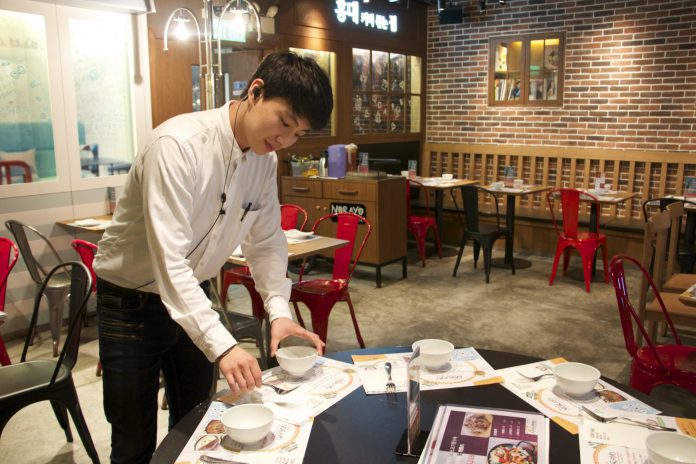
One of the arrivals on the scene is Norayo K-café, an upstairs Korean-style café. Online reviews for the Tsim Sha Tsui eatery tend to rave about the friendly staff and note that many of them speak Korean. This is not surprising as many of them, like Simon Park Yong-gwang, are young Koreans on working holidays in Hong Kong.
Many young people in Hong Kong dream of spending a year abroad on a working holiday and stories from those who have spent months picking grapes and travelling around Europe or working as baristas in Bloomsbury and exploring hip London corners are eagerly shared and enjoyed. But we tend to forget that working holiday visa arrangements are reciprocal and there are young foreigners taking working holidays in Hong Kong.
Park, 27, has been in Hong Kong since last August. While browsing job-hunting websites, he discovered there were companies offering jobs to Koreans in Hong Kong, so he applied for a working holiday visa.
Like many young people, Park has always wanted to experience living abroad and the working holiday offers him a great opportunity.
“To work overseas before 30-years-old is my dream, I am now 27 so I have still two years left, and I want to have lots of [overseas] experience,” he says.
Park had been studying Chinese in mainland China for a year and a half before coming here. He had thought Hong Kong would be similar to the Mainland but that view has now changed. “People in the Mainland are a bit impolite, but everyone in Hong Kong is polite,” he says.
Living in Hong Kong is expensive, especially with the high cost of renting accommodation. Luckily for Park, his employer provides accommodation for the staff who are here on working holiday visas. With a monthly income of about HK$13,000, Park can cover his monthly expenditure of around HK$8,000.
Park does not need to worry about money, but he does struggle with loneliness.
“Because we keep working here, we don’t have chance to communicate with people outside and this is a bit lonely to us,” he says.
However, he has met some local friends through playing football in Kowloon Park when he gets off work and that has helped to beat off the loneliness.
He thinks Hong Kong is a friendly place and welcomes foreigners, which is different from his home country. He says people in Korea are weary of foreigners but Hong Kong people treat foreigners as good friends. Also, in Korean culture, age and seniority are important so younger people must always show respect for their elders. Park finds it more relaxed in Hong Kong and he feels comfortable working with his younger colleagues.
Park’s colleague, 24-year-old Kim Hae Ri, is also on a working holiday visa. Kim works as a chef in a restaurant that specialises in Korean barbeque which is owned by the same company as Norayo K-café.
Kim has been here for less than two months and finds the language barrier to be a challenge. Before coming to Hong Kong, she had thought Hong Kong people spoke both Putonghua and Cantonese, but then she discovered that most people in Hong Kong usually speak only Cantonese. Still, she is satisfied with her job because it provides her with language training as well as accommodation.
Kim is majoring in Italian cookery in Ulsan College in South Korea and her college helped her to apply for the working holiday visa and find a job. However, as the working holiday visa arrangement forbids Koreans from working for the same employer for more than six months, Kim will need to find another job. She would like to work in an Italian restaurant.
Water sports enthusiasts raise the alarm over marine pollution
by Stanley Lam
Paddling gently while standing on a board in the ocean as the sun bounces off the rippling water or lying flat on the board and floating while taking in the spectacular Sai Kung scenery – these are experiences enjoyed by an increasing number of stand-up paddle boarders in Hong Kong .
Stand-up paddle boarding (SUP) is a water sport that started in Hawaii. Here in Hong Kong, Bryan Ng Yu-fung, the founder of Hong Kong Stand Up Paddle Board Association, is trying to promote it as a way to explore the natural scenery of Hong Kong rather than a racing sport.
“We have been using it to tour around Hong Kong mainly in Sai Kung in the Geopark area,” Ng says.
His favourite spot is Bluff Island, also known as Ung Kong, in the south of the Sai Kung Peninsula. Bluff Island has one of the four biggest sea caves in the eastern waters of Hong Kong. Known as the Sea Arch, it stands 25m high in the ocean.
While SUP tours are still a relatively new way to explore Hong Kong, kayaking trips have long been a good way for people to relax and enjoy Hong Kong’s backyard. David Leung Tat-keung, a kayaking coach with over 15 years of experience, says even many elite kayak racers are constantly surprised at how different trips made along the same route can feel.
“This week it’s sunny, next week maybe it’s windy, and the following week may be foggy, the weather keeps changing,” he says.
But many water-sports veterans have noticed that their marine paradise is under threat. Leung says the waters off Sai Kung are getting more polluted. The area is crowded with day-trippers on weekends and holidays and more rubbish is being dumped into the sea by visitors and junks.
To escape the crowds, Leung started to explore Lantau Island last year.
“There are many places that are beautiful, just that you’ve never been there. I’ve been to Peng Chau, Cheung Chau, Chi Ma Wan and Discovery Bay. The natural landscape is really beautiful. When there’s nobody else, it feels like you’re at Pattaya,” says Leung.
Leung observes that the water quality in Lantau is better than Sai Kung because it is surrounded by the open sea which means ocean currents will sweep away the rubbish floating on the water surface.
But former university rower Simon Yeung Chung-yu may beg to differ, as he has seen a different side of Lantau.
In October 2015, Yeung joined a round-trip rowing expedition from Hong Kong to Macau entitled “Pearl River Estuary Challenge”. It was organised by the Chinese University of Hong Kong Rowing Team Alumni Association and raised over HK$260,000 for the World Wildlife Fund Hong Kong’s dolphin conservation work.
During the expedition, Yeung saw the construction of the Hong Kong-Zhuhai-Macau Bridge in North Lantau.
“Obviously it’s very polluted, many construction ships were moving around. If I were a dolphin, I wouldn’t live there, but it’s actually your home,” he says.
Yeung questions the need for building an over-budget bridge that is destroying the natural landscape.
“You see tens to hundreds of construction ships working, but under this freaking background pops up a dolphin,” he sighs.
According to a 2015 report by the Agriculture, Fisheries and Conservation Department in 2015, there are only 61 Chinese white dolphins left in the waters off Lantau, and numbers are dropping fast in Northeast and Northwest Lantau. The situation is worst in Northeast Lantau, where only one dolphin is left.
Yeung recalls his experience of meeting white dolphins when training in Tai O before the expedition.
“We thought we were just raising funds for the dolphins, we never thought we’d actually see them. We all screamed when we first saw one,” he says excitedly. At first, he did not believe his teammates when they told him they saw dolphins because there was so much rubbish in the sea. “You will ask yourself whether what you saw was just a styrofoam box or really a dolphin”.
<-nextpage!>
Rowers are not the only ocean-goers contributing to nature conservation. Dragon-Overtime, a local dragon boat team based in Tai Po has incorporated it into their training.
Yeung says team members are required to train in the water and on land. As part of the training on land, they hike along the Shing Mum Reservoir. One time, their coach brought some bin bags and asked them to pick up the rubbish along the way. They collected several big bags of rubbish. Since then, hiking and collecting rubbish has become part of their training.
Yeung, who has run training sessions this way for Dragon Overtime, has seen an improvement in people’s environmental awareness. He agrees with the campaign to put fewer rubbish bins in country parks.
“This is a good concept as we can’t always blame people for leaving rubbish, sometimes they dump it in the rubbish bin but monkeys throw it out,” he explains.
This January, the team ventured beyond the Shing Mun Reservoir for the first time to collect rubbish. Along with about 40 volunteers recruited online, they went to Tung Lung Chau after one teammate found when he was camping on the island that its coastline was covered in rubbish.
However, Dragon Overtime will not go to collect rubbish in Tung Lung Chau on a regular basis because it is hard to access and to transport rubbish off the island. They had to get professionals to set up a pulley to pull out rubbish for transportation and ask the government to arrange for a boat to transport the collected rubbish.
Dragon Overtime member Lang Wing-huen is glad to see more people are organising groups to hike and collect rubbish but she thinks little can be done about the rubbish in the sea.
“The size and amount of coastal rubbish is much larger, and Hong Kong has a long coastal line, and the rubbish is in many areas,” she says.
As regular ocean-goers, water sports enthusiasts are only too aware of how pollution is damaging Hong Kong’s marine and coastal environment. Some of them are making their own efforts to make a difference.
But Lang thinks the government needs to allocate more resources to solve the problem of coastal rubbish. “it depends on how willing the government is to solve this, but I don’t think this is its [first] priority.”
Edited by Emily Man
* An earlier version of this story (and the print edition) states that Simon Yeung Chung-yu used to work in construction. This is incorrect and has been amended. We apologise for our mistake.
Scholar stands up to safeguard institutional autonomy and academic freedom at the University of Hong Kong
By Ryan Li
At noon on October 6 last year, around 2,000 people dressed in academic robes and black outfits set off on a solemn and silent march through the University of Hong Kong campus. They were protesting at what they saw as the erosion of institutional autonomy and the University Council’s controversial handling of the appointment of former Law Dean Johannes Chan to the post of pro-vice-chancellor.
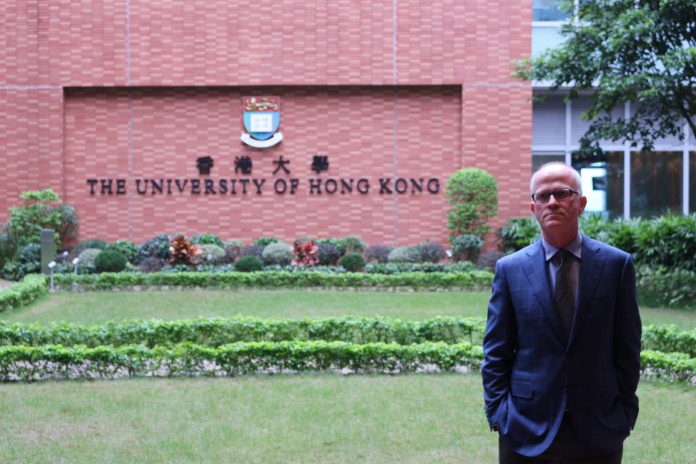
The procession thrust Timothy O’Leary, the head of the School of Humanities and a hitherto low-profile Irish philosophy professor into the limelight as a defender of academic freedom and university autonomy.
O’Leary arrived in Hong Kong in 2000 and considers the city his home. While he says he dare not call himself a Hongkonger because he does not speak Cantonese, he certainly feels like one.
“I’ve lived here for 15 years and I feel a very strong connection and commitment to Hong Kong, and when bad things happen in Hong Kong I feel bad about it – angry or sad – and I think that’s kind of a sign of identifying with the place. You care about it.” As he sees it, bad things have indeed happened in Hong Kong in recent years. Back in 2001, O’Leary noticed that many people who had emigrated before 1997 had returned to Hong Kong as it seemed not much had changed after the handover.
All that has now changed and, for O’Leary, the tipping points were the government’s attempt to introduce national security laws under Article 23 of the Basic Law in 2003 and the controversial political reform plan and Occupy Movement in 2014.
He says it is a political reality that Hong Kong is a Special Administrative Region of the People’s Republic of China. The key issue then is how it can maintain its uniqueness, and not become just another Chinese city like Shanghai or Beijing. This, he believes, is becoming increasingly difficult.
As a long-time resident, he has already witnessed the gradual erosion of some of Hong Kong’s most fundamental values. As an academic, the decline that strikes him the most is the weakening of academic freedom and the threat to institutional autonomy.
O’Leary sees the attack on the universities as one of the consequences of the government’s failure to get its proposal for political reform passed. “After that, all of a sudden the universities became the front line, or a new battleground in this fight,” he says.
It is a battle that O’Leary feels duty-bound to fight. The University Council’s decision to block the appointment of Johannes Chan as pro-vice-chancellor despite his being recommended by a selection committee headed by the vice-chancellor, was widely panned as being politically motivated.
It prompted him to help organise the silent march and establish a group called HKU Vigilance to monitor academic freedom and institutional autonomy and support staff under political pressure. He also stood for and won a seat on the HKU Council along with other teachers known to be academic freedom advocates.
Apart from advocating for academic freedom as a scholar, O’Leary has supported various student protests demanding the council give a valid reason for rejecting Chan’s appointment. Outside the university, he supports students’ rights to peaceful protest, and to engage in civil disobedience such as occupying Admiralty during the Umbrella Movement.
He disagrees with those who say student activism damages the university’s reputation. “If I heard the students from a university, say in Oxford, were engaging in protests against their governing body, it wouldn’t make me think less of Oxford,” he says.
O’Leary says he never imagined that he would be able to achieve anything before he took up such a prominent role in defending the university and supporting student movements. But as the head of the School of Humanities, he has a strong commitment to the university and feels obliged to do something.
“I guess I didn’t know if I could do it before I did it, but I did it,” he says.
He fully understands that playing an active role in standing up for the university’s autonomy comes with risks. That is why he respects colleagues who may be concerned about their job security and career prospects, and hence choose not to speak out.
Nobody has approached O’Leary to say they have been prevented from expressing their opinions, but O’Leary does feel that some staff do not want to declare their stance because that may damage their academic reputation.
On the other hand, many have approached him to express their support for what he is doing. O’Leary says many people have told him they are glad to see his actions even though they themselves are not willing to stand before the public.
He acknowledges that it feels a little strange that a foreign professor would be one of the people to organise and lead the silent march. It might lead some to think that even a foreigner cares more about the university than some local staff do. O’Leary tries to rationalise it by saying it shows “how internationalised HKU is”.
The overseas academic who comes most readily to mind when it comes to the recent controversies surrounding HKU is Vice-Chancellor Peter Mathieson. When he was appointed to the post, critics questioned Mathieson’s credentials and suggested he was a wrong fit for the job as he had no working experience in Asia. But after two years working with Mathieson, O’Leary speaks highly of him.
“I think he is a very strong academic defender of freedom of speech for students and staff of the university,” he says. “And I think that’s great.”
O’Leary does not agree with Mathieson’s description of the student protests against the new HKU Council Chairman Arthur Li Kwok-cheung as “mob rule”.
But he says Mathieson’s job is not an easy one, especially as he had not expected he would have to handle so many political issues when he took up the job offer in 2014.
He gives a positive assessment of Mathieson’s performance during the Occupy Movement in 2014, when many students and staff of HKU were involved in the protests. O’Leary says he gets the impression that Mathieson wants to focus more on improving the school’s academic research but political issues just keep cropping up.
Over the past few months, the staff unions at eight local universities have been voting on whether to amend the university ordinances to scrap the tradition of having the Chief Executive as the chancellor or president of the universities. In his role as the chancellor of HKU, Chief Executive Leung Chun-ying appointed Arthur Li as chair of the HKU Council despite widespread opposition from students, staff and alumni.
Posters outside O’Leary’s office
Over 90 per cent of staff at eight tertiary institutions voted in favour of abolishing the power of the Chief Executive to appoint members to university governing councils. But O’Leary is not optimistic it will make a difference.
“Have you ever known the Chief Executive to give in to public opinion?” he asks, with a half smile.
Academia is sometimes referred to as the ivory tower, and at other times the universities are seen as a microcosm of society. In recent months and years, they seem to be closer to the latter. From the involvement of academics and students in the Umbrella Movement, to the controversy over Johannes Chan’s aborted appointment, and the rise of the localist movement, universities are invariably tied to politics in the wider world.
Edward Leung Tin-kei, who stood in the New Territories East Legislative Council by-election as a candidate for the localist organisation, Hong Kong Indigenous, is a philosophy major at HKU. Undergrad, a publication of the HKU Students’ Union, has also explored the concept of localism in its magazine and book Hong Kong Nationalism. These works were openly criticised by the Chief Executive for “advocating independence”.
Some now regard HKU to be a hotbed of localism and even of Hong Kong independence. As a philosopher, O’Leary thinks localism is understandable and comes from people’s sense of identity as Hongkongers. However, there is an element of the localist movement that worries him – what he describes as “very nasty” anti-Mainlander sentiment.
For O’Leary, it is possible to oppose the actions of the central government without personally being abusive towards mainland tourists and students in Hong Kong. From his point of view, these Mainlanders are not responsible for the wrongdoings of their government. What is more, he says it is racist to develop hostility towards people based on their membership of a group.
Apart from the anti-Mainlander sentiment, O’Leary is also unhappy with the use of violence by some radical localists, which his student, Edward Leung Tin-kei has defended.
During Chinese New Year this year, clashes between protesters and police broke out in Mong Kok soon after the attempted clearance of some street vendors by Food and Environmental Hygiene Department officials. Leung was on the frontline during the clashes and was arrested at the scene.
O’Leary says he has not had a chance to talk to Leung after the incident, but he disagrees with using violent means to achieve political goals. “Will this work?” he asks. “I mean, obviously that’s not going to work either. That’s going to work even less [than peaceful protest].”
Although he is clearly worried about the threats to values such as academic freedom, press freedom and the rule of law and by the prospect of protests turning violent, O’Leary says he is both pessimistic and optimistic about the future of Hong Kong. He is optimistic because he sees many people who cherish the things that make Hong Kong different from other cities in China. On the academic front, he will be working alongside them.
Since taking on the fight for institutional autonomy and academic freedom, O’Leary finds he has less free time. But he hopes that by joining the university council, he can help to bring the voices of academic staff into the body so that the outside members can understand their concerns and demands.
“Businessmen don’t necessarily understand the nature of a university,” he says.
Outside of the university, O’Leary grasps every opportunity he gets to relax. He says one of his favorite hobbies is to cook, especially Italian food. Then he jokes, “When I was a student, I imagined that the professors didn’t have a personal life.”
Edited by Mavis Wong
*An earlier online version and the print edition of this article erroneously stated the date of the HKU silent march was October 5th, instead of October 6th. We apologise for the mistake
Defeated district councillor Rosanda Mok Ka-han plans to shake-up ADPL as new party chair By Rubie Fan
Last year’s district council elections will be remembered for the success of young newcomers and the felling of political heavyweights. In Sham Shui Po, the veteran Association for Democracy and People’s Livelihood (ADPL) district councillor and legislator Frederick Fung Kin-kee lost his seat to a 25-year-old pro-Beijing candidate who was dubbed a pro-establishment “little flower” by the mainstream media.
Not so far away in Ma Tau Wai, Rosanda Mok Ka-han suffered a similar fate, losing her seat by just 45 votes to a 24-year-old pro-establishment rookie. Ironically, some mainstream media referred to Mok as a “past-it little flower”.
“The residents thought that Mok Ka-han had been the district councillor for a long time and they should let the young people try,” she says. But the 43-year-old is anything but “past it”. Although she was disappointed with the result, she chose to stay in the ADPL and serve her former constituents.
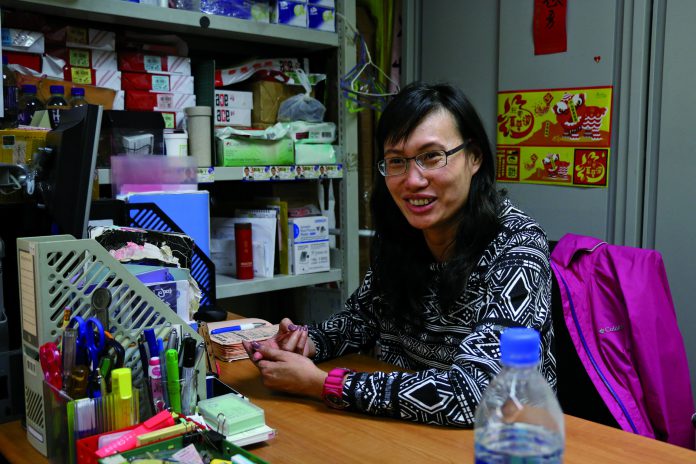
Sitting between stacked up paper boxes, Mok starts counselling two women in her office in Ma Tau Wai Estate, the public housing estate she has served for more than 15 years. Only now, she is doing so as the new chairperson of the ADPL.
The man she replaced as chairman is her mentor, former district councillor and legislator Bruce Liu Sing-lee. Mok chose to work as Liu’s assistant after graduating from City University because she identified with the ADPL’s motto of helping the needy from the grassroots. She says that as a student she had taken summer jobs working with a “rich political party” that she does not identify by name. “I couldn’t agree with the work of the rich political party. They thought you could make things work with money. But I think there’s a difference between wanting to really serve society and hankering for the status of a councillor. There are things money can’t buy,” she says.
In 1999, Liu encouraged her to contest the Ma Tau Wai seat in the District Council Election. She was 27 when she won on her first attempt. Young female district councillors were a rarity at the time and stereotypes about women were common among councillors.
Some experienced male councillors questioned a woman’s ability to serve the community and thought female councillors treated the work as something to be done in their spare time. On the contrary, Mok found that her identity as a woman and as a mother helped her on some issues.
“A female district councillor has a certain advantage on some women’s issues. You would be more able to view them from a female’s point of view,” she says.
An example is the campaign she fought alongside other district councillors for more comprehensive breastfeeding support facilities around two years ago. Mok points out they were not just advocating for the setting up of nursing rooms but also for support for mothers’ emotional and mental health.
She says some of her male colleagues in the council did not understand the issue. One of them, who is also a university professor, suggested mothers could learn how to breastfeed from YouTube videos and claimed there was not much support for breastfeeding in other countries.
“Mothers sometimes have to sit in a conference room or even the toilet to pump milk. Only women would understand the hard feelings of having to hide away,” Mok says.

































 d numbers are dropping fast in Northeast and Northwest Lantau. The situation is worst in Northeast Lantau, where only one dolphin is left.
 As he sees it, bad things have indeed happened in Hong Kong in recent years. Back in 2001, O’Leary noticed that many people who had emigrated before 1997 had returned to Hong Kong as it seemed not much had changed after the handover.
 He fully understands that playing an active role in standing up for the university’s autonomy comes with risks. That is why he respects colleagues who may be concerned about their job security and career prospects, and hence choose not to speak out.
 The man she replaced as chairman is her mentor, former district councillor and legislator Bruce Liu Sing-lee. Mok chose to work as Liu’s assistant after graduating from City University because she identified with the ADPL’s motto of helping the needy from the grassroots. She says that as a student she had taken summer jobs working with a “rich political party” that she does not identify by name. “I couldn’t agree with the work of the rich political party. They thought you could make things work with money. But I think there’s a difference between wanting to really serve society and hankering for the status of a councillor. There are things money can’t buy,” she says.