
















Home Blog Page 108

A Radical Road to Reform

Hong Kong’s democrats split on how to achieve democracy and justice

By Pash Chan and Cindy Ng

“They’re starting the arrest!”

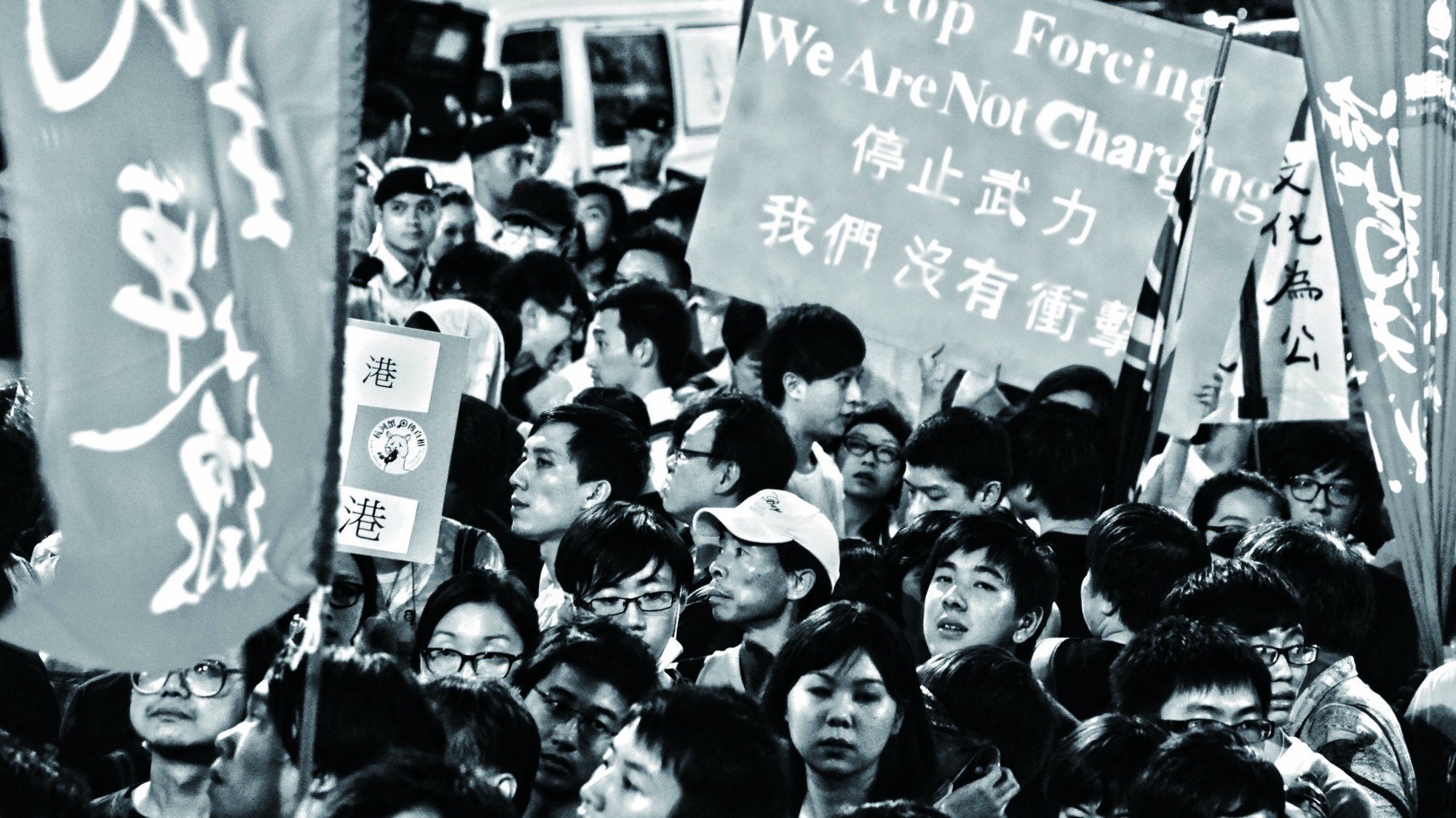
Those were the words Tam Tak-chi, a radio host and activist better known as “Fast Beat”, heard as he tried to make his way towards his fellow protesters on Queen’s Road in Central. Before he reached them, several arms lifted him straight to a squad car. Enraged protesters blocked and shook the vehicle, demanding that the police release Tam. While the police officers beside Tam looked on nervously, Tam was calm, even though he knew he may well be imprisoned for “unauthorised assembly”.

Just two blocks away on Ice House Street, a lone protester stood in the centre of the road. Legislator Leung Kwok-hung, or Long Hair, was surrounded by hundreds of policemen. As he yelled, “Leung Chun-ying!” people standing outside the police cordon shouted back, “Step down!”. After an hours-long stand-off, Leung was arrested at midnight, ending the New Year demonstrations, of striving and failing to bring about democracy, some protesters’ patience has been exhausted. Occupying public spaces, paralyzing traffic and other physical confrontations have become more frequent.

For them, working for political reform in the Legislative Council (LegCo) is just a naïve dream. Only half of the seats are elected by one-person-one-vote through geographical constituencies, while the other half are elected through “small circle” functional constituencies. The system consistently gives the pro-establishment camp an upper hand, even though it does not win as many votes as the pan-democrats. The advantage is compounded by the split-voting mechanism which means that private members’ bills and motions must be passed by a majority of lawmakers from both sets of constituencies.

Frustration over the limits of what can be achieved within the system has sparked debate over whether the quest for democracy needs to be fought outside of the system instead. The question has split the pan-democratic camp and its supporters and extends to the debate in the media and among ordinary citizens.

“[The traditional pan-democrats] despise the system because they know it is defective. On the other hand, they insist on fighting for democracy through it. This is illogical,” Leung Kwok-hung says. “Either they are fooling the people, or they are fooling themselves.”

Leung believes the only way to abolish the unfair system is for protests to intensify. Ever since entering the legislature in 2004, Leung has been famous, or infamous, for deliberately breaking rules, from throwing bananas and letting off helium balloons inside the LegCo chamber to carrying paper coffins to functions he was invited to attend as a legislative councillor. He was also an organiser of the filibuster to derail government policy.

For the legislator who won the most votes in his geographical constituency in the 2012 LegCo election, it may seem ironic that Leung views LegCo as just a platform to create noise. But he believes every time he steals the spotlight in meetings through his disruptive behaviour, he makes a slight difference.

“Similarly, any single protest cannot correct our society, but you would still take part. Every protest is to accumulate the power for changes,” Leung says.

His commitment to his cause has landed seven days for disrupting a LegCo session with then Chief Executive Tung Chee-hwa. Before he was charged with unlawful assembly in the New Year protest, he was already appealing a two-month jail term for disrupting public order during protests at a 2011 consultation over government plans to scrap by-elections for vacant LegCo seats.

Death, Life and Everything in Between

Learning about death helps youngsters get the most out of life

By Yoyo Chan and Tommy Lee

“I am happy to have cancer,” says William Chan Wai-lam.

Chan, a 30-year-old with a pudding bowl haircut and preference for the name William Outcast, sits and smiles broadly.  Half of his body is covered in countless black dots and passers-by cannot help but stare at him.

Chan is used to the stares. He was born with the dots. Each dot is a melanoma, a tumour of skin cancer.  “They hurt like having stones in your shoes,” says Chan.  There have been acute episodes – Chan was once admitted to hospital after vomiting blood.  He was told to say his goodbyes to his family and was transferred to the intensive care unit.  He knows that at any moment, the cancer could spread and kill him. He has lived with death all his life.

In July last year, Chan organised his own funeral and invited 200 friends and relatives to mourn his “death” and celebrate his life. Chan conceived it as a class in life and death education and, indeed, it is probably the highest profile life and death education event ever to be held in Hong Kong.

Life and death education refers to teaching about the concept of death itself. In traditional Chinese society, death is taboo and represents misfortune. People will try to avoid saying words that sound similar to “death” during the Chinese New Year or even skip the fourth floor of buildings. When a member of the family dies, the rest of the family is expected to avoid visiting others’ homes or attending weddings.  The purpose of life and death education is to break these taboos and to help people to rethink the value of life through understanding death.

After his funeral last summer, Chan dedicated himself to various forms of life and death education. He held an art exhibition and conducted workshops and talks at schools. “Death is good,” says Chan. “Through death we find the value [of life].”

For Chan, it is not a pity to die as long as you pursue your dream in life.  Chan himself is a living example of this belief. But he is not alone in recognising the importance of life education.

Wallace Chan Chi-ho, assistant professor in the Department of Social Work at the Chinese University of Hong Kong (CUHK), offers a course on grief and life education. Although most people may see such education as something that focuses on the elderly and those facing imminent death, Wallace Chan believes it is also meaningful for teenagers.

A Call For Speech Professionals

Shortage of speech therapists thwarts children’s development

By Joyce Cheng and Katrina Lee

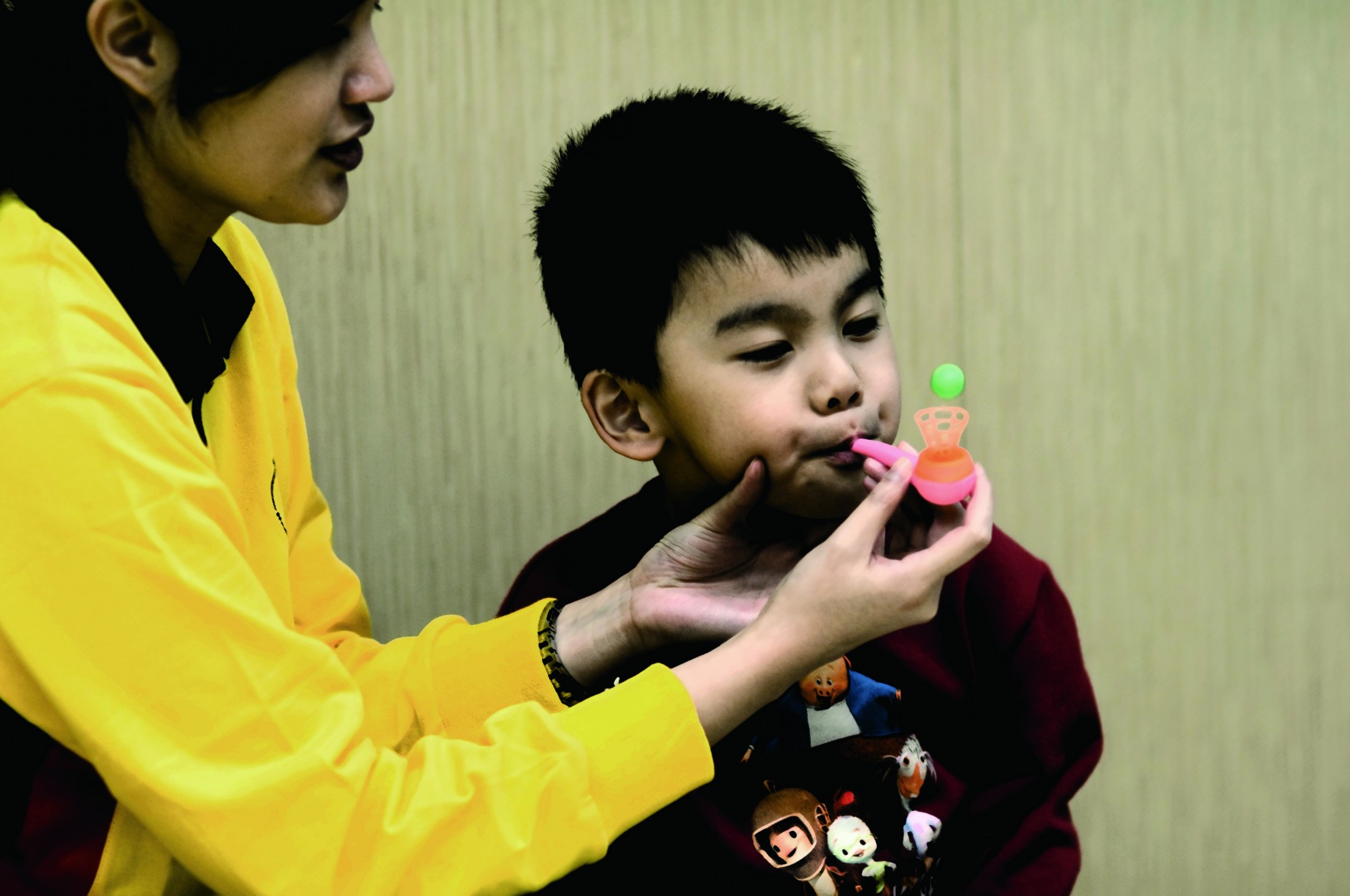
In a colourful classroom filled with toys and picture cards, a woman speaks slowly and clearly to a group of three children sitting around her, ensuring they articulate correctly and rectifying their pronunciation.

For most people, speaking is such a natural activity, they take it for granted and may not realise there are people around them, including children, suffering from communication disorder.

In recent years, families have become more aware of speech and communication problems, especially when parents find their children having difficulties in attaining certain language abilities expected for their age.

For instance, a three-year-old child should be able to say, “I want to eat apples.” But a child with language delay might keep repeating “apples, apples, apples,” or reverse the sentence structure. They might have trouble expressing themselves in simple sentences.

Communication disorders can affect a child’s learning, development and personality. Children who struggle to speak properly could eventually become less sociable and have lower self-confidence.

Language delay and communication disorders take many forms and have many different causes, some of them are genetic or developmental and some are acquired. They refer to impairments in the ability to receive, send and process sounds, words and visual language systems such as writing.

Children with conditions like autism or dyslexia, and children who lack an appropriate language-learning environment are among those who experience communication disorders.

“Speech disorder isn’t only about talking. For example pronunciation, voice problems, swallowing problems and even stuttering are all included in language problems,” says Jessi Chan, a private speech therapist at McKenzie & Associates Rehabilitation Services.

Speech therapists provide professional assessment and therapy to patients with communication disorders and play an important role in assisting and rectifying the language issues they are experiencing.

All therapeutic sessions are specifically designed for individuals to target their needs. Therapists use a variety of techniques such as training cards with phonetic articulations and pictures, facial massages and jaw, lip and tongue exercises to strengthen the muscles of the mouth. For children, games and toys are also used to facilitate their speaking and enhance their attention in a session that lasts between 30 minutes and one hour.

Playing with Shadows

Traditional Chinese shadow puppets get a new lease of life

 By Charlene Kwan

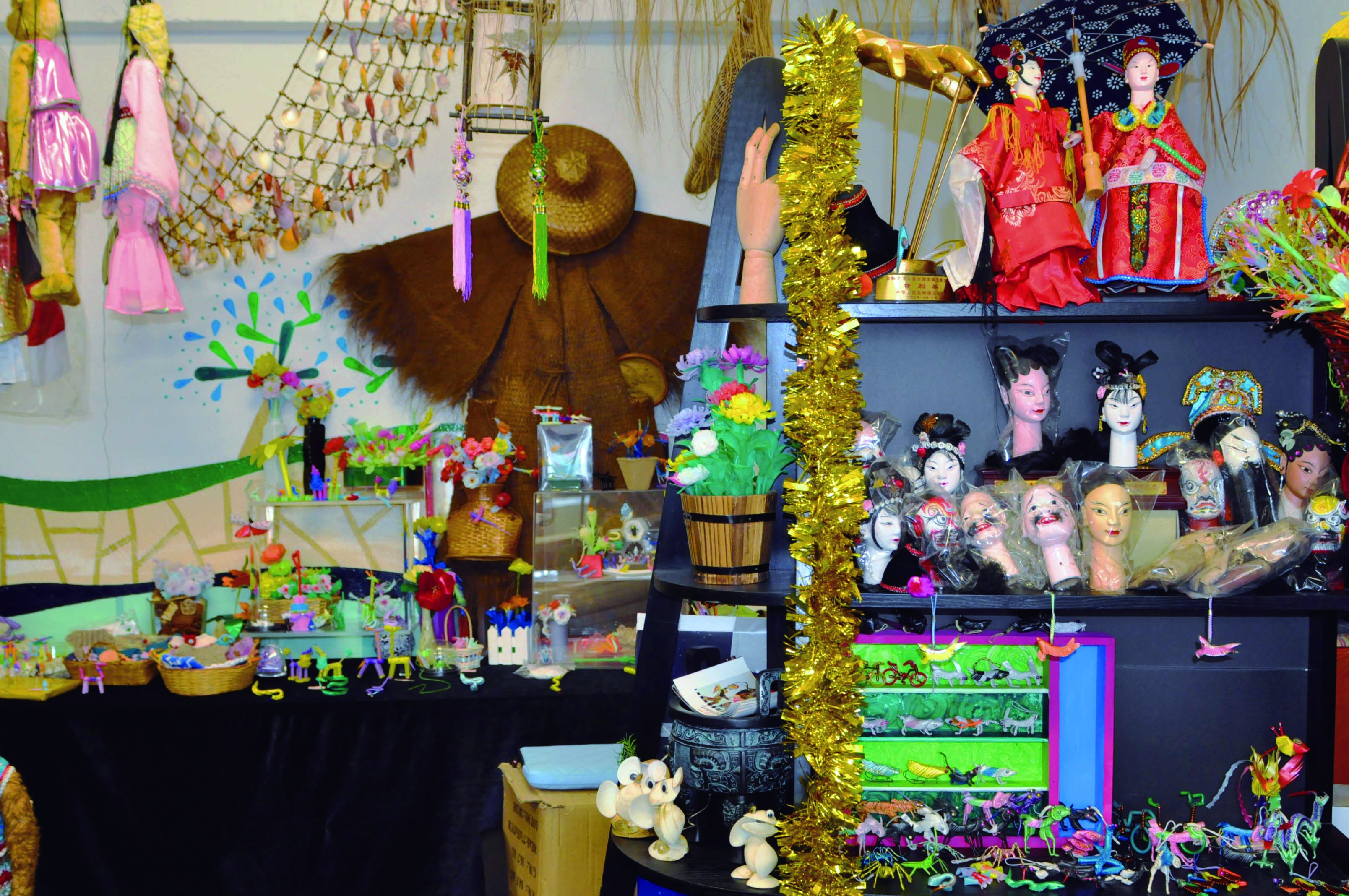
In a 300-square-foot studio in an industrial building, a man wearing reading glasses is carefully and skillfully cutting a piece of cowhide into the shape of a puppet.

Wong Fai, director of Hong Kong Puppet and Shadow Art Center, is a shadow play maestro in his 60s. He has been fascinated by puppets since he was a boy and began to learn puppetry seriously, with marionettes, when he was 17.

His love of puppetry led the Hong Konger to travel to Hunan in the late 1970s to study shadow play from Tan Degui, an eminent shadow play maestro at the Hunan Puppet and Shadow Art Troupe of China.

Wong returned to Hong Kong as a full-time puppeteer performing at nightclubs and other places of entertainment. In the 1990s, the market for puppet shows shrank and the demand for performances declined. Wong worked as a building surveyor for the next decade or so, treating his art as a part-time job.

Even so, Wong has never lost his enthusiasm for shadow play. In 2000, he decided to devote himself fully to shadow puppetry once again and invited other masters from the mainland to help.

“I think if we let it fade away and no longer have these performances, this culture in Hong Kong, I think it would be a pity,” he says with an unconscious frown.

What inspires and drives Wong to persist is his admiration for the skill of the masters he was apprenticed to who were passionate about performing throughout their lives. “[They were] performing until the last day of their lives and were extremely enthusiastic about this job,” says Wong, adding that their dedication was a lesson that was worth learning.

Wong thinks the best thing about apprenticeships is that apprentices not only learn performing skills from their masters, but also life values. Despite this, he himself does not have any apprentices. “Shadow play requires a lot of time and patience in practising even basic skills,” explains Wong. “Hong Kong people only enjoy things that yield immediate rewards.”

To make shadow play more attractive to the next generation, Wong acknowledges the need to bring it up to date. In 2003, he used a combination of puppets, including marionettes, hand puppets and shadow puppets in a show, striving to make a fresh impression on his audience.

But he says it is difficult for people of his generation to hit upon new ideas. “Our concepts are very traditional, and we do not have broad enough vision,” laughs Wong. “We will have to rely on the younger generation to modernise this art.”

Opportunity came knocking through a Chinese folk art programme run by the Hong Kong Baptist University a few years ago. Wong met Lee Yuk-shan, a student who was willing to help him in his quest.

In the Mood for Cheongsam

Meet Hong Kong’s cheongsam collectors

by Elaine Tsang

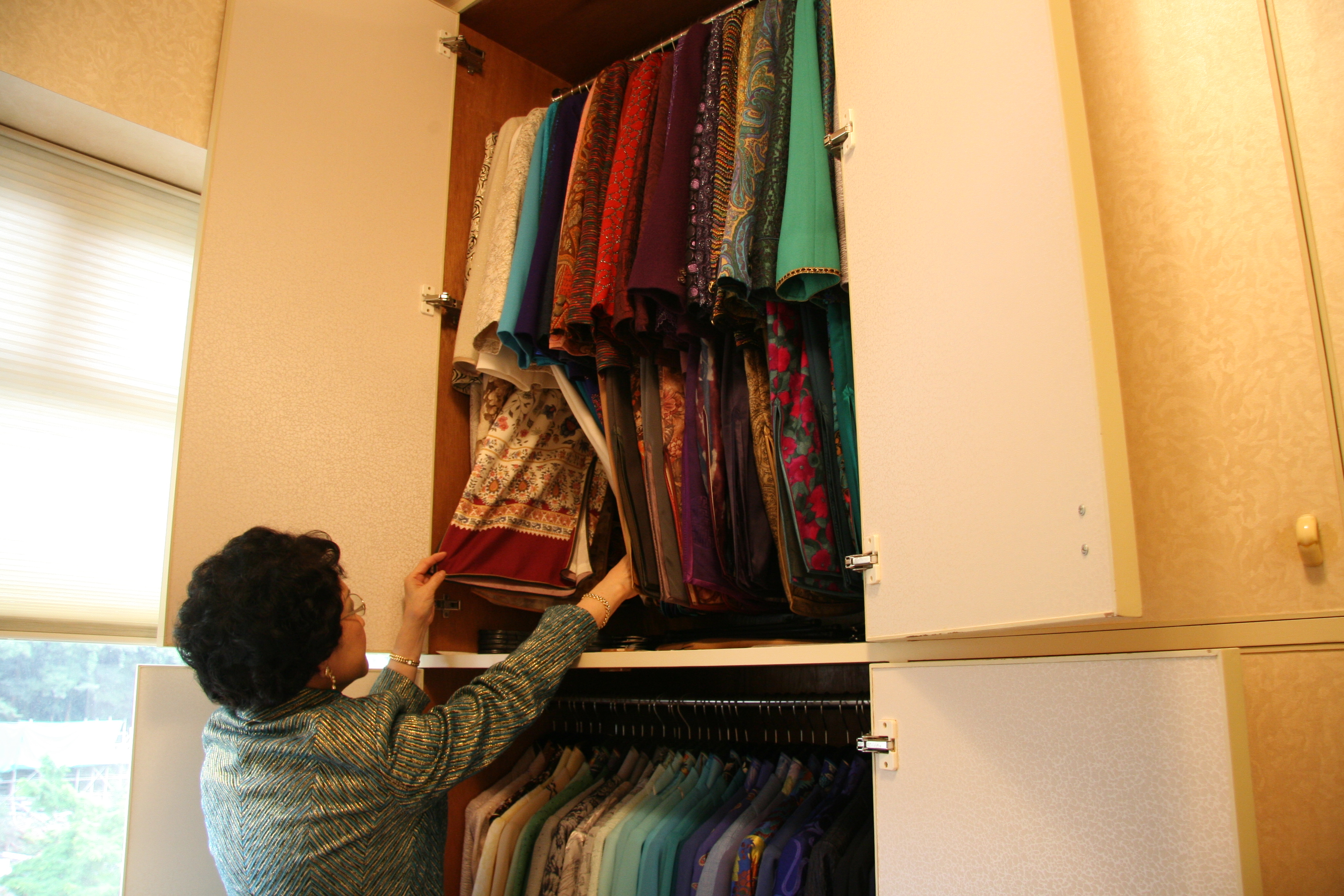
Opening an ordinary black suitcase, a young man smiles and takes out the dresses from his exquisite collection. From the pile of embroidered cheongsams, Helius Yuen Kin-wai picks out his favourite piece.

“It has the longest history within my collection,” Yuen explains of his choice, a sheer blue lace cheongsam. “Also, its design really represents the era which it comes from, the 1920s and 1930s.”

Yuen started collecting cheongsams when he was 20 and now, at only 28, he has more than 700. He was just 11, however, when he fell in love with them thanks to an old photo which showed how the dresses can turn any woman into a star.

Yuen was not a motivated student. He attended a vocational school where he fell in with a bad crowd and spent much of his days roaming the streets.

“I only studied until Form Two,” Yuen says. “[You could say] it was playfulness or naughtiness; I stopped going to school when I was about Form Three.”

At the time, Yuen had no education, no job, and no meaningful goal in life. It was only after he took up a part-time job as a sales assistant that he realised he had to find some life goals for himself. It was this search that led to his cheongsam collection.

Yuen’s current devotion to the cheongsam can be attributed to his friend and mentor Joel Chung Yin-chai, a famous toy collector.

“When I first met him, he was my boss. I was a salesperson selling clothes then,” Yuen explains. “A boss who sells clothes should be very well-dressed and tidy. But every time I saw him, he was carrying rubbish.”

Yuen was curious about Chung’s litter-picking habit and discovered Chung was picking through rubbish to find anything that was related to Hong Kong culture; old photos, stationery and in particular, toys. He told Yuen that things that others threw away could be prove useful to him. Bearing that in mind, Yuen decided to follow Chung on his search.

“When you pick something up you need to clean it, to put it somewhere safe. You must do research and understand the historical meaning behind the object,” Yuen explains. That was when he began to think about his ambition to collect cheongsams, and to learn something about Hong Kong.

This would later influence Yuen’s own beliefs as a collector of cheongsams.

The First Lady of Hong Kong Television

Eighty years-old and still going strong, Lily Leung Seun-yin never tires of acting

By Hilda Lee

Immaculately dressed in a trouser suit, accessorised with a gold tulip brooch and matching earrings, Lily Leung Suen-yin greets Varsity with a friendly smile and perfect poise. Looking at her radiant face, nobody would guess that she had worked until 4 a.m. that morning.

The 80-year-old veteran actress has been in show business since 1957. Her career-defining role as a wealthy and haughty woman known as the “Upper Class Person” in the hit 1990s TV sitcom, A Kindred Spirit, is deeply etched into people’s memories. Even now, she still catches the attention of most passers-by in the street.

But the role is just one of the great achievements in Leung’s 56-year career. Leung has been on TV for almost as long as TV has been in Hong Kong. In that time, she has marked many major milestones.

She was named “the first lady of television in Hong Kong” because she was a voice actress in the first TV programme, Puppet Family, a children’s programme. She was one of the first actresses to act in a TV drama, one of the first news anchors, a host of the first variety show, and a host of the first television programme aimed at women viewers (teaching them about make-up and deportment).

Leung never set out to be an actress. She came from a respectable middle-class family, whose fortunes changed when her father’s business failed after World War II. She gave up her studies after high school and went to work selling perfume in the Sincere Department Store to support her siblings’ tuition fees. After working in the perfume department for two to three years, people gave her the title of “Princess of Perfume” owing to her beauty.

But the beauty never regarded herself as a “princess”. She just wanted to be an ordinary woman who could earn money to support her home and her own family.

It was a chance suggestion from her husband that set her on her extraordinary path.

Leung’s husband read an advertisement in the newspaper saying that Rediffusion was recruiting announcers and encouraged his wife to apply. Rediffusion, Hong Kong’s first television station was established in May 1957 as a subscription cable service.

Then aged 24, Leung had already given birth to three children. To this day, she expresses her heartfelt gratitude to her late husband for his constant support and encouragement.

Running into the Light

Sudden blindness brings Mok Kim-wing a life full of surprises

By Vanessa Cheung

On a cool and breezy night at the Hammer Hill Road Sports Ground in Diamond Hill, the sea of runners practising for the Standard Chartered Marathon was joined by an unusual duo – Kim Mok Kim-wing and his partner Yeung Yuk-wing who guided him with a hand strap.

Mok, 48, is blind and Yeung is hearing-impaired. Both are members of the aptly named Fearless Dragon long-distance running team which has around 25 members, of whom around 15 are visually impaired while the others are hearing-impaired. On the track, one deaf runner is paired up with a blind runner to form a team in which the deaf runner takes on the role of a lead runner to guide his or her blind running mate.

Mok is a former blind athlete for Hong Kong and won a silver medal in the standing long jump in the Far East and South Pacific Games for the Disabled in 1984. With his rich experience in sport, Mok founded Fearless Dragons two years ago. “Sport is not the ultimate goal, it is a way to provide a bridge [between the disabled and the rest of society]”, he says.

The team keeps growing and setting higher targets. Last year, the team took part in the 10 km event of the Standard Chartered Marathon. However, this year Mok ran in the full marathon event. The distance is 42 km, which is equal to the distance from Aberdeen to Lo Wu. After practising for two years, Mok can finish it in 5 hours and 46 minutes.

Apart from The Fearless Dragon, Mok also co-founded the Hong Kong Blind Sports Association. He believes sports can be a way to help the disabled build up their confidence and to engage with society. To this end he also organised golf and bowling activities for the disabled in the association.

Mok has devoted his life to helping other disabled people view their disabilities positively. But he did not always view his blindness so positively himself, in fact, he recalls a sense of desperation when he first lost his sight.

Cecilie Gamst Berg’s Canto Crush

Norwegian preaches Cantonese “fundamentalism” through unconventional language classes

by Rachel Cheung

Dressed in a police officer’s uniform and brandishing a baton, Mister Public Security Bureau rushes to different restaurants in Hong Kong and demands that people replace traditional characters on the menu with simplified ones. This is a scene from one of Cecilie Gamst Berg’s YouTube videos. Gamst Berg is a Norwegian who has been teaching Cantonese in Hong Kong for 16 years and the videos are a part of her unusual take on Cantonese learning.

Gamst Berg’s passion for the Cantonese language and Hong Kong culture propels her to teach Cantonese through different channels. Until 2011, she was one of the hosts of an RTHK radio programme called Naked Cantonese, which ran for four years. But she was not satisfied with just that. She wanted to have her own TV programme. After being rejected by several producers, she turned to YouTube and began broadcasting her own videos on her channel.

Her eccentric videos are full of crazy characters, costumes and cheap props. They feature colourful stories that teach people Cantonese, as well as Gamst Berg talking about her adventures in China. Like her Cantonese classes, they are full of fun scenarios. They revolve around adult themes such as drinking and brothels and reflect her belief that language learning is all about imagination and creativity.

Gamst Berg appears in all them, assuming the improbable personas of characters such as the language police officer (the aforementioned Mr Public Security) and the beer-bellied local “bloke” Ah Mok. “I invented all of them, except one, which is my favourite – Aluminium Man,” she says.

In person, Gamst Berg provides private tutoring in places like Hong Kong diners and restaurants and holds parties for students at her village house in Pui O, which she has named the “Happy Jellyfish People’s Democratic Language Bureau”. She also calls herself a Cantonese fundamentalist because the word “fundamentalist” combines fun and mentalist, a fun, crazy and creative person just like her.

Her teaching career began in a private school where she taught English. But friends and colleagues were more interested in knowing how she learnt Cantonese and demanded that she teach them. This soon became a full time job with a good income. She now has 35 to 40 regular students, most of whom are foreigners.

Re-living World War II

War ruins and the memories of veterans are all that remain to remind us of World War II in Hong Kong
by Louie Cheng,Emily Chung & Sharon Lee

The Great Escape

Become a real escapist with Freeing HK

By Emily Chung

You are thrown into a tiny, dark room, with your hands cuffed behind your back. The door shut and locked. Now, you are left alone in front of a treasure box. Some random pictures hang from the ceiling. A timer is ticking in the corner. You have 45 minutes to sort out the clue and complete your great escape.

Welcome to Freeing HK, the city’s first ever real-life escape game. Just like escape games on mobile apps and the internet, players make their way out of themed chambers by solving various codes and puzzles. Only the Freeing HK experience stimulates all five senses rather than just hearing and vision. You need to be on the scene and you are the protagonist.

The game has three different themed chambers in ranging degrees of difficulty. The entry level chamber is a kidnapping scene, where players strive to unlock their handcuffs and reclaim their freedom before gangsters come back. The second level is a remake of the US TV series Prison Break: players have to break out from a jail cell using codes hidden in scrambled letters and numbers on a wall. The most difficult chamber is a laboratory full of gimmicks. If they are not careful smoke emitters and alarms will be triggered. Each chamber can accommodate two to five players at one time.

Should you be lucky enough to escape all the chambers, a limited edition chamber featuring seasonal festivals or events awaits.

Real-life escape games have swept many places including the United States, Japan and Taiwan. Some local elements have been added to the game here in Hong Kong. For instance, all the riddles are based on a knowledge of the city, such as its geography and transportation.

“Many people say Hong Kong lacks a creative culture, but this is not the case. We try to bring a lot of Hong Kong culture into the locked rooms [in the game],” says Raymond Sze Wai-hang, one of the founders of Freeing HK.

Sze is a second-year business student at Hong Kong University of Science and Technology, where he met his co-founder Instant Wan Sze-tang, a lecturer, author, and member of the high IQ Mensa society. Both  enjoy detective comics such as Kimdaichi and Detective Conan. They were fascinated by the idea of building a real-life escape game in Hong Kong.

Maggie Wu Ho-yi, a Hong Kong Polytechnic University student, went to Freeing HK for the first time earlier this year. Wu says the real-life game can be a good alternative pastime for teenagers.

“The young always play on their laptops, game consoles and mobile phones at home. Maybe going out with friends [to play Freeing HK] offers a more eye-opening experience,” Wu says.

Although Wu and her friends ultimately failed to escape from the most difficult chamber “Dr. Alpha’s laboratory”, she cherishes the experience as it helped boost cooperation amongst her friends. Wu said the game allowed her to better understand her friends, as genuine they showed their genuine emotions under stress and with the clock ticking.

If you have been dreaming of becoming an action hero, want to challenge yourself, or simply have a good time with your friends, check out Freeing HK at Room 415, Pakpolee Commercial Center, 1A-1K Sai Yeung Choi St S, Mong Kok. One game costs HK$128 per person. To reserve a place, visit http://www.freeinghk.com.