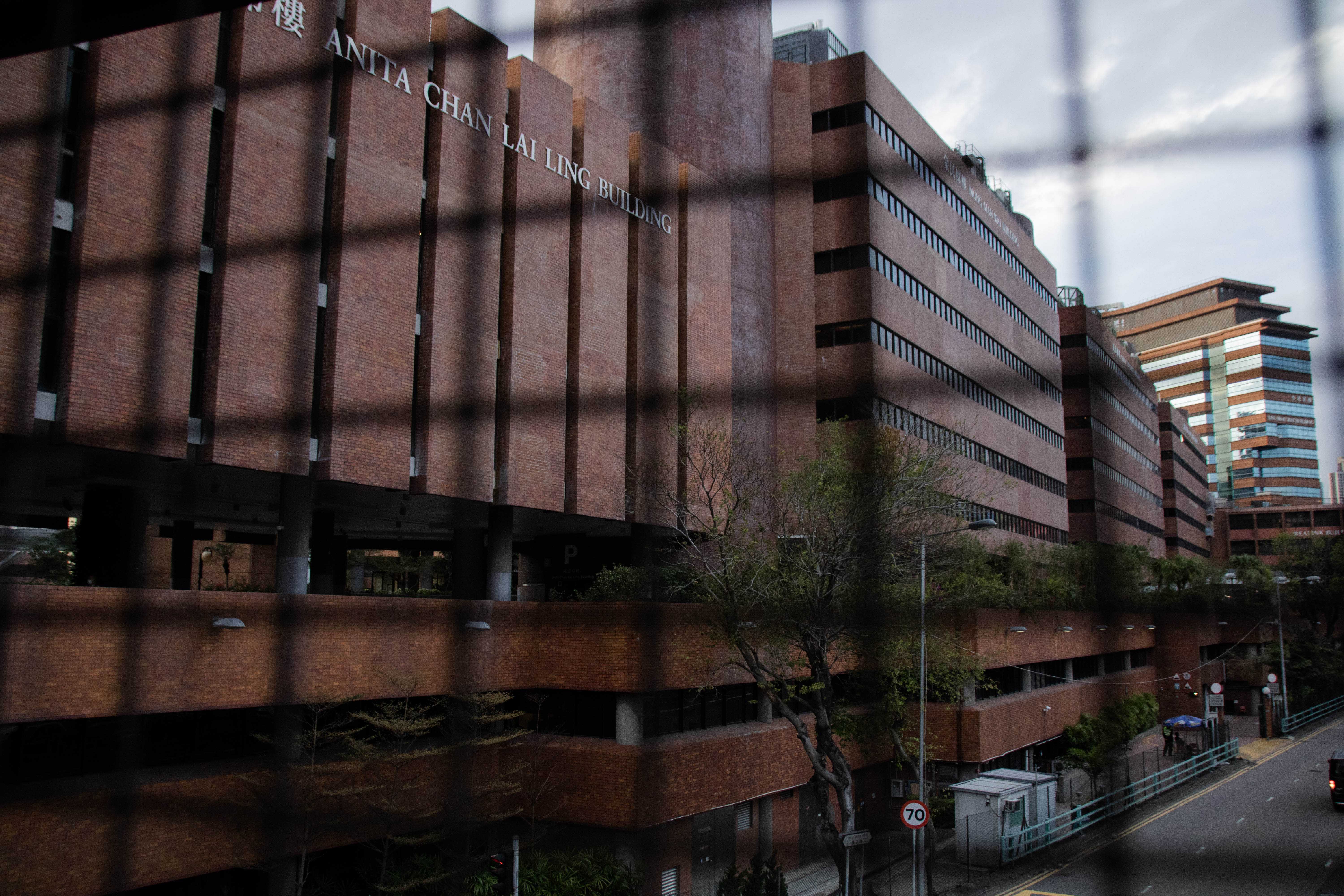
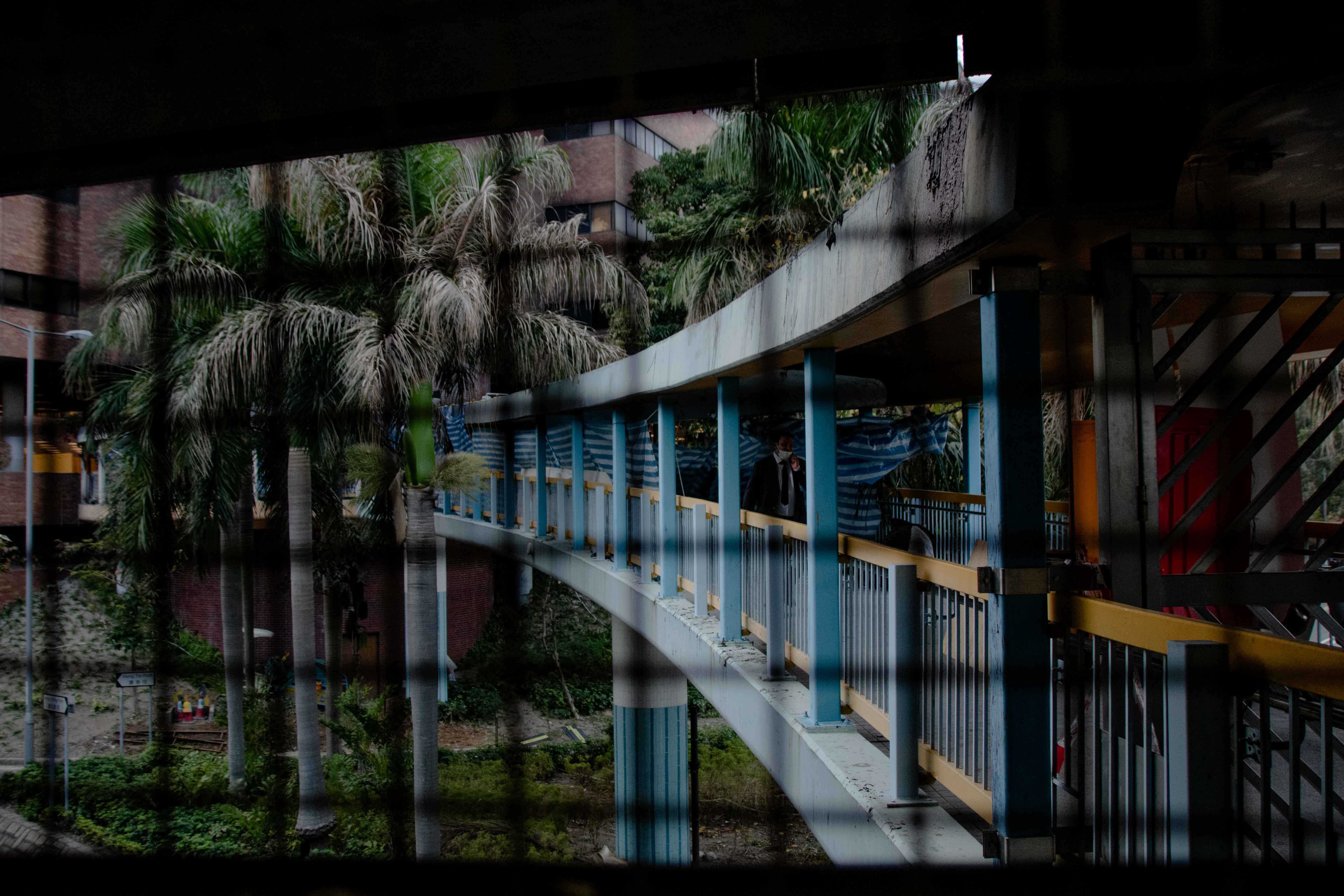
Metal fences cage the city amid anti-government protests.
By Reüs Lok
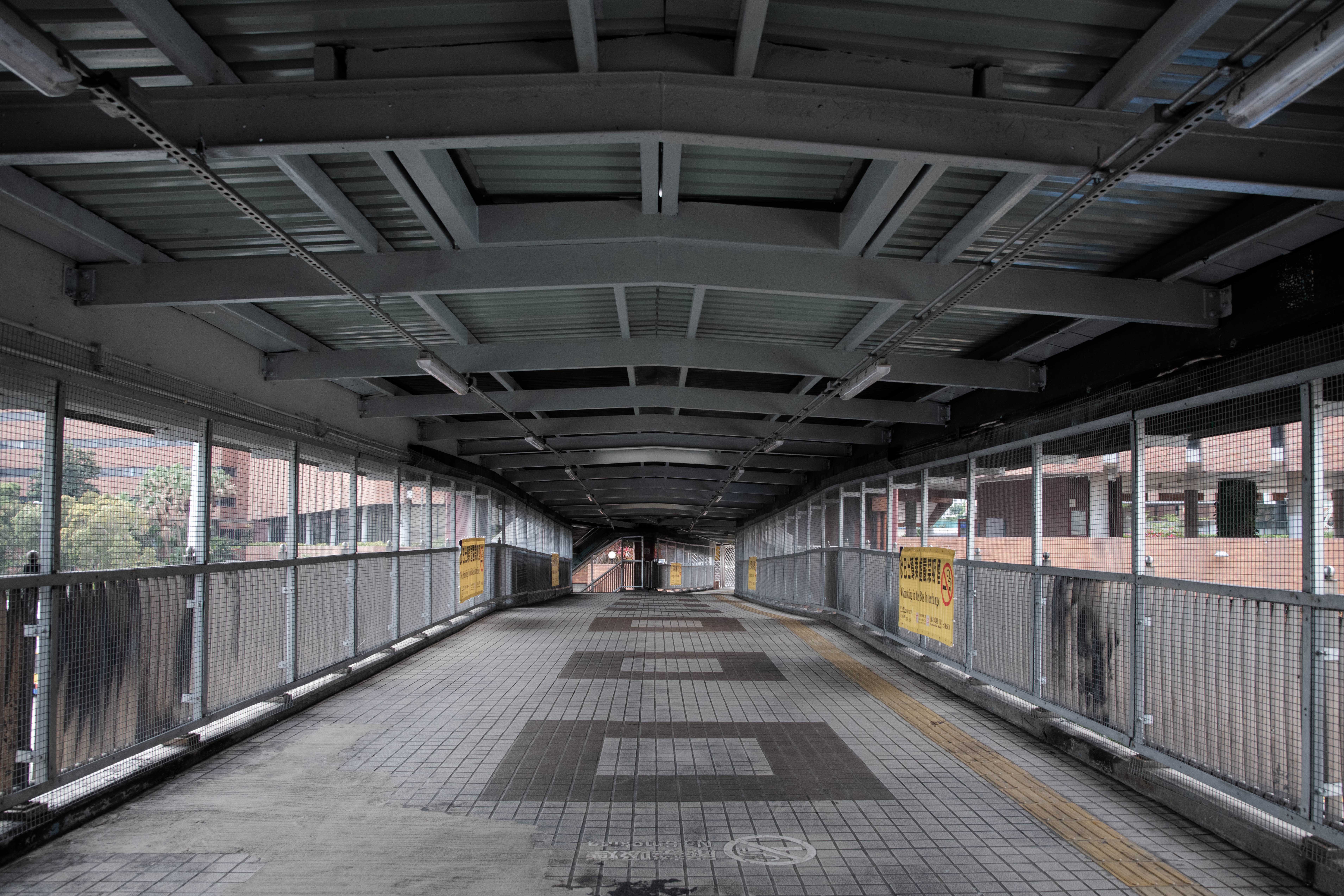

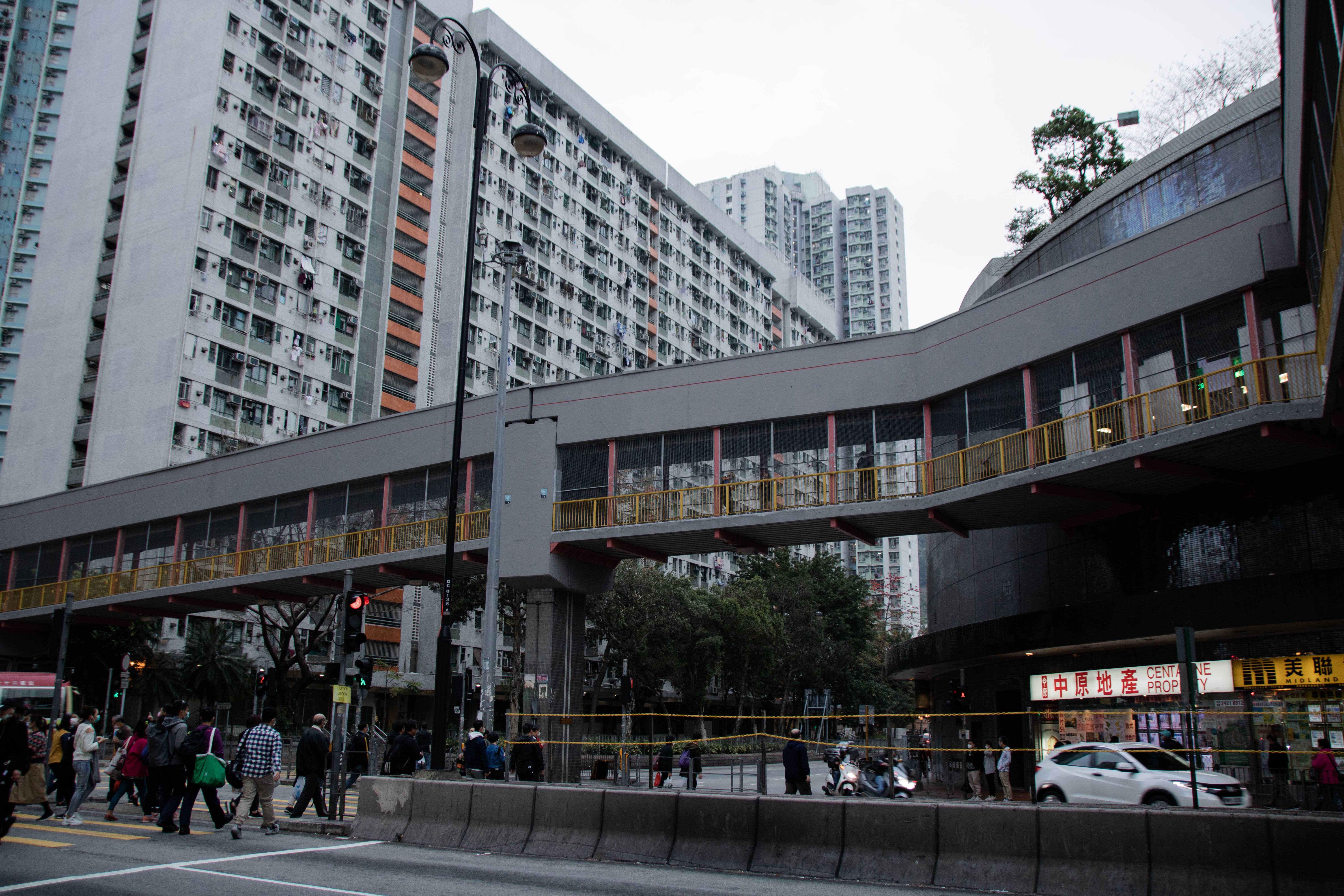
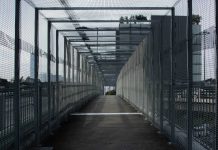
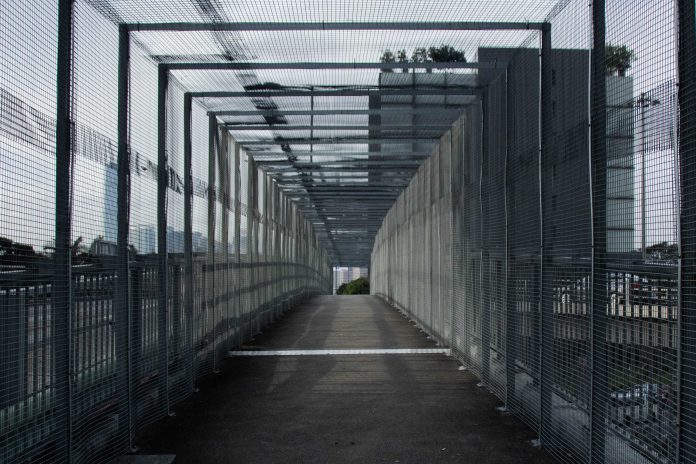

Iron nets have been installed in the footbridge connecting Hung Hom station and Hong Kong Polytechnic University, near the Cross Harbour-Tunnel.
Iron nets installed block the view of PolyU.
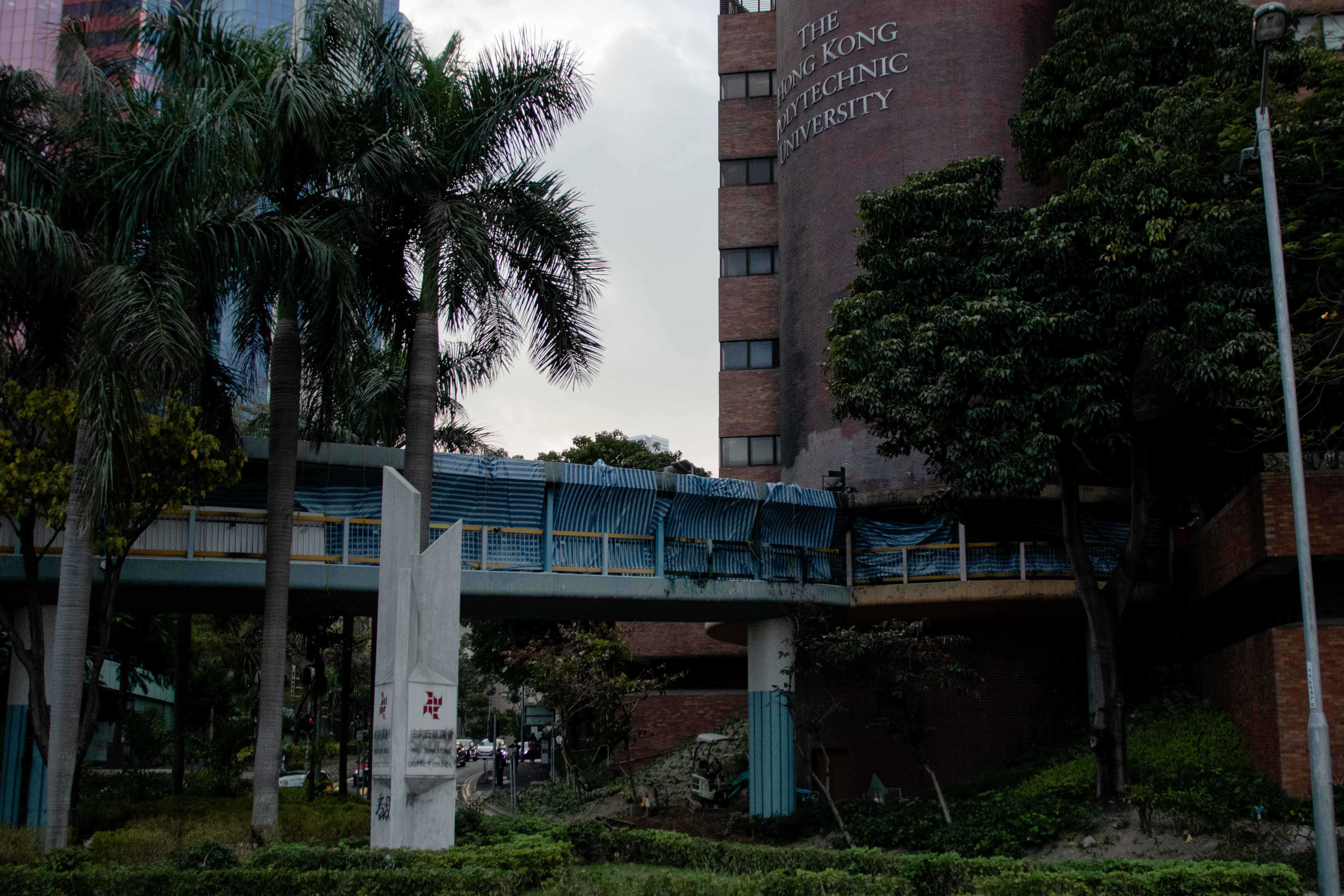
A footbridge inside PolyU campus has not been fenced but wrapped by plastic sheets.
Plastic sheets have also been used to cover some of the footbridges near PolyU.
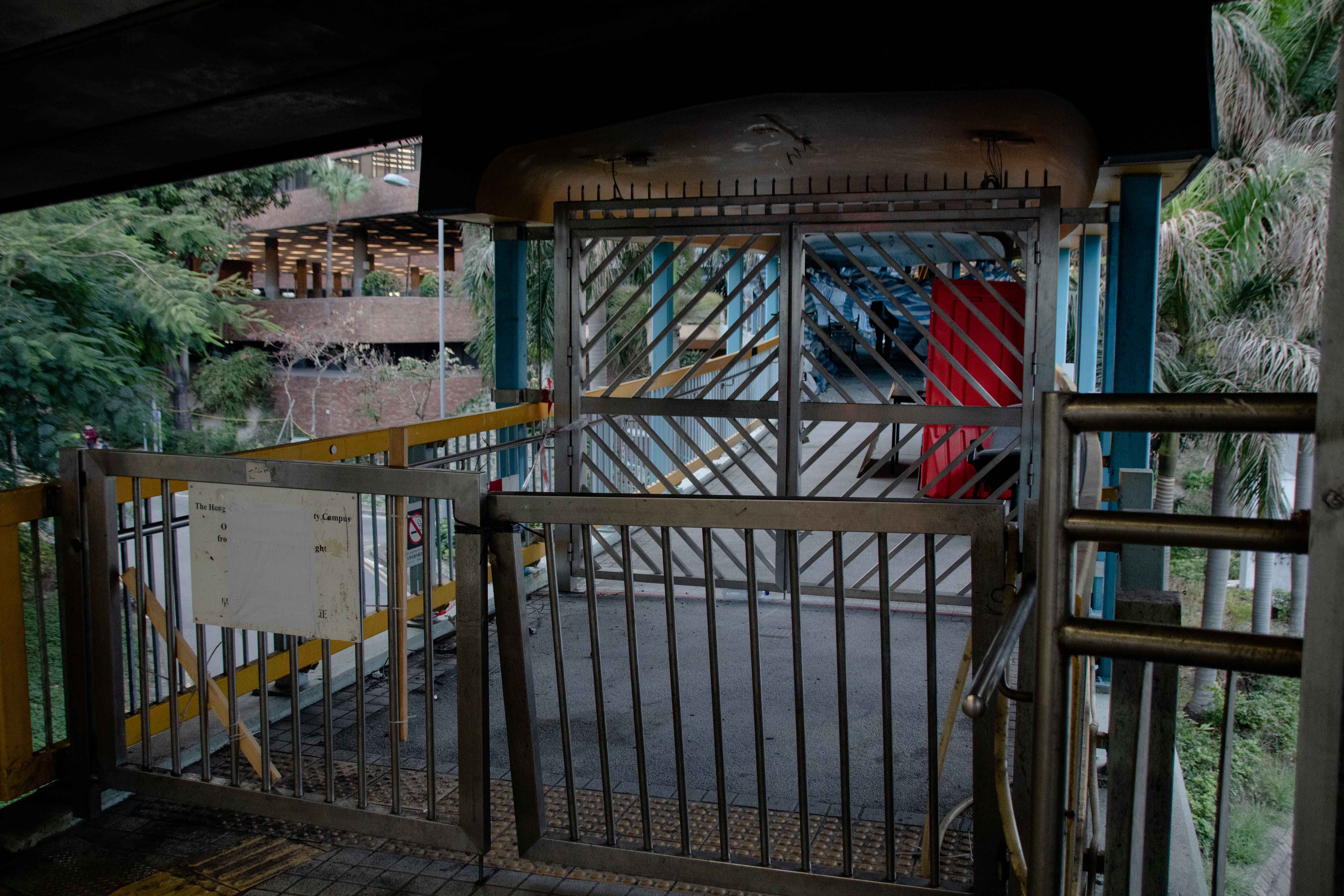
One of the entrances of PolyU remains closed.
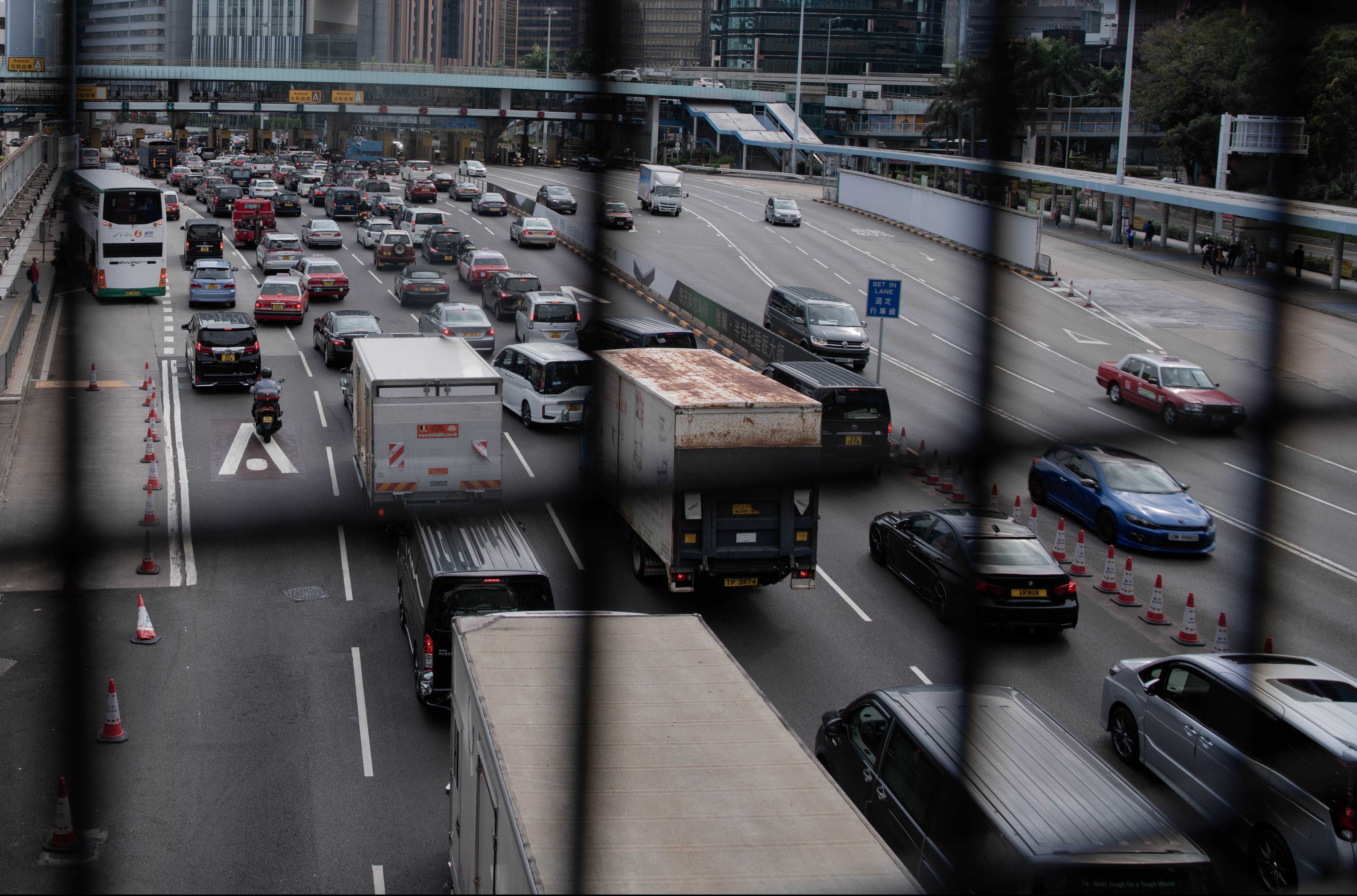
Traffic resumes as Cross-Harbour Tunnel reopened after two weeks of closure.
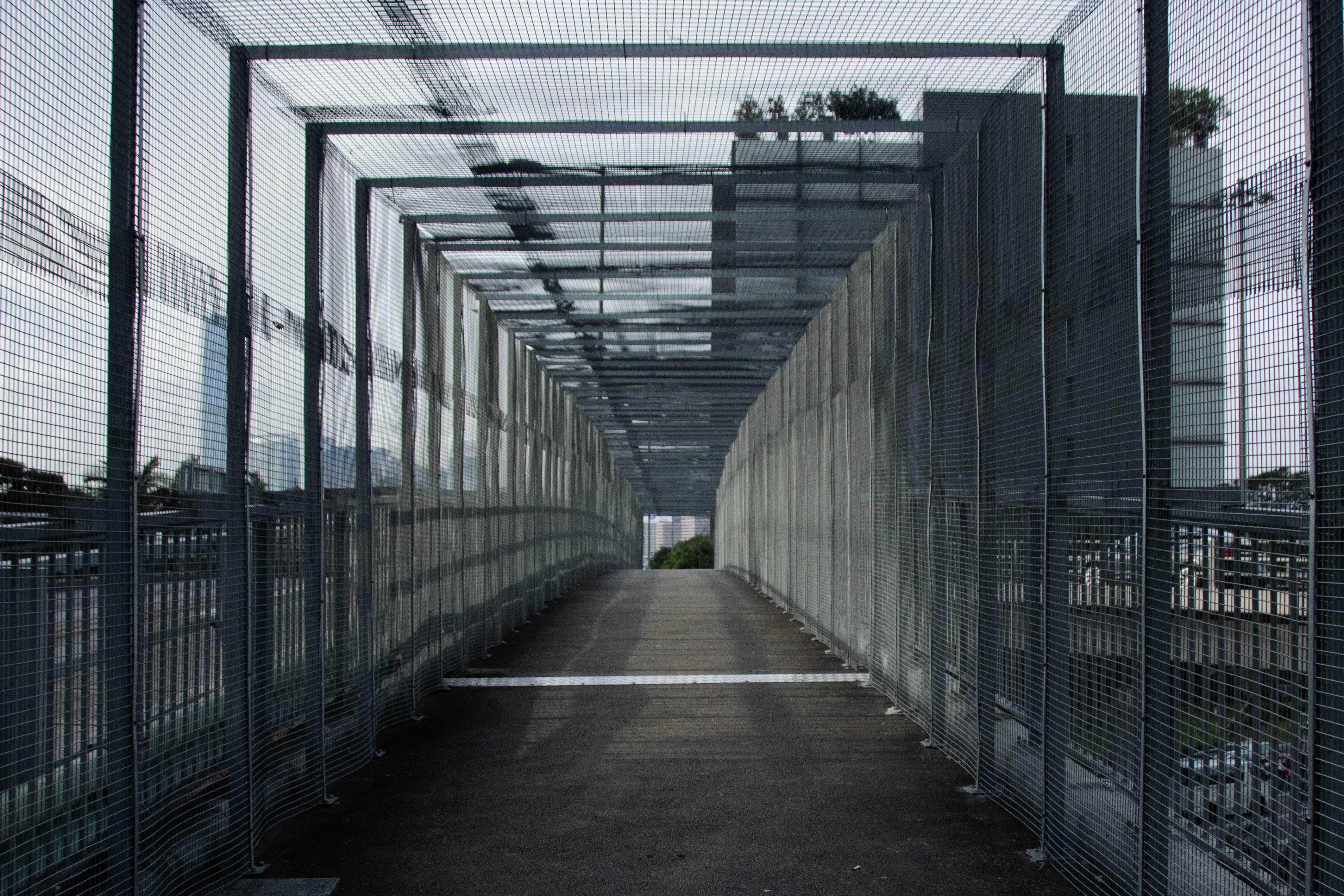
The footbridge connecting Hung Hom station and PolyU has been wrapped by iron nets, also looks like a cage.
Caged-like iron fences have been installed in a footbridge in Wan Chai.
Passersby are walking through the cage-like footbridge in Hung Hom.
A lock with the slogan “revolution of our times” has been attached to the iron nets.
Iron nets have also been installed in footbridges in Kwai Tsing district, where protests are rare.
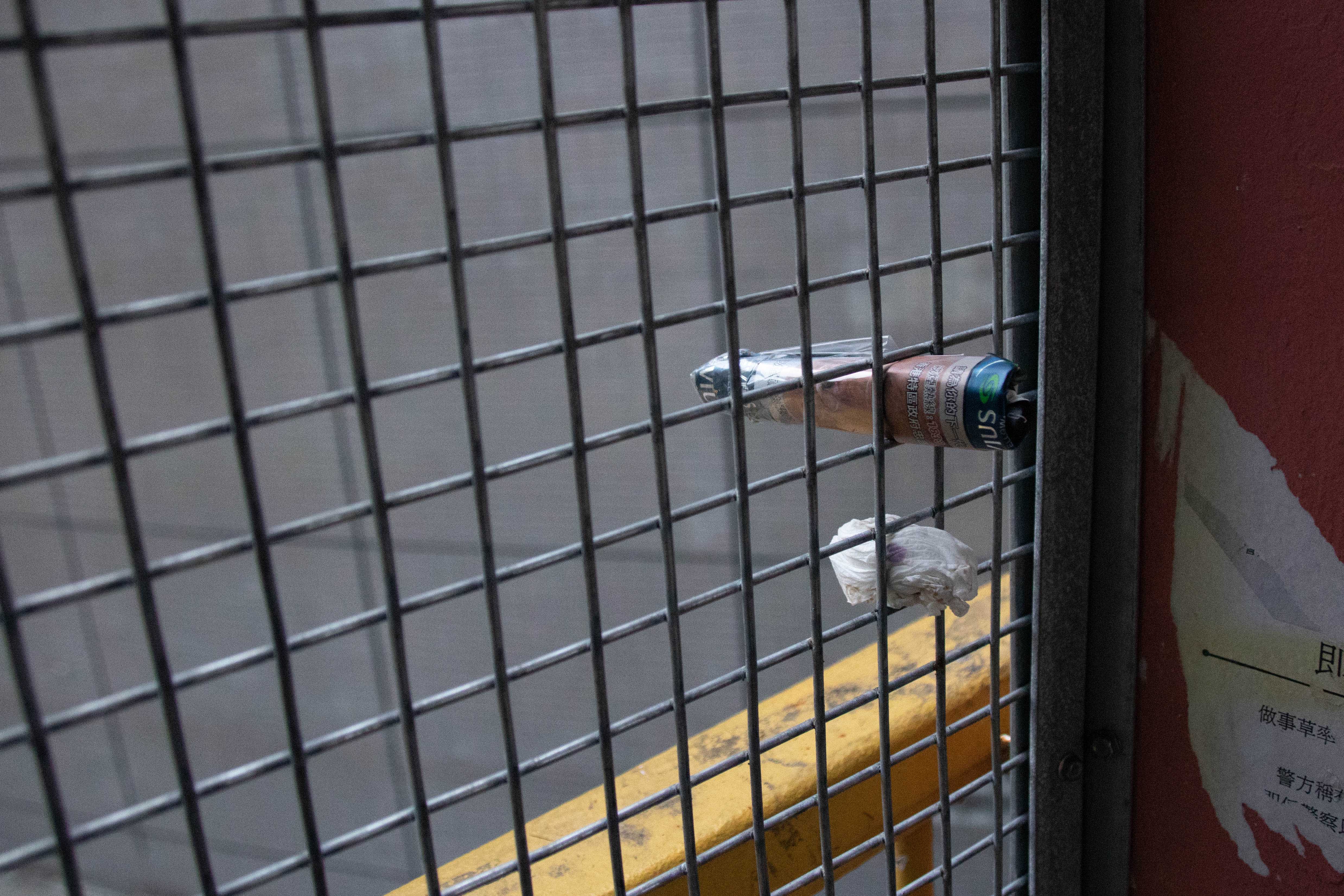
Used tissues and trash are tucked between the holes of the iron nets.
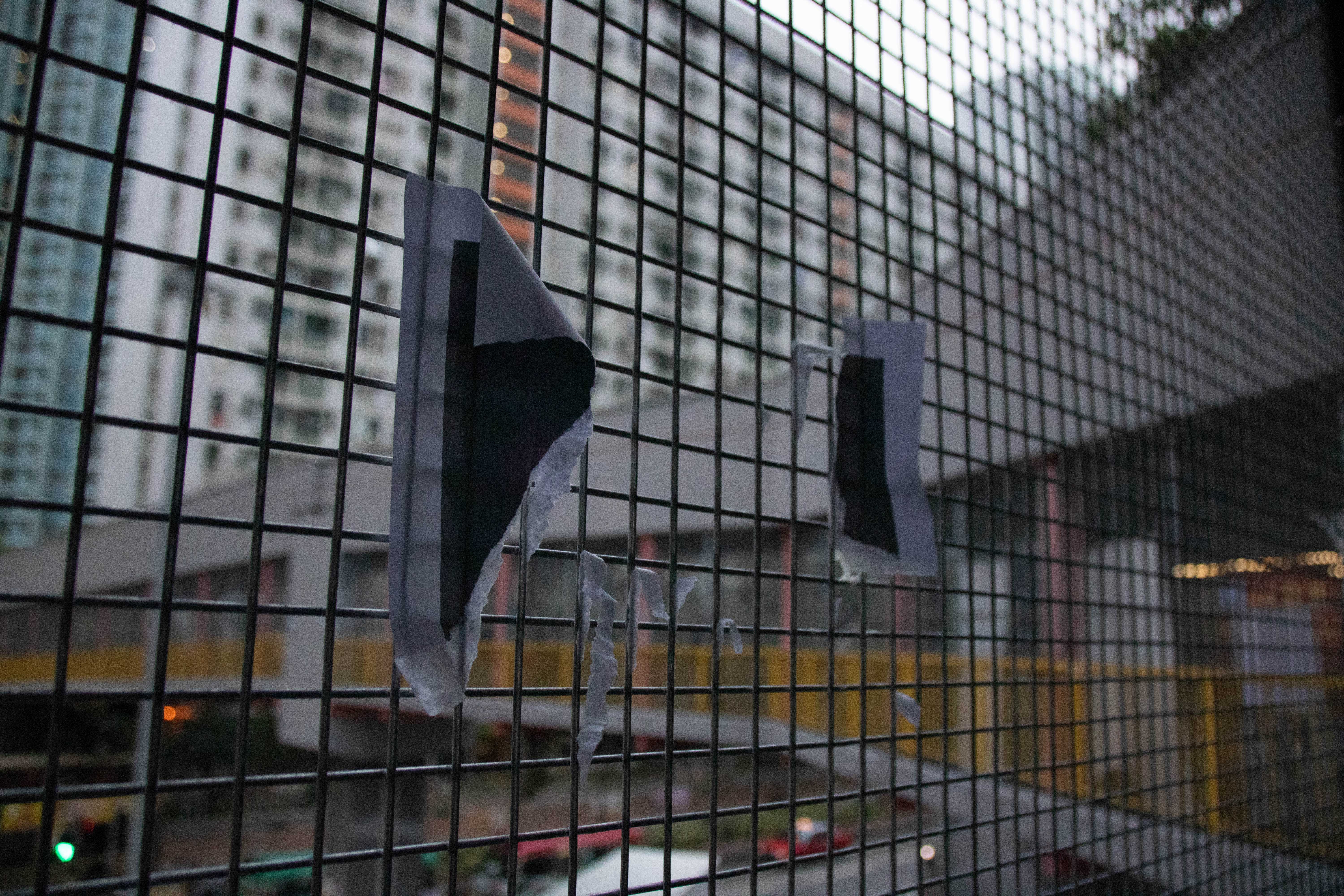
A poster stuck on the iron nets in Kwai Tsing is partly removed.
Iron nets have been installed on footbridges across
the city amid the anti-Extradition Law Amendment Bill (anti-ELAB) movement,
especially those above trunk roads or railways, in a bid to prevent protesters
throwing objects from heights onto nearby carriages.
Yau Tsim Mong District Councillor Leo Chu Tsz-lok objects
to the installation. Two pedestrian footbridges near Hong Kong Polytechnic
University (PolyU) have been fenced in his constituency, after violent clashes between
police and protesters in November last year.
Anti-ELAB protesters tried to block the Cross-Habour
Tunnel by throwing objects from footbridges above the Cross-Habour Tunnel Toll
Plaza and that connecting PolyU and Hung Hom station in the week of November
11, 2019 in an attempt to trigger a city-wide strike. Violent clashes broke out
between protesters and police officers at the PolyU campus. Police sealed off
all campus entrances and surrounded the campus till around the end of November.
The city’s vital tunnel reopened after two weeks of closure, on November 26,
2019.
Chu learnt about the installation on December 25, 2019
after being informed by nearby residents. He says the district council was not
consulted or informed about the installation and the Highway Department did not
reply to them when they asked for details of the arrangement.
“The installation did not solve the deep-rooted socio-political problem. It is only an ostrich policy,” says Chu. “Is it practical to fence all footbridges in Hong Kong?” He also questions if the fencing has breached the Fire Safety Ordinance and worries if it will threaten safety of footbridge users. Chu says residents nearby are very concerned.
“The installation did not solve the deep-rooted socio-political problem. It is only an ostrich policy.”
“Installing
iron nets is only a temporary solution. The root cause of the social problem
has nothing to do with the footbridges,” says Chung Shing, a PolyU student who
frequently uses the footbridge connecting the campus and Hung Hom station. “The
fencing also recalls memories of what happened at PolyU in November last year.
All memories come to my head when I walk across the bridge,” he adds.
Fenced footbridges can also be found in other
districts where protests are rare. Kwai Tsing District Councillors, Ng Kim-sing
and Tong Ho-man, discovered installation of iron nets in a pedestrian
footbridge connecting Ko Fong Street and Kwai Chung Plaza in January this year.
Similar to Yau Tsim Mong district, no official
consultations or announcements were made before the installation. Tong and Ng
wrote to the Highway Department concerning the issue. The department replies
that the installation is only a temporary measure to prevent throwing of objects
from the footbridges. The two councillors find the explanation unacceptable.
“No cases of objects being thrown from height on that footbridge have been
reported in the past year,” Tong says.
Tong says the fencing has caused many problems. Some
residents complained to him that the fences make them feel uncomfortable.
Walking across bridges wrapped by nets, residents have the feeling of being
trapped in a prison cage. “These nets also lead to poorer littering problem,”
he says.
“How can the problem be solved when the government
does not try to understand why people are still saying ‘Five demands, not one
less’?” says Ng. “Even if no one throws objects into carriageways anymore, does
it really mean the problem has been solved? I think we all understand that the
problem is still here.”
The Highway Department explains the installation of iron nets is to ensure safety of road users and maintain normal traffic on public roads by preventing the throwing of objects onto nearby carriages. It says the arrangement is only a temporary preventive measure given rise by the exceptional circumstances and the government will review the situation as and when necessary. However, no timetable of removal is given.
Apart from selling daily goods, HKongs provides job opportunities for protesters.
By Reüs Lok
With the ongoing anti-government protests, political stance of a shop or a restaurant becomes one of the major considerations when consumers shop. This gives birth to a new term – “yellow economic circle”. It means that consumers in favour of pro-democracy yellow camp and the anti-Extradition Law Amendment Bill (anti-ELAB) movement only spend money on shops and restaurants that openly support the same political ideal.
HKongs (光時),
an online grocery store, is a member of the yellow economic circle. The online
shopping platform was launched after the anti-ELAB movement broke out, aiming
to provide job opportunities to protesters, especially those who have been
arrested or charged.
“We want to provide a job or a stepping stone for those who have been arrested or have become unemployed due to political reasons,” says Sam, a volunteer from HKongs who declines to reveal her full name. “Hiring those who actively participated in the movement is our top priority,” she adds. HKongs now employs 26 protesters or Sau Zuk (手足), a terminology used by protesters referring to each other.
“We want to provide a job or a stepping stone for those who have been arrested or have become unemployed due to political reasons.”
HKongs is very different from other companies. Their
team consists of both volunteers and paid employees. All volunteers are recruited
through LIHKG, an online forum, and they all have their own full-time job.
Volunteers have no salary and need to balance between their full-time job and
work at HKongs. There are around 15 volunteers working as company managers and
trainers for the online store now.
Hkongs had a tough start when volunteers set up the
company. Suppliers refused to provide warehouse support at first. But after
building their reputation as a business that helps arrested protesters,
suppliers who share their political view actively reach out to them and offer
them support.
HKongs is also cooperating with other shops in the
yellow economic circle, trying to look for possible ways to share resources and
logistics networks. “I’m confident about the development of the yellow
economy,” says Sam. She thinks the number of “yellow stores” is increasing, and
that helps further develop internal support and communication within the yellow
economic circle.
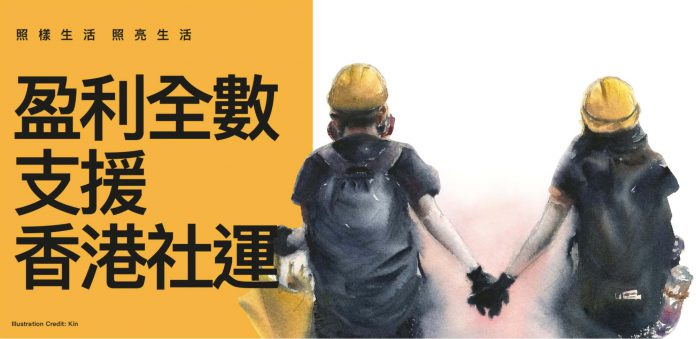
If you want to know more about HKongs and support them, you may make purchases on their website or visit their Facebook page for more details.
A generation of young political activists was born in the Umbrella Movement in 2014. The 79-day movement made Hong Kong people feel the urge for a revamp in the political system in Hong Kong. The city is under the international limelight again after five years. The unprecedented anti-extradition bill movement has taken the globe by storm and even won support from foreign governments.
The movement has a long-lasting impact on Hong Kongers, especially young people who have active participation in the fire line. It has affected their mental health, academic studies and family relationship. Thousands of protestors have been arrested and some are facing criminal charges. Some young activists even fled to Taiwan for political asylum. Our periscope section sheds light on how volunteers in Taiwan, South Korea and Hong Kong offer support to young protestors.
The Mainland Affairs Council of Taiwan joins hands with other non-governmental organizations to offer assistance to Hong Kong young protestors who fled to the island. Temporary residency and mental care are available for them. Scenes of police firing tear gas and water cannon at protestors in Hong Kong bring a strong sense of déjà vu to Koreans. What happened in Hong Kong bears much resemblance to the 1980 Gwangju Uprising. Varsity talks to Korean students and witnesses of Gwangju Uprising to learn their views about the social unrests in Hong Kong and how they show support to the democratic movement in the city.
In Hong Kong, a church provides temporary accommodation to young protestors who are expelled by their parents due to different political views, while other volunteers offer private tutorial service and job opportunities to them. Varsity interviews university students who provide free online tutorials to secondary school students who had active participation in the social movement. Volunteers from an online grocery store, which aims to hire activists, share with us how they create a platform for boosting the “yellow economy”.
This issue of Varsity also features how people from all walks of life ushered in a revolutionary change in Hong Kong. The social unrests affect dating relationship, district council elections and domestic helpers’ job opportunities in Hong Kong.
You will also find stories about pet adoption, pursuing quality lifestyle and cultural significance of neon signs in Hong Kong. Flipping through the profile of three professionals with an unusual occupation and the photo of Freedom Trail in Boston definitely bring you some inspirations to life. We hope you enjoy the read!
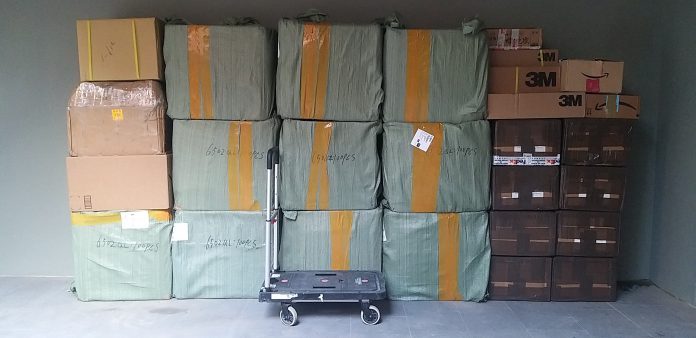
Supplies are gathered and transported from Taiwan to Hong Kong.
By Linn Wu, Mandy Yim
The Risky Way Out of Nothing
“I was accused of illegal assembly, so I had to obey bail conditions: curfew, regularly report to the police station, not to leave Hong Kong…,” says Andy, a 22-year-old Hongkonger, who declines to disclose his full name. He was arrested on August 11, 2019, the day when a female protester was shot in the right eye. The woman, who may be blind in one eye, became a figurehead of the faceless and leaderless anti-extradition bill movement in Hong Kong.
According to a government press release, as of Mar 2, 2020, among 7,549 people that were arrested during the movement, 3,091 were students. Most arrested protesters are facing charges of unlawful assembly, rioting and possession of offensive weapons.
Unlike the majority of protesters, Andy, due to his unique identity – a student of National Taiwan University of Art who was admitted in 2017, successfully applied for a change of bail conditions to stay in Taiwan after submission of supportive documents such as flight tickets, his student identity card and proof of dormitory residence. Andy adds, “I could freely enter Taiwan, but those without the identity as a student studying in Taiwan are in a very different situation. They fled to Taiwan confidentially.”
There is a trade-off for seeking asylum in Taiwan. Protesters choose to sacrifice Hong Kong residency to avoid political trials but there is no guarantee that they are safe once they embark on the journey. “If you enter Taiwan illegally, it is possible for the Taiwanese government to handle it through lawful means, rather than regard it as a special case. If an arrest warrant is issued, you are a wanted person. Don’t even think about returning to Hong Kong,” Andy explains.
Bookseller of Causeway Bay Books Lam Wing-kee fled to Taiwan in April 2019, fearing that he could be extradited to mainland China under the proposed government bill which is now withdrawn. Activist Lee Sin-yi fled to Taiwan in January 2017 ahead of the Mong Kok riot trial, leaving aside court hearings and an arrest warrant in Hong Kong. Both Lam and Lee had flown to Taiwan with a travel visa.
“To arrested protesters, at present time, if you arrive in Taiwan, you see heaven. If not, you see a dead alley,” Andy says.
Assistance After the Boat Journey
Alvin Chang speaking at a demonstration in Taiwan on August 4, 2019 (photo courtesy)
Alvin Chang, spokesman for Taiwan Youth Association for Democracy, says, “Actually, the Mainland Affairs Council of Taiwan has offered daily support to Hong Kong protesters who flee to Taiwan. Yet, the council is not revealing details in public to minimize the risks of exposing these people.” He adds that NGOs and some other supporting units in Taiwan have privately contacted the council.
NGOs in Taiwan work closely with one another to exchange information and organize democratic activities to help Hong Kong protesters in Taiwan. In a bid to show their support, National Students’ Union of Taiwan, Hong Kong Outlanders, Taiwan Youth Association for Democracy and Taiwan Citizen Front organised “929 Taiwan Hong Kong Grand Parade – Support Hong Kong, Fight Against Totalitarianism” with more than 100,000 participants.
Apart from holding protests, NGOs have continuously pressured the Taiwanese government through petitions, posts on Lennon Walls and social media platforms such as Telegram, LINE, Facebook and Instagram. “Our protests give Hong Kong protesters mental and emotional support, and that is the assistance that they need the most after arriving here,” Chang says.
Lennon Wall posts in support of the protests in Hong Kong can be seen on university campuses.
He adds that since the council, as a governmental institution, can provide neither material nor promotional assistance, NGOs can fill the service gap.
The Ministry of Education and educational institutions in Taiwan also introduce measures to ensure that student protesters’ learning is not disrupted amid the movement. During class suspension in Hong Kong in November and December 2019, universities in Taiwan allowed Hong Kong university students, regardless of nationality, to audit classes in Taiwan. A few even opened up application for students to transfer to their universities.
At universities in Taiwan, two kinds of special programmes, targeting students from Hong Kong universities, regardless of nationality, are launched. One is the visiting student programme, which allows students to start auditing courses instantly without credits offered. Another programme is for school transfer or higher education. Students can apply directly through the Ministry of Education.
According to National Taiwan University (NTU), which accepts most visiting students, almost 500 students have applied for the Special Visiting Student Programme, which started last December, including 200 Hongkongers and others from 16 different countries.
Community with A Shared Future
To Taiwan’s NGOs, supporting Hong Kong is not the primary intention of establishment. “In the past, very few Taiwanese people were concerned about Hong Kong. Not until news reports of the massive pro-democracy demonstration on June 12 did they realize the political threat is actually very close to them,” Chang recalls. As demonstrations against the proposed extradition bill morphed to deep-rooted political legitimacy and police accountability, he witnesses Taiwanese people’s growing awareness of “Today’s Hong Kong, Tomorrow’s Taiwan”.
“We have a common enemy,” Chang says.
Tens of thousands of people participated in the demonstration in Taiwan on June 16, 2019. They held signs saying “Taiwan backs Hong Kong.”
“Hong Kong and Taiwan are on the same boat. It is not Taiwan backing Hong Kong but Hong Kong shielding Taiwan,” says Josh, a fourth-year Taiwanese university student who declines to reveal his full name. He volunteers to work at Chè-lâm Presbyterian Church in Taiwan, where material supplies from different parts of Taiwan are sent to, collected, and delivered to protesters in Hong Kong.
Helpers at the church have been calling for support for the movement on the internet, providing shelters to protesters seeking refuge in Taiwan and delivering various supplies to frontline protesters in Hong Kong, including protective gears, external medicines such as normal saline, respirators and anti-tear gas cartridges. “Only supporting or sharing articles online is far from enough now,” Josh says.
Like many other Taiwanese, Josh considers the fate of Hong Kong and that of Taiwan are closely related. “Hong Kong and Taiwan have the same oppressing neighbour [China], who keeps using politics to override rule of law and freedom, and still wants to persuade and deceive others… I loathe it,” he says.
A post-it note on supplies saying “Take care tonight, Hongkongers”
As the movement continues for over half a year, more and more Hongkongers flee to Taiwan in fear of political persecution. Josh worries some of them will not seek help and if the assistance can really cater to their needs. “Real challenges start after they safely flee to Taiwan. Problems in seeking jobs, going to school or security follow,” he says.
A Sustainable System
Josh thinksTaiwan lacks a comprehensive system for political sanctuary. Most of the support Hongkongers receive comes from NGOs, which have limited sources and are highly dependent on public support. “I hope the government can introduce measures to help Hongkongers, or else we can only help case by case, which I don’t think is enough,” he says.
Infinite Effort, Finite Effects
Goobear Chen (photo courtesy)
Goobear Chen, Chairman of National Students’ Union of Taiwan, says, “The fundamental mission of Taiwan NGOs is to put pressure on the government to amend the refugee law.” He thinks that since information flow is limited and operations have to be under the table, it is difficult for any organization to provide assistance. In the long run, Taiwan NGOs will not be able to provide financial assistance to Hongkongers. Therefore, lawfully accepting fugitives would be the most effective measure.
Concerning the amendment of refugee law, Chen believes there is a certain degree of consensus among Taiwanese. He does not think it is a difficult problem. “But I am quite pessimistic about Hong Kong’s future after the movement. The whole issue is hard to cope with.”
The Open Secret
“It is neither the Taiwanese government’s nor Taiwan NGOs’ responsibility to help us,” Andy says while acknowledging the help he gets from Taiwanese civic society.
“Fleeing to Taiwan has become a hot topic in Hong Kong, arousing concern of both governments,” Andy says. He believes increasing media exposure of NGOs like Chè-lâm Presbyterian Church and district councillors like Daniel Wong Kwok-tung (The ‘Protective Umbrella’ Project) may have alerted the governments. He foresees that there will be more frequent government interferences to stop such concerted effort made by NGOs in Hong Kong and Taiwan.
“At this moment, Taiwan is already an extremely hard choice for fleeing,” Andy says with a frustrated tone.
The ‘Protective Umbrella’ Project, initiated by Daniel Wong Kwok-tung, Kowloon City District Councillor, aims at raising funds for Hong Kong people who fled to Taiwan and want to set up small businesses such as restaurants and second-hand boutiques in Taiwan to earn their own livings. He also helps protesters to apply for working visas.
A Little Faith, a Big Controversy
Under the current policy, Taiwan government refers to Article 18 of the Laws and Regulations Regarding Hong Kong and Macau Affairs when dealing with Hong Kong people seeking asylum in Taiwan. It states: “Necessary assistance shall be provided to Hong Kong or Macau residents whose safety and liberty are immediately threatened for political reasons.” So far, no resident from Hong Kong or Macau has received lawful assistance from the Taiwan government under the act.
“At this stage, the act has already provided solid legal foundation,” Tsai Ing-wen, Taiwan’s current President, stated on December 4 2019. “Revising the refugee law is unnecessary.”
South Koreans show support to Hong Kong as they recall their own memory of struggles
By Eve Lee & Fiona Cheung
Two hundred people in black marched from Seoul City Hall to the Embassy of the People’s Republic of China in late November in support of the Hong Kong anti-Extradition Law Amendment Bill (anti- ELAB) Movement. They chanted slogans and held banners in Korean, English, and Chinese that read “We support Hong Kong Resistance”.
Han Ka-eun, a 23-year-old student from Ewha Womans University and a member of Workers’ Solidarity, was one of the protestors in the rally.
“We distributed leaflets to explain Hong Kongers’
five demands to Koreans and tourists in the streets,” Han says.
“Korea has a history of student movements, so it is natural for Korean students to sympathize with Hong Kong students and fight for their human rights,” says Han. “I stand with Hong Kong because their demands are fundamental human rights. And we believe the five demands are right,” she adds.
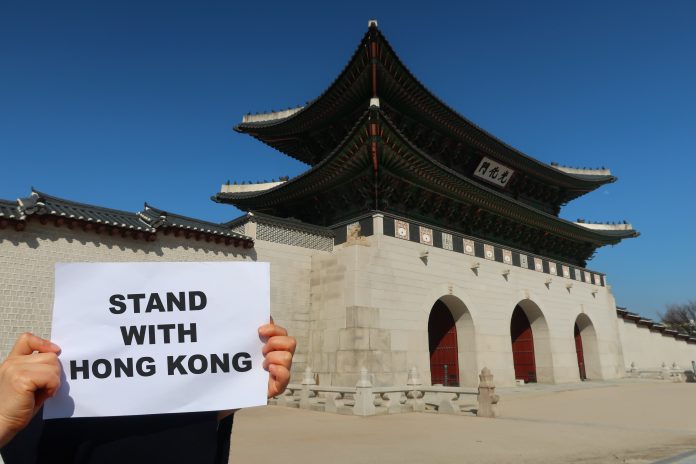
Two South Korean students with the banner “STAND WITH HK” at Yonsei University Photo courtesy: Jun Sangjin
Hong Kong protests have taken the globe by storm for their fight for freedom and democracy. The controversial amendment to the Fugitive Offenders Ordinance proposed by the Hong Kong Government in February in 2019 sparked a public backlash. Hundreds of protestors flock to different districts in Hong Kong as the anti-ELAB Movement continued with the five key demands – withdrawal of the bill, the investigation into police brutality and misconduct, retracting the classification of protesters as “rioters”, amnesty for arrested protestors, and dual universal suffrage.
Reminiscence of South Korea’s Gwangju Uprising
South Korea has its own bloody history of democratic movements in the past few decades after the Korean War in the ’60s. Kim Hyun-sook, a 57-year-old docent of the Asia Culture Center in Gwangju, shares her memories of the Gwangju Uprising in 1980 that she witnessed as a high school student.
Kim says she was on the train with her friends
on May 18, 1980. “Through a window, I saw a young man with a soldier. He was
bleeding, and he kneeled down next to a soldier,” Kim recalls. “But he didn’t
seem afraid. He looked firm and strong,” she adds.
“A group of beaten demonstrators was lying on the ground and the soldiers were stepping on their back on May 19,” Kim says. “On May 21, my mom said a commerce centre was full of corpses in coffins,” Kim continues, “And the centre was overwhelmed with a smell of dead bodies and sickening odor.”
“It saddens me to see citizens of Hong Kong
getting hurt like what happened in Gwangju,” Kim sighs.
Lim Ju-wha, representative of Gwangju Welfare
Human Rights Research Institute and Amnesty International Korea 60group, says the
recent social unrest in Hong Kong is similar to the Gwangju uprising in the
aspect that it is a violent physical confrontation between the authorities in
power and the citizens.
“In both Gwangju uprising and the anti-extradition bill movement, there is the suppression of democracy. Freedom of speech is violated and police officers do not face investigation for their brutality against protesters in Hong Kong,” says Lim.
Lim observes how history repeats. “National
violence brings posttraumatic stress disorder (PTSD) to all past, present and
future generations,” says Lim. “The South Korean government is helping those
who are still suffering from the trauma of the Gwangju Uprising,” she adds.
“To help prevent the repeat of Gwangju history, some South Korean students have stood up to fight with Hong Kong,” Lim says, “And this is also why people in Gwangju support Hong Kong as well.”
South Korea’s struggle to democracy — Gwangju Uprising Chun Doo-hwan, a former South Korean Army general, began his authoritarian rule with a military coup on December 12, 1979, after the assassination of the former president, Park Chung-hee.
The military junta then decided to resume martial law, which was imposed previously by other dictatorial leaders, in early 1980. University students began to protest, demanding immediate democratization and calling for an end to martial law.
In response to the protests, on May 17, 1980, the government extended martial law to the whole country and arrested opposition figures, dissolved the National Assembly, closed all universities nationwide and banned all protests.
In defiance of suppression, a massive protest, the Gwangju Uprising, ensued in the city of Gwangju. Intense clashes between university students and the military government took place outside the front gate of Chonnam National University in Gwangju from May 18 to 27, 1980. The movement grew with the participation of civilians and won against the army on May 21, 1980. But the retreated army attacked the city again in the early morning of May 27, 1980, ending the uprising in a pool of blood. Hundreds were killed and injured.
The uprising failed to achieve what it had hoped for but remembered as one of the most significant events in South Korean history of the democratic movement.
Lennon Walls on campus
Lennon Wall in front of Yonsei University Central Library
Apart from joining
rallies, some South Koreans supporting Hong Kong’s democracy movement have also
set up Lennon walls, mostly on campus, to encourage Hong Kong students studying
in South Korea.
A student organisation from Yonsei University collected encouraging messages and posted them on Lennon Wall from November 20 to early December in support of the Hong Kong protests.
“We received a letter of support for Hong Kong protest from Bae Eun-sim, mother of Lee Han-yeol. Lee died after the June Democracy Movement of 1987,” members of the organisation say. “We posted the letter on campus and recited it during the assembly on December 8 to bring more support.”
“The saddest thing is that the students get hurt and die during their fight. I hope no one gets hurt anymore […] I sincerely hope for the victory in Hong Kong”
Bae Eun-sim, mother of Lee Han-yeol
Lennon Walls in South Korean universities Lennon Wall originated from Prague represents resistance against the communist government. The first Lennon Wall in Hong Kong was set up outside the Central Government Complex during the 2014 Umbrella Movement. The mosaic walls of post tips sprout throughout the small city with the escalation of the anti-ELAB Movement in 2019.
South Korean students who support the movement have also set up Lennon Walls across different university campuses in Korea. Some notes and banners were, however, damaged — especially those printed with “Liberate Hong Kong, Revolution of our time” in Chinese, a slogan commonly used in the movement. Conflicts between individuals and activists occurred.
“Maybe it’s because there is no such thing in Mainland China, so some Chinese students don’t know they shouldn’t do that,” explains Kiki, a 20-year-old student studying management at Korea University who refuses to disclose her full name.
Despite strong resistance from Chinese students, a group of ordinary Korean citizens created a Facebook page, “Hong Kong Protest Lennon Wall in South Korea”, as a safer platform to express opinions and support the movement.
The Facebook page administrator, who hopes to stay anonymous, says the page also aims to arouse public attention of the issue with the use of the social media platform.
“It is a direct threat to our freedom of speech,” the administrator says. He describes the vandalism act as “disrespectful” and “unacceptable”.
While condemning vicious attacks of the physical Lennon Walls, the administrator stresses that they are not against any nationality and believes no discriminatory comments should be posted.
Plights for giving assistance to Hong Kongers did not occur only from individuals but also from authorities.
Hankuk University of Foreign Studies issued a notice to forbid students from posting “political” posters to maintain orders on campus in November. Several other universities implemented similar measures.
In the incidents of authorities removing Lennon Walls on university campuses, speculations about pressure from China were aroused. “Along with the case above, many speculated that part of the problem, if not the only, was because of their dependence on the Chinese students’ tuition fees,” the administrator from the online Lennon Wall says.
Students immediately responded to the measure and regarded it as further diminishing South Korea’s freedom of speech.
These students involved felt they were not only fighting for democracy in Hong Kong but also defending their own freedom to speak.
The administrator says, “Some South Koreans know how challenging it is to make democracy live up to its name. Hence, they are able to better relate to conflicts in Hong Kong.”
An internal Chinese affair?
“It is a big encouragement to us,” says Joey
Siu, external vice-president of City University of Hong Kong Students’
Union.
Siu believes the current situation in Hong
Kong is an international issue– it influences the interest of stakeholders
around the globe and the relationship between different countries.
“Their support also reflects their opinion to
their own government,” says Siu. “Apart from supporting the Hong Kong protesters,
it puts pressure on their government to respond to the Hong Kong issues and
stand up against China’s human rights violations,” Siu explains.
A group of people gathered at Korea University in support of the Hong Kong protests Photo courtesy: Kiki
There, however, are others who think otherwise. Kiki, a student studying management at Korea University who asks for anonymity, believes that Korean students should not interfere with Hong Kong affairs.
“I think what’s happening in Hong Kong is an
internal affair of mainland China,” she emphasizes, “there should not be
foreign interference.”
“We have the right to talk”
“People should be able
to talk about political issues freely,” an administrator of an online
organisation, Hong Kong Protest Lennon Wall in South Korea, says.
The administrator, who
declines to reveal his full name, believes “We have the right to talk about
politics of any country and it is not an act of challenging their
sovereignties.”
A banner by the members of Yonsei University Students who support the Hong Kong Democratic Resistance
“Hong Kong problem is
not just a ‘China’ problem; it’s of all humans, and of us” states the
introduction from the Facebook page of the online organisation. The
administrator and members of the platform consider themselves the same as Hong
Kong people who are experiencing a political and humanitarian crisis.
“We hope to bring
change for democracy,” members of the Yonsei University Students who support
the Hong Kong Democratic Resistance say, “Democracy, in which normal citizens
can make their own decisions in their daily encounters. That is what we want.”
The student concern
group explains their plan for the coming semester in March.
“We will try to enhance our solidarity with the Hong Kong civic organizations to acquire more information about the movement,” members of the organisation say, “If there is obscure information, we will debate internally and externally to dig out the truth.”
Koreans want more media coverage on Hong Kong In South Korea, news outlets covered the anti-extradition bill movement in their headlines when violent clashes occurred across university campuses in last November. Reporters deployed to Hong Kong were equipped with bulletproof waistcoats.
Kim Jimin, a third-year university student studying Spanish at Kyung Hee University, thinks South Korean media updates news about the social unrest constantly but not in a thorough manner.
“It is dubious. Some people think the South Korean media is being censored by pressure from pro-China groups,” says Kim. “I think many Koreans are aware of the recent incidents in Hong Kong but not the important details of what Hong Kongers are actually fighting for,” she adds.
Members of Yonsei University Students who support the Hong Kong Democratic Resistance agree with what Kim says about South Korea’s biased media coverage.
“We ask Korean media to provide the public with in-depth reports that explain the root causes of the Hong Kong protest and its significance,” they say, “we would like to know the change in the social climate of Hong Kong after the 2019 Hong Kong local elections.”
Table of incidents around Lennon Walls in Korea
Where?
What happened?
Yonsei University
The Hong Kong protest supporting banners on campus were damaged and torn by unknown individuals in late October and early November.
Hankuk University of Foreign Studies
Korean students supporting Hong Kong protests said to suffer from cyberbullying by the Chinese students for their advocacy
Chonnam National University
Banners and Lennon Walls were damaged by individuals.
Hanyang University
The school transferred and archived all the notes on Lennon Wall as confrontations between Korean and Chinese students continued
Seoul National University
A student organization on 19 November filed a case against those who damaged the Lennon Wall
Korea University
A series of cases were reported about damage and preservation of Lennon walls. Korean student activists were reported to be harassed by some Chinese students for supporting Hong Kong protest.
Myongji University
A fight broke out between Chinese and Korean students after the Chinese students tried to damage posters on Lennon Wall on 19 November 2019
Volunteers help anti-Extradition Bill Movement protesters.
By Reüs Lok
“When you become homeless, it helps a lot if someone provides a place like home for you to stay,” says Ah Hin, a frontline protester of the anti-Extradition Law Amendment Bill (anti-ELAB) movement who declines to reveal his full name. He moved out of his home after arguing with his family due to differences in political views. He then lived with a host family from November 2019 to January 2020. The arrangement was made by the Good Neighbour North District Church.
Settling Down in the Social Movement
The Good Neighbour North District Church arranges temporary shelters for homeless social activists or people affected by the social movement. It provides pairing service between applicants and people who are willing to offer bed places. Once the social worker team of the church receives applications, they will match applicants with available hostel places or host families as soon as possible.
For Ah Hin, “home” is a place to rest at ease. Though he only lived with the host family for three months, he thinks of it as his safe house and somewhere that could protect him. “Receiving help for a few months is already more than enough,” he says, adding that it was better for him to stay with a host family than going home.
Receiving help for a few months is already more than enough.
J, a 26-year-old protester, who declines to reveal his full name, also lived with a host family under the arrangement of the Good Neighbour North District Church. Like Ah Hin, arguments and distrust with his family has driven him to move out.
J’s host family paid great effort to protect him. “My host family even lied to their pro-government relatives that a guest came and stayed in their home. It was meant to prevent them meeting me,” he says. He was touched and left a postcard to express his heartfelt thanks after living with his host family for three weeks.
“Temporary shelters act as a buffer for protesters in my view,” J says. He says the measure can effectively mitigate short-term economic pressure for moving out.But he thinks the church can provide more assistance on career aspects so that unemployed protesters can sustain their living in the long run.
Bonding the Society
Roy Chan Hoi-hing is also a pastor from the Good Neighbour North District Church.
Roy Chan Hoi-hing, the person-in-charge of the temporary shelter project, says he decided to launch the scheme after meeting teenagers who are expelled from home after being arrested or having rifts in their families. The church takes up the social responsibility to help the needy.
“Even the government and businessman say they have given up the teenagers,” Chan says. “But the church will pick up those being abandoned. ‘Connecting with youth’ isn’t just a slogan but about taking care of others’ need. Love means responding to people when they are desperately calling for help,” he says.
“Connecting with youth” isn’t just a slogan but about taking care of others’ need.
Chan has also held different activities to take care of the mental health and financial needs of help seekers, such as organising meal gatherings for host families and teenagers, and hiring social activists as officers who offer help to those also affected by the anti-ELAB movement. But he acknowledges that these are just temporary measures to help young protesters.
“In the long term, it is vital for families to accept them,” Chan says. Since the applicants have to face their own family members one day, he says that his accommodation services cannot be a permanent solution to the social problem. “Our work is only the tip of the iceberg. I am sure that help needed by teenagers is much more than you can think of,” he says.
Supporting Helpless Students
Apart from offering a roof for the young protesters, academic support is also provided to secondary school students who took part in the social movement. University students EE, Tom and Yee, who decline to reveal their full names, are volunteer tutors of a social media platform Stand by U. They provide free online tutorials to secondary school students affected by the movement. Feeling baffled by the political atmosphere but could not provide assistance to the frontline protesters due to different personal concerns, the three “Wo Lei Feis” (和理非), which the term refers to peaceful, rational and non-violent protesters,join the online tutoring platform.
Unlike traditional face-to-face tutorials, EE, Tom and Yee have to teach through pre-recorded videos and distribute learning materials through cloud drives. They interact with students on social media platforms and tutoring service like marking exercises is done online.
Learning resources Yee and her teammates posted on Instagram, with compatible videos uploaded on YouTube. (Photo courtesy of Yee)
These are measures to protect both tutors and students’ privacy due to fear of potential privacy data leakage which might lead to arrests by police. EE says some students even create a new Instagram account to follow their social media page in order to protect their identities.
The three tutors always wonder if they have ever helped students truly in need, as students’ identities are not revealed. “We cannot choose our students,” Tom says. “Some of our students may not take part in the movement or even hold opposite views. We cannot stop them from accessing our resources,” he says.
Yee believes no student should be left behind. “Can I really turn a blind eye to students when they ask me for help?” Yee says. She recalls how she chats with students online and says she can feel their anxiety facing public examination, especially when they do not know where to seek help.
Can I really turn a blind eye to students when they ask me for help?
The three tutors think the anti-ELAB movement will be a long battle and students may continue to feel helpless. They find the approach of reaching students online effective, as they can reach out to more students. “Students after a year or two can still access to those resources we have posted online, and they can still benefit from our service,” Tom says.
Earning a Living with Dignity
Apart from academic support, some volunteers provide job opportunities for young social activists by setting up a company. HKongs, an online grocery store established in October 2019, has hired about 20 to 30 activists of the anti-ELAB movement. “We hope they (the social activists in the anti-ELAB movement) can join our company so that they can live with dignity,” says Sam, a marketing team volunteer from HKongs who declines to reveal her full name. The idea comes from a rally held by the Civil Human Right Front on June 16, 2019. The company believes if all two million protesters in the rally are willing to shop from their online platform on a regular basis, it can sustain the business and even have sufficient capital to hire all unemployed social activists.
The structure of Hkongs is different from that of traditional enterprises – the managerial staff are 20 volunteers. Sam says they are responsible for major operation of HKongs while continuing their full-time job.
Hkongs takes a flexible and protective attitude towards their employees. Employees are welcomed to take leave for protests and strikes. The company even pays them in advance if they have financial needs. The company also takes an extra step to protect their employees’ identities by hiding their company name with their logistics partners.
“Let protesters reintegrate into the society, work and life” is one of the objectives of HKongs. (Source: Hkongs)
Sam says Hkongs is probably the first company in Hong Kong that employs social activists. “If candidates inform us that they were arrested in the social movement, we usually hire them before thinking about what duties they are capable of doing,” she says.
Since most of their employees have little working experience, the volunteers offer vocational trainings before passing the work to them. “We hope they will be able to get promotion in the company and then they can take up the responsibility of training more newcomers in the future,” Sam says, explaining their plan of running the business in the long run.
Sam has never expected getting involved in the company’s operation as a volunteer for over four months. She believes the company operation is on the right track by offering training to social activists. “It would be great if we can ultimately help them in life planning,” she says.
Talking about the company’s future, Sam is full of confidence. “If Hongkongers continue to support us, I can’t see why this business cannot go on,” she says.
Dimming neon signs brighten Hong Kong’s visual culture.
By Chaelim Kim and Soweon Park
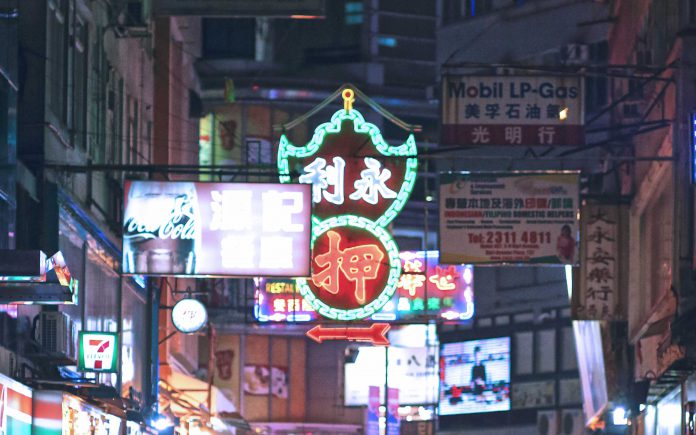
“Neon lights contribute to maximising the colour and attraction of Hong Kong,” says Jin Park, a Korean photographer. Attracted by exotic buildings and harbour views of Hong Kong, Park visits the city repeatedly and thinks neon signs are the major attraction for tourists in the city.
Good Old Days of Neon Signs
Hong Kong has long been known as “Pearl of the Orient” due to the spectacular night view of neon lights. Park feels sad that neon signs he saw in Tsim Sha Tsui in September 2018 were gone when he went there again in March 2019. “And I can see that many neon signs have been taken down,” he says.
“Neon signs set the mood of Hong Kong in its good old days,” Park adds.
Jin Park took photos during his travel in Hong Kong. (Photo courtesy: Jin Park)
“Neon signs set the mood of Hong Kong in its good old days.”
Jin Park
Since the 1920s, neon-filled streets have given Hong Kong its distinctive atmosphere and act as a backdrop for movies like Chungking Express and Blade Runner.
Kwok wrote the book Fading of Hong Kong Neon Lights – The Archive of Hong Kong Visual Culture. (Source: Joint Publishing HK)
The colourful signs also serve as the cultural icon of Hong Kong. “I think neon sign is part of our cultural identity. It’s a unique culture of Hong Kong,” says Brian Kwok Sze-hang, assistant professor of the School of Design at the Hong Kong Polytechnic University.
As the author of Fading of Hong Kong Neon Lights – the Archive of Hong Kong Visual Culture, a book which photo-documents remaining signs in Hong Kong, Kwok has conducted comprehensive research on the city’s vanishing neon signs. “When you look up at the sky, you see a unique view created by neon signs,” he adds.
Thanks
to the lack of restrictions, neon signs with a variety of shapes, sizes and designs
shaped Hong Kong’s distinctive neon landscape. “Japan has a strict policy on neon signs in terms of their
sizes, so they’re not as unique and pretty as the ones in Hong Kong,” Kwok says.
Vanishing Neon Signs
However, the golden era of neon signs is gone. It is much harder to spot neon signs in major districts in Hong Kong nowadays. They are either replaced by energy-efficient light-emitting diodes (LED) or taken down by the government as it has stepped up effort to restrict creation of neon signs due to safety concern since 2010.
Kwok agrees that the government should take down some dangerous neon signs that pose a threat to public safety but notes that preservation is equally important as neon signs are a part of Hong Kong’s culture and history. He thinks the government should collaborate with some concern groups in the society to preserve this culture.
Apart from government efforts, Kwok thinks that shop owners who own the signboards should also acknowledge the cultural value of neon signs. Due to tightened restrictions and high maintenance cost of neon signs, there is a trend of replacing neon signs with LED signs.
Kwok believes neon signs have their cultural and historical value. (Photo courtesy: Brian Kwok Sze-hang)
“Shop owners prefer LED signs because they are cheaper, last longer and more colourful. But I think LED lights are too strong and bright,” Kwok says. “Neon signs give out soft and romantic light and they are perfect for the night.”
The drop in demand for neon signs also leads to fewer people joining the neon sign manufacturing industry leading to decrease in supply.
Visual Culture Preservation
It may seem that neon signs and everything relating to them are slowly being erased from the community. Yet, some organisations are working hard to preserve neon signs culture in Hong Kong while the once neon-filled streets have become neon-free streets in recent years.
One of them is M+, a new
visual culture museum in Hong Kong that will be opened next year. It has preserved some traditional
neon signs,
believing they are the
iconic element of Hong
Kong’s visual culture. “Given how much they contribute to the landscape of Hong
Kong, it will be regrettable if neon signs become less visible in the public
sphere,” a M+
spokesperson says.
However, neon signs in Hong Kong
have been exposed to the city’s maritime climate for a long time. The high
level of salt in the air may corrode them, and that makes it more difficult to preserve old neon signs. The spokesperson
of M+ says: “There is definitely collective nostalgia for a time when neon was
a vibrant and active craft, and it may only be able to survive as an artisanal
skill.”
Defining culture as a living thing
that is constantly changing and evolving, the museum believes preserving neon
signs may help generate new forms of expertise that can support the creation of
neon signs in the future. The M+ spokesperson adds: “Key efforts are devoted to
ensure adequate documentation of existing techniques to be used in the future.”
Kwok also points out neon signs need to be preserved: “What’s worthy about neon signs is that they connect the community and the people.”
He adds that some shop owners are willing to keep neon signs though the maintenance cost is high as they mark long history of their shops. “It’s like keeping a promise with the community. Neon signs symbolize honour, respect, and credibility,” Kwok says.
People should adopt pets instead of buying them to safeguard animal welfare
By Kassandra Lai & Savoki Zhang
“Charcoal stood out from others because it was so energetic, cheerful and tame,” Veronica Chan recalls the first moment she saw her lovely dog at a carnival promoting dog adoption and responsible pet ownership two years ago.
Playing with Charcoal, a three-year-old male mixed breed
dog, for a while during the event which was supported by various animal welfare
organisations with the Agriculture Fisheries and Conservation Department
(AFCD), Chan made up her mind to take it home.
The second-year nursing student at the Chinese University
of Hong Kong (CUHK) initially thought that pets awaiting to be adopted feared
human beings and might have illnesses. But she found out they are well taken
care of by professionals in adoption shelters. “Some people believe pets from adoption centres have behavioural problems.
However, Charcoal proves them wrong,” she says.
Buy pets drives illegal breeding
Chan adopts her pet
simply because she wants to save lives. “I heard that some pet shops in Hong
Kong are breeding animals illegally and mistreating them,” the 19-year-old student
says. “Buying pets from pet shops may help breeders expand their business and this
will harm the animals.”
Illegal traders set up breeding facilities in rural areas where dogs are bred like factory products to cash in on pet trading that is worth millions of dollars a year in Hong Kong. For example, 135 dogs and cats were found housed in 76 crates under poor living conditions suffering from serious illnesses in Tai Kok Tsui in 2013. In 2017, 101 dogs were found at a breeding house in Yuen Long where they were trapped in overlapping and filthy crates, underfed and weak.
Chan continues that the
practice of euthanizing pets in Hong Kong also prompts her to adopt pets. “Some
of the pet shelters in Hong Kong may euthanize animals if they can not be
rehomed. That is really sad,” she says.
According to a written reply from the AFCD, the number of animals not suitable for adoption and eventually being euthanized by the AFCD rose from 2,660 in 2017 to 6,366 in 2018 but dropped to 3,419 in 2019.
“The big problem is the consumer. The illegal trade can only function if there is a demand from the consumers,” says Dr. Fiona Woodhouse, deputy director of the Society for the Prevention of Cruelty to Animals (SPCA).
IN TERMS OF THE ETHICAL APPROACH, YOU ARE GIVING AN OPPORTUNITY FOR UNWANTED PETS TO FIND A HOME
says Dr. Fiona Woodhouse, deputy director of the SPCA
Law to protect animals
In March 2017, Hong Kong government revised the Public Health (Animals and Birds) (Trading and Breeding) Regulations, requiring every person who sells and breeds dog to obtain a Dog Breeder Licence and with a higher penalty from $2,000 to $100,000. The licence comes with a code of practice which details the arrangements for licensed premises and the care of a dog.
With stricter legislation in place, Woodhouse calls on the customers to double-check the legitimacy of breeders’ licence and avoid buying animals online. “It’s very difficult for the government to locate social media usage and private messaging,” she adds.
Dr. Fiona Woodhouse, deputy director of the SPCA
Amid worries that the licensing system would set a low bar of eligibility for home breeders as it relies on self-reporting system to let breeders judge by themselves whether they comply with the code of practice, Woodhouse says, “this licensing system is one of the targets in the world.”
Yet, Sally Anderson, founder of Hong Kong Dog Rescue (HKDR), says the AFCD is understaffed and illegal breeders are still operating as they did before.
Some states in the United States, such as California and
Maryland, have passed laws to prohibit pet shops from selling dogs bred in dog
breeding facilities – “puppy mills”. They can only obtain animals from breeders
that meet requirements laid out in the bill. Meanwhile, the United Kingdom is
also planning to ban third-party sales of puppies and kittens starting from
April 2020.
Under the new licensing regulation, the investigation unit of the AFCD has stepped up actions against illegal sales of dogs by looking for “dog for sale” advertisements on the internet and conducting regular inspections to shops selling pet accessories and offering pet-related services.
Up to December 2019, the AFCD prosecuted 72 cases of selling animals without a license out of 695 complaints.
Measures to encourage pet adoption
In a bid to encourage pet adoption, animal rights concern groups and the AFCD regularly organise events, like school seminars and holding exhibitions with celebrities. Such works have led to an increase in dog adoption from 6.4 per cent in 2010 to 17.8 per cent in 2018 and cat adoption from 12.4 per cent to 19.8 per cent, according to the Thematic Household Surveys conducted by the Census and Statistics Department. However, 34.8 per cent of dogs and 19.9 per cent of cats were still obtained from pet shops in 2018.
“More resources should be put on
education and prevention rather than giving money to the animal shelters,”
Woodhouse says.
Education helps change public mindset and prioritise adoption over personal preference. “Adopters may have in mind that they want a certain breed of dog or cat. Sometimes people have preference over the colour. Age can be a factor.” Woodhouse continues. A system that helps operators to find shelters for animals is also needed as it is difficult for them to find places allowing pet owners to have a pet at home in Hong Kong.
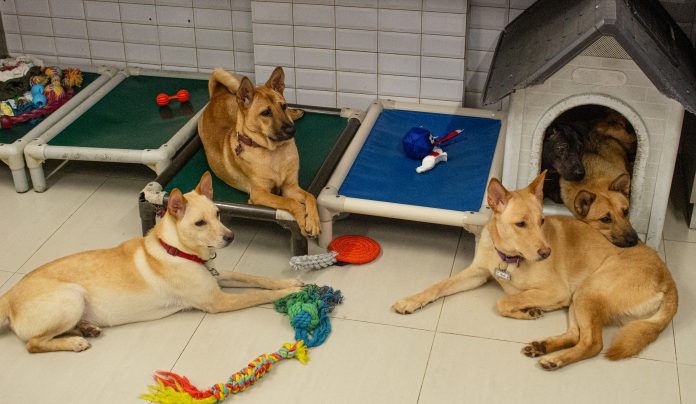
Adoption centre at the SPCA’s headquarter in Wan Chai
The Housing Authority has forbidden public housing tenants to have pets since November 2003, unless those with permission, such as service dogs, small household pets and desexed cats. Woodhouse suggests Hong Kong can learn from Singapore’s housing policy and project ADORE (Adoption and rehoming of dogs). Each public housing household is only allowed to adopt one local crossbreed dog when it is around seven to eight months of age and has to comply with stringent ownership conditions, like sterilization and compulsory training.
Procedures for pet adoption
Hong Kong Dog Rescue Ap Lei Chau Homing Centre
Many people hesitate to adopt pets, fearing there are complicated and lengthy processes, but Anderson says, “There have to be some questions asked but there’s a limit as to what’s actually necessary.”
“The main thing we look for is whether the adopter has a good understanding of what a dog is, meaning that it’s an intelligent animal with emotions, feelings, and a need to be part of a family,” she stresses.
MANY PEOPLE MISS THE FACT THAT PUPPIES NEED COMPANIONSHIP, SOCIALISATION, TRAINING, AND FREQUENT MEALS TO GO UP INTO HEALTHY AND WELL-ADJUSTED ADULTS,
says Sally Anderson, founder of HKDR
Chan says she has a happy experience when she adopted Charcoal.
“We first registered by filling in forms and a home visit was also arranged later. After all these, we were allowed to pick up Charcoal from the shelter,” Chan recalls.
“The adoption procedures may bring some
inconveniences as we have to arrange a time for a home visit, but I think
nothing can get in your way once you are determined to adopt,” Chan says.
The landslide victory for the pro-democracy camp in the District Council election 2019 brings significant changes to Yuen Long.
By Kelly Yu & Isaiah Hui
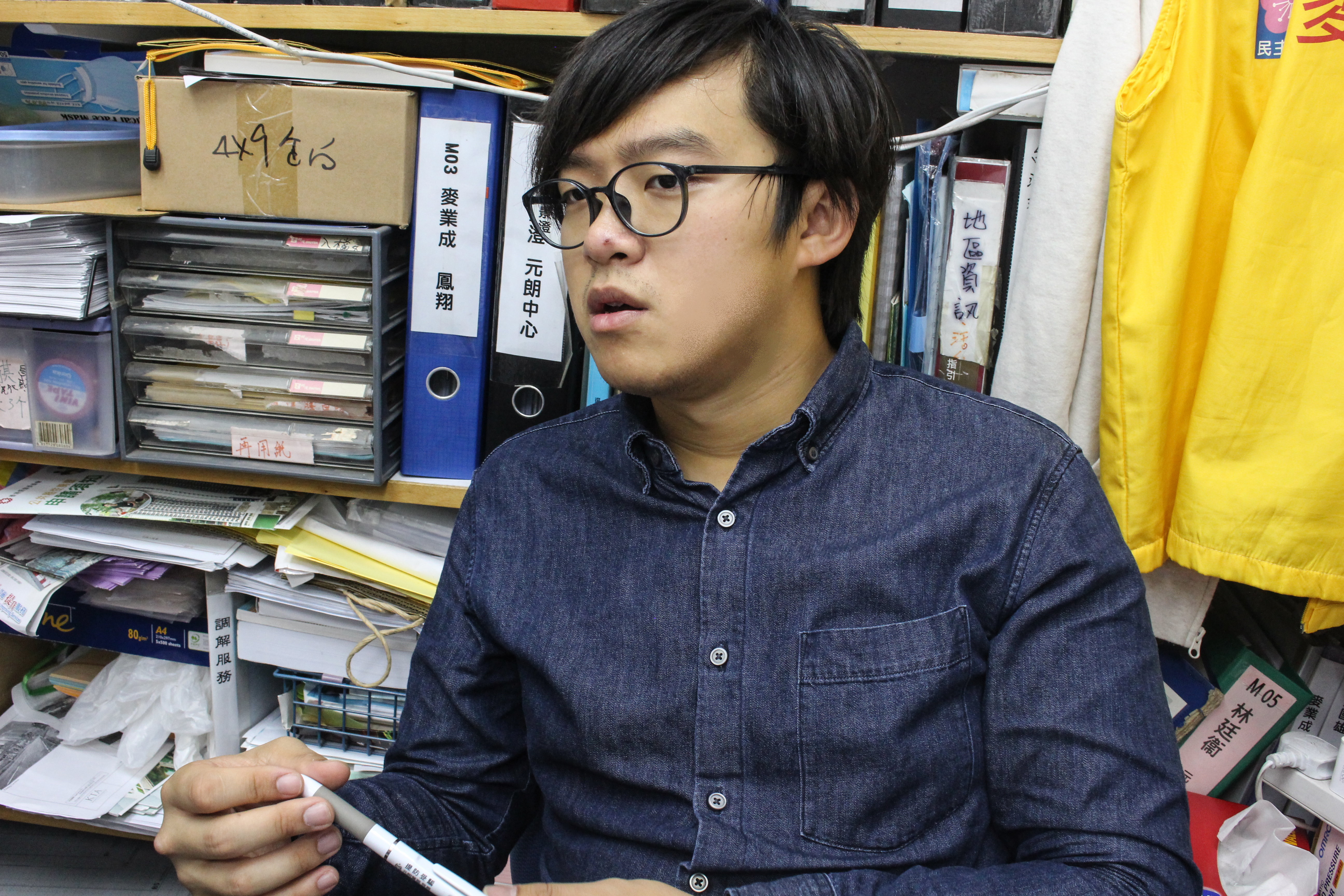
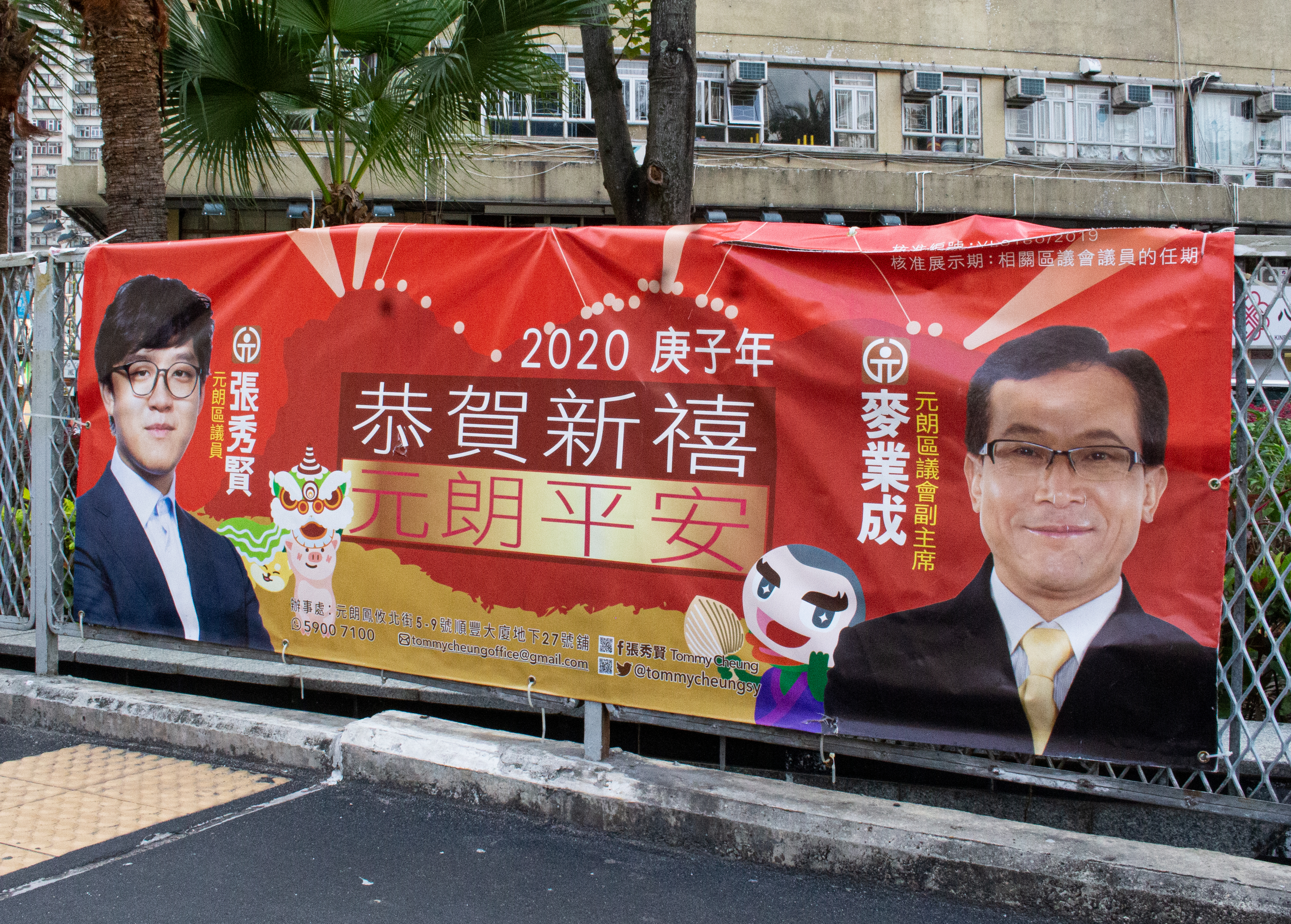
Tommy Cheung Sau-yin, former spokesperson of a pro-democracy student activist group Scholarism, was elected as a district councillor in Yuen Long. Like other newly elected pan-democrats, the 26-year-old is passionate about making changes in the community he serves.
First things first
The former student activist is also the chairperson of a working group that was formed by the pro-democracy district councillors in the first meeting of Yuen Long District Council after the vote to investigate the 7.21 incident.
On July 21, 2019, mobs in white stormed Yuen Long MTR Station and attacked protestors returning home, passers-by and journalists indiscriminately with wooden rods and steel bars overnight. Emergency calls were made, but it took police officers 39 minutes to arrive at the scene – when the mobs had already left the scene. No arrest was made that night.
This incident has provoked a public outcry over the accountability of the police, who is accused of failing to protect citizens and colluding with the suspected triad gangsters.
Tommy Cheung Sau-yin, district councillor in Yuen Long
“The government is not cooperative in investigating the incident,” Cheung complains. “Out of about 500 (suspected) gangsters, only 37 were arrested and seven were charged so far.”
Despite this, Cheung believes that forming a working group is still necessary. “It is very unlikely the government will give us a logical explanation. Yet, with the power of a working group, request for compensation and an apology are possible,” he says.
The Landslide Victory
“The first thing we must do is to investigate 7.21 incident,” says Cheung, attributing his electoral success to his promise of probing the incident in his manifesto. Together with 32 fellow pro-democracy members in Yuen Long, Cheung has become part of the 45-member district council since the election.
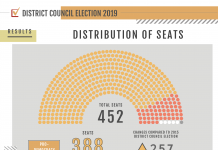
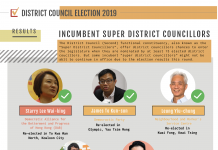
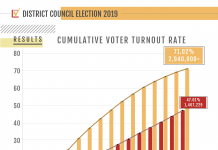
More than 2.9 million people cast their votes in the district council election held on November 24, 2019, setting a record high of 71.2 per cent turnout rate, compared with 47 per cent in 2015. The election was perceived as a referendum for Hong Kongers to voice how they felt about protest crisis which broke out in June 2019. Having gained control of 17 out of 18 districts, the pan-democrats won nearly 60 per cent of the votes and secured a total of 392 out of 452 seats.
A shift in political
power
Like many other districts, Yuen Long is now dominated by pro-democratic district councillors, with 33 out of 39 constituencies taken by pan-democrats. Cheung believes that with the pan-democrats being the majority in the district council, the policy-making process will be more efficient, and the council’s function of reflecting public opinions can be restored.
Regarding changes Cheung wants to make in Yuen Long, Cheung says he will tackle long-standing problems, such as poor hygiene and parallel trading. He says he would also like to organise town hall meetings to invite residents to take part in the policy design discussion.
Sharing similar views with Cheung, Johnny Mak Ip-sing, the vice chairperson of Yuen Long District Council, says there was not enough public consultation in the past, citing the controversial footbridge project in the district as one example.
Left: Tommy Cheung Sau-yin ; Right: Johnny Mak Ip-sing
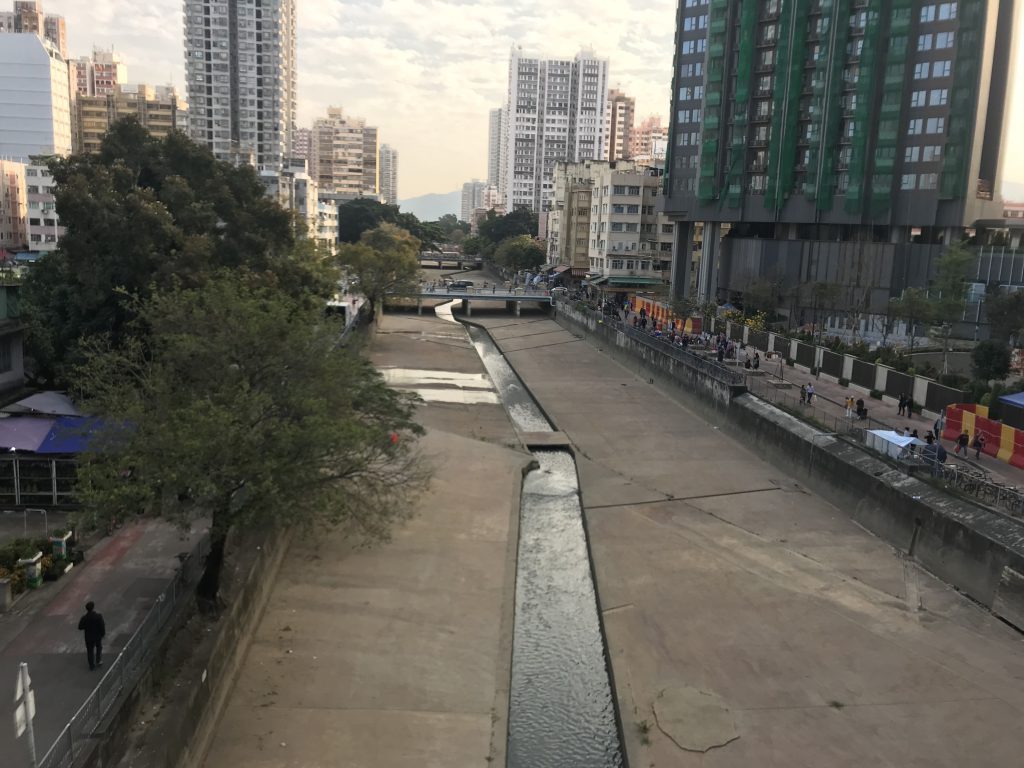
Under the proposed plan, the government plans to build a 540-meter-long footbridge, connecting between Long Ping Station and South of Kau Yuk Road over Yuen Long Town Nullah, a major drainage channel in the district. The district council has been discussing the plan since 2009. The project is expected to be completed in 2023 with an estimated cost of HK$1.7085 billion. Various professional groups and Yuen Long residents have criticised the footbridge project for being too costly.
Yuen Long Town Nullah
“The project was announced in the policy address…government officials all follow to please the Chief Executive just because she announced the plan,” Mak says. “The purpose of the project is to reduce the number of pedestrians crossing the road, thereby improving the traffic flow. But why shouldn’t the solution be the other way round? Instead of increasing the traffic flow, we should regulate the flow of private cars,” Mak says.
“Some sections of Yuen Long Nullah can be decked to create more road space and for people to do recreational activities,” Mak explains. “We will discuss the matter further in a working group, which was set up after we took office, for revitalizing the footbridge and the nullah, and we hope to address the matter this year.”
Joyce Lau Cheuk-kei, a 20-year-old Yuen Long resident, agrees that there was a lack of public consultation on the footbridge project. She says that the pro-government district councillors did not consider public needs at all in the past.
“More young pro-democracy district councillors are elected. There is a change in the political climate and the community as a whole,” says Lau. She hopes more voices from different stakeholders can be heard, and she is confident that the landslide victory can resume the function of the district council which is to channel public views into government policies.
Districts
Changes after the election in November 2019
Tuen Mun
Urge the government to enforce the Pleasure Grounds Regulation
Tai Po
The setup of Security and Constitutional Affairs Committee
Kwun Tong
Suspend the HK$0.5 billion musical fountain project
Wan Chai
Form a working group to monitor a $130 million community project
Implications from the election
Ma Ngok, associate professor of the Department of Government and Public Administration at the Chinese University of Hong Kong (CUHK), believes the pro-establishment camp will not be able to regain public support. “The pro-government used to be the majority in district councils who have access to public resources. But they cannot do that now after losing their seats,” says Ma.
“It is impossible for her (the Chief Executive) to appoint hundreds of them (former pro-establishment district councillors) to take up positions at public offices or advisory committees. Actually, I think she is just trying to pacify them. There are not many such positions and they do not get paid. Also, most positions are occupied by the pro-establishment camp already.” Ma explains.
Ma Ngok, associate professor of the Department of Government and Public Administration at the CUHK
The political environment has led to a rise of new faces from the pan-democratic side. “This is what I have observed – political awakening brought by the district council election. The election was highly political, as the public voted with a political cause in mind,” Ma continues.
But Ma believes the momentum will have little impact in the coming Legislative Council election. “Unlike district council election, the legislative council election allocates seats with proportional representation and I can only foresee a slight win for the pan-democratic camp.”
THE LANDSLIDE VICTORY PROBABLY WILL NOT HAPPEN AGAIN IN THE LEGISLATIVE COUNCIL ELECTION
Despite lasting social unrest and the Covid-19 outbreak, domestic helpers are staying in Hong Kong to support their families.
By Patricia Ricafort
Hama, an Indonesian domestic helper recalls being pulled and interrogated by a masked stranger after getting off a bus. “He pulled me over and asked me where I was from, where I lived. I didn’t answer him…I was frightened and confused,” Hama, who declines to reveal her full name, says.
She had this horrible experience when an anti-extradition bill protest was happening nearby.
Holiday fright
Since June 2019, demonstrations have escalated into a much wider and prolonged anti-government movement in Hong Kong. The protests first started to go against the extradition bill, and protestors then stated their five demands including setting up an independent commission to investigate police brutality and dual universal suffrage.
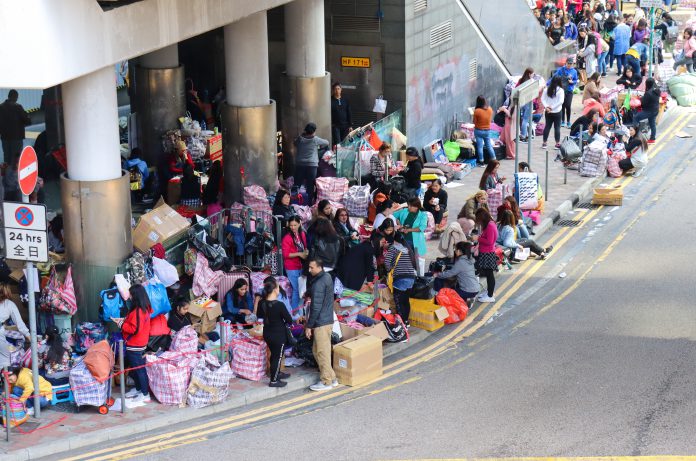
Hama is gathering with her friends at Victoria Park on a day off.
Hama, who works in Pok Fu Lam, is concerned about the continued social unrest in Hong Kong. “I am worried that I won’t be able to return home when clashes happen,” she says. She used to feel safe to go “yum cha” on Sundays with her employers but she stays at her employer’s home more often now.
Some of her friends working in Aberdeen are so scared that they have stopped going to the Victoria Park on their days off. “They have friends who got injured accidentally when protests broke out,” Hama says.
Victoria Park is less crowded than usual on Sunday.
Similar stories can be heard from other domestic helpers. A Filipino domestic helper who reveals her name as Liza, says, “I know someone had to sleep in a church because there was no transport back to their employers’ homes.”
Tear gas was fired during rallies in Central, where many migrant workers gathered to enjoy their days off. As the “Be-Water” strategy adopted by protestors encourages spontaneous protests in different districts in Hong Kong, domestic helpers are often affected by protests.
Migrant workers at Central before tear gas was fired on January 19, 2020.
Tebia-Bonifacio, Chairperson of Gabriela Hong Kong, an alliance of women’s organisations supporting migrant Filipino workers, explains migrant workers usually go to Central to make some money and meet their friends on Sundays. As the protests usually happen in the afternoon, Tebia-Bonifacio says helpers still go out in the morning but leave earlier. “They make sure by noon, they move out of Central.”
The outbreak of the novel coronavirus has further restricted domestic helpers from having holidays as usual. “Because of current Covid-19, many domestic workers are not allowed to have holidays by their employers, especially (since the release of the) Hong Kong Labour Department statement encouraging employers not to allow their helpers to go out,” says Tebia-Bonifacio.
The statement released by the Labour Department on January 30 requests domestic helpers to stay at home on their day off. “The government appeals to FDHs (foreign domestic helpers) to stay home for rest on their rest day as far as possible, and to stay away from crowds on public transport or at public places. At the same time, employers must not require FDHs to work on their rest day,” the statement reads.
Tebia-Bonifcaio estimated that around 20% of the members from Gabriela Hong Kong are forbidden from taking their days off on February 6, 2020. “Some domestic helpers are asked to do some work, but some of them can rest in their rooms,” she says.
Feeling the pinch
Apart from personal security and health concerns, some domestic helpers have become unemployed because their employers decide to leave Hong Kong due to the social unrest.
Liza knows around 10 people who encountered this. She estimates that around four of them were unable to find a new job before their visa expired and were therefore forced to return to the Philippines.
“Cases of domestic workers being severely affected by the protests would be domestic helpers who have lost their jobs because their employers have lost their jobs or have decided to go back to their home countries during the protests,” says Rey Asis, program coordinator of the Asia Pacific Mission for Migrants (APMM), an NGO which supports migrant workers’ rights in Hong Kong.
HelperPlace, an online employment platform for foreign domestic workers, also observes an increasing number of jobless foreign domestic helpers.
Mark Silva, community manager of the group, says, “There are a lot of expats moving out of Hong Kong because of the unstable situation. So when these expats return to the UK, or go back to Singapore, or any countries where they come from, they leave their helpers with no job. This is a situation that we call ‘terminated due to relocation’,” he adds.
“From our statistics, we have a lot of helpers available and needing jobs but we do not have enough employers to hire them,” Silva says. “For these past months, if you ask me what’s the effect of the current situation in Hong Kong, the effect is that we have a lot of helpers losing jobs and needing jobs but we don’t have employers to hire them. The number of helpers (looking for work) is increasing,” she says.
In August 2019, the Department of Labour and Employment under the Republic of the Philippines considered imposing a ban on worker deployment to Hong Kong due to the social unrest. Yet, most Filipinos did not consider leaving Hong Kong.
A survey conducted by HelperChoice, which interviewed 982 Filipino domestic helpers in Hong Kong last year found 97 per cent of the respondents would not consider relocating or going back to the Philippines.
The coronavirus outbreak which began in Wuhan also causes more job losses among domestic helpers.
Filipino migrant organizations commemorating the International Working Women’s Day. (Photo courtesy of Gabriela Hong Kong)
On February 2, 2020 the Philippine Consulate General in Hong Kong announced a temporary ban on Filipinos from traveling to China, including Hong Kong and Macau. “Since the travel ban has been imposed by the Filipino government, workers, students and Hong Kong Filipino residents are now banned from going back to Hong Kong, so the possibility of losing their job is now the problem,” says Tebia-Bonifacio.
Gabriela Hong Kong reported 30 cases of migrant workers stranded in the Philippines on February 6, 2020.
The grass isn’t greener
Even with the current social unrest, many domestic helpers are reluctant to quit their jobs and leave Hong Kong. Many domestic workers are the primary breadwinners in their families.
“If (migrant workers) lose their jobs, they also lose the capacity to support their families back home. This is why even in times of difficulties during their employment, they cannot go back home right away,” Tebia-Bonifacio says.
“The only reason why I took the job of domestic worker is because there is no other opportunity”
Shiela Tebia-Bonifacio
Domestic workers working aboard have a much higher chance earning better income than working in their home countries. Tebia-Bonifacio shares that even incomes of professional positions in domestic workers’ home countries are less lucrative than domestic work in Hong Kong. “For a full-time professional teacher in the Philippines, the salary of a domestic worker is much higher than what the full-time teachers in the Philippines would earn,” she says. In 2019, the average monthly salary of Elementary and High School Teachers in Public Schools in the Philippines is PhP$19,600 or around HK$3,000.
Tebia-Bonifacio had been working as a full-time teacher in the Philippines for three years before working here in Hong Kong as a domestic helper. “The only reason why I took the job of domestic worker is because there is no other opportunity. For a poor family like mine with no connections in the government, it is very hard to get a job that has a decent salary,” she explains.
Though employment opportunities are available in other countries, many foreign domestic workers still prefer working in Hong Kong. “There are a lot of workers in Singapore, Middle East and Malaysia – these helpers actually registered on the (HelperPlace) platform and they wanted to work in Hong Kong. For these workers from the Philippines, they prefer to work in Hong Kong for the reason that the salary is higher and the freedom to have a rest day once a week,” says Silva.
Welfare of Domestic helpers in Hong Kong and Singapore
Working location
Hong Kong
Singapore
Minimum Allowable wage
HK$4,639 per month
No minimum wage*
Day off
One day off per week**
Exchangeable for an extra payment
*Statistics from HelperPlace reveal that wages for domestic workers start from SG$500 or HK$2,880 per month in Singapore. **Under Hong Kong’s Employment Ordinance, employers are required to grant domestic helpers one day off per week. Employers are not allowed to request their helpers to work on rest days except in cases of unforeseen emergencies in Hong Kong.
In 2018, 386,075 foreign domestic helpers worked in Hong Kong, according to figures from the Census and Statistics Department. Most of them were from the Philippines and Indonesia.
Despite the unstable situation in Hong Kong, the number of Filipino domestic helpers increased from 210,897 in December 2018 to 219,915 in November 2019, according to the Philippine Consulate General in Hong Kong.
“The common sentiment of migrant workers right now is if their employers are willing to keep them, they are willing to stay,” says Tebia-Bonifacio.
















 Iron nets have been installed in the footbridge connecting Hung Hom station and Hong Kong Polytechnic University, near the Cross Harbour-Tunnel.