












Home Blog Page 61

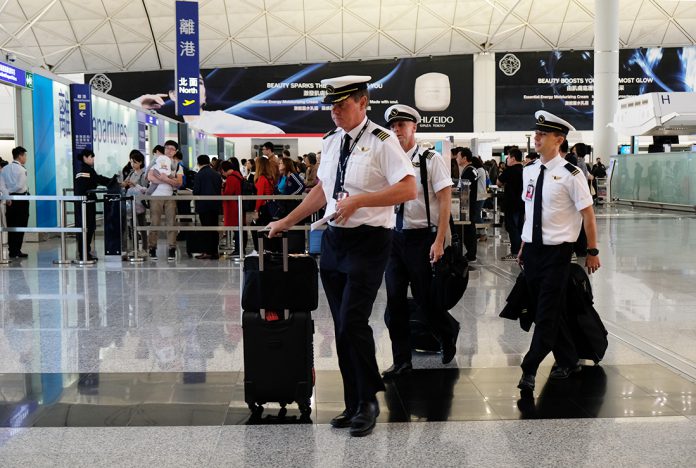
Getting on the flight path

Hong Kong plays catch-up as lagging aviation education contributes to labour shortage

By Iris Yeung & Tommy Yuen

O

n the July 31 2016, dozens of activists marched through the terminal building in Hong Kong’s International Airport (HKIA) to oppose a HK$141.5 billion project to build a third runway and associ­ated facilities. They said the project would be a white elephant and cause untold environmental damage, in­cluding threatening the survival of the Chinese white dolphin. But dissenting voices in the community failed to stop the project.

The three-runway system (3RS) is scheduled for completion in 2024 and aircraft movements are set to in­crease from the 68 flights per hour on the current two-runway system to 102 flights per hour. Together with the expansion of Terminal 2 and other facilities, authorities predict an extra 50,000 extra staff will be required to perform various jobs in the expanded airport. However, even at its current scale, industry insiders say the airport is short-staffed and the cultivation of aviation talent has been under-devel­oped for years.

Law Cheung-kwok, the director of policy at the Aviation Policy and Research Centre at the Chinese Univer­sity of Hong Kong, says that aviation education in Hong Kong lags behind the rapid development of the sector, and it is too late to start filling the void. This despite the fact that the Basic Law highlights the status of avia­tion in Hong Kong.

“There are only two ‘centres’ in the Basic Law that Hong Kong is posi­tioned as, one is as a financial centre, the other is aviation. They are impor­tant industries for Hong Kong’s economic pro­duction,” says Law. “Indeed, the financial industry is highly valued, but the attention paid to [Hong Kong’s role as an] avia­tion hub is relatively low.”

According to Article 128 of the Ba­sic Law, the Hong Kong government should maintain “the status of Hong Kong as a centre of international and regional aviation” but Law points out the absence of an aviation school in any of the University Grants Com­mittee-funded universities in Hong Kong.

“If this field is that important, we should have had it [general aviation education] long ago,” he says.

Some tertiary institutes have launched aviation courses in recent years. The Hong Kong Polytechnic University established the Interdisci­plinary Division of Aeronautical and Aviation Engineering in 2016. It also offers degree programmes in avia­tion management. The Hong Kong University of Science and Technology started offering a Bachelor’s degree in Aerospace Engineering in 2015 and Master’s degrees in Aeronautical Engineering and International Air Transport Operations Management respectively in 2016.

Other education institutes of­fer self-financed higher diplomas or certificates courses. One example is the HKU School of Professional and Continuing Education (HKUSPACE)which has offered a range of avia­tion programmes since 2006. These include diploma courses in aviation management, ground services, air­port operation and a certificate for the Australian Private Pilot License (PPL). There are over 1,000 total an­nual enrolments.

The Hong Kong International Aviation Academy (HKIAA) was established last year

Last year, the Airport Authority Hong Kong (AAHK) established the Hong Kong International Aviation Academy (HKIAA) which offers a range of day camps, beginners courses, certificate programmes with 12-month paid internships, professional short courses for existing industry person­nel and academic courses such as a Master’s degree and diploma and top-up degree courses. In all, the academy offered more than 177 courses in 2017 covering airport operations and man­agement, air traffic control, aviation security and aviations services. The HKIAA says the offerings reached more than 5,500 participants last year.

Lam Siu-ming, the senior pro­gramme director of the College of Life Sciences and Technology at HKUS­PACE sees the establishment of the HKIAA as a positive development.

“We are comparatively slow [in aviation education], but at least we have started, I hope we can catch up,” he says.

Lam thinks aviation education was slow to get off the ground in Hong Kong in part because of its geographi­cal location. The available air space limits the flying experience young people can have, and this is an intrac­table problem, particularly when it comes to the training of local pilots.

A simulated cockpit at the HKUSPACE aviation laboratory

Lam says he has met many young people who dream of becoming pi­lots. Over the past decade, 98 gradu­ates from HKUSPACE aviation pro­grammes have become airline pilots. But the college can only guide stu­dents through the syllabus of the private pilot’s licence programme. In order to obtain a PPL, which is compulsory for a qualified pilot, stu­dents must undergo further training overseas at their own expense. With two more advanced qualifications re­quired before one can become a com­mercial pilot, it costs a total of around HK$1 million to train to be a pilot.

While few can afford the train­ing, Cadet Pilot Programmes (CPP) launched by local airlines do subsidise those with talent to realise their avia­tion dreams. Currently, Cathay Pacific, Cathay Dragon and Hong Kong Airlines organise such programmes. Those who make it through the tough rounds of theory and practical tests, are sponsored to undergo pilot train­ing in Australia and New Zealand.

Hong Kong Airlines launched their first CPP in 2017. Of the more than 4,000 applicants, only 10 were selected. Lam thinks the stringent se­lection methods and requirements are necessary.

“As a passenger, you’ll be fright­ened if the pilot is not up to standard. The industry would not ease the re­quirements.”

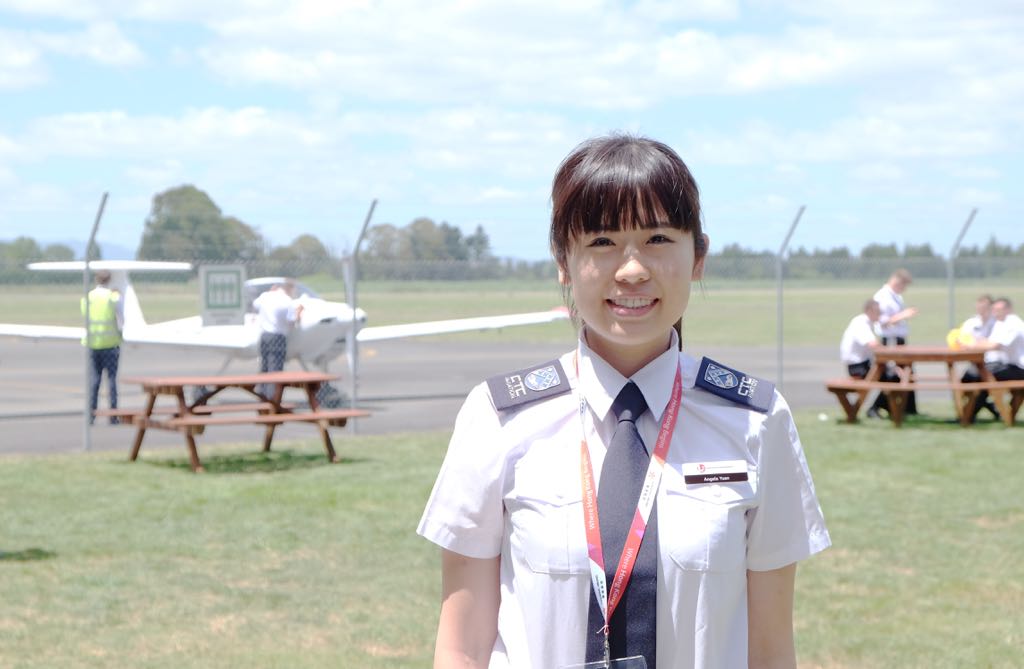
Hong Kong Airlines cadet pilot Angela Yuen Yan-chi is training in New Zealand now
Photo Courtesy of Angela Yuen Yan-chi

Angela Yuen Yan-chi, 29, was one of the lucky few to join the first-batch of Hong Kong Airlines cadet pilots. She says only 7.5 per cent of the air­line’s 560 pilots are local. The per­centage will increase when the cadets complete their flight training but it will take years before the percentage rises significantly.

There is a global shortage of ex­perienced pilots but Yuen says the problem is particularly acute in Hong Kong because the territory is simply too small. “The airspace is not enough to share with neighbouring cities like Macau and Shenzhen,” she says, add­ing that Shek Kong Airfield is the only place to carry out flight practice.

“The only runway available in Shek Kong Airfield makes the cost of flying expensive.”

Krizto Chan Ho-ying, a 27-year-old aviation enthusiast agrees that avi­ation education in Hong Kong is not widely affordable. Chan has applied for the cadet pilot programmes for Cathay Pacific, Cathay Dragon and Hong Kong Airlines but so far with­out success.

“It’s a bit of a luxury here, even for those of us who are so into it, we have to save money for years before we can have our first flight,” she says.

Over the years, Chan has invested a lot to prepare herself for the CPP as­sessments. During her university years, she at­tended courses at the Hong Kong Youth Aviation Acade­my, a non-profit or­ganisation run by practising profes­sionals in the aviation industry, which aims to help aspiring pilots fulfill their goals. She underwent flight training in New Zealand too and holds a private pilot licence. None of this guarantees a place in the local cadet pilot pro­grammes.

“You have to be the top, you have to be very sharp, and you have to be lucky,” says Chan.

The shortage of aviation person­nel is not limited to pilots. More avia­tion courses have become available recently but the historical inadequacy of aviation education provision has exacerbated the manpower shortage problem in the industry as a whole.

Cheung Shu-wang, chairman of the Staffs and Workers Union of Hong Kong Civil Airlines, estimates there is currently a labour shortfall of 5,000 airport workers. While safety is not affected yet, services are.

The most noticeable and imme­diate impact is longer waiting times for luggage but Cheung says there is insufficient staff in many areas, in­cluding parking aprons, check-in counters, bag­gage reclaim, technicians, pi­lots and man­agers. Cheung says these short­ages will affect airport operations and service quality. For its part, the AAHK does not respond to the criti­cism directly. But they say the use of technologies, such as the “baggage tagging robot” and “trolley counting system” can help improve operational efficiency.

As to whether Cheung thinks the setting up of the HKIAA can help ease the problem, he is not so sure.

“I think its efficiency and planning [in cultivating personnel] cannot really catch up with the growing demand for airport ground staff,” he says.

While the new institute offers courses on a range of high-end skills, Cheung thinks the airport is in ur­gent need of semi-skilled workers at the parking apron. He says the union will propose feasible policies to the AAHK.

Jeremy Tam Man-ho, who served as a commercial pilot before becom­ing a Civic Party lawmaker, says the government has been, characteristi­cally, slow to act.

“Every time, it’s not until there re­ally aren’t enough people that the gov­ernment thinks of methods to magic up some people. So that’s why you’ll see the establishment of HKIAA, it’s really to complement the third run­way.”

Tam thinks the government is on the right track to develop aviation. It now has policies in place and is following them, but he still thinks they have not done enough.

He adds: “I think the launch of HKIAA is appropriate, but there is not enough promotion, also the courses are not broad enough and some of them are very expensive.”

For those already employed at the airport, some financial support maybe available. The HKIAA says applicants for 20 of the professional courses can apply for a refund of 80 per cent of the fees, up to a maximum of HK$18,000 on completing the courses under the gov­ernment’s Professional Training and Examination Refund Scheme. And the fees if some courses are waived for airport staff “if they enroll through their respective organisations”, says the HKIAA.

But in order to attract new recruits, Tam suggests airlines, the HKIAA and aircraft engineering companies should offer more internships to encourage students to assess their aspirations and suitability for various posts in the sector. While companies may see offering internships as a kind of so­cial responsibility on their part, Tam points out they also benefit from nur­turing new blood. Therefore, he wants to see more cooperation between the industry and education institutes, so that companies can observe and hire suitable candidates upon their gradu­ation.

Former labour sector lawmaker Ip Wai-ming, who is now the deputy sec­retary of the Staffs and Workers Un­ion of Hong Kong Civil Airlines, says the high turnover rate is another factor of the manpower shortage in the industry. He thinks the staff shortage problem should be solved through the unions, government and re­lated corporations working together.

Ip believes the government should invest in order to get rewards, espe­cially if it regards aviation as an im­portant economic pillar of Hong Kong.

“They have to make people be will­ing to enter the industry, giving them the feeling that this is an industry with prospects and development, which can lead them to make a living.”

Edited by Jade Li
Cabin Crew Blues

Frontline staff suffer as competition between local airlines intensifies

By Lily Yu & Sarah Poon

when Alex (who does not wish to disclose his full name) joined Hong Kong Airlines as a flight attendant half a year ago, it was a childhood dream come true. The 23-year-old was attracted to the job by the glamourous and professional image. The reality was a little different. For a start, he did not expect the “red-eye flights” in his roster to be so frequent. These are flights that depart after midnight and arrive early in the morning.

“After arriving at the destination in the middle of the night, I have to complete the transit procedures and load the meals within an hour, then fly back [to Hong Kong] immediately,” Alex says.

While such demanding hours used to be a concern for long-haul cabin crew members, local airlines are increasingly operating red-eye flights for short-haul routes as well.

“They [the airlines] exhaust their staff and do not care much about how tired we are,” says Alex. Hong Kong Airlines did not respond to interview requests.

In the aviation industry, the health condition of crew members has to be monitored for flight safety reasons. Tiredness resulting from sleep loss or extended wakefulness is described specifically as “fatigue”. In 2014, Cathay Pacific alone recorded 1,100 cases of fatigue among crew members, which was an increase of 38 per cent over the previous year – but only 29 were considered serious enough to be reported to the Civil Aviation Department (CAD).

To prevent fatigue among aircrew, standards issued by the Civil Aviation Department (CAD) state that crew members are entitled to a minimum 12-hour rest period in between flights. However, Alex questions whether 12 hours are sufficient for a full physical recovery. Despite complying with legal requirements, the rest period starts right after the crew alights from the plane, not taking into account the time it takes for them to travel home and take any meals. As a result, crew members end up sleeping only six to seven hours before having to get ready for their next shift.

Carol Ng Man-yee, who has worked as a flight attendant for 27 years and is an executive committee member of the Hong Kong Cabin Crew Federation, says existing operational regulations in the Civil Aviation Ordinance (Cap. 448) only guarantee the bare minimum for protecting crew health, and therefore safety.

“We shouldn’t stay at the lowest threshold, but a little higher than that,” she says. Ng points out that while local airlines have the discretion to adjust aircrew flight times based on their operational needs, they usually adopt the CAD’s Flight Time Limitation Scheme rigidly. She worries that working staff to the point of exhaustion could leave airlines unprepared for flight disruptions and emergencies.

“Our flying life is governed by hundreds of different agreements; no other industry has more agreements than we do,” Ng says.

She stresses that it is important for cabin crew to be fully aware of their rights, and to know when they are being taken advantage of by employers. Many new recruits do not bother to read through their cabin crew handbooks even once, let alone try to understand what protections they are entitled to, Ng says.

Venus Fung Po-yan, who chairs the Cabin Attendants Union of Hong Kong, says rookies are often too timid to stand up to employers when they are exploited. She recalls an incident in which a crew member was so fatigued that she fainted right after landing.

Fung, who has worked as a flight attendant for Scandinavian Airlines for two years, has noticed that foreign carriers treat cabin crew very differently to locally based carriers, namely Cathay Pacific, Cathay Dragon, Hong Kong Airlines and HK Express.

“Crew members are essential assets to foreign employers, but in Hong Kong, they are anytime replaceable,” she says.

According to Fung, the management style of local carriers can undermine the crew’s emotional well-being, which is best exemplified in the way employers look on crew members who apply for sick leave. Fung says flight attendants have the responsibility to declare themselves both physically and mentally fit for every flying duty; they are therefore obliged to report sicknesses whenever necessary for the sake of flight safety.

She says local employers often jump to the conclusion that crew members are abusing the system to shirk their duties, an assumption that has given rise to the establishment of “absence monitoring programmes” to detect patterns of absence and issue warnings. On the contrary, Fung says foreign operators are more likely to be empathetic with their crew members and respect their decisions.

Kelly (not her real name) is an inflight service manager at a leading local carrier who has worked as cabin crew for more than 30 years. She has noticed that staff welfare and promotion prospects have deteriorated since she joined the profession. Seniority is emphasised in the airline industry; for instance all crew members are granted rebate air tickets by the airline, but those at more senior positions are given priority to board.

“In general, they [airlines] are more careful in giving out staff benefits than before,” she says.

Dora Lai Yuk-sim, internal vice-chairperson of Cathay Pacific Airways Flight Attendants Union (CPAFAU), agrees that flight attendants who have joined the industry in recent years enjoy fewer benefits in terms of retirement protection and career prospects. As a flight attendant at Cathay Pacific for 31 years, she witnessed the change in the airline’s wage payment system from a monthly to hourly rate in 1996.

In contracts drawn up since 1996, a flight attendant’s income is made up of a base salary, as well as hourly pay calculated by flying hours and ground duty hours. Although a small number of flight attendants can join the High Hours Scheme if they want to earn more, the income of most staff can fluctuate a lot.

“This has split the crew community up into two groups under different forms of employment, and it is in a way weakening the collective bargaining power of the union,” says Lai.

Flight attendants’ unions in Hong Kong are among the territory’s strongest and most successful. Lai believes the size of a union’s membership determines its bargaining power. Apart from constantly negotiating for pay rises, CPAFAU finally reached a deal with Cathay Pacific to resume an induction talk – where committee members are officially allowed to introduce the union to new staff – starting earlier this year. Lai sees this as an important first step to educating flight attendants about their legal rights.

CPAFAU, which now represents around 76 per cent of Cathay Pacific’s Hong Kong-based cabin crew, works closely with the Civil Aviation Department to monitor the duration of flight duty periods (FDP) via a Mandatory Occurrence Reporting system. It also reviews provisions related to the well-being of crew members.

Lai thinks the union has been successful in striving for better treatment of flight attendants because it tries to maintain an even-handed approach in disputes between the employer and employees. She believes there are also historical factors at play in determining CPAFAU’s bargaining power, as the union helped to ensure smooth operations when Cathay Pacific first started services in Hong Kong.

Pauline Mak Po-ling, vice-chairperson of Hong Kong Dragon Airlines Flight Attendants Association (FAA), thinks the overall success of flight attendant unions is gradually built up through uniting the crew community. “Those who have worked long enough would know about the changes brought about by the union, as well as our achievements; that’s why they are very willing to join us [as members],” Mak says.

Glory Cheng (front left) and Pauline Mak Po-ling (second from left in front).

Glory Cheng, an executive committee member of FAA, says it is of the utmost importance to connect members from different age groups. Citing the recent debate on extending the retirement age of crew members, Cheng stresses how important it is to raise awareness in the younger generation even if they are not directly involved. She says mutual support is the key to maintaining the unity that is vital to bargaining power.

One of the concerns shared by all members in the community is the understaffing problem. As a cost-cutting strategy, their airline has reduced the number of cabin crew members serving on individual flights; in other words it has increased the staff workload.

Dragon Airlines is not the only operator to have adopted belt-tightening measures lately. Last year, its parent company Cathay Pacific laid off 600 back office staff as part of a three-year restructuring plan. The company recorded a net loss of HK$1.25 billion in 2017, and cited changing customer habits and a “challenging business environment” as the reasons for the redundancies.

In recent years, traditional carriers have faced stiff competition from low-cost carriers (LCCs). LCCs are airlines which charge lower prices but do not provide services traditionally included in the fare, such as meals and baggage handling. To turn around their losses, full service carriers have opted to cut jobs and trim employee benefits.

The emergence of LCCs also means more people can afford to fly, which means both cabin crew and ground handling staff have to serve a wider variety of passengers.

“Very often when passengers complain [about services provided by LCCs], they don’t know the terms and conditions are different from those of full service airlines,” says Stewart Chun, the acting general manager of SATS, a ground-handling service provider for a number of airlines based in Hong Kong.

He says services provided to passengers of all kinds of carriers are held up to the same standard when operations are normal. It is only when flight disruptions happen that airlines make arrangements for passengers according to the fares they are paying. This often leads to frustration and complaints.

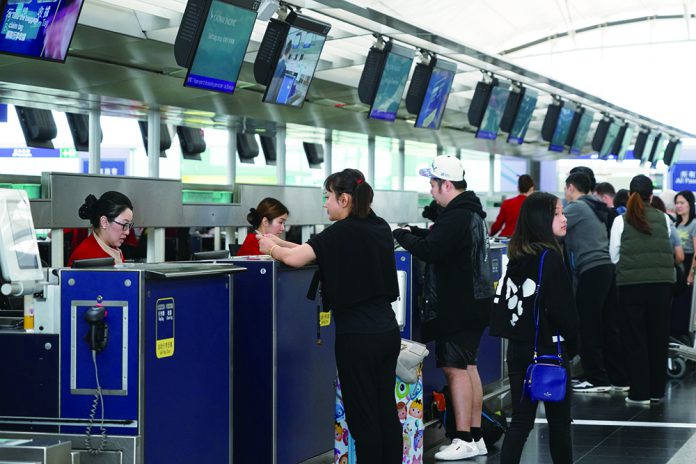
A ground handling staff member directs passengers to flight check-in counters.

Harriet Wan Hiu-long, a 22-year-old who joined Cathay Pacific as a customer service officer two months ago, often has to deal with customer complaints and requests at the check-in counter. She says overbooking, in which airlines accept more reservations than there are seats for, has always been a problem in the aviation industry. Despite undermining consumer rights, overbooking is a common practice among airlines as a business strategy. As a frontline worker, Wan does not have any say in the matter, but has to deal with the dissatisfaction it causes among passengers.

“While the airline earns money through overbooking their flights, we as workers in operation are the ones who suffer customers’ sentiments,” she says.

Edited by Elaine Ng

How Hong Kong lost its crown

Time to rethink regional role as Hong Kong International Airport slips in world ranking?

By Daphne Li & Howard Li

A

nother aircraft lands and taxis off the runway. A jet bridge is marshalled to the parking spot right way, while fleets of shuttle buses run across the tarmac in the distance. With a daily average of 1,100 flights to and from over 220 destinations, the Hong Kong International Airport (HKIA) is one of the busiest passenger airports around the globe. Yet in recent years, Hong Kong’s pride seems to have lost some of sheen, losing ground to other airports in the region.

According to research conducted by the British aviation advisor Skytrax in 2018, the HKIA ranked fourth in the annual evaluation of the World’s Best Airport, having lost its claim to the top spot in 2011 and never regained it. Singapore’s Changi Airport won the accolade for a sixth consecutive year, Seoul’s Incheon came in second, ahead of Tokyo’s Haneda.

The 2018 Skytrax rankings were based on votes from 13.73 million airline customers from over 100 countries, with 550 worldwide airports taking part. The survey evaluates areas and aspects from check-in, arrivals, transfers, shopping, security and immigration through to departures at the gate.

Hong Kong International Airport has fallen in the rankings in recent years

Explaining the decline of Hong Kong’s ranking, Lam Chiu-ying, the convenor of an aviation concern group People’s Aviation Watch, says he thinks having “insufficient aircraft parking spaces with aerobridge[s] connected to the terminal” and the “ambience of the terminals” are partly to blame.

Lam, who opposes the construction of a third runway at the airport because of the environmental impact and because he believes there will not be sufficient increased demand, adds the HKIA should focus on improving traveller’s experience. He suggests it could develop more efficient entry and departure processes, working towards fewer flight delays and improving airport ambience.

However, Stewart Chun Kin-ming, the acting general manager of SATS, a ground-handling company in Hong Kong, says what Hong Kong International Airport needs most to reclaim its former glory is for personnel in different sectors to work together. He says the biggest obstacle to this is the current labour shortage in the airport.

Chun says many of the jobs at the airport are hard and not all people can endure them, which makes it difficult to hire workers. He says the government should take responsibility for attracting more young people to work in the industry rather than just investing in a smart airport.

“At the moment, many jobs still require humans to do the work. Manpower is still important unless someone can invest hundreds of billions of dollars in job optimisation, which I cannot see in the short term,” he says.

Alan Li Wing-foo, the chairman of the Hong Kong Airport Ramp Services Employees Union elaborates on the reasons why it is hard to recruit and keep airport staff, such as baggage handlers. He says the hours are long, the work is physically arduous, there is a poor work environment and the location of work is geographically remote. He adds the return trip to and from work usually takes workers three hours.

Yet, with a third runway in the pipeline, the airport will require even more staff. With the Airport Authority Hong Kong (AAHK) saying the existing two-runway system is reaching maximum handling capacity, the government approved the Three-runway System project to meet a predicted growth in air traffic demand and boost Hong Kong’s competitiveness.

The project involves land reclamation and the building of a new passenger concourse and parking positions, a 3.8 kilometre-long runway and a new baggage handling system. The AAHK predicts the airport will be able to serve 100 million passengers and 600,000 flights annually by 2030 after the third runway is completed. The scale of the works is almost equivalent to building a whole new airport.

But Li is worried about where the workers will come from. “We now have around 73,000 people working in the HKIA. But according to the figures released by the government or AAHK, the airport needs to have 127,000 people working there after the project is completed,” Li says. This means the airport will need to find an extra 50,000 workers. “Where can we find these 50,000 people?” Li says.

The AAHK doest not share Li’s concerns. In a written reply to Varsity‘s questions, it says it has taken various measure to draw talent to work at the airport, such as improving working conditions, providing job security and reasonable salary packages and organising an annual Career Expo and job fairs to attract new talent.

Due to the saturation of HKIA facilities, it is harder to deliver the luggage promptly

For his part, Li, despite his worries about staff shortages thinks the completion of the third-runway system project could improve ground handling services because the current capacity of the airport facilities is saturated. The opening of Midfield Concourse (MFC) in 2015 with its extra aircraft parking stands only made matters worse.

The MFC serves around 10 million passengers a year, however, air travellers in the MFC share the 13 baggage carousels in the Baggage Reclaim Hall with other passengers in Terminal 1. Worse still, the delivery system in the MFC relies on trucks to carry the luggage back to Terminal 1, further adding to passengers’ waiting time and affecting the travelling experience.

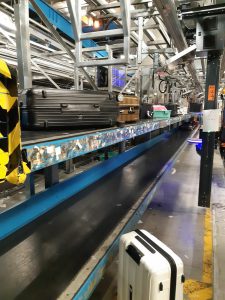
Li says the existing 13 baggage carousels are overloaded and it is difficult for ground service workers to handle the hundreds of pieces of luggage from each flight promptly. “If the airport is fully occupied and aircraft land and park at the same time, what do you expect [ground service workers] to do when baggage from the hundreds of flights are loaded onto the 13 baggage carousels?” he says.

The existing 13 baggage carousels are overloaded
Photo courtesy of Alan Li Wing-foo

Besides falling behind on ground services, the technology and the quality of other international airports are also affecting Hong Kong’s standing. Legislative councillor and professional pilot Jeremy Tam Man-ho takes Singapore’s Changi Airport as an example. Construction of terminal four of Changi Airport was completed last year. Tam says there are many new features in the terminal which the HKIA can learn from, such as the automatic immigration clearance system. “It is like the Hong Kong e-channel services, but it applies to [nearly] all the passports,” Tam explains.

Tam points to the rest zones with comfortable sofas provided in Changi airport, which passengers waiting for delayed flights appreciate. “You can see in Hong Kong it’s another case, in which there are always delayed flights and people sleep everywhere. The chairs are not designed for resting,” he says.

However, aviation sector analyst Michael Hui Chun-wai of Flight Ascend Consultancy, has a different perspective on Hong Kong’s declining rank. He questions whether the HKIA should be chasing the top ranking.

Hui thinks Singapore’s Changi airport excels in baggage delivery services and customs entry but he casts doubt on whether reaching Changi’s level on these parameters is the most important hallmark of a successful airport. “I think Singapore [Changi] Airport is very nice, new and advanced. But is it necessary to make it  that fast-paced? Is it necessary to reach for that high efficiency?”

Hui says Hong Kong is actually doing a great job. “Actually if you observe the immigration process in Hong Kong, it is rather quick comparing to so many other countries. In Asia, it is possible that the [performance of] the HKIA is above average.”

Hui also believes the Skytrax ranking is not comprehensive enough to assess the overall performance of an airport because it only focuses on the experience of travellers. “I believe Skytrax is a quite a popular ranking but I think it might be one-sided. There are various aspects that need to be seen and addressed,” he says.

More importantly, Hui thinks Hong Kong should be realistic and strategic about its role as an aviation hub. “Most of the time, we don’t really need to use words [like] ‘we have to be the first’ or ‘we have to be the biggest airport’ as a benchmark because the market does not have the capability to achieve this,” explains Hui.

Hong Kong is still one of the busiest airports in the world. According to the AAHK, HKIA handled 72.9 million passengers in 2017 and is the world’s busiest airport for cargo. Together with airmail, cargo throughput at HKIA exceeded the 5 million tonne mark for the first time in 2017, making it the first airport in the world to have handled that amount in a single year.

Hui says this shows HKIA is still highly competitive among Asia’s international airports, however he adds its decline is inevitable. This has nothing to do with the airport itself but everything to do with market realities.

The Hong Kong International Airport used to be a major hub for goods and passengers travelling to and from mainland China. In particular, it was a transit point for travel across the Taiwan Strait before direct air links were established in 2005. From that year onwards, Beijing’s Capital Airport overtook HKIA in annual passenger traffic. Not only are there now more international connections to major mainland airports like Beijing, Shanghai Pudong and Guangzhou, but also to second-tier mainland cities. The development of high-speed rail services also adds to the competition.

“Therefore, I think the thing that the HKIA needs to improve is to adapt to the trend of market,” says Hui.

Lawmaker Jeremy Tam Man-ho agrees that consumer rankings are not the most important issue the HKIA has to be concerned with. “Ranking is important, but [more important] is strategic positioning. Hopefully, the HKIA can keep its status as the number one cargo airport in the world,” Tam says.

Edited by Kristy Tong

Sign On

Will emphasis on speaking and hearing lead to demise of Sign Language in Hong Kong?

By Jane Leung & Scarlet Shiu

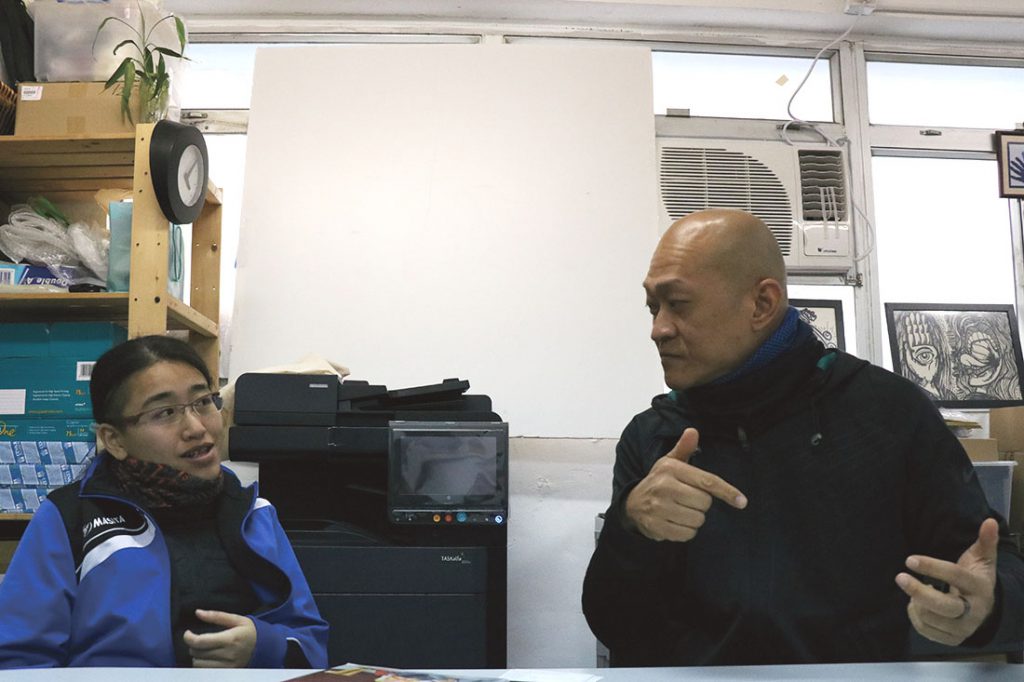
At the Sign Language Association’s office, Wang Kai-fung communicates with his Deaf colleagues using his hands and constantly changing facial expressions. But when he sits down to talk to Varsity, he speaks easily in fluent Cantonese.

Wang, the 52-year-old founder of the Sign Language Association recalls his experience of studying in a mainstream school as a Deaf child. He says Deaf students have to pay very close attention to the shape of the teacher’s mouth when they are speaking in order to guess the meaning of words and sentences.

“Basically, I kept considering words that might fit the shape of the teacher’s mouth. Most of the time, it took me a while to figure out the exact words,” says Wang. “Then, I had to track back and interpret the meaning of the sentence. My thinking [process] became more complex and it slowed down my learning.”

Wang Kai-fung uses Sign Language to communicate with his colleague

In fact, this is still the case for many students with hearing impairments today. In the 1960s, the government began to promote integrated education, with the aim of “educating handicapped children in the same way as ordinary children whenever possible”. In 1972, it began providing free hearing aids for hearing-impaired students. Since 1994, children with severe hearing impairment who find hearing aids unhelpful have been receiving cochlear implantations, a low-risk surgical procedure.

Cochlear implants help transmit weak electric currents to the brain so recipients can recognise sounds without audiphones. The government now sponsors 70 cochlear implantations every year, and most children are able to study in mainstream schools after the surgery.

As a result, the number of schools for the Deaf declined sharply from 13 at its peak in 1973 to just one today. One impact of these policies is that the number of people who use Sign Language has declined over the decades. A report published by the Census and Statistics Department in 2014 showed there were 155,200 people with hearing difficulties in Hong Kong, of which only 2.5 per cent knew how to use Sign Language.

Joseph Hui Ka-yan, 39, is the principal of Hong Kong’s sole school for the Deaf, the Lutheran School for the Deaf. Although fewer Deaf people know Sign Language these days, Hui still recognises the value of Sign Language and uses it at the school to cater to the needs of different Deaf students.

“We adopt the Total Communication approach, which incorporates any modes of communication, be they graphics, videos, sound, mouthing, Sign Language or words,” says Hui. “We use anything that is fit for use.”

Hui says there are only 76 students across the primary and secondary sections of the school for the Deaf because the Education Bureau stipulates that only students with severe or profound hearing impairment can enter the school. However, his school has also been appointed to support other hearing impaired students in mainstream schools through the “Enhanced Support Service for Hearing Impaired Students Attending Ordinary Schools” (ESS) scheme supervised by the Education Bureau, which provides students with academic counselling and verbal communication training after school or on Saturdays.

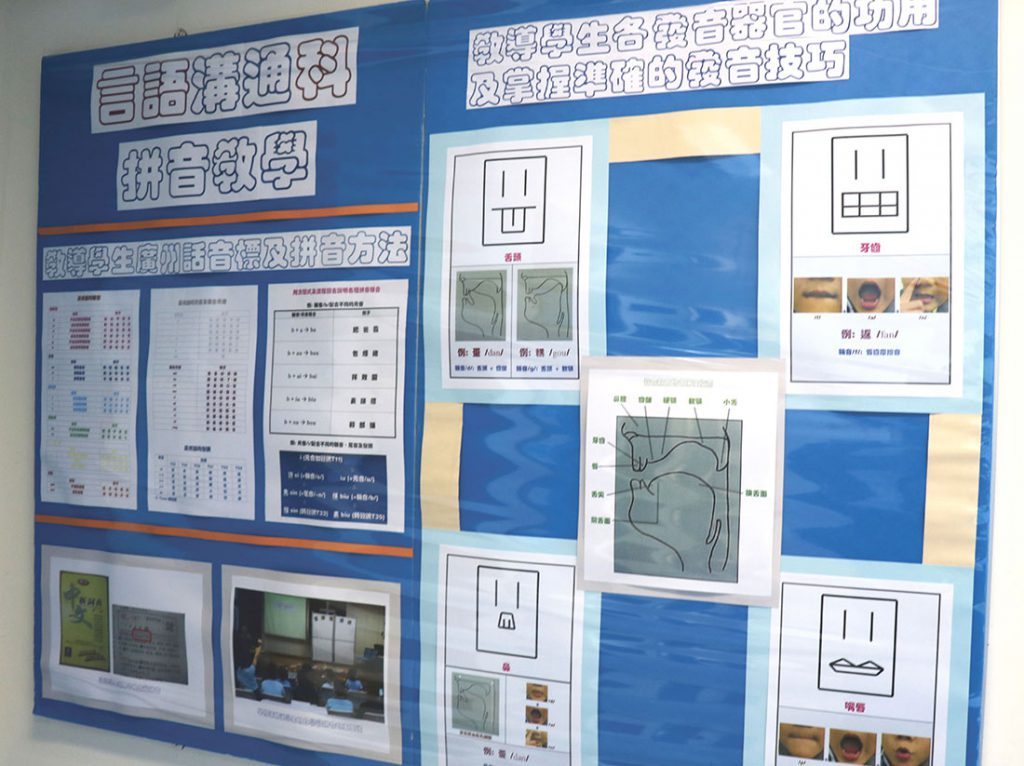
A notice board at the Deaf school that shows students how to pronounce Chinese words

Even with hearing aids and cochlear implants, hearing cannot be fully restored and language development is affected in children with hearing impairment. In the current academic year, 56 per cent of the students at Hui’s school have had cochlear implants but still have severe or profound hearing impairment. Hui hopes the Education Bureau can lower the admission requirements for entering the Deaf school so more students can get the support they need.

Despite the emphasis on teaching children with hearing impairments in mainstream schools using oral and written language with the assistance of electronic hearing devices, there is growing support for adopting a sign-oral language bilingual approach to help Deaf children maximise their language development potential. Experts agree that the early learning of Sign Language will not affect later acquisition of oral language as some had previously believed. In fact, it can enhance learning of oral and written language.

However, there are actually two types of Sign Language used in Hong Kong – natural Sign Language and signed Chinese. Hui uses both but says teachers have to stick to using signed Chinese instead of natural sign language during lessons.

Natural Sign Language is similar to colloquial Cantonese – it expresses the meaning of the conversation directly, while the signed Chinese corresponds to the sentence structure in Cantonese, so signs are used to indicate word order.

Hui says it is possible to use natural Sign Language when he is doing Sign Language interpretation in school talks, but not in class. As teachers need to talk and sign at the same time, they revert to signed Chinese because it fits the spoken sentence structure.

Outside the classroom setting, however, signed Chinese can be regarded as too difficult to understand. Sisters Don Leung Ling-sum, 36, and Leung Pui-yan, 24, were raised by Deaf parents. Pui-yan says signed Chinese is “stiffer” because it represents each and every word in a sentence. She says Deaf people understand natural Sign Language better as it uses visual concepts instead.

Pui-yan illustrates this by citing a common Chinese idiom – “people mountain people sea” – which means there are a lot of people at a place. Leung says rather than signing four separate Chinese characters, the Deaf will understand the phrase better if it is expressed by showing many people rushing to the scene in natural Sign Language.

Don says that although it is harder to understand, the language interpretation in the Legislative Council still adopts signed Chinese. Since 2013, the Legislative Council Secretariat has been providing simultaneous Sign Language interpretation for all council meetings to promote barrier-free communication. It hopes to facilitate people with hearing impairments to understand the work and proceedings of the Legislative Council through live broadcasts on video webcasting systems and televisions.

However, Don says she does not understand half of the content as the interpreters translate whole paragraphs word by word, rather than convey the meaning directly in natural Sign Language. Pui-yan adds that it is hard to do simultaneous Sign Language interpretation for Legislative Council meetings because the vocabulary used is very advanced and interpreters cannot prepare for them.

“It’s best if interpreters can prepare beforehand so that they have something in mind and know briefly what to sign,” says Leung. “If it is simultaneous and live-recorded, interpreters might not be able to understand it right away and get stuck.”

In addition to introducing Sign Language interpretation in the Legislative Council, the Rehabilitation Advisory Committee under the Labour and Welfare Bureau set up a working group in 2009 to promote the use of Sign Language. The Labour and Welfare Bureau said in a written reply to Varsity that the objective of the government’s rehabilitation policy is to create a barrier-free environment and facilitate the integration of persons with disabilities into the community.

The working group recommends the promotion of Sign Language development in Hong Kong in three directions, namely promoting the use of Sign Language in daily life, promoting the message of integration by encouraging the general public to learn Sign Language, and conducting studies on ways to induce students with hearing impairment to learn Sign Language.

However, a motion moved by lawmaker Leung Yiu-chung to make Sign Language an official language of Hong Kong was voted down in the Legislative Council in early 2017. More than half of the members from the functional constituencies abstained, with members from the pro-establishment camp saying this was because Sign Language use is uncommon and not unified in Hong Kong.

Cindy Chan is the founder and chairman of Children of Deaf Adults (CODA) Hong Kong. CODA Hong Kong is working closely with other NGOs and lawmaker Leung to fight for Sign Language to be adopted as an official language in Hong Kong.

Cindy Chan does Sign Language interpretation

Chan sees an increasing trend of Sign Language usage among the general public and believes Sign Language will receive a higher status and priority in society if it is officially recognised. It would mean the government would better cater to the Deaf community’s needs in terms of education and interpretation services in public organisations like hospitals and police stations, says Chan.

“Taking the United States as an example, since they have listed Sign Language as an official language, they will provide Sign Language interpretation whenever a Deaf person is present. When the Deaf visit the doctor, it is compulsory to offer Sign Language interpretation,” says Chan. “This is not the case in Hong Kong.”

Chan adds that most Deaf people are unaware of their rights to request translation services in hospitals and police stations. As things stand, So Kim-wan, a 31-year-old Sign Language tutor at CODA Hong Kong, says Sign Language interpreters have dim career prospects because there is a very limited quota for Sign Language interpreters provided by the government or NGOs. So says this contributes to the phenomenon of most Sign Language courses being extra-curricular activities, instead of professional and systematic teaching.

“Even when you are recognised as a professional [interpreter], the problem is that Hong Kong does not provide the way out for you,” says So. “You have to maintain a basic living, but when this is so difficult to achieve, how can you ask people to devote themselves to do Sign Language interpretation?”

So thinks the government is making some progress in promoting Sign Language, but that Hong Kong still lags behind other cities like Macau where support for the Deaf community was identified in the Ten-year Development Plan for Rehabilitation Services 2016-2025. Measures taken there include training frontline public sector workers in Sign Language and subsidising training for Sign Language interpreters.

Here in Hong Kong, So says misunderstandings still abound about the Deaf. For example, So says the term “deaf-mute”, which the media and the government commonly uses when referring to the Deaf community, has always been inaccurate.

“They are not deaf-mute because their vocal cords are normal. They can speak,” says So. “The term [deaf-mute] is actually a bit insulting to them, but society remains unchanged.”

To eradicate such misconceptions about the Deaf community, So thinks the government should include fundamental concepts about the Deaf in primary and secondary school education. He says students will not have any idea about the Deaf, unless schools arrange voluntary services for them to come into contact with the Deaf.

“Just basic knowledge about Deaf people would be enough, because that is what people don’t have,” says So. “Let’s take the first step.”

Edited by Katie Cheng

Caught Off-guard

Lax visitor registration is compromising security on public housing estates

By Raven Hui & Sam Kwong

In front of the gate, there is a panel with buttons and a keypad next to a screen displaying the words “Please enter the password”. A security guard stands behind the gate to keep an eye on the people coming in and going out. This is a common set-up for ensuring secure access at most public housing estates across Hong Kong these days.

However, not all residents use the keypads every time – some may find it difficult to remember the passwords as they are regularly changed for security reasons. Often, helpful security guards will open the door or press the lock release for residents’ convenience.

Yet, this seemingly helpful gesture can occasionally allow undesirable strangers to enter the buildings. In an infamous case last June, a man followed a woman to her home in Tuen Mun’s Po Tin Estate before forcing the victim into her own unit and raping her.

Mrs Chan, who didn’t want to give her full name, lives on Po Tin Estate, where some of the units are used for interim housing. She says the security guards in her building usually open doors for people with familiar faces. However, she thinks it is difficult for the guards to remember the faces of all the residents because of the high mobility at the estate, where people tend to come and go.

“It’s actually quite expected that he [the security guard] wouldn’t notice [the suspect in the 2017 rape case] was an outsider, because there’s too much of a mobile population here, because [they] move in and out. Sometimes they [the security guards can] forget, right?” she says.

Mrs Chan recounts an incident in which she saw a man claiming to be looking for somebody entering the lift of the building she lives in. She found it suspicious that every time someone exited the lift, he would try to follow them. Chan says that after the 2017 rape case, she pays more attention to whether the people entering the building are residents or strangers.

Varsity has found that it is a common practice for security guards in public housing estates to open doors for those entering buildings. In February, our reporters tried to get into 65 buildings in nine public housing estates located in Kowloon East, Kowloon West, New Territories North and New Territories South and Hong Kong Island (categorised according to their respective police districts) assuming the identity of private tutors. The reporters managed to enter more than 90 per cent of the buildings by either following residents when they went in or by having the doors opened by security guards.

Security guards questioned us on our identity 20 per cent of the time, and we were required to log our details into the visitors’ registration less than 8 per cent of the time.

To obtain the Security Personnel Permit required in order to work as security personnel, a guard has to pass a trade test recognised by the Security and Guarding Services Industry Authority (SGSIA), have a certain number of years of experience in performing security duties over a specific period of time, or pass the end-of-course exams for security training courses endorsed by SGSIA.

According to the Syllabus for the Trade Test for Security Guards, which is largely based on the basic training standards set by SGSIA, the main duties and responsibilities of a security guard include the prevention of unauthorised access to premises and properties, registration of visitors and taking precautionary measures to prevent personal data from leaking out to unauthorised parties. Guidelines for security guards are also subject to contract requirements between the estate and estate management companies.

Ah Lai is a security guard who sits behind the counter in the lobby in a public housing estate building in Wong Tai Sin.

Ah Lai (who does not want to disclose her full name to protect her job) is a security guard who sits behind the counter in the lobby in a public housing estate building in Wong Tai Sin. Her main duties are to memorise the faces of the residents, spot visitors and record their identities, and to take turns to patrol around the building. Ah Lai says she only presses the door release button for residents she recognises.

Compared to private residential buildings, public housing tends to have a lot more units. This makes it difficult to remember the faces of all the residents. Ah Lai says that she has to stay alert by constantly looking at the gate, but there is a chance that she may miss a stranger and end up mistakenly letting outsiders enter despite her 13 years of experience as a security guard.

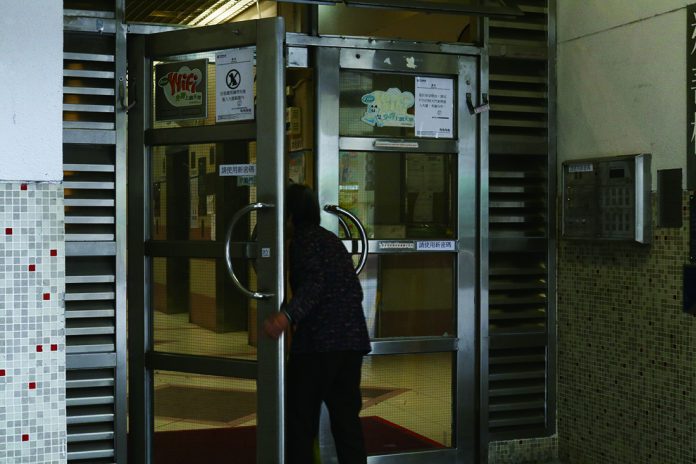
Signs on the door of a public housing estate building, reading “this door always remains closed” and “visitors, please go to the counter at the lobby for registration”.

On the ground floor of public housing buildings, there are usually notices reminding visitors to register their details and residents to key in the entrance password themselves for security reasons. Ah Lai says that in principle, residents should enter the password themselves and security guards should only open the door for residents who have mobility problems. She explains that while she does open the door for residents, this is because she has been working in the same building for years and has memorised the faces of most residents.

The 62-year-old says it is hard for her to follow the guidelines strictly because residents are used to having security guards open the door for them and some even take it for granted.

“Sometimes when we can’t open doors because we’re refilling our water bottles or have our heads down writing things, they’ll glare at you… They’ll scold us ‘what are you doing sitting there? Why don’t you open the door?’” Ah Lai says.

Public housing estates used to be seen as hotbeds of crime. In 1986, RTHK’s Hong Kong Connection programme ran an episode on the triad-ridden environment in Kwai Chung Estate. Tsz Wan Shan Estate, which was later subdivided into several estates, was the sphere of influence of a triad group known as the Thirteen Guardians of Tsz Wan Shan (慈雲山十三太保).

With major improvements in security starting in the mid-1990s, public housing estates have gradually shed the negative images from the past. Installations, such as CCTV, entrances with password pads or smart cards, and intercom systems were put in place by 1998. These have improved the security conditions on public housing estates.

Authorities do not provide a breakdown of crimes committed on public housing estates, but from a search of news articles of reported cases in 2017 in the Apple Daily (and accessed via the Wisers Information Portal), we found seven instances of rape by inputting the search terms “estate” and “rape”. Of these, three took place on public housing estates. When the search terms “estate” plus “burglary” were entered, reports involving seven burglary cases came up, one of which took place on a public housing estate.

Hammie Ng Ka Wing has been living in Pak Tin Estate in Shek Kip Mei for eight years. She thinks the estate is safe even though she observes that most residents do not input the password when they come in through the main entrance of her building. The default appears to be security guards opening the door for residents and Ng does not have a problem with it.

“If they [the security guards] can recognise the residents, it’s good [to open doors for them]. This way … the interpersonal relationship can be better. It’s like helping each other out,” says Ng.

However, she thinks there may be a security issue with the building’s back entrance. She herself usually enters the building the back way where there is no security guard and residents must input a password.

“Those doors close very slowly, people can seize the chance to sneak in,” says Ng, who speculates the doors close slowly so as to not cause injury to the elderly. “But this may let criminals sneak in,” she adds.

Ng is aware of the series of burglaries in Kowloon East from July 2016 to October 2017 that targeted public housing estates in Kwun Tong and Sau Mau Ping, but she is not worried this will happen in Pak Tin Estate.

“It’s unavoidable. On the other hand, our estate is rather old, most people are not very wealthy, so the chance [of burglary] will be lower,” she says.

Hui Kam-sing is a Wong Tai Sin district councillor and a member of the Estate Management Advisory Committee of Chuk Yuen (South) Estate. Growing up on a public housing estate in Tsz Wan Shan and having served as a social worker for people affected by public housing redevelopment in the 1980s, he has witnessed how security systems have been standardised and improved in public housing over the years.

But while the hardware has improved, Hui thinks the human factor is what determines the standard of the “software” in security.

“First, it depends on individual security guards, some are more proactive in [in checking identities],” says Hui. “Second, it depends on the demand of the estate management companies or the residents. To be honest, residents in public housing don’t necessarily require you to be very strict.”

Hui says he rarely hears residents complaining about security; they do not seem to mind that access control is not strictly implemented.

“When security is good, people will take it easy. They’re just afraid of crimes, like sexual assault and burglary but if there aren’t any of those, then why should they be nervous? That’s what people are like. When they’re worried they’ll be nervous and vigilant, then they’ll let down their guard when there’s nothing to worry about.”

Currently, the management of about 60 per cent of the Housing Authority’s rental estates have been outsourced to private companies through tendering exercises, while the rest are directly managed by the Housing Department.

Johnnie Chan Chi-kau is the President of the Hong Kong Association of Property Management Companies. Comparing private and public housing, Chan says the level of security requirements depends on the scope of service provided by the estate management companies as stipulated in their contract as well as residents’ expectations.

“Residents in private housing are more accepting of [being questioned about their identity by security guards]. They think that more questioning is a safeguard of security,” says Chan. He thinks those who own their property may see tighter security as a safeguard of their investment, while public housing tenants may view it as an inconvenience. He adds security personnel in public housing are sometimes treated impolitely when carrying out strict identity checks and registration.

The difference extends to the way residents interact with the companies responsible for providing security. Chan says owners of private units tend to be more committed to monitoring management companies’ work. “But residents in public housing are different. They just sign a tenancy agreement with the Housing Department [Authority]… After the security company is hired, whether it’s expensive or not, good or bad … they don’t think there’s a problem.”

Edited by Nannerl Yau

Living and Learning in Parallel

Foreign students feel left out as universities rush to internationalise

By Erica Li & Soohyun Kim

Hillary Susanto had expected to meet people and make new friends from all over the world when she came to Hong Kong. Now, as she approaches the fourth year of her Bachelor of Business Administration (Honours) in Management at the Hong Kong Polytechnic University (PolyU), she is bitterly disappointed by the mismatch between her expectations and reality.

“Every article says Hong Kong is an international city and that’s what I thought,” says Susanto. “But I did not expect that they would be this really closed … they close themselves towards foreigners and I didn’t expect that.”

Susanto, who is from Indonesia, is the president of the International Students Association (ISA) at PolyU. She decided to run for the office because she noticed a yawning gap between local and international students. She wants to make use of the platform to create opportunities for international students to be active in campus life and integrate with local students.

Looking at the composition of university clubs and societies, Susanto says they are all composed of local students and international students have few chances to participate. She cites the experience of a friend from India who tried joining in an activity held by a local society on campus. As the only non-local student at the event, her friend sat for two hours without understanding a thing as the proceedings were conducted exclusively in Cantonese.

“I have the experience of being isolated in a group of local students. So I wouldn’t want that kind of experience happening again,” Susanto says.

However, she does not bear a grudge because she says she understands the culture of local students and their preference to not interact with international students.

“Like when you’re in your comfort zone and you have all of your, you know, friends where you speak the same language. You wouldn’t want to step out of it,” she says.

Like many institutions around the world, Hong Kong universities want to pursue internationalisation to become and remain globally competitive. This is partly driven by university rankings systems which include international indicators in their ranking criteria.

According to the Quacquarelli Symonds (QS) World University Rankings 2018, five out of Hong Kong’s eight publicly funded universities are among the top 100 out of 959 ranked universities in the world. The number of international students, international faculty and co-authored articles has a significant impact on the rankings, with the first two making up a total of 10 per cent. And in recent years, Hong Kong institutions have scored highly in these two areas.

However, a closer look at the data reveals this has mostly been achieved because of the high number of mainland students and faculty in Hong Kong universities. According to the University Grants Committee (UGC) 2016-2017 annual report there were 12,037 mainland students out of 16,474 non-local students of UGC-funded programmes in Hong Kong. That means mainland students make up 73 per cent of the non-local student population.

David Ho Wai-lun, a researcher with the SynergyNet think tank and teaching fellow at the Technological and Higher Education Institute of Hong Kong says: “The ranking of universities somehow is just a game that cannot reflect how internationalised Hong Kong universities are.”

Ho, who has conducted research on the topic, thinks internationalisation should be about bringing Hong Kong’s higher education into line with international standards. He says this helps to build up the global networks for academic research and the exchange of knowledge, ideas and expertise. However, he is worried that an over-emphasis on conducting research of global interest and with global impact could lead to neglecting the development of local research. It could also affect the career development of young scholars who want to focus on researching local issues.

Another side-effect of pursuing internationalisation is the use of English in university classrooms. While there are benefits in Hong Kong students achieving improved English proficiency, some students question what they describe as the “overuse” of English in lessons.

Wong Pak-hei, a local student currently studying Cultural Studies at the Chinese University of Hong Kong (CUHK) says: “In Hong Kong, papers in Chinese language would not be valued.” He thinks students should have a choice over whether they want to write their papers in Chinese or English as they are studying in the “Chinese” university of Hong Kong.

Wong is sceptical about universities’ attempts to boost their rankings in order to attract international students. “The most important thing is what kind of experiences you are giving to the non-local students to attract them, and that doesn’t come from rankings,” says Wong.

Having shared a room with a Taiwanese student and a Korean student last term, Wong thinks the needs and welfare of international students are not adequately addressed.

“I feel like they are being thrown in here and then ignored with no support and assistance,” he says.

i-Centre in The Chinese University of Hong Kong (CUHK)

It is not just the administration side which is at fault. Raees Begum Baig, an assistant professor at the Social Work Department of CUHK, says local students are not sufficiently sensitive to or aware of the presence of international students on campus.

Baig gives an example from her class in which she noticed that during discussion time, a Mexican student who was the only non-local student in a group of four, sat silently while the others spoke in Cantonese.

“You have to get a language that people understand. You may not be their friends. You don’t really need to be their friends. But at least you need to be communicating with them,” says Baig.

Baig thinks international students can bring more diverse views into classes. For instance, when she talks about migration in class, European students, whose home countries are experiencing refugee crises can share their points of view with local students.

“So it depends on the students or the teacher how they try to incorporate the two groups together,” she says.

Baig points out that merely having international students studying at a university does not mean the whole campus becomes more international.

“It’s the parallel society within the campus,” laments Baig.

There may be many English-speaking activities on campus but these activities are restricted to international students. Local students tend to attend only Cantonese-speaking activities.

To transcend the parallel society phenomenon, Baig says internationalisation should be defined by daily actions and interactions on the ground.  She thinks internationalisation is only achieved when local and non-local students can really interact with each other and have the same choices in their academic life.

“So it’s all about the same choices and whether we perceive the two batches of students as [having] one identity as students, rather than we always have to separate them as international students and local students,” she says.

Baig is currently working on a study on inclusion on campus and has a group of five students helping her on the project. Park Soo-bin, a Korean member of the team, thinks there are very clear-cut social circles on campus and that international students and local students belong to different ones.

Professor Baig’s research group on her study of inclusion within campus.

“So even within the classroom, we are all in the same place like learning the same thing, doing the same thing, we are still separated,” says Park.

Leung Mei-sze, the only local in the group, thinks the university wants to welcome more international students but local students do not give them any support.

“In the societies’ promotion period, you see the dem-beats [cheering], or the tiny leaflets that they gave out are also in Chinese,” says Leung.

Simone Charlet, a German member of the group, adds that language is only a symptom of the underlying reasons for the separation. “People don’t see us as one of them,” she says. Charlet thinks there are many barriers and walls in people’s minds and that local and international students are not really one. She for one, feels excluded.

Robin Albrecht, another German member of the group hopes that everything on campus can be as accessible to non-Cantonese speakers as they are to Cantonese speakers. “We are just as much students as Cantonese speaking students,” he says.

Instead of just trying to attract international students, Albrecht hopes the university can go a step further and think about what happens when they get here and provide assistance for them.

Cheng Kai-ming, an emeritus professor in the Education Policy Unit of the University of Hong Kong (HKU), agrees universities have a role to play and should think carefully about what to do after international students are admitted.

Cheng thinks Hong Kong, as a metropolis, should not have universities that are confined to local students. He thinks it is not the intention of the universities to admit more mainland students, rather that there is just an overwhelming number of students from the Mainland applying to universities all around the world. “It’s nothing about good or bad. It’s that you have to live with such a situation,” he says.

All UGC-funded institutions in Hong Kong have a cap on non-local students, where they may make up to 20 per cent of the undergraduate population. Peter Li from the International Office of the Hong Kong Baptist University (HKBU), says that of this 20 per cent, they aim to admit 10 per cent from mainland China, and 10 per cent from other parts of the world. “Basically for diversity sake, to make sure that, you know, not creating a ghetto type of situation on campus to make sure that we are keeping balance so to speak,” Li says.

Li admits that, in order to improve or maintain a university’s ranking, it is necessary to be able to present some numbers. While bringing in international students would boost these numbers, he hopes the numbers do not dictate the kind of programmes and activities that take place on campus. After all, Li says, ranking is not everything.

“In my opinion, I think internationalisation is beyond the numbers,” he says. “Like it or not, local or mainland or other international students, if you have a critical mass, chances are students will try to interact.”

Edited by Brianna To

Tabletop Fantasy

More Hongkongers are embracing board game culture

By Valerie Wan

Chess, Monopoly, Scrabble and Cluedo may be some of the best-known board games but they represent just a fraction of the table-top games on the market. Contemporary board games come in many shapes and sizes and have an ever-growing variety of themes. They are also no longer just a form of entertainment – board game designers are merging entertainment with education, designing games people can play while learning at the same time.

Princeton Wong Tsz-fung is a 24-year-old game designer and the cofounder of NightDreamer, a local games company. Their latest project, Electioneer, is a Hong Kong-themed board game based on the local electoral system. There are five geographical constituencies and seven functional constituencies in the game and players have to get the highest number of votes to win.

Electioneer

Wong says, initially, he had no intention of developing anything with a political theme – he thought he would introduce the unexplored parts of Hong Kong through a game, especially to foreigners. “I just wanted to create a board game with Hong Kong’s map,” he says. In the process, he discovered unique features and characteristics of various districts and landmarks in the city. In creating the game, he has developed a deeper understanding of his home city, he says.

The project was funded on Kickstarter, a global crowdfunding platform. In the space of around a month, Electioneer raised HK$87,794 from 198 backers. Wong regards the platform as a channel for both crowdfunding and promoting the project. The game is being sold online for HK$408 but Wong says the profit margin is slim and the funds from the Kickstarter campaign barely cover the cost of production.

Being a board game designer in Hong Kong is not easy. Wong says Hong Kong people tend to be more demanding and have higher expectations of local designs. It is hard to make a living as a full-time board game designer, so he is considering taking freelance jobs in the future. Still, he says the ultimate purpose of making and playing board games is to have fun. “I don’t want to make board games perfunctorily just for the sake of sustaining a living and making profits,” Wong says.

Edward Chow Tak-shing is one of the six hosts of BG Port HK, a platform that aims to promote board game culture in Hong Kong. They regularly post board game reviews, recommendations and experiences on YouTube, Facebook and their blog. Chow, who works in education, recalls how he became fascinated by a strategic board game when he visited a board game café 10 years ago.  He enjoys playing European games the most, which are not dependent on luck and involve competition between players through indirect conflicts.

“I think board games are the best kind of entertainment in the world,” he says.

Chow enjoys board games because they can provoke thought while fostering face-to-face communication and negotiations but his approach is not share by everyone.

Cloud Ho Kin-shing, the owner of board game café Board and Card Games says the most popular games are party games, which are characterised by their simplicity and relatively short playing time. He adds that popular games – such as Dixit, Cluedo, Alias and Camel Up – are those with rules that can be understood within five minutes. “Hong Kong people don’t like to think,” he says. “You won’t read a bunch of English rules to play a game after school or work.”

Locally designed board games account for only five per cent of the games in Ho’s café and he attributes this to the lack of talent in the local board game market. Another reason Ho thinks there are fewer local games is that they tend to be more difficult, and people usually prefer easier games. “An interesting game does not guarantee a good sales outcome,” he says.

Despite the variety and popularity of video, online, mobile, and virtual reality gaming, board game culture has been on the rise in Hong Kong recently. Compared to when he first started his business eight years ago, Ho says board game culture has become more popular. He says he now has around four times as many customers visiting his shop than when he first opened and around 40 per cent of them are from schools and non-governmental organisations. Ho also sees more parents using board games for educational purposes.

A mother and daughter at a board game cafe.

Press Start is a games and events start-up that advocates for the gamification of learning. It collaborates with corporations, schools and NGOs on training, curriculum design, and workshops, integrating board games into education. The group hosts monthly open board game socials to introduce and recommend different kinds of games to players according to their experience level and preferences.

Vince Siu Hin-wai, one of its founders, says they hold training sessions and workshops, and welcome newcomers to the socials every month. Participants are not informed about the intended learning outcome of a game beforehand but are simply told to go ahead and play and then there is a casual discussion. Siu says their role is not to guide the players towards a specific outcome but simply to foster a learning environment.

But for board game culture to move up to the next level in Hong Kong, Siu thinks there needs to be a change in mindset.

“We all know the Chinese saying – playing is not good. But why?” asks Siu. “Does playing mean you can’t learn anything?” He adds that the local education system, especially parents, have to change their way of thinking.

A board game social.
Courtesy photo of Vince Siu Hin-wai

For Siu, a player can acquire multiple skills through board games. One of his own favourite games is based on running a craft brewery business. The strategy game conveys some basic principles of the business, such as the ingredients and equipment used. Those who have little understanding but are interested in craft brewing can learn more through the game. Also, he says board games teach players how to react to losing, and can help foster leadership and resource management skills as some games require players to come up with strategies to manage limited resources. These are things school exams cannot do.

Founded in 2006 when board game culture had yet to become so prevalent in Hong Kong, Jolly Thinkers is one of the earliest board game cafes and game education specialists in the city. As a pioneer in Hong Kong’s board gaming scene, Jolly Thinkers researches educational and entertaining board games from around the world and stages board game activities, workshops, and learning groups for all ages. Apart from running a café and education services, it is also involved in retailing and publishing.

Joyce Lam Yuen-han, one of the co-founders, is a former secondary school teacher.  “It’s all about the magic of boardgaming and I really want people to know,” she says. Lam thinks board games have the power to connect people and are educational. She wanted to create a relaxing setting for board game players, so she chose to introduce the educational elements in a café setting. “You learn well when you are happy,” Lam says.

Another founder, John Guest teaches linguistics at the University of Hong Kong. He recalls the catalyst for starting the business was the occasion he brought his small suitcase of board games to Lam’s house and she really enjoyed playing them. Guest, who spends his weekends introducing customers to games and teaching people how to play them, thinks Hong Kong’s board game industry is developing steadily. He says that whereas most of their customers were adults at the beginning, there are now more students and parents bringing their kids to the café. For Guest, board games are becoming an alternative for those who do not want to be so immersed in mobile games and seek more interaction.

In a further development, Jolly Thinkers partnered with a company called Play Infinity to introduce the Boardgaming Instructor Certificate programme two years ago. The course equips educators with the knowledge and skills to teach and provide board game-related services and the certificate is recognised by the World Leisure Organisation.

People from different sectors, including teachers, social workers, and even staff from the Correctional Services Department have signed up for the courses. Lam and Guest hope the programme can encourage more people to spread the word about the benefits of board games to a larger audience in Hong Kong.

But compared to its neighbours like Taiwan and Japan, Hong Kong’s board game industry is still relatively underdeveloped. Charles Yan Kwing-hung works in the furnishing industry and founded Time2Play Game Ltd in 2010 to provide board game design, production, publishing, and consultation services. He says Hong Kong is still four to five years behind Taiwan, which has a larger population and its own mature crowdfunding platforms. The printing factory that Yan’s company works with is in Taiwan and it produces 70 per cent of Taiwan’s locally designed board games. Yan says production costs on the island are much lower than in mainland China.

He says the biggest challenge of the boardgaming industry is the low revenue and profits. In Hong Kong, designers have to take on multiple roles such as project management and promotions on top of designing. In more developed markets, there are editors, publishers and retailers supporting the role of designers. Yan thinks local designers have to aim for the international stage in order to break out of the limited local market.

However, Yan sees opportunities in the local board game industry overall. Board game culture is not just a flash in the pan but a popular hobby after years of low-key development, he says.

Edited by Selena Chan

Dolls for Dementia

Comfort dolls are becoming an alternative therapy for dementia patients

By Fangdong Bai

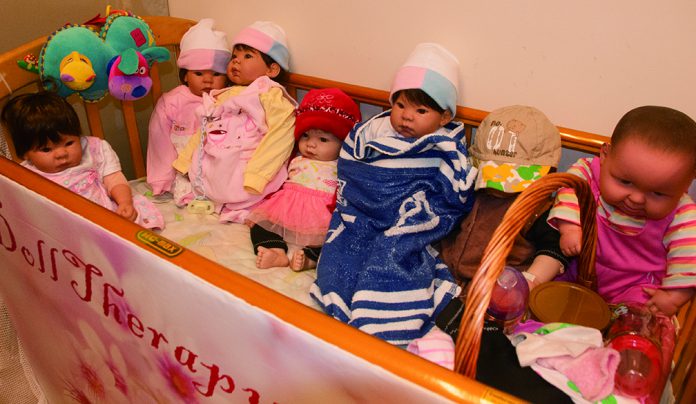
Dolls are usually seen as children’s toys or carefully displayed collectors’ items but occasionally they can be seen in the arms of old people, who may be rocking, talking or singing to them. Comfort dolls are becoming increasingly popular for therapeutic use to alleviate the symptoms of dementia in elderly care institutions and hospitals in Hong Kong.

Doll therapy originated in the 1990s, as a non-pharmacological intervention for people with dementia. The idea draws upon attachment theory in psychology, which proposes that humans need to form strong emotional attachments to develop in “normal” and healthy ways. Research carried out at Queens University Belfast showed the therapy reduces the need for medications and reduces anxiety, aggression and wandering behaviour of dementia patients.

The Department of Old Age Psychiatry of Castle Peak Hospital started using doll therapy in 2015. Advanced Practice Nurse Lui Hung-kong says the seven dolls currently in use were purchased from the United States and cost around HK$700 each. The dolls resemble Asian babies, and their weight is similar to that of newborn babies. Lui says the cost of doll therapy is relatively low, but carers play an important role in the process. “How we the staff execute [the therapy] directly affects the effectiveness of doll therapy,” he says.

Lui says the hospital provides guidelines to its staff, patients’ families, and nursing home carers. He points out carers only take a passive role in the intervention and that patients can decide whether they want to take part in the therapy, adding that those who have had traumatic experiences with babies are excluded.

The doll therapy corner is equipped with baby necessities.

As patients may treat the dolls as real babies, carers need to pay attention to the dolls’ safety and comfort. The doll therapy corner in the department’s activity room is equipped with toys, diapers, and pacifiers, to show the patients that the “babies” are in a safe and protected environment. Lui recalls the time when he almost hit a doll’s head by accident and one of the patients became really agitated and told him to be careful. He says although some family members were against the therapy at first, most of them gradually accepted it as they saw its effectiveness.

Lui cites the case of a 77-year-old male dementia patient who was grumpy and had behavioural problems such as wandering and violence issues. He also tried to hide other patients’ slippers and stayed awake at night. Although he tried different medications, they were not very effective. Doll therapy had a positive impact on this patient who named the doll after his eldest son and became very involved in the role of a caregiver.

The patient whistles and sings to, feeds, and smiles at the doll. He shares his experiences with other patients, and even leaves a space between himself and the “baby” when sleeping to avoid hurting it. Lui says that on one occasion, he occupied and sat on another patient’s bed and they nearly got into a fight. But once a member of staff handed him the doll, his attention was immediately diverted and the conflict was resolved. There has been a significant change in his behaviour and his family bought him a similar doll afterwards.

But doll therapy has its critics, who see it as demeaning and patronising because it treats the elderly as if they were young children. They say it involves dishonesty and deception and is manipulative.

Lui is aware of these criticisms and says staff at the hospital would never define what the dolls mean to the patients or tell them they are real babies. Also, they respect each patient’s interpretation and the values they attach towards the doll.

Doll therapy is also being used in mainland China, which is grappling with a rapidly ageing population and the diseases of ageing. The Li Ai Elderly Home is a privately operated elderly care centre in Chengdu, Sichuan. More than two thirds of the elderly living there are dementia patients and the centre has been using doll therapy since it first opened in June last year. Yang Qinglin, the consultant at the centre, says doll therapy is only used as an auxiliary therapy, along with other non-pharmacological therapies such as music, horticultural and massage therapy.

The centre has purchased fewer than 10 comfort dolls so far, while some families bring their own dolls to the elderly patients. Yang says comfort dolls distract patients from depressive thoughts and relieve the symptoms of dementia.

Although dementia medications claim to reduce the severity of symptoms, Yang says most families find the drugs are not very effective.

“In normal cases, we don’t encourage families to choose medications after a period of time,” says Yang. Apart from the lack of effectiveness, he adds that the medications have side effects such as causing an inability to think clearly and cognitive impairment. As a result, patients have to take sedative drugs too. Without an effective and specific solution to treat dementia yet, Yang regards doll therapy as a more moderate form of therapy.

Back in Hong Kong, the Jockey Club Centre for Positive Ageing has been using doll therapy for more than 10 years. There are currently six dolls available, mainly purchased from local department stores, for dementia patients ranging from mid-stage dementia to the severe cognitive decline stage. Occupational therapist Nancy Tang Yeuk-man says the dolls provide companionship and remind patients of the days when they were the caregivers.

Comfort dolls at the Jockey Club Centre for Positive Ageing.

Elderly patients who are unable to join group activities because of their physical condition or disability may feel useless. They have little to occupy their time or find any real meaning in life. Doll therapy works particularly well for these patients as they can have meaningful interactions with the dolls, which makes them feel they are still capable of taking care of children and increases their confidence. Compared to other forms of non-pharmacological therapies, doll therapy is easy to carry out in different settings, including at home.

However, Tang says there has been little research carried out on doll therapy in Hong Kong and there is a lack of guidelines and protocols on its use. Although she has seen more nursing homes using comfort dolls in recent years and dolls are available at most centres, they are not used in a very structured or systematic way. “Not all centres are doing it in a therapeutic manner,” she says. She adds that caregivers have to pay attention to who will be receiving the therapy. It is inappropriate for caregivers to give a doll to patient indiscriminately, as some may have negative reactions to a baby.

Apart from human-like dolls, the Jockey Club centre also uses robotic pet therapy and currently has an electronic cat. Tang says it performs random movements and fosters better interactions with the patients than comfort dolls do. It also holds patients’ attention and creates feedback. However, Tang points out that as most robotic pets are manufactured in Japan, and “speak” Japanese, it is hard for patients to have a deeper level of interaction with them.

As for developing Hong Kong’s own robotic pets, she knows some organisations are interested. “I think it’s still in process,” she says. But she believes both doll therapy and robotic pet therapy are growing trends in Hong Kong.

One of the robotic pets used by elderly care centres in Hong Kong is PARO, a therapeutic robotic seal that was also developed in Japan. It is designed to look like a baby seal, an animal most people have no direct contact with, which means patients can accept it easily without preconceptions. IDS Medical Systems (Hong Kong) Company Limited is the sole agent of PARO in Hong Kong. Manager Peter Wong Yu-fu says PARO is basically a substitute for pet therapy, which is also known as animal assisted therapy. Patients may have difficulties taking care of real animals, and with robotic pets, there are fewer hygiene and allergy problems.

PARO

The PARO model that elderly care centres in Hong Kong are using is the Chinese version and the ninth generation of the robot. PARO learns to behave in the way users prefer and its posture sensor allows it to remember every gesture the user makes. It recognises voice patterns but does not speak. In other words, it can only carry out interactions instead of conversations. “A real animal doesn’t speak,” Wong says, “so it should be as identical to a real living creature.” He says PARO provides companionship and relaxation to dementia patients, and he receives generally positive reactions from care centres.

But compared to Northern European countries like Denmark and Norway where the government finances the use of PARO as a piece of medical equipment, the development of the therapeutic robotic pets in Hong Kong is mainly supported by NGOs.

PARO robots cost HK$50,000 each and Wong says, in Hong Kong, only the leading elderly care institution groups, such as Tung Wah Group and Po Leung Kuk, have the resources to purchase one. Fewer than 50 have been sold in Hong Kong since 2013, when the company first introduced PARO to the city.

But Wong is glad to see the government making efforts to support the use of high-tech medical equipment in recent years. Looking ahead, he hopes more elderly care centres can see the benefits of PARO for dementia patients, leading to more widespread use of the therapy.

By Selena Chan

Becoming Angie Cheong

How the Malaysian-born actress and businesswoman learnt to love different roles

By Ada Chung

She has played a Spider Spirit, a sexy leather-clad ghost hunter and much more besides, but the story of 44-year-old Angie Cheong Wai-yee’s life could give any of the dramas she has acted in a run for their money. It is a story of departures and heartbreaks, of homecomings and love.

And it begins in Ipoh, Malaysia where Cheong was born and grew up with four siblings. She says her parents were open-minded and let their children grow up freely and independently. Given the freedom to dream, the young Angie dreamed of becoming an actress from a very young age.

She fondly recalls how she loved to act out different parts in front of a mirror when she came home from school. “I think every one of us is born to be a certain role,” says Cheong. “I wanted to act, I wanted to be an actress.”

Like many overseas Chinese, she grew up watching Television Broadcasts Limited (TVB) dramas and aspired to join the company when she grew up. This was no easy task for a girl in Ipoh but Cheong soon figured out a path to make her dream a reality. “There was only one path [to become an actress in Hong Kong], that was to compete in a beauty pageant,” she says.

Having set her goal, Cheong set about preparing to run for various beauty pageants. She made her first attempt when she was 13 years old, participating in a teen beauty pageant called The Young Princess Beauty Contest (妙齡公主). Although she did not win, she gleaned experience which helped her in later contests.

Cheong realised the importance of preparation and worked hard on presenting herself in the best possible light to win over judges. Her hard work paid off when she won the title of Miss Chinese Malaysia in 1992. This meant she could represent Malaysia to compete in the Miss Chinese International in 1993, which was held by TVB in Hong Kong.

Cheong was not so concerned about winning the contest, but about having the chance to stand on TVB’s stage. “I didn’t care whether I won or not, but that among the candidates, I must make myself stand out in the spotlight so that I could stay in Hong Kong [TVB],” she says.

Cheong did not win the competition but decided to stay on in Hong Kong in case TVB made her an offer. “I told them I’d stay at this hotel after the competition, you can look for me there, I will stay for three days,” she recalls.

The plan paid off, on the second day, TVB rang her and asked if she would like to stay and become an actress. “I was very happy, I felt like my dream had come true,” she says.

At first, adapting to her new life in Hong Kong was a challenge. She had no friends or family, she had never experienced winter in Malaysia and the Cantonese spoken in Hong Kong was different from that spoken in Malaysia. She remembers answering the phone calls put through to TVB’s Artists’ Department so she could practise her Cantonese and reading the newspapers out loud to a supervisor every day.

Over time, Cheong’s efforts bore fruit. She was given starring opportunities in dramas, including popular ones such as Mind Our Own Business (開心華之里) in 1993, Crime and Passion (新重案傳真) in 1994, and the long-running hit sitcom A Kindred Spirit (真情) in 1995.

Outside of TVB, Cheong also acted in films and in Asia Television Limited (ATV) dramas such as the cult classic My Date with a Vampire II (我和殭屍有個約會II). The girl from Ipoh became a household name.

During these years, Cheong says she learnt a great deal about her craft – her acting skills improved a lot. She also learnt about the importance of team work as making a drama requires collaboration among many production members.

Then, in 2003, Cheong’s world came crashing down. Cheong was beaten up by her fiancé, an experience that left not just physical but also emotional wounds and damaged her self-esteem.

“I was so ashamed at that time,” she says. “Whenever I saw people whisper in one another’s ear, or get a glimpse of me, I felt like they were talking about what happened to me.”

Looking back, Cheong says she lacked the judgment to make the correct decisions for herself. After the abuse, she was under immense emotional strain and needed to find a space where she could find some relief. Later that year, she decided to leave Hong Kong for Beijing, to make a fresh start in a Chinese city where nobody would recognise her.

Cheong took some time off to collect her thoughts and to look back at her life. She came gradually came to the realisation that, “it seems that besides acting, I know nothing…Should I change my way of life?”

In 2004, she decided to venture into business – importing Malaysian tropical fruit jams to Beijing stores. First, she needed to find a local distributor to help her get the goods into local stores. With no local connections, she did not know where to start. “I went to the local supermarket that sold imported food … there were stickers with the distributors [details] on every product,” she recalls. Cheong copied these details and contacted the distributors one by one. Finally, she found one who would work with her.

Cheong with her son Hanson. Photo courtesy of Angie Cheong.

While Cheong was managing her fruit jam business in Beijing, the idea of doing volunteer work hit her, out of the blue. In the summer of 2006, she began to help out at the Ping An Medical Foster Home (平安之家) in Beijing, which helps orphans with serious illnesses and birth defects get medical help and care.

“I guess when a woman reaches a certain age, she would feel a kind of maternal instinct inside,” says Cheung as she tries to explain why she chose to volunteer at the home.

The decision was to bring an even bigger change to Cheong’s life. At the home, she met a two-year-old, Hanson, who was born with a heart defect. “I thought he was very cute,” says Cheong. “The second time we met, I brought him to have ice-cream at the hotel lobby. He called me ‘mother’.”

At that moment, Cheong decided she would try to adopt Hanson but the process was long and complicated. It had already been arranged for Hanson to be adopted by an American couple but Cheong knew the process would take some time (usually eight months to a year).

She asked the principal of the home if she could take care of Hanson while the adoption was pending. The principal was a Hongkonger who had seen Cheong’s work as an actress. She rejected the request because she was not convinced that Cheong would have the time or commitment to take care of the boy.

Cheong refused to give up. She showed her determination through her actions, visiting the home every day to cook meals for Hanson and take care of him. Her dedication finally moved the principal and she was allowed to bring Hanson home.

A few months after that, the American couple gave up on adopting Hanson and Cheong applied to adopt him. It took eight years of complex proceedings before Cheong was finally declared Hanson’s legal mother in 2014.

Being a mother to Hanson has been life-changing. She has to take care of Hanson’s daily living and medical expenses. As her fruit jam business was not doing so well, she moved from Beijing to Panyu, Guangdong in 2008 to expand the scope of her business. She obtained agent’s rights to sell certain daily commodities and wholesale bird’s nest, and opened a gift shop selling ginseng, dried seafood and wine in Guangxi. She also operated franchises of the chain dessert shop Hui Lau Shan in Beijing, Tianjin, Chongqing and Chengdu.

She thinks her experience as an actress has helped her in business as she is good at communicating with others. But, at the same time, she had to cast away her identity as an actress in order to start learning about business from zero.

Above and below: Angie Cheong during the shooting of the TVB drama “Old Maids’ Alliance”. Photo courtesy of Angie Cheong.


Having settled into her life as a businesswoman and mother, Cheong came “home” to Hong Kong and to TVB in 2013 after an absence of 10 years, to star in the hit drama, Never Dance Alone (女人俱樂部), a series that also featured other former stars who had all but retired from the entertainment industry, such as Gloria Yip.

The drama series – which restarted her acting career – chronicled the ups and downs in the lives of a group of six women who went to school together. The real ups and downs in the lives and careers of the show’s stars – in particular Cheong and Yip – added resonance to the show.

To Cheong, her relationship with Hanson seems like destiny. “I believe Hanson is the grace from God,” she says. After adopting Hanson, her personality changed. “I have turned into a more mature person who embraces family life.” Currently, Hanson lives with Cheong’s family in Malaysia, while she travels back and forth between Hong Kong, Malaysia and the Mainland.

Her son’s medical condition has made Cheong realise how precious life is. “That is why I cherish the moment…it is important to love others with our heart”, she says. “The value of life is to share your love to others selflessly.”

Looking back over her life, Cheong describes herself as a “phoenix rising from the ashes”. She has played different roles on the screen and in life and she is thankful for them all.  “I am in love with every role,” she says.

Edited by Nancy Mak

Nami – The Chameleon Campaigner

Hong Kong-Nepali student fights for rights of foreign domestic workers

By Jasmine Ling

When the 18-year-old applied for a part-time job two years ago, she could not have imagined she would wind up speaking in front of an audience that included reporters, officials from Asian governments and representatives of the International Labour Organisation. But that was what Namrata Shrestha – known as Nami – did at the 10th Association of Southeast Asian Nations (ASEAN) Forum on Migrant Labour in the Philippines capital Manila last October.

The theme of the forum was “Towards Achieving Decent Work for Domestic Workers in ASEAN”, and it was organised to support the implementation of the ASEAN Declaration on the Protection and Promotion of the Rights of Migrant Workers. Representing the Hong Kong Federation of Asian Domestic Workers Union (FADWU), Nami talked about the working conditions of domestic workers in the city and received a standing ovation from the participants. “I felt like ‘oh my god’… I am contributing to a change,” she says.

Nami speaking at the 10th ASEAN Forum on Migrant Labour. Photo courtesy of Nami.

Now 20, Nami was born in Hong Kong to Nepali parents and is a third year student of aviation management and logistics at the Hong Kong Polytechnic University. She began working part-time as organising secretary at FADWU when she was just 18. A college friend had told her about the position. Although she had no previous work experience, she landed the job because of her determination to change domestic workers’ lives. “I just wanted to help the people…I just wanted to help someone out,” she says.

FADWU, which is affiliated to the Hong Kong Confederation of Trade Unions (HKCTU), is an umbrella group of five unions representing local and migrant domestic workers of different nationalities, namely Nepalese, Thai, Filipino and Chinese. It has more than 1,500 members. By bringing together domestic workers of different nationalities, FADWU strives to advocate for rights for all of them. “Even [though] there are different nationalities, we come together and we fight for each other,” says Nami.

As the organising secretary, Nami’s job is to coordinate the unions that make up FADWU. As she is of Nepalese ethnicity and speaks the language, she mainly takes care of the Nepalese union.

Nami’s first job in FADWU was to coordinate a project for the Union of Nepalese Domestic Workers in Hong Kong (UNDW). The project consisted of a number of different events such as a survey and dance and English classes for Nepalese domestic workers. The survey found that nearly 45 per cent of Nepalese helpers were paid less than the legal minimum wage for foreign domestic workers and that more than 53 per cent did not get the mandatory full rest day a week.

“Nepalese domestic workers are like little to none, they are very, very minority,” Nami says.

Conducting the survey was a means to let workers know about the rights they are entitled to. Nami took part in organising a press conference to present the findings of the survey and publicise the plight of Nepalese workers. She felt a sense of accomplishment as UNDW’s membership increased from 65 to 110 after the poll and other activities related to the project.

Nami is also involved with an annual FADWU event called FADWU Kitchen, which is a gathering where all domestic workers bring their own food, share with one another, play games and have fun. Although they may be of different nationalities and speak different languages, Nami says the domestic workers have much in common and share “the same passion”.

Looking at this confident and lively young woman today, who is so active in helping some of Hong Kong’s most disadvantaged workers, it is hard to imagine that Nami was once shy and quiet. But that is how she describes herself as being in her school days.

She was born in Hong Kong but financial hardship led her mother to send her back to live with her grandmother in the Gorkha District of Nepal when she was just six months old. She later moved to Kathmandu, Nepal’s capital city, where she entered a boarding school.

Nami describes herself as being very active and tomboyish at that time. She took part in different activities like dancing and drama, and sports like football, swimming and badminton. She enjoyed a carefree childhood in Nepal.

That all changed after her mother gave birth to her younger brother and Nami was brought back to Hong Kong so the family could live together. Nami entered primary three at school where she had to contend with a different culture and different languages.

Since she had spent most of her time in Nepal playing, she could speak in Nepali, but not well, let alone communicate in English and Cantonese. She attended a local ethnic minority school, Sir Ellis Kadoorie Primary School, where she became very quiet. By the time she progressed to Sir Ellis Kadoorie Secondary School (West Kowloon), her English had improved a lot and she had adapted to life in Hong Kong. She made many Nepalese and Filipino friends as well. However, she says she was still a lot shyer than she had been in her Nepal days.

Nami says it was not until she took up her job at FADWU that she regained her confidence. She recalls that when she first started working on the UNDW survey for her first project, she had found it awkward to strike up conversations with strangers. But in order to conduct the poll, she had to go out and ask domestic workers questions about their work. She learnt to communicate with others and became more comfortable doing so over time.

She also learnt in other ways too. The 20-year-old has to bear the responsibility of speaking for domestic workers. She has held press conferences, given television and radio interviews, and spoken on behalf of FADWU and domestic workers at the Legislative Council.

“I would say I really, really grew up with FADWU,” she says.

Nami (first row, third from the left) with FADWU members at an exhibition featuring work by a disabled Nepalese artist. Photo Courtesy of Nami.

Nami says her multi-tasking job as organising secretary of FADWU makes her something of a “chameleon”. She can be a choreographer in a dance class one moment, an English teacher, event photographer, a journalist interviewing and writing about domestic workers for FADWU publications, an activities leader, and a spokesperson in the media at other times.

What all her FADWU roles have impressed upon her is the serious problems domestic workers face in Hong Kong. The problems are often complex and different nationalities face different difficulties.

For Filipino and Indonesian domestic workers, Nami says the problem is not so much that they do not know about their rights. The widespread problem in these communities is the exploitative behaviour of employment agencies, such as the overcharging of agency fees. For smaller minority groups like the Nepalese, Indian and Bangladeshi domestic workers, the problem is that many do not know English and Chinese and they tend to be unaware of their rights. As a result, these workers are frequently exploited and mistreated by their employers in terms of salary and working hours.

Nami says that one case that left a very deep mark on her involved an Indian domestic worker whose employer, over the course of six months, refused to allow her out of a house on Lamma without permission. The woman was around 60 years old and could only speak Punjabi. Her employer had physically abused her and withheld her wages. Initially, Nami only barely managed to communicate with her in Hindi. Later, FADWU helped her file a case with the Labour Department and get her unpaid salary back.

The woman’s case made Nami very sad. “Domestic work is like any other, it’s a job…they are at home doing their job so that you can go out and do your own job,” she says. “If you don’t like them…you can terminate them. Don’t abuse their rights at least.”

She believes that there are worse cases in which victims do not know where to find help. She says most victims do not even know there is a union. “They don’t know how to approach us, so we try to approach them,” she says, explaining why the union organises outreach activities.

Nami is currently working on a project funded by HER Fund, a foundation that gives financial support to help protect the human rights of grassroots women. The project includes carrying out a survey on domestic workers’ working conditions, and putting on activities like Cantonese, English and dance classes and cultural festivals that promote labour laws. She wants domestic workers to know about their rights.

She has gained a lot from her two years in FADWU. “It’s more than a job, they give me so much…I am very, very happy to work here,” says Nami.

And she is not just a multi-tasker within the organisation. Nami also finds herself involved in many activities outside FADWU as well.

Apart from being a full-time student and part-time unionist, she also works as a part-time teacher in a tutorial centre where she teaches local children English comprehension, writing and phonics.

As for her studies, Nami says she has been interested in aviation since her secondary school days. She took the Applied Learning Course in Aviation in senior secondary and cultivated her interest in the subject. She thinks aviation is a growing industry with a lot of prospects. She believes the aviation system in Nepal is backward and she hopes to learn more about aviation and help her native land in the future.

Some of her friends find it interesting how she can be a social activist, a teacher and an aviation student at the same time. Although her roles do not really overlap, Nami does not think it is a big deal. Apart from her aspirations to help domestic workers, her teaching and aviation studies, she also wants to open orphanages in Nepal in the future and, as if that wasn’t enough, the plan eventually is also to help street dogs.

“You don’t really [need to] limit yourself to one thing”, she says. “I’m happy doing what I am doing.”

Edited by Nancy Mak