











Home Blog Page 62

Save the Last Song for Me

Temple Street lounge singers are still clinging to the stage

By Johanna Chan, Edith Chung & Gloria Li 


On a typical mid-week evening, the music lounge would be packed full of people. Soft coloured lights would bounce around the room to the rhythm of the music played on stage. As the singer began her performance, heads would turn and some audience members would sing along to the familiar melody. As the tune comes to an end, there would be rapturous applause as happy customers rushed forward to put their tips in a box in front of the stage. The singer would smile graciously, give a small bow and thank her patrons for their generosity. As the night wore on laughter, conversation and song would resonate around the club.

Such was the scene in veteran lounge singer Eva Wong’s glory days. As she recalls it, Wong lets out a heavy sigh and says those days – when she could make over a HK$1,000 a night – are long gone.

Hong Kong had a vibrant live music scene in the 1960s, with singers entertaining audiences in up-market restaurants, nightclubs and night markets. Young women would sing at stalls on Temple Street, providing entertainment for passersby and picking up tips. Businessmen saw this as an opportunity and began moving stalls indoors, transforming them into today’s lounges.

Temple Street singing lounges still preserve much of the lifestyle, music and local nightlife culture from that time.

Hoi Ying, a singer at the Cantonese Lounge remembers how nervous she was the first time she stepped onto the stage to sing, how her hands trembled as she held the microphone. But she also remembers how the audience had cheered for her and how patrons came forward to leave tips. That was nearly ten years ago. These days, Hoi Ying no longer feels stage fright but neither does she feel excited when people give her tips. She only feels the increasing pressure of trying to make ends meet.

Hoi Ying says when she first started singing, she could make upwards of several hundred dollars from performing for a few hours. Now, she says there are nights where she makes less than HK$ 100 in an evening.

She explains singers’ earnings come solely from tips, of which a large portion is handed back to the lounge owners. “Singing a song means paying HK$100 site fees. And the boss will take away 20 per cent of our tips,” Ho Ying says. “Now the business environment is not good, which puts pressure on us.”

She believes the scene is dying because fewer people are frequenting song lounges and those who do are often not there for the music.

There are those who like to sit back and enjoy the performances. But as customers can do whatever they like in the lounges, some treat it as a chance to catch up with friends, others to play mah-jong, games with dice, or even  a chance to flirt with the singers.

There are also those who treat the lounges as a bar and smuggle in bottles of beer and liquor.  Mr. Lui is one of them. The 58 year-old visits the lounges and stays until dawn every night. He frequently spends thousands of dollars on tips and alcohol. He has friends in Temple Street who drink with him, and he will only grab a cab to go home when he is drunk.

Mr. Cheng is another regular customer, but one who goes for the music. He treats it like a hobby. To him going to a song lounge it is just like any other kind of entertainment. Others may spend their cash on gambling, he would rather pay for live-music. He says listening to music is a relaxing and healthy hobby and he always comes to the lounges when he is free.

Although the customer base is shrinking, new singers still start at the lounges, attracted by the flexible hours and relatively easy way to make earn some extra income.

Fong Ting, who became a part-time singer three years ago, says the hours are very convenient for her, “I only need to work two to three hours every night and sometimes I could earn a few hundred dollars just by singing in one club.”

Fong Ting says there are difficulties in every job, and singing is relatively easy and profitable compared to other jobs.  However she admits there are fewer and fewer customers in recent years, and there is little they can do about it as most patrons are retirees. Youngsters have no interest in these old clubs, she says, describing her career as a “sunset industry”.

Watch below for a performance from one of the singers from Tokyo Lounge: 

The veteran lounge singer Eva Wong, who now owns her own club, has little patience or respect for singers like Fong Ting who are in it for the money.

“When money is involved, the approach and heart change,” she says. “You’ve twisted (the performance) into something else entirely.”

Wong says she opened Tokyo Lounge two years ago in order to continue her singing career after many clubs she sung in started going out of business. Today, her singing lounge is one of seven still operating on Temple Street. Wong once envisioned her lounge as a grand and luxurious place, she saw herself performing with a live four-man band to an adoring audience,

“When you’re singing and the audience listens to you singing for them, that response you get from their reaction, oh that feeling,” she enthuses.

But the reality of operating a business in a fading industry quickly caught up with her. Wong’s dreams were quickly dashed as she shouldered countless financial burdens. “It is really hard when you are on Temple Street, no matter how enthusiastic you are, reality will smack you on your head.”

As her business depends on tips from individual customers, she is constantly worried about how many will turn up on any given night. Regardless of the turnout, she must find the money every month to pay the rent, the keyboard accompanist, and the cleaners.

Performers are another source of uncertainty. Accompanists are getting scarcer, but more singers are joining the industry. As the singers are not required to call in before coming in to work, Wong is sometimes caught short. Once, she sang alone for an hour to keep the lounge open.

Despite the uncertainties and financial worries – veterans like Wong find themselves unable to leave the stage. For her, and many other performers, the reason they entered the industry in the first place was because singing is their passion,

“I am a singer at heart,” she says. “If you don’t let me sing, what else can I do?”

Edited by Yi Yeung 
Saving China

How an artisan and art teacher is keeping a dying art alive

By Gloria Li 

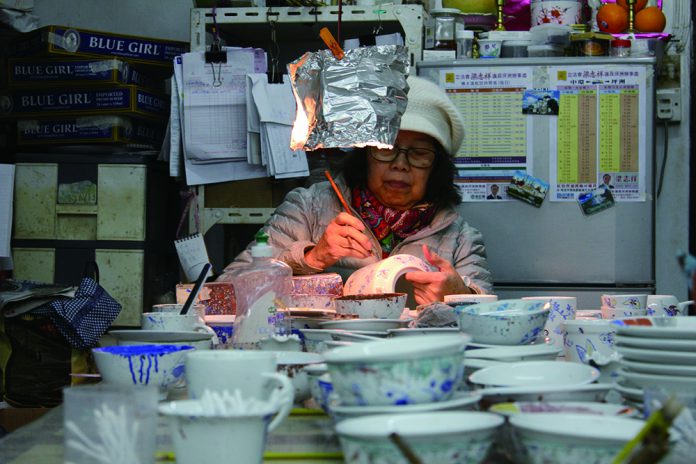
Sitting quietly under an amber light, Lam Kiu colours a porcelain teapot with a brush. For the 73-year-old, this is just another peaceful afternoon in her shop, Chiu Kee Porcelain. Tucked away on Peng Chau Island to the east of Lantau Island, Chiu Kee has witnessed the vicissitudes of the Cantonese porcelain industry since the 60s. Lam, who is one of the few remaining masters of porcelain painting, has been practising this traditional technique for over half a century.

An industry which thrived from the 60s to the 80s, the Cantonese porcelain business relies on the skillful artisans who paint intricate patterns on the white ceramic. In its heyday, thousands of were craftsmen employed to create these pieces of art in Hong Kong.

The aging Chui Kee Porcelain store is located on Peng Chau Wing Shan Street.

After learning the art of porcelain painting in Singapore, Lam and her husband returned to Hong Kong in 1967 and started their porcelain business on Peng Chau Island a year later. She says back then the area was a bustling industrial center with dozens of Cantonese porcelain factories.

They would purchase semi-manufactured white china and paint them before baking them to the kiln. Their products were then transported by ferry to Kowloon for sale. In the glory days, Lam employed over 30 artisans to cope with the mass of orders.

Cantonese porcelain features gorgeous colors, precise composition and exquisite hand crafts. Lam’s specialty was impressing patterns onto porcelain with stamps, then painstakingly polishing them and colouring them with brushes.

Miss Lam paints on all types of porcelain products, ranging from cups, bowls to teapots.

However, with the increasing labor and rental costs, the local Cantonese porcelain industry declined in the late 1980s because labour was cheaper in the Mainland. Lam closed down Chiu Kee’s factory but opened the Chiu Kee Porcelain shop where she would paint and sell porcelain on her own, while her husband worked other jobs to make ends meet. “Fewer and fewer craftsmen stayed in the industry because they couldn’t make money,” Lam says.

Facing serious financial pressure in 2005, Lam considered closing up the shop for good as the family could no longer afford to pay the rent by selling porcelain. “I was loath to part with porcelain painting as I knew it would disappear if I closed the shop,” Lam says. The shop was saved when Winus Lee, a ceramist and art teacher, offered to join the business and share the rent.

After the partnership was formed, Lee helped Lam host painting classes for interested people in order to promote the traditional craft. In the workshop, Lam explains the basic skills and knowledge about Cantonese porcelain painting, and instructs students to practise by themselves. “Sometimes when I see my students enjoying painting porcelain so much or making pretty works, I am also very happy,” Lam says.

Although she is well past retirement age, Lam has no intention of putting down her brushes. “I will feel bored if I don’t paint,” she says. “I enjoy the process of painting. I don’t want to stop once I’ve started.”

If you are interested in purchasing porcelain or joining a workshop, please visit 7, Wing Hing Street, Peng Chau. You can search “Winus Lee mini ceramic workshop” on Facebook or call 91938044 for more

Edited by Yi Yeung

Climbing is for Everyone

Amusement park meets climbing gym

By Johanna Chan 

You face the transparent climbing wall, and on the opposite side, your friend does the same. You give each other a quick nod, and begin the ascension. You reach up for the purple hold, then the green, and then another purple. Your partner has to mirror your every move. With a final push, you both reach the top and with a smile, push the red button together, signalling a successful team climb.

Pairs mirror each other’s movement while climbing up this course.

While most indoor climbing facilities in Hong Kong offer typical climbing walls, Verm City in Quarry Bay also has a Clip N’ Climb area with 19 themed sections for beginners. Besides the 6.3-metre transparent wall, there is also is a rainbow-coloured climbing spiral, a speed challenge wall, and a vertical drop slide.

With sports climbing becoming an official Olympic sport in 2020, Cary Lee, 45, the director of Verm City, saw the need to nurture a young generation of rock climbers. He says it is difficult to find new climbing talent because children lack exposure to the sport. He set up the Clip N’ Climb, where people clip their harness in to an automatic belaying system, as a less intimidating way to introduce rock climbing to Hong Kong. Through the Clip N’ Climb, Lee and other instructors are able to spot potentially talented individuals who may be interested in taking it a step further and training more professionally.

Even young children try out this drop challenge, going down a slide.

Lee says he enjoys seeing families and friends come together and bond over climbing. He says many enter the gym with their faces glued to their smartphones, but once they start the challenges, the phones are forgotten and everyone is participating – giving tips and encouragement to help each other complete the climb. Friends challenge and encourage each other while parents physically help their children get up.

Lee compares climbing to life, saying that in different stages of life you get different amounts of help. At the beginning of a route, a climber could get a lot of physical support, but once they get higher up, they must rely on themselves.

“Climbing is about problem solving. Every route you see represents a riddle,” he says. He believes that there are no barriers to climbing. Throughout his career, Lee has seen children as young as two years old and adults as old as 80, as well as physically and mentally disabled people climb up the walls.

Friends challenge each other to reach the top of this creative climbing course.

Lee’s eyes gleam when he recalls new climbers pushing themselves to reach the top for the very first time. He says he feels a rush of joy whenever he sees their self-confidence build up through climbin  g.

The veteran climber believes the biggest obstacle for newcomers is the psychological fear of taking the next step. He says much of climbing is about mentally challenging and believing in oneself. “Only those unafraid to die are unafraid of heights,” says Lee.

Verm City is located at 4/F, 321 Java Road, Quarry Bay. For more details, call 2560-8128 or visit https://www.vermcity.com/.

Edited by Yi Yeung 

Dodge this!

This is one sport Hong Kong does not want to miss

By Edith Chung 

With just ten seconds of the game left and two players down, the Hong Kong dodgebee team was in dire straits. As the timer ticked down to the final second, the team launched a final offensive, successfully knocking out three players on the opposing team, securing the match win.

Recalling the memory with a smile, Ken Lai Kong-ip, the head coach and a founder of the Hong Kong Dodgebee Association Limited (HKDA) said his team would end up finishing sixth in the Taiwan open tournament – a first for a Hong Kong team. Dodgebee is a mix of both frisbee and dodgeball. Originating from the United States in the 70’s, the sport was brought to Asia in the late 80s. Lai first discovered the sport online and with a group of friends, formed an association to promote it in Hong Kong.

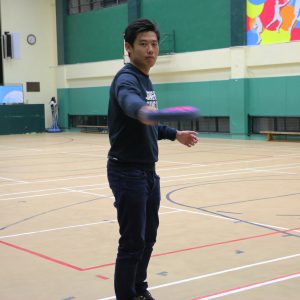
Ken Lai Kong-ip, one of the founders of HKDA demonstrates how to throw a dodgebee

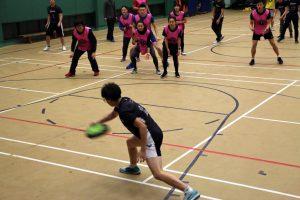
The rules are simple- each team has up to 13 players and players are elimnated if they are struck by the dodgebee disc – which is made of soft foam – or if they drop it when they try to catch it. The side that eliminates the other first or has more players at the end of the four minute round wins the game. Sometimes, there may be multiple discs on the field and teams have to think of creative methods to win. “It consists of many sports elements, requiring both athleticism and strategy,” says Lai.

What most attracts Lai to dodgebee is that the sport is easily accessible for anyone. He says the gender, height or weight of a person does not matter, they can still play on the same field against one another. As the disc is made of soft materials, dodgebee is also a very safe sport that even children can learn to play without being afraid of getting hurt, adds Lai.

Another advantage dodgebee has over other sports is that it does not require a lot of space. Lai believes this makes the sport highly suitable for a compact city like Hong Kong. “It only needs a volleyball court’s space,” he says, “you could have like 26 players in the court at the same time when you are playing it.”

Dodgebee is a sport which does not require a lot of space and can be played with both boys and girls on the field

Dodgebee is still a relatively new sport, however it is quickly gaining popularity. Lai recalls the competition HKDA held last year at Wan Chai’s Southern Playground where there were several hundred people competing and around a thousand spectators. He feels the sport has caught the spotlight as many different media outlets reported the event. Lai hopes this may galvanize the Government to provide more resources for the sport to grow.

The association provides starter courses as well as lessons for trainers, participants can learn at least one technical skill within three to four hours.

If you are interested in learning the sport or want to know more about it, please visit Room A7, 26/F, Jing Ho Industrial Building, 78-84 Wang Lung Street, Tsuen Wan. You can also search “Hong Kong Dodgebee Association” on Facebook or their official page http://hkdodgebee.org/ for more details.

Analyst: Pro-democracy camp needs high turnout rate for strong showing but should win Legco by-election

By Jasmine Ling

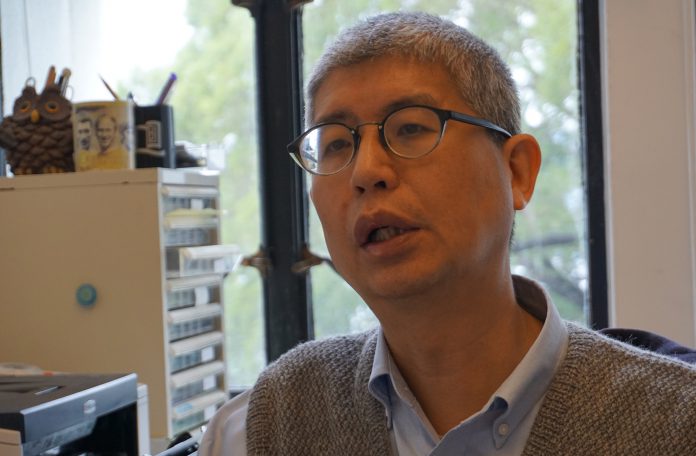
Political scientist Ma Ngok says the pro-democracy camp is likely to win all three geographical seats in tomorrow’s Legislative Council By-election, although the margin would be highly dependent on the voter turnout rate. Ma, an associate professor at the Department of Government and Public Administration at the Chinese University of Hong Kong says a high turnout rate would also be decisive for pro-democrat Paul Zimmerman’s chances of winning in the Architectural, Surveying, Planning and Landscape functional constituency.

Ma’s predictions are based on the historical share of votes obtained by the pro-establishment and pro-democracy camps in previous elections and by-elections, which give the pro-democracy camp an an edge in the geographical constituencies. As tomorrow’s elections – in Kowloon West, Hong Kong Island and New Territories East – will be decided by a single-seat single-vote system and both camps are united behind a single candidate, it should be a straightforward race.

Of the three constituencies, Hong Kong Island saw the smallest difference between the pro-democratic and pro-establishment vote in 2016. But Ma thinks the pro-democracy camp still has a higher chance of winning the seat. He says the constituency is the one most affected by the disqualification of an electoral candidate – in this case, Demosisto’s Agnes Chow-ting who was the highest profile candidate to be barred. Ma adds that Au Nok-hin, who was seen as Chow’s backup candidate, has run a good campaign.

The central issue of the pro-democracy camp’s campaign is opposition to the disqualification of legislators following ‘oathgate’. As two of the ousted lawmakers, Youngspiration’s Yau Wai-ching and Baggio Leung Chung-hang belonged to the localists’ camp, Ma thinks the pro-democracy camp might be able to pick up some localist votes, although the extent they are able to do so is uncertain.

However, Ma does not expect a high voter turnout given the subdued election atmosphere so far. By-elections tend to attract fewer voters anyway and media coverage of this by-election seems to be limited. There have only been a few election forums and unlike previous elections, few commissioned polls to track the popularity of candidates.

“If I compare this by-election to the 2016 New Territories East by-election, it’s obvious that the mood of discussion was [then] far more intense”, says Ma.

Still, Ma says it is hard to know what impact this will have on the final results. As the voter turnout will likely be lower than for general elections, both pan-democracy and pro-establishment camps may not be able to fully hold onto their bases in this by-election

While the pro-democracy camp is campaigning around the issue of disqualification, Ma says the pro-establishment camp does not appear to have a persuasive campaign issue to counter their rivals. Government-friendly forces are focusing on advocating against filibustering in the legislative council However, as Ma points out, filibustering is no longer possible after the amendments to the Legislative Council’s rules and procedures were passed last December.

“No matter who is winning in this election, it won’t affect the fact that there should be little chance of filibustering in the Legislative Council,” he says.

In fact, the outcome of Sunday’s poll will have little impact on the overall political landscape, says Ma. Rather it would send a “political message” one way or the other.

“It sends a very different political message if voters are very angry about DQ and come out to vote for pan-democrats, and if they can re-enter [the legislative council] with a large margin, or if they’re really disillusioned, there’s a low turnout rate and a couple of pro-establishment [candidates] are elected.”

Edited by Nancy Mak

Tony Tse Wai-chuen wants to win seat back, back more large-scale infrastructure projects

By Erica Li

Tony Tse Wai-chuen wants to get back into the Legislative Council so that he can back large-scale infrastructure projects in Hong Kong. The former legislator for the Architectural, Surveying, Planning and Landscape Functional Constituency says such projects are crucial for the city’s development.

“They’re long-term investments, high-return investments. Hong Kong would die without them,” he says.

He suggests that 30 per cent of public works should be allocated to the local small and medium sized enterprises. “Only the locals [can] understand the problems of Hong Kong,” says Tse, throwing a jab at his Dutch-born rival for the seat Paul Zimmerman.

The 63 year-old surveyor represented his sector in the legislative council from 2012 to 2016, before being defeated by Edward Yiu Chung-yim in the 2016 legislative council election. Yiu was subsequently disqualified after deviating from the official oath during his swearing in.   

Tse says he made many policy suggestions which he describes as beneficial to the industry and society during his tenure, but that they were rarely followed.  

He thinks better use can be made of local talents in solving  problems in the industry, “Whenever projects are delayed or over-budget, it’s because the professionals are not put to good use,” he says, adding this includes the problems with the construction of the Express Rail Link.  

On the issue of housing, Tse supports more sandwich class housing because he thinks it would improve the upward mobility of Hong Kong’s middle class.  “The sandwich class could have the chance to move to private housing after a few years,” Tse says, “then the social disparity could be reduced.”

In light of the controversy surrounding the illegal structures a the home of Justice Secretary Teresa Cheng in January, Tse was quick to criticize his by-election rival Paul Zimmerman for having unauthorized building works, “He did apologize, but apology is not enough when it comes to breaking the law,” quips Tse.

Zimmerman has since removed the illegal structures and has stated that he has never tried to hide the fact that they were unauthorized, adding that he registered them under the ‘Reporting Scheme for Unauthorized Building Works’ with the Buildings Department in 2011.

Tse – who boasts 42 years of experience in the sector – also has other questions about Zimmerman’s credentials. He says his rival does not even have the right to vote in the functional constituency as he does not have the relevant professional qualifications.

Tse is also dismissive of  the “anti-disqualification” platform that the pro-democracy candidates have placed at the centre of their platforms in this by-election. He accuses them of “moving the goalposts”. Tse says the rule of law is the cornerstone of Hong Kong and the democrats should respect the court’s decision on the disqualifications instead of shifting the narrative when judgements do not go in their favour.

The other candidate running in the Architectural, Surveying, Planning and Landscape functional constituency in the 2018 Legislative Council by-election is incumbent Southern District Councillor Paul Zimmerman.

Edited by Yi Yeung

Anti-LGBT candidate Joyce Chiu seeks guidance from Bible

By Iris Yeung

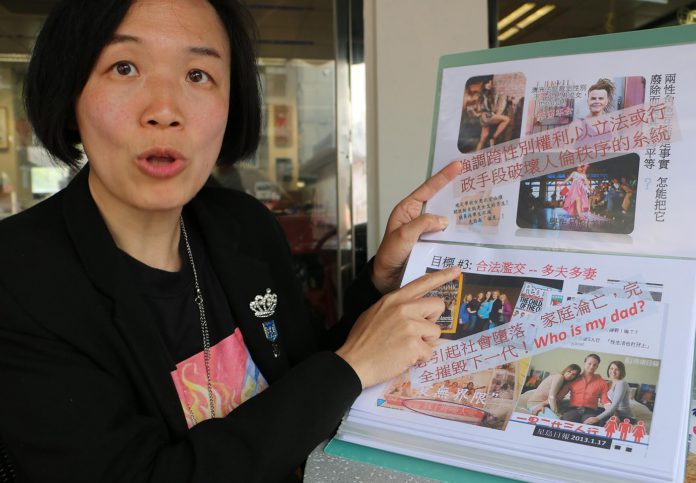
Anti-LGBT activist Joyce Chiu Pui-yuk says she is guided by God and the Bible in her bid for the New Territories East seat in Sunday’s Legislative Council By-election.

Chiu, who describes herself as a guardian of the city – says the defence of  “traditional” family values is at the centre of her platform.

Although the by-election is taking place against the backdrop of a slew of controversial issues such as co-location arrangement for the Express Rail Link and legislation of Article 23, Chiu says she does not have a clear stance on any of them. Instead of taking sides in the debates, she says she would make up her mind by following the words in the scriptures, even if this would lead to going against public opinion.

Chiu is a member of the anti-LGBT rights group, Family School Sexual Orientation Discrimination Ordinance Concern Group. She is best known for her opposition to same-sex marriage.  

The 47-year-old former nursery school teacher says she wants to “build a caring society” and is concerned with the learning difficulties faced by students with special education needs. She says more resources should be allocated to this group of children, especially those from low-income families.

Chiu also says there is a need to strengthen the moral education of students and thinks the recent stand-off between students and staff at the Baptist University of Hong Kong over a Putonghua test highlights the need for students to respect their teachers.

For Chiu, a lack of mutual respect is a problem that isn’t confined to Hong Kong’s campuses, she says it is also rampant in the Legislative Council. Chiu is critical of what she thinks is the radical approach of some lawmakers.

“For some people, they would throw things at others inside the Legislative Council chamber whenever they’re dissatisfied with some issues, or they would threaten others in a loud voice. This is not good for Hong Kong society. Lawmakers should be role models in showing respect for others,” she says.

Unlike the other five contenders in the New Territories East by-election, Joyce Chiu is a first-time electoral candidate. She says she is neither with the pro-democracy or pro-establishment camp. But despite her limited political experience and lack of party support, she is confident she can impress voters with her diligence and outspokenness on the issues she is concerned about. “I won’t just talk the talk. I would walk the talk as well,” she says.

The other candidates in the New Territories East Constituency in the 2018 Legislative Council By-election are Nelson Wong Shing-chi, Christine Fong Kwok-shan, Estella Chan Yuk-ngor, Bill Tang Ka-piu and Gary Fan Kwok-wai.

Edited by Nannerl Yau

Periscope March 2018 – Made in Hong Kong Redux

In this issue of Periscope we look at three sectors that used to be known for their ‘home-grown’ productivity but have declined since their former heydays – agriculture, industry and film. These sectors are supposedly undergoing revivals but we ask if this is really the case and explore the challenges facing revitalisation.

In 2016, the government announced a New Agricultural Policy and followed this with plans for a new hi-tech agricultural park in order to modernise and boost agriculture in Hong Kong. We talk to local farmers, founders of farming societies and concern groups voice their discontent on the mismatch between government expectations and farmers’ needs.

In response to growing calls to diversify the economy, the government has promoted “re-industrialisation” as a new area of economic growth with the help of innovation and technology. Manufacturers in different fields tell us about the difficulties in realising the government’s plans to develop high value-added industries.

It may be impossible to recapture the golden days of Hong Kong cinema, in which local films enjoyed massive popularity throughout Asia. But there are now more young independent filmmakers making films that provoke audiences to reflect upon society, display a strong Hong Kong sensibility and often address social issues. We hear about how young producers and directors sustain a living in Hong Kong, and talk to critics about government policies and subsidies for local film productions.

Made in Hong Kong Redux – Editor’s Note

We often hear calls to revive various sectors in Hong Kong, be it the financial sector, the tourism industry, the city’s status as a food paradise or even local arts and traditions. Some of these calls are led by the government. In this issue of Varsity, we look at three areas that are supposedly undergoing a revival – agriculture, industry and film. We ask if revivals are really underway in these areas and explore the challenges facing revitalisation.

Our first Periscope story looks at agriculture in Hong Kong. The share of locally grown vegetables has dropped from around a third of the Hong Kong market in the 1980s to around 2 per cent now. In recent years, the government has announced key policies, the New Agricultural Policy and a new hi-tech agricultural park, in order to modernise and boost agriculture in Hong Kong. It has a scheme to assist local farmers to rent farmland and set up funding schemes to enhance agricultural productivity. But there have been few successful applications over the years. We listen to local farmers, founders of farming societies and concern groups voice their discontent with the New Agricultural Policy and the mismatch between government expectations and farmers’ needs.

A similar story can be seen in Hong Kong’s manufacturing industry. Hong Kong’s manufacturing industry was once a major pillar of the economy. But when the mainland economy opened up in the 1980s, many local manufacturers moved north to pursue lower costs. Hong Kong’s economy became centred around the financial sector and services. However, in response to growing calls to diversify the economy the government has promoted “re-industrialisation” as a new area of economic growth with the help of innovation and technology. Varsity talks to manufacturers across different fields and engineering professors about the difficulties in realising the government’s plans to develop high value-added industries.

Our third story on revival focuses on the local film industry. While it would be hard for Hong Kong to recapture the golden days of Hong Kong film, in which local films enjoyed massive popularity throughout Asia, there are now more and more young filmmakers making independent films. Many of them want to provoke audiences to reflect upon society, display a strong Hong Kong sensibility and often address social issues. However, they may find it hard to screen their films in mainstream cinemas for political as well as commercial reasons. Guerilla community screenings in public spaces have become an alternative for independent filmmakers. We hear about how young producers and directors sustain a living in Hong Kong, and talk to critics about government policies and subsidies for local film productions.

This issue also features stories about the difficulties of living with an ostomy bag, why many victims of workplace bullying are too scared to speak out, and about how not all vegetarian food is healthy – especially if it is highly processed.

This month marks the 25th anniversary of Varsity. We sincerely thank all our readers for their support. We hope we can continue to bring you stories that will resonate with you in the future. As always, we hope you enjoy the read!

Katie Cheng

Managing Editor

Back on the Farm

Can the New Agricultural Policy and hi-tech Agri-Park help local farmers?

By Fangdong Bai & Valerie Wan

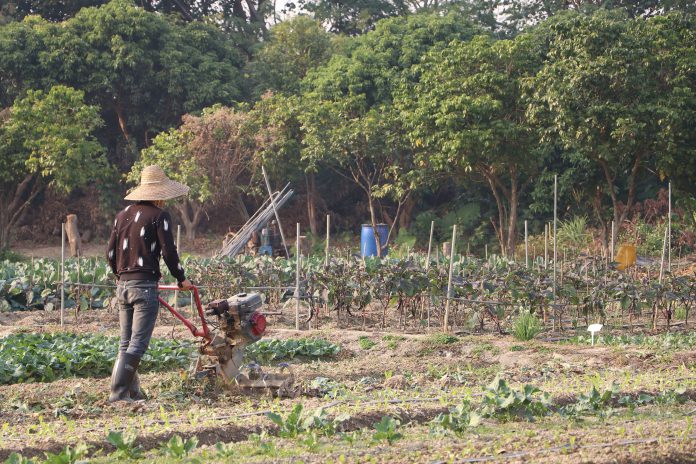
Walking through his 1.2 hectare farm with his hands behind his back, Leung Pun-kin conducts his daily inspection of his crops. The septuagenarian has spent more than half his life farming and is the owner of the Healthy Organic Farm in Yuen Long, one of the oldest and largest organic farms in Hong Kong.

“At the peak time, the figure may scare you, but I used to earn HK$10,000 a day,” he says with a proud smile.

The smile is soon replaced by a frown as Leung says that now, decades on, he is still making over HK$10,000 a day. However, operating costs have shot up to HK$300,000 a month. At the current rate of earnings, the business is barely sustainable.

Over the past few decades, the share of locally grown fresh vegetables has dropped from over 30 per cent of the Hong Kong market in 1986 to just 1.7 per cent in 2016, which means the territory relies heavily on imported food.

Farmer Leung Pun-kin inspects his crops daily

The decline in local agriculture is directly related to Hong Kong’s urban development. The construction of new towns in formerly rural areas such as Yuen Long, Fanling, Sheung Shui and Tuen Mun accelerated in the 1970s and 1980s. These areas, with their expanses of fertile, flat plains were once the core of Hong Kong’s agricultural industry.

“People would rather go learn a trade or work in construction to earn their living. Why would they choose to farm and endure the elements?” laments Leung, who is also a former president of the Organic Farmer Association. The group was formed by local farmers to help each other out in the face of the challenging environment for farmers in Hong Kong.

One of the biggest challenges is the search for arable land. Leung says some landlords refuse to lease their land to farmers. “The landlord will say the land rent of HK$10,000 a  year isn’t even enough for them to put a bet on the horses or football for a single day,” he says. “The landlords prefer to keep their land fallow than to rent to us.”

The government has tried to help, implementing the Agricultural Land Rehabilitation Scheme (ALRS) under the Agriculture, Fisheries and Conservation Department (AFCD) to assist farmers who want to rent private land to farm. The AFCD has received 484 applications over the past 10 years in its role as a matchmaker to line up landowners with prospective tenants. There have only been 165 successful cases.

In 2016, the government undertook a bigger commitment to helping local agriculture. In his policy address, the then Chief Executive, Leung Chun-ying said: “The value of agriculture goes beyond its economic contribution.  Developing local agriculture not only increases choices in terms of origin of food, it also helps optimise land use, improves the environment and hygiene in rural areas, and conserves the natural ecology.”

He announced a new agricultural policy and the establishment of a HK$500 million Sustainable Agricultural Development Fund (SADF) to fund projects that would enhance agricultural productivity and output, or help farmers switch to sustainable or high value-added operations.

In a written reply, the AFCD said it had received 20 general applications by the end of 2017 but none has yet been approved. The applications are being processed and some of them have been submitted to the SADF Advisory Committee for vetting. The board is composed of government officials, some farming sector representatives, academics and professionals from the accounting and legal sector. A spokesperson said it may take time for applicants to clarify technical points and the feasibility and financial arrangements of their proposed projects.

Wong Chat-tai, the founder of the New Territories Local Farmers’ Organic Vegetable Marketing Co-operative Society has a farm in Yin Kong village in Sheung Shui and is one of the applicants waiting for an answer.

Wong says the SADF application process is too complicated for regular farmers like her, “This Fund is [supposed to be] for those who work with hoes, not for those holding master’s degrees or researchers who work with pens. How can you use their metrics to assess us? It isn’t reasonable at all, is it?” she says. “[The government] has a responsibility to assist us instead of holding us up.”

Wong also questions the make-up of the vetting committee and thinks it should include  more agriculture practitioners. “Though it seems to be a matter of impartiality, but how can they vet the application if they are just laymen?” she says.

As for the New Agricultural Policy and its flagship programme, the new Agriculture Park (Agri-Park), Wong wonders if it will really benefit ordinary farmers. The government hopes the Agri-Park will nurture new agro-businesses and agro-technology operating on a commercial scale.

It will provide 75 to 80 hectares of farmland in the North District. The AFCD will lease the farmland for commercial crop production, including conventional and organic crop-raising, floriculture, and modern technological farming activities. Construction is currently underway in Kwu Tung South.

Farmers who have been displaced by government development projects, including those who lost their farms due to the Agri-Park project itself, are eligible to apply. The remaining farmland will be open for tender.

Farmer Chiu, who does not wish to disclose his full name, is one of the farmers affected by the North East New Territories New Development Area plan (NENTNDA). He has been a farmer all his life, having inherited the family farm in Kwu Tung North. Chiu believes the farmers in Kwu Tung and Fanling are the last hope for preserving traditional farming in Hong Kong.

But he is sceptical about the Agri-Park. For him farming is simple and does not require large-scale infrastructure. “You only have to provide farmers with arable land, water and a supply of electricity,” he says.

Chiu says the government thinks of local agriculture as a sunset industry with little economic return. “Resources come like toothpaste being squeezed out of the tube that barely keep you surviving,” Chiu says. “Our next generation might be left with no choice but to rely on imported food.”

Tse Tat-yan from the Ma Shi Po Concern Group is also unconvinced by the Agri-Park. He lives in Ma Shi Po, Fanling, which is part of the NENTDA. For Tse, the government’s grand plans, including the Agri-Park, are “public relation skills” to impress the public. He says the policies do not really address the needs of farmers.“They [the government] are good at making all these frameworks to show they will take care of the affected farmers, but in fact they won’t,” says Tse.

Tse thinks the corporate management style of the proposed Agri-Park does not suit traditional farming practice. Agricultural activities in the Agri-Park are commercial and profit-oriented, and the land inside the park is set up for intensive production, he adds.

A traditional way of scaring off birds from the crops

In conventional agriculture, farmers live on the land, next to their workplaces but the Agri-Park will not have living spaces for farmers. For Tse, this is impractical and unrealistic because farmers have to watch over their crops and even work overnight.  “The Agri-Park is for the high-techs. Farmers? Maybe, if you still survive,” he says.

Even if they want to apply for land to farm in the future Agri-Park, the farmers do not know when they will be able to do so. There is still no completion date and in fact, they face uncertainty over the whole land resumption process.

As he is affected by development projects at the Kwu Tung North and Fanling North New Development Areas, Tse is eligible to apply for the Special Agricultural Rehabilitation Scheme (SALRS) to find a match for suitable government or private land to continue his agricultural activities. But he says he still does not know when his land will be resumed and how much compensation he will receive.

It is not for want of asking. Tse says he has been looking for answers since 2013, when he became eligible for the scheme. But what he does know is that there has not been a single successful land matching in the more than four years since then.

Kenneth Wong Koon-kwai, a retired Hong Kong Baptist University geography professor, says the government should think of more ways to allocate arable land for agricultural use. “Nowadays, the problem is people who want to farm do not have the land while people who have the land do not want to farm,” says Wong.

Wong thinks the existing government policy and measures fail to provide practical help to local individual farmers and people who want to work in the agricultural sector. The New Agriculture Policy  conceptualises agriculture as a hi-tech business, but Wong thinks this may be neither sustainable nor practical in the Hong Kong context.

“There is no way we can compete. If you run the Agri-Park as a business, then in Hong Kong, firstly you have limited space. Then, if you want to run an agri-business you need to have technological knowledge. Do you think we have lots of people with this knowledge in Hong Kong?”

Wong notes that there are young people in Hong Kong and around the world who are reflecting on the meaning of farming and agriculture, and who believe that relying on purely commercial agriculture is not sustainable for the planet.

“If you really want to encourage agricultural development, you don’t have to think of it as a business, one that has to make a profit,” says Wong. “This is already an out-dated mentality.”

Edited by Brianna To