





Home Blog Page 64

From Offerings to Furnishings

Traditional paper-craft finds new groove

By Jane Leung, Lily Yu & Sam Kwong


Au Yeung Ping-chi sits quietly in the 55-year-old paper crafting shop he inherited from his father and carefully puts together a frame made of bamboo splints, comparing it to a cartoon monkey he had sketched on a piece of paper earlier. A customer has asked him to make the paper monkey, based on the appearance of a stuffed toy, as an offering for a dead relative.

Paper crafting is a technique involving the use of bamboo splints, pieces of coloured paper, rice paper strips, silk fabrics and adhesive paste. The craftsperson first builds a basic structure, attaches paper to the frame, adds colours and assembles separate parts of the piece. The burning of joss paper and paper effigies as offerings to the deities and the dead at funerals and festivals is an ancient Chinese practice. People in Hong Kong relied on paper craft supplies from Guangdong until the first local paper crafting shops opened here in the 1940s.

As a second-generation paper-crafter, 39-year-old Au Yeung Ping-chi has been incorporating new elements in his paper offerings. His father has been supportive and grants him a lot of freedom to apply his modern sensibilities and creativity to the traditional craft.

In his father’s day, clients asked for paper cars, houses and servants to enrich the afterlives of their ancestors. In recent years, the requests have been more diverse – for instance, customers have asked Au Yeung to make a set of ski equipment, a slot machine and a bowl of rice noodles with chicken wings.

Unlike in the past, and in a break with taboos surrounding death, Au Yeung has sometimes been instructed to make paper crafts as decorative objects for the homes of the living. “A young man once asked me to make a paper camera that holds his business cards…and a paper radio for another customer as well,” Au Yeung says.

A crucial difference between paper crafts that are used as offerings and those for decorative purposes is that the latter are usually made with iron wires instead of bamboo, as they do not need to be burnt.

“Most people are still under the impression that the paper crafting industry is all about burning paper cars, houses and ships for the dead at the funeral homes,” says Mo Cheuk-kei, 45, who is also a paper craftsman. He points out that apart from funerals, paper crafts also feature prominently in nearly all religious and festive occasions in the Chinese calendar, especially the Hungry Ghost Festival, Mid-Autumn Festival and Lantern Festival. The Hong Kong Traditional Paper Crafting Arts Union, which Mo chairs, runs classes teaching students to make decorative lanterns that are in high demand at these festivals. With some modifications to the original designs, these creations can be used as ceiling lamps, table lamps or wall lamps at home.

Hong Kong’s paper crafting industry enjoyed its heyday in the 1960s thanks to an influx of seasoned craftsmen arriving from the Mainland. But with the opening up and economic reform of China in the 1980s, many local paper crafting stores moved production to the Mainland. Since then, the Hong Kong market has been dominated by cheap, low-quality paper crafts made across the border while the domestic industry continues to shrink. Unofficial estimates put the number of paper craftsmen in Hong Kong at less than 50. Only three or four crafters are “professional”, in the sense that they are capable of creating a paper craft from start to finish.

In an attempt to help preserve traditions with high cultural value, the government compiled the first Representative List of the Intangible Cultural Heritage of Hong Kong in 2017, and the paper crafting technique is one of the items on the list.

Hui Ka-hung, 38, taught himself how to craft the heads of lions used in lion dances at the age of 11. He later founded his own brand Hung C Lau Ltd. and says his business has benefited from the exposure brought about by the listing. “Paper crafting has attracted more media coverage and more people have paid attention to it as a local product…we are given more opportunities,” he says.

Hui thinks innovation is the key for the long-term development of paper crafting as an industry. “I am eager to do creative things, because paper crafting should not be confined to being a traditional, old-school technique…I want to transform it into an art.”

With this end in mind, Hui has partnered with local artists and designers to create large installations. In one of his latest projects, he used traditional paper crafting skills to turn a street-art style lion head by a Thai designer into a three-dimensional piece which was displayed in a shopping complex in Causeway Bay.

While traditional paper crafters are turning to innovative ideas, a number of self-taught amateurs are also contributing to the craft’s ongoing evolution. Wong Lit-kei specialises in crafting paper qilins. A few years ago, he experimented with making these Chinese mythical creatures and put one on display in his mother’s incense shop in Cheung Chau. Neighbours began asking him to make them to display as decorations in the home.

“Some even fill their beds up with these mini qilins, or put them up onto the wall; I didn’t know they would like them that much,” Wong says. To his surprise, he even received orders from tourists from Taiwan, Singapore, Britain and Australia.

Despite reminders from his elders, 33-year-old Wong does not perform traditional rituals to scare the “spirits” of the qilins off before crafting them. Not sharing the taboos associated with either qilins or paper crafting, Wong and his customers are at ease with keeping them at home as decorations or feng shui devices. Occasionally, Wong is also asked to custom-make paper crafts of other things, such as a fox head for display in a boutique.

Another amateur craftsman Cheng Siu-Mo, 35, made his first lantern from a pre-made pack eight years ago. Then, without any formal training, Cheng developed his own method for making cartoon lanterns with rattan splints. Through trial and error, he has developed new products that differ from traditional paper crafts.

“Conceptually it might a paper craft, but it turns out to be more than that – a decorative figure that has different uses,” Cheng says as he explains how his creations can be used as lamps, displayed as figures or given as gifts.

Eventually, he was inspired to learn traditional paper crafting techniques and apply these to his works. He believes the two styles, old and new, can complement each other.

Edited by Elaine Ng
Crochet Away!

Learn to create your own crochet crafts at La Belle Epoque

By Lily Yu

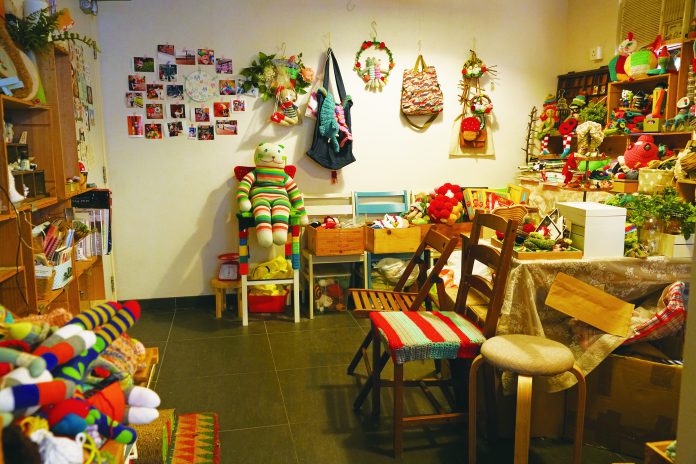
Astriped cat with green ears and a big smile greets you as you walk into La Belle Epoque’s  studio on Fortress Hill. Countless brightly-coloured, intricate crochet dolls of all shapes and sizes occupy this space. Here, you can not only buy the yarn craftwork, but also learn to create your own.

La Belle Epoque, or beautiful age, was a period from the late 19th to early 20th century when the arts flourished in France. The term brings to mind elegant and luxurious lifestyles. Owner Billie Ng Sze-kiu likens the spirit of her crochet craftsmanship to that of haute couture, a high-end custom-fitted form of fashion that originated during that period. “We chose the name ‘La Belle Epoque’ because we want to spend all of our time creating beautiful things, just like people did back then,” Ng explains.

Ng and her partner of eight years, Mary Cheung Wai-man, organise crochet and embroidery workshops at weekends. Classes are divided into several levels to accommodate the varying abilities of participants, who also get to decide what to make with their crochet hooks be it dolls, home decorations or accessories. In the beginner’s class, offered at least once a month, students usually learn how to crochet cactus-shaped decorations. Ng says the workshops are popular among young girls and mothers-to-be who would like to make something for their babies.

La Belle Epoque started out as a tiny shop in Tai Hang in 2008, and has expanded its business from retail to conducting workshops, offering made-to-order services, as well as making advertising props and installations for a number of banks, pharmaceutical companies and shopping malls. Ng says advertising agencies love their craftsmanship and the human touch that comes with their handmade dolls and their promotions which come across as less of a hard sell. “Using a doll [to promote products] helps create a softer style,” says Ng.

Before opening La Belle Epoque, Ng was a creative director at an advertising company. Her background enables her to communicate well with clients because she knows what they are concerned about. “I ask who their target audience is, and what tones they prefer,” says Ng. “And they will think I do understand what they need.” Ng and Cheung, a former graphic designer, both quit their stable jobs to pursue their passion for crafts. The duo take up complementary roles. Ng is responsible for external communications such as meeting with clients, while Cheung designs products and executes ideas.

“The sense of fulfillment in creating something from scratch is priceless,” says Ng. One of the things she treasures most is the bonding she has developed with her customers over the years. To Ng, encounters with customers are more than just doing business because they remember her as a creator rather than a salesperson. “I make memories whenever I craft; these memories are infiltrated into the craftwork and when someone brings it home, he is also taking [these memories] with him,” Ng says.

If you are interested in learning to make unique crocheted pieces, La Belle Epoque is the place for you. Visit Room 1605, 16/F, Corn Yan Centre, 3 Jupiter Street, Fortress Hill or go to their Facebook page for more details.

Edited by Elaine Ng


College Hip-hop Rebels

The Low Mays rap their version of Hong Kong culture

By Jane Leung

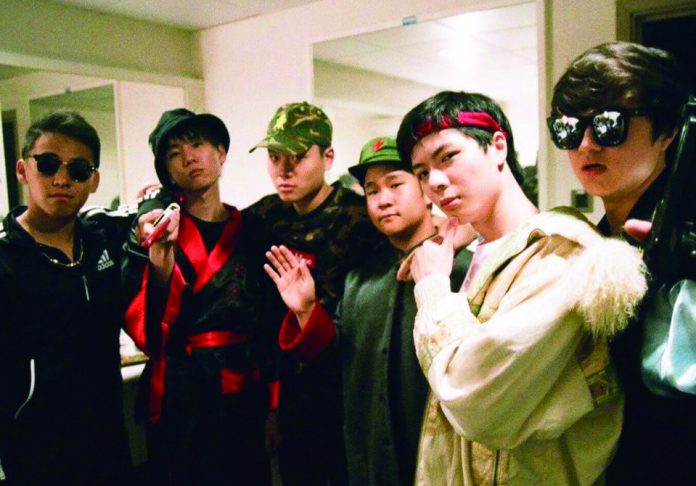
Hip-hop group The Low Mays may look tough with their gangster outfits and profane lyrics, rapping about sex, gangs and violence, but they are just six local university students in their 20s who want to express themselves through what they think represents Hong Kong culture.

Group members Matt Da Bospel, Butcher Fong, Lil Hanwo, Healthy Lin, Creme Supreme and Yung Bumblebee are primary and secondary schoolmates who started making music for fun. They made their debut in 2015 with songs revolving around Hong Kong’s gang culture in the 1990s, and gained popularity the following year when their YouTube videos were widely shared on online forums. The music video of one of their songs, Pekyau Street, which features violent clips from local films, went viral on the Internet last year, garnering more than 160,000 views on YouTube to date.

In August last year, the group released the mixtape Triadism, which features political messages. Tank speaks of the June 4 massacre, and other songs include Bad and Bourgeoisie, No Child Policy and Great Leap Forward.

The six members never thought they would go all the way from performing rap at their secondary school’s morning assembly to having their own shows today. “It was funny and astonishing,” says Creme Supreme as he recalls how they rose to fame and saw their fans singing along with them at their live shows.

Creme Supreme, who is responsible for audio mixing, says their music is influenced by trap artists such as Lil Pump. Instead of copying their music styles, he says they try to extract certain components and develop them into something unique. For example, ad-libs, which are single words or short phrases that are spoken in the background, are commonly used when American rappers perform. The group incorporates this feature in their music using Cantonese slang.

Despite being a full-time student, Creme Supreme says he normally spends a few hours on songwriting every day. The rapper’s inspiration can come from anything around him. Whenever he has a new idea, he jots it down, records lyrics on mobile phones and arranges the tunes on a computer. Many of the songs by The Low Mays are impromptu, including Fulham Space Station (富林太空站), which was released last summer. Creme Supreme didn’t expect listeners to like it, because he just wrote the whole song in 10 minutes, but the video has over 71,000 views on YouTube.

With their daring style, the band has encountered obstacles when trying to promote their music to a wider audience. They have been asked by concert organisers, record labels and radio stations to change the names of their songs because they contained bad language. “Hong Kong has its own Cantopop, which is unique to the city and [people’s music taste is] hard to change, but more and more people are listening to our songs,” says Creme Supreme, who is optimistic about the group’s future.

Fans of local hip hop should check out The Low Mays’ concert this summer. You can also listen to their music out on YouTube (Warning: contains profanities and references to sex and violence).

Edited by Elaine Ng


It’s back to basics for Nelson Wong Sing-chi as he campaigns for a less emotional politics

By Lily Yu

Former Democratic Party member and lawmaker Nelson Wong Sing-chi raised eyebrows when he donned an Ultraman costume to campaign in the New Territories East Legislative Council By-election in 2016. Wong says it was his team’s idea, he never quite liked it and is going back to basics this time around.

Apart from turning his back on superhero costumes, Wong is running as an unaffiliated candidate in Sunday’s by-election in the same constituency. When he ran in 2016, it was as a member of the centrist party founded by former Civic Party lawmaker Ronny Tong Ka-wah, Third Side. That time, Wong came in fourth, losing to eventual winner Alvin Yeung Ngok-kiu of Civic Party by 143,585 votes.

Wong started his political career as a social worker in the Northern district in 1983, working with the poor, the elderly and the youth. His says his experience in social work has allowed him to better understand community needs.

His campaign slogan this time is “The courage to choose rationality” (選擇理性的勇氣) because he wants to remind citizens to be rational.

In the six years since his completed his previous term of office in the Legislative Council in 2012, some lawmakers have used more radical means such as filibustering and physical actions to fight for their goals Wong does not agree with these tactics.

“We can use these radical means but it should not be the only way. Communicating and compromising are keys to achieve the goals,” he says. “If we refuse to communicate [with the government], we will never be able to achieve our goals and help citizens.”

Wong says negotiation and communication with the government have been crucial to his work in Northern District. The most memorable achievements in this work being helping to establish the Northern District Hospital in 1994, and tackling the flooding problem in the district.

He faces fierce competition in the race for the New Territories East seat but Wong says his biggest challenge doesn’t come from the other candidates, but from voters’ attitudes. He thinks today’s voters cast their ballots according to which camp a candidate is affiliated to, without paying attention to their work and platforms.

“I have to make voters understand that voting for a candidate based on just which camp they belong to is not a good thing for Hong Kong, it is irrational and emotional behaviour,” he says.

Without any party affiliation and backing, he admits he faces a tough fight but insists there is still a chance. “I am the best choice,” he says, citing his 35 years of experience in politics.

If elected, Wong says he would advocate for the expansion of the Northern District Hospital and setting up of medical centre at district level to tackle the current overcrowding problem in public hospitals. He adds he would also work on reactivating the political reform process.

The other candidates in the New Territories East Constituency in the 2018 Legislative Council By-election are Christine Fong Kwok-shan, Estella Chan Yuk-ngor, Bill Tang Ka-piu, Joyce Chiu Pui-yuk and Gary Fan Kwok-wai.

Edited by Nancy Mak

Au Nok-hin runs on behalf of the pro-democracy camp in the Hong Kong Island By-election

By Gloria Li

Former Democratic Party Executive Committee member Au Nok-hin says he’s running in the Hong Kong Island Legislative Council by-election as the Plan B for the whole pro-democracy camp, not just Agnes Chow Ting and Demosistō.

The 30-year-old Southern district councilor fears the government’s moves to disqualify lawmakers and candidates with dissenting political views is becoming ‘normalised’. He compares the current by-election – which was triggered by the disqualification of  four lawmakers – to a referendum.

The disqualification of legislators is actually a disqualification of 180,000 voters’ opinions,” Au says. “It is a disregard of the people’s voice.”

Au’s candidacy has the support of the whole pro-democracy camp, including the Democratic Party which he quit last year in order to play a role uniting progressive pro-democracy forces. It’s a role Au has some experience in as a former convener of the Civil Human Rights Front,

As for whether he is afraid of being disqualified himself, Au says: “If the government is to disqualify me, please disqualify the whole pro-democracy camp,” Au says.

As the candidate the pro-democracy camp is united behind in Hong Kong Island, Au thinks he is representing certain values. For instance for the rule of law rather ‘rule by law’. Controversial issues and events, such as the  co-location checkpoint scheme and the imprisonment of the student leaders of 2014’s Occupy protests have raised questions about the independence of Hong Kong’s judiciary, as well as the way the government uses its power and the law.

I don’t want a Hong Kong that is ruled by law. We should bring back the idea that laws are used to protect citizens’ rights, rather than become a tool for suppression,” says Au.

As the candidate with the most experience in politics, Au says that he is also interested in exploring how to bring local issues into the legislative council and improve the regulations around buildings management.

While Au thinks that his biggest rival is Judy Chan Ka-pui from the New People’s Party, he hopes that people vote for him, and for justice.

Instead of saying that I have confidence in myself, let’s say I have confidence in Hong Kong citizens,” he says.

The other candidates in the Hong Kong Island constituency in the 2018 Legislative Council By-election are Judy Chan Ka-pui, Edward Yum Liang-Hsien and Ng Dick-hay.

Edited by Jade Li

Edward Yiu Chung-yim needs high turnout rate, pan-dem and localists’ votes to win Kowloon West

By Tommy Yuen

Edward Yiu Chung-yim is hoping his professional expertise, one year of experience in the Legislative Council and status as the only disqualified lawmaker to be standing in Sunday’s by-election will give him enough votes to take the West Kowloon seat. Yiu says a victory for him would send a clear message against the government’s disqualifications.

He acknowledges that running a campaign for a geographical constituency is very different from his previous campaign for the Architectural, Surveying, Planning and Landscape functional constituency in the by-election. For starters, he needs far more volunteers as the voter base has increased from 8,000 to 490,000. Still, he thinks he is able to mobilise this expanded base.

“The [pro-democracy camp’s] primary election results show that I can stimulate people’s participation [in politics] by regaining the seat in the name of a disqualified lawmaker,” says Yiu.

Running as an unaffiliated candidate, Yiu is glad to receive help from the whole pro-democracy camp. “You may say that my characteristic [of having insufficient political resources] enables the pro-democracy camp to unite their power to support a candidate,” he says.

Although the Kowloon West constituency only has a total of three candidates, which is the least among all geographical constituencies in the by-election, Yiu says he is taking the race very seriously. He says it will be a challenge to get most pro-democracy voters to vote for him due to a “wide spectrum in the pro-democracy camp”, ranging from traditional pan-democrats to localists.

“Although I advocate a win-win situation and hope to unite pro-democrats, how can I put all the contradictory ideologies into one person?” ponders Yiu. “Can voters break preconceptions and support me, Edward Yiu? There is a risk.”

Yiu says he is trying to get the vote out on Sunday as a higher turnout rate would boost his chances, and because fewer people usually vote in by-elections. “The margin is so small [between the votes of pro-democracy and pro-establishment camp]. If I lose more than 20,000 to 30,000 votes, I will lose,” he adds.

He says that if he can re-enter the Legislative Council, he will work on short-term, mid-term and long-term goals, with the final aim of “turning the tables [on the pro-establishment camp] in the Legislative Council”.

“The oppression from the government has gradually made Hong Kong people lose hope,” Yiu says. “This is not something that we want to see, no matter inside or outside the Legislative Council. We have to make Hong Kong people see hope.”

The other candidates running for the Kowloon West constituency in the 2018 Legislative Council By-election are Vincent Cheng Wing-shun and Jonathan Choi Tung-chau.

Edited by Katie Cheng

Pro-government activist Ng Dick-hay standing in HK Island LegCo By-election to change negative image of Beijing supporters

By Gloria Li

Ng Dick-hay, a former spokesman of the pro-establishment and anti-Occupy Movement Defend Hong Kong Campaign says he’s standing in the legislative council by-election in Hong Kong Island in order to change what he describes as people’s “superficial” and “biased” perceptions of those who support the Chinese government.

“I feel that the image of those organizations and individuals who identify themselves as Chinese isn’t very distinctive in Hong Kong.” says the 52 year-old IT business owner. “I want to make the public to have a more positive understanding of this group.”

Ng actively comments on politics, publishing online articles and is a regular caller to radio phone-in programmes. He thinks election forums in recent years have been increasingly dull and believes he can lift the quality of debate.

He adds that by staying unaffiliated, he can express his views more freely. “I do not accept donations from any organizations or people, so I can maintain my freedom of speech and voice more distinctive opinions,” says Ng.

In addition to his proud assertion of his Chinese identity, opposition to Hong Kong independence is Ng’s most distinctive standpoint. Ng says he conducted a poll two years ago which found that 18 per cent of his respondents supported independence, with the majority of them aged 30 years and below. This got him worried that over time, Hong Kong independence will become a mainstream ideology in society.

In this vein, he thinks the disqualification of Demosistō’s Agnes Chow Ting from standing in the by-election is a good move. He says Demosistō’s advocacy of “self-determination” involves dissociation from the Chinese nation which is unacceptable.

“Disqualification gives a signal that if people want to be involved in politics, they cannot move towards independence,” says Ng. “As Chinese, this is the bottom line. We cannot give in anymore.”

Despite his pro-Beijing views, Ng doesn’t see himself as a member of the pro-establishment camp. He says on some issues, such as urban planning, he has more in common with the pro-democracy camp. Without a political party, campaign team or funds, Ng knows it is almost impossible for him to win the by-election.

“It is already quite satisfactory if I can get more than 10,000 votes as a first-time candidate,” he says. “Then I can get back my HK$ 50,000 election deposit.”

The other candidates in the Hong Kong Island constituency in the 2018 Legislative Council By-election are Au Nok-Hin, Judy Chan Ka-pui and Edward Yum Liang-Hsien.

Edited by Katie Cheng

Paul Zimmerman’s tough fight to fill functional constituency seat vacated by Edward Yiu in Legislative Council By-election

By Ada Chung

Incumbent Southern District Councillor Paul Zimmerman is making his third bid to enter the Legislative Council, this time for the Architectural, Surveying, Planning and Landscape functional constituency seat  previously held by Edward Yiu Chung-yim.

Yiu, who was disqualified for deviating from the official script when he was taking his oath as a legislative councillor, is backing Zimmerman, who is also supported by others in the pro-democracy camp.

The Dutch-born urbanist believes he can help to bring together people from different sides when it comes to the city’s planning and development.

“So all these issues [related to the city’s development], are bringing people from different sectors and that is something that I have always done, and this is what I hope to continue to do and I think definitely a strength that I have.”

Zimmerman says the government only spends money on large scale projects, and neglects small-scale community projects and public projects which he believes would benefit both the public and small firms.

“The problem in Hong Kong is for young, small architects, planners and surveyors to get their hands dirty and do nice things,” Zimmerman says.“[areas for community projects] they’re all ready to go, but there is no money, no program to fix them up.”

He also wants the government to enact a ‘conservation bill’ to protect areas from being destroyed during redevelopment. He explains that while the government currently distinguishes and zones conservation areas, there is insufficient legal protection. Zimmerman thinks that the public may be more willing to accept development in greenbelt areas if there were a conservation bill.

The former Civic Party member is critical of the government’s housing plans and believes there isn’t enough pressure on the administration to consider alternative sites for redevelopment, such as brownfield areas – or ‘inefficiently used land’ in the New Territories. He believes this is mainly because the government is unwilling to negotiate with landowners – some of whom are linked to the Heung Yee Kuk.

Zimmerman faces a tough fight in a seat that had always been held by the establishment camp before Yiu’s groundbreaking victory. And his image took a knock following a series of media reports about illegal structures in his Sai Kung residence. Although he has since removed the unauthorized building works, Zimmerman believes he could have handled the issue better.

“Of course I regret that situation has come about,” he says.“If I could turn the clock back, I would have been much smarter.”

Zimmerman adds he has never tried to hide the fact that there were illegal structures at his home and he had in fact registered them under the ‘Reporting Scheme for Unauthorized Building Works’ with the Buildings Department in 2011.

The other candidate running in the Architectural, Surveying, Planning and Landscape functional constituency in the 2018 Legislative Council by-election is former legislator, Tony Tse Wai-chuen.

Edited by Yi Yeung

Former radical Edward Yum rebrands himself as a pragmatic independent in HK Island race

By Jasmine Ling

Today, Edward Yum Liang-hsien is standing in the Legislative Council By-election for the Hong Kong Island on what he describes as a “pragmatic” platform as an independent. Should he be elected, he vows to “find a way out for Hong Kong through developing the economy”. But back in 2010 Yum was something of a firebrand radical democrat. The former member of the League of Social Democrats and then People Power used to be known as the Victoria Park Bro(維園阿哥)due to his emphatic speeches in the RTHK programme City Forum. Yum was famous for shouting at pro-establishment figures.

Although there were reports that Yum once worked as a consultant for pro-establishment figures Pamela Pak and Paul Tse Wai-chun in 2012, and that he was withdrawing from politics to concentrate on making money in 2013, Yum has been out of the news in recent years.

He says he has never left politics. As a partner and head of fund services for an international financial services firm, he says he is always in both the business sector and in the political field.

 [I am] always concerned about current affairs and society, it’s just that I’m in different positions at different times,” Yum says.

For Yum, his professional financial knowledge should be a major pull for Hong Kong island voters. He thinks island residents should should focus on his platform which focuses on economic policies.

Looking back on the disputes between his former friends in the democratic camp and the pro-establishment side, Yum says he’s more interested in implementing detailed and feasible plans, rather than engaging in empty talk.

“I hope citizens can find more that resonates with them in this election, that we can walk together on a practical path that is good for Hong Kong, instead of staying at the level of [political] conflict and competition [among points on] the political spectrum or camps and parties,” he says.

Yum is not opposed to filibustering per se – a tactic that his old party-mates championed – but thinks it has been abused.  He questions whether it is an effective strategy in the current political climate and suggests it may cause resentments from the public without achieving what citizens want. .

“I think you should consider the actual conditions, when to filibuster, when to stop or even should we continue filibustering.”     

Yum says he hasn’t given up  his principles on universal suffrage. However says he isn’t entirely against the “8.31” decision which states the central government would approve who could stand in any Chief Executive election by universal suffrage. Yum says there is room for discussion on the arrangements under the decision made by the Standing Committee of National People’s Congress (NPCSC).

“I think not many people [are willing to] encourage communications and discussions,” he says. “I think this is something that isn’t proposed by any candidates, political parties or lawmakers.”

As an independent candidate, he thinks he isn’t encumbered with any political considerations related to the 2014 Occupy Movement. But he does think the disqualification of Demosistō member Agnes Chow-ting – who was involved in the movement – is “unjustified”. He says every citizen has the right to be elected, and it is inappropriate for the government to bar someone from running for the election on the grounds of their political stance.

The other candidates in the Hong Kong Island Constituency in the 2018 Legislative Council By-election are Au Nok-hin, Ng Dick-hay and Judy Chan Ka-pui.

Edited by Jade Li

Neo Democrat Gary Fan wants to return to Legco for New Territories East in order to fight against DQ’s

By Tommy Yuen

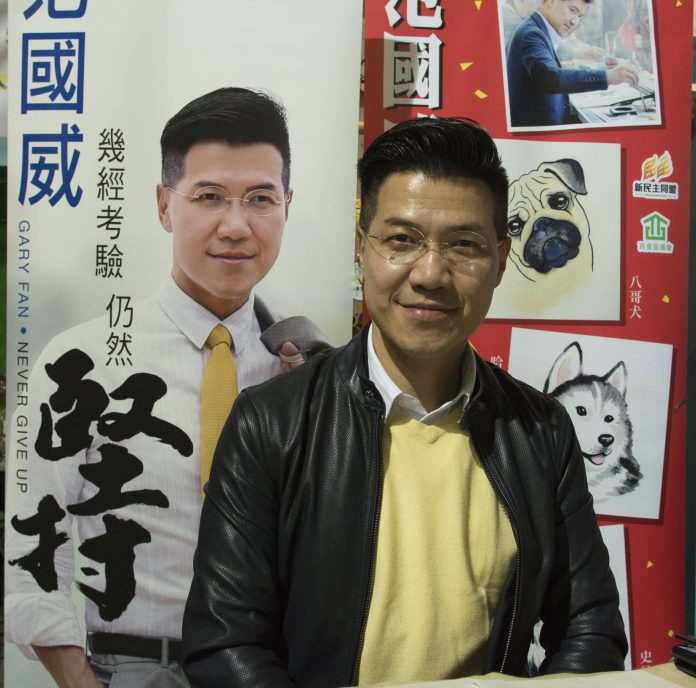
Gary Fan Kwok-wai of the Neo Democrats hopes to return to the Legislative Council in the upcoming Legco by-election in order to win back a seat for the pro-democracy camp and to fight against the disqualification of lawmakers and candidates for election.

“If the pro-establishment camp seizes the chance [to take up the Legco seat], it will legitimise the government’s action of disqualifying the lawmakers. It is not acceptable,” says the pro-democracy camp’s agreed candidate for the New Territories East (NTE) constituency.

Fan, who is a serving district councillor, also represented New Territories East in Legco from 2012 to 2016. He missed out on a seat in September 2016, losing by 6402 votes to Youngspiration’s Sixtus Leung Chung-hang. Leung was subsequently disqualified following the ‘Oathgate’ controversy.

Disqualifications have also marked the nomination period of the March 11th by-election, with three would-be candidates disqualified from standing – Demosisto’s Agnes Chow Ting in Hong Kong Island and localists Ventus Lau Wing-hong and Chan Kwok-keung in NTE.  Fan believes these disqualifications have brought his message and the political lines between the two main camps into much sharper focus.

Fan became the single ‘agreed’ candidate for the pro-democracy camp after winning a primary against Labour Party Chairperson Steven Kwok Wing-kin and former student leader Tommy Cheung Sau-yin.

He says the pan-democrats’ primary election has been an important mechanism to coordinate candidates from the pro-democracy camp, to avoid vote-splitting and tackle the “fragmentation within the democratic parties”.

Should he win on March 11th, Fan says his primary battlefields will be the co-location arrangement for the Express Rail Link, the National Anthem Law and Article 23.

As for work at the district level, Fan wants to focus on improving the links between policies decided at central level and work done at the district level. He believes that developing grassroots democracy has taken on a more important role after the pro-establishment camp amendments to the Legco rules of procedure, and as a way to counteract what he calls “authoritarian oppression”.

New Territories East has attracted the greatest number of candidates in the by-election, one of whom is Nelson Wong Sing-chi, a former Democratic Party member. Fan predicts Wong’s involvement will affect the outcome of the by-election to some degree.

”When more people join [the race], the effect of vote splitting will be more serious… regardless of whether the competitors have departed from the democratic path or only claim to be democrats without the public’s recognition,” he adds.

Fan hopes the Neo Democrats’ work at district level will win him votes from supporters of the pan-democrats and some localists, although he concedes it is impossible to gain all of Sixtus Leung’s votes on polling day.

In the meantime, he is not worried the recent fatal bus accident in Tai Po and the Chinese New Year will divert people’s attention from the by-election as there is still time.

“When the time is getting closer to March 11th, people’s attention will focus back onto the by-election,” he says.

Other candidates in the New Territories East Constituency in the 2018 Legislative Council By-election are Christine Fong Kwok-shan, Estella Chan Yuk-ngor, Bill Tang Ka-piu and Joyce Chiu Pui-yuk.

Edited by Nannerl Yau