















Home Blog Page 68

Rough Justice

Former juvenile offenders speak out against physical abuse by prison guards

By Angela Siu & Kristy Tong

For most people, “chicken wing” and “Chinese kale” are food items. But for Paul Fu Hon-chin and Berry Lam Kai-shing, these terms have more sinister connotations. For these two 28-year-olds and other young men who have been juveniles in detention, they refer to common techniques of physical abuse by prison guards.

In Hong Kong, a juvenile prisoner is a young offender aged between 14 and 21. In the vocabulary of juvenile offenders, “chicken wing” refers to being beaten on the back heavily with an elbow while in a bowing position. Sometimes, inmates are kicked or kneed in the sensitive spots of the thigh, resulting in temporary numbness – this is referred to as “Chinese kale” or gai lan in Cantonese.

Paul Fu says he witnessed and experienced physical abuse as a juvenile offender during his three months in Lai Chi Rehabilitation Centre for drug possession in 2005 and one month in Pik Uk Correctional Institution in 2007 also for possession. He was then detained again for five months in a drug addiction treatment centre after being convicted of the same offence in 2009.

These penal institutions are all run by the Correctional Services Department (CSD). The CSD assigns young offenders to correctional institutions according to their age, gender and security ratings based on the severity of their offence. Young offenders aged from 14 to 20 may be admitted to a training centre or a rehabilitation centre, while offenders with drug addiction problems may be placed in a drug addiction treatment centre.

Paul Fu Hong-chan witnessed and experienced physical abuse as a juvenile offender.

Today, Fu is a social worker and an active member of the Juvenile Prisoners Human Rights Concern Group (JPHRCG), which is working to highlight and end the abuse of juvenile prisoners.

After more than a decade, Fu can still vividly recall his first day in Lai Chi, when he was slapped about and sworn at by an officer because he forgot the name of the rehabilitation centre when asked. His vision was blurred for a few minutes and all he could hear was ringing in his ears.

“You know this is a horrible place like hell, where you might be slapped ruthlessly any time,” Fu says. “I would rather die than stay there,” he adds.

Besides physical violence, Fu says juvenile prisoners are mistreated in many other ways, such as being forced to eat faeces and lick urine, being barred from going to the toilet, or given only 15 to 30 seconds for a shower, even when their bodies are still covered in soap.

He says the life of a juvenile prisoner is “like [that of] a dog”, adding that “during the process [of imprisonment] things like your dignity are slowly shattered.”

Berry Lam Kai-shing, another former juvenile prisoner and member of the concern group, was still emotionally troubled after his release. He would wake with a start and the first feeling that came to him was the terror of being beaten. He also dreamt of being beaten from time to time.

Lam was imprisoned in Pik Uk in 2008 for six months for drug trafficking when he was around 20 years old. When he turned 21, he was transferred to Tong Fok Correctional Institution, which is a prison for male adult prisoners. He says the treatment of adult prisoners is totally different from that of juvenile prisoners. Officers in juvenile prisons tend to use tougher, more violent and humiliating measures to treat the prisoners.

Berry Lam Kai-shing suffered from nightmares after his release.

Although they may live with long-term scars, Lam says very few juvenile prisoners dare to speak up during or after imprisonment. He says silence has become a culture among young offenders because they think it is useless to complain. Lam has seen complainants who were called into an officer’s room to “have a talk” coming out denying the claims they had made. He suspects those complainants were either beaten or threatened. He also dismisses the possibility of seeking help from relatives during family visits because the conversations are recorded.

In a written reply, the CSD says it adopts a “zero-tolerance” attitude towards the misconduct of staff. The department says inmates can lodge complaints through both internal and external channels. Currently, one of the main channels for juvenile prisoners to make complaints is to send a complaint form to the Office of the Ombudsman through the letterboxes in the prisons.

However, Lam says this rarely ever happens because inmates need to get the form from CSD staff, and few would dare do so. Inmates can also complain to the Complaints Investigation Unit (CIU), an internal unit of the CSD set up to handle and investigate allegations against prison staff. They can do this by raising their hands when senior CSD officials visit the facility and lodging a complaint, again in view of others. According to the 2016 Annual Review published by the CSD, only three out of the 314 complaints investigated by the CIU in the past three years were substantiated.

Jordi Tsang Sing-cheung, convenor of JPHRCG, says it is hard for juvenile prisoners to lodge a successful complaint about the misconduct of CSD officers partly because of the absence of calendars and clocks in the correctional facilities. This means prisoners are unable to provide a time and date for alleged abuses. The lack of CCTV in the spots where abuse takes place also makes it difficult to gather evidence.

When a complaint is made to the CIU, it will carry out an investigation and submit a report to the Correctional Services Department Complaints Committee which will examine and endorse the investigation findings. However, Tsang says the independence of the process is questionable because both units are under the CSD. “[The complaint mechanism] seems clearly explained but it is in fact a peer investigation,” he says.

If complainants are dissatisfied with the investigation result, they can appeal to the Correctional Services Department Complaints Appeal Board. This board comprises 10 Justices of the Peace (JPs) but the identities of the 10 are not disclosed.

Another disincentive for juvenile inmates to complain is the fear of extended sentences. Unlike adult prisoners, juveniles do not have an exact term of imprisonment when they are admitted. Instead, they may be imprisoned for a flexible period of time, determined by the Commissioner of Correctional Services taking into account their progress and conduct. The period of imprisonment varies in different penal institutions. For instance, it ranges from two to five months in rehabilitation centres, and from six months to three years in training centres.

Social worker and JPHRCG member Rebecca Lam Waimen says young offenders are usually afraid that officers may give them poor reviews and increase their term of imprisonment.

“There is no standard set on [juvenile prisoners’] performance and when they can be released. So it depends very much on the officer’s impression on you, whether he likes you and thinks you are cooperative,” says Lam.

Even after they are released, ex-offenders may be subject to a supervision order for one to three years, during which their performance and progress will be monitored by a CSD welfare officer. The supervisee may be recalled to detention if the welfare officer deems it necessary. This discourages juvenile prisoners from speaking out even after release.

Juvenile inmates can also complain externally to JPs. Under the Justice of the Peace Ordinance in Hong Kong, one function of a JP is to visit any custodial institution or detained person. Each JP who is not a government official conducts on average one visit a year, while each Official JP conducts three to four visits a year. During these visits, JPs have to listen to and handle inmates’ complaints.

However, according to the annual reports on JP visits published by the Chief Secretary for Administration’s Office, none of the 1,400 or so complaints received by JPs from 2005 to 2015, were substantiated.

Under the JP visit programme, all JP visits are unannounced. However, former lawmaker Emily Lau Wai-hing, who has been a JP for over 20 years, says the visits are not genuinely “unannounced” because prison officers will be informed in advance of the range of dates during which they may take place.

Lau says not all JPs are familiar with prison affairs or the scope of their duties. She suggests the government should provide training so that JPs can get up to speed on the basics, such as the number of prisoners, and what they should check for during their visit, as well as the complaints received on the last JP visit.

The United Nations Committee report on the “Convention against Torture and Other Cruel, Inhuman or Degrading Treatment or Punishment” published last February, recommended that Hong Kong should establish an independent body to carry out effective unannounced visits by JPs.

However, in a written reply to Varsity, the Chief Secretary for Administration’s Office responded to the UN report by insisting that the JP Visit Programme provides an effective independent channel for monitoring and improving the penal system.

Legislative Councillor Fernando Cheung Chiu-hung says the government should set up an independent third party to review the CSD’s current approach in its treatment of prisoners, especially juveniles. He calls on the administration to reform the CSD based on findings from such a review.

Cheung says this is necessary because the current complaint mechanism is ineffective. He says this is borne out by the fact that there have been no complaints in the last 10 years from the Sha Tsui Correctional Institution. Cheung finds this hard to fathom because the institution adopts an old-fashioned “3S model”. This refers to “Short” (short period of term of imprisonment), “Sharp” (strict discipline) and “Shock” (unforgettable experience), that is supposed to help juvenile prisoners rehabilitate and reintegrate into society.

“The problem they [young offenders] have to face is this outdated, completely inhumane method which the CSD thinks still works, which exploits one’s dignity,” says Cheung.

Tobias Brandner

Tobias Brandner, a prison pastor and associate professor at the Divinity School of the Chinese University of Hong Kong, has been visiting prisons for 20 years. He describes the 3S model as being like a boot camp. He says it is based on the idea of totally breaking something or someone and then rebuilding them, which he considers outdated and ineffective.

Although some people may think prisoners deserve such treatment as their punishment, Brandner disagrees. “Human rights are inalienable. Inalienable means this is something independent of, that is something basic, something intrinsic in you that can under no condition be taken away,” he says. “Human rights are about being equally and fairly treated.”

Law Yuk Kai, director of Hong Kong Human Rights Monitor, says the alleged physical violence used by CSD officers sets a bad example that goes against the rationale of helping the juvenile prisoners to rehabilitate. Law says juvenile prisons have over-emphasised the deterrent effect.

The Chinese for the Correctional Services Department is made up of the characters for ‘punishment’ and ‘education’. But Law says he can only see punishment.

“The CSD claimed to adopt both ‘punishment’ and ‘education’ in its mission, but where has the ‘education’ gone? Who have they educated?” says Law. “A civilized society will not allow people to abuse the right granted by the public to abuse and humiliate others.”


Edited by Fiona Chan
One Country, Two Prison Systems

Hong Kong people in mainland jails feel helpless in unfamiliar system

By Crystal Wu & Elaine Ng

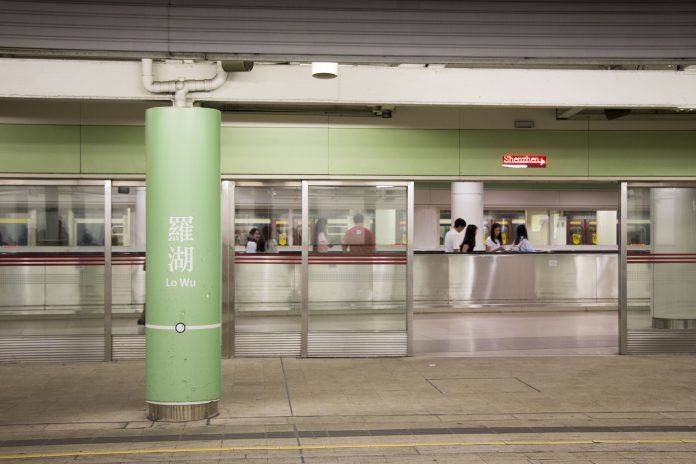
In late November 2007, Haak Jai (not his real name) who was then 18, spent the first night of three months in detention in the Luohu Detention Center. He still shivers at the memory of spending the cold nights with just a thin blanket he had to share with another detainee. Everyone around him, the other detainees and the guards, all spoke in Putonghua, adding to his unease.

He found himself in jail because he was running with the triads at that time and smuggling drugs across the border. He was caught by police in Shenzhen and arrested for possession. As he had a Hong Kong Identity Card, the mainland authorities notified Hong Kong authorities and his family learned of his arrest two or three days later.

As more and more Hong Kong people travel to and live in the Mainland for work and other purposes, it is inevitable that some will run foul of the law there. They may be involved in criminal activity like Haak Jai was, or end up in trouble as a result of traffic accidents, or business and financial disputes.

According to the Hong Kong government there were more than 4,000 Hong Kong people detained in the Mainland between 2012 and 2016. What they and their family members have probably discovered is that there is only so much the Hong Kong government can do to help them and that the legal, judicial and penitentiary system in the Mainland is very different from Hong Kong.

As Haak Jai recalls it, a detainee was placed in four categories of cells before trial and after imprisonment. The first was a newcomers’ cell, the second was a cell for those who had been formally arrested and charged, then a cell for those undergoing trial and judgment and finally a cell for those who had been convicted.

He says he began to understand the hidden rules soon after arriving at the newcomers’ cell. “Cell heads (倉頭) bribed the prison officials and become the leader of the cell,” he says. According to Haak Jai, the cell heads did not have to work but had the power to arrange jobs, such as doing the laundry and washing dishes, for all the other inmates.

The Criminal Procedure Law of the People’s Republic of China states that a suspect can be detained for 10 days at most in common criminal cases before being charged, and 14 days under special circumstances. As for “serious cases”, the limit on the detention period is 37 days.

After staying at the newcomers’ cell, Haak Jai was tried in court. As he had been caught red-handed, he did not hire a lawyer and pleaded guilty to drug possession. He was then sentenced to one year of imprisonment and moved to Dabu County prison in Meizhou after spending three months in Luohu.

Prisoners had to pay for all their daily necessities, says Haak Jai. His mother sent him cash so that he could buy his own toothbrush, towel and extra food from the officials. “What happens if you cannot afford a toothbrush? Don’t brush your teeth then,” he says, adding that guards demanded a 10 percent commission from every purchase an inmate made.

But what upset him most at the time was the disrespect for human rights that he saw around him. “Human rights are what the guards grant you; you cannot fight for it,” says Haak Jai. Apart from the privileged “cell heads”, other inmates could be punished and beaten up by guards, sometimes with batons that he remembers as being two metres long.

Unlike prisoners in Hong Kong, Haak Jai says mainland prisoners did not get paid for the round-the-clock work they did making toys, nor did they get free time for sports and exercise.

However, another Hong Kong detainee Chan, who refused to disclose his full name, describes a very different experience. He was driving on the Guangshen Expressway when his tyre blew out and the resulting accident caused two deaths. Chan was injured in the accident and was treated in a hospital.

He was also charged with careless driving, but his family members were allowed to keep him company at his bedside. Guards also allowed him to go out to get a massage or go jogging. In all, he spent 13 months on medical parole between 2002 and 2003 before he learned the charges were dismissed in court.

Explaining why he was given this special treatment, he says: “It was because I am a member of a local Committee of the Chinese People’s Political Consultative Conference; therefore, I have political privileges.”

Apart from his preferential treatment, Chan describes the trial process as a tussle of guanxi (關係), which means the network of influence, between the plaintiff and defendant. “It was my friends, not the lawyers, who helped me with my release with their influence on the authorities,” he says.

Chan says he was not aware of the Reciprocal Notification Mechanism, not to mention seek any legal assistance provided by the Hong Kong government. The mechanism between the Hong Kong police and mainland Public Security authorities was established in January 2001. Apart from notifying family members when Hong Kong residents are detained, the Immigration Department can provide some help, such as passing on requests from the families to the relevant authorities and providing information on hiring lawyers.

Between 2012 and 2016, mainland authorities notified the Hong Kong Police, through the Reciprocal Notification Mechanism, of 4,148 Hong Kong residents who had been subjected to criminal compulsory measures in the Mainland. In a written reply, the Security Bureau says most cases were related to deception, smuggling, dangerous drugs and theft.

Dennis Tang Chi-wing, an attorney practising in the Mainland, says the smuggling of air guns has become a common offence in recent years. He says some young people have taken air guns across the border after getting part-time job referrals through Facebook. Reports suggest Shenzhen has a growing black market for smuggled guns as the war-game market expands there.

Under China’s Criminal Procedure Law, a detainee has the right to hire an attorney, either by himself or through his family. This legal right, however, is not always guaranteed, especially when a case is political in nature.

Lam Wing-kee

Lam Wing-kee, the 61-year-old former owner of Causeway Bay Books, was accused of selling prohibited books and detained in the Mainland for eight months from 2015 to 2016. Lam says he was forced to sign an agreement declaring that he would give up his right to hire a lawyer and contact his family members. “You cannot use the way of life and rule of law in Hong Kong as yardsticks,” Lam says. “Hong Kong and the Mainland have totally different systems, or this country has no concept of the rule of law at all.”

Lam says that an officer from the Central Case Examination Group (中央專案組) told him that even without a charge, the authorities could still sentence him to life imprisonment. “There are no such things as suspects in the mainland, only criminals,” he says.

Lam Wing-kee believes he was under surveillance when he crossed the Luohu Port to return to Hong Kong in June 2017.

What he found most difficult to bear was the psychological intimidation. “For every 45 minutes, they scolded me for being anti-revolutionary and anti-[Communist] party,” he says. He thinks the repeated interrogations were calculated to make him plead guilty. At one point he began to contemplate suicide.

Ching Cheong, a 67-year-old veteran journalist, endured treatment of this kind and worse when mainland authorities detained and imprisoned him from 2005 to 2008, on suspicion of espionage. At first, he was put under residential surveillance (監視居住), a form of solitary confinement, in a room sealed with black curtains for 100 days.

This violates the Standard Minimum Rules for the Treatment of Prisoners adopted by the First United Nations Congress on the Prevention of Crime and the Treatment of Offenders, which states that in all places where prisoners are required to live, the windows should be large enough to enable the prisoners to read or work by natural light.

Worse still, Ching was cut off from all social interaction; the interrogator became the only person he could talk to. “I even begged him to come interrogate me; I was desperate for a dialogue, even if we were not on the same level,” Ching says.

“All the rules in jail were aimed to dehumanise people,” he continues. As he recalls, the prisoners were made to squat before prison wardens when talking to them. They were also forced to form a circle and eat sitting in that position.

Police had allowed Ching to call his wife three days after his detention to tell her that he had been arrested. However, there was not a single official notification from the Chinese or Hong Kong government. “The Reciprocal Notification Mechanism is simply useless,” Ching says.

Ching is not alone in distrusting the mechanism. Richard Tsoi Yiu-cheong, a community organiser at the Society for Community Organisation (SOCO), points out some of the shortcomings of the current system.

Under the Mainland’s Criminal Procedure Law, authorities have the responsibility to contact a detainee’s family within the first 24 hours of arrest. However, in a reply to the Legislative Council from December 2015, the Security Bureau said the mainland notification unit would be able to notify the Hong Kong unit within 10 days and mostly within 15 days. Tsoi attributes the time lag to the distance between Hong Kong and the Mainland, with information passing through the county, provincial and central level authorities, to Hong Kong.

Richard Tsoi Yiu-cheong

Tsoi says there is much that can be improved. For instance, the family of a detainee is usually notified of the detainee’s whereabouts and the offences involved. But they are not given any further information, such as the detainee’s health or living conditions. “The Hong Kong government plays a very passive role,” says Tsoi.

As for the only current channel of assistance provided by the Hong Kong government, a hotline managed by the Assistance to Hong Kong Residents Unit under the Immigration Department, Tsoi has his doubts about its effectiveness. He notes that a family member who called the hotline was referred to the Shenzhen branch of the Hong Kong Federation of Trade Unions (HKFTU) when she asked about the whereabouts of a detainee. “How strange. It is not even a formal avenue,” Tsoi says. The Federation hotline in Shenzhen says the office does provide legal consultation services to Hong Kong residents imprisoned in the Mainland.

Tsoi suggests that Hong Kong officials should have access to Hong Kong detainees, taking reference from the rights of embassy and consular officials. “In order to check if the imprisoned citizens are not tortured and protected by the law, it is a usual practice that the embassy has the right to visit them,” he says.  He also thinks the government could extend its legal aid services to help Hong Kong residents in the Mainland.

“I hope the Hong Kong government can take the initiative to protect the rights of Hong Kong citizens in the Mainland,” says Tsoi.

Edited by Doris Yu

Women on the Inside

Hong Kong’s prison population has the highest percentage of female prisoners in the world. Why is this the case?

By Marilyn Ma & Grace Liyang

Constance Sou Shing-yan’s story is one of parental neglect, falling in with triads at a young age while seeking their protection, drug addiction and crime. Now 51, she was jailed three times for drug-related offences between 1988 and 2010. In all, she spent 17 years behind bars.

She can still remember the daily routine clearly. After waking up at 6:15 a.m. every morning, the women would complete their chores in their cells and proceed to the factory. Sou sewed uniforms for the disciplined services staff and garments for hospital patients, as well as doing bookbinding work for public libraries.

There were frequent fights. “Some people have anxieties and they can’t restrain themselves, so they fight. Others plan fights,” she says. Sou also says that prison officers would beat prisoners. “They grabbed your collar and asked “what do you want?” and then they beat you,” she says.

As of August this year, there were 1,764 women in custody in Hong Kong, 1,486 of whom were serving prison sentences and 279 on remand. According to the World Prisons Brief Data, 20.8 % of Hong Kong’s prison population is female. This means Hong Kong ranks first in the world – apart from countries with very small populations – in terms of women as a percentage of the whole prisoner population.

There are currently three adult female prisons in Hong Kong – Lo Wu Correctional Institution and Tai Lam Centre for Women, while Nei Kwu Correctional Institution accommodates women prisoners who have drug addiction problems. In addition, Lai King Correctional Institution holds young female prisoners and Siu Lam Psychiatric Centre houses females who require psychiatric observation, treatment or assessment.

Zhang Wei, who is now 49 years old, came to Hong Kong from Hunan in 1988 after marrying a Hong Kong resident. Like Constance Sou she was convicted of drug-related offences and had four spells in prison 20 years ago. She was first arrested and jailed in 1988 and from then until 2012, she served four terms, totalling 18 months. When she looks back, she remembers injustices and unfairness.

For instance, she says, each prisoner could only receive one pack of sanitary napkins every month, and a roll of tissue paper. As this was often not enough for a woman’s needs, Zhang says prisoners shared their napkins with others. She says she saw those who shared their napkins, as well as the recipients getting caught by prison officers, and getting extended sentences as a result.

“That was really unfair. These are part of female’s physiological needs. That prisoners wanted more is not out of greed,” she says.

“Prison staff are supposed to punish and educate prisoners, but in my view, there was only punishment,” she adds.

Zhang says she once hit a senior officer when she was in an emotionally distressed state. This resulted in a beating from around 20 officers who had removed their name badges to prevent her from complaining, she adds.

However, Constance Sou, who says she witnessed violence against inmates, says she believes she was treated fairly in general. Sou says she thinks procedures like strip searches and the violent pinching of prisoners’ arms are legitimate because she thinks that, as prisoners, they deserved punishments.

While people may have different views about whether prisoners deserve such punishment, none would argue that the children of prisoners should suffer as a result of their mothers’ actions.

But some mothers have complained of inadequate arrangements for childcare behind bars. Women who give birth to a child in prison or those who have children under three years old, are allowed to keep their children with them until the completion of their sentence or until the child reaches the age of three.

According to the Correctional Services Department (CSD), a total of 36 women in custody gave birth during their detention in 2016, of which 31 opted to look after their babies in the correctional institutions.

The CSD says all mothers and their infants are accommodated at the baby care unit located in the institution hospital. The CSD provides milk formula while the mothers are allowed to receive baby items such as disposable nappies, clothes and toys from relatives and friends during visits. For those without relatives and friends, the CSD’s Rehabilitation Unit will collaborate with non-governmental organisations to provide assistance.

“But it’s almost impossible for the toys from family members to pass the inspection, so basically the kid has nothing but the mother to play with,” says Venus Lau. The 38-year-old was sentenced to three and a half years imprisonment after getting involved in drug trafficking to pay off her husband’s debts. She gave birth to her youngest daughter in prison when she was on remand in 2010, and raised the child in Lo Wu prison until her release in 2014.

Lau says almost none of the toys her mother sent to the prison for her granddaughter managed to make it through due to strict restrictions on sizes and material. For instance, books have to be completely made of paper, while other toys have to be completely plastic. Also, the age group the items are suitable for has to be printed on the toys. “My mother tried to send toys 10 times, but mostly failed, except once she could send a doll in,” recalls Lau.

In the end, all Lau could do was tell stories and play with her daughter’s pacifiers. She says that as a result, her daughter was slow to learn from her surroundings and experienced anxiety over surrounding objects and noises. She was afraid of drilling sounds, for several months after leaving the prison.

Even though there is a Parent-Child Centre provided by the CSD, Lau says she and her daughter could only visit it once a week, under the supervision of a CSD “guardian”. She also says the toys there were not suitable for young babies to play with, such as toy kitchen sets.

Raising children in jail is hard for a mother, and may have a detrimental effect on the child. “She was born in this environment, and got used to the quietness from the beginning, she did not know what toys are, so it is alright,” sighs Lau. “Of course as a mother, I feel pity for her.”

The reason Hong Kong has such a high proportion of female inmates is because 55 per cent of the women in custody are foreigners, most of whom are jailed for immigration violations such as working while on a tourist visa.

Human rights activists say more non-local women have been jailed in Hong Kong because of the global increase in human slavery, drugs, sex and labour trafficking. They say the government is turning a blind eye to the situation.

Anti-human trafficking activists say the government is turning a blind eye to the situation.

Tina Chan, a project manager from Stop Trafficking Of People (STOP), says there are women trafficked from poorer and less gender-equal countries such as Honduras, Columbia, Venezuela, the Philippines and Thailand to Hong Kong being jailed on drug trafficking convictions.

Tina Chan, Project manager of Stop Trafficking Of People.

She says there are mainly two types of human trafficking, forced labour and prostitution. She cites the example of a Filipina who was forced to engage in sex work in Wan Chai in order to repay the airfare and costs paid by the trafficker who promised to get her a decent job. Chan says there are also many known cases where women say they were duped by “fake boyfriends”. They may unwittingly commit crime when they help these “boyfriends” to bring luggage to Hong Kong which contains drugs.

Apart from drugs convictions, non-local sex workers are also arrested in Hong Kong for breaching their conditions of stay by working without approval from the Immigration Department. A member of staff from sex worker concern group Ziteng, who identified herself as Li, says most mainland sex workers are women in their thirties or above, who are mothers wishing to earn money for their families.

Li accepts that they will be arrested if they are caught breaking the law, but she says police action sometimes involves breaking into women’s flats when they are not working and arresting them without any evidence. She says some women say officers indecently assault them before carrying out official procedures.

Yenni Kwok, a journalist who works on women’s rights issues, says Hong Kong’s justice system is blind to systemic injustices surrounding the experiences of women, especially when it comes to those from marginalised or vulnerable backgrounds.

Kwok explains Hong Kong has relatively liberal immigration rules and trafficking rings exploit them to bring vulnerable women to Hong Kong.  These women have very little education and may unwittingly violate laws in Hong Kong.

She says she thinks judges tend to be biased against women, and sometimes ask defendants victim-blaming questions. She hopes the judicial system will become more aware of the issues faced by women and reference how the judiciary in Indonesia tries to protect women by agreeing to conduct gender sensitivity training for judges.

Human rights lawyer Patricia Ho.

Patricia Ho, who has worked as a human rights lawyer in Hong Kong for 11 years, says she has never heard of gender sensitivity training in Hong Kong. She says Hong Kong is two decades behind when it comes to anti-trafficking legislation and suggests it could refer to the Modern Slavery Act that has been adopted in America, Canada, New Zealand and Britain.

Adopting such legislation would bolster law enforcement, and the identification and protection of victims. Ho also says Hong Kong could follow Britain’s example of not prosecuting identified victims of trafficking.

As for female prisoners’ rights, she suggests that prison rules and management practices, such as strip searches, should be legally justified. “It’s insane, but in Hong Kong, those are just seen as standard procedures,” she says.

Edited by Chloe Kwan

When No One Calls it Rape

Calls for men to be recognised as victims of sexual violence

By Jade Li & Yi Yeung

In October 2015, police began an investigation into allegations of sexual assault by seven firemen on a colleague. This followed the circulation of pictures online showing a half-naked man being held down in changing room by a group of firemen who appeared to be trying to insert an object into his bottom. A year later, the Fire Services Department launched a probe into another alleged assault incident when a video was shared online showing a man being held down while other men pulled his trousers down.

In April this year, there were reports of alleged hazing rituals at a university dormitory where hot wax was dripped onto the genitals of a male student and his face was slapped by the genitals of another male.

While reports of these incidents generated much discussion and controversy at the time, there seems to be little overall attention paid to the sexual violence against men in Hong Kong society.

Although the vast majority of victims of sexual assaults are women, the Social Welfare Department (SWD) did record 14 cases of sexual violence where the victims were men between January and June 2017. This, out of a total of 451 newly reported cases of sexual violence.  Given the SWD’s reporting system relies on information provided by the reporting agencies, the real number of victims, both male and female, is likely to be higher.

Oskar Wan Chi-ho, a community organiser at the Anti480 Anti Violence Resource Centre, says he and his colleagues have received a number of enquiries and requests for help from men over the years. But he says there are few sources of support available to them because the government does not take the problem of sexual violence against men seriously.

Anti480 was set up by the Association Concerning Sexual Violence Against Women in 2005 and mainly focuses on education and advocacy against sexual violence, and services for women. But in 2012, Anti480 submitted several documents to the Legislative Council’s Sub-committee on Strategy and Measures to Tackle Domestic Violence and Sexual Violence. They asked the government to reform existing law to protect the rights of male victims of sexual violence. One such change would be to recognise that men can be victims of rape.

Display at the headquarters of Anti480.

Wan says the government’s response was very disappointing. “The Government said that Hong Kong citizens have established a certain definition for rape, and if they modify the law for rape hastily, citizens would not be able to adapt,” says Wan, sneering.

In 2012, the Law Reform Commission (LRC) issued a wide ranging consultation paper on rape and other non-consensual sexual offences which proposed changes in the way rape is defined and make it a gender neutral offence.

Under existing law in Hong Kong, rape is defined as an offence committed by a man having non-consensual sexual intercourse with a woman. It also specifies that “the act of sexual intercourse must consist of penetration of the woman’s vagina by the man’s sexual organ, i.e. his penis.” This means that under Hong Kong law, only women can be victims of rape.

Wan says the current law aligns with social perceptions of men as having strong sexual impulses or men as sexual predators. When men are recipients of sexual advances, whether they are consensual or not, they are seen as beneficiaries, he adds.  “When you go online to search for [stories about] male victims, you’ll see a bunch of awful comments down below like ‘good for him’ or ‘wow, was the girl cute or not?’,” says Wan.

To raise social awareness and tackle the problem of gender stereotyping, Wan thinks schools have an important role, but it is even more crucial to change the overall culture in society.

As it is, the inability to see that men too can be victims means there are few NGOs providing male services. Harmony House, a charity that works with victims of domestic violence is one of the few that does. Gabriel Chan Pui-yan, project supervisor of Harmony House, says most victims of marital rape are women. “So when a case of a male victim appears, people will only question: how is this possible?”

Studies on how gender stereotypes affect men in Hong Kong.

Such perceptions make it difficult for men to come forward when they are victims of sexual abuse. Audrey Li Yuk-lam, senior training and development officer of Harmony House, says that was one of the reasons they started a project aimed at men in 2016. “The project is worthy because we want to bring out something that is neglected by society. We want people to start thinking about gender stereotypes.”

Li says rape is an offence where the perpetrator exerts power over another, less powerful individual. In a patriarchal society, men are seen to be stronger, more powerful and superior. They also tend to be physically stronger than women.  “So when you speak from a male [victim’s] perspective, this inferiority makes [speaking out] a lot harder. When rape itself represents power differences, this doubles their suffering,” says Li.

Gender stereotypes and homophobia also prevents men from speaking up when they are victims of sexual violence from other men. Tom Chan (not his real name) is visibly shaken as he describes how he agreed to have sex with a man he met at a party, on the understanding that his partner would use a condom. However, the man removed the condom without Chan’s knowledge or consent during the act.

“At that moment I think it is rape, it has violated my physical autonomy and consent,” says Chan.

Under current law, non-consensual sex between men cannot be defined as rape, although Chan could have reported the incident to police as a case of ‘non-consensual buggery’.

This could change if the LRC’s  proposals are adopted because rape would be defined as an offence “committed against a person of either sex and covers penile penetration of the vagina, anus and mouth.” It would also create a statutory definition of consent that would stress that it is “freely and voluntarily given” and move away from a focus on the “subjective belief of the accused as to whether the complainant consented.”

As things stand, Chan did think of reporting the incident to police but decided not to because he did not think they would take it seriously. He also feared he would open himself up to mockery.

Although the LRC’s Review of Sexual Offences Sub-committee was formed in 2006 and the consultation paper on rape and other non-consensual sexual offences was published in 2012, there is no timetable for when any of the recommendations will be put forward for legislation.

Officials say the government is waiting for the publication of all four consultation papers of the review of sexual offences before it will begin the legislative process. Up till now, only two of the consultation papers have been published with no concrete publication dates for the remaining two.

Raymond Chan Chi-chuen, a legislative councillor who thinks both genders should be treated equally under sexual offences laws, says the government is shifting its responsibility onto the LRC.

“But members of LRC are volunteers, who cannot be hastened,” says Chan. “I have mentioned this problem to the Department of Justice but they said it is none of their business because they have already passed the issue to the LRC.”

For Chan, this is just another example of the government’s inaction on gender equality issues. He recalled the death of a transgender woman at Tai Wai MTR station in July. “With a real life tragic case, the Government agreed that they should speed up the gender recognition legislation. However, everything is just talk, especially when they don’t even have a fixed timetable,” says Chan.

The government has previously said it is afraid of unsettling the public by changing the law. But a clearly frustrated Chan says that public reaction depends on how the Government implements the process.  “It is unacceptable for me that the Government doesn’t have a clear stance; even if it doesn’t have a stance, it has a role.”

Oskar Wan from the sexual violence concern group Anti480, says the education system and government must work harder to change gender stereotypes. For him, changing the law is an important part of that.

“[The Government] claims Hong Kong citizens have a definition of rape, so we need to reform the law to change this definition. Tell the public that anyone can be raped, everyone should be protected,” says Wan.

Edited by Minnie Wong

Special Needs Children Await Adoption

Why do so few local families in Hong Kong adopt children with special needs?

By Angela Ng & Brianna To

Gretchen Ryan and her husband were months into the process of adopting their third child, when they noticed the baby had stiff limbs. So they arranged for the boy to have a brain scan and assessment. The infant, who they named Torrey, was diagnosed with cerebral palsy, a neurological disorder caused by a brain injury during brain development that affects body movement and muscle coordination.

When it was time for the adoption to be finalised in court, the judge asked the couple if they knew the infant had cerebral palsy. “We said ‘yes, we do’,” recalls Ryan. “We had actually acknowledged his condition before we finalised the adoption.”

Not only that, but when they had the opportunity to meet Torrey’s birth mother, Ryan says they told her: “We would never have considered anything else. We will love him and care for him no matter what.”

Gretchen Ryan with her son Torrey in Cebu, the Philippines in 1995.
Photo courtesy of Gretchen Ryan

Not all prospective adoptive parents are as willing to take on the challenges of raising a child with special needs in Hong Kong as the Ryans are. According to the Social Welfare Department (SWD), of the 75 children awaiting adoption as of June 30, 40 are disabled and 11 have health issues. That means almost 70 per cent of the children waiting to be adopted have special needs.

Yet SWD figures from the past five years show that fewer than 20 per cent of children adopted in any given year are children with special needs. In 2016, just 11 per cent of children adopted were those with special needs. This shows there is a gulf between the number of children with special needs awaiting adoption and those who are adopted. This is despite a trend towards greater acceptance and less prejudice surrounding adoption in general among the local Hong Kong community.

As a result, some children with special needs are adopted by overseas families through inter-country adoptions, although only eight such adoptions were recorded in the first half of 2017 compared with 115 local adoptions.

There may be cultural reasons why it is harder to place children with special needs with local Chinese families and past studies have shown that most families that do adopt such children in Hong Kong are expatriate families. However, the lack of adequate support services, cost of care and the stigma surrounding intellectual and physical disability in Hong Kong society are also factors.

What is clear is that the low adoption rate is not the result of a lack of adoption services. The Social Welfare Department’s Adoption Unit works with three accredited non-governmental organisations, namely International Social Service Hong Kong Branch, Mother’s Choice Limited and Po Leung Kuk. These organisations also offer inter-country adoption with countries like the United States, Canada, the United Kingdom, Australia, India and Thailand.

The adoption process includes a thorough home study, assessment of the physical and mental condition of the adopting families, criminal record checks and a court procedure to finalise the adoption. In cases of children with special needs, the adopting parents are reminded of their condition to ensure they fully understand the responsibilities and extra care they must take on and provide.

Dr James Oliver, a general practitioner at the Island Health Family Practice in Discovery Bay, who has been handling pre-adoption medical examinations, says that, in his experience, the social services “take great pains” to make clear to would-be parents what the potential problems are and give them the chance to pull out at any time. There is never any pressure.

Although Gretchen Ryan was ready and willing to shoulder greater responsibilities when she adopted Torrey, she says there have been times when she has had to deal with frustrations arising from how others treat him. The key for her has been to change people’s perceptions of disability through direct interaction.

Ryan recalls a time when Torrey was embarrassed publicly because of his swollen feet, which are deformed due to cerebral palsy. He was about to enter a local swimming pool when a woman told him it looked as if he had an infection and should not be getting in the pool. Torrey was very frustrated; he turned around and went home.

“I will never go swimming again, never, never, never!” Ryan recalls Torrey saying as he kicked the wall after getting home.

Instead of letting the incident pass, Ryan found a way to get in touch with the woman and told her that her words were very significant to the boy. To Ryan’s surprise, the woman wrote Torrey a letter and bought him some chocolate. In the letter, she said: “I think you are gonna be a wonderful swimmer, keep going.”

“I realised that we can change people’s mindset and be a caring community,” says Ryan who believes the most important thing is to change people’s way of thinking. However, she acknowledges there also needs to be more systemic support for people with special needs.

“More families will adopt children with special needs if they have the resources in the community for education, and for the therapy and medical treatment that they need,” she says.

Gretchen Ryan her son Torrey at Chicago Airport in 2017.
Photo courtesy of Gretchen Ryan

Education is a major concern for families with children who have special needs. In the Ryans’ case, Gretchen says it was easy before the age of five. Torrey attended the baby group and preschool at the Child Development Centre in Wan Chai which provides a range of activities, education, assessment and therapy. After that, the family managed to find an English Schools Foundation (ESF) school – the Jockey Club Sarah Roe School – that has a learning support class for students with special needs. However, the school has a long waiting list and options are limited for those who cannot afford an ESF school.

Sit Hui-ping, an associate professor in the Faculty of Education at the Chinese University of Hong Kong (CUHK), says the unfavourable environment in Hong Kong may be one of the reasons so few children with special needs are adopted. Sit has recently conducted research on how children with disabilities can stay physically active.

“Hong Kong is the most densely populated city and space is an issue,” she says. “Barriers related to accessibility to both public transport and buildings are common.”

Sit also notes the lack of access to adequate rehabilitation services, education resources and employment opportunities, as well as social isolation and discrimination as other factors affecting the low adoption rate of children with special needs.

She thinks both the government and the community should promote an inclusive atmosphere to facilitate interaction between children with and without physical disabilities.

“Inclusive education should also be promoted in Hong Kong where children with physical disabilities could share the same education resources together with children with typical development,” she says.

But for now, children like Torrey remain a minority. Most children with special needs who are awaiting adoption are placed in foster care or in institutional care.

Kookhee Andersson, came to Hong Kong 11 years ago from Sweden and has a son with Down’s syndrome, who is now seven. In 2014, Andersson fostered a child with Down’s syndrome for 18 months.

Andersson, who was herself adopted as a baby in Korea by a Swedish family, was keen to foster. “I know right now the children are desperate for families to sign up for fostering,” she says, recalling how she first came to take care of the 13-month-old boy. However, she admits it can be difficult to raise a child with Down’s syndrome in Hong Kong, and it is even more so looking after two.

She thinks there is a lot of stigma against children who look different in Hong Kong. “I think maybe if you don’t have that experience, it can be quite painful, maybe hurtful, because they do look, and sometimes you hear hurtful comments,” says Andersson.

Although outsiders may think that fostering is easier than adoption, Andersson disagrees. “The number one reason why people don’t foster again is because it’s so hard, emotionally, to let go,” she says. She recalls the transformation she saw in the child she fostered in the 18 months that she cared for him.

As for children who are neither fostered nor adopted, some are enrolled in boarding schools arranged by the Education Bureau and others may reside in homes run by Mother’s Choice or Po Leung Kuk.

Mother’s Choice is one if the organisations accredited by the Social Welfare Department to offer adoption and fostering services.

Multiple studies have shown that, on the whole, children who grow up in institutional settings have more problems in later life than those who grow up in adopted or birth families, and that the younger a child is when it is adopted, the better the outcome will be.

Florrie Ng Fei-yin, an associate professor at the Department of Educational Psychology at the Chinese University of Hong Kong says: “Children in institutional care typically receive less sensitive care, individual attention, and cognitive stimulation when compared to other children. This affects their physical growth, cognitive development, as well as their socioemotional development.” Ng adds that although the care given in adoptive and especially foster families can be variable, it is usually better than that provided in institutional care.

Masie Cheng Yuen-man, who volunteers with Mother’s Choice’s section of children with special needs disagrees. “Many girls who grow up in small group homes or NGOs live very well. It is not true that these people are bad. They are taught well in fact,” she says. Cheng says, however, that people who have grown up in such homes are often badly stigmatised in Hong Kong and many dare not tell people about their background.

Edited by Stanley Lam

K-Wave on Campus

Korean students now make up the second biggest contingent of non-local students in Hong Kong universities

By Katie Cheng & Brian Yu

When he first arrived in Hong Kong as the only Korean student in his cohort of 92 students in the undergraduate computer science programme at the Hong Kong Polytechnic University (PolyU), James Kim Nam Hyuk felt very lost. He only had limited contact with people from Hong Kong and found it hard to adapt to his new environment.

But soon, at the residence hall where he lived, local students dropped by, greeted him with smiles and struck up conversations. He ended up making good friends and began to enjoy his life as an international student in Hong Kong.

“They were very friendly to Korean people… I was very thankful about it,” he says.

James Kim is now in his third year and, even during his short time in Hong Kong, the number of South Korean students in Hong Kong has shot up. According to the Education Bureau, the number of Korean students studying in full-time undergraduate programmes at University Grants Committee (UGC) funded tertiary institutions more than doubled from 495 in 2012 to 1,095 in 2016. This accounts for 6.65 per cent of the tertiary international student population, and makes Korean students the second most numerous non-local students in Hong Kong after those from the Mainland.

Chung Peichi is an associate professor from the Department of Cultural and Religious Studies at the Chinese University of Hong Kong (CUHK) and is conducting research on Korean popular culture. She explains one of the reasons Korean students are choosing to study in Hong Kong is because Koreans are fond of Hong Kong popular culture and films. They also see Hong Kong as an international city that has close ties to China.

“Here, you can have people to access Chinese, English, and Cantonese. I think that gives a very good impression [that] if parents send their kids here for education, they get to learn many different things,” says Chung. She adds many Korean parents who choose to send their children to Hong Kong for university do so with an eye on accessing the markets and opportunities in mainland China.

Kim Jeehoon, a third-year student in the Integrated Bachelor of Business Administration Programme at CUHK, agrees. Kim says Hong Kong is an Asian financial hub and he thinks he will have more opportunities after graduating here than his friends studying in the United States will.

“Their path is set only to the one route. All the business students are preparing for the AICPA (American Institute of Certified Public Accountants) and getting into the big four [accounting firms] says Kim. “But in Hong Kong, you can find various other fields in finance, accounting and consulting. So that was very intriguing for me.”

Even if Kim cannot find a job in Hong Kong after he graduates, he believes that studying in Hong Kong still has its advantages due to the growth in economic ties between South Korea and China. Kim is now taking Mandarin courses at university as he believes that being able to speak Chinese will be a plus when it comes to job hunting.

Kim also suggests another reason why more and more Korean students are coming to Hong Kong for tertiary education – the ranking of local institutions. He says Koreans really care about rankings and Korean newspapers like Korea Joongang Daily, started covering stories on QS World University Rankings, especially on Asian universities rankings, in around 2012. At that time, universities in Hong Kong ranked highly among other Asian universities. For example, the University of Hong Kong was ranked second in Asia in 2013.

Costs are another factor. Maria Cho Young Eun, who is in her third year of study at the Department of Comparative Literature at the University of Hong Kong (HKU), previously spent a year studying at a liberal arts college in the United States. When her parents were unable to afford the tuition fee in the United States, she made a sudden decision to come to Hong Kong because it was cheaper and it was already too late to apply for universities in South Korea.

Now, Cho regrets that decision. She says she had expected Hong Kong to be very international, but she found it fell short of her expectations because she cannot make any close local friends.

“I feel left out when they [local students] speak in Cantonese or Mandarin because I don’t speak any of those languages,” says Cho. “I still made some friends within our department and I still talk to them during lecture times, but then I never really hang out with them during my leisure time.”

Kim Sojung, an assistant professor at the School of Journalism and Communication at CUHK, who is also an academic advisor for the Korean students in the department, thinks the language barrier is a major problem for Korean students, no matter where they studied high school.

She says most of the Korean students in Hong Kong actually came here from China, where they were educated for some years in international schools. She thinks many of them speak Mandarin fluently as a second language, but not Cantonese.

Language is not the only issue. Like many Asian students, Koreans often hesitate to participate in class discussions because they feel pressured when speaking in public. Kim Sojung attributes this to educational and cultural influences.

“They [Korean students] used to be quiet before. They didn’t have much chance to participate in discussion,” she says. “Also, it is said that sometimes being quiet is like a virtue… So, that’s why probably they are not used to it.”

Maria Cho can relate to that. She is glad there are only three to four Korean students in her department, so she does not have to feel any kind of peer pressure from other Korean students when she behaves more “internationally” and is more active during classes.

“I don’t know why, but I tend to be more shy when I’m with other Korean students,” says Cho. “I’m more shy to speak up during lectures or ask questions of the professors when there are many other Korean students.”

Still, she thinks the learning environment in Hong Kong is very different to the United States. At the liberal arts college she attended, there were around 30 students at lectures, but there are upwards of 100 and even as many as 300 in HKU. “You can’t be academically engaged or motivated or inspired or fascinated when you are just one of a hundred people in the lecture,” says Cho. “And if you are just one of the hundred people, then of course the professor is not going to know whether you do the readings or not.”

Cho says she always did the readings when she was in the United States but she tends not to at HKU because they do not hold discussions during lectures. If there was any discussion it was only for about 15 minutes during tutorials.

Apart from academic issues, Cho is also unhappy about accommodation arrangements. She lived in a residential hall at HKU in her first year but in her second year, she had to be interviewed by other students to decide whether she could carry on living in the accommodation. They asked her questions like whether she got along with local friends living on her floor and even asked her to list their Chinese and English names and their room numbers.

“I got really nervous and I thought the interview was really intense,” says Cho. “And it’s not really respecting international students.”

In the end, she was rejected and had to rent a place off-campus, which did not go well. “I don’t get why they consider GPA or hall activities such a big factor that determines whether you get into the hall or not,” says Cho. “Whether you have accommodation provided for you in Hong Kong or not should be the first factor considered.”

For male Korean students, returning to their studies after serving their national military service may sometimes present challenges. PolyU student James Kim says they normally return to South Korea to serve at least 21 months of military service after their second year of university.

“We lose track of what we have studied for the first two years and we have to catch up from where we left off,” says James. “But by then, we forget mostly everything from the first two years so it is really hard.”

As an academic advisor to Korean students, Kim Sojung hopes they can approach their teachers if they encounter problems, even if they have other sources of support, like the Korean student associations on campus.

“I can be a teacher and a friend,” she says, adding that they can also be mentors since they have more experience of life.

“I totally understand how Korean students feel stressed about language barriers or some of the unfamiliar culture. Without the family support, hopefully, they approach [me] more often and have a chance to talk more often.”

With the popularity of all things Korean in Hong Kong in the wake of the Korean Wave, Hongkongers are generally welcoming to Koreans. But cultural studies professor Chung Peichi thinks the government, universities and society at large could do more to encourage greater communication and provide more support. She thinks this would encourage more Koreans to choose to come to Hong Kong.

“I think it is good for people from many other places to come to Hong Kong.” says Chung of Chinese University, “It will bring different kinds of stimulation.” Whether they came as tourists, students or for other reasons, overseas visitors would enrich Hong Kong, she says.

Edited by Chester Chan

Taking the Play out of Playground

How to inject more fun into Hong Kong’s boring and prohibitive playgrounds

By Nancy Mak

In the past few years, a wave of nostalgia has seen people flocking to take photographs of the few remaining old-style playgrounds in Hong Kong’s housing estates and equal numbers posting old photos of the playgrounds of the past on social media networks like Facebook and Instagram.

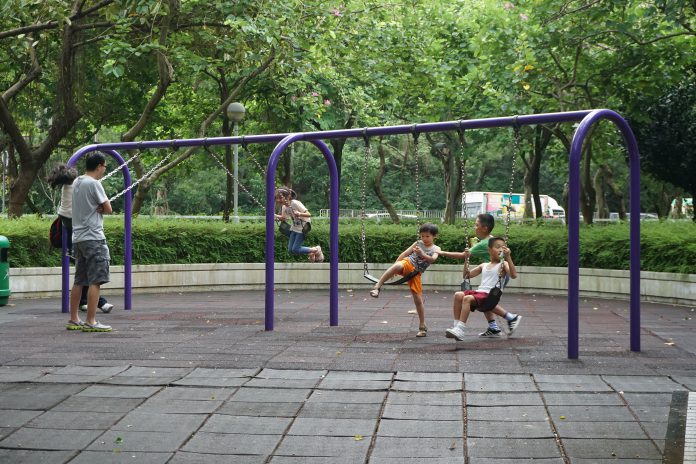
Adult Hongkongers may happily recall sliding down the chute of a long metal slide, bumping up and down on shaky seesaws, spinning around on merry-go-rounds, and flying through the air on swings, or scaling the heights of a climbing frame.

Yet in recent years, many of these structures have vanished, replaced by composite playground facilities, comprising colourful plastic components such as low slides, noughts-and-crosses games, steps, small tunnels and connecting bridges. While these facilities may look enticing, they are often criticised for lacking variety and make for a standardised play experience across playgrounds in the different districts of Hong Kong.

Mr Au has been bringing his 12-year-old daughter to the Victoria Park playground in Causeway Bay for years. He thinks that after the playground was refurbished, the slides are too short and there are not enough challenging climbing facilities for children.

“All the play facilities are too low. [The children] used to climb higher, and their bravery and courage could be cultivated,” he says.

Across the harbour in the Kowloon Park playground, Mrs Lam watches as her five-year-old daughter plays on the slides.

“It’s safe enough here,” she says. “But it’s lacking in variety, it’s all just slides. The rope nets, the merry-go-rounds and swings, there aren’t any of those any more.” Mrs Lam says children could learn and practise their physical coordination and balance skills on the old playground equipment.

According to a study by Playright Children’s Play Association carried out in 2015, Hong Kong’s playgrounds are too boring for most children. The group recorded videos of five children’s playgrounds over four days in August of that year. After studying 600 minutes of video footage, the group found there were barely any children using the playground facilities a quarter of the time.

Chung Yiu-bun, a lecturer in the Department of Psychology at the Education University of Hong Kong, is worried that the lack of diversity in playgrounds will have adverse effects on children’s mental and physical development.

Chung believes that a playground should be a site for children to learn and practise social interaction.

“How they play with other children of different ages and how they interact with adults are all important in the learning process,” says Chung, who adds that play fosters children’s emotional learning in a way that cannot be taught during lessons.

Not only have the playgrounds become less fun and diverse, but they are also subject to more restrictions and limitations. Signs can be found in public playgrounds prohibiting cycling, skateboarding, making loud noises, playing music or lying on benches. Staff are sometimes seen telling children off for playing ball games and even for running. The rules are enforced to ensure playground safety but they have a dampener effect on free play and fun.

Visitors are expected to keep the noise down in playgrounds and parks.

Chung recounts an incident where he and his son were playing around with a football in a grassy open space at a public tennis court. Although they were not in anybody’s way, a security guard came over and stopped them.

“I was quite angry at the time, we weren’t actually playing a football match. The strict, rigid rule that only certain activities are permitted in a certain place is just so weird,” says Chung. “This deters people from making use of the public space and playgrounds.”

He says it is important for all stakeholders, including parents and children as well as the government, to have input and reach a consensus on how playgrounds are designed. Otherwise, children will lose interest in going to playgrounds altogether.

The Leisure and Cultural Service Department is responsible for the design and management of children’s playgrounds at more than 630 venues throughout Hong Kong. Paul Chan Yuen-king, Programme Leader of Landscape Architecture at the Technological and Higher Education Institute of Hong Kong, says the management-oriented administration of playgrounds restricts creativity and imagination.

“We are now relying on the regulation department which is responsible for management and maintenance to consider also the design elements; thus many possibilities are excluded,” Chan says. “As a designer, when the regulating department says no to a design element, I can’t include it.”

He says the LCSD’s power in deciding what can and cannot be allowed creates a vicious cycle. A designer is not allowed to include certain elements and the playground or park prohibits users from engaging in certain activities because the design of the playground does not cater to it. He takes cycling as an example: “All parks forbid cycling now, it is so ridiculous that you need to get off your bicycle when you pass through a park while cycling,” he says.

When it comes to the design and use of space in playgrounds, Chan says Hong Kong lags far behind other advanced cities. For example, playgrounds in western countries combine the playground designs with the natural landscape, for instance slides are incorporated into the landscape.

“Actually [Hong Kong playgrounds] don’t have much creativity, they want all [playgrounds] to be simple and easily managed,” he adds.

Children are even forced to play only within a playground’s boundary. “They draw a boundary and set a space that is called the playground and it is covered with soft mats. When you’re outside of that boundary, you’re not supposed to play.”

On the bright side, the LCSD is planning a new and innovative playground in Tuen Mun Park that is slated to open next year. It co-organised the Inclusive Play Space Design Ideas Competition for the 5,000-square-metre area in 2016 and invited public participation in the design.

The new playground space includes more exciting and diverse elements including sand and water play and equipment that sways and spins, as well climbing frames and movable parts for knocking and touching. However, in the process of executing the winning concept, a lot of compromises still have to be made due to many safety considerations.

In the meantime, some community organisations are working hard to create attractive and engaging playground spaces for local children.

Playright Play Association, the group which carried out the survey on the city’s playgrounds, is a local organisation that stresses the importance of play for children’s growth. It organises regular activities in public spaces which encourage children to use their own imagination when they play. Last year, the group organised a nine-day community-based playground along the Central and Western District Promenade. Children could pile up bricks, cardboard and tyres however they wanted to create their own ideal playground on the lawn.

In September 2016, several NGOs – the Des Voeux Road Central , Clean Air Network and the Hong Kong Public Space Initiative – succeeded in getting permission to close a section of Des Voeux Road in Central to traffic on a Sunday afternoon.

More than 40 groups held different activities in the area, including structure building, musical performances, dance and play, to turn the area into a playground for all. One of the organisers, Winnie Tse of the Clean Air Network, thinks playing spaces should not be limited to parks. “Children in the past played anywhere they wanted on the street,” says Tse.

In the grassroots neighbourhood of  To Kwan Wan, a local organisation called Play Depot invited children to design their own toys and play space. They invited six groups of artists to join the project in various workshops held this Spring. One of the artists taught kids to utilise unused wood and bamboo to make percussion instruments, like the cajon, using simple tools and woodcraft. Another group used materials that are commonly found in To Kwa Wan, like car tyres and bamboo, to make installation art and games.

Children in To Kwa Wan made use of recycled materials like cardboard and tyres to create their own playground.
Photo courtesy of Play Depot

After the workshops, an exhibition and a playground was created in the Cattle Depot Artist Village, which was open to the public. Children raced on dinosaur cars made out of car tyres and climbed up and down wooden installations such as stairs and observation towers.

Unlike at ordinary playgrounds, there were no prohibition notices at Play Depot. Alex Tam, the organisation’s executive director says they did not want to “object” to anything. Rather, they hoped users would spontaneously help maintain a harmonious play environment.

“It was not us who solely operated Play Depot, I hope to let people know that it was we and the community who created and maintained such a playground together,” says Tam.

Edited by Rubie Fan

Learning to be a Boss

Foreign domestic workers study the basics of starting their own businesses back home

By Nannerl Yau

It is a familiar sight – groups of foreign domestic workers relaxing, sharing food and conversation in the parks and public spaces along Chater Road in Central on a Sunday afternoon. But instead of chatting with friends, some women are setting up booths and handing out leaflets. They are volunteers for Enrich, a local group that organises workshops and courses on financial planning and entrepreneurship for Hong Kong’s foreign domestic workers.

One of the volunteers, Ma. Jofel Javier, greets all who pass by with smiles, explaining what the organisation does in great detail. The 31-year-old Filipina finished college before coming to Hong Kong to work as domestic helper four years ago. She joined Enrich three years ago and studied in a programme to help her prepare for starting her own business.

For Javier, developing proper saving habits is a big step towards realising her business dream. Through the programme, she has corrected her spending habits and learnt how to save money by counting her daily expenses.

“Before I came to Enrich, I always buy. When I get my salary, I always buy new things. But when I get to … Enrich, I know how to save now,” she says.

Javier’s family runs a garments business back home, but she plans to work for another two years in Hong Kong in order to save enough to set up her own business. In this endeavor, she is teaming up with her long-time friend and fellow Filipina domestic helper Marivic Castillo.

Making a monthly salary of HK$4,410, some domestic helpers find it hard to put aside savings every month – and some may even end up spending all their wages on unnecessary entertainment and shopping.

Marivic Castillo explains how a small envelope she was given by Enrich has helped her to save money.

“Inside the envelope there are different coloured pockets,” explains the 31-year-old, as she goes through them. “We insert there an amount. We mark [it]. For example, sending money to the Philippines, and this for, like daily expenses, phone parts, for transportation.”

Castillo is also a graduate from the programme and has very clear and specific plans for her future. She is returning to the Philippines next year after finishing her contract and will finish her university studies and start a business with Javier.

Marivic Castillo shows off the envelope Enrich gives to students to help them organise their finances.

Enrich has helped her to set a concrete goal for the future, so she does not have to stay and work here as a domestic helper for long. She can barely contain her excitement when she shares how she is striving to reach her saving target.
“Once I[’ve] reach[ed] the one goal, I need one more, and getting more and more,” says Castillo. “Now I want to save like one thousand, in the next month, I want to save two thousand, then three thousand, four thousand!”

Without skills in financial planning, domestic helpers may find it difficult to start a new life after they return home.  “That’s why, when they go back to the Philippines, and then [they have] no money and they come back [to work in Hong Kong] again,” says Javier.

According to the Immigration Department, there were 351,513 foreign domestic helpers in Hong Kong in 2016, 54 per cent of them from the Philippines and 44 per cent from Indonesia. These are countries where the living standard is significantly lower than that of Hong Kong, prompting many women to work as domestic helpers in this city. One study of foreign domestic workers found that back in their home country the average monthly salary of helpers from Indonesia was US$120 a month, while for workers from the Philippines it was US$157. Many of these helpers are the breadwinners for their families.

Given they are making around three or even as much as four times what they might earn back home, many may assume they would have saved enough to start their own businesses by the time they return. However, according to a 2016 study published by the international social enterprise Farsight, only six per cent of migrant domestic workers felt they had saved enough money when returning home. Ten per cent said they returned with no money at all and among them 50 per cent said they returned with only material possessions. Financial difficulties are often the reason for returned workers to go abroad to work again.

Mindful of the poor financial management and planning among domestic workers, the founders of Enrich set up the charity 10 years ago to empower domestic workers by equipping them with knowledge on how to save, budget and plan for their own financial security. They offer 27-hour programmes and workshops in financial planning, investment and entrepreneurship.

Enrich members are able to sign up for various financial management courses.

In a unit called “Setting Up My Business”, participants learn basic business concepts, marketing, business finance and planning. Senior Programme Manager Tynna Mendoza has seen the changes in the students in both knowledge and confidence.

“[What they have gained is] actually more confidence to say, I’m capable of doing this. And they became more aware of the risks, they [also] become aware of the possibilities of, if this fails, this is the backup,” says Mendoza.

The learning does not stop after they complete the 27-hour workshop. Participants need to save money and prepare themselves for the setting up of a business. They can discuss any difficulties and setbacks they encounter at a three-month post-workshop, while the connections and bonding they make through the programme are long-lasting. Some students stay on as volunteers like Javier and Castillo.

In the past two years, Enrich has also reached out to the community of Indonesian domestic workers. Whereas previous training was in English, the organisation has now invited native Indonesian speakers to join its operation.

Dwi Nyoman Wihasti, an Indonesian domestic helper who came to Hong Kong in 2006, is returning home next February. Dwi has some limited experience of running a small-scale laundry with her mother. But after gaining more knowledge from the workshops, she feels she is ready to try starting something on a bigger scale.  She has long held a dream to set up a catering business, making lunchboxes and distributing them in and around industrial areas. Dwi is planning on a workforce of around 250 people.

Although she is excited at the prospect of returning home to realise her dream, she also knows there are risks and challenges.

“There [are] a lot of difficulties, of course, because it is in big scale. I have to take care of the license in Indonesia which is not easy. I have to recruit own employees. I have to build the kitchen which is suitable and hygienic. There are a lot of other difficulties but I believe I can do it,” she says.

Enrich is not the only organisation helping migrant helpers to gain the skills they need to keep and grow their money. The Saint Mary’s University of the Philippines has a Hong Kong campus that offers a bachelor’s degree course in entrepreneurial management that is registered with Hong Kong’s Education Bureau. Students at the university are domestic workers from both the Philippines and Indonesia. Once admitted, they have to fulfill requirements for a three- to four-year degree programme in order to graduate. This includes taking classes at the Hong Kong campus and home study of lecture modules.

Angel T. Ramos, the Principal of Saint Mary’s University of Hong Kong says: “Education is very important to many Filipinos. Most of them did not complete [in the Philippines] because of poverty…Education is something people cannot steal from you.”

Completing a university degree in Saint Mary’s in Hong Kong is equivalent to completing one in the Philippines. Filipinos who have not finished their university degree in the Philippines can continue their study while they are working in Hong Kong and having a university education gives them more choices for their future. Those who already have a degree can earn extra credits and take a national exam that will allow them to qualify as teachers in the Philippines under a returning residents’ scheme. They can also enroll for a master’s degree in education. Some St Mary’s graduates may pursue further study when they return home but many choose to set up businesses instead.

Like many local universities in Hong Kong, Saint Mary’s University also organises student activities. On a Sunday afternoon when there were no lessons, students and teachers all gathered at a school playground in Causeway Bay for the annual Sportsfest. Students dressed up in team shirts, formed teams to compete in different events and cheered loudly at the venue.

Students from Saint Mary’s University participate in the annual Sportsfest.

One of them was Jocelyn Telsio, a Filipino domestic helper who will graduate next year and is planning to return home in five years and start a restaurant.

Working and studying at the same time is hard. It is no easy task to pay the school fee which costs her more than a third of her salary each semester plus she has to both send money back to her family and save money for her future business. However, Telsio says studying in Saint Mary’s has changed her life and vision.

“Before, my mind is very closed. I think things are impossible. But when I come, I realise there are many things that I need to learn,” she says.

Edited by Rubie Fan

From Class Time to Screen Time

Hong Kong movie critic and fan Sean Tierney appears in films and on the lecture podium

By Eric Park

After giving a three-hour lecture on film to undergraduate students at the Chinese University of Hong Kong, Sean Tierney heads to his office in the nearby industrial area, Fo Tan. The American cuts a striking figure with a close shaved head, standing at almost two metres and weighing 112 kg, he could easily be mistaken for a military man.

Indeed, unusually for a film professor, Tierney has been a Navy SEAL, a mercenary and a bodyguard – but only in the movies. Tierney has acted in a number of Hong Kong films including 2015’s From Vegas to Macau II, which starred Chow Yun-fat, Andy Lau Tak-wah and Carina Lau Kar-ling, and this summer’s Andy Lau blockbuster Shockwave. The screen appearances mean he sometimes gets recognised by random strangers.

“People will ask me ‘Are you an actor?’ and I’ll say ‘No, actually I’m a lecturer’,” he says, standing in front of a wall of shelves stacked full of DVDs in his office. Other walls are adorned with movie posters, including one of his boyhood heroes, kung fu legend Bruce Lee. It is a fitting space for a Hong Kong movie fan whose identities as film scholar, teacher, critic and actor are intertwined.

Sean Tierney with Andy Lau in Hong Kong movie From Vegas to Macau II.
Photo courtesy of Sean Tierney
Sean Tierney with Lam Suet in Hong Kong movie From Vegas to Macau II.
Photo courtesy of Sean Tierney
Sean Tierney with local actors in Hong Kong movie From Vegas to Macau II.
Photo courtesy of Sean Tierney

“[It] goes all the way back to Bruce Lee,” says Tierney, recalling a childhood during which he was fascinated by the martial arts movies shown on Kung Fu Theater, a television show that was broadcast every Saturday afternoon in the 1970s and ‘80s.

Describing himself as a person with a very short attention span, Tierney says one of the few things that captivated him for hours on end was watching people doing things that he knew he could not do himself. Even today, whenever he watches his favourite Bruce Lee films, he asks himself, “How does anybody move so fast?”

As his respect for Bruce Lee evolved into a passion for Hong Kong movies in general, Tierney began to feel there must be a lot more to Hong Kong film culture than he was aware of, that he was missing out on: “I knew that something was there; I didn’t know what it was but I knew I wasn’t quite getting it,” he says.

Apart from always being fascinated by the stories, movies and cinematic style that he saw on the screen, Tierney was also curious about their cultural context. It was this curiosity that eventually led him to pursue post-graduate studies in intercultural communications and film at Howard University in Washington DC in the late 1990s.

After watching Hong Kong on the screen for so many years, Tierney came to Hong Kong for the first time in 2001 to present a paper at an academic conference.

“I literally saw the Peninsula Hotel and my initial response wasn’t ‘Oh, what a wonderfully historic building’ it was ‘Oh, there was a scene in a Jackie Chan movie that took place in this driveway’ and I thought that really cool,” he recalls.

He realised that if he really wanted to understand the movies, he would have to live in Hong Kong. “And that sort of became a goal for me in 2001,” he says.

A year later, in 2002, Tierney was conducting research comparing the movie industry in Hong Kong with that of Hollywood. He found director Andrew Lau Wai-keung’s email and sent a message, saying that he would “really appreciate a chance to speak to Mr. Lau”. Lau became one of the hottest names in Hong Kong cinema after his film Infernal Affairs took HK$30 million at the box office within two weeks of opening in December that year, so Tierney was pleasantly surprised that he could find the time to meet him in person.

He says it was one of the most memorable experiences of his life. He sat and talked to the director for 90 minutes in Lau’s office. “I was still basically a graduate student; I was almost done but I wasn’t a doctor yet,” says Tierney. “I kept saying ‘Mr. Lau, don’t you have something better to do than talk to me?’ and he said ‘No! You’ve come a long way and why wouldn’t I talk to you?’”

Tierney says his experience tells him that Hong Kong’s film industry is far more accessible than Hollywood. He tells another story of how he received a call from the office of Yuen Woo-Ping, one of the most successful and influential figures in Hong Kong action cinema, who was action choreographer on the Oscar-winning film Crouching Tiger, Hidden Dragon. “I’ll never forget standing in HMV in Tsim Tsa Tsui and my phone rings, and it says, ‘Hello this is Yuen Woo-Ping’s office and we’re really sorry, Mr Yuen is in America and won’t be able to meet you but he hopes next time he can.’ and I’m staring at the phone! You never get that in America.” He adds that if he wanted to interview Steven Spielberg, for example, he would have to get through “15 layers of assistants” whose job it is to ward him off and make him give up.

Apart from researching and teaching film, Tierney also expresses his passion for Hong Kong movies through reviewing them. He started a YouTube channel, The Silver Spleen, four years ago and regularly makes frank video reviews of local Hong Kong films. All genres are covered, from commercial films to cult films, many of which are not even popular among local people.

Tierney says his YouTube videos are an outgrowth of his blog posts. He describes them as being there to entertain people. “If people use my reviews to decide whether or not to watch a movie, I guess that’s nice,” he says. However, the videos always have a critical dimension and Tierney certainly pulls no punches. He says he is able and willing to criticise films in a way that others cannot for “professional reasons”, that is fear of offending people in the industry and possibly affecting their careers.

Like everyone who makes videos and posts them online, Tierney has haters too.

“I’ve had people literally say things: I hope Donny Yen beats you up,” recounts Tierney. But he is undeterred and is not afraid of what people will think. “No. Ideally, people might make better movies. That would be awfully nice,” he says.

In fact, Tierney got his first role in a commercial Hong Kong movie after a director who saw his reviews met him and decided he looked like a bodyguard and cast him as one.

But before the Silver Spleen and the roles on the silver screen, Tierney came to Hong Kong in 2005 to take up a post as assistant professor at the Chinese University of Hong Kong. He discovered that while he enjoyed teaching immensely, he was not necessarily cut out for the conventional academic career path of today. “Publish or perish, as they call it. It’s a tough thing and I didn’t publish enough research,” he says.

For one thing, he says, the kind of critical social science research he conducted usually takes a long time and for another, he never had any administrative aspirations. “I’ve never wanted to be the chair of a department, or a dean or any of that sort of thing,” says Tierney.

Tierney now teaches three classes a semester at two universities and that occupies plenty of his time, not to mention his video-making projects. He loves the mix of teaching film and, at the same time, being involved in the actual movie industry. It certainly helps that he can illustrate his teaching with anecdotes about working with Andy Lau.

“It makes it easier because, the other day, I was teaching about character development and I could talk about something from a movie that I was in,” says Tierney. “I contribute that experience so that when I teach the students about it, it’s not just to make myself look cool; it’s about giving them an example that I know would hold their attention.”

Edited by Howard Yang

Baton Charge

Native Hong Kong conductor Vivian Ip blazes a trail for local music development

By Selena Chan

Women conductors are still a rarity in the world of classical music. For example, in 2017, only seven of the 57 conductors in the annual classical music festival, the BBC Proms, were women.

Popular perceptions of maestros tend to be of strong, stern, physically flamboyant and powerful characters. This makes 31 year-old Vivian Ip Win-wun something of a surprise. Female conductors at the top level are still scarce in Hong Kong. Only Virginia Yip Wing sie, conductor and music director of Hong Kong Sinfonietta, has notably and literally picked up the baton for women conductors to date.

The similarly named but unrelated Ip, a young conductor with an approachable yet assertive personality, started conducting at the age of 14. Last year, she was appointed as the first female assistant conductor of the Hong Kong Philharmonic Orchestra (HK Phil).

Ip loves conducting because ensemble music is her favourite kind of music and the conductor is in the privileged position of being able to see a choir or an orchestra as a whole. She says that being able to appreciate the full picture of the performance allows her to feel the music in a complete way.

Her determination to develop a career in music dates back to secondary school. “I hoped music could be a part of my life instead of a hobby only,” says Ip. “Turning music into a profession allows me to dedicate all my time and efforts into it.”

Despite their initial objections to their daughter embarking on what they thought was an unstable profession, Ip says her parents eventually gave their support when they saw how happy and contented she was when making music. She jokes that there was nothing they could do about it anyway, since she had made up her mind and insisted on taking this path.

After graduating with a music degree from the Chinese University of Hong Kong, Ip first went to the United States for her master of music degree in choral conducting at the Indiana University Bloomington. After that she studied for a magister degree in orchestral conducting at the University of Music and Performing Arts Vienna, in the historical heart of classical music.

Ip considers it impossible for musicians to starve in Hong Kong because they can always make a living by teaching, but she thinks that performance opportunities for professional musicians in the city are limited. Therefore, after studying for five years in Vienna, she stayed there for another two years after graduating, taking up choral conducting and instrumental projects. It was not until the job position of assistant conductor of the Hong Kong Philharmonic orchestra came up that she decided to come back.

As assistant conductor, she mainly acts as understudy. She studies the orchestra’s repertoire, reflects musicians’ feedback to the conductor, listens closely to the balance when there is a concerto or collaboration with a choir, and stands in when the conductor cannot make a performance.

The orchestra has a new programme every week and usually rehearses Wednesday through to Friday, then performs at the weekend. A lot of individual study is needed before the rehearsals.

At the same time, Ip is responsible for some of the orchestra’s outreach and education programmes. This May, Hong Kong Phil launched an educational outreach programme for students, with Ip as the conductor. The programme consists of a series of 10 consecutive concerts and while orchestra members might find it repetitive, Ip cherishes the interactions between the students and the orchestra.

As a young conductor, one of the hardest things she has to manage is dealing with relatively senior players in the orchestra whose performances may not work out the way she wants them to.

“I would doubt myself at first,” says Ip, “but as I proceed, I become more certain and I just give my best.”

It is especially challenging as Ip may be responsible for lighter and less challenging programmes, which some players may not take as seriously. She has to find a balance between achieving the performance she wants without making the musicians feel bored or annoyed.

In a field dominated by men, Ip says she sometimes hears some female conductors talking about their difficulties in getting opportunities, but it is virtually impossible to prove whether they lost out on jobs because of their gender.

In 2013, the principal conductor of the National Youth Orchestra and the Royal Liverpool Philharmonic Vasily Petrenko told an interviewer for a Norwegian newspaper that “Orchestras react better when they have a man in front of them… a cute girl on a podium means that musicians think about other things.” He later said the remarks were taken out of context and that he was describing the actual situation in his home country of Russia rather than his own views. Nevertheless, the comments created a controversy that highlighted existing prejudices about women conductors.

It is also a viewpoint that Ip completely disagrees with. She thinks that when countries like Germany and Britain have female leaders, it is outdated to judge a leader by gender. As female conductors can be as talented as male conductors, it would be sexual discrimination if the female conductors’ charisma and musicality is not appreciated just because they are women. Ip says the remarks attributed to Petrenko could amount to sexual harassment as musicians are supposed to be professional and it is their job to stay focused and respect the conductor.

For her part, she is glad to see more female orchestral conductors coming onto the scene and shattering this stereotype. “I hope the goal is not to judge a conductor by gender, but simply by musicality and personality,” she says, adding that women conductors can be as powerful as men in terms of gesture.

Certainly, it would be a mistake to dismiss Ip’s powers as a conductor because of her easy-going personality and small stature.  Kathy Fok Ka-man, music director and principal conductor of the Hong Kong Children’s Choir (HKCC), was Ip’s mentor and teacher when she was a schoolgirl choir member. As someone who has known Ip since she was nine, Fok says her first impression of her student was her diligence and discipline. Fok vividly remembers Ip studying scores and reading books backstage while other children were playing and chattering before an opera performance.

For her part, Ip is grateful for all the things Fok taught her: fairness and seriousness about work, humbleness and respect towards colleagues, and care towards students. She sees Fok as a role model and mentor. “It is not her success that encourages me; it’s her quality as a person and as a musician,” Ip says.

While Ip sees Fok as an inspiration, she may not  be aware that she herself is also an inspiration to others.  Vivian Suen Ming-wai was Ip’s fellow chorister at HKCC and now serves as artistic coordinator and a conductor of the choir. Suen says Ip gives her a lot of advice and partly inspired her to also pursue a career in conducting. It is from Ip that Suen realised a conductor does not always have to be physically big or masculine to make other musicians trust and obey them.

“Although she is relatively tiny compared to other conductors physically, the knowledge and courage inside her is not tiny,” Suen says.

Despite their determination, Ip and Suen will find that Hong Kong still lags behind in terms of cultural development, resulting in a rather small-scale core audience for classical music concerts.

Looking ahead, the biggest challenge Ip foresees is the keen competition in the conducting field. Being a conductor requires both hard work and luck, and there are not enough jobs to go around. Ip says it is hard to develop a career in music in a place where the government focuses on economic growth more than cultural development. She has still to figure out her next move after her two-year appointment with Hong Kong Phil ends.

She says she will keep looking for further choral and orchestral conducting opportunities but does not plan to settle down in Hong Kong yet. “You can’t do too much planning in this field,” Ip says.

The conducting life is a nomadic one – conductors go to where the work is. For Ip that means she could be working in Europe, America or Hong Kong. She is open to opportunities and wants to develop as a professional conductor. On the other hand, she feels her roots are in Hong Kong and she would like to contribute to future generations. Teaching is one option for her, but she thinks she needs to continue performing and gaining experience in order to be a better teacher.

This drive to learn is also what motivates Ip to take part in competitions around the world. She says she does not enter these events to win prizes or fame, but to appreciate the music and learn from other competitors. Learning and teaching is a two-way street because, for Ip, lifting others is a way she can improve herself, and she never tires of learning.

“After all, music is something I can’t live without,” says Ip.

Edited by Ryan Li